Raising kids is expensive. As an economist, we’re used to thinking about cost very broadly, including the opportunity cost of your time. Indeed, a post I wrote a few weeks ago focused on the fact that parents are spending more time with their kids than in decades past. But I want to focus on one aspect of the cost, which is what most “normal” people mean by “cost”: the financial cost.
Conveniently, the USDA has periodically put out reports that estimate the cost of raising a child. Their headline measure is for a middle-income, married couple with two children. Unfortunately the last report was issued in 2017, for a child born in 2015. And in the past 2 years, we know that the inflation picture has changed dramatically, so those old estimates may not necessarily reflect reality anymore. In fact, researchers at the Brookings Institution recently tried to update that 2015 data with the higher inflation we’ve experienced since 2020. In short, they assumed that from 2021 forward inflation will average 4% per year for the next decade (USDA assumed just over 2%).
Doing so, of course, will raise the nominal cost of raising a child. And that’s what their report shows: in nominal terms, the cost of raising a child born in 2015 will now be $310,605 through age 17, rather than $284,594 as the original report estimated. The original report also has a lower figure: $233,610. That’s the cost of raising that child in 2015 inflation-adjusted dollars.
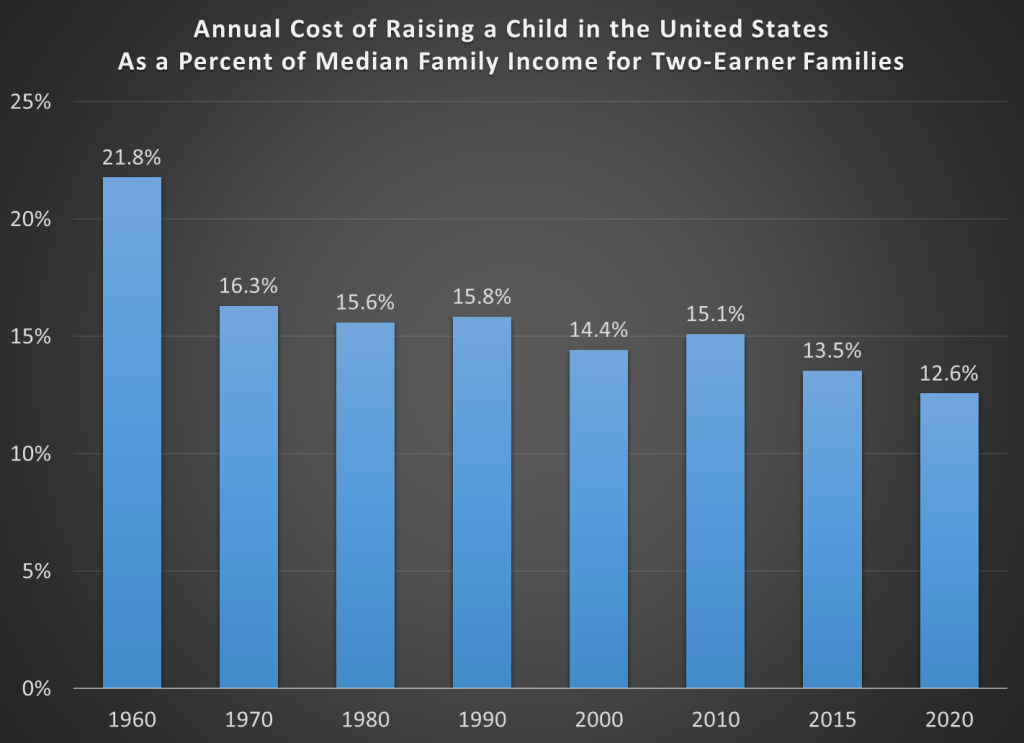
As I’ve written several times before on this blog, adjusting for inflation can be tricky. In fact, sometimes we don’t actually need to do it! To see if it is more or less expensive to raise a child than in the past, what we can do instead is compare to the cost to some measure of income. I will look at several measures of income and wages in this post, but let me start with the one I think is the best: median family income for a family with two earners. Why do I think this is best? Because the USDA and Brookings cost estimates are for married couples who are also paying for childcare. To me, this suggests a two-earner family is ideal (you may disagree, but please read on).
Here’s the data. Income figures come from Census. Child costs are from USDA reports in 1960-2015, and the Brookings update in 2020.
Things go by online about moms and kids that bother me. Here I will Be Like Pete and try to articulate a positive vision. We could talk more about parenting small children.
Ambitious people, both men and women, might want to be parents. Time spent on parenting takes away from other projects, so the earlier you start planning the better. Hearing about the experiences of other parents is both instructive and inspiring.
Parenting, like modern creative careers, is an unpredictable enterprise. Maybe one reason people are not encouraged more to plan is because the disappointments can be so devastating in this arena. There is a risk that I will sound insensitive if I am too positive. That said, I feel like discussions I see in public miss the point too often and fail to use the “billboard space” we have effectively. There is an ocean of thoughtful honest free content for How to Achieve Your Writing Goals, but there is very little on how to achieve your parenting goals that resonates with ambitious young people. The writing advice can be ignored by those who don’t want to write; parenting advice can be ignored by those who don’t want kids.
Economists talk a lot about parents and children, especially now that the US is near population decline. One particular point I have heard is: “Data shows that piano lessons do not have a causal impact on lifetime earnings, so your problems are solved. Everyone sit back and enjoy your kids.”
This message may be helpful to some people, but it seems like primarily a lie to me. “Enjoy your kids” assumes a lot. I’d prefer an honest approach about the sacrifice involved, or the “opportunity cost”. I think that the benefits of parenting outweigh the cost, but it’s not inspirational to say “selfish lazy people will enjoy parenting.” Raising kids who you enjoy being around is not easy, but there are tricks and proven methods to help.
The economist who gets it is Emily Oster. Her books go more like this: “You probably aspire to having family meals that you can enjoy. Sit down with your co-parent 6 months ahead of time and plan out how you are going to achieve such a wonderful ambitious goal while also being able to schedule other events and pursuits.”
Emily Oster books/newsletter is a great place to start. She’s not for everyone, but if you are reading an econ blog then she might be for you. The good news for ambitious parents is that many books have been written that explain how to achieve certain results. Ambitious smart people can figure out good techniques, although as I said earlier be prepared for things not to go as planned. It helps to start on the learning process before you have kid to care for. Once you become a primary caregiver, you will have less time to read, so read widely and often whenever you can. We have a /Parenting category in this blog, to curate some of the good stuff.
This boy’s ambition was to dig a trench from a tidal pool all the way to the ocean.
Kids could come up in conversation about ambition more, as a possible complement not just as a substitute.
This Elon tweet has layers: “Being a Mom is just as important as any career” What do you think the subtext is? How would a college student understand this?
Why use this hackneyed phrase when he could say something to actually inspire both his male and female Gen Z fans to become parents? If Elon is a good parent, then teach us how he combines it with an ambitious life. And if he’s a bad parent, he should say less about it. If he’s trying to elevate mothers, then retweet a mother.
Similarly, a male economist who writes books about how easy parenting is should explain how he got through the first 5 years. Either someone else raised his children or he worked hard to maintain a routine and boundaries. Did he create his own routine from scratch or did he borrow from someone else’s model? Were his children in daycare 40 hours a week?
It can be hard to write about these topics honestly, because of privacy issues. So, we are back to Emily Oster, because she has been willing to tell the world what really goes on in her own family. Elon should just tweet out her newsletter every week if he’s such an advocate for mothers.
Dr. Oster is not the only one. There are millions of mothers creating content who would value the exposure. What if Elon (or some other ambitious person with a large platform) retweeted a trick for getting children to try carrots. “Wow, genius technique. Follow this Mom for more…” Or, Elon could highlight a man who being a great parent.
Ambitious people just talking about their kids and their own honest personal experiences is a good way to achieve Elon’s stated goal of getting more people to have kids. If Elon wants to tell us that he loves his kids, then that’s inspirational, and I don’t think it’s a lie.
I will engage in some introspection here, not because I think I’m so interesting, but because I see pro-natalist men talking past everyone else on how to raise the birth rate. I had a parenting win this past week. I solved a behavioral problem in a creative way and I’d love to talk about it. I’d like to feel like I’m part of a community conversation. I’d like to be recognized for my expertise. That’s what most people want, right? More resources in the attention economy devoted to parents is a form of compensation that I have not heard discussed before.
I have heard advice to female professors to not put up pictures of their children at the office. If colleagues know you care about your children, then you might be ostracized from the intellectual community that you have spent your whole life trying to join. In my own small way, I have pushed back against this norm by occasionally talking about kids and babies, so that other people who want families can feel part of a bigger community online and in academia. My broader point in this post is that there is a kind of rhetoric about family life and parenting strategies that would make young ambitious people think that having kids will not prevent them from pursuing other goals.
It’s not bad to talk about a 14-hour workday or an organizational strategies for achieving professional goals. I wouldn’t want to censor anyone or stop them from sharing how they accomplished something valuable. On the margin, more conversations could also include a discussion of how life changes if you become a parent, so that ambitious young people can build mental categories for this.
Stephen Dubner brought the teen children of famous economists on his show to talk about what it was like to grow up with those weirdos. It’s funny. Listeners will not feel like they are being told what to do or judged. Dubner is simply lending his platform to parents and children. He’s using the billboard space. There is parenting content on the internet already, but if it’s all siloed over at parents.com then it may not make it to the young person who is trying to figure out what “the Good” is.
When writing in the capacity of an economist, one should never pitch an experience as “free”. Going anywhere has opportunity costs, especially if you have to pay several tolls on the New Jersey Turnpike. That said, if you want kids to see New York City as part of a road trip, consider Liberty State Park.
You can enter and park for free. There is a playground, picnic tables, and lots of trails. You can see the Statue of Liberty, Ellis Island and Manhattan across the river.
Taken from a nature trail inside the park. There is also a clear view of the statue next to the river.
At the northern edge there is a memorial for those lost on 9/11.
If you have hours to spend, you could also pay admission for the Liberty Science Center. Currently, my family has free admission because of the ASTC Travel Passport Program.
Drone racing was an event at the World Games in my city. Now I know it exists (as does canoe polo!).
The composition of contestants was interesting. One pilot was only 14 years old, the youngest person competing in the 2022 World Games. Another pilot was in a wheelchair. Drone racing is for sports like Work From Home is for professional jobs – the number of competitors is potentially enormous.
Spectators reported that it was hard to follow the actual drones with your eyes. People in the stadium for the race usually watched the jumbo screens that show the point of view of the pilots. This raises the question: why bother with the drones at all when we could just be doing e-sports? There is something special about the extra challenge of a physical race. The machinery adds a NASCAR-like element, and it gives people an excuse to gather together.
Videos, if you’d like to get a sense of how the sport works:
Polaris published an industry report that predicts growth.
Drone racing will grow in the United States. This seems like a sport that will appeal to Generation Alpha and their parents.
As a parent, I would support it. It’s expensive, so that’s going to be prohibitive for a while, but millions of Americans bought drones at some point in the last decade. Drones get broken in races, but the cost of components is coming down. Part of the sport is being able to repair and build your own custom drones.
A handful of US high school already have drone racing clubs. Adults will be able to point to the value of learning technology that comes along with racing for fun.
I’m on the record as being against preschool classroom Valentine’s Day parties. As Scrooge said, people are “spending the mortgage money on frivolities”. The parents sending in gifts is the pinnacle of the rotten heap. I would abolish daycare Valentine’s Day parties entirely – outlaw them like those super sized soda cups.
Now, with Covid subsiding and my son in elementary school, I’m getting to see school-aged-kid birthday parties (as I mentioned yesterday). The parties as events that build social capital are great. The gifting aspect of it is mostly dumb. I abhor waste. I put “no gifts” on the birthday invitation for my son.* Most guests brought a present anyway. Next year, should I write “if you bring a gift I will burn it in the driveway before you can enter”? These parents would say they are worried about the island of plastic trash in the Pacific, but what do their actions tell?
It would be nice if school birthday parties could adopt the white elephant/Yankee swap convention that keeps present volumes down at Christmas/holiday parties, but it’s impossible for logistical reasons. If it were socially acceptable to grab a lightly used board game out of your basement and wrap it up to give a school friend, that would also be better. Maybe I should write that on our invitation next year and report back to you all! What do the really really crunchy parents do?
Economists think it’s clever to say, “Haha. You thought Christmas presents were wholesome, but they are inefficient. Merry Deadweight Loss.” Personally, I like most Christmas/holiday presents for the signaling value. I’d be happy with Christmas presents if we could get plastic junk for kids under control and heavily curtail presents at other times of the year.
Related resources: 1) Alex and Tyler donned Christmas sweaters to bring you this video on Christmas gift giving 2) Zachary has written about Christmas gifts
*Do you like funny stories? My son can read. When he noticed that I had written “no gifts,” he got mad at me. I explained that people can still bring gifts if they want to. Then I was mortified when he came home from school reporting that he had told his classmates that they can still get him presents.
The American Community Survey began in 2000, and started asking about college majors in 2009, surveying over 3 million Americans per year. This has allowed all sorts of excellent research on how majors affect things like career prospects and income, like this chart from my PhD advisor Doug Webber:
See here for the interactive version of this image
But the ACS asks about all sorts of other outcomes, many of which have yet to be connected to college major. As far as I can tell this was true of marriage and children, though I haven’t searched exhaustively. I say “was true” because a student in my Economics Senior Capstone class at Providence College, Hannah Farrell, has now looked into it.
The overall answer is that those who finished college are much more likely to be married, and somewhat more likely to have children, than those with no college degree. But what if we regress the 39 broad major categories from the ACS (along with controls for age, sex, family income, and unemployment status) on marriage and children? Here’s what Hannah found:
Every major except “military technologies” is significantly more likely than non-college-grads to be married. The smallest effects are from pre-law, ethnic studies, and library science, which are about 7pp more likely to be married than non-grads. The largest effects are from agriculture, theology, and nuclear technology majors, each about 18pp more likely to be married.
For children the story is more mixed; library science majors have 0.18 fewer children on average than non-college-graduates, while many majors have no significant effect (communications, education, math, fine arts). Most majors have more significantly more children than non-college graduates, with the biggest effect coming from Theology and Construction (0.3 more children than non-grads).
In this categorization the ACS lumps lots of majors together, so that economics is classified as “Social Sciences”. When using the more detailed variable that separates it out, Hannah finds that economics majors are 9pp more likely than non-grads to be married, but don’t have significantly more children.
I love teaching the Capstone because I get to learn from the original empirical research the students do. In a typical class one or two students write a paper good enough that it could be published in an academic journal with a bit of polishing, and this was one of them. But its also amazing how many insights remain undiscovered even in heavily-used public datasets like the ACS. We’ve also just started to get good data on specific colleges, see this post on which schools’ graduates are the most and least likely to be married.
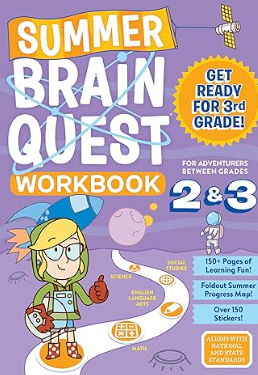
These workbooks are well designed. I’m not promising that your kids will not see it as a chore, but I think these books make practicing math and writing about as fun as it can be.
We found Brain Quest in a bookstore while we were looking for things to do in my son’s summer after kindergarten. The K-to- 1 summer workbook was fun and helped maintain what he had learned in kindergarten. He loved adding a new sticker to the adventure path after finishing each activity. You can finish it in one summer by doing about 5 pages per day, which only takes about 10 minutes.
We really love the summer map books but they also have schoolyear books. The First Grade school-year book is huge (320 pages). There aren’t as many stickers as the K-to-1, but they still have a way of marking off accomplishments that my son finds satisfying. It’s a kind of gamification, but it’s not more screen time.
These pages can be done after school on weekdays. What I like best is that it gives us some structure to leaning on weekends and holidays. It’s cheaper than tutoring.
There was a buzz over a new study showing that pre-K is not necessarily good for children. It’s amazing how experts can be completely surprised by the results of a major study on an issue like pre-K education.* Noah Smith summarized the literature and thought through some policy implications. Emily Oster also just summarized the paper and points out that it provides almost no help for parents making decisions. **
I’ll offer some “amateur astronomer” observations about preschool and childcare.
What to call the daycare I patronize, since it offers all of the pre-K functions? I’ll call it Day-K. My kid comes home from Day-K with worksheets difficult enough for a kindergartener, but it was handed to a 3-year-old and the kid just scrawled a few lines of crayon across it. Most little kids aren’t going to retain material that is beyond their developmental level. Why bother printing these nice worksheets at all instead of just letting them color a bear?
Something that surprised me was how early kids can learn the alphabet and yet how disconnected that is from anything useful such as being able to read words. If a 2-year-old can do it (e.g. recognize “A”) then a 4-year-old can probably pick it up easily anyway.
Good private daycares in desirable urban areas are expensive but have unbelievable waitlists. Donald Shoup advocates that cities should charge more for parking. He reasoned that every city block should have an open parking space. Instead of spending valuable time circling like a vulture, you should just pay a lot of convenient parking or else know you will have to go somewhere else. Would the same logic apply to the good daycares? Should they not charge so much that there is always an open slot for the next parent who can pay? One issue with this from the daycare owner’s perspective is that they don’t want new kids cycling through constantly. A brand-new kid who does not trust the staff and has not learned the routine is a temporary disaster. I believe that the waitlists work because the owners want a predictable flow of great committed customers. By keeping fees low enough to have a long waitlist, they get good families to stay and they can easily fill any holes left by departures or dismissals.
If the program was free, I suspect that would change the dynamic inside compared to high-fee Day-K. Daycare kids are on a regimented schedule. Everyone thrives on the routine. The staff are happy when the kids know the rules. If people were coming and going unpredictably, that might make it harder for kids to learn.
Even under optimal conditions, there are scuffles at daycare. Being pushed down on the playground is often the only thing a kid will remember from a full day of “instruction”. How could pre-K actually negatively affect some kids, as the new study shows? One way I can think of is that the experience a good teacher tries to provide could be ruined by one kid who is loud or violent. If half of the classes are functioning as day care and having no impact at all on future outcomes and half of the classes have a kid hitting, then the average effect for all pre-K classes could be negative. The social environment of pre-K is probably highly variable. Sometimes you could get a great social atmosphere in which kids learn to share and sing. Sometimes the chaos level could make things difficult, I imagine. This is speculative. But I think it’s ok to speculate in the brainstorming period that should follow a surprising result.
Daycare centers have a fantastic physical environment. When I think of the returns to scale, the low table and chairs that fits the 3-year-olds perfectly comes to mind. A preschool classroom has a perfect bathroom with low toilets and sturdy step stools at the sinks. There is no heirloom China or nice upholstery in the room to worry about. There are dozens of age-appropriate toys and craft supplies can be bought in bulk. This physical environment allows kids to be creative and have fun. Adults don’t have to hover over them, afraid that they’ll hurt themselves or break something at any moment. By contrast, having a 2-year-old child roam my house was terrible. I kick myself for not making more up-front investments in kid-proofing and creating safe play areas. But it’s expensive and difficult for a parent to outfit their own home perfectly for each stage of development. The great thing about a daycare classroom for 3-year-olds is that it is perfectly fitted for 3-year-olds, because 3-year-olds will be cycling through it for the next decade. The physical scale factor makes me a daycare optimist for urban areas. However, as I wrote earlier, things could be trickier for low-density population areas.
The study has given us a lot to think about. I hope the research community can be helpful in continuing to figure out the puzzle.
One thing we can conclude, as Noah says in his blog, is that a compulsory university pre-K would be bad. Forcing families to send 4-year-olds to an institutional program (the way 5-16 kids are regulated) would be an expensive “own goal” policy. I don’t know of anyone seriously considering that, which hopefully means that nobody is.
* As a lab experimentalist, I’m used to being surprised by data. Check out this podcast just recorded with John List. He talks about surprising findings from field experiments. You never know until you run the experiment. Hence, my post in September about a rant about behavioral economics.
** Yesterday, Emily Oster announced that she is leaving Twitter because it had become a toxic place for her. You can still find her at substack, instagram, and other traditional publishing outlets (e.g. her books).
I hacked Christmas this year to get two books I had been hearing about from reviewers and friends: Project Hail Mary and My Struggle by Knausgård. I wrapped the sci-fi one for my husband, because he will like it. I handed the weird one to him and asked him to wrap it for me. I killed many birds with one stone. The people who read econ blogs will appreciate my accomplishment.
Right after Christmas I had a plane trip that provided some reading time for My Struggle. I like it. As a warning to others, I wonder if the reason “everyone” thinks it is so relatable is that the types of people who review books share the author’s burning desire to be a writer.
The non-fiction book for adults I recommend this year is Liberty Power by historian Corey Brooks. If you have ever cared about social justice or affecting change, then wouldn’t you be curious to know how the abolitionists really did it around 1850? How, practically speaking, did a handful of people with moral convictions rid the United States of legal slavery? Abolitionists were striving and scheming to use the newly minted American democratic political system to their advantage even though they were in the minority. One of their big decisions was to start a third political party after they grew frustrated with slavery-complicit Northern Whig politicians. I blogged here about the connection with current politics.
I had a huge gap in my knowledge of American history before reading this book. Nothing that happened between George Washington and the Civil War seemed interesting, until this book created a narrative that I cared enough about to follow. History books might not be the perfect gift for everyone, but I bet no one in your family already has it!
Another book I reviewed earlier is Emily Oster’s The Family Firm, which any parent of young children would probably find helpful if they like research.
When I’m not reading for work, I read to my kids. I strongly recommend, for kids aged 6-12, The Voyage of the Dawn Treader. This ties into Liberty Power, because the main characters abolish the slave trade on one of the islands they sail to!
Before reading Dawn Treader, you should certainly start with the book that sets up the world, The Lion The Witch and the Wardrobe. I have a tip for younger kids: start reading this book right at the point where Lucy walks into the wardrobe for the first time. Younger kids won’t miss the first few pages that explain how the 4 children came to be in the old house.
For 4yo and 5yo kids, I recommend Aesop’s fables. These are short and self-contained. There are many versions of fable books for kids with good illustrations.
In addition of my specific plug for the Narnia series, I encourage parents to read fantasy with children. I see a lot of children’s books that promote science or STEM-readiness. My son enjoys learning about dinosaurs and nature, however I am certain that he’s learned the most from the conversations we have had about adventure stories.
Reading to your kids is costly in terms of time. We have limited time, so let me make an argument for dropping some of the other competing activities. I speak as someone who professionally teaches hundreds of college students to program. Those games that try to trick 5-year-olds into “programming” are less valuable than reading and discussing fantasy stories.
Inspire them with the story of a ship sailing to unknown islands. Talk about how a lovable band of flawed characters can escape from a clever magician. What your child will need to be able to do when they are 20 is read and comprehend a textbook that explains a totally new technology that no one alive today understands. Then they will need to think of creative ways to apply that technology to real world problems.