Collapsible Boats You Can Store in Your Apartment: ORU Folding Kayaks and MyCanoe Canoes

My wife and I were sitting on a bench near a local lake, having a picnic dinner. On a little grassy spot nearby I noticed a young woman put down a large bag, and then slide out some large, odd-looking plastic pieces. Then she unfolded something, and, oh my goodness, she had brought a fold-up kayak in that bag:

A friend joined her with sliding some joiner tubular pieces over the seams on top to zip these seams together:

The whole assembly took less than ten minutes. The resulting kayak was very light to carry:

And away she paddled:

I had drifted over to talk to her as she was assembling the kayak, and she said she just stored the boat in its bag in a closet in her apartment. Also, that it was great  fun to use.

This was one of a selection of foldable kayaks sole by ORU. They make smaller, lighter, cheaper models for paddling on still water, and heavier-duty kayaks for ocean waves and white-water rivers. These kayaks get generally very high reviews. They are a bit pricy, and may not stand up for long scraping over rocks. But they are  clearly  full-blown, worth-paddling kayaks with rigid sides and clean lines.

This resonated with me, because maybe twenty years ago, I got a pair of inflatable kayaks that we could store in the basement and pull out and inflate at the lake. Paddling them was an awful experience. Although we inflated them to spec, they sagged in the middle, with the two ends sticking up in the air and catching the wind. It was like paddling a bathtub which was being constantly carried downwind.

I also found through that experience that kayaking was very uncomfortable for me. But I do like canoeing. So, after seeing how great the folding kayak was, I looked online and found a similar collapsible canoe, made by MyCanoe.  The design is a little harder to execute, because with a canoe you have an open top, whereas with a kayak you can seal up the top and get the whole boat to be something of a nice structural tubular structure. But the MyCanoe seems to work OK, and has the same advantages of being lightweight (19 lb for one-person Solo, 43lb for two-person Duo) and of folding into a small package for transport and storage. There is an oar-lock accessory so you can row it with two oars, as an alternative to paddling. The Solo is pretty short and wide, so it is very maneuverable , but I would be surprised if it tracks well in a straight line when you just want to paddle from point A to point B using one paddle.

You can find plenty of demos and reviews on YouTube for these folding kayaks and canoes. And there are other collapsible kayaks out there, per this review, but some of them are heavier and more involved to assemble.

Anyway, these folding craft are a pretty classy, free-enterprise technology solution for folks who like to get out on the water, but don’t have a garage or backyard to store a regular kayak or canoe, much less a trailer for a motorboat or a sailboat.

Solar Cookers: Save Money, Save Lives, Save the Planet by Cooking with the Sun’s Rays

The Case for Solar Cooking

We all know we ought to reduce our CO2 generation to mitigate global warming and to conserve limited fuel reserves. Without descending into a tussle over exactly how man-made it is or whether it is part of a natural cycle which may turn soon to plunge us into yet another ice age, it does seem clear that the earth is experiencing a warming trend with possible serious consequences, and it is obvious that fossil fuel reserves (oil, natural gas, coal) are finite.

Although domestic cooking in developed countries comprises only a tiny fraction of total energy consumption, this is not true in some regions. Some 2 billion people still cook over fires of wood, charcoal, or animal dung. It is usually the women doing the cooking over these fires, inhaling smoke with all its consequences. Also, it is again women who largely end up gathering the fuel. All this gathering and fire-tending consumes time which takes away from other tasks like raising food. Also, women are often assaulted in the forests while they are foraging for wood.

It is possible to construct devices which capture enough of the sun’s rays to cook food (more technical details below). Many NGOs try to help people in poor, mainly sunny/tropical regions and in refugee camps to purchase or construct solar cookers. It is possible to set up cottage industries for locally making and selling these devices at low cost. It is just a win-win-win.  Solar Cookers International specializes in this work, and has developed and shared some of the most useful technology here. They claim some four million solar cookers are in use, and present figures for how much CO2 emissions and money for fuel are saved.

Why is this relevant to us in the West? Well, if we care to help the lot of the less-fortunate, we can give money to support these solar cooking initiatives. As noted, they can help the well-being of people, especially women, in many ways. A less-obvious  impact of us using solar cookers in our own homes is that folks in other lands are aware of our life-styles. It turns out that a non-trivial barrier to wide-spread adoption of solar cooking is that they are suspicious of Western aid workers promoting a method of cooking that no one back in the developed countries uses. If solar cooking could be more visible in our lifestyles it would have a significant effect in lands where it is really needed.

And getting around to our more personal motivations – it is kind of intriguing and rewarding to cook directly from the sun. On a hot day, it can mean cooking a casserole without heating the oven/kitchen. You can do great projects with kids (your own or others), designing and making and using solar ovens. And of course, you can signal your virtue by reducing your CO2 footprint.

If you find yourself in some situation when you have no other means to cook, a solar cooker could be a life-saver. To temper this reality, however, in most  temperate regions there will be many days without sufficient sunshine to make these work. Also, they are often much slower to heat up and cook than conventional stoves, so you need to plan ahead. That said, if you have a sunny morning or afternoon, you can put your pot of rice or whatever out to cook in the sun, go about your business, and come back in 2-3 hours, knowing your “solar crock pot” will have simmered your dish without burning it.

Types of Solar Cookers

I find the technical details here fascinating, but I will skip the juicies here and just briefly describe how these things are made and how they work. In all cases, there are some mirrored reflecting surfaces which concentrate the sun’s rays onto a cooking pot. For reflecting surfaces, one can glue aluminum foil onto cardboard. However, the foil grows dull with time, so it is better to use some kind of aluminized plastic surface, such as car windshield reflectors, mirrored craft adhesive sheeting, or even the insides of potato chip bags. Usually, the pot is in some kind of enclosure which is transparent to let the sunlight in but traps heat around the pot.  

There are a number of configurations that work. A description of various designs, with illustrations, is here  and here.

Perhaps the most minimalistic solar cooker is the panel cooker. Here, the pot is enclosed in a clear  oven bag or within two glass bowls. Segmented or curved reflective panels are arranged to reflect the sun on the pot from multiple angles. Solar Cookers International’s Cookit ($50) is said to be the most widely produced solar cooker, and it is of this design. There are many DIY designs floating around, including ones made from bent car windshield sun screens. A high-end, high-performance panel solar cooker is the Haines 2 ($100). These panel cookers lose effectiveness in cold, windy conditions, due to excessive heat loss.

Another design that people make a lot at home (see the internet) is a box solar cooker. Typically, you use a smaller cardboard box within a larger box, with the spaces between the two boxes filled with some kind on insulation (e.g., crumpled newspaper). A hinged glass lid and some reflecting panels on top of the box complete the device. A very expensive ($450) but very effective box-type solar cooker is the All-American Sun-Oven. This can function year-round, but takes up a lot of space in storage.

In tropical regions with the sun high overhead, there is some use of a plain, large parabolic mirror which can focus a very hot spot of sunlight onto the bottom of a pot or pan suspended above the mirror.

A more recent, high-tech approach is the line of solar cookers from Go-Sun. These feature smallish parabolic reflectors that focus the rays on a long, skinny cooking tube inserted in a double-walled glass tube with vacuum insulation. These cookers have only medium size capacity, but cook food really hot, really fast (e.g., can bake biscuits) and are not affected by cold weather. So, they are the most convenient and versatile cookers in many ways, although they do best with relatively solid foods like hot dogs or breads or cut-up meat or vegetables, not with liquidy loads like stew or soup or simmering beans. (Full disclosure: I caved in to my itch for one of these things, and have put it on my birthday list).

Malwarebytes Poll: Public Fascination with ChapGPT Has Turned to Suspicion

ChatGPT and related AI have been all the rage these past few months. Among other things, “AI” became the shiny object that companies have dangled before investors, rocketing upward the shares of the “Magnificent Seven” large tech stocks.

However, a recent poll by computer security firm Malwarebytes notes a marked turn in the public’s attitude towards these products:

It seems the lustre of the chatbot-that’s-going-to-change-everything is starting to fade….

When people explored its capabilities in the days and weeks after its launch, it seemed almost miraculous—a wonder tool that could do everything from creating computer programs and replacing search engines, to writing students’ essays and penning punk rock songs. Its release kick-started a race to disrupt everything with AI, and integrate ChatGPT-like interfaces into every conceivable tech product.

But those that know the hype cycle know that the Peak of Inflated Expectations is quickly followed by the Trough of Disillusionment. Predictably, ChatGPT’s rapid ascent was met by an equally rapid backlash as its shortcomings became apparent….

A new survey by Malwarebytes exposes deep reservations about ChatGPT, with optimism in startlingly short supply. Of the respondents familiar with ChatGPT:

  • 81% were concerned about possible security and safety risks.
  • 63% don’t trust the information it produces.
  • 51% would like to see work on it paused so regulations can catch up.

The concerns expressed in the survey mirror the trajectory of the news about ChatGPT since its introduction in November 2022.

As EWED’s own Joy Buchanan has been pointing out specifically with regard to citations for research papers (here, here, and in the Wall Street Journal), ChatGPT tends to “hallucinate”, i.e., to report things that are not simply true. In the recent working paper “GPT-3.5 Hallucinates Nonexistent Citations: Evidence from Economics” , she warns of the possibility of a vicious spiral of burgeoning falsehoods, where AI-generated errors which are introduced into internet content such as research papers are then picked up as “learning” input into the next generation of AI training.

Real-world consequences of ChatGPT’s hallucinations are starting to crop up. A lawyer has found himself in deep trouble after filing an error-ridden submission in an active court case. Evidently his assistant, also an attorney, relied on ChatGPT which came up with a raft of “citations to non-existent cases.” Oops.

And now we have what is believed to be “the first defamation lawsuit against artificial intelligence.” Talk show host Mark Walters filed a complaint in Georgia which is:

…asking for a jury trial to assess damages after ChatGPT produced a false complaint to a journalist about the radio host.  The faux lawsuit claimed that Mr. Walters, the CEO of CCW Broadcast Media, worked for a gun rights group as treasurer and embezzled funds.

…Legal scholars have split on whether the bots should be sued for defamation or under product liability, given it’s a machine — not a person — spreading the false, hurtful information about people.

The issue arose when an Australian mayor threatened to sue the AI company this year over providing false news reports that he was guilty of a foreign bribery scandal.

Wow.

Thousands of AI experts and others have signed an open letter asking: “Should we let machines flood our information channels with propaganda and untruth? Should we automate away all the jobs, including the fulfilling ones? Should we develop nonhuman minds that might eventually outnumber, outsmart, obsolete and replace us? Should we risk loss of control of our civilization?”.    The letter states that “Such decisions must not be delegated to unelected tech leaders. Powerful AI systems should be developed only once we are confident that their effects will be positive and their risks will be manageable.”    It therefore urges  “all AI labs to immediately pause for at least 6 months the training of AI systems more powerful than GPT-4…If such a pause cannot be enacted quickly, governments should step in and institute a moratorium…AI labs and independent experts should use this pause to jointly develop and implement a set of shared safety protocols for advanced AI design and development that are rigorously audited and overseen by independent outside experts.”

Oh, the irony. There is reason to believe that our Stone Age ancestors were creating unreal images like this:

whilst stoned on peyote, shrooms, or oxygen deprivation. And here we are in 2023, with the cutting edge in information technology, running on the fastest specially-fabricated computing devices, and we get…hallucinations.

My $109 Raspberry Plant: Growing “Raspberry Shortcake” in a Container

One of Warren Buffet’s most famous quotes (channeling the venerable Benjamin Graham) is: “Price is what you pay; value is what you get.”  He thus rationalizes buying top-quality companies or stocks, even if their price is not beaten down. So, allow me to explain why I put over $100 into a single, not-very-large raspberry plant.

In various earlier homes I have lived in, I have grown raspberries. To my way of thinking, this is an ideal crop for a home gardener. You can get maybe five bare-root dormant plants from a gardening supply house like Burpee in the early spring, plant them in the ground, and by that fall have a crop of sweet, flavorful berries you can eat right off the bush. And then you have a perennial bed that will fill in with even more canes each year. The “everbearing” (“fall-bearing” or primocane) varieties like Heritage or Caroline can produce from June through early October, depending on your climate zone. Not many pests attack raspberries, and the only maintenance needed is pruning, fertilizing, and watering during droughts. They do need nearly full sun, and well-drained soil.

I now live in a townhouse, However, I did want to grow raspberries, partly for the fun of growing my own food, partly out of nostalgia, and partly to give my grandson the experience of picking food from a plant instead of from a grocery store shelf.

The townhouse I live in now only gets nearly-full sunlight at one corner of the house. There is no appropriate garden bed there, so I need to use a container. Raspberries normally grow 3-4 feet tall, with roots that go down maybe two feet. I did not really have the space for a two-foot high/two-foot diameter container, and such a large container would be hard to move around. So last year I tried to grow a regular raspberry (Glencoe variety) in maybe a 14-inch x 14-inch pot. It was a total fail. The root space was just too small for this large a plant, I think.

So this year I regrouped, dug deep in my wallet, and bought a special dwarf raspberry called “Raspberry Shortcake.” This variety is bred to grow in small spaces. This plant is mostly supplied in a #1 size pot (nominally 1 quart, but actually smaller). I was impatient and wanted a larger plant that would bear fruit this year, so I spent more and bought a larger (# 2 pot) plant from Plant Addicts. It arrived in late April, and I transplanted it to a 16” x 16” (40 cm x 40 cm) plastic pot from Better Homes and Gardens. This pot is white, which I hope will reflect some of the sun’s heat during the summer.

This is a summer-bearing (floricane) raspberry, so it will only bear fruit for a few weeks in June-July. However, there is a new Asian fly pest spreading in the U.S. that attacks raspberries later in the season, so it may be best to avoid the fall-bearing varieties now anyway.

The plant had been pruned back to several slender, woody stems about ten inches high. Each of these stems has since put out several side shoots, most of which have now borne clusters of berries at their tips. I have enjoyed several dozen berries, and they are still coming. Also, I have had the pleasure of seeing my grandson pick and eat berries off the bush. I am a satisfied customer. Photos:

And close-up on the berries:

This plant cost me $72 ($57 plus $15 shipping). We got lucky with the pot, paying only about $22, when you can easily pay twice that for this sized pot. Potting soil was another $15. So about $109 all-in.

Obviously, I could have bought many little cartons of raspberries in the store instead for $109. I paid a high price for my plant, but got a value that I am satisfied with.

POSTSCRIPT: Just for completeness, to inform other would-be buyers of this plant – – it’s berry production peaked in mid-June here in U.S. growing zone 7a. It continued to produce a few berries a day till the end of the month. Since about July 1, it still produces perhaps an average of one berry a day, with 6-7 visible on the bush at any one time, but they are not ripening properly. Sometimes they just fall off before they are ripe, but most often they ripen very unevenly: some of the little “drupes” turn dark red (and then sometimes fall off) while the rest are still whitish. This may be a reaction to the heat, it is sunny and has hit 90 degrees F nearly every day, so the soil around the roots in the pot is way hotter than it would be for an in-ground planting . Anyway, none of this takes away from the satisfactory performance in June.

Post-PostScript: After watering the plant more frequently to let it transpire like crazy in the heat, and also after I loosely wrapped a 14-inch high strip of aluminum flashing around the pot to deflect some of the sun’s rays, the berries seem to be ripening better…getting 1-2 berries a day, though July 15, though they really are petering out now.

Save $$$, Easily Change Your Car Cabin Air Filter Yourself

I have done various maintenance and repairs on my cars over the decades. Usually, they turn out to be harder and more time-consuming than I thought. Changing the engine oil and oil filter has become genuinely harder since the oil filters have migrated deep up under the engine, where it is hard to access them without putting the car on a lift, and disposing of a milk jug of used oil has gotten more difficult.  I used to be able to easily change out a light bulb in the headlight, but the last car where that needed doing required you to take apart much of the front end of the car to get at the headlight. However, I recently found that changing the cabin air filters in my two vehicles (van and sedan) is so easy, I wish I had started doing it years ago.

Why Change the Cabin Air Filter?

The cabin air filter filters the air coming into the passenger section of the car. It knocks out road dust and pollen, and other bits of whatever that might get sucked into your air system as you are going down the road. So, it protects your and your family’s lungs as well as the components of the air handling system. Typical recommendations are to change out the filter about once a year or every 15,000-20,000 miles.

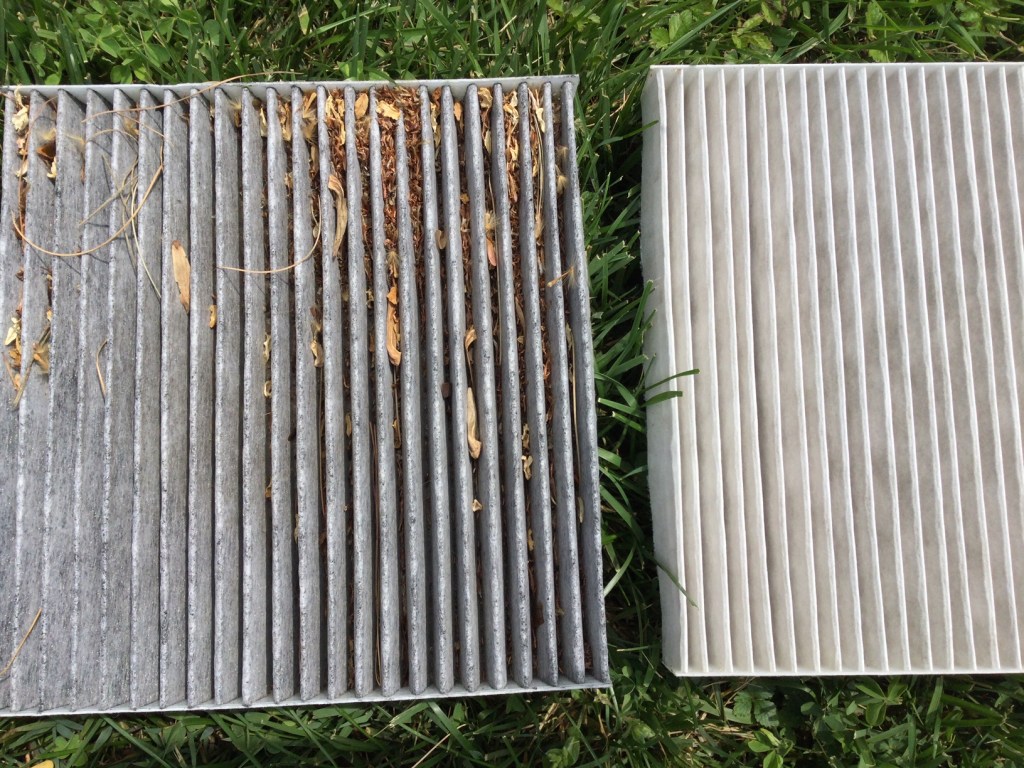
The photo below shows the cabin air filter I just pulled out of my van after maybe 2 years and 25,000 miles, next to a relatively clean filter. Obviously, I let this one go a bit too long: it is grey with dust/dirt, and partly blocked with plant debris.

I have not been quick to change out these filters because garages or dealers often charge something like $80-$100 for this. And until recently, I never considered doing it myself, because for some reason I thought it was a hard job. I had read of people having to contort in unnatural positions with heads inserted under dashboards as they disassemble layers of car to get at the filter.

It Is (Often) Super Easy to Change a Cabin Air Filter

It all depends on where the filter is located. For most models of cars, you can find guidelines on line, including YouTube videos. There are some models where you indeed may have to unscrew a cover plate somewhere below the dashboard to expose the filter. But in most cars, you remove the glove box to expose the filter. That may involve undoing come screws or a snap or strut, and squeezing the edge of the glove box inward. For my Hondas, all I had to do was empty the glovebox, (authoritatively) squeeze in the edges, and the glove box pivoted down, and behold, there was the filter in its little holder. Then slide out the holder, pull out the old filter and put in the new filter (purchased at AutoZone for $20 each), slide the holder back in place, and finally tilt the glovebox back up until it snapped in place.

Ten minutes max, easy-peasy. Obviously, this saved money, but it also felt empowering. I highly recommend trying it.

Why are desktop computers so cheap?

I recently bought a used desktop computer for what seemed like next to nothing. $240 for a machine more powerful than my much-more-expensive 2019 MacBook Pro, most notably due to its 32GB of RAM. Desktops have always been cheaper than equivalently powerful laptops, Windows computers cheaper than Macs, and used computers cheaper than new, so this isn’t totally shocking. But the extent of the difference still surprised me. For instance, buying a new desktop from Dell with similar specs to the used one I just got would cost $1399.

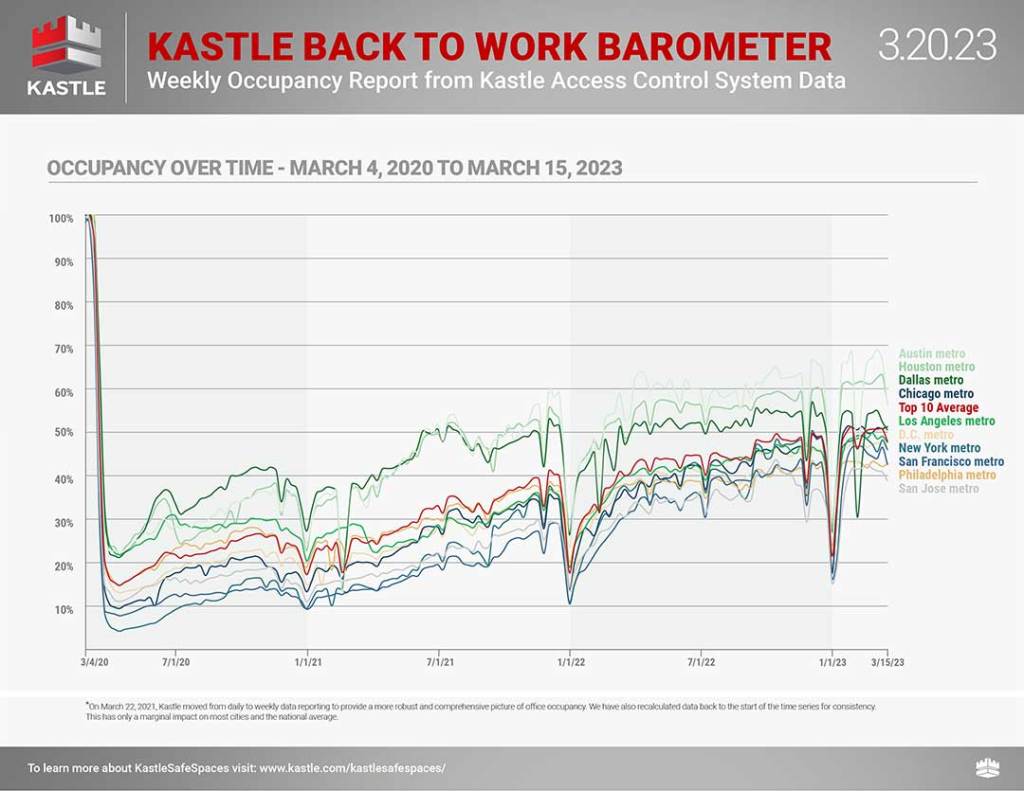
So why is the used discount so big right now? My guess is that its one more knock-on effect of work-from-home. Remote work has been the most persistent change from Covid, and there’s been a huge decline in the demand for office space, with occupancy rates still half of pre-Covid levels.

This means that offices are on sale relative to their pre-Covid prices. Office REITs are down 37% over the past year even after the Covid-induced drop of the previous two years. So it makes sense that all sorts of office equipment is on sale too. Offices tend to be full of employer-owned desktop computers, but when employees work from home they typically use their own machine or a company laptop. That means less demand for office desktops going forward, and a big overhang of existing office desktops that are being under-used. Employers realizing this may just sell them off cheap. Several things about the refurbished desktop I bought, such as its Windows Pro software, indicate that it used to be in an office.

Complacency and American Girl Dolls 2

It’s time to revisit American Girl Dolls and the Saturn V rocket. The trending topic among millennials is the new “historical” American Girl doll who lives in the year 1999.

Previously, I blogged about the historical Courtney doll from 1986 in “Complacency and American Girl Dolls.” I used Courtney’s accessories to illustrate stagnation in the physical environment (within rich countries) of recent decades. Courtney has a Walkman for playing cassette tapes and she has an arcade-style Pac-Man game to entertain herself. I pointed out that ’80’s Courtney had to be given the World War II doll Molly just to keep life interesting.

What do Isabel and Nicki have a decade later in 1999?  

They have a personal CD player and floppy disks. It’s cute and the toys will sell. However, it does not seem like innovation has introduced many new capabilities. Isabel can listen to music through her headphones and be entertained on screens, just like Courtney could.

Isabel eats Pizza Hut and has dial-up internet access. There is no sense of sacrifice or expanding the frontier. The world was settled, and history had ended.  

What counts for adventure in 1999? Shopping vintage clothing. Just like Courtney, Isabel revisits the past to get a sense of purpose or excitement.

This is Isabel’s diary. Having nothing to do besides look at clothes from past decades, she obsesses over status. Presumably “Kat” complimented her hat in person. Facebook didn’t start until 2004, so Isabel is not worried about “Likes” in social media.

So, what did I do with my kids for their school break on Presidents’ Day?  We went to the U.S. Space and Rocket Center to see the Saturn V rocket.

Continue reading

Average US Consumption: 1990 Vs 2021

On Twitter, folks have been supporting and piling on to a guy whose bottom line was that we are able to afford much less now than we could in 1990 (I won’t link to it because he’s not a public figure). The piling on has been by economist-like people and the support has been from… others?

Regardless, the claim can be analyzed in a variety of ways. I’m more intimate with the macro statistics, so here’s one of many valid stabs at addressing the claim. I’ll be using aggregates and averages from the BEA consumer spending accounts.

Continue reading

EWED Recommends Gifts 2022

Every year I request posts about stuff the writers actually use. My logic is that a great wave of stuff-buying is coming, so let’s try to highlight the good items and reduce holiday waste.

For Children

James recommends buying a whole bounce house. It might seem like something you could only afford to rent once a year, but the price of buying one you can use at home is now less than $300. In a big room, you can even do this indoors. Be the Christmas hero. Check on the space requirements.

I recommend two games that help kids learn to read. These are a great complement to Kindergarten or 1st-grade reading assignments. With enough confidence, you can convince kids that these games are toys and not “a book?”.

Sight Word Swat

Zingo sight words

SPOT IT is a card game that takes up almost zero space in the house or car. No reading or numeracy required and yet fun for adults!

Phantom Toll Booth A book for school-aged kids.

Little Tikes Easy Store Picnic Table with Umbrella, Scott says it’s worth the price if you have young kids around the house. Let them do messy food or activities there.

Food

Sounds like a good gift for adults who like to cook. Scott found a relatively affordable Black Rice.

Office to Garden

Compressed gas for computer maintenance. See Scott’s explanation on PC care.

Velcro Cut to Length – Zachary suggests: “Do you have a phone charger beside your bed that keeps falling on the ground? Just Velcro it to the nightstand lamp and it will stay exactly where you want it.”

Minute Soil is better than the dirt you have. This makes growing plants more fun and easier. Sounds like a great gift to wrap up for someone who likes gardening.

Set for Life

I agree with Zachary that cordless men’s hair clippers are a great investment.  

Barge All Purpose TF Cement Rubber – Praise from Scott: “Unlike most “superglues”, it will work on rough or porous surfaces, including situations like leather where flexibility is needed.”

Qwix Mix windshield – Windshield wiper fluid concentrate that is easy to store at home for when you need it.

Stoner Car Care 91154 10-Ounce Tarminator Tar, Sap, and Asphalt Remover Safe on Automotive Paint and Chrome on Cars, Trucks, RVs, Motorcycles, and Boats

Lastly, Mike has some correct life advice. Give yourself what your future self would want. For example, if you enjoy video games but don’t exercise enough, then try setting up an exercise bike right in front of your video games. That way you’ll get your cardio in and not have regrets the next week.

Must-Have Practical Gifts

My wife and I have different preferences for the kind of gifts that we like to receive. She likes earrings, flowers, massages, and electronics. I like hand tools, power tools, and any other item that makes domestic life more efficient. I can really appreciate a nice new pair of dockers or a button-down.

If you have a dad, husband, or anyone else in your life who appreciates practical gifts, then this list is for you. Below are four gift ideas that are sure to make the practical person in your life very happy – even if they may not be what you would want to receive. I’ve personally vetted all of the below items, so I can attest to the satisfaction that they are sure to provide that hard-to-shop-for person.

1)  Custom Length Velcro

Is your life in disarray? Are your cords and chargers in disarray? Then look no further. Nothing compares to the knowledge that the nest of cords behind your wall unit is no more. Use Velcro to bind and truncate your computer cords and your kitchen appliance cords. Do you have a drawer or box full of tangled extras? Velcro is nice because you can cut it to your custom length and reuse it with minimal loss of life. You can also use it in electrical applications or in the cabin of your vehicle. Do you have a phone charger beside your bed that keeps falling on the ground? Just Velcro it to the nightstand lamp and it will stay exactly where you want it. AND, because it’s reusable, you can easily remove it and keep the cords in your luggage nice and compact.

2) Minute Soil

Growing stuff is hard. But flowers, greenery, or even vegetables are nice. Yes, I’m basically recommending that you give someone dirt. But it’s awesome dirt. There’s this stuff called coconut coir. It’s coconut fiber that’s been compressed into a small disc or brick that’s ideal for shipping and delivery. Just add water and you’ve got some fancy dirt just waiting for an application. Coconut coir is all plant-based material, drains well, and it’s easy to store. You may not think of dirt as something that has a shelf life, but regular potting soil can definitely grow some unsavory things if you let it sit for long enough. Coconut coir is the solution to all of your spur of the moment small-scale horticultural endeavors.

3) Qwix Mix

Shipping items to our homes has been a game changer for shopping. But home delivery is not sensible for low priced heavy items like some liquids. My family was frequently running out of windshield wiper fluid and we’d end up stopping at a grocery store and overpaying. But no more! Qwix Mix is a windshield wiper fluid concentrate. Just an ounce in addition to a gallon of water saves us unplanned trips, high prices, and the storage cost of purchasing gallons of fluid ahead of time. I can’t vouch for the de-icing formulation, but the southern climate formula does exactly what it’s supposed to do.

4) Ufree Hair Clippers

Since the Covid recession, many of us have taken up our hand at cutting hair at home. For a while, we were borrowing a neighbor’s clippers. They were loud and had a short cord. But I’ve since purchased Ufree clippers and they are so much more convenient. They’re quiet, cordless, charge with a USB cord, and have a battery level display. But the battery lasts so long that you don’t even need to think about it. This kit comes with a beard trimmer, several guards, and a cape (throw the cape away, it’s bad). The clippers are metal and have some heft to them. Several colors are available – they come in black, silver, and gold finishes. But how can one not choose the gold ones?

That’s my list of great gifts for practical people. IDK your gift limit, but if you buy all 4 of these gifts you’ll spend about $100. That might leave room left over for stocking stuffers and chocolate.

(We’re not paid for any of these recommendations. But using our links is always helpful.)