If you haven’t been living under a rock, you probably saw at least one image of Elon Musk’s “Starship” rocket blowing up last week. This is a really big rocket, some 165 ft high, which Musk intends to use to ferry humans to Mars, as early as 2026. And before that, paying passengers like you and I are to climb aboard for brief tourist excursions to outer space.
The rocket is designed to land back on its launchpad, to be ready for its next flight. That part is what went wrong last Wednesday. I snagged three screenshots from the live-streamed SpaceX video on YouTube to show what happened. The first image shows the vessel descending on its rocket jets, obviously dropping way too fast as it neared the ground.
This is what happened upon impact:
Ouch. It turns out that not enough fuel was getting to the rocket engines to slow the vessel’s descent.
Here are the smoking ruins:
Another man may have been chagrined over this outcome, but not the indomitable Musk. He had given this flight only one in three odds of landing intact, and he was ecstatic over the vast majority of things that went right, and the useful data collected. After all, the rocket did successfully take off, ascend to 40,000 ft (12 km), and mainly descend in the desired horizontal orientation to minimize overheating. Right after the blast he tweeted:
“Fuel header tank pressure was low during landing burn, causing touchdown velocity to be high & RUD, but we got all the data we needed! Congrats SpaceX team hell yeah!!”
When you are Elon Musk, a little RUD (Rapid Uncontrolled Disassembly) is all in a day’s work. Which may be partly why he accomplishes so much more than most of us.
Any discussion of building a humane economy that addresses important needs like purpose, security, and opportunity would be incomplete without civil society — the third sector composed of our families, churches, affinity groups, and civic organizations.
In this post, I will touch on purpose. This year our conversations have been dominated by COVID-19 and discussions about the costs and benefits of state and local policies. In August 2020, the CDC released a report on the mental health effects from the lockdown and the results leave one stupefied. Among young adults (18-24 years old), 25 percent had suicidal ideation. One of the authors’ proposals includes “promoting social-connectedness” suggesting the dearth of community played an important role.
The anguish described above also calls to mind recent attention on “deaths of despair”. This refers to the rise in mortality among middle-aged white men starting in the late 1990s from suicide, overdose, chronic liver disease or cirrhosis. What causes these deaths of despair? In their book Deaths of Despair and the Future of Capitalism, Anne Case and Angus Deaton write,
“Destroy work and, in the end, working-class life cannot survive. It is the loss of meaning, of dignity, of pride, and of self-respect that comes with the loss of marriage and of community that brings on despair, not just or even primarily the loss of money.”
This is also reflected in Marco Rubio’s plea for a common-good capitalism where he cites deaths of despair as a ripple effect from an “economic re-ordering” and holds up the primacy of creating jobs that provide dignified work. This is important. As Adam Smith has noted, “Man naturally desires not only to be loved but to be lovely,” and work helps a man to feel he has made a contribution and is deserving of love and respect. At the same time, I want to resist the temptation to think despair flows only from economic conditions.
In his book Sickness Unto Death, Kierkegaard claims that humankind falls into despair when we have a misunderstanding about who we are as human beings. But, for Kierkegaard this despair can serve an important role. Despair signals our need for God, the only one who can heal our despair. A couple years ago at the Southern Economic Association meetings, I saw some preliminary work that suggested these deaths of despair were pre-dated by the decline in occupations but actually corresponded to earlier declines in religious participation. In order for life to have meaning, a person must have faith, and that faith is sustained in communities.
The key point is this: Man cannot live on economics alone. More depth is needed and this can be found in our communities. If a person removes themselves from important communities that can have a negative impact on their flourishing.
Here is a question: Before the fall of man, was everything perfect in the Garden of Eden? No. “The Lord God said, “It is not good for the man to be alone. I will make a helper suitable for him.”” (Genesis 2:18) We want to love and to be lovely. There must be some other for us to direct our love and receive love from. And, while that other could be a higher power like God, even Adam before the Fall, wanted that love to come from another human. Small groups like our churches provide the context through which this natural inclination can be pursued. Obviously there are other groups too like families, recreational organizations, civic organizations, etc.
Small groups can be chosen for different reasons and with different levels of commitment. This is a good thing because it is akin to a portfolio of identities. Having many different communities where we can engage different pursuits seems preferable to worship at the altar of politics. When we talk about a life well lived, human needs like purpose, security, and opportunity seem important to meet. Economics and work are important for that sense of purpose but we should not overlook how a lack of community can lead to a loss of purpose.
As the Fall semester comes to close on college campuses, it’s a good time to reflect on and assess how the past semester went. Many universities went to almost exclusively virtual learning, but other schools tried to make Fall 2020 as normal as possible given the circumstances of the COVID-19 pandemic.
My school, the University of Central Arkansas, chose the route of trying to have things as normal as possible — by which I mean students live on campus, classes are mostly in-person — while still accommodating students and faculty that preferred a more physically distant atmosphere. For example, UCA increased the number of fully online courses available, roughly trying to meet faculty and student demand. I normally teaching one online course per semester anyway, and I continued that this semester. Other faculty had more online classes than usual, or moved their class to be partially online.
So what was my experience?
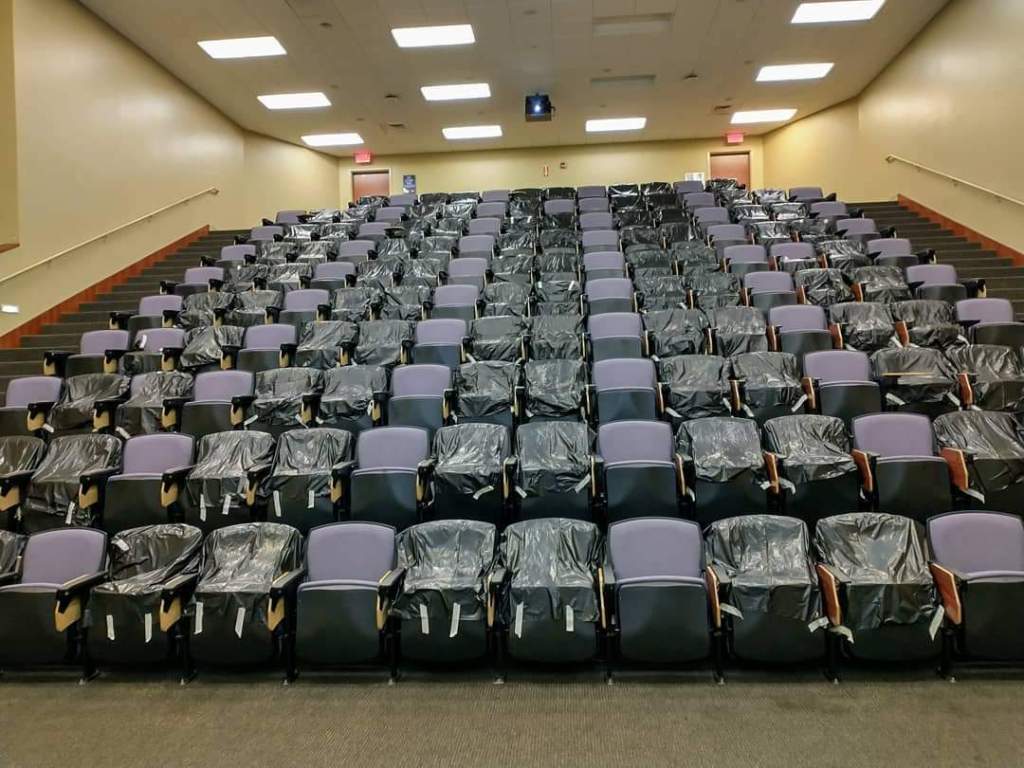
First, the students, the most important part of the teaching process. Overall, I would say my students did very well. At least in the classroom, they complied with all the rules the University set forth: wearing masks, physical distancing in classrooms (seen in the image below), even the one-way entrances and exits to the building. There were only 3-4 times I can recall this semester when a student entered my classroom without a mask, and they immediately asked me for one upon realizing their mistake (I kept a pack of surgical masks with me).
My classroom at the University of Central Arkansas, with chairs blocked off for physical distancing.
As far as academic performance of students, I was very pleased with the students. For those students that were able to stick with the class and keep up, which was most students, they perform as well or better than previous semesters. Some students, due to personal circumstances, had trouble keeping up. I tried as much as possible to accommodate students in these situations, by being flexible with deadlines, offering additional resources, and generally just trying to listen to them and empathize. It was hard for everyone.
On my end, I tried to make the teaching atmosphere of the classroom as normal as possible. I usually do have some interactive aspects of the classroom, where students work in small groups, talk to their neighbors, etc. Most of those activities didn’t happen, unfortunately. But otherwise, the classroom atmosphere operated as usual.
As my students did, I also wore a mask in the classroom while I lectured. For students that had to miss class due to quarantine, isolation, or other reasons, we were asked to record every lecture and have an option for students to watch the lecture virtually if needed. Making sure that the video was properly recording and the I had set up the Zoom link for students that needed to be remote added an extra element to think about at the beginning of each class, but it was the kind of thing that once you get used to it, it just became normal.
I will say that I often felt very exhausted after teaching each day. The mental load of making sure everything was working right in the classroom, combined with the constant sense of doom in the world around us, made this a challenging semester mentally. I’m sure this was even more true for some of my students. But, we made it.
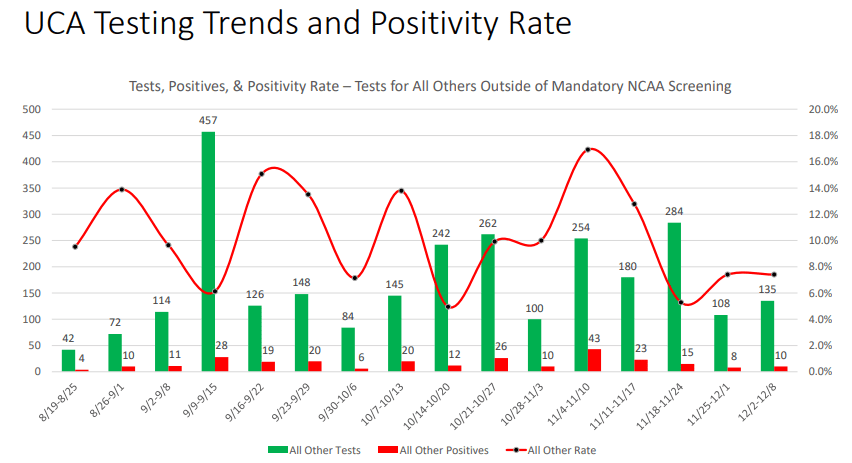
Finally, how about the administration of my University. I’ll bite my tongue a little here: I am up for tenure this year! But really, I don’t have anything major to complain about. Guidance was communicated well, although sometimes big changes were rolled out a bit more quickly than the faculty liked. UCA provided isolation and quarantine dorms for students, though these never came close to capacity. Weekly updates on testing, cases, and related data were provided to everyone (and made publicly available, so I’m not revealing any secrets here).
Testing data for UCA students. This data excludes athletes, since they were required to get tested regularly, which could have skewed the data.
As you can see above, the general student body at UCA did report positive COVID cases every week. And some weeks the positive test rate was a little higher than I was comfortable with! But we never had a large spike in cases, and the University held firm to its commitment to offer in-person classes for everyone that wanted them, as long as the campus was generally safe.
All in all, I think it was the best semester we could have had under the circumstances. The only thing really weighing on my mind: we are going to do it all over in the Spring semester. And we’ll do it as well as we can.
In the United States, the median age of marriage has been climbing for decades. In 1960 the median age of first marriage for men and women was 22.8 and 20.3 respectively. Fast forward to 2019 and the median ages are 29.8 and 28. Here are the historical tables.
Qualitative studies that interview young people suggest they are waiting on marriage until their careers get underway. Marriage is now something you do once you have a high income. But, this treats marriage as if it were a consumption good.
“With the rising cost of living, mountains of student loan debts, and a lack of job security, some of us just aren’t financially in a position to get married or settled down until we’re a little older.”
What is striking is how marriage is not viewed as a productive and helpful institution to overcome these obstacles in life. This runs contrary to the literature on the Economics of the Family that documents how marriage facilitates gains from trade, risk pools like an insurance policy, and allows couples to take advantage of economies of scale.
Yes, you can obtain some of these advantages with cohabitation but not at the same level of commitment.
This view of marriage as a luxury that is only consumed when your career and finances are in order is harmful because it leads to less opportunity. Marriage is productive and expands our possibilities.
A new working paper by Mike Makowsky and Patrick Warren finds that “firearms offered an effective means of Black self-defense in the Jim Crow South.” By this the authors mean that greater access to firearms by Blacks decreased the likelihood of being lynched.
That headline finding is sure to be provocative in both debates over gun control and the history of Jim Crow. And with good reason. What I found most interesting is how they measured Black access to firearms. Since they did not have direct access to any good sources measuring Black access to firearms, they proxy access with the percent of Black suicides committed with firearms. Increased access to firearms would also mean a higher proportion of suicides were committed using firearms.
We assess firearm access in the U.S. South by measuring the fraction of suicides committed with firearms. Black residents of the Jim Crow South were disarmed, before re-arming themselves during the Civil-Rights Era. We find that lynchings decrease with greater Black firearm access. During the Civil-Rights Movement, both the relative Black homicide and Black “accidental death by firearm” rates decrease with Black firearm access, indicating frequent misclassification of homicides as accidents. In the contemporary era, greater firearm access correlates with higher Black death rates. We find that firearms offered an effective means of Black self-defense in the Jim Crow South.
A balance sheet gives a snapshot of a corporation’s assets and liabilities. The difference between total assets and total liabilities is (by definition) the value of the equity owned by the owners or shareholders of the company.
With, say, a manufacturing firm, the assets would include tangible items such as buildings and equipment and inventory, and intangibles such as cash, bank accounts, and accounts receivable. Liabilities may include mortgages and other loans, and accounts payable such as taxes, wages, pensions, and bills for purchased goods.
The balance sheet for a bank is different. The “Assets” are mainly loans that the bank has made, plus some securities (such as US Treasury bonds) that the bank has purchased. These assets pay interest to the bank. The money the bank used to make these loans and purchase these securities came mainly from customer deposits or other borrowings by the bank (which are considered “Liabilities” of the bank), and also from paid-in capital from the bank owners/shareholders. [1] As usual, the current equity of the bank is assets minus liabilities. Thus:
The Federal Reserve System is a complex beast. We will not delve into all the components and moving parts, but just take a look at the overall balance sheet.
Unlike other banks, the Fed has the magical power of being able to create money out of thin air. Technically, what the Fed can do with that money is mainly make loans, i.e. buy interest-bearing securities such as government bonds. The Fed makes its transactions through affiliated banks, so it credits a bank’s reserve account with a million dollars, if it buys from that bank a million dollars’ worth of bonds. Those bonds then become part of the Fed’s “assets”, while the reserve account of the bank at the Fed (which is a liability of the Fed) becomes larger by a million dollars. Since the Fed is not a for-profit bank, the “Equity” entry on its balance sheet is nearly zero. Thus, total assets are essentially equal to total liabilities.
The Fed also has the power of literally printing money, in the form of Federal Reserve Notes (printed dollar bills). These, too, are classified as liabilities. Thus, you are probably carrying in your wallet right now some of the liabilities of the central bank of the United States.
Before 2008, the balance sheet of the Fed was under a trillion dollars. Nearly all the “Liabilities” were the Federal Reserve Notes and nearly all the “Assets” were US Treasury securities. The reserve accounts of the affiliated Depository Institutions was minuscule. All that changed with the Global Financial Crisis of 2008-2009. To help stabilize the financial system, the Fed started buying lots of various types of securities, including mortgage-backed securities (MBS) [2]. The Fed thus propped up the value of these securities, and injected cash (liquidity) into the system.
Here is a plot of how the assets of the Fed ballooned in the wake of the GFC, from about $ 0.9 trillion to over $ 4 trillion:
The initial purchases in 2008 were US Treasuries, which the Fed had prior authorization to do. To buy other securities, especially the mortgage products, required congressional authorization. The increased liabilities of the Fed which offset these purchases were mainly in the form of larger reserve accounts of the affiliated banks. The Fed started paying interest on these reserve accounts, to keep short term interest rates above zero at all times (otherwise the whole money market in the U.S. might implode).
With the Fed relentlessly buying the mortgage and bond products, the interest rates on long-term mortgages and bonds was kept low. This was deemed good for economic growth. The Fed tried to sell off some securities to taper down its balance sheet in 2018, but that effort blew up in its face – – the stock market started crashing in response in late 2018, and so the Fed backtracked . You can look at weekly tables of the Fed balance sheet here.
Anyway, the GFC and its aftermath provided the precedent for massive purchases of “stuff” by the Fed. When the Covid shutdown of the economy hit in March of this year, the Fed very quickly went into high gear. Its balance sheet shot up from $4 trillion to $7 trillion in just a few months. It bought not only Treasuries and MBS, but corporate bonds. This was way outside the Fed’s original charter, but the crisis was so intense that nobody seemed to care whether these actions were legal or not. And now, to finance the huge deficit spending of the federal government in the wake of the shutdowns, the Fed has been buying up nearly the entire issuance of Treasury bonds and notes.
These actions may have long term consequences we will explore in later posts [3]. For now, the Fed has made it clear that it will keep interests rates near zero for at least the next couple of years. Invest accordingly.
ENDNOTES
[1] Huge caveat: This statement gives the impression that a bank must first receive say a thousand dollar deposit before it can make a thousand dollar loan. That is not the case. The reality is just the opposite: the act of making a thousand dollar loan actually CREATES a corresponding thousand dollar deposit. This is very counterintuitive, and I won’t try to explain or justify this point here.
[2] Technically, the Fed is not “buying” the mortgage-backed security (MBS). Rather, it is making a “loan” to the bank, and holding the MBS as collateral against that loan.
[3] It is now harder to take the federal deficit seriously as a constraint on spending: the government can issue unlimited bonds to fund deficits, which the Fed will purchase to keep interest rates low. Yes, the government has to pay interest on those bonds, but the Fed has to return most of that interest to the Treasury, so the real cost to the government of that extra debt is low.
How do we conduct cost-benefit analysis when different policies might harm some in order to help others? This question has become increasingly important in the Year of COVID.
In particular, it is possible that some interventions to prevent the spread of COVID may save the lives of the vulnerable elderly, but have the unfortunate effect of causing other harms and potentially deaths. For example, increased social isolation could lead to increased suicides among the young (we don’t quite have good data on this yet, but it’s at least a possibility).
If you don’t think any public policies will reduce COVID deaths, then the post isn’t for you. It’s all cost, no benefit!
But for those that do recognize the trade-offs, a common way to do the cost-benefit analysis is to look at “years of life lost” or YLL. This is a common approach on Twitter and blogs, but I’ve seen it in academic papers too. In this approach, you look at the age of those that died from COVID, and use an actuarial life table to see how long they would have been expected to live. For example, an 80-year-old male is expected to live about 8 more years. Conversely, a 20-year-old males is expected to live another 56 years.
So, here’s the crude (and possibly morbid) YLL calculus: if a policy saves six 80-year-olds, but causes the death of one 20-year-old, it’s a bad policy. Too much YLL! (Net loss of 8 years of life.) However, if the policy saves eight elderly and kills just one young person, it’s a good policy. A net gain8 years of life. (Of course, we can never know these numbers with precision, but that’s the basic idea.)
But I think this approach is fundamentally flawed. Not because I oppose such a calculation (though maybe you do, especially if you are not an economist!), but because it’s using the wrong numbers. Briefly: we shouldn’t value every year of life equally.
The superior approach for this calculation is to use an approach called the “value of a statistical life” (VSL). In this approach, we assign a value to human life (the non-economists are really cringing now) based on revealed preferences of various sorts. Timothy Taylor has a nice blog post summarizing how this value can be estimated, which is much better than how I would explain it.
In short, the average VSL in the US is around $10-12 million, depending on how you calculate it. You might be skeptical of this figure (I was at first too!), but what really convinced me is that you get roughly this number when you do the calculation using very different approaches. It just keeps coming up.
So how does VSL apply to our COVID calculation? What’s really interesting about VSL is that it varies with age. And not perhaps as you might expect, as a constantly declining number. It’s actually an inverted-U shape, with the highest values in the middle of the age distribution. Young and old lives are roughly equally valued! Once we realize this, I think we can see how the YLL approach to analyzing COVID trade-offs is flawed.
Kip Viscusi has been the pioneer in establishing the VSL calculation. If you’ve heard that “a life is worth about $10 million” and scratched your head, Viscusi is the man to blame. Over the weekend, Viscusi gave his Presidential Address to the Southern Economic Association (he actually delivered it in-person at the conference in New Orleans, but to a very small crowd since the conference was over 90% virtual).
As you might have guessed given his area of research, Viscusi used this address to estimate the costs of COVID, both mortality and morbidity (the talk is partially based on this paper). He didn’t talk much about the policy trade-offs, but we can use his framework to talk about them. Here’s a very relevant slide from the presentation.
Notice here we see the inverted-U shaped VSL curve. You may not be able to read it very well, but Viscusi helps us with a bullet point: VSL at age 62 is greater than at age 20. Joseph Aldy, a frequent co-author of Viscusi, has extended the curve even further up to age 100 which you can see in this column. Aldy and Smyth use a slightly different approach, but the short version is that the VSL for a 62-year-old is much greater than a 20-year-old (roughly double). The 20-year-old VSL is roughly equal to that of an 80-year-old.
So let’s go back to the above YLL calculation, which told us that if a policy intervention only saves six 80-year-olds but results in the death of one 20-year-old, it’s bad policy. Too many YLL!
However, using the VSL calculation, this policy is actually good, since 20- and 80-year-olds have roughly equally valued lives. The policy only becomes bad if it kills more 20-year-olds than elderly folks. This may seem strange, given the short life left for the 80-year-old, but it is where the VSL calculus leads us.
I will admit, this calculations are morbid in some sense. But we live in morbid times. Death is all around us, and we need to some clear method for assessing trade-offs. YLL seems like the wrong approach to me. VSL seems better, but if we take a third approach, something like All Lives Matter (and matter equally), we end up with the same calculation when comparing a 20- and 80-year-old.
In the end, we should also be looking for policy interventions that have low costs and don’t result in additional deaths. For example, I think there is now good evidence that wearing masks slows the spread of viruses, which will lower deaths without any major costs. But if we are going to talk about trade-offs, let’s do it right.
(Final technical note: there is an approach that combines YLL and VSL, called “value of a statistical life year” [VSLY]. Viscusi discusses VSLY in the paper that I linked to above. I won’t get into the technicalities here, but suffice it to say VSLY involves more than simply adding up the years of life lost.)
In recent years, we have seen growing discontent with the distributional effects of free trade, widespread favor-seeking from businesses, and a recurring sentiment that the economy is rigged.
Distributional concerns. The 2016 election of Donald Trump likely stemmed from graphics like those below that demonstrate the geography of job losses and gains. According to this Bloomberg article, the goods-producing sector that includes manufacturing, construction, and mining lost 1.2 percent of their jobs during the Obama administration.
Favor-seeking. The Occupy Wall Street Movement was viewed as an expression of the frustration that government privileged banks above individuals despite their irresponsible business practices.
The notion that the economy is harmful to some and the deck is stacked against most is damaging the reputation of capitalism. According to a 2019 Gallup Poll, positive views of capitalism among young adults (ages 18-39) have declined from 66 percent in 2010 to 51 percent in 2019 and positive views of socialism are now at the same level as positive views of capitalism.
While this same group does hold a favorable view toward free enterprise, even that is down to 83 percent in 2019 from 89 percent in 2010. Individuals also view small businesses favorably but many of those local businesses are having difficulty weathering the shock of COVID-19 and that could tilt the composition of the economy toward big business which is viewed less favorably.
This constellation of public opinion is the milieu from which calls for “common-good capitalism” (focuses policies on firm and government obligations to workers) have emerged. Personally, I do not have great confidence in proposals like higher minimum wages, increased tariffs, and more that aim to address the pain that underlies these attitudes about the market economy.
At the same time, I do not have a clear path forward. The favorable views toward free-enterprise suggest individuals want others to exercise their talent and freedom in markets. That is good! At present, we do not want to kill the goose that lays the golden eggs. On the other hand, it is difficult for me to fathom how we can have a government big enough to help workers and one that creates conditions of fairness. It is wishful thinking to assume that the rent-seeking that has undermined the credibility of the market will go away if we turn to “common-good capitalism” or something else.
There is an old Jewish aphorism that, “the clever man can extricate himself from a situation into which the wise man never would have got himself in the first place.” Leadership in the United States lacked the wisdom to adhere to the limited and enumerated powers in the Constitution and Congress has long abandoned being jealous guardians of their authority that undermines checks and balances. Hopefully we are not all out of clever.
A week ago, we described commercial loans in general, and how they differ from bonds. Companies nearly always need money to make money, and thus have to borrow money in addition to selling stock shares. Companies that are new or smaller or doing poorly or have already borrowed a lot can still get loans, but these loans typically come with stringent conditions and require paying relatively high interest. These “leveraged loans” are the loan equivalent of “junk” bonds. When a bank lends money as a “Senior Secured Loan”, this entails agreements (“covenants”) which may specify that in event of default, this loan gets paid off ahead of any other creditor, and also that some specific asset held by the company, such as a building or an oil field, will be given over to the bank.
Financial institutions like insurance companies and pension funds are hungry for “investment grade” securities like bonds rated BBB or higher. Normally, these institutions would not consider buying into the senior loan marketplace, since these instruments are not considered investment grade.
Enter “Collateralized Loan Obligations” (CLOs). With a CLO, 200 or so loans which have been made by banks and then sold off into the market are bundled together, and then the cash flow from the interest paid on these loans plus the principal paid back is repackaged into slices or “tranches”. The highest level tranches get first dibs on being paid from the overall CLO cash flow, then the lower and lower tranches. The majority of bank loans today end up being packaged into CLOs. CLOs are an example of a lucrative operation known as “securitization”: “Securitization is the process of taking an illiquid asset or group of assets and, through financial engineering, transforming it (or them) into a security” (per Investopedia).
The rate of loan defaults in recent years has been only 3-4%, and on average the recovery on a given defaulted senior secured loan has been around 80%. So the actual losses (e.g. 4% x 20%, or 0.8% net) have been quite low. The highest annual default rate in recent memory was about 10%, in the Global Financial Crisis of 2008-2009.
The theory is that, although any particular loan has a nontrivial chance of defaulting, it is unthinkable that more than say 20% of all loans would default; and even if a full 20% of the loans did default, we would expect that the actual losses after liquidating the pledged collateral would be more like 4% of the entire loan portfolio (i.e. 20% defaults x 20% loss per default). This means that the top 95% or so of CLO cash flow should be considered very secure, and the top 60-70% are utterly secure.
Thus, the top 60-65% of the CLO cash flow is packaged as super secure, relatively low-yielding AAA rated debt, and as such is bought up by conservative financial institutions, including banks. This arrangement keeps those institutions happy, and also facilitates the making of loans to the needy companies who are taking out the underlying loans.
The figure below from an Eagle Point Investment Company presentation depicts typical CLO tranches:
The lower the position in the CLO cash flow “waterfall”, the higher the yield and the higher the risk of non-payment. The AA, A, and BBB debt tranches are all considered investment grade, though with higher risk and higher yields than the AAA tranche. The Eagle Point Investment Company happens to buy into the BB-rated debt tranche, which is just below investment grade. You, the public, can buy shares Eagle Point Investment (stock symbol EIC). These shares pay about 7% yield, after hefty management fees have been subtracted.
The equity tranche lies at the very bottom of the CLO heap. If there were, say, 20% loan defaults with only 50% recovery of the loans, the equity tranche might get completely wiped out. So these are more risky investments. As usual, there is high reward along with the risk. Oxford Lane Capital (OXLC) deals in CLO equity, and it will pay you about 15% per year, which is huge in today’s low-interest world. But….you need to be prepared to have the stock value cut in half every ten years or so, whenever there is a big hiccup in the financial world.
Anyone who was an economics-savvy adult during the GFC should be asking, “But, but, but…aren’t these CLOs essentially the same thing as the collateralized debt obligations (CDOs) that blew up the world in 2008?” The answer is partly yes, in that in both cases a bunch of loans get bundled together and then resliced into tranches. That said, we hope that the underlying loans in today’s CLOs are more robust than the massively shady home mortgage loans of 2003-2008 that fed into those CDOs. Back then, unscrupulous banks and mortgage companies handed out thousands of housing loans to ill-informed private individuals who did not remotely qualify for them, and then the banks dumped these loans out into the broader financial markets via CDOs. The bank loans behind today’s CLOs are more sober, serious, vetted affairs than those ridiculous subprime home mortgages.
This past summer, in the thick of the Covid shutdowns which have stressed small businesses, The Atlantic published a dire assessment of the potential for CLOs to sink the system, with the catchy title The Looming Banks Collapse . The article noted, fairly enough, that there has been a trend in the past few years to weaken the covenants on loans which would normally protect the lender against losses. Most loans these days are considered “covenant-lite”, compared to several years ago. There is genuine concern that the recovery on these loans might be more like 40-50%, instead of the historic 70-80%. On the other hand, the looser requirements on these loans may mean that fewer of them will technically violate these looser covenants and thus fewer companies will actually default. A recent survey estimates that the default rate in the $ 1.2 trillion dollar leveraged loan universe will peak at only 6.6% in 2021.
Also, today’s CLOs seem to be rated by the major ratings agencies more responsibly than the notoriously optimistic ratings given to CDO’s back in 2008. “CLOs are usually rated by two of the three major ratings agencies and impose a series of covenant tests on collateral managers, including minimum rating, industry diversification, and maximum default basket”, according to an article by S&P Global Market Intelligence. That article has a good description of CLOs, including a brief tutorial video on the nuts and bolts of how they work.
A few months back, I received a call for essays from the AEI Initiative on Faith in Public Life. The question was: In the contemporary United States, what would a truly humane economy look like? and it has been rattling around my head for a couple months. Occasionally I’ll write down some thoughts. In this post, I want to share with readers an excerpt from those thoughts.
“… I will situate a humane economy in the literature on fairness and justice and turn to a well-known philosophical device called the “veil of ignorance”. From behind this veil, there is no knowledge of race, sex, abilities, etc. From behind this veil — unencumbered by bias — a person would choose a humane society. John Rawls believed individuals, not knowing where they would be located in the income distribution, would seek to maximize the lowest income. This is what he called the “difference principle”.
In 1987, three political scientists conducted an experimental test of the veil of ignorance (Frolich et al., 1987). Students were presented with distributions of income that reflected different philosophical convictions like utilitarianism, egalitarianism, the difference principle, and utilitarianism with a floor constraint. Then students were asked to vote on their preferred distribution without knowing their ultimate position in the distribution. Students then deliberated with each other for a minimum of five minutes and unanimous vote was required for the adoption of a distribution otherwise one would be chosen randomly.
Rawls was right that individuals come to unanimous agreement behind the veil, however, the difference principle failed. The authors write, “Under all experimental conditions, all groups reached consensus and no group ever selected maximizing the floor as their preferred principle.” From behind a veil of ignorance, what did most people want? Overwhelmingly groups chose utilitarianism subject to a floor constraint. For a majority of people, prosperity is not dirty and undesirable. The economic pie can be large and some people can do very well. However, there is some willingness to limit the ceiling to raise the floor.
The direction of Rawls’ instincts were correct. People do think about the folks on the bottom rung and this experiment, and others like it, reveal something about human nature. We want the opportunity for great prosperity and we want to care for those less fortunate …”
After this discussion of the veil of ignorance, the essay proceeds with a reminder that if we are attempting to secure some material threshold, the poor in the United States are materially doing well by historical and global standards. But, for the remainder of the essay I focus on a different kind of poverty: unmet needs. Specifically the needs for purpose, security, and opportunity. Then I make the argument that to best meet these needs we need a more robust civil society and federalism.