The (attempted) return of Soviet economic statistics

From Warren Nutter’s “The structure and growth of Soviet industry: A comparison with the United States.” The Journal of Law and Economics 2 (1959): 147-174.:

“Let us acknowledge at once that all statistics contain faults and errors. Let us also acknowledge that no government or other agency resists the temptation to stretch figures to its own account if it feels it can get away with it. Representative government, competitive scholarship, and free public discourse are the Western institutions that have counteracted error and misrepresentation in statistics, imperfectly to be sure, but at least to some degree.

The peculiar difficulties with Soviet statistics stem, in the first instance, from the system of authoritarian, centralized planning-from what has been called a “command economy.” Published statistics come from only one source: the state. There are no independent sources to restrain each other or used as checks against each other, except to the extent that related figures published by different state agencies might not be fully coordinated before publication. At the same time, the suppliers of data to the central authorities -the economic and administrative units- have a stake in the figures they report, since their performance is judged on the basis of them. The Soviet statistical authorities do not hide their concern over the misreporting that results from this feature of the economic system. A second set of difficulties stems from the crusading nature of Soviet communism. Statistics are grist for the propaganda mill. Knowing the ideological views of Soviet leaders, one cannot expect them to dispense facts in a passive and detached manner.”

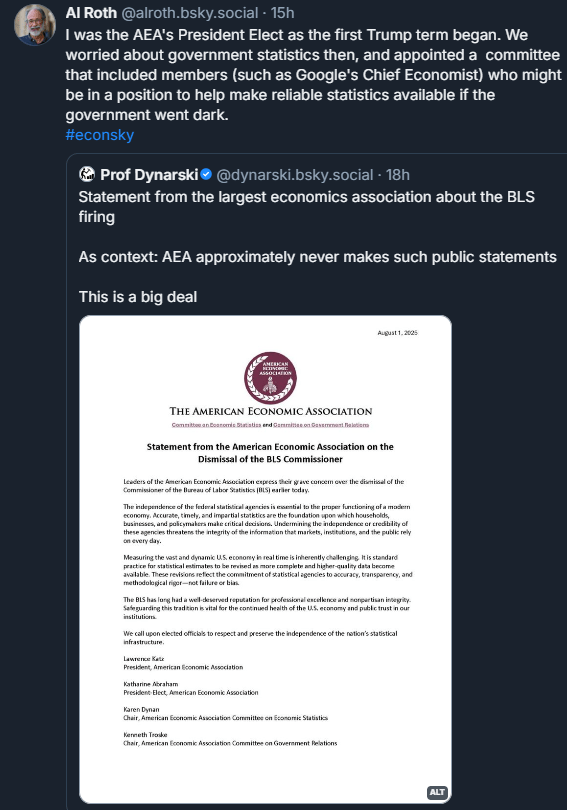
As many of you likely know, the President fired the director of the Bureau of Labor Statistics because he didn’t like that the newest employment numbers painted an unflattering portrait of the US labor market. Fortunately, the US continues to benefit from alternative to government statistics, but make no mistake, the BLS produces the absolute best labor market measurements the world has ever known.
It’s telling that while Soviet data seemed to often fool outsiders at the time (despite the occasionally raising of doubts), there was no such delusion within the Soviet Union, where provincial leaders would consistently look to outside sources for accurate economic reports.

Nutters is credited with co-founding the “Virginia School of Political Economy” at the University of Virginia with future Nobel Laureate James Buchanan. The Virginia school is most associated with public choice economics, something which by the 70s was often construed as an intellectual counterbalance to the modeling of government as infallible corrective to market failures that was particularly enticing to those favoring a socialist planned economy. That an administration and political coalition that loves to rail against omnipresent socialist threats is demanding that the US embrace a Soviet-style data apparatus is a reminder that history is never without irony.

See New York City for Full Price

I posted See New York City for Free in 2022 and See New York City for Cheap in 2024. In summer 2025, we spent 4 nights in Midtown. I will post general reflections about kids and New York here. Last week, l posted a short itinerary for our half-week in Manhattan with elementary-aged kids, as suggestions for other parents: NYC Family Summer Trip Itinerary

1. Assuming a middle-income family with 1-3 kids, when it comes to travel, I propose Do Less for Preschool. Save money by staying close to home when the kids are under the age of 6. I know people who do international trips with babies, usually because they are visiting family. I have not.

2. A mentor encouraged me to have kids early. One of my objections in 2014 was that I hadn’t traveled the world yet. Everyone I knew was posting selfies in Thailand. How could I have kids if I haven’t even posted from Thailand yet? He told me that you can travel with your kids when they are older. Now it’s 2025. Did that time go by fast? It’s a blur at this point. I remember the time when I read in a book that your kids will potty train themselves if you let them walk around with no diaper. When I tried that, my folks just went on the floor. That’s the stage of life when you might want to put unnecessary travel on hold.

3. Someone had told us that the NYC Subway is not safe and we should not take our kids on it. We used the Subway every day and it was fine. I saw one young man jump the turnstile. The elevator smelled bad. One night when I was checking routes, I noticed a warning on the map reading, “trains are delayed while we request NYPD for someone being disruptive on train…” So, people who rely on the Subway at all times might still have some complaints.

We enjoyed peace and safety in touristy areas between the hours of 8am and 9pm. Were we the beneficiaries of the crime decrease? I saw a bus ad celebrating the decrease in murders in NYC. Before I left Birmingham, Mayor Woodfin announce a big decrease in murders. The trend seems to be real.

4. The Observation Deck of the Empire State Building trip is almost more meta than the MOMA. You are inside the building looking at pictures of the outside of the building. You are posting pictures of yourself next to 50-year-old pictures of the outside of the building. People appear to go to the real thing in order to poast.

You can just do things, as they say, or at least you could in 1930.

Both kids voted that the Empire State Building was more “wow” than the MOMA. Maybe they like constructing more than deconstructing.

5. I vote the Museum of Modern Art (MOMA) as more “wow” because the permanent installations include many famous pieces including Starry Night by Van Gogh.

I had booked a day at MOMA without knowing exactly what was inside. My kids got to see me going around saying things like, “Wow. They have a real Picasso!” Instead of acting as a docent through a world I’ve already explored, my kids get to discover a lot along with me. We discussed what counts as “art” and “how did that get on the wall of a museum?”

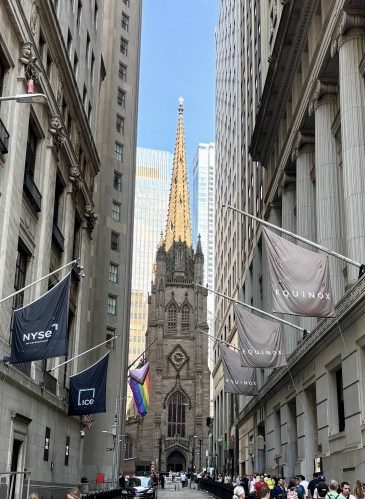
6. If you are going to Lower Manhattan to see the New York Stock Exchange and the World Trade Center, don’t miss a free tour of Trinity Church. (Hamilton’s tomb is in the churchyard.) It is an example of progress to see the cathedral dwarfed by the surrounding skyscrapers considering that: “With its 281-foot steeple, the third Trinity Church became the tallest building in the United States.”

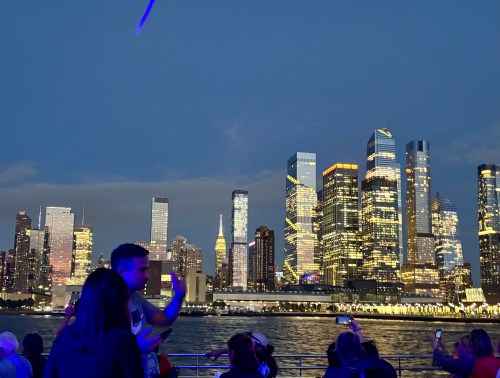
Here at EWED, Jeremy has often pointed out that people are richer today than in the past. The maligned Boomers would have seen a shorter New York skyline as children. Many of the supertall glass structures you see today were built after 2001, meaning it’s Gen Z who gets to live with them. (I learned that on our harbor boat tour.)

7. The 7-year-old got Lion King and the M&M store in Times Square. The tour of the United Nations headquarters was for the older people. The 10yo and I learned a lot from an excellent tour guide.

The 7yo had to be carried. She did not understand why they were calling “an emergency meeting on Syria.” The next day I asked her what she remembered from touring the UN. She sincerely replied, “What United Nations?” If you are wondering if she remembers anything from the trip, the answer is yes. The Empire State Building and the Chrysler building, among many other things, are newly part of the family vocabulary.

After the UN tour, I took the family back across 1st Avenue to see the Isaiah Wall. Scaffolding blocked our view, which is not encouraging for the hope of peace. The idea is that: “They shall beat their swords into plowshares, and their spears into pruning hooks; nation shall not lift up sword against nation, neither shall they learn war any more.”

Imagine a child named Johnny trying to form a model of the universe from the journey I set up for my kids this summer. In New York, Johnny embarked on a cultural safari that began at the MoMA, where he stood wide-eyed before melted clocks and soup cans, absorbing the idea that the world might be an absurd, fragmented collage. Then came The Lion King as a dazzling counterpoint, suggesting that the world is imbued with cosmic purpose. Every giraffe, ghost-dad, and blade of savannah grass existed in service of a divine, eternal monarchy. Finally, at the United Nations, he was led past flags and translation booths, where no one bowed to anyone and the world’s contradictions were negotiated over coffee. By the end of the day, Johnny wondered: is meaning a myth, a fact taught by the Spirit, or a matter of committee?

I noticed that they serve Starbucks coffee in the basement of the UN and in the Empire State Building. As long as we can get coffee before and dinner after, no one seems to care if the message is coherent.

Organization of the Federal Reserve – OR, Why The President is Impotent against the Fed

In my recent post that included Federal Reserve political independence, I dared to use the word ‘trust’, and commenters let me know that they were not pleased about it. In strict economic terms, there is no such thing as trust. Either that, or it’s the same thing as expectations or maybe low-information expectations. Since it wasn’t the main thrust of my post, I didn’t lay-out the informed reasoning behind my confidence in President Trump’s inability to cause Argentina or Turkey or even 1970’s US levels of political influence on the Fed.

In short, I’m not worried about it because the operational structure of the Fed and the means by which individuals join the Fed are determined by congress and are pretty robust. Below is a diagram that I made. I know that it’s a lot, but I’ll explain below.

Continue reading

GDP Predictions: Pretty Good!

Last week I wrote about the GDP predictions from Kalshi and the GDPNow Model. They were both showing 2.4% for Q2 of 2025 last week. They both changed slightly by yesterday, up to 2.8% and 2.9%. The final result (technically, the “advanced” result, but the final one for purposes of this comparison) was 2.97%. The Atlanta Fed GDPNow model continues to be a top performer, and you can’t do much better than averaging these two estimates. And you can pretty consistently do better than the median result from the WSJ/Dow Jones survey of economists.

Here’s the updated table:

And here is the original post explaining the data.

Warren Buffett Quotes on Gold as a Bad Investment; Was He Right?

To say Warren Buffett is not a fan of gold would be an understatement. His basic beef is that gold does not produce much of practical value.  His instincts have always been to buy businesses that generate steady and growing cash by producing goods or services that people need or want –  – businesses like railroads, beverage makers, and insurance companies.

Here are some quotes on the subject from the Oracle of Omaha, where I have bolded some phrases:

“Gold … has two significant shortcomings, being neither of much use nor procreative. True, gold has some industrial and decorative utility, but the demand for these purposes is both limited and incapable of soaking up new production. Meanwhile, if you own one ounce of gold for an eternity, you will still own one ounce at its end” — Buffett, letter to shareholders, 2011

“With an asset like gold, for example, you know, basically gold is a way of going long on fear, and it’s been a pretty good way of going long on fear from time to time. But you really have to hope people become more afraid in the year or two years than they are now. And if they become more afraid you make money, if they become less afraid you lose money. But the gold itself doesn’t produce anything” — Buffett, CNBC’s Squawk Box, 2011

This from when the world’s 67-cubic foot total gold hoard was worth about $7 trillion, which by his reckoning was the value of all U.S. farmland plus seven times the value of petroleum giant ExxonMobil plus an extra $1 trillion:

“And if you offered me the choice of looking at some 67-foot cube of gold … and the alternative to that was to have all the farmland of the country, everything, cotton, corn, soybeans, seven ExxonMobils. Just think of that. Add $1 trillion of walking around money. I, you know, maybe call me crazy but I’ll take the farmland and the ExxonMobils”  – – Cited in https://www.nasdaq.com/articles/3-things-warren-buffett-has-said-about-gold

And my favorite:

Gold gets dug out of the ground in Africa, or someplace. Then we melt it down, dig another hole, bury it again and pay people to stand around guarding it. It has no utility. Anyone watching from Mars would be scratching their head“. – – From speech at Harvard, see https://quoteinvestigator.com/2013/05/25/bury-gold/

One thing Buffett did NOT say is that gold is “barbarous relic”.  That line is owned by John Maynard Keynes from a hundred years ago, referring to the notion of tying national money issuance to the number of bars of gold held in the national vaults:

“In truth, the gold standard is already a barbarous relic. All of us, from the Governor of the Bank of England downwards, are now primarily interested in preserving the stability of business, prices, and employment, and are not likely, when the choice is forced on us, deliberately to sacrifice these to outworn dogma, which had its value once” –  Monetary Reform (1924)

Has Buffett’s Berkshire Hathaway Beaten Gold as an Investment?

 Given all that trash talk from the legendary investor, let’s see how an investment in his flagship Berkshire Hathaway company (stock symbol BRK.B) compares to gold over various time periods. I will use the ETF GLD as a proxy for gold, and will include the S&P 500 index as a proxy for the general U.S.  large cap stock market.

As always, these comparisons depend on your starting and ending points. In the 1990s and 2000s, BRK.B hugely outperformed the S&P 500, cementing Buffett’s reputation as one of the greatest investors of all time. (GLD data doesn’t go back that far).  In the past twelve months, gold (up 41%) has soundly beaten SPY (up 14 %) and completely trounced BRK.A (up 9%), as of last week. A couple of one-off factors have gone into these results: Gold had an enormous surge in January-April as the world markets digested the implications of never-ending gigantic U.S. budget deficits, and the markets soured on BRK.A due to the announced upcoming retirement of Buffett himself.

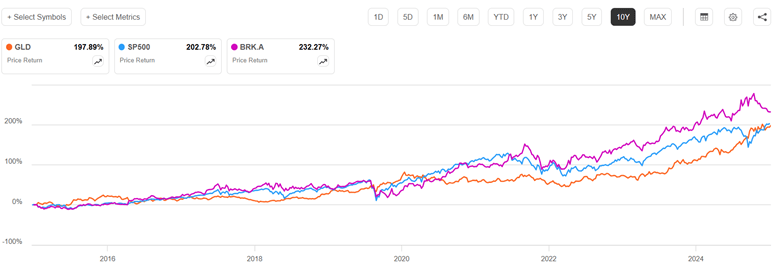
Stepping back to look over the past ten years shows the old master still coming out on top. In this plot, gold is orange, S&P 500 is blue, and BRK.A is royal purple:

Over most of this time period (through 7/21/2025), BRK.A and SP500 were pretty close, and gold lagged significantly. Gold was notably left behind during the key stock surge of 2021. Even with the rise in gold and dip in BRK.A this year, Buffett’s company (up 232%) still beats gold (198%) over the past ten years. BRK.A pulled well ahead of SP500 during the 2022 correction, and never gave back that lead. In the April stock market panic this year, BRK.A actually went up as everything else dropped, as it was seen as a tariff-proof safe haven. SP500 was ahead of gold for nearly all this period, until the crash in stocks and the surge in gold in the first half of 2025 brought them to essentially a tie for the past decade.

The consequences of a “Papers, please” economy

While DOGE is advertising their new deregulation AI (HT MR) with promises of “trimming 100,000 of those rules“, the reality is that the administration is ushering in the most profound layer of government involvement into our lives since the introduction of the income tax.

It defies the opportunity cost of my time to try to recap the crappy-policy-via-executive-order blunderbuss that has been the last 6 months, but it is sufficient to focus on two dimensions: immigrant targeting and tariffs. ICE is pulling people off of the street and detaining them for hours for “based on their physical appearance” in what can only be described as a dedicated effort to remove current immigrants, denaturalize past immigrants, and deter future immigrants. While these travesties play out one raid and immigration court ambush after another, tariffs are being introduced rapidly and haphazarly, always at the expense of the economy, and sometimes even in opposition to their stated goals of reshoring manufacturing. The prospect for (relatively) frictionless commerce across borders is quickly becoming unobtainable.

So what’s going to happen, now? Is America going to become a Whiter, autarkic island that steadily de-growths itself into a quieter state of nostalgic bliss, cheerfully accepting a shorter, sicker, less opulent life than before? Sure, the food will be worse and more expensive, our electronics obsolete and more expensive, our cars older and made from inferior materials (and more expensive), but that’s just the way things have to be, right? People will live and do as they’re told, right?

Have you met people?

People adapt. They find every workaround, every crack. Their lives will change, in many ways for the much worse, but they will work with what they have to make the best that they can. And this case, the best way to adapt will be to become just a little more criminal. Not fully criminal, just a little more. More aspects of our lives will become akin to driving 10 mph over the speed limit because that’s just what everyone does.

Daily life will, slowly and at times imperceptibly, move underground. More jobs will pay in cash. Fewer exchanges will be made absent a personal relationship. More goods will arrive in suitcases at the luggage return. Friends will ask friends to pick up a phone/earbuds/tablets for them when visiting less economically restricted countries, while also reminding them to delete their messaging apps before heading through security. More goods will be altered from their true, optimal consumable form to qualify for a lower tariff. The advantage of physical over digital media will widen again. Where exchange exists outside of the law, trust needs to be found outside of contract. At the margin, business will become just a fraction of a percent more nepotistic. More employees will be found somewhere in the family tree. Everyone will just become a bit more crooked and, in doing so, expect everyone else to be a just a little more crooked. The US is a shockingly high trust society because it pays to be trustworthy. This is how such things unravel.

More immigrants will live within arrangements that hide them from not just the authorities, but from observation in general. Curtains and blinds covering windows at all hours. Dinner will taken at home rather than the restaurant. Clubs and concert gatherings that appeal to immigrant crowds, or even just less White crowds, will advertise less, relying on word of mouth. Workers will move more often, rather than garner attention. The sick and injured will not be taken to the emergency room. The gaps in an already fractured society will become a little wider.

Employers will keep more people off the books. Off health insurance and workers compensation. Employees will, perversely, be grateful for the lower exposure. Insurance companies will find new ways to audit liability without exposing their clients personnel. Predatory human trafficking will find larger herds of underground populations to hide their practices within. Fewer people will trust and rely on the law. Fewer people will enjoy it’s protections.

What about compensating wage differentials? On the one hand, labor supply will be reduced as it is pushed underground, reducing their numbers and safely available hours. On the other hand, the necessity for employers to reduce the visibility of their workers while incurring the risk of legal punishment will reduce demand. The net effect on equilibrium wages is uncertain. However, those employers who manage to guarantee longer and safer tenured employment will capture greater rents from those they employ. Getting to work more consistently and going to sleep feeling safer is quite the fringe benefit, one that employers may find to be a more a profitable form of compensation than just simple wages.

I’d keep writing, but I already sound like a paranoid crank. I’m not sure I am comfortable, anonymous reader, with this level of intellectual vulnerability in such a public forum. Papers, please.

NYC Family Summer Trip Itinerary

This is a condensed list of what we did with elementary-aged kids for three fun days in Manhattan in July. 

Like a camping trip, NYC with kids depends on the weather. In good walking weather you can occupy many hours exploring free outdoor attractions. In bad weather, you might feel the need to constantly buy admission tickets, retail, taxis and sit-down restaurant meals.

Our hotel was a 5-minute walk from Grand Central Station. We had a good view from our room on the 28th floor. We could even look down on an interesting active construction site. When traveling with kids, or any group larger than a couple, you’ll probably be stuck in the hotel sometimes, so paying extra for a good view might be worth it.

In the hotel lounge, adults could drink a free glass of wine and listen to a guy playing calm piano songs from memory like “My Heart Will Go On.” When my ten-year-old (10yo) asked for “Seven Nation Army” by The White Stripes, the request was denied. 

Tuesday

We walked to The Empire State Building. Passing the Public Library was a highlight although it was not open yet. I had booked entry tickets to the Empire State building online months ahead of time for a 9:30am time on a Tuesday. We spent no time waiting in line.

Next, we took the Subway to the Museum of Modern Art (MOMA). I had reserved tickets for the day. If your kids need a break from quietly appreciating art on the wall, there is a garden courtyard and kid’s craft area.  

It was hot but we were lucky to not be in the middle of a genuine heat wave. We got to-go food from a shop and walked north to Central Park for a picnic on rocks in the shade. Playgrounds and fun statues provide points of interest for kids.

We walked up to the Chess pavilion where my kids dropped in on chess games with friendly strangers (a nice man provided the pieces). You could bring your own chess or checkers pieces if you want to guarantee a game.

Note: Even though many places claim to have bag polices online, you can almost always get a regular sized backpack and/or metal water bottle through security.

Wednesday

This might sound like a planned itinerary, but the only thing we locked in ahead of time for Wednesday was an afternoon Broadway show. By the time we got back to our hotel at night, my phone had counted over 14,000 steps for the day. Our first stop was Clinton Castle on the southern edge of the island. Benefits to children include bathrooms and a museum display of how Manhattan was expanded through land reclamation. I’m not including all the places we stopped to eat in this blog but we especially liked discovering Liberty Bagels.

We saw the bull statue and the New York Stock Exchange (from the outside). A great stop in Lower Manhattan is a free self-guided tour of Trinity Church. We walked to the 9/11 memorial and then back to the subway so we could rest in our hotel during the hottest part of the day.

Lion King on Broadway was fun (and expensive). Afterwards, we were in Time Square, and it was finally time to do what my kids had been talking about all year: return to the M&M store. Kids love the M&M store.  

Then we walked to Hell’s Kitchen for dinner. We went back east to Rockefeller Center and bought books for the kids at McNally Jackson. From there, with a “we can make it” attitude, we walked back to the hotel in the dark. This is where the “safe streets” matter as much as the weather.

Thursday

This morning had not been planned ahead of time, so we spent some of our time figuring things out. We walked to the United Nations headquarters. I was able to get visitor passes and a guided tour. We had a great guide who explained the building and the aims of the UN for 45 minutes. I learned a lot and my 10yo was engaged.

Should you take your children on a tour of the UN? I had to carry my 7yo most of the time. The next day, I asked her what she remembered. She sincerely replied, “What United Nations?” If you don’t think your younger child will be outright disruptive, then you might take a younger kid along with an older kid who can appreciate it.

We had an appointment to enter the USS Intrepid Museum at 2:30. We didn’t make it until 3:30 and it closes at 5pm. The place deserves more than 90 minutes. It has a big kids’ activity area that is fully indoors.

Our last scheduled event was a Circle Line Harbor Lights Cruise from 7pm to 9pm. In the summer, this is a sunset cruise of lower Manhattan and the Statue of Liberty. Just at the end you see the city lights against the night sky. The tour guide was entertaining and smart! I learned interesting NYC facts and history. They have enclosed areas with windows for bad weather but that would not be as fun. Being able to sit up on the open-air top deck made the view amazing for everyone.

I’m Chair! 😬

As of July 1st of this year, I am the Chairman of the Department of Economics at my university. It’s one of those positions that includes more work and not much compensation. Depending on who I tell, I’m given both congratulations and condolences. Generally, at my university there is an expectation that department faculty ‘take turns’ being chair. So, we’re expected to serve whether the pay is good or not. There’s a lot of informal practice around this process.

In addition, Economics Majors have been less popular at liberal arts institutions over the past several years. No one knows why and there are probably multiple reasons. At my institution, our department has healthy enrollment among the peripheral majors. So, the Economics BA and BS have lower enrollment, but the Business Economics and the Global Affairs majors are more popular than ever.

All the same, I’d like to increase the number of students who have declared majors in our department and the number of Economics graduates. How do I do that?

Continue reading

Is A Music Major Worth It?

Our new paper concludes that the answer is a resounding “It Depends”.

It depends on your answer to the following questions:

  1. If you didn’t major in music, would you major in something else, or not finish college?
  2. How dead set are you on a career in music?
Source: Figure 1 of Bailey and Smith (2025)

We found that

  1. Music majors earn more than people who didn’t graduate from college, even if they don’t end up working as musicians
  2. Among musicians, music majors earn more than other majors
  3. But among non-musicians, other majors earn much more than music majors

So on average a music major means higher income if you would be a musician anyway, or if you wouldn’t have gone to college for another major, but lower income than if you majored in something else and worked outside of music. The exact amounts depend on what you control for; this gets complex but this table gives the basic averages before controls:

Source: Table 2 of Bailey and Smith (2025), showing wage plus business income for respondents to the 2018-2022 American Community Survey

For better or worse, a music major also means you are much more likely to be a musician- 113 times more likely, in fact (this is just the correlation, we’re not randomizing people into the major). Despite that incredible correlation, only 9.8% music majors report being professional musicians, and only 22.3% of working musicians were music majors.

Sean Smith had the idea for this paper and wrote the first draft in my Economics Senior Capstone class in 2024. After he graduated I joined the paper as a coauthor to get it ready for journals, and it was accepted at SN Social Sciences last week. We share the data and code for the paper here.

Continue reading