The Smoot-Hawley Tariff of 1930 was opposed by a thousand economists, but passed anyway, exacerbating the Great Depression. Now that the biggest tariff increase since 1930 is on the table, the economists are trying again. I hope we will find a more receptive audience this time.
The Independent Institute organized an “Anti-Tariff Declaration” last week that now has more signatures than the anti-Smoot-Hawley declaration, including many from top economists. One core argument is the sort you’d get in an intro econ class:
Overwhelming economic evidence shows that freedom to trade is associated with higher per-capita incomes, faster rates of economic growth, and enhanced economic efficiency.
But I thought the Declaration made several other good points. Intro econ textbooks say that tariffs at least benefit domestic producers (at the expense of consumers and efficiency), but in practice these tariffs have been mainly hurting domestic producers, because:
The American economy is a global economy that uses nearly two thirds of its imports as inputs for domestic production.
I get asked to sign a petition of economists like this every year or so, but this is the first one I have ever agreed to sign onto. Most petitions are on issues where there are good arguments on each side, like whether to extend a particular tax cut, or which Presidential candidate is better for the economy. But the argument against these tariffs is as solid as any real-world economic argument gets.
The full Declaration is quite short, you can read the whole thing and consider signing yourself here.
Today the stock market does seem to move a lot on the news about Trump’s ever-evolving tariff policy. If you see the S&P 500 is up today, you can probably guess that Trump or his advisors slightly backed off some aspect of their previously announced tariff policy. And vice versa. That much is true.
But back in 2020, the implied correlation in the market was briefly over 80% in the spring of 2020, and was over 50% for almost all of the summer of 2020. Today, the correlation is closer to 40%. That’s a bit lower than 2020, but it is a significant jump from where it was 2-3 months ago.
Despite the nearly universal outcry, President Trump was standing firm on his massive tariffs. “No backing down”, etc., despite the evaporation of trillions of dollars in stock values. On Tuesday, April 8, White House spokesperson Karoline Leavitt affirmed: “The President was asked and answered this yesterday. He said he’s not considering an extension or delay. I spoke to him before this briefing. That was not his mindset. He expects that these tariffs are going to go into effect.” However, the next day, Wednesday, April 9, Trump announced on his social media platform, Truth Social, that for all countries but China, there would be a 90-day pause in reciprocal tariffs.
What happened here? The common explanations are that (1) the chaos and losses in the markets had finally grown intolerable, or that (2) the president had planned all along to pause the tariff hikes on April 9. I suspect there is some merit to both of these factors – -despite all the prior warnings, I think (1) Trump did not expect such market devastation (he sincerely believes that he is making the American economy great, so why should markets crash?), and also (2) that he had indeed planned to play around with tariff implementations in pursuit of deals.
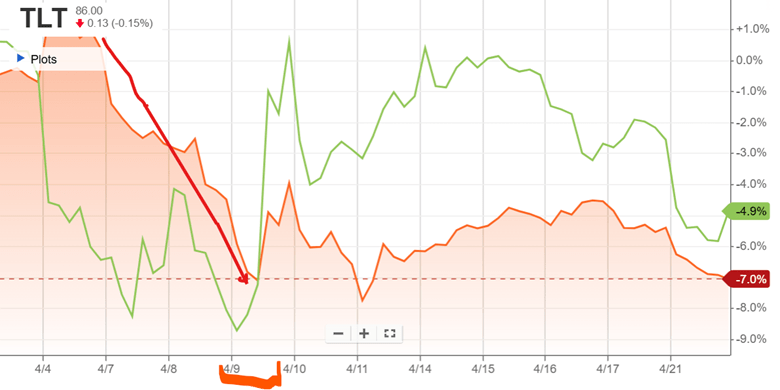
But what some analysts pointed out as a further factor was the drop in the market value of U.S. Treasury bonds, which correlates directly to a rise in interest rates. The actions of the Administration have seemingly caused market participants, especially abroad, to question the risk-free status of U.S. debt. If the government has to pay higher interest on its debt, it is game over, as interest payments will spiral up and consume an ever-higher share of the federal budget. The chart below shows in orange the price movement of the TLT fund, which holds long-term T-bonds, plummeting on April 7, 8, and 9 (red arrow), as an indicator of rising rates. TLT price then shot upwards, along with stocks (the green line is S&P 500 fund SPY) late on April 9, in the relief following the tariff announcement:
As Treasury Secretary, Scott Bessent would be particularly sensitized to the interest rate issue, and able to communicate that to the boss. He has been a successful hedge fund trader and manager, so he understands the plumbing of the system, unlike some other presidential advisors. Up till then, however, economist Peter Navarro, who is ultra-hawkish on tariffs, had had the ear of the president.
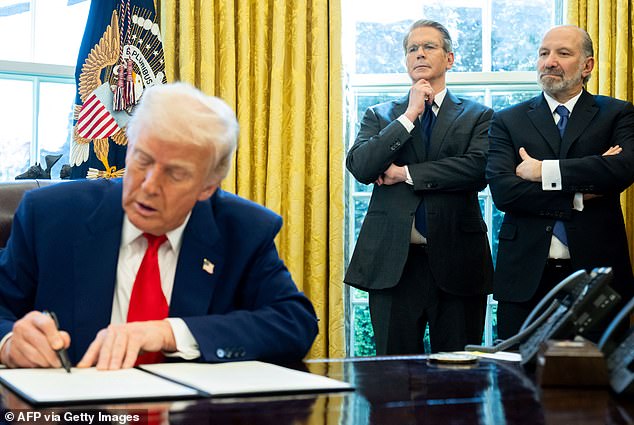
So, what did Bessent do? (This is the part that only came to my attention a few days ago, even though technically this is old news). It seems he enlisted the support of Commerce Secretary Lutnick, and adroitly chose a time when Navarro was tied up in a meeting, and barged in on the president in an unscheduled meeting so they could get him alone. And it worked! Evidently, they persuaded him that now was the time to do the clever deal-making thing and issue a pause. It’s a mark of how readily the president can change his mind that his own press spokespeople were unaware of this volte-face, and had to scramble to make sense of it. It is also interesting that cabinet members are resorting to cloak-and-dagger tactics to get policy done.
Bessent naturally gave all the credit to the president for the decision, but he and Lutnick had photos taken to show who saved the financial world – for now:
Scott Bessent (standing, left) and Howard Lutnick (right) with President Trump as he signs 90-day pause in reciprocal tariffs. Source: Daily Mail.
The president’s recent musings about trying to fire the supposedly independent Fed chairman have since contributed to interest rates going back up again, but that is another story.
“From 2005 to 2019, forty US states raised the dollar value threshold delineating misdemeanor and felony theft, reducing the expected punishment for a subset of property crimes. Using an event study framework, we observe significant and growing increases in theft after a state reform is passed. We then show that reduced sanctions for theft have broader effects in the market for illegal activity. Consistent with a mechanism of substitution across income-generating crimes, we find decreases in both drug distribution crimes and the probability that a released offender previously convicted of drug distribution is reincarcerated for a new drug conviction.”
For those interested in a bit more of the nitty-gritty, we analyze both arrest and recidivism data within a stacked event study because we are dealing with staggered (diffent years) and fully-absorbing treatments (i.e. once they raise it they never lower it back). States raise their felony theft thresholds for a portfolio of stated and unstated reasons, but the reality is that the value of the marginal stolen good is often deteriorated by decades of inflation only to be doubled or tripled by a single act of legislation. This makes for an excellent before/after experimental setting to test the effect on crime.
We’re going to look at two things broadly: arrests and recidivism. The importance of arrests is straightforward: they give us a sense of the rates of crime across populations. Recidvism is more subtle. More on that in a bit.
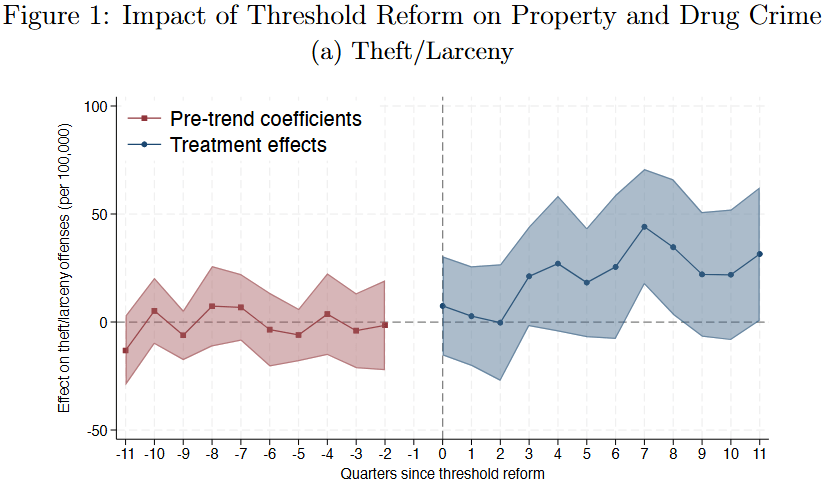
In the quarters leading up to a threshold change (above) we see flat pre-trend with a coefficient of zero i.e. nothing happening. Nothing happening is good, it means that neither law enforcement nor criminals exhibit any sign of anticipating the change. Once a given state makes the change, we see an uptick in rates of theft within 6 months that persists for three years. Speculating beyond that is dangerous – too many other things happening in the world. But criminals seem to be responding.
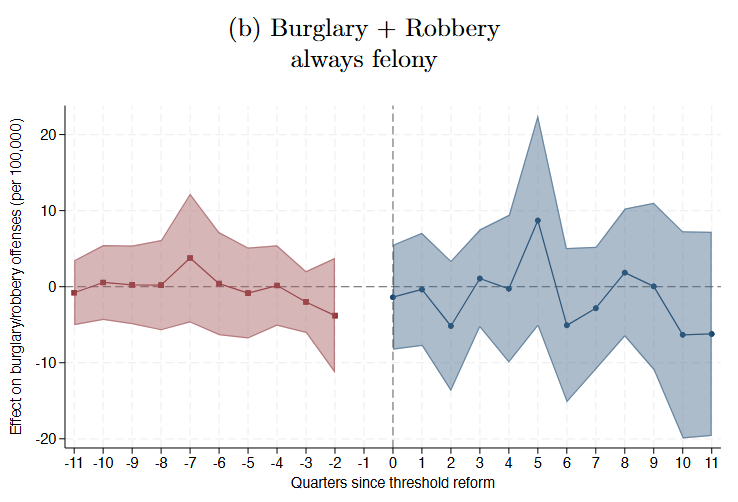
We don’t see any effect on Burglary or Robbery, however (below). This is also a sign of rational criminals since these thresholds don’t apply (i.e. they are always a felony, regardless of property value). In other words, we don’t see an effect on all property crime, just on those crimes for which expected punishment is reduced.
We do, however, see an interested effect on drug distribution (below). In the quarters after a theft threshold reduction, we see a significant and persisting reduction in drug arrests. Yes, we include controlling covariates for medical and recreational marijuana legalization. There’s something else going on here. Are people exiting one income-generating crime for another?
This is where recidivism comes in. Using detailed, restricted-access, prisoner records, we track when prisoners are released and if/when they are returned to prison. By stratifying the analysis by the crime types they were previously incarcerated for, we can separately estimate the effects of felony threshold changes on individuals with human and social capital in the drug distribution business from those who do not. What we observed is both striking and subtle.
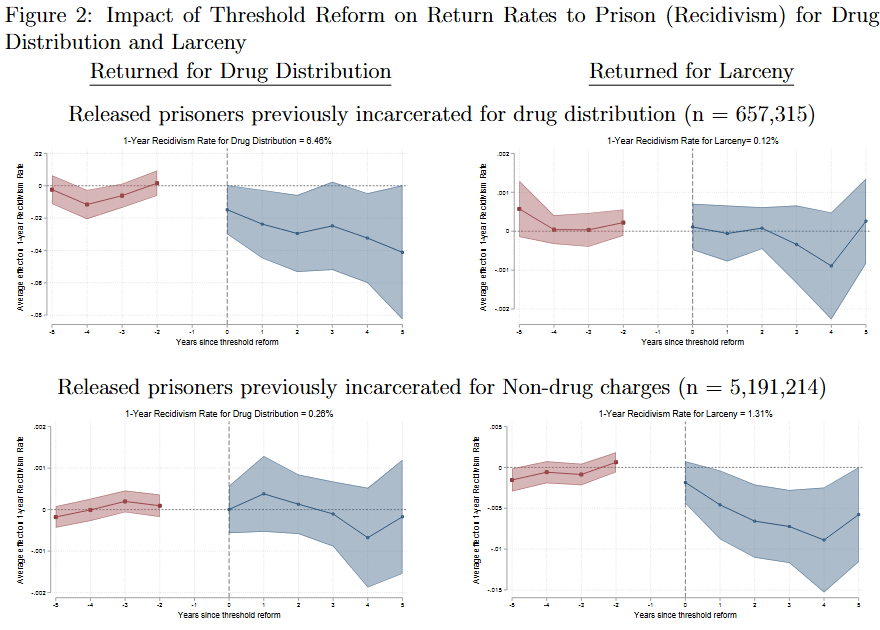
For indidividuals previously incarcerated for drug distribution (top left), their rate of return for future drug convictions is immediately lower with a reduction in the felony threshold. For those who were never in the drug trade, there is no effect (bottom left). Reducing the expected punishment for theft is pulling individuals out of the drug business.
Now let’s look at the return rate for felony larceny. For most prisoners (bottom right), there is a massive reduction in the rate of return for larceny. This makes complete sense – if more theft is classified as a misdemeanor, you are much less likely to be re-incarcerated with a new sentence for it. When we look at prisoners previously incarcerated for drug distribution, however, there is no observed effect (apologies for the changing y axis scales, there’s no good way to keep them constant). What does this mean? We interpret this as evidence that the reduction in punishment for theft is canceled out by the shift into theft as a preferred way of earning income. The labor substitution effect cancels out the effect of reduced punishment.
There’s obviously a lot more in the paper. No, there is not an effect on violent crime (Table 2). No, there is not an observed effect on officer enforcement intensity (Appendix Table A3). No, we can’t do a regression discontinuity at the threshold values (too much bunching, see Appendix Figure A7). The conclusions are both obvious and subtle, but the most important may simply be the reminder that all policies have tradeoffs and spillovers, no matter how narrow they might seem.
TLDR; When states increase the property value threshold delineating misdemeanor from felony theft, prospective criminals respond by a) committing more theft and b) substituting out of drug distribution and into theft. This pattern of substitution in the criminal labor market is more evidence that criminals are not only rational and respond to deterrence incentives, but are also selecting across criminal options, which means we should expect spillovers across crimes when policies create differential changes in expected punishments, enforcement, and returns.
CNN NewsNight with Abby Phillip Aired April 17, 2025 – 22:00 ET
ABBY PHILLIP, CNN ANCHOR
BATYA UNGAR-SARGON, AUTHOR, HOW THE ELITES BETRAYED AMERICA’S WORKING MEN AND WOMEN
CHARLOTTE HOWARD, EXECUTIVE EDITOR, THE ECONOMIST
PHILLIP: Jerome Powell is the head of the Fed and has a mandate to keep inflation low and employment high. So if there are, you know, macroeconomic things that are happening in the economy that make it very difficult for him to do that, you don’t think he’s going to comment?
UNGAR-SARGON: Do you know what would have really helped? What would be a really good idea right now to help bring down inflation and make sure that things keep running smoothly? It’s dropping interest rates. Why doesn’t he do that?
PHILLIP: Why doesn’t he do that?
HOWARD: So interest rates, if you were to drop interest rates, you would stoke inflation.
GPT expands on Howard’s point: “Dropping interest rates would not lower inflation—in fact, it typically makes inflation worse.
Interest rates are a key tool the Federal Reserve uses to manage inflation. When rates are lowered, it becomes cheaper to borrow money. This encourages people and businesses to take out loans, spend more, and invest more, which increases demand for goods and services.
But when demand rises faster than supply can keep up, prices go up—that’s inflation.
So, in a time of high inflation, cutting interest rates would likely make the problem worse, not better. The Fed raises interest rates to make borrowing more expensive, which slows down spending and cools demand, helping to bring inflation under control.”
Recall that the United States achieved disinflation starting in 2022, largely due to the Federal Reserve’s aggressive interest rate hikes. Tyler calls the disinflation America’s triumph.
As for the commentariat, a diverse array of economists ranging from the Keynesian Paul Krugman to many conservative economists recognized that rate increases and disinflation were necessary and had to be done with promptness and fortitude. And so credibility reigned.
Recently, I learned what humidity is. That might sound stupid, so let me clarify. I knew that humidity is the water content of the air. I also knew that the higher the number, the more humid. Finally, I also knew that the dew point is the temperature at which the water falls out of the air. But, now I understand all of this in a way that I hadn’t previously.
First, what does it mean for there to be 70% humidity? As it turns out, it’s a moving target. There are two types of humidity: specific and relative. Specific humidity is the mass of water in, say, a kilogram of air. So, more humidity means more water. This is obvious. There’s a related concept called absolute humidity, which is more like mass of water per volume of air (sometimes used in place of specific humidity). Again, more humidity means more water. Neither of these is the way that humidity is reported on the weather channel.
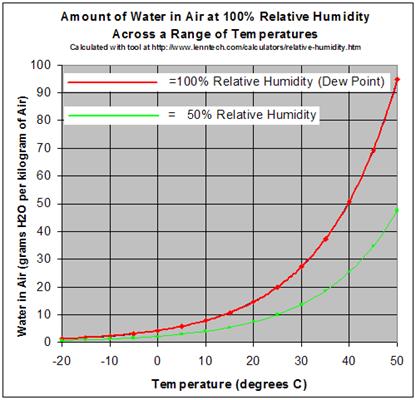
Relative humidity is the number that you see in your weather app. What’s that? Relative to what? First, we need to know that warm air can hold more water than cool air. Pressure also matters, but atmospheric pressure doesn’t change enough to make its effect on humidity significant on relevant margins. So, all of this discussion, and the number in your phone, is at atmospheric pressure. Below is a graph that illustrates the maximum amount of water that can be in the air at different temperatures (red line). So, at 30 degrees Celsius (86 degrees Fahrenheit), there can be as much as 27 grams (0.95 oz or ~2 tablespoons) of water in the air.
The tariffs still have me thinking about buying VIX calls and stock puts (especially when policy changes loom on certain dates like July 8th), and on the bigger question of finding the sort of investments that did well in the 1970’s, another decade of stagflation that was kicked off by a President who broke America’s commitment to an international monetary system that he thought no longer served us.
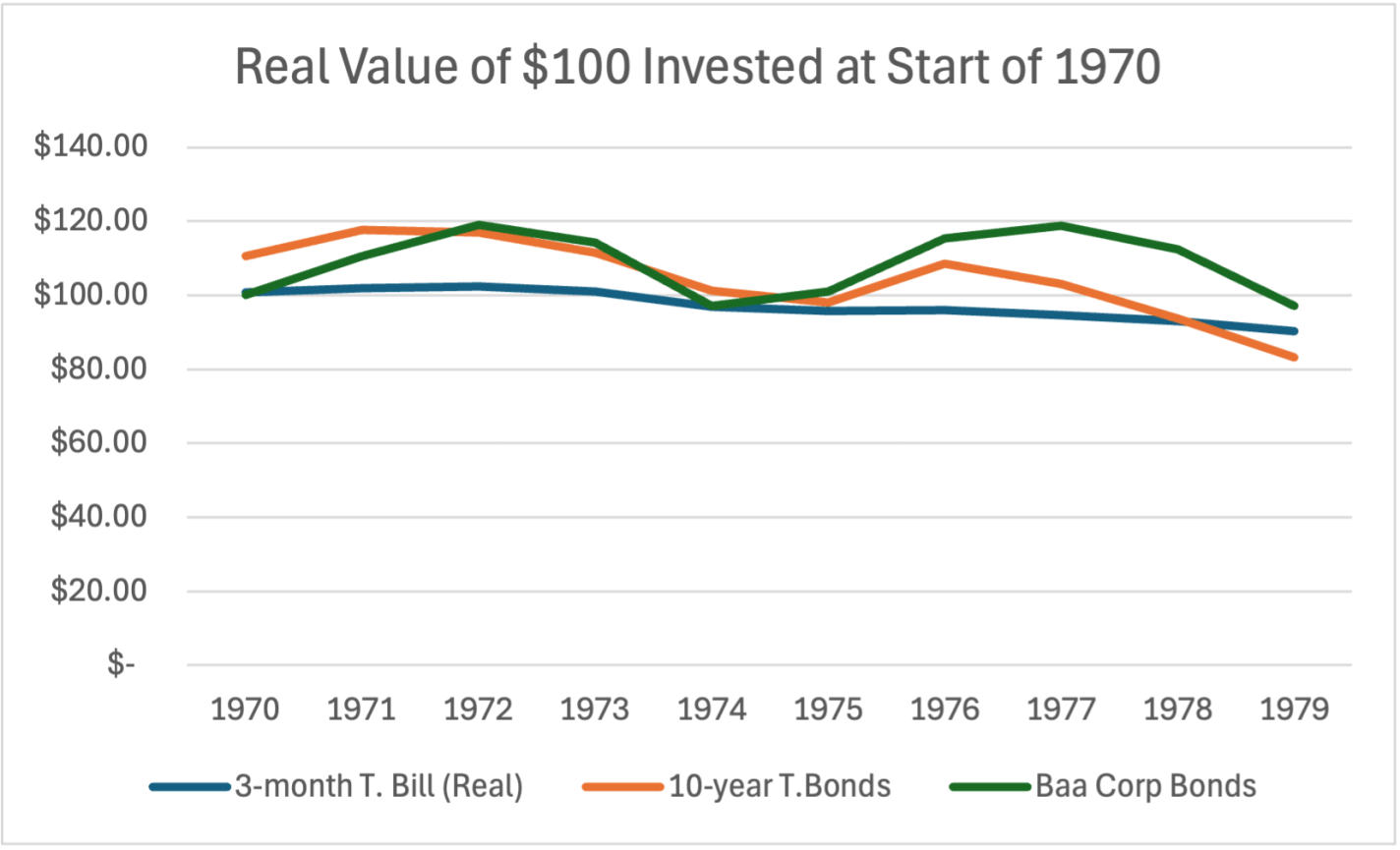
That’s how I concluded last week. So this week I’ll answer the question- what were the best investments of the 1970’s? When the dollar is losing value both at home and abroad, holding dollars or bonds that pay off in dollars does poorly:
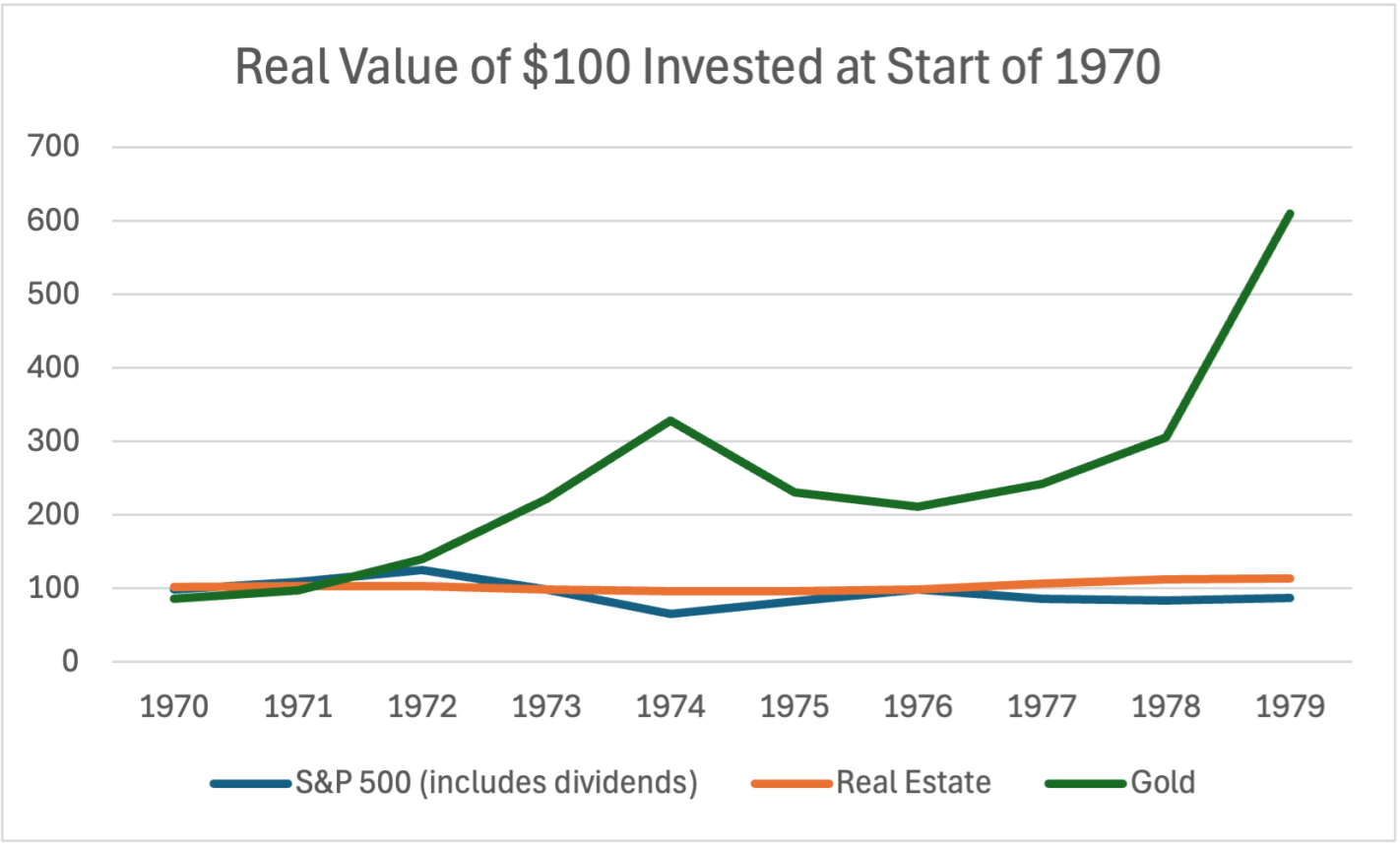
Stocks can do alright with moderate inflation, but US stocks lost value in the stagflation of the 1970’s. Foreign stocks and commodities generally performed better. Real estate held its value but didn’t produce significant returns; gold shone as the star of the decade:
Gold is easy to invest in now compared to the 1970s; you don’t have to mess with futures or physical bullion, there are low-fee ETFs like IAUM available at standard brokerages.
Of course, while history rhymes, it doesn’t repeat exactly; this time can and will be different. I doubt oil will spike the same way, since we have more alternatives now, and if it did spike it wouldn’t hurt the US in the same way now that we are net exporters. Inflation won’t be so bad if we keep an independent Federal Reserve, though that is now in doubt. At any time the President or Congress could reverse course and drop tariffs, sending markets soaring, especially if they pivot to tax cuts and deregulation in place of tariffs ahead of the midterms.
Things could always get dramatically better (AI-driven productivity boom) or worse (world war). But for now, “1970s lite” is my base case for the next few years.
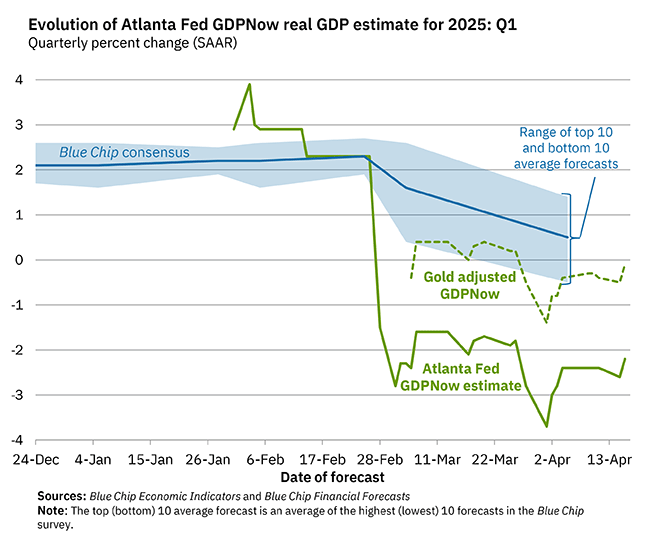
Last month I wrote about the projected decline in GDP from the Atlanta Fed’s GDPNow model. Since then, they have released an alternative version of the model, which includes a “gold adjustment” to account for non-monetary gold inflows, which may be impacting the model to overstate the negative impact of imports (and it looks like this may be a permanent change to the model).
With those changes, and some more recent data, the GDPNow model is still pointing to a negative reading for Q1 of 2025, though only very slightly now: -0.1%.
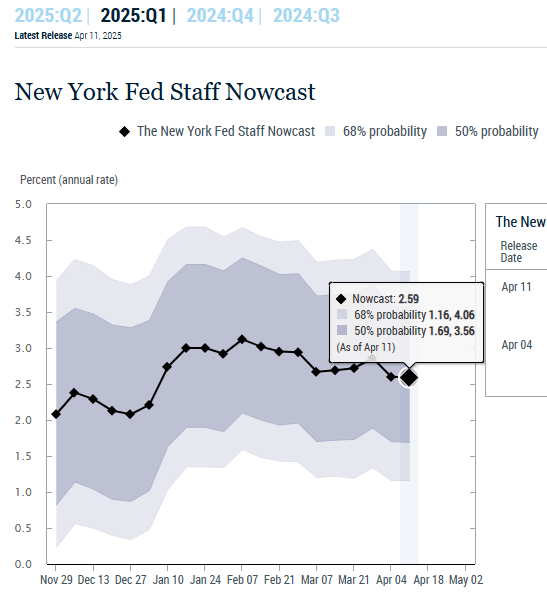
It’s also worth noting that the New York Fed has a similar model, but one with very different estimates right now: about 2.6% for Q1.
We’ll still have to wait until April 30th to get the preliminary estimates from BEA.
Here we discuss some stock funds that go down less than stocks in general; the flip-side is that they go up less than plain stocks, as well. Some investors may appreciate the reduction in gyrations, especially after a week like the previous one.
Long-short funds come in two main flavors. When you buy a stock, that is considered being “long”. If you short-sell a stock (borrow shares from some broker, that you plan to pay market price for later, such that you make roughly one dollar for every dollar the stock goes down), that is being short.
“Equity-neutral” funds are short as much value of stocks as they are long. So, they are net 0% long. Obviously, you would expect the value of such a fund to not decline much in a market crash. But conversely, it would not go up much in a bull market, either. So how is this better than just holding cash in your account? The magic is if the active fund managers can manage to be long a set of stocks which go up more than the stocks that they short. They often try to pair longs and shorts in the same sector. For instance, in 2024 if a fund was long Nvidia and short Intel (another stock in the semiconductor sector), that would have been a big net win. Sometimes this works, and sometimes it doesn’t.
The actual performance of such a fund is very dependent on the active managers’ skill and luck. For instance, here is a ten-year total return plot of two market-neutral funds, one from AQR and the other from Vanguard. The Vanguard fund (VMNIX) muddled along pretty flat from 2015 through 2021, then had a slow rise 2021-2023, then went flat again. The performance of the AQR fund (QMNNX) has been more erratic. It went up 2015-2017, then down a lot (this would have been hard to bear at the time, when the S&P was roaring upward) for 2018-2020. It then roughly matched the Vanguard fund for a couple of years, then pulled way ahead 2023-2025, as it made some great long/short choices:
However, the ten-year performance of these funds fell far short of a simple S&P500 holding (blue line above). Since stocks go up the vast majority of the time, a long-short fund which is net long seems to make more sense.
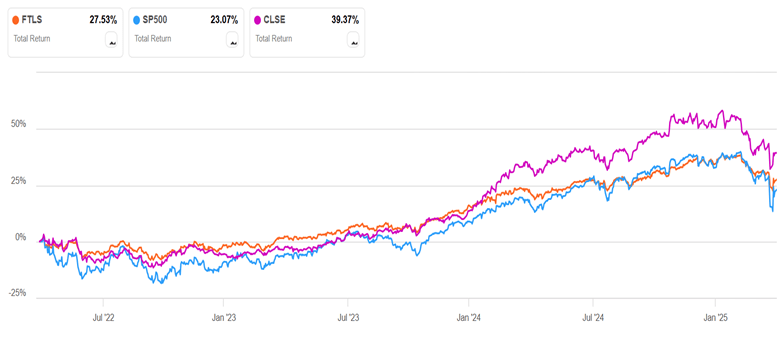
A plain vanilla net-long long-short fund is FTLS. It seems to be among the best of the long-short ETFs. It is usually about 60% net long. I modeled its performance against a portfolio of 60% S&P 500 stocks and 40% cash (rebalanced periodically), and it performed about the same. That is, FTLS went up and down with moves about 60% of what the S&P did. That is OK, but one might wonder why one would hold such a fund instead of just holding a 60/40 stocks/cash allocation for the same amount of investment. If we look at time periods with appreciable down periods, such as the past three years (see chart below), FTLS does look comforting; its muted dips in 2022 and 2025 compensate for its slower rise in 2023-2024, so it presents as a slow, fairly steady rise with a 3-year total return slightly higher than S&P. It is certainly easier psychologically to hold such a fund, and it might help small investors avoid the deadly mistake of panic-selling during a market downturn.
CLSE is a long-short fund that is often about 70% long. Management there takes a more swashbuckling, risk-taking approach. It went down less than S&P in the bear market of 2022 (as expected), and then it soared high above S&P in the first half of 2024, as it made skillful/lucky picks to go very long tech growth stocks like NVDA. That tech-heavy approach has backfired so far in 2025, since CLSE has fallen as much as S&P in the past several months (NOT what one hopes for a long-short fund). Despite that glitch, however, CLSE still weighs in with a 3-year return far ahead of the broader S&P (39% vs. 23%):
Another strategy to mitigate market ups and downs is for a stock fund to buy and sell put and call options, to create a “collar” effect. Buying puts limits the downward movements; the puts are financed by selling calls, which limits the upward swings. The fund ACIO, for instance, seeks to capture 65% of the S&P’s upside, while limiting loss to 50% of the downside. In my stock charting, I found it ended up performing about like FTLS. As of a week ago (Tue, Apr 8), the S&P was down 15% year to date (i.e., since Jan 1), while FTLS and ACIO were only down 8.3 % and 9.6%, respectively.
Standard Disclaimer: This is for information only. Nothing here is advice to buy or sell any security.