Fuel Costs Are Way Up, But It’s Still Pretty Affordable to Fill Up Your Tank (relative to wages)

Two months ago I wrote about gasoline prices and tried to give the current prices some historical context. Gas prices have, of course, only continued to increase since then. Here’s a chart I created to give a bit more context, using an idea from Ryan Radia: how much does it cost to drive a car 250 miles? Since fuel efficiency has increased over time, we might be understating how much it costs to drive today relative to the past. And of course, to give the “cost” proper context I have stated in terms of hours worked at the average wage (note: the final data point is from April 2026, as we don’t have wage data for May yet):
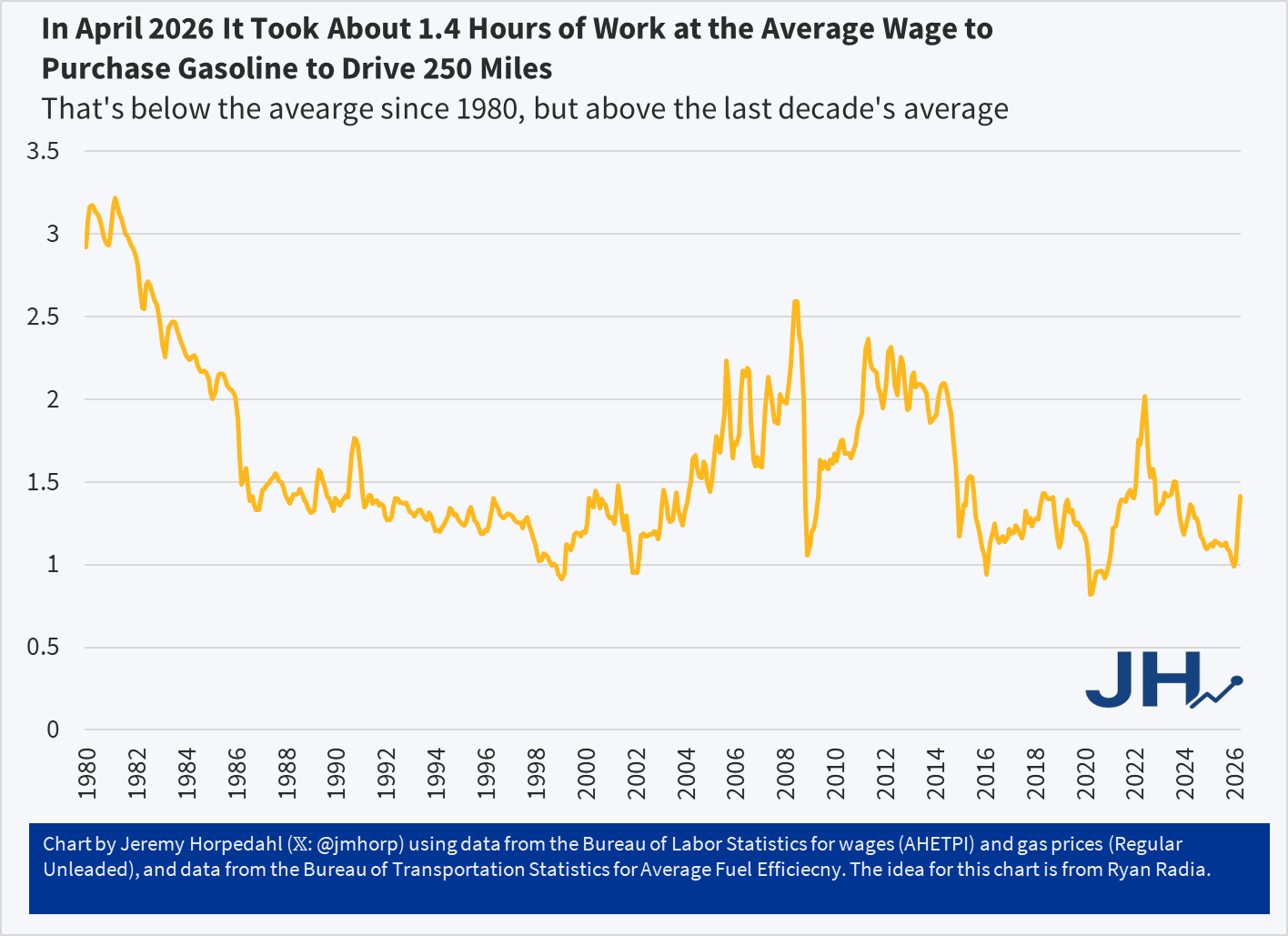
In April 2026 it took about 1.4 hours of work at the average wage ($32.23) to purchase enough gasoline to drive 250 miles (10.7 gallons) at the average fuel efficiency (23.4 miles per gallon). That average fuel efficiency figure is from 2024, the latest available, so it could be a bit higher today. Maybe it’s a little easier than 1.4 hours of work to buy it, but even if fuel efficiency had crept up to 25 mpg (that would be a big increase in 2 years, historically speaking), it would still be 1.3 hours of work.

1.4 hours of work is certainly a big jump from earlier in 2026, but you’ll notice it is still on the low end in this chart, and well below the peak we saw in June 2022 of just over 2 hours of work to buy 250 miles worth of gasoline.

But 23.4 miles per gallon is pretty low, as this is includes lots of trucks and SUVs with pretty bad fuel efficiency. What if we looked at some more fuel efficient vehicles?

Here’s a few I checked on (all for 2026 models, with gas and electricity at current national averages):

  • Toyota Camry: 0.71 hours of work
  • Chrysler Pacifica Hybrid: 0.61 hours on electric, 1.18 hours on gasoline
  • Tesla Model Y: 0.37 hours of work

It will probably not surprise you that the all-electric Tesla Model Y is cheaper than the average car to operate at current prices, but you may not have realized that it is almost four times cheaper. But the Toyota Camry, with all models operating as hybrids now, also comes in pretty good at about half the cost of the average vehicle to operate (and the Camry is a very affordable car to purchase). The Chrysler Pacifica hybrid minivan does pretty well too, though even operating only on electricity (30 miles at a time), it’s only slightly more fuel efficient than the Camry.

Gas Prices are High — But Don’t Adjust Them for Inflation!

Gasoline prices are high and rising. Anecdotally, they seem to be increasing at the pump by the hour. And indeed, in nominal terms they are now the highest they have ever been in the US (this is true with both the AAA daily price level and the EIA weekly price level). At over $4.10 per gallon, the price now exceeds the peaks briefly hit in 2008, 2011, and 2012. And it’s looking like this peak might not be so brief.

But we all know you can’t compare nominal dollars over long periods of time. We need some context for this price! Plenty of news stories provide what they think is the right context: adjust it for inflation! For example, USA Today reports that today’s price “would come to around $5.25 today when adjusted for inflation.”

$5.25: that’s a pretty concrete number. But it’s not really useful. OK, so clearly that’s higher than the current price, about 20% higher in fact. Still, it doesn’t really give us the right context.

As I argued in a previous post on housing costs, inflation adjustments aren’t always the best way to contextualize a historical number. Yes, when you want to compare income or wages over time, it’s good to adjust for inflation. It’s necessary, in fact. And a good economist will always do that.

However, when comparing particular prices over time, it doesn’t really make sense to adjust for other prices. All you are really saying is “if the price of gasoline increased at the same rate as the average price level, here’s what it would be.” Perhaps slightly useful, but it doesn’t really get at the thing we’re really try to address: is gasoline more or less affordable than in the past?

The best approach is to adjust the prices for changes in wages or income. Which measure of wages or income you choose is important, but it’s the best adjustment to make. No need to make any inflation adjustments, are worrying about whether the index you choose is properly accounting for quality changes, substitution effects, etc. If you want to know how affordable something is, compare it to income.

Here’s what I think is the best simple comparison for gasoline, which I’ll explain it below. In short, it tells us how many minutes the average worker would need to work to purchase one gallon of gasoline.

Since the price of gasoline is rising sharply every day lately, my chart will surely be out of date very soon. But right now, it’s the most current data I could provide with a comparable historical series: EIA weekly data current through March 7th, 2022 (Monday). We can see that at current prices, it takes about 9 minutes of work at the average wage to purchase a gallon of gasoline. At the peak in 2008, it took over 13 minutes of work to purchase a gallon, and it fluctuated between 10 and 12 minutes of work for much of 2011-2014.

Continue reading