Why do Costa Ricans outlive Americans?

Which country in the Western Hemisphere has the longest life expectancy?

Unsurprisingly its Canada, at 82.2 years (pre-Covid).

But which country in the Americas comes in second?

Surprisingly, its Costa Rica at 80.8 years.

Source

The United States, by far the richest country in the Americas, had a life expectancy of 78.4 years that was falling even before Covid.

How is it that Costa Rica outperforms not only the much richer United States, but also other somewhat richer countries like Panama, Mexico, Argentina, and the Dominican Republic?

Clearly they don’t do it by outspending us- Costa Rica spends the equivalent of $1600 dollars per person per year on health care, compared to nearly $12000 in the US (7.3% of their GDP goes to health care vs 16.8% for the US).

Source

So what exactly is Costa Rica doing right? Atul Gawande tackles this question in his latest article for the New Yorker.

He argues that the key has been Costa Rica’s investment in primary care and public health. The US might may have many more of the world’s best (and most expensive) hospitals, but the easiest and cheapest health benefits come from keeping people out of hospitals in the first place.

the country has made public health—measures to improve the health of the population as a whole—central to the delivery of medical care. Even in countries with robust universal health care, public health is usually an add-on; the vast majority of spending goes to treat the ailments of individuals. In Costa Rica, though, public health has been a priority for decades.

In the nineteen-seventies, Costa Rica identified maternal and child mortality as its biggest source of lost years of life. The public-health units directed pregnant women to prenatal care and delivery in hospitals, where officials made sure that personnel were prepared to prevent and manage the most frequent dangers, such as maternal hemorrhage, newborn respiratory failure, and sepsis. Nutrition programs helped reduce food shortages and underweight births; sanitation and vaccination campaigns reduced infectious diseases, from cholera to diphtheria; and a network of primary-care clinics delivered better treatment for children who did fall sick. Clinics also provided better access to contraception; by 1990, the average family size had dropped to just over three children.

The strategy demonstrated rapid and dramatic results. In 1970, seven per cent of children died before their first birthday. By 1980, only two per cent did. In the course of the decade, maternal deaths fell by eighty per cent. The nation’s over-all life expectancy became the longest in Latin America, and kept growing. By 1985, Costa Rica’s life expectancy matched that of the United States.

Gawande goes on to describe how every Costa Rican gets a home visit from a health care worker at least once per year. This is quite the contrast to the US, where even getting primary care doctors to let you see them in their office can be a fight. I moved to Rhode Island last year and this week finally tried getting a primary care doctor here. I looked through the list of doctors covered by my insurance that my insurer said were accepting new patients and started making calls (by the way, why calls? do any doctors book appointments online?). 2 said that they actually weren’t taking new patients. 9 never answered the phone. The 12th doctor I tried, one farther away and lower-rated than I’d like, finally agreed to see me- in 3 months.

For anyone with less free time, determination, or insurance coverage, it would be natural to just give up after the 5th or the 10th “no”. Clearly many Americans do, leading manageable conditions like diabetes or high blood pressure to turn into acute health crises and expensive hospital visits.

I do think individual doctors could do better here by thinking through their appointment process from the patient’s perspective. But at its core this is simply a numbers issue- we don’t have enough primary care doctors to go around. We actually have fewer doctors per capita than Costa Rica, and relatively high share of specialists means that we have even fewer primary care doctors to go around. More medical school spots, more primary care residency spots, and fewer restrictions on immigrant doctors could go a long way way toward helping to US catch up to…. Costa Rica.

That, or their secret is just the volcanoes. This is surprisingly plausible- the US state with the longest life expectancy is also the one best known for volcanoes, Hawaii.

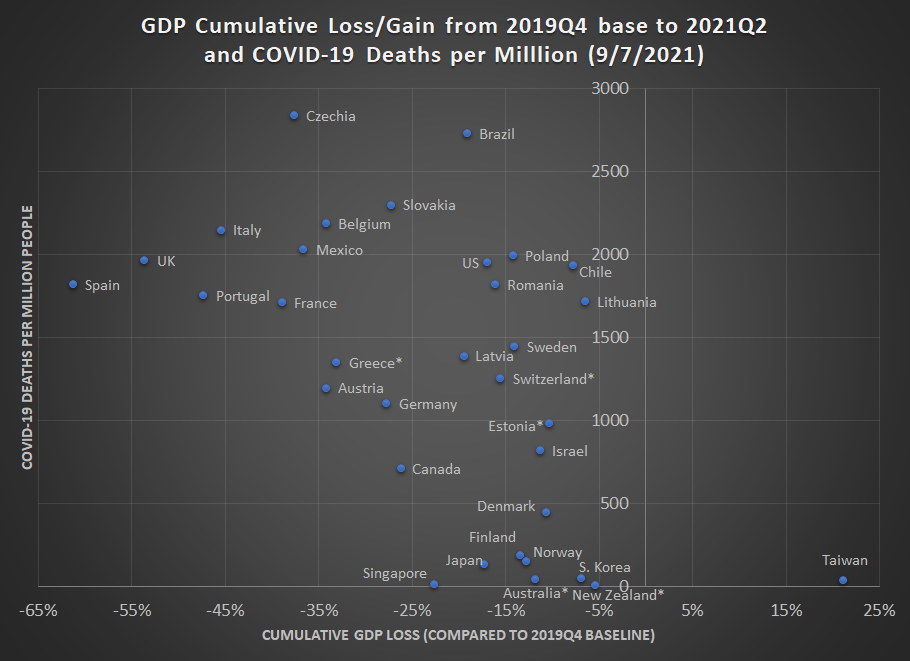
GDP Losses and COVID Deaths (6 month update)

Back in March of this year, I wrote blog posts providing data on GDP losses and COVID-19 deaths for 2020, both for selected countries and US states. Since we’ve now had another 6 months of GDP data and the pandemic continues to take lives, I thought it would be useful to update that data.

I will update the data for US states in a future post, but here is the most recent data for about 3 dozen countries (mostly European and North American countries, since they have the most believe COVID data).

*indicates that the GDP data is only through the first quarter of 2021
Continue reading

On Manufacturing Collectability

Topps lost the the licensing rights to Major League Baseball which, prior to it actually happening, is a thing that your typical baseball fan would not have previously acknowledged as even possible. Topps makes baseball cards. Not the only baseball cards, but for most of the history of baseball cards, Topps were the baseball cards. How can baseball cards exist without Topps?

Major League Baseball (MLB), of course, simply sold the licensing rights to someone else: Fanatics. Now, to be perfectly clear, I don’t care abou, any of the corporate entities involved here, imaging rights, or even baseball cards. What I am interested in is the concept of a purposely designed collectible–not something that becomes collectible, an item designed solely to exist as a collectible.

The markets for baseball cards rise and fall, and there was one definitive bubble in the early 90s. Like any commodity, prices are an emergent outcome of supply and demand, and while in the short run price movements are associated with fad and event driven demand, in the long run a collectible item’s price ascent begins and ends with supply. For an item to exist as a collectible with investment-grade price growth potential, it’s supply must be short-term limited and long-term fixed.

Fanatics just paid a lot of money for the MLB imaging rights, more than Topps was willing to bring to the table as a 70-year producer and stake holder. Part of Fanatics reasoning in committing so many resources to the rights is their ambition to produce non-fungible tokens (NFTS), which they will no doubt restrict the supply of to a profit maximizing level. NFTs, I suspect, offer Fanatics the opportunity to pursue a parallel product distribution that will allow them a new channel for price discrimination. Specifically, I expect the physical cards to be relatively inexpensive, sold at a price comparable to recent historical prices in an effort to serve price sensitive kids and hobbyists. The NFTs, on the other hand, I expect to be greatly limited in supply, a promise to hardcore collectors that the assets in question will offer the investment-grade inelasticity of supply that collectors covet in their aspiration to hold collectible items that hold value as art-adjacent consumption value while also being long term lottery tickets.

Fanatics believe the key to unlocking this is the image rights to Major League Baseball. Their cards and NFTs are the real ones, the official ones.

But that begs the question: why does the market care that they are officially sanctioned? The value of the image rights was to be able to use the names and logos of Major League Baseball without getting sued. The only way to profit off baseball cards previously was to produce at scale – you couldn’t capture the future collectible value nearly as well as the present consumption value. And there was no way to produce at scale without the imaging rights – there’s no good way to secretly print and sell a million baseball cards with images you lack the rights for. A person or company can’t sell a million black market bootleg cards without getting caught.

But someone could sell three.

A person can sell three cards without getting caught. A person could sell an unlicensed NFT without getting caught. And so can it’s next owner, and the one after that, ad infinitum. In the crypto world of NFTs these transactions, especially in the long term, are feasibly untraceable. If anyone can sell three baseball cards and associated NFTs, then anyone can make them as well.

Remember zines? Actually, maybe you don’t. In the before-times, aficionados of musical, artistic, or even just aesthetic subcultures would print their own magazines at home, pay for a 100 copies at Kinko’s, and then distribute them independently on their own through the mail or at small local bookstores. Not dissimilarly, many artists have for years produced “Art Cards, Editions and Originals” (ACEOs). Essentially baseball cards, but with small collectible works of art instead.

An independent artist that tried to produce baseball ACEOs and sell them on eBay would probably fly below the radar. But in the unlikely event that their card did become the card that the market chose as the most sought after, then yes, MLB and Fanatics would likely pursue legal action. The thing about pursuing a copyright so vigorously is, like many consumer goods for which distribution is illegal, restricted supply only increases their value. And an NFT transaction is considerably harder to trace than a physical or even traditional software good. It’s called “crypto” for a reason.

Sure, Fanatics will be the only company that can sell the “official” baseball card, the “real” one. But who’s to say that they’ll be selling the best one? In a world without enforceable image rights, the market is likely to care a lot less about the what’s official, and a lot more what’s the, always ephemeral and hard to anticipate, best. When you’re talking about a commodity where limiting supply is the key to unlocking value, NFTs and crypto technologies change the entire landscape, because copyright and image rights are only only enforceable to limit production at scale, which means any effort to do so just creates great incentive for small scale independent production.

This isn’t just relevant to baseball cards, either. This is relevant to anyone designing a product with the intention of it becoming collectible, where some portion of its value today is it’s predictable scarcity tomorrow. Twenty years ago downloadable music changed the entire market for music. Musicians at the highest levels of popularity found themselves returned to a world where the bulk of their income came from live performance, which had of course been the norm for musicians for most of human history prior to the vinyl record. It would be interesting if baseball cards, and other portable pieces of functional art (such as Magic or Pokémon cards) found themselves on a similar path, where large scale production of collectibles becomes outflanked by anonymous independent artists.

You’ll probably never own a $5.2 million Mickey Mantle 1952 rookie card. But you maybe you’ll paint Shohei Ohtani as a half-man, half-Gundam neo-noir warrior prince pitching a no-hitter the same night he hit three grand-slams. And maybe the market will say that the official photo cards of Ohtani are nice, but your image, and your NFT, are the one true image that captured the moment he became the greatest baseball player ever. Maybe the market will select your card.

(What I’m saying is…maybe the market will say your card is….topps. Yeah, sorry, I’ll see myself out).

Government Elimination of Perceived Vices

My post yesterday was about video games, prompted by the CCP legal restriction on video games for children. To enforce this rule, the government is making a list. Any adult playing these online video games will have to register with their real name. Is this a regulation of an addictive substance for minors, like we have for cigarettes, or is it progress toward managing the leisure time of males?

Before the Communists came to power (and before video games existed), previous Chinese government administrations had tried to ban another addictive form of recreation: smoking opium. The British famously did not help with this endeavor, but the British imports of opium ended years before the CCP crackdown. Where others had failed, the CCP practically eliminated opium from China in about 3 years. For my information, I’m drawing partly from a honors thesis on this topic.

The CCP started the relentless march toward eliminating opium in a clever way. They gathered information before announcing how ambitious the program would be. It started with making a list.

There had been previous attempts to send soldiers to destroy poppy fields (hello, 21st century?) but never in a coordinated enough way to stamp out supply. Police had raided opium dens in the cities, but nothing ever worked. Addicts were going to buy the stuff as long as it was being produced, and producers were going to grow the stuff as long as it was profitable. The CCP pulled off a coordinated attack on both producers and consumers in the entire country at the same time.

After a period of record-keeping, the CCP started forcefully addressing opium both in the rural areas where it was both produced and in the cities. There were different strategies for all the unique regions of China.

Those who did not cooperate knew that prison or immediate execution could result. The CCP, along with civilian volunteers, provided rehabilitation for some addicts who were willing to register themselves as offenders. It was acknowledged that kicking an opium addiction is hard. When possible, the government manipulated taxes and subsidies in such as way that farmers would choose to switch away from cultivating opium. The use of force was a reason for the success of the campaign, but people who were willing to cooperate often could find a way to transition away from their old habits.

The Communists did not just write laws and send soldiers. They held rallies that sound to me a lot like religious revival meetings. They galvanized millions of people to not just distain addictive drugs but to become volunteers for the cause. I would assume that many Chinese parents didn’t like opium in 1949 but were not yet so fervent as to become police informants. That changed in 1950. Everyone wants to have a moral cause. For some people today, it’s global warming. For millions in 1950’s China, it was eliminating opium distribution and addiction.

In one of my posts on Afghanistan I speculated that it is self-defeating for Americans to purchase illicit opium as consumers and also task our military with stamping out its production by force. This week when I read about the opium campaign, I found that a related message was used in 1950. The CCP presented opium abstinence as a way to defeat America in the Korean War.

I will be curious to watch developments concerning screen time and China. There is much to be determined. As Vice reported this week, ‘It’s unclear how the government will define “sissy pants”…’

Video Games: Emily Oster, Are the kids alright?

On Monday, China announced that kids under 18 will be limited to only 3 hours per week of online gaming. Those hours are scheduled for the evenings of Fri-Sun with a 9pm cut off. Go to bed, young man!

Last month I reviewed Emily Oster’s new book The Family Firm. In light of China’s ruling over how kids spend their free time, I’ll explain her view of video games.

Interestingly, she does not have a chapter called ‘Video Games: Do we need the CCP to intervene?’ She has one chapter near the end called Entertainment that includes video games and screen time. She writes at the beginning of the chapter that, “Screen time strikes fear in the heart of many a parent.” Most parents, at least among her audience, have their own smart phone and at least one TV in the house. It is such a relief, honestly, to get the kids to sit down and stop making trouble in the 3-D world. In What Women Want I wrote about a wealthy celebrity mom who has a nanny and a cook. She spends quality time with her kids, when she wants to. Most of us can’t afford a weekend nanny, but we might leave our kids with technology when we need a break. (I believe, with no data to back this up, that childhood mortality is down partly due to screens keeping kids off of cliff ledges and out of abandoned mines.)  Then, at the end of the day, we worry that they have spent too much time on screens.

Oster writes, “Screens change your brain, say the headlines. (Spoiler alert: Everything changes your brain.)” Parents like me have come to love Emily Oster’s ability to cut through the noise. Everything changes your brain. Video games are not a completely separate new form of human experience.

Helping a child’s brain develop is a big responsibility. We know that you can mess this up, most obviously in the cases of serious abuse. So, can you put on Sesame Street while you make dinner? Should you allow your son to play video games?  I’ll put the rest under Read More.

Continue reading

Streaming Content: Scattering Vs Dumping

Like a good millennial, I don’t have cable. Instead I have Netflix, Amazon, Hulu, Disney+, YouTube, and a free trial of Apple TV. And before you say that I’m spending just as much as I would have spent on cable, just – no. First, I am not. Second, I have way more capability and discretion than I ever had with cable. Each of these streaming services now has their own studio(s) and competition is causing them to produce some content of exceptional quality. And, they differ in their decisions to scatter vs dump. Amazon and Apple TV scatter their new episodes on a weekly schedule. You can still watch the episodes whenever your heart desires once they’re released. But if you are up-to-date, then you must wait 7 days until new episodes are available. Netflix, on the other hand, dumps out a new series all at once. You can spend the afternoon (or morning, or night) watching an entire season of the newest content from a high-end studio.

If we take a look through the way-way-back machine, then we can observe must-see-TV on NBC in the 1990s. Networks followed the scattering model. Most people didn’t own a DVR and on demand wasn’t really a thing except for pay-per-view. VCR (video cassette recorders) were ubiquitous, but people enjoyed watching their shows as they were released rather than later watching a recording. The 90s and early 00s were a special time for NBC in particular: Friends, Seinfeld, Frasier, 3rd Rock from the Sun, and ER were all a part of the weekly line-up – with Will & Grace and Scrubs soon following the finale of Seinfeld.

New weekly episodes that were released during a literal ‘season’ of the year had been the model for as long as television signals had been broadcasted. Several of today’s streaming services still adhere to the 80-year-old practice.

Why?

I’ve got 3 reasons for why streaming services still scatter new releases. The first is the one I that have the least to say about: Buzz. It’s good marketing for a show to be released over a longer period of time. In a world of social media, the longer the time that a show is salient in your life, the greater the opportunity for you to share the show with your friends or for critics to acclaim (or pan, as the case may be). It’s a marketing tactic. If all of the episodes in a season were released all at once, then a show would be in-and-out of your life like a stray ice cube that goes rogue from the refrigerator ice-dispenser. You care for a bit. But soon, it’ll evaporate and never be a concern again. I’m not an expert in marketing. So I’ll just leave it at that.

The second reason is due to the time value of money. The sooner that we can enjoy revenues and the later that we can push costs, the better. It’s true for multiple reasons. Financially, every day sooner that you receive a dollar is an additional day during which you can earn a return by investing it elsewhere. For ease, let’s hold the schedule of costs constant and just worry about the revenues. If a streaming service releases episodes weekly, then episodes can start dropping before the season finale is even completed. There’s nothing that says that the whole season has to be ready by the time the first episode is released.  And, when episodes are released earlier, would-be viewers are sooner willing to sign-up and become paying customers. Releasing episodes weekly allows a studio to increase revenues before the whole product has finished production.

The 3rd and final reason for streaming services to release on a weekly schedule is due to the subscription structure of marginal revenue. Streaming services earn *no* additional revenue per episode viewed by customers. The marginal revenue earned from paying customers comes from subscriptions. That is, each month of a subscription is revenue for the streaming service provider – no matter how many episodes a subscriber watches. Therefore, if a season is released piecemeal, then it increases the number of weeks during which the streaming service receives revenues from the customer. Of course, people could just wait until all of the episodes are released and then subscribe for a single weekend of lethargic binging. But that can only happen when a viewer is comfortable with forsaking the frontier of new video content. That would mean that a viewer is out of fashion and out of the conversation that their friends and co-workers are having. And if this sounds like small potatoes, then keep in mind that such conversations are often about signaling belonging, comradery, and cultural sophistication. Many people are inclined to stay up-to-date on TV, the news, and sports and therefore have a greater willingness to pay.

There you have it. The 3 reasons for streaming by scattering over weeks rather than dumping all at once are 1) More persistent saliency among viewers and potential viewers, 2) Sooner rather than delayed revenues, and 3) More periods for which streaming service can charge their customers for new content.

I only have one explanation for why some streaming services do in fact dump an entire season at once. Netflix does it on the regular and Amazon started doing it in the past several years too. I suspect that they do it as a means of attracting a particular market segment: binge-watchers. There being two players who compete on this margin may make either provider appear less attractive for consumers who desire new, binge-worthy content. But, luckily for Netflix, streaming content providers aren’t in a perfectly competitive market. That content is an imperfect substitute means that it’s monopolistically competitive. And, for the moment, that means higher profits. The keen reader will recognize, however, that zero long run economic profits are also implied.

Institutions Getting Smarter on Covid

Two weeks ago I argued for 4 non-coercive anti-Covid policies I thought were under-rated. I haven’t generally been impressed by the institutional response to the pandemic, and so I wasn’t expecting the policies I mentioned to get traction any time soon. But some did!

I argued for:

  1. Full vaccine approval
  2. Emergency vaccine approval for children
  3. Ventilation
  4. Outpatient treatments that work

Since then, the big news is that the FDA fully approved the Pfizer vaccine. This seems to have increased the pace of new vaccinations.

I really wasn’t expecting the FDA to move that fast- they have generally learned to be slow because Congress has been much more likely to complain about them approving a bad drug than about them denying or slow-walking a good drug. But Congress itself seems to be changing in response to Covid, with 108 House members pushing the FDA for a timeline on approving vaccines for 5 to 11 year-olds.

I don’t know of a good way to gauge progress on ventilation overall, but I was pleased to see HEPA filters show up in the classrooms at Providence College:

Likewise, I don’t know if Fluvoxamine prescriptions are up in the weeks since a good sized study showed it reduced Covid hospitalizations 31%, but the popular press articles about it keep coming (don’t be deterred by “Vox”, the linked article is by Kelsey Piper and its excellent).

So some institutions seem to be getting smarter, and perhaps coincidentally, we seem to be at the peak of the Delta wave. According to Covidestim.org, Rt is now below 1 in 31 states, and falling in 45 states, including all of the Southern states hit hardest by Delta. Barring a new twist (another worse variant? Winter Delta wave in the North?), things just get better from here.

Who is the Wealthiest Generation?

Have you seen this chart?

I have seen it many times. It comes from this Washington Post article, but it seems to go viral on Twitter about every 6 months or so.

The implication of the chart seems to confirm what many young people feel in their bones: Boomers had it much easier, and it’s getting harder and harder for later generations to catch up and build wealth. For many the graph… explains a lot, as one recent viral Tweet put it (in the weird world of social media, 5 short words and a recycled chart are all it takes for 20,000 retweets).

But wait. A few questions probably come to mind. For example, when Boomers were young they comprised a much larger share of the population. The original article makes an attempt to adjust for this, by calculating a few ratios towards the end of the article. However, there’s a much more straightforward way to adjust for this, which also nicely fits into a chart: put wealth in per capita terms!

If we do that, here’s the chart we get (also, of course, adjusted for inflation).

Data is for 1989-2021 from the Federal Reserve’s Distributional Financial Accounts, but only the first quarter is available right now for 2021. For 1989, it is the average of the third and fourth quarters. Population data comes from Census single-year of age estimates for various years. 2020 and 2021 population estimated using growth rate from 2010-2019.
Continue reading