Lifespan / CNE Merger Economics

The largest hospital system in Rhode Island, Lifespan, is trying to merge with the second-largest hospital system in Rhode Island, Care New England. Next Wednesday I’ll be on a panel discussing the proposed merger, following a panel with the Presidents of the three institutions involved (Lifespan, CNE, and Brown University). I’ll summarize my thoughts here.

Basic economics tells us that if a company with 50% market share buys a company with 25% market share in the same industry, they have strong market power and are likely to use this monopoly position to raise prices.

The real world is often more complicated, especially when it comes to health care, but in this case I think basic economics holds up well. A wealth of empirical evidence, including studies of previous hospital mergers, suggest that reduced hospital competition leads to higher prices without bringing commensurate benefits in quality or efficiency.

I think the Federal Trade Commission will almost certainly challenge the merger, and that they will likely succeed in doing so. The FTC merger guidelines more or less demand it, and current FTC leadership if anything seems to want to be more aggressive than required on antitrust. To me the biggest question is whether they will try to stop the merger entirely, or whether they would allow it to proceed subject to conditions (e.g. spin off one or two hospitals to remain independent)- I’ll be watching with interest and letting you know how it goes.

Has Economic Growth Really Slowed Since 1970?

In the post-WW2 era, by many different measures the US economy performed better before about 1970 than after. You can apparently see this in many different statistics. For example, the productivity slowdown is a well-known and well-studied phenomenon. And even given the productivity slowdown, median wages don’t seem to have kept pace with productivity growth.

I think there are good reasons to doubt these particular statistics. For example, on wages and productivity see this working paper by Stansbury and Summers.

But even considering all these criticisms of the statistics, we do observe that overall GDP growth has been slower since about 1970. Why might this be?

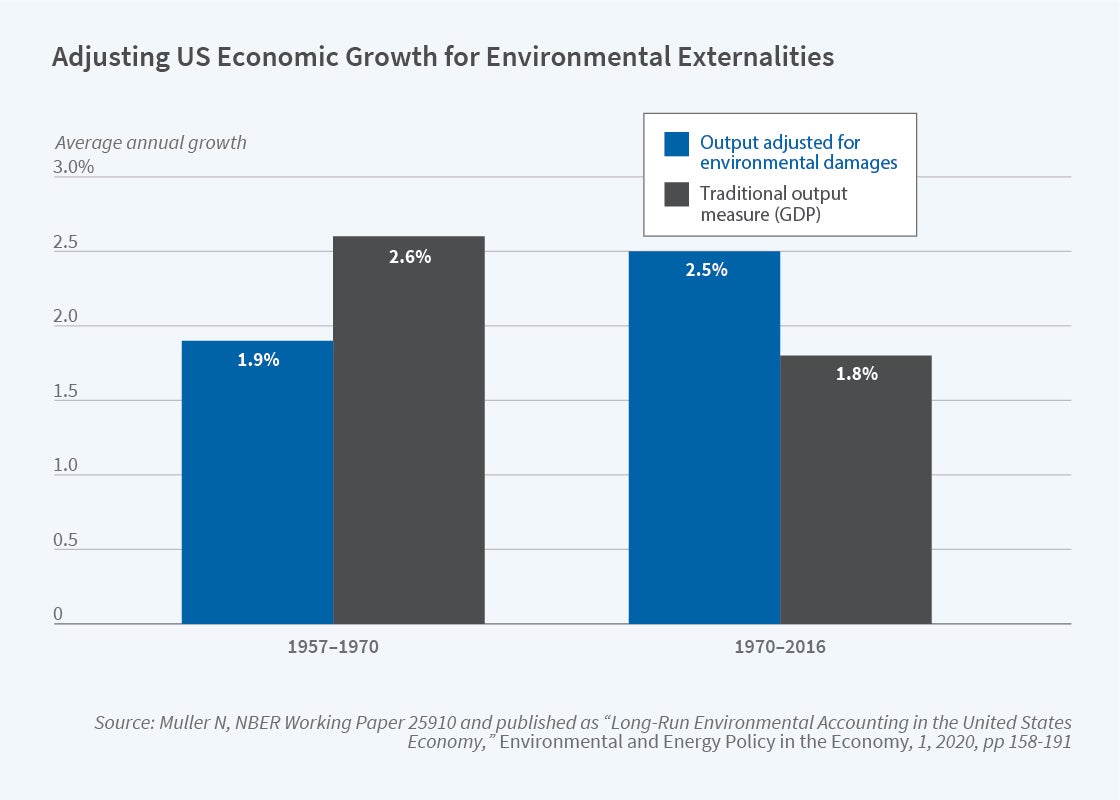
In an NBER summary of his research, Nicholas Muller argues that a big part of the GDP growth slowdown is because we aren’t including environmental damage in the calculation. This is not a new argument (Muller is an important contributor to this literature), and the exclusion of environmental damage is a well-known flaw of GDP, but Muller’s paper does a great job of quantifying how much we are mismeasuring GDP. The following figure is a nice summary of what GDP growth looks like when we consider environmental damage.

2021number3_muller1.jpg

If we use the standard measure of GDP, growth indeed slowed down after 1970. If instead we augment GDP for environmental damages, the period after 1970 was actually faster! The adjustment both slows down growth from 1957-1970, and speeds up growth after 1970.

There are lots of things we can draw from this, but if the results are close to accurate, there is a clear implication: environmental regulations (such as the Clean Air Act) do reduce GDP growth, as traditionally measured. So the skeptics of regulation are partially right: regulation reduces growth!

However, this seems to be a clear case where standard critiques of GDP (as you can find in just about any Econ 101 textbook — yes, really!) need to be incorporated into the complete cost-benefit analysis of the impacts of environmental regulation.

Opening My New Crypto Account: Plaid App Wants My Full Bank Login Information

I finally got around to opening an account at BlockFi where I can buy cryptocurrencies directly. Later I will discuss why I chose BlockFi and what I plan to do there. For now I’d like to mention one roadblock I hit in starting it up.

Signing up for the BlockFi account itself was pretty straightforward. But when it came to actually funding it, I was required to use Plaid to handle transfers of funds to and from my bank accounts – – and Plaid wanted me to tell them my full username and password that I use to log into my bank account. “No,” I said to myself, “they can’t really mean that.” But yes, they do mean that.

Armed with these credentials Plaid is able to not only pull money out of my account (like, for instance, PayPal does), but they can also login as me and have access to every financial transaction I have ever done, every check I have ever written. It’s not that I have anything interesting to hide, but this level of privacy invasion creeps me out. Also, the sad truth is that any company, including Plaid and its partners, are vulnerable to hacking, so I am not thrilled at having my bank login information floating out there in cyberspace.

On their website, Plaid is nice enough to disclose the scope of its snooping:

We collect the following types of identifiers, commercial information, and other personal information from your financial product and service providers:

  • Account information, including financial institution name, account name, account type, account ownership, branch number, IBAN, BIC, account number, routing number, and sort code;
  • Information about an account balance, including current and available balance;
  • Information about credit accounts, including due dates, balances owed, payment amounts and dates, transaction history, credit limit, repayment status, and interest rate;
  • Information about loan accounts, including due dates, repayment status, balances, payment amounts and dates, interest rate, guarantor, loan type, payment plan, and terms;
  • Information about investment accounts, including transaction information, type of asset, identifying details about the asset, quantity, price, fees, and cost basis;
  • Identifiers and information about the account owner(s), including name, email address, phone number, date of birth, and address information;
  • Information about account transactions, including amount, date, payee, type, quantity, price, location, involved securities, and a description of the transaction; and
  • Professional information, including information about your employer, in limited cases where you’ve connected your payroll accounts or provided us with your pay stub information.

The data collected from your financial accounts includes information from all accounts (e.g., checking, savings, and credit card) accessible through a single set of account credentials.

Plaid promises not to sell or rent this personal data. Fine. But even if they don’t formally sell it, they may simply give it away widely. In their words:

We share your End User Information for a number of business purposes:

  • With the developer of the application you are using and as directed by that developer (such as with another third party if directed by you);
  • To enforce any contract with you;
  • With our data processors and other service providers, partners, or contractors in connection with the services they perform for us or developers;
  • With your connected financial institution(s) to help establish or maintain a connection you’ve chosen to make;
  • If we believe in good faith that disclosure is appropriate to comply with applicable law, regulation, or legal process (such as a court order or subpoena);
  • In connection with a change in ownership or control of all or a part of our business (such as a merger, acquisition, reorganization, or bankruptcy);
  • Between and among Plaid and our current and future parents, affiliates, subsidiaries and other companies under common control or ownership;
  • [etc., etc.]

Yeesh.

I’m sure Plaid means well, but I just didn’t like the sound of all that. So, I came up with a plan: I would start up a second account at my bank, with a slightly different name and a different account number, and just give Plaid access to that one account. The only thing I would do with that account is to fund my BlockFi account, so it would not have years and years of my other financial transactions embedded in it.

In the end, that worked, but it took a more time and phone calls than I expected. Opening the new account was a surprising pain, for reasons I won’t go into here. Then, it turns out that the bank doesn’t have a category for one person having two accounts with two different logins. There was nothing I could do about it online, so I had to talk to someone at the bank who had the power to limit my login authority to my new account. This meant that I now have to use my wife’s login to access my/our old account, which is OK. But it probably would have been cleaner simply to start my new account at some different (online) bank.

Anyway, just in time for the current crypto meltdown (Bitcoin is down more than 20% from its high a month ago), my account is active and funded. More on that in future installments.
The stakes have never been higher

These two tweets came through my feed today through secondhand channels

I am not suggesting that these two tweets are equivalent. The first is grotesque cosplay, the second a bit of hyperbole (possibly inspired by the first). Rather, I think they are both part of the same democratic mechanism – the belief that there are more votes to be gained from incentivizing turnout of the base rather than persuading those at the margin. The voters in your base have already decided you and your party are a better option than the rival option, so the only obstacle between you and their vote is the opportunity cost of their time relative to their chances of being decisive in the next election. None of this is new – this uncanny astuteness is how 24 of the last 3 failures of the Median Voter Theorem were predicted. If you want the base to show up, you don’t need to persuade them – you need to scare them.

You need people to vote, so you give them big stakes. Of course, mathematically no stakes short of global extinction are big enough to warrant voting in a national election. The thing about stakes, though, is that even short of extinction-level threats, they still increase the value of a vote that absolves your guilt if the other side wins. You can move on with your life because at least you tried.

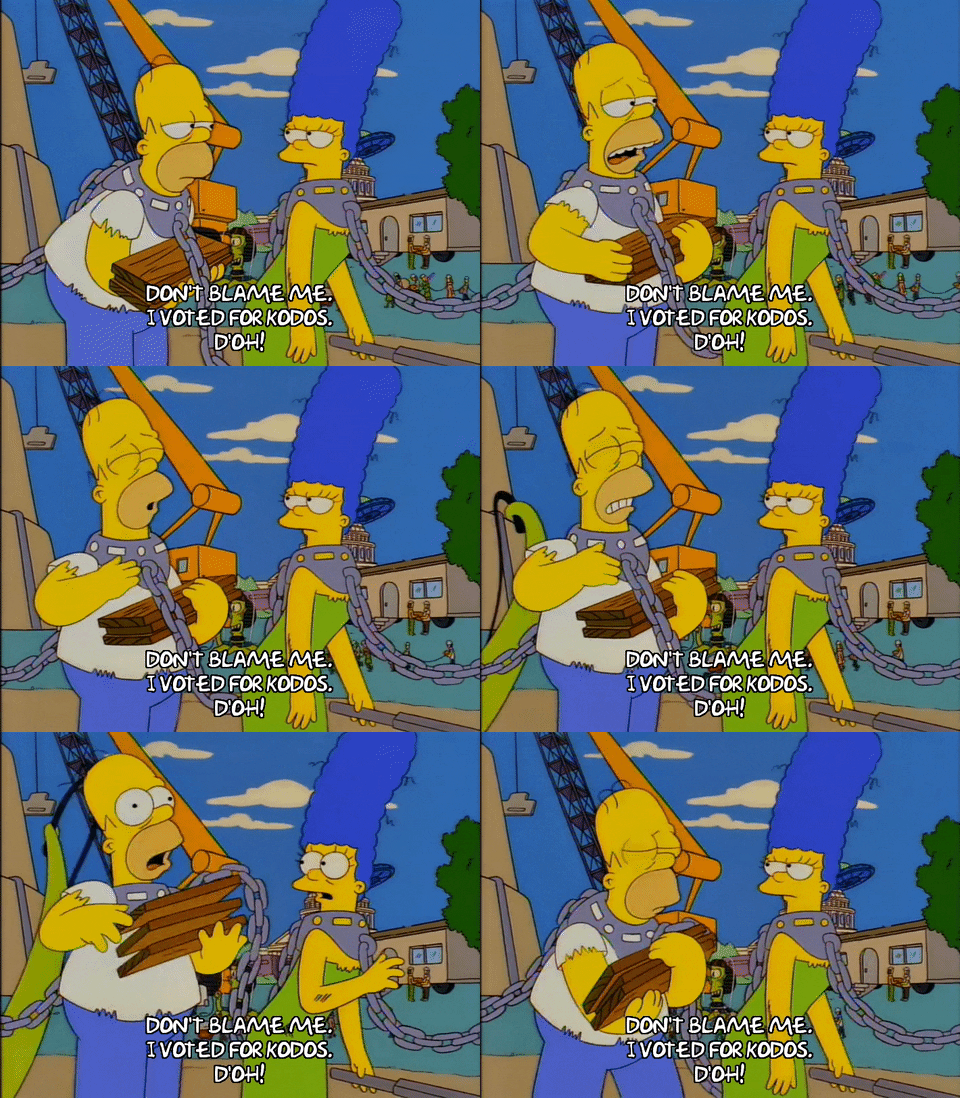
Episode 1 Halloween GIF by The Simpsons

When you’re trying to bring out the base, stakes are everything. Problem is, people start to catch on when every election somehow manages to be the most important one ever. You need to recruit someone to convince your base that this election is the most important one ever. Someone credible. And that’s what politicians and activists have figured out. The most credible source for the potential terror that only our candidate can hold at bay is the opposition. Not their candidates or campaigns, mind you. Their base.

The most credible way to increase the stakes for your base is the rile up the rage and vitriol of the the opposition’s. If you want to truly convince your voters that the stakes are high, all you have to do is chum the water and let the craziest avatars of your political opposition do the work for you. They’ll wave their guns, call each other “comrade”, insult their religious faith, call them stupid, make veiled threats, make unveiled threats, all of which will make perfectly clear that if we don’t win this next election, these people will win. They will win and have power. They must be stopped.

This is the principal reason there has been such a meteoric rise of professional trolls and hyperbolic “reply-guys”. The trolls, your Tucker Carlson’s and Chapo Trap Houses chum the waters, and then an entire ecosystem of reply-guys respond, quote tweet, and record 30 second CNN/Fox News video commentaries. Politicians have discovered that truly horrific people, and the shrieking dystopia fetishists that swarm them, are amazing at bringing out political support, not through persuasion or direct signaling of group identity, but through the specter of the lunacy of the opposition, and the subtle implication that if you don’t signal your affinity for our group, you are by implication associated with the toxicity of our opposition.

Which is why when these sort of messages show up on social media or television sound bites, you can quickly see that they aren’t propaganda or even fan service. They’re bait.

Bait GIF

And just so you don’t get the wrong impression, I fall for this too. I try not to, but these people are professionals for a reason.

Look at me, promoting this image on social media. They played me like a fiddle. I knew exactly what its goal was, and it still put me in such a despairing rage that the rest of the world had to hear about it.

Just because I’m an economist, and one who studies political economy at that, that doesn’t mean I not still a sucker.

Economic freedom and income mobility

A few weeks ago, my friend James Dean (see his website here, he will soon be a job market candidate and James is good) and I received news that the Journal of Institutional Economics had accepted our paper tying economic freedom to income mobility. I think its worth spending a few lines explaining that paper.

In the last two decades, there has been a flurry of papers testing the relationship between economic freedom (i.e. property rights, regulation, free trade, government size, monetary stability) and income inequality. The results are mixed. Some papers find that economic freedom reduces inequality. Some find that it reduces it up to a point (the relationship is not linear but quadratic). Some find that there are reverse causality problems (places that are unequal are less economically free but that economic freedom does not cause inequality). Making heads or tails of this is further complicated by the fact that some studies look at cross-country evidence whereas others use sub-national (e.g. US states, Canadian provinces, Indian states, Mexican states) evidence.

But probably the thing that causes the most confusion in attempts to measure inequality and economic freedom is the reason why inequality is picked as the variable of interest. Inequality is often (but not always) used as a proxy for social mobility. If inequality rises, it is argued, the rich are enjoying greater gains than the poor. Sometimes, researchers will try to track the income growth of the different income deciles to go at this differently. The idea, in all cases, is to see whether economic freedom helps the poor more than the rich. The reason why this is a problem is that inequality measures suffer from well-known composition biases (some people enter the dataset and some people leave). If the biases are non-constant (they drift), you can make incorrect inferences.

Consider the following example: a population of 10 people with incomes ranging from 100$ to 1000$ (going up in increments of 100$). Now, imagine that each of these 10 people enjoy a 10% increase in income but that a person with an income of 20$ migrates to (i.e. enters) that society (and that he earned 10$ in his previous group). The result will be that this population of now 11 people will be more unequal. However, there is no change in inequality for the original 10 people. The entry of the 11th person causes a composition bias and gives us the impression of rising inequality (which is then made synonymous with falling income mobility — the rich get more of the gains). Composition biases are the biggest problem.

Yet, they are easy to circumvent and that is what James Dean and I did. We used data from the Longitudinal Administrative Database (LAD) in Canada which produces measures of income mobility for a panel of people. This means that the same people are tracked over time (a five-year period). This totally eliminates the composition bias and we can assess how people within that panel evolve over time. This includes the evolution of income and relative income status (which decile of overall Canadian society they were in).

Using the evolution of income and relative income status by province and income decile, we tested whether economic freedom allowed the poor to gain more than the rich from high levels of economic freedom. The dataset was essentially the level of economic freedom in each five-year window matching the LAD panels for income mobility. The period covered is 1982-87 to 2013-18.

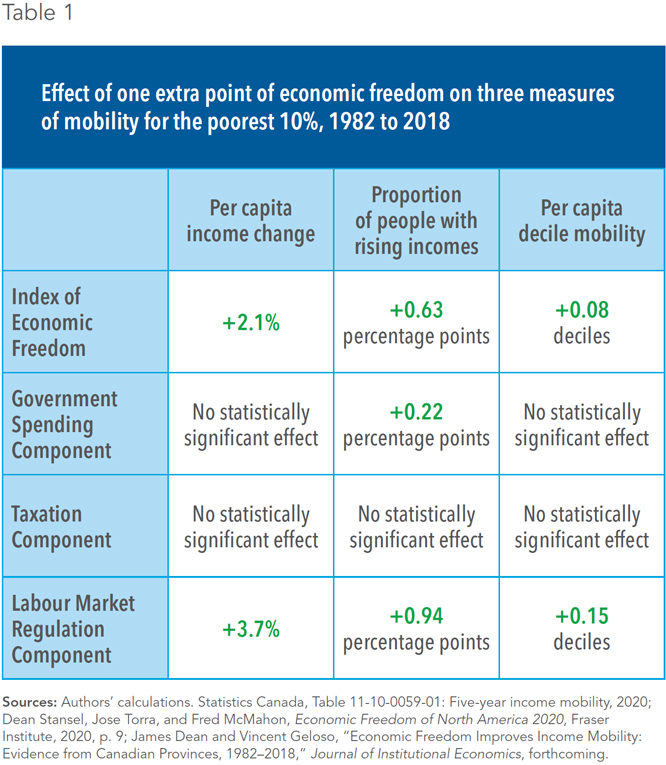
What we found is in the table below which illustrates only our results for the bottom 10% of the population. What we find is that economic freedom in each province heavily affects income mobility.

Image

More importantly, the results we find for the bottom decile are greater than the results “on average” (for all the panel) or than for the top deciles. In other words, economic freedom matters more for the poor than the rich. I hope you will this summary here to be enticing enough to consult the paper or the public policy summary we did for the Montreal Economic Institute (here)

Getting hired by a bot is unsettling

Samford student Savanah Needham identified an interesting recent WSJ article about the use of AI in hiring. Savanah writes:

In The WSJ, we learn that AI is being used for hiring employees rather than a traditional hiring manager, thus job applicants fear that they must impress a robot instead of relying on human interaction to get their dream job. The writer argues that job applicants deserve to know ahead of time how the algorithm will judge them and ought to receive feedback if they are rejected. Her proposal highlights the uncertainty that job candidates face in the newly AI-augmented hiring world.

We desperately need such a system. AI’s widespread use in hiring far outpaces our collective ability to keep it in check—to understand, verify and oversee it. Is a résumé screener identifying promising candidates, or is it picking up irrelevant, or even discriminatory, patterns from historical data? Is a job seeker participating in a fair competition if he or she is unable to pass an online personality test, despite having other qualifications needed for the job?

Julia Stoyanovich, WSJ

Robots can look at social media postings, linguistic analysis of candidates’ writing samples, and video-based interviews that utilize algorithms to analyze speech content, tone of voice, emotional states, nonverbal behaviors, and temperamental clues (HBR 2019). In just a few quick seconds, AI uses all the data it has on you to jump to conclusions. AI uses tools that claim to measure tone of voice, expressions, and other aspects of a candidate’s personality to help “measure how culturally ‘normal’ a person is.”

You spend a large amount of time proving to employers that you are not like the others, you’re different/better than other candidates…but now we need to try and convince a robot that we are “normal.”  

Researchers predict that face-reading AI can soon discern candidates’ sexual and political orientation as well as “internal states” like mood or emotion with a high degree of accuracy. This can be worrisome if the face reader claims that one is “too emotional” or assigns someone to a certain political party. 

Forgiveness is Underprovided

Forgiveness is Important

Whether one might socially offend us or whether one commits a crime, we face a fundamental tension between punishment and forgiveness. Punishment is important because it acts as a deterrent to the initial offense or to subsequent offenses. But punishment is also costly. Severing social or commercial ties reduces the number of possible mutually beneficial transactions. We lose economies of scale and lose gains from trade when we exclude someone from the market. Forgiveness is important because it permits those who previously had conflict to acknowledge the sunk cost of the offense and proceed with future opportunities for trade. However, an excess of forgiveness risks failure to deter destructive behaviors.

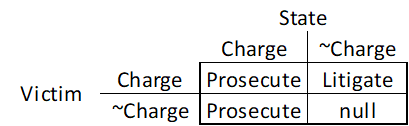
In the US, we enjoy a state that can prosecute alleged offenders and enforce punishments regardless of the economic status of the offended. While not perfect, the state incurs great cost by being the advocate of those who could not enforce great retributive punishment by their own means. A victim may choose to press charges against an offender, or the state can press charges despite a permissive victim.

In fact, our system of prosecution is somewhat asymmetrical. The state can press charges against a suspect, regardless of the victim’s wishes. While a victim can’t compel an unwilling state to press charges, say if the evidence is scant, an individual can engage in litigation against the accused.

Most of the possible combinations of victim and state strategies result in some kind of prosecution of the alleged offender. Except for litigation, our punishments in the US tend not to be remunerative – the victim isn’t compensated for the evils of the offender. ‘Justice’ is often construed as a type of compensation, however.

Herein lies a problem.

Continue reading

New: Journal of Comments and Replications in Economics

I was pleased to see yesterday the announcement of a new journal, the Journal of Comments and Replications in Economics. As the name implies, it will publish articles that comment on or attempt to replicate previously published economics papers.

While empirical economics papers have in some ways become more believable over time, it is still rare for anyone to verify whether the results can actually be replicated, and formal comments on potential problems in published papers have actually become less common over time (though Econ Journal Watch has been a good outlet for comments).

The ability to independently verify and replicate findings should be at the core of science. But economists, like most other disciplines, are generally too focused on publishing original work to test whether already-published papers hold up. When we do try to replicate existing work, the results aren’t very encouraging; at best 80% of economics papers replicate.

If we want people to trust and rely on our work, we need to do better than that. The US Department of Defense agrees, and funded a huge project to determine what types of social science research hold up to scrutiny. I’ve been a bit involved in this and hope to sum up some of the results once this semester is over. For now, I’ll just say I’m happy to see the new Journal of Comments and Replications in Economics (and that it is both free and open-access, a rare combo) and I hope this represents one more small step towards economics being a real science.

Pumpkin Spice: 15th Century Edition

It’s pumpkin spice season. That means that not only can you get pumpkin spice lattes, but also pumpkin spice Oreos, pumpkin spice Cheerios, and even pumpkin spice oil changes.

The most important thing to know about “pumpkin spice” things is that they don’t actually taste like pumpkin. They taste like the spices that you use to flavor pumpkin pie. (Notable exception: Peter Suderman’s excellent pumpkin spice cocktail syrup, which does contain pumpkin puree.)

Last week economic historian Anton Howes posted a picture of the spice shelf at his grocery store and guessed that this would have been worth millions of dollars in 1600.

Some of the comments pushed back a little. OK, probably not millions but certainly a lot. Howes was alluding to the well-known fact that spices used to be expensive. Very expensive. Spices, along with precious metals, were one of the primary reasons for the global exploration, trade, and colonialism for centuries. Finding and controlling spices was a huge source of wealth.

But how much more expensive were spices in the past? One comment on Howes’ tweet points to an excellent essay by the late economic historian John Munro on the history of spices. And importantly, Munro gives us a nice comparison of the prices of spices in 15th century Europe, including a comparison to typical wages.

As I looked at the list of spices in Munro’s essay, I noticed: these are the pumpkin spices! Cloves, cinnamon, ginger, and mace (from the nutmeg seed, though not exactly the same as nutmeg). He’s even included sugar. That’s all we need to make a pumpkin spice syrup!

Last week in my Thanksgiving prices post I cautioned against looking at any one price or set of prices in isolation. You can’t tell a lot about standards of living by looking at just a few prices, you need to look at all prices. So let me just reiterate here that the following comparison is not a broad claim about living standards, just a fun exercise.

That being said, let’s see how much the prices of spices have fallen.

Continue reading