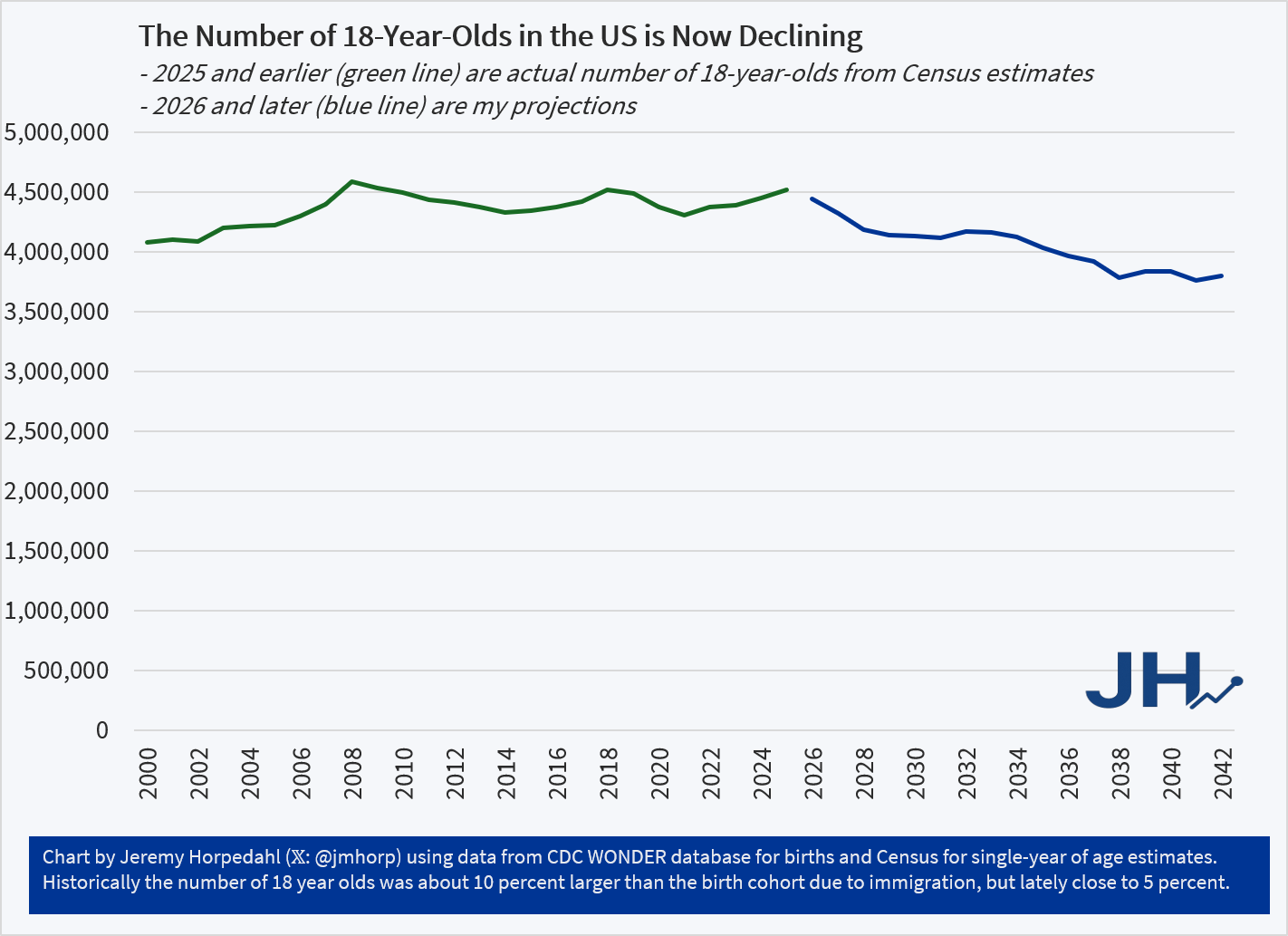
If you have spent any time around higher education lately, you have probably heard of the “demographic cliff” or “enrollment cliff” for years now. Well, it’s finally here. In terms of total number of births, the US peaked in 2007 at a little over 4.3 million births. That’s the highest year ever, even higher than the peak of the Baby Boom (not in terms of fertility rates, of course, I’m just talking about absolute number of births).
Babies born in 2007 turned 18 in 2025. But after 2007, births started to fall. In 2025, there were just about 3.6 million births, a decline of about 700,000 babies since 2007, or a 16 percent decline. The number of 18-year-olds won’t be exactly the same as the number of births in a given year: it’s actually usually a bit higher, as net immigration is much larger than the small number of children that die before they reach 18. For example, the 1982 birth cohort had 3.68 million babies, but 18 years later in the year 2000 there were 4.08 million potential college students.
Historically there have been about 10 percent more 18-year-olds than the birth cohort, but lately (2021-2025) it has only been about 5 percent higher than the birth numbers.
There are, of course, all kinds of social, economic, and political implications of falling births. I just want to mention one that is specific to the industry that I work in: potentially falling college enrollment. And because this enrollment will not be uniform across states and universities, this will cause serious budget issues for many colleges in the coming years.
Some folks in higher ed have lately been asking when the demographic cliff will hit. It’s here: