Update: I added a comment on the post to clarify why I don’t think that having seniors stay at home is the correct Coasean solution. In short: social isolation has high costs!
Bryan Caplan has an interesting post on COVID and reciprocal externalities. Caplan starts off with the straightforward Coasean statement: “Yes, people who don’t wear masks impose negative externalities on others. But people who insist on masks impose negative externalities, too.”
For those not familiar with Coase’s 1960 article, one of his fundamental insights about property rights is that when property rights are not clearly defined, both parties can be imposing costs on one another. The externalities are reciprocal, not just in one direction. The efficient outcome, when bargaining is not possible, is to allocate the property right such that the “least cost avoider” is the one that adjusts their behavior. In other words, you allocate the property right to the party who would obtain the property right if bargaining were possible.
But Caplan uses this Coasean framework to come to the opposite conclusion that I would. Why?
My co-blogger Mike Makowsky has a great post earlier this week about the minimum wage. Go read it before you read my post. When Mike said he was bothered by the notion that “the welfare state must be channeled through employment,” I very much nodded in agreement. It reminded me of a frustration I have with the entire debate about the minimum wage vs. the Earned Income Tax Credit as policy tools to help out the least well-off in society (yes, some argue they are complements, but let’s put that debate aside for the moment).
Here’s my frustration. In both the popular discussion and occasionally among academics/policy wonks, the difference between the minimum wage and the EITC is often framed this way: employers pay for the minimum wage, but the government pays for the EITC. I know there are important questions about the incidence of the minimum wage, but let’s assume that the proponents of higher minimum wages are correct, and the full cost comes out of business profits.
But the distinction between “employers” and “the government” is not a useful one. Where does the government get its revenue to pay for things like the EITC (or alternatively, food stamps)? They must come from society. There is some diversion of real resources from Group A to Group B. Group A is, in the case of the minimum wage, the owners of businesses — in other words, individuals with high incomes. Group B is the workers. But this is true in the case of both the minimum wage and the EITC!
Joshua Hendrickson recently wrote about the provision of public goods, and how we teach public goods in economics. My post today is not so much a reply to Hendrickson, but is inspired by his mediation on public goods as I gear up to teach another semester of Public Finance.
The theory of public goods that economists discuss among themselves is pretty straightforward: when a good is both non-rival and non-excludable, there is a strong case for government intervention of some sort (though not necessarily public provision). The opposite is true when a good is both rival and excludable: there is a strong case for laissez faire.
Seems simple enough, right? But communicating this concept to undergraduates and the general public has been a major challenge. Part of the confusion arises from the term itself, “public good.” Non-economists tend to use the term interchangeably with the notion of “the common good, as is clear from Wikipedia, a dictionary, or a conversation with your grandma. For this reason, I sometimes substitute the awkward phrase “collective consumption good” (this is actually Samuelson’s term in his classic article on the topic), but all the textbooks so use it so I often default to the standard terminology.
From Jonathan Gruber’s Public Finance and Public Policy
But I think there’s a deeper problem than just terminology. Economists have put themselves in a box. Literally. Here’s a standard 2×2 matrix from Jonathan Gruber’s undergraduate public finance textbook. I don’t mean to pick on Gruber here — this is a pretty standard presentation. You can find it in many microeconomics textbooks too, or on Wikipedia. Everything goes in a box! It’s a nice stylized way to think of the terminology. It makes for nice test questions. But here’s the real problem with it as a pedagogical tool: it doesn’t seem to help many students! Or at least, it doesn’t seem to help them retain the knowledge between their micro principles courses and upper division courses (at least in my experience, I’d be happy to hear others chime in here).
So how can we teach this concept better? I have a few ideas. I’d like to hear yours too.
It’s the most wonderful time of the year, when we start to get all those little documents in the mail and electronically showing how much you earned in the past year. The purpose of these little documents, of course, is to complete your federal and state income tax returns. While many Americans dislike paying income taxes, there is another tax that is rated as even worse in surveys: the property tax.
Why do Americans dislike the property tax so much? One popular explanation is that people don’t like the idea that “you never really own your property.” In other words, even after you have paid off your mortgage, you must continue to pay property taxes, which feels like a form of “rent” that you pay to the government. Of course, that “rent” does pay for a variety of public services, primarily K-12 education in most locations, but this still seems to rub many Americans the wrong way. The libertarian phase “taxation is theft” conveys a similar sentiment for income taxes, that you never “really own” your own labor if you must pay taxes on your earnings.
But there is also an economic explanation for the hatred of the property tax: it is very salient, especially to taxpayers that no longer have a mortgage. While those of us that still have a mortgage on our home pay property taxes through our normal monthly mortgage payment, Americans that have paid off their mortgage typically write a check (or two) to pay the full amount of their property tax bill. An interesting paper by Cabral and Hoxby finds that jurisdictions with more taxpayers using escrow for their property taxes (meaning they have a mortgage) also have higher property tax rates. And furthermore, they “find that owners with tax escrow report their taxes much less accurately than those without tax escrow” (look at Figure 2 in the paper to see the huge differences).
Income taxes, on the other hand, are not salient for most Americans. Payroll withholding means that the taxes are taken out before we even get our paycheck, and you’ll only notice them if you look at your pay stub. And about three-quarters of US taxpayers get a tax refund at the end of the year. For most Americans, the only salient part of the income tax system is a check they receive as a refund, rather than writing a check for their property taxes.
What does all this mean? Should income taxes be made more salient? Should property taxes be made less salient? A simple answer could be that all taxes should be equally salient. Or if you view one tax as superior in some way, maybe that tax should be less salient, so there is less opposition to it.
I don’t have the answers to these questions. But I do have a question for readers: do you know your own income tax rate? Specifically, what is the marginal rate on your federal income taxes? I invite readers to write down their guesses, then look up the correct answer. How close were you? Please leave a comment, and be honest!
My last post of 2020 tried to end the year on an optimistic note: the rapid innovation of a new vaccine was truly a marvel. But I also warned you that I would have a post in the new year talking about the deaths of 2020 during the pandemic. And here it is.
Throughout 2020, I have tried to keep up with the most recent data, not only on officially coded COVID-19 deaths, but also on other measures. An important one is known as excess mortality, which is an attempt to measure the number of deaths in a year that are above the normal level. Defining “normal” is sometimes challenging, but looking at deaths for recent years, especially if nothing unusual was happening, is one way to define normal. The team at Our World in Data has a nice essay explaining the concept of excess mortality.
One thing to remember about death data is that it is often reported with a lag. The CDC does a good job of regularly posting death data as it is reported, but these numbers can be unfortunately deceptive. For example, while the CDC has some death data reported through 51 weeks of 2020, but they note that death data can be delayed for 1-8 weeks, and some states report slower than others (for reasons that are not totally clear to me, North Carolina seems to be way behind in reporting, with very little data reporting after August).
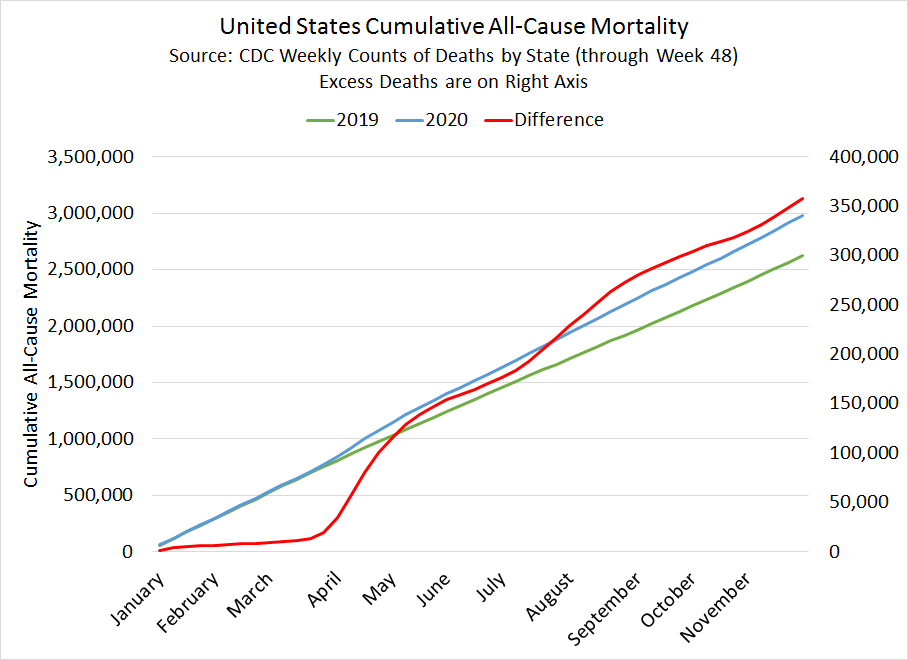
So there’s the caution. What can we do with this data? Since 2019 was a pretty “normal” year for deaths, we can compare the deaths in 2020 to the same weeks of data in 2019. In the chart at the right, I use the first 48 weeks of the year (through November), as this seems to be fairly complete data (but not 100% complete!). The red line in the chart shows excess deaths, the difference between 2019 and 2020 deaths. From this, we can see that there were over 357,000 excess deaths in 2020 in the first 11 months of the year, or about a 13.6% increase over the prior year.
Is 13.6% a large increase? In short, yes. It is very large. I’ll explain more below, but essentially this is the largest increase since the 1918 flu pandemic.
We’ve already talked about different methods for distributing the vaccine in the face of limited supply on this blog (see my post and Doug Norton’s post). But today I want to talk about something different: the speed at which this vaccine was developed. It is truly amazing.
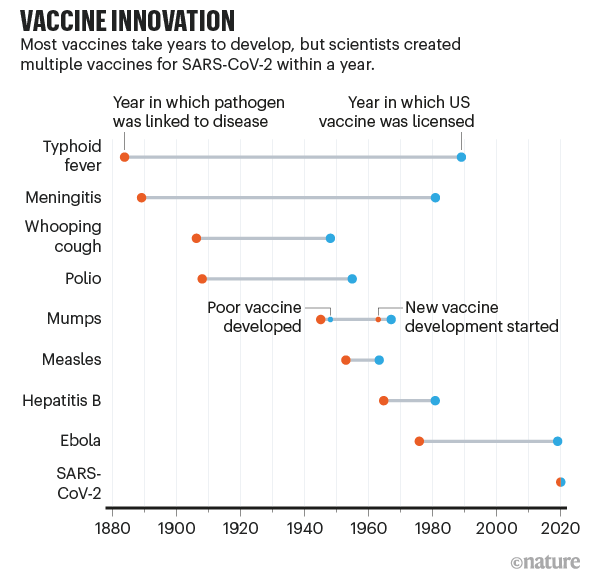
This chart from Nature (adapted from the fantastic Our World in Data) dramatically shows just how quickly the COVID-19 vaccine was developed compared with past vaccines. What used to take decades or even a century was done in mere months (yes, even with all the regulatory barriers today).
Exactly how we developed this vaccine so quickly is a complex story that involves the advanced state of modern science, incentives offered by concerned governments, and the harnessing of the profit motive to advance the public good. We don’t know all the details yet, and likely won’t for a long time since, like a pencil, no one person knows how to make and distribute a vaccine.
Along with the colorful phrase “pork barrel” spending, logrolling is a term used to describe the process of vote trading in elected legislative bodies. The process has long been maligned by political scientists, pundits, and the general public. It’s also come up in the debate about the proposed Budget/COVID Relief Bill.
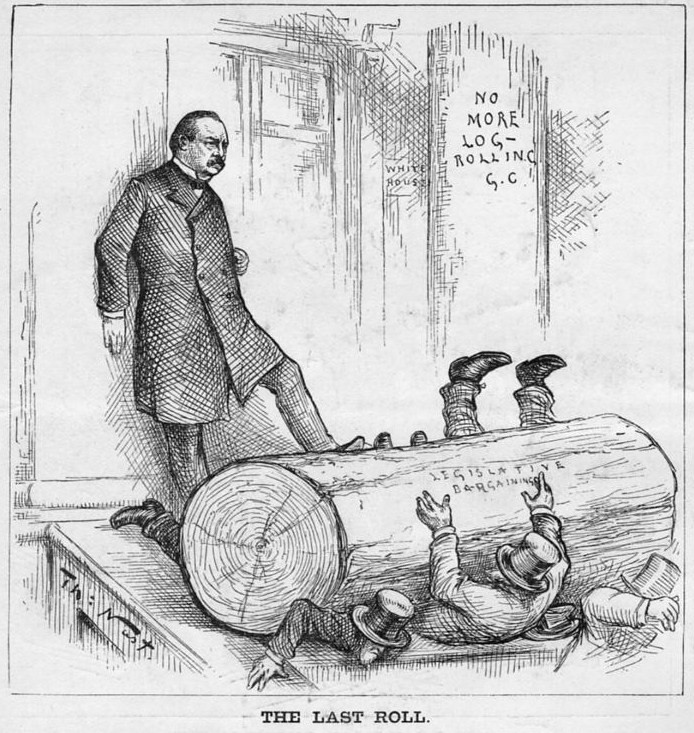
President Grant tried to stop logrolling. He failed.
What’s bad about logrolling? I think there are two general lines of argument. First, it just seems immoral. Citizens can’t legally trade their votes, and many see any attempt to do so as wrong. You get one vote, and one vote only. For someone to have more votes than others rubs our intuitions the wrong way, similar to the ability for wealthy individuals or corporations to essentially have more votes by influencing politicians through campaign contributions.
More pragmatically, logrolling gets a bad name because it could lead to wasteful spending, particularly the “pork barrel” type that Americans really hate (unless it is coming to their district, of course). If you vote for my bill, I will vote for yours, even though I might not care about your bill. Maybe even I think your bill is kinda bad, but I think my bill is really good, so I am willing to hold my nose and vote for your bill, if it gets me what I want.
Buchanan and Tullock (1962) turned this logic on its head. Logrolling is efficient because it allows members to express their preferences, specifically the intensity of their preferences. Moreover, it allows legislative bodies to get things done that are beneficial for society, even if none of those things would pass in a simple referendum.
In the short term, there are only a few million doses of the COVID vaccines available, but well over 100 million adults in the US that want to take the vaccine if offered for free to the consumer. There are also billions worldwide that would like the vaccine.
So who should get it first? In practice in the US, the allocation method has already been determined politically: the federal government will allocate vaccines to the states, and states will allocate them to individuals based on a priority list: health workers and the most vulnerable first, then teachers, etc. The NY Times has a tool that shows you your probable place in line.
But essentially the allocation method being used is central planning.
John Cochrane has proposed a “free market” solution: sell the vaccine to the highest bidder. Or at least, sell some doses to the highest bidder.
As an economist, there is always some appeal in thinking about a free market solution. But there is a problem in this case: there are positive externalities from taking the vaccine. It not only benefits me, but it also benefits others. My willingness to pay only reflects the benefit to me, the private benefit. The social benefit is mostly ignored by a simple auction, and in the aggregate for a vaccine most of the benefits are likely to be social benefits. But positive externalities don’t imply we need to use central planning!
As the Fall semester comes to close on college campuses, it’s a good time to reflect on and assess how the past semester went. Many universities went to almost exclusively virtual learning, but other schools tried to make Fall 2020 as normal as possible given the circumstances of the COVID-19 pandemic.
My school, the University of Central Arkansas, chose the route of trying to have things as normal as possible — by which I mean students live on campus, classes are mostly in-person — while still accommodating students and faculty that preferred a more physically distant atmosphere. For example, UCA increased the number of fully online courses available, roughly trying to meet faculty and student demand. I normally teaching one online course per semester anyway, and I continued that this semester. Other faculty had more online classes than usual, or moved their class to be partially online.
So what was my experience?
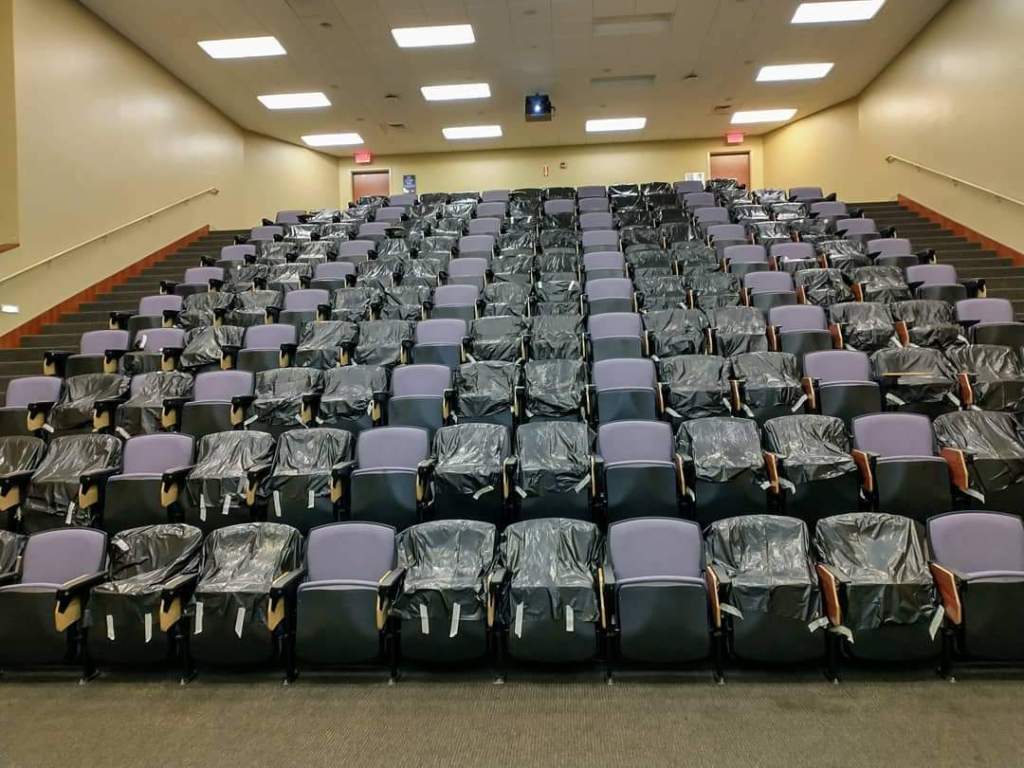
First, the students, the most important part of the teaching process. Overall, I would say my students did very well. At least in the classroom, they complied with all the rules the University set forth: wearing masks, physical distancing in classrooms (seen in the image below), even the one-way entrances and exits to the building. There were only 3-4 times I can recall this semester when a student entered my classroom without a mask, and they immediately asked me for one upon realizing their mistake (I kept a pack of surgical masks with me).
My classroom at the University of Central Arkansas, with chairs blocked off for physical distancing.
As far as academic performance of students, I was very pleased with the students. For those students that were able to stick with the class and keep up, which was most students, they perform as well or better than previous semesters. Some students, due to personal circumstances, had trouble keeping up. I tried as much as possible to accommodate students in these situations, by being flexible with deadlines, offering additional resources, and generally just trying to listen to them and empathize. It was hard for everyone.
On my end, I tried to make the teaching atmosphere of the classroom as normal as possible. I usually do have some interactive aspects of the classroom, where students work in small groups, talk to their neighbors, etc. Most of those activities didn’t happen, unfortunately. But otherwise, the classroom atmosphere operated as usual.
As my students did, I also wore a mask in the classroom while I lectured. For students that had to miss class due to quarantine, isolation, or other reasons, we were asked to record every lecture and have an option for students to watch the lecture virtually if needed. Making sure that the video was properly recording and the I had set up the Zoom link for students that needed to be remote added an extra element to think about at the beginning of each class, but it was the kind of thing that once you get used to it, it just became normal.
I will say that I often felt very exhausted after teaching each day. The mental load of making sure everything was working right in the classroom, combined with the constant sense of doom in the world around us, made this a challenging semester mentally. I’m sure this was even more true for some of my students. But, we made it.
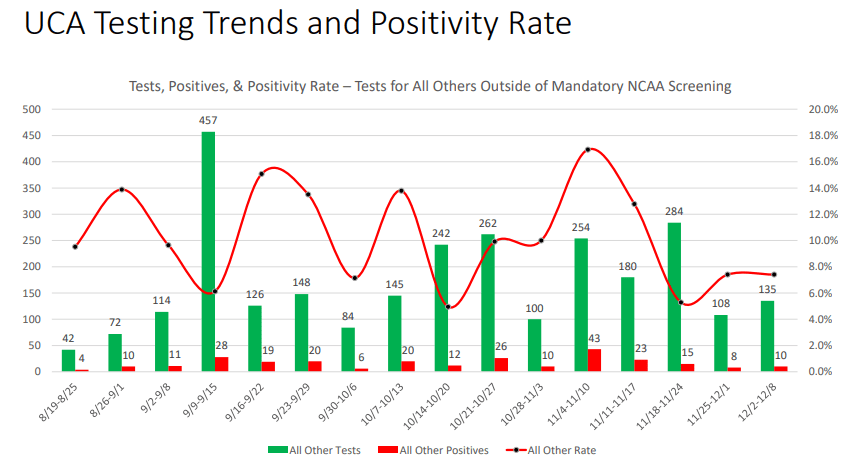
Finally, how about the administration of my University. I’ll bite my tongue a little here: I am up for tenure this year! But really, I don’t have anything major to complain about. Guidance was communicated well, although sometimes big changes were rolled out a bit more quickly than the faculty liked. UCA provided isolation and quarantine dorms for students, though these never came close to capacity. Weekly updates on testing, cases, and related data were provided to everyone (and made publicly available, so I’m not revealing any secrets here).
Testing data for UCA students. This data excludes athletes, since they were required to get tested regularly, which could have skewed the data.
As you can see above, the general student body at UCA did report positive COVID cases every week. And some weeks the positive test rate was a little higher than I was comfortable with! But we never had a large spike in cases, and the University held firm to its commitment to offer in-person classes for everyone that wanted them, as long as the campus was generally safe.
All in all, I think it was the best semester we could have had under the circumstances. The only thing really weighing on my mind: we are going to do it all over in the Spring semester. And we’ll do it as well as we can.
A new working paper by Mike Makowsky and Patrick Warren finds that “firearms offered an effective means of Black self-defense in the Jim Crow South.” By this the authors mean that greater access to firearms by Blacks decreased the likelihood of being lynched.
That headline finding is sure to be provocative in both debates over gun control and the history of Jim Crow. And with good reason. What I found most interesting is how they measured Black access to firearms. Since they did not have direct access to any good sources measuring Black access to firearms, they proxy access with the percent of Black suicides committed with firearms. Increased access to firearms would also mean a higher proportion of suicides were committed using firearms.
We assess firearm access in the U.S. South by measuring the fraction of suicides committed with firearms. Black residents of the Jim Crow South were disarmed, before re-arming themselves during the Civil-Rights Era. We find that lynchings decrease with greater Black firearm access. During the Civil-Rights Movement, both the relative Black homicide and Black “accidental death by firearm” rates decrease with Black firearm access, indicating frequent misclassification of homicides as accidents. In the contemporary era, greater firearm access correlates with higher Black death rates. We find that firearms offered an effective means of Black self-defense in the Jim Crow South.