As someone who has dabbled in lab experiments for over a decade, I’m familiar with complaints about external validity. If an experiment is run with only college students, then how can we know if the finding will generalize to other populations? It’s a question worth asking, but many questions are worth asking and it doesn’t mean that controlled experimentation can’t add value to the economics literature. In the age of general suspicion of small studies, people say that replications are needed. We should only trust a conclusion that is supported by multiple studies. The thing about replications is that the process has to start somewhere. Empirical work has to get read and published. Replications are composed of individual studies.
I just met John List at the Alabama stop on his epic national book tour. He directed me to his work of art: Ungated Link. He wrote a play in response to the attacks on his work concerning external validity. He employs a rhetorical strategy of making your critics look obtuse. Even though the play is absolutely silly (thoroughly entertaining), he builds a strong defense for doing experiments. It is literally presented as the arguments of a defense lawyer. Before the trial begins, a “reporter” summarizes the conflict that has created the need for a formal trial:
Court Reporter Clifton Hillegass: Thank you Judge Learner. While it is never easy to convey succinctly the key points of a debate, this dispute has crystallized in a manner that leaves no middle ground. The prosecution, led by Mr. Naiv Ete, argues that all empirical work in economics must pass a set of necessary external validity conditions before being published in academic journals or used by policymakers. To date, in this courtroom no empirical work has passed his conditions, effectively rendering the question of generalizability beyond dispute, or as Livius Andronicus reminded us, Non est Disputandum de Generalizability. Ms. Minerva, Lead Defense, has argued that this line of reasoning leaves only theoretical exercises and thought experiments to advance science and guide policymaking, an approach that she fears will return us to the dark ages.
The paper is called “NON EST DISPUTANDUM DE GENERALIZABILITY?” It’s a good refresher on the history of science, not just economics.
Maybe the first best is for you to spend your weekend reading dense technical papers. But if you aren’t feeling up to that, then this play will make you feel like you learned something without even trying.
I’ll link this up to some of the posts I wrote last year about experiments and critics:
By one definition of the word, Las Vegas is the textbook example of decadence. Is the physical structure of The Strip evidence of American decline? Ross Douthat specifically mentions Disneyland and Las Vegas together in his book, The Decadent Society. He calls them “consumer sublime” which, along with the iPhone, creates a fake experience rather than building something real (like Space Travel).
In his CWT, Douthat expounds on Vegas explaining that, “it represents a kind of simulated sublimity where you are creating models of all of the great achievements of the human species in the modern world and practicing various forms of entertainment around them. So in that sense, it is under my definition too, not just the chocolates-and-bondage-dens definition. I think it is decadent.”
I wrote about Disney World last month and I happened to have just been to Vegas. These places are nice, especially in Spring when it is sunny but not yet too hot.
The New York-New York resort was built in Las Vegas in 1997, followed by the opulent Bellagio in 1998. Paris and the Venetian, both nods to Old World centers of art and culture, were finished in 1999. This construction explosion was all happening during my childhood, and now it is established in modern culture by films such as Ocean’s 11 and The Hangover.
One thing Vegas has all to itself is its sign.
It also boasts to be a place where you are encouraged to overdose on drugs, alcohol, sex, and gambling. That’s not great, but it’s not what Douthat means by decadent. What I noticed is that it’s a loosely regulated place where they will sell you anything that gets you to take out your credit card. There are marijuana stores right across the street from Gucci stores. You pass slot machines on the way out of fancy restaurants.
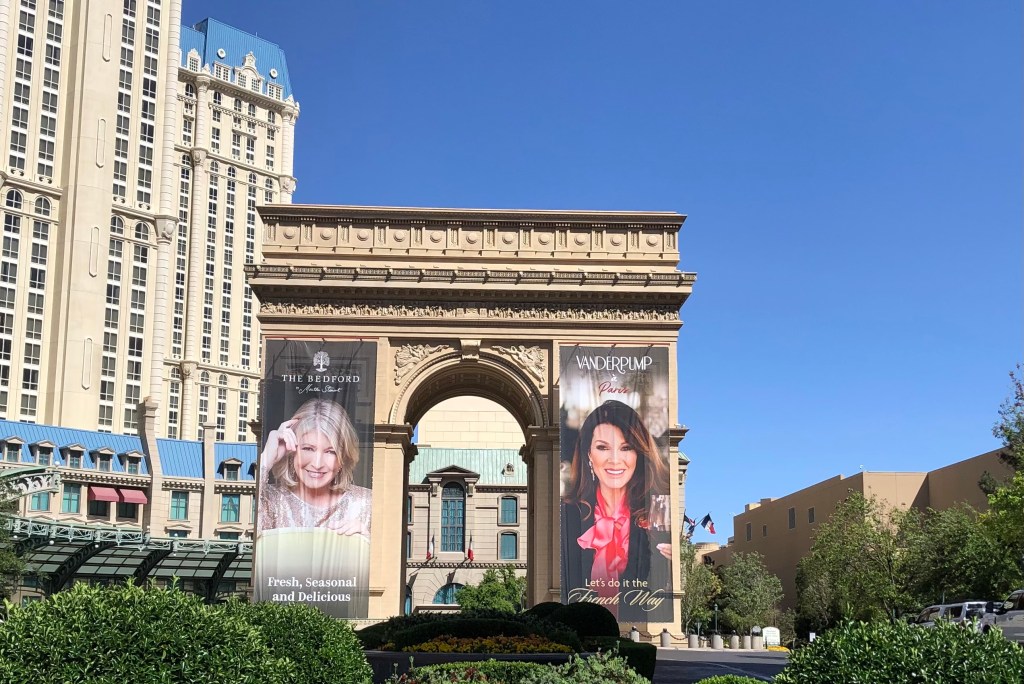
Tattoo shop next to weed shop, directly across the street from upscale fashion boutiques. l’Arc de Triomphe brought to you by Martha Stewart
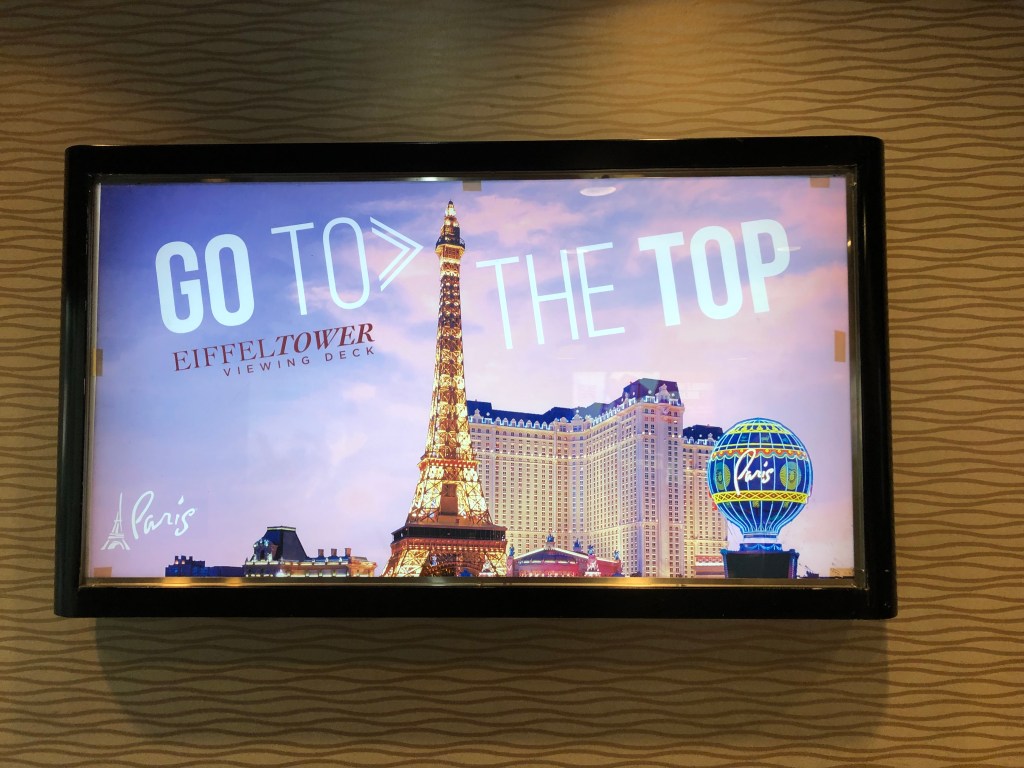
The entertainment-by-spending-money enterprise (Walt Disney World was expensive, too) all takes place in a cool physical setting. The pedestrian bridges on the main streets make it fun and practical to walk around, right past all the stores. The Strip is bordered by shiny tall hotels that each have a theme. The centerpiece, in my opinion, is the Paris resort.
How do you signal that civilization is here, when you are in the middle of Nevada-Mars? Meme the heart of European culture. Considering how yucky activity can get on the Strip, that nod to Europe provides a veneer of respectability to lure in rich people with families. I don’t only think of it in that cynical way. Plenty of Las Vegas is unique and new, but humans can only handle so much new at once. The Eiffel Tower is code. It’s a form of language that people understand. It makes us feel safe and perhaps even makes us safe by setting a tone for the style of partying.
Tourists are in a new place surrounded by strangers. Are we going to attack each other? Are Russian soldiers about to come through and massacre us? Do we agree about what is admirable? Everything feels like it is going to be fine, because we are here in civilization. If Americans ever do settle Mars, we’ll build an Eiffel Tower there, too.
This might all seem trivial, except that I have heard multiple people saying something about how Putin thought he could attack Ukraine at this moment because “he thinks the West is decadent.” That makes investigating the issue seem worthwhile.
As I concluded about Disney World, the problem is not that we have a few nice areas to practice escapism. A progressive society would build more of these places with access for more people. Let’s build a bigger Eiffel Tower in the desert that more people can fit under. If the French object, then make it a fake Empire State building. Big Ben, anyone?
The non-superficial problems Douthat mentions are serious. Our declining birth rate has plunged further since he published his book. Our political system seems just as sclerotic (Vegas is the place where developers got a “yes” while every other American city was saying “no”). As I said in my previous post, everyone should read his book and ponder.
To leave Las Vegas, I took an Uber for a morning flight. My driver came from Afghanistan three years ago. I told him I was glad he made it out before the Taliban took over and he said that it is bad there right now. He had to learn English in 6 months out of dire necessity so that he could get better jobs. Now he dreams, like so many Americans, of “getting out of this town”. What does he think of Las Vegas? His complaints are that it is too sunny and boring.
The destinations of his dreams are San Francisco or New York City. I informed him of the places I know that have less sunny days. I wish we could have talked more, but from what I can tell he has embarked on his American Dream. He was located with his parents (and perhaps more family members) in Las Vegas directly from Afghanistan. He’s young and dreams of leaving. However, he said his parents like where they are and want to stay put now that they have found a secure home. That puts the city in a new perspective. It may not be the aesthetic that Ross prefers, but families have found a home where there used to be uninhabited wilderness.
This is from The Price of Peace by Zachary Carter. What strikes me is the fact that a fleeing refugee doctor enabled Keynes to join the fight, again at the age of 58.
The following passage starts on page 316: “In the meantime, Keynes was at last in good health again. He owed his new energy in part to Hitler’s aggression. In 1939, Keynes had hired János Plesch, a Hungarian Jewish doctor who had relocated to London after fleeing Nazi persecution.
[Plesch resolved Keynes persistent throat infections by administering one of the earliest antibiotics (that was developed in German labs by Bayer before the war!).]
“After two decades of depression, however, the British economy was entering the fight of its life in ragged condition. … On the eve of war, worker productivity was 125 percent higher in the United States than it was in Britain.
“In the meantime, Germany had shifted its offensive focus to London. The Blitz…
“British diplomats didn’t have time to waste. After trying everything else, they brought in Keynes.”
“So Keynes went to Washington in May 1941 to negotiate more practical terms of cooperation and promptly infuriated nearly everyone he met.”
My thoughts: Money wins wars. Wars redistribute talent. Talent makes money. Is the cycle still going? Is this a post-industrialization phenomenon only? Will Tyler’s upcoming book on talent shed any light on this topic?
Podcast with Anne Applebaum on dictators (May overlap considerably with your Twitter stream of info, but at least you could walk while learning and take a scrolling break.)
The destruction of value is graphic and tragic, caused by Russia invading Ukraine this month. Of course violence is common, around the world and throughout history. Violence and repression lead to poverty. Only in rare circumstances have autocracy and despotism been escaped, so that commerce can flourish and wealth can be shared.
Last week I blogged about my nice experience at Disney World. I was happy to see them telling the story of technological growth at The Carousel of Progress ride. At Disney, people really commit to their stories. Adults don’t wear mouse ears or Jedi robes ironically, in the park. The Carousel of Progress message is 100% optimistic about our future, without any cynicism or hedging. There is no mention of government institutions or which legal arrangements will allow progress to continue.
Here is some political economy that is missing from the ride. I quote, without indenting, from the late P.J. O’Rourke’s book On the Wealth of Nations. O’Rourke explains, sometimes using Adam Smith’s words, how in rare circumstances humans managed to rise out of poverty and subjugation.
Beginning of Chapter 7: The first two books of The Wealth of Nations are Adam Smith’s creed of economic progress. Smith placed his faith… in the logic of common sense. We are required to care for ourselves. We act upon this requirement. Our actions are demonstrably beneficial to others. The economy progresses, QED. Or it would, Smith wrote, “if human institutions had never thwarted those natural inclinations.”
More from Chapter 7, on pre-Medieval history of Europe: Smith wrote that the “rapine and violence which the barbarians exercised” left Western Europe “sunk into the lowest state of poverty.” Commerce was destroyed, towns were deserted, fields were left uncultivated. But although the rule of law and the legal title to property that goes with it were destroyed, the result was not “Imagine no possessions/ I wonder if you can.”
End of Chapter 7, an explanation of how economic progress started in the Westwhen the merchants gained some freedom: Adam Smith argued that the inclination of the feudal overlords to be selfish was so strong that it overwhelmed their instinct for self-preservation:
All for ourselves, and nothing for other people, seems, in every age of the world, to have been the vile maxim of the masters of mankind. As soon, therefore, as they could find a method of consuming the whole value of their rents themselves, they had no disposition to share them with other persons. For a pair of diamond buckles… they exchanged… the price of the maintenance of a thousand men for a year, and with it the weight and authority which it could give them. The buckles, however, were to be all their own… whereas in the more ancient method of experience they must have shared with at least a thousand people… and thus, for the gratification of… vanities, they gradually bartered their whole power and authority.
Never complain that the people in power are stupid. It is their best trait.
Joy writing again: “Stupid” refers to the fact that the European lords could have maintained their own power if they had been willing to keep themselves and everyone else poor through continued violence. Consider who is currently being being crazy versus “stupid,” in Europe and elsewhere.
In Disney World’s Magic Kingdom, you can get off the Carousel of Progress and walk across the park, past the Main Street shops, to a dark scary ride called The Pirates of the Caribbean. Someone could teach a travel course where students do both rides and then discuss wealth creation. It would pair nicely with a Doug North reading. Then, everyone could ride “It’s Small World” ironically.
Last week I went to Disney World for the first time. The decorations live up to the hype. The whole enterprise down to the efficient parking systems was impressive.
Galaxy’s Edge is a new Star Wars themed area in Hollywood Studios
In his book The Decadent Society, Ross Douthat argues that following the Apollo mission, Americans underwent a period of economic stagnation, demographic decline, and intellectual and cultural repetition. I think he makes good points, and every American should grapple with his proposition.
He specifically mentions Disneyland on page 36-37:
But has anything that fits this description happened since the moon mission? … There has been a growth in what [David] Nye calls “the consumer’s sublime” of Disneyland and Las Vegas. … But the hyperloop is a blueprint, Las Vegas is a simulacrum…
Has Douthat been to Orlando recently? Walt Disney was not complacent, and neither are the Disney employees who continue to carry out his vision. Orlando is a place where Americans have built stuff in the past few decades instead of trying to veto all progress.
Perhaps it is a decadent society that overvalues the Disney World pilgrimage. My parents never took me, so I am proof that you can have a good childhood without it. However, to build this zone and enjoy it seems like a perfectly legitimate peacetime activity for a country. People desire to stroll down a safe, beautiful, clean, walkable street with their families. The problem is that so many Americans can only do that for a few days per decade and empty their savings to Disney for the privilege.
There is a pernicious idea that respectable Americans live in towns that look just like 1950 and they do tourism at sites that look like 1850. Walt Disney obviously did not think that way. On Twitter, @EliDourado and @mnolangray are agitating every day to build more better stuff. We don’t need Donald Duck on every corner, but we could create cities that serve families better.
One surprise I found inside of the Tomorrowland zone of Magic Kingdom is an old ride called The Carousel of Progress.
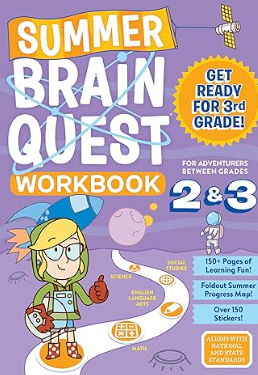
These workbooks are well designed. I’m not promising that your kids will not see it as a chore, but I think these books make practicing math and writing about as fun as it can be.
We found Brain Quest in a bookstore while we were looking for things to do in my son’s summer after kindergarten. The K-to- 1 summer workbook was fun and helped maintain what he had learned in kindergarten. He loved adding a new sticker to the adventure path after finishing each activity. You can finish it in one summer by doing about 5 pages per day, which only takes about 10 minutes.
We really love the summer map books but they also have schoolyear books. The First Grade school-year book is huge (320 pages). There aren’t as many stickers as the K-to-1, but they still have a way of marking off accomplishments that my son finds satisfying. It’s a kind of gamification, but it’s not more screen time.
These pages can be done after school on weekdays. What I like best is that it gives us some structure to leaning on weekends and holidays. It’s cheaper than tutoring.
1. Read this letter from a young woman inside of Russia. Her despair is not sadder than the Kindergarten getting bombed, but it helps explain why people are resisting Russian rule. Ukrainians’ lives would be like hers except worse.
2. ‘My city’s being shelled, but mum won’t believe me’ With loyalty like this, I don’t understand why Russian state TV is bothering to cover up the shelling. Mum’s personal loyalty to Putin already transcends her love of her own daughter. Is lying itself a flex and a form of psychological warfare against the opposition within Russia?
5. President Putin speaks his truth, embraces his identity, and blocks his haters. With a trifecta like that, I have no doubt that he practices self-care. And now people are upset that they can’t get through to rattle him. Now people wonder: why can’t we reason together anymore? Yet, this is what Americans are encouraging each other to do. We are out of practice when it comes to discovering and debating The truth.
Previously I wrote about Americans blocking each other on social media. Now when we want to get through to someone on the other side, we have less channels of communication open. Americans don’t get enough practice seeing the world through someone else’s eyes. We have gotten into a bad habit of curating our sources of information to insulate ourselves from the facts and opinions that would force us to learn or argue with someone who holds a different point of view.
Also, we are seeing many people cut ties with Russians. I understand, initially, why there was a blitz on all Russian people, as we tried to get through the news of what was happening with urgency. However, this next week might be an opportunity to reach out to an economist on the inside of Russia, if you know one. Should they be protesting on the street, instead of checking emails? At this point they have already made their decision. You could start a research project with them about some banal uncontroversial topic. They are going to suffer, regardless of whether they have a foreigner to talk to or not. This opens a channel.
(The faculty at Kyiv School of Economics is probably getting behind on their research. They would probably love it if you would look up their previously published papers. )
The percent of Russians who don’t agree with the war should be a concern to the Kremlin. Most of them will not openly say what they think within the borders of Russia, so it creates uncertainty. On paper, Russia is favored to be able to inflict more casualties, but this aspect of Russian society makes the future hard to model. Any young men who are sent to the front lines will learn what is actually happening from the Russian speakers in Ukraine. How will that affect them?
The AEA Data Editor kicked it all off with this tweet:
Please stop using "cd" (in Stata) or "setwd()" (in R) all over the place. Once (maybe, not really), that's enough. Can we mark those commands as "deprecated"?
“Please stop using “cd” (in Stata) or “setwd()” (in R) all over the place. Once (maybe, not really), that’s enough.”
Replies proliferated on #EconTwitter this week. In this blog post I am collecting solutions for R. These days you might share the code used to generate your results for an empirical paper. That code would ideally be easy for other people to run on their own computers. File paths are hard (as I blogged previously).
A project for a single paper might have multiple code files. The code interacts with data stored somewhere. Part of the task of the code is to point the statistical program to the data set. It is frustrating if an outsider is trying to replicate a result and must alter the code in multiple places to point to their own location of the data.
Here is a concise summary of good practice, for any code language: “cd and setwd() specify the directory. When you share code and run on a different computer, they don’t work. Therefore, good practice to only specify once, at the beginning”
It is hard to know when oneself does not have enough context to appreciate a piece of art. When someone else lacks context, it is easier to see.
Consider my children watching last week’s Super Bowl halftime show. Snoop Dogg was performing on a stylized urban-themed stage. My kids could see the same thing I could see. They did not, remotely, “get it”.
You better lose yourself in the music…
“Lose Yourself” performed by Eminem
Children have little context for anything. But this half time show was a cultural moment. Millennials and Gen X experienced an awakening, or perhaps a collective crisis.
The following tweet got 60 thousand likes about how old the performers are. Everyone was calculating how many years had gone by since this hip hop and rap music was new. Decades have passed and now we who have the context to understand this music are feeling old.
In some nursing home in the year 2070, school children will trudge in and sing “Lose Yourself” because it makes the old people happy. The kids will not understand the appeal.
For all the people sweating about Dre being old and now facing their own mortality, lemme point out that plenty of y’all don’t even know who Kendrick Lamar is. There was a more obvious sign of your oldness staring at you the whole time.
Matt and Ben are tweeting about music in code, but it happens to be a code I know. There are many codes that I do not know. I think that is part of what Tyler means in his latest posts about how “context is scarce”.
The real reason for writing about context this week is not the Super Bowl. I was reading yet more articles about tech skills and labor demand.* Once again, I came across the issue of soft skills. Could we say, “Soft skills are that which is scarce”?
When workers lack hard skills, it seems straight-forward to pack them off to a bootcamp. Teach them, for example, some functions in a programming language. The solution to a lack of soft skills is less clear, although maybe that is what decades of modern education is for. Corporate workers today need to know when to apply their skills and what tone to use in their email communication. They must not embarrass the company.
If a manager tells a worker to do “X task,” they cannot explain every detail. The worker needs to have the context to carry out the work on their own. Workers need to know the code.**
Could that be why so many employers desire a bachelor’s degree? Tyler wrote:
9. So much of education is teaching people context. That is why it is hard, and also why it often does not seem like real learning.
Does this explain why there is simultaneously age discrimination and the ubiquitous “5 years of experience” hurdle for good jobs? Managers are looking for the sweet spot of current technical savvy and institutional context.
* I was reading a report by Quinn Burke. Here’s a published paper on soft skills and STEM. Here’s a blog of mine in which I wrote, “Trust falls and Tolkien is the prescription for this workforce.”
Around January of 2021, hospital staff and other select personnel received the first vaccines meant for the public. As a classroom teacher, I was designated important enough in the state of Alabama to get a Pfizer vaccine as early as February 2021.
Imagine what could have happened next
Americans grew antsy in May of 2021, because less than half of the population had been able to get a vaccine. It was frustrating to see the vaccine winners carrying on with life without fear of the virus while supply constraints made it impossible for everyone to join them at once.
An unintended consequence of the gradual vaccine rollout was that Americans who were initially concerned about vaccine safety had months to observe their family members and neighbors who got in line first. By July of 2021, most Americans personally knew of someone who died from Covid, and almost no one had witnessed a bad vaccine outcome.
By the end of the summer of 2021, over 90% of the American public was fully vaccinated. The economy roared back to life and working parents did not have to worry about school closures anymore.
Americans felt proud to have invented and implemented the world’s best Covid vaccine. Considering that Trump has started the research and Biden had overseen the distribution, it was one thing that red and blue Americans could unite over.
The internet as a concept was vindicated because anyone who wanted to understand vaccines could do their own research. Scientific knowledge is no longer the domain of a select elite. Anyone can see the Covid death rates for vaccinated versus unvaccinated people. Amateurs can create data visualizations to share. Information on mRNA technology is free to all.
Speech remained free with regard to vaccine dialogue, but those who tried to discourage Americans from getting Covid vaccines were shouted down in all forums or accused of being foreign trolls.
The first Covid wave in April of 2020 was terrible and the second big event around Christmas of 2020 resulted in thousands of deaths per day lasting for months. No one wanted to repeat that.
The number of Americans who died from Covid in January 2022 is available from the CDC website.
Number of Covid deaths in January 2022, CDC
59367
Number of Covid deaths in January 2021, CDC
97866
We came fairly close (60%) to repeating the tragedy after the Christmas of 2020. The exponential rise and fall of a new Covid variant and the ensuing pattern of deaths is something we have been through several times. We knew this would happen.
Would every one of those deaths have been prevented by higher vaccine take-up? No. But the death rates among vaccinated people are much lower. Charles Gaba, a data analyst, estimates that about 143,000 Americans have died since the summer of 2021 who would have lived if we had a higher vaccine uptake rate.
My best explanation for this is that people want to feel like they are in control of their own lives. Due to a variety of factors, a large number of adults have a different concept of being in control than I do.* Something that shaped my personal attitude toward the vaccine was reading about the research and development process in real time, which I largely did by keeping up with Marginal Revolution.
Unrelatedly, Jeffrey Clemens has given our blog a label this week that I’m happy with: “speculative but engaging”
Enjoyed this speculative but engaging piece on the economics of the labor market for journalists. https://t.co/vKwPhhzM5C







 Economist Writing Every Day