“Pfumvudza” Planting Technique Revolutionizes Crop Yields in Zimbabwe

Birth of a New Farming Method

Brian Oldreive is a Zimbabwean, born there in 1943. A star cricket player as a young man, he moved on to become a successful tobacco farmer. In 1978, he became convinced (given the harm that tobacco causes) that he should no longer grow tobacco. When he tried to switch to food crops like corn (called maize in Africa), using standard agricultural practices, he could not make a go of it. He ended up losing his farm and his livelihood due to his moral stand against growing tobacco. He went to work for another large farm, but even there it was a struggle to grow food at a profit. Soil was eroding and crop yields were falling.

He began to think that maybe there was a better way to farm than the usual Western model. One day in 1984 when he was walking in the forest, he noticed that the trees and bushes there grew just fine, with no help from humans, no plowing or irrigation. How was that possible? He observed two things. First, the ground was covered with a thick layer of leaves and other debris, which formed a natural mulch. Beneath this mulch layer (“God’s blanket”), the soil was moist. This was while the region was experiencing drought, and regular farmers’ fields were parched. Secondly, the undisturbed mulch layer naturally decayed to return nutrients to the soil.

Oldreive parlayed those observations into a system of no-till agriculture which mimics the created order. He called this “Farming God’s Way”. The emphasis is on high productivity from a small plot. This involves precision planting at the proper time, crop rotation (corn/beans), and deep mulching to retain moisture and keep weeds down. Nutrients are supplied by both compost and chemical fertilizers.

This method can be practiced by farmers owning no tool other than a hoe. This breaks the cycle of farmers or nations going into debt to purchase expensive Western agricultural machinery, which then may become useless due to inadequate maintenance out in the bush.    

This approach contrasts with conventional farming practice which plows up the soil, leaving it to erode away when it rains and to dry out when it doesn’t rain. Plowing also disturbs the natural ordering of the microbial communities within the upper and lower soil layers. (There is aerobic metabolism near the surface, and a whole different anaerobic community in the soil lower down).

Oldreive started by planting one small plot using this approach in the estate he was then managing:

I decided to copy what God does in natural creation and I observed that the leaves fall down on the ground and the grass dies down and there is a protective blanket over the earth, and that is how God preserves soil to infiltrate the water that we receive…

Many people did not believe me and said I was wasting time. But I was not deterred because I was convinced that this method would work. I decided to put the model into practice by starting with just two hectares. I prayed for wisdom and God showed me how to plant maize into wheat straw residue. This is just the same as what God does in nature.

That two-hectare (about 5 acre) plot confounded the skeptics, yielding about ten times more corn per hectare than the local average yields. He then planted more acreage using this approach. Over the next few years, while a number of conventionally-run farms around him went broke, he kept expanding and growing more food with his system.

Oldreive believed these insights were gifts from God which were meant to be shared with others. Therefore, he shifted his effort towards teaching other Africans how to farm with this method.

Things Fall Apart in Zimbabwe

Continue reading
European Energy Crisis, Updated: Germans Shut Down Perfectly Good Nuclear Plants, Utilities Send Socks to Shivering Customers and Advise Eating Porridge

As we noted in September, natural gas prices are sky-high in Europe. Coal-burning power plants have been shut down and the windmills have not spun as fast as expected, which led to a drawdown of European natural gas stocks for electric power generation. The Russians are not sending as much gas as hoped through their pipelines, so Europe is scratching around for (very, very expensive) liquified natural gas to be shipped by ship from the U.S. and the Middle East.

As noted, this hurts European economies in various ways. Fertilizer plants and aluminum smelters have shut down because of too-costly natural gas feedstock, consumers are paying much more in utility bills, and some governments are going deeper into deficit by paying subsidies to partially cushion consumers. This energy shortage also makes Europe very vulnerable to Russia, at a time when Putin is menacing Ukraine with invasion.

France derives about 70% of its electricity from nuclear energy. Due to its low cost of generation, France is the world’s largest net exporter of electricity, earning over €3 billion per year from this. China and other countries are ramping up nuclear. (The U.S. is sadly dysfunctional when it comes to building nukes; we can’t seem to do anything without years of delay and billions in cost overruns).

Like nearly everything in Germany, the German nuclear power plants are well-run. They have never had a serious incident. Nuclear power plants pump out gobs of electric power with essentially no CO2 emission.  If you think that green advocates in Germany would therefore desire to keep these plants running, you would think wrong. Such is the loathing for nuclear power that Germany is shutting them down. Every single one. Katja Hoyer writes:

Just before midnight on Dec. 31, Germany switched off three more of its nuclear power plants [including one in Grohnde]. Once it had 17; now only three are left, and they too will be shut down at the end of the year. Soon Germany will produce no nuclear energy at all. But the activists were wrong to celebrate. Germany’s hasty nuclear retreat is neither safe nor green. It’s a disastrous mistake that will have ramifications well beyond the country’s own borders.

The Grohnde plant is a perfect example of what Germany is giving up. It was one of the most productive nuclear power plants in the world. It provided enough electricity to cover 15 percent of Lower Saxony’s annual energy needs single-handedly, saving 10 million tons of carbon dioxide emissions a year in the process. The site even made headlines in February 2021 for producing more electricity than any other nuclear power plant in the world. Now it will have to be dismantled at a cost of around 1 billion euros.

The loss of these nukes puts further strain on the European-wide grid. The irony of shutting these plants down and therefore buying more power from other countries generated by nuclear power and by burning more gas and coal seems to be lost on the Germans. Their plan to mitigate the effects of calm winds is to build even more windmills, even if that requires deforesting vast tracts of woodland.

Let Them Eat Porridge

The U.K. utility Ovo, which prides itself on providing all-renewable power, sent customers a link with advice for keeping warm whilst turning down their thermostats this winter. These suggestions included cuddling your pets, eating hot porridge, cleaning the house, having a hula hoop contest, doing star jumps (jumping jacks), and leaving the oven open after you are done baking. I leave to your imagination how this advice was received by the British public. In lieu of affordable electricity, the utility company E.ON which shut down one those German nuclear power plants sent out 30,000 pairs of socks to encourage people to get by with less power and heat.

You couldn’t make this stuff up.

Ongoing Drama with Turkey’s Currency: Heterodoxy or Lunacy?

Economics involves human beings making decisions. Where there are humans, drama is never absent. Hence, somewhere in the broader financial sphere, there is always some drama. The chart below displays gyrations in the exchange rate of the Turkish lira which may be fairly characterized as “dramatic”. This chart shows the lira-per-dollar exchange rate over the past six months; a higher number here means lower lira valuation.

Foreign Exchange Market Prices, Turkish Lira per Dollar.         Source: TradingView.com

What is going on here? Why the spike up in November/December, followed by an even more sudden drop?

As usual, loss of value in foreign exchange goes hand in hand with domestic inflation. Inflation within Turkey for the month of December was reported to 36% on an annualized basis. Now, an orthodox economic response to runaway inflation includes raising interest rates. Higher interest rates tend to make a currency more valuable. Higher interest rates encourage people to hold onto their currency, since they are rewarded by interest on their savings. Conversely, low interest rates, especially when coupled with inflation, motivates people to spend down their money before it loses more value. In the case of emerging market countries like Turkey,  high inflation/low interest drives people to exchange their local currency for more stable foreign currencies, like dollars or euros (or crypto stablecoins like Tether).

But Turkey is Turkey, and Turkey is run by the authoritarian President Erdogan. He has economic views which might most charitably characterized as “heterodox”. Erdogan claims that high interest rates actually cause inflation. His views may be influenced by the prohibition on charging interest in classic Islamic practice. The Turkish president has stated, “My belief is that interest rates are the mother of all evils. Interest rates are the cause of inflation. Inflation is a result, not a cause. We need to push down interest rates.”  President Erdogan has sacked numerous treasury officials who disagreed with him, and pressured the central bank to implement four interest rates cuts in the last four months of 2021.  

It seems he hopes to stimulate enough internal growth to paper over any other problems. I think there could be some merit to that notion, but the current inflation level is toxically high. Lower- and middle-class Turks find it hard to purchase necessities.

 Lowering the value of your currency to make your exports more attractive has been practiced successfully by various Asian nations, but Turkey is too exposed to foreign exchange to weather such a huge drop in the value of the lira. A large part of Turkey’s recent economic growth has been funded by foreign investors, and that may dry up because of the currency instability. Turkey is dependent on imports for many essentials, including all of its energy needs, so imports have become much more expensive for Turks as their currency depreciates. Furthermore, because of the fluctuating value of the local currency, many loans are denominated in dollars or euros. This makes it burdensome for borrowers to keep up payments of interest and principal, when these foreign currencies have become more expensive.

Modern currencies have essentially no intrinsic value. Money is a big confidence game. A shopkeeper will take my dollar bill in exchange for some candy, because he is confident that some other party will in turn accept that dollar bill in exchange for something else of value. If confidence in a currency collapses, so does its exchange value.

Foreign creditors and domestic Turkish consumers were becoming more and more nervous about the prospects for the lira in late 2021, as inflation was fueling further inflationary expectation.  It crashed to a record high exchange rate of 13.44 against the dollar on November 23 after the Turkish leader insisted that rate cuts would continue.

Things really started getting out of control in mid-December. Turks frantically ditched their currency in exchange for euros and dollars, which led to further devaluation of the lira.  On December 21st, however, the Turkish government unleashed an innovative initiative. They offered to backstop the value of the lira deposits of Turkish residents, as long as those deposits were held in lira for a certain period of time. Besides offering interest on the deposits, the offer was to compensate depositors for any loss in value against the dollar. The intent was to motivate residents to keep their lira as lira.  

Turkey’s new Finance Minister Nureddin Nebati has no real finance background; his main qualification for office appears to be a willingness to do what his boss wants. When Nebati was asked to give details of this initiative, he reportedly answered thus: “”I won’t give a number now. Can you look into my eyes? What do you see?… The economy is the sparkle in the eyes.”   Hmm.

President Erdogan has said he is protecting the country’s economy from attacks by “foreign financial tools that can disrupt the financial system.” Western economists are not impressed. Market strategist Timothy Ash commented, “ More complete and utter rubbish from Erdogan…Foreign institutional investors don’t want to invest in Turkey because of the absolutely crazy monetary policy settings imposed by Erdogan.”

At any rate, this unusual measure, combined with old-fashioned central bank intervention (the Turkish central bank is believed to have used some 10 billion dollars’ worth of its foreign reserves to buy lira), seemed to stem the immediate panic. Within a day, the exchange rate thudded down from about 18 to about 13, which is roughly the level today.

It has been pointed out that it simply is not feasible for the government to backstop all relevant bank deposits against a huge currency depreciation;  the Turkish government and central bank would burn through all their foreign reserves, and have to resort to printing ever more worthless lira. However, sometimes the mere promise of such a guarantee (whether or not it is practical) is enough to restore some measure of confidence, which in turn means that the currency will not collapse and  thus the resources of the central bank will not be put to the test.   As we said, confidence is what it is all about. We will see how this plays out.

Primary Driver for This Inflation Is Surging Demand (Fueled by COVID Payments), Not Supply Chain Constraints

Inflation is colloquially defined as, “Too much money chasing too few goods (and services)”. Supply chain constraints get talked about, and these are widely blamed for the inflation we are seeing.  Of course, supply limitations play into inflation, but to focus on them is to miss the elephant in room. The primary driver of this inflation is not “too few goods”, but “too much money.”

Such is the thesis of a widely circulated article by Ray Dalio’s investing firm Bridgewater Associates, “It’s Mostly a Demand Shock, Not a Supply Shock, and It’s Everywhere.” The point is summarized:

While the headlines tend to focus on the micro elements of the supply shock (the LA port, coal in China, natural gas in Europe, semiconductors globally, truckers in the UK, etc.), this perspective largely misses the macro cause that is likely to persist and for which there is no idiosyncratic solution. This is not, by and large, a pandemic-related supply problem: as we’ll show, supply of almost everything is at all-time highs. Rather, this is mostly an MP3-driven upward demand shock. [emphases in the original]

In Bridgewater’s terminology, “MP3” is “Monetary Policy #3”, and refers to massive deficit spending combined with central bank quantitative easing. We saw this implemented in 2020-2021 when the federal government pumped out trillions of dollars of stimulus payments and enhanced unemployment benefits, and the Fed instantly soaked up the bonds that were issued to pay for these trillions. This fed/Fed combo amounts to simply printing money on an enormous scale.

Those trillions of dollars funded a huge surge in durable goods purchases. By late 2021 the supply of these goods was well above 2019 (pre-COVID) levels, and even above normal growth trendlines. However, the supply and transport systems simply could not grow fast enough to accommodate this insatiable demand. Charts below substantiate this. To focus on supply chain bottlenecks of themselves is misleading. The primary driver for this inflation has been the trillions of dollars of federal largesse. The Fed knows all this, obviously, but Jay Powell (the Chief Enabler of this deficit spending) would likely not have been reappointed if he spoke too directly about the cause of this inflation. Hence the endless prattle about supply chains.

Continue reading

How Many Semiconductor Chips Are There in a Car?

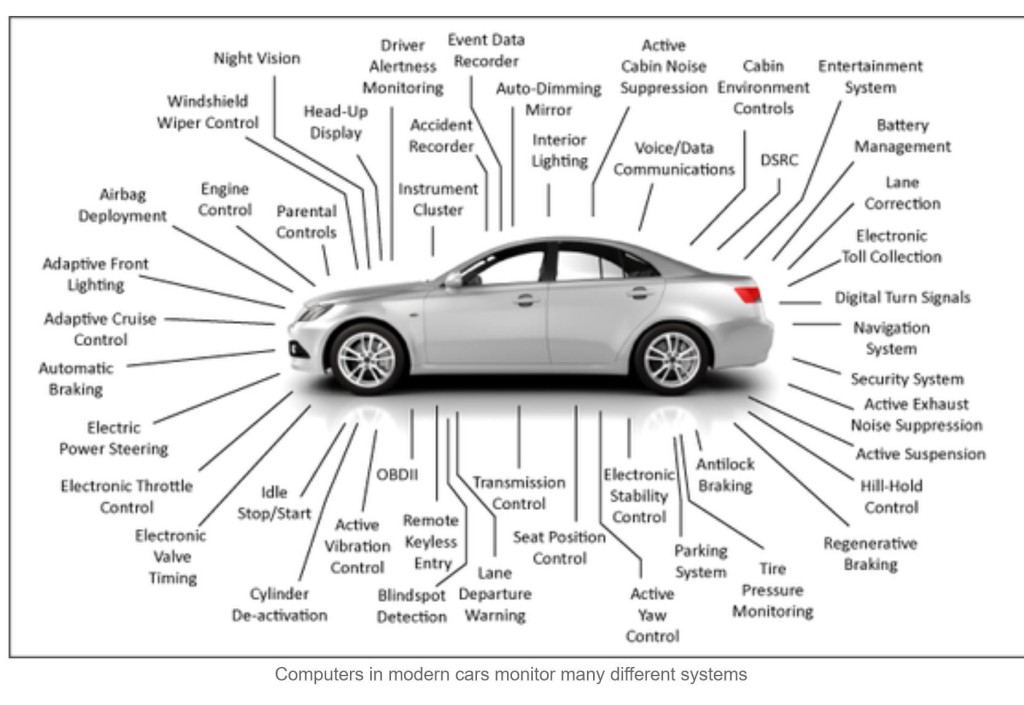
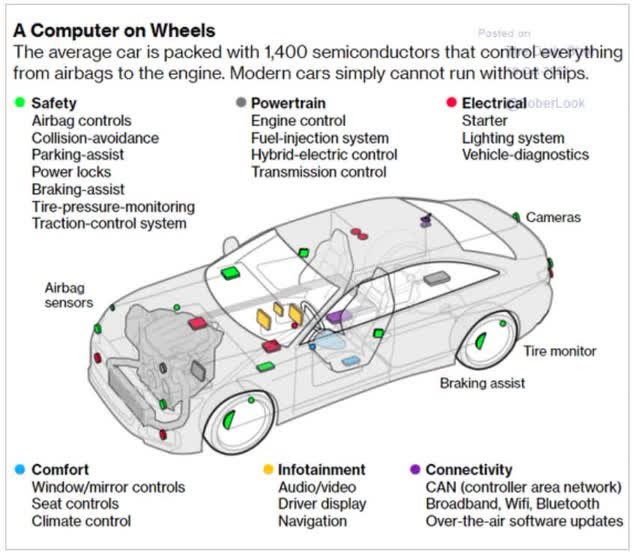
I recently read a statement that there is something like 1400 individual semiconductor chips in a typical modern car.  I wondered, “Can that be correct?”   1400 is a lot of anything.  I have torn apart whole PCs and found only a few dozen chips.

Chips in cars have big economic significance. As called out on a post back in March, COVID shutdowns of semiconductor plants and other factors meant a shortage of critical chips for cars. This has led to extensive shutdowns of car and truck assembly lines in 2021, affecting employment and auto maker profits.  It is estimated that the world lost 11.3 million units of production in 2021 due to the chip shortage, and may lose another 7 million units in 2022.

But back to 1400  chips…I did not find the One True Pronouncement of chips in cars (a promising N Y Times article lay tantalizingly behind a paywall). But I found a number of statements that corroborated that order of magnitude, and also fleshed out the many uses for such chips.

This picture is worth maybe 1400 words:

Source

Here is an even more detailed diagram (sorry, hard to read):

Source

Cars and trucks have something like 100 distinct electronics modules, and each module has multiple chips. Wiring in cars is expensive and vulnerable, so it is better to distribute the information processing rather than run a bunch of wires back to one central processor.

The chip supply situation should sort itself out by 2024, if all goes well. Meanwhile, electronics has become the tail that wags the automotive dog – – electronics have gone from being just 18% of a car’s cost in 2000, to being 40% of its cost in 2020 , and projected to be 45% by 2030:

Mouse Wars: Amazon Mousetrap Reviews as Literature

I have looked at various mouse traps on Amazon. The reviews there are a tremendous source of information. Folks get passionate about their battles with the little rodents who invade and foul their homes. Some reviews soar to literary heights. Here is a user who pours out his despair over being bested by a mouse:

Earthlings Beware!!!! The Toughest Mouse in the World Still Lives: You Could Be NEXT!!!!!!!

Reviewed in the United States on June 30, 2020

These traps were incredibly easy to used and bait. However, I bought these traps To prevent my pets or children from getting injured and to spare my wife from picking up the dead mouse if I wasn’t home. In theory it was the perfect conceptualized mouse trap for a busy house. When this trap arrived I was ready to declare war on the invaders. I put on my camo gear, covered my face with camo paint took some peanut butter out of the cabinet and baited this rodent killing machine. I turned the switch to “set” and tucked it in a spot where I saw mouse droppings. Then I shut off all the lights, Turned on my night vision goggles and waited. Nothing happened, that fury bastard beat me, but I was determined to win the war. I repeated the process the second night only this time I used popcorn to make a trail to the plastic rodent guillotine. I set the trap and went to bed. By dawn I woke up like a child on Christmas, went running down the stairs and to the trap. Boom! The indicator on the side said mouse caught! The pride of winning this battle washed over me. I had defended my castle against an fierce enemy . But wait, why is the trap so light? Surely if a dead mouse was in here I would have been able to feel the weight difference of such a light and sleekly designed trap. I rotated the device in my hand to peer inside of the killing machine. There I stood, with all the pride draining from my short lived victory. The mouse had indeed been attracted to the trap, it followed the popcorn trail of happiness right inside of the devil’s mouth to feast on the peanut butter buffet set up inside. Once inside it tripped the killing mechanism as designed. But this mouse in my house was no ordinary mouse. He must have been a ninja mouse because he dodged the killing instrument likely with a three quarter lateral spin and landed on one hand. He proceeded to eat the peanut butter, then chew his way out of the trap to warn the other ninja mice. I was beaten, defeated by a mouse. I packed up my family and our belongings and moved to new house leaving our old house to the victor. At my new house though, we adopted 70 cats, and although we smell like a mixture of broken dreams and cat urine we never heard from the ninja warrior mouse or his friends again.

 Tomcat Kill & Contain Mouse Trap, 2 Traps  , review by “Brain“

Here is gangsta-style epic, ending in a bitter-sweet victory:

Continue reading

How Can Cryptocurrency Accounts Pay Such High Interest?

As noted last week, I am happily receiving 9% interest in my new crypto account at BlockFi. How can they do that? The short answer is that BlockFi lends out my holdings to other parties, who pay somewhat more than 9% interest to BlockFi. This model is common to essentially all of the crypto brokers who pay out interest, but I will focus on BlockFi because (a) I have skin in the game there, and (b) they have been fairly transparent about their operations.

On the simplest level, this operates like a plain bank savings account does. A bank takes in funds from depositors, and (to oversimplify) lends those funds out to borrowers. The bank then pays to its depositors a portion of the interest it receives from its borrowers. Up until the last few years, this bank savings account model worked pretty well;  a depositor might receive something like 2-3% interest on a savings account or certificate of deposit. More recently, short term rates have been near zero, so depositors get almost nothing in a bank savings account.

As noted earlier, BlockFi pays up to 4.5% interest on Bitcoin and 5% on Ethereum. These are leading, high volume coins that are widely used in decentralized finance (defi). Here is how BlockFi describes the parties to which it lends (mainly) Bitcoin:

Who Borrows Crypto?

BlockFi works with institutional counterparties for trading and lending cryptocurrency. These counterparties look to us to help them provide liquidity for their businesses. But who are some of these borrowers?

( 1 ) Traders and investment funds who see a fragmented marketplace and discover arbitrage trading opportunities. Arbitrageurs need to borrow crypto in order to close mispricing between exchanges or dispersed markets. Similarly, margin traders need to borrow in order to execute their trading strategies. This is a simple example, but it demonstrates how arbitrage and margin trading activities facilitate price discovery, which is an essential component of developed markets.

( 2 ) Over the counter (OTC) market makers make money by connecting buyers and sellers who do not want to transact over public exchanges. OTC desks need to keep inventory on-hand to meet their client demand. Owning crypto outright is capital intensive and comes with the attendant risks of price fluctuations. Instead, they may prefer to borrow inventory in order to facilitate transactions. Liquidity is another essential component to healthy markets.

( 3 ) Businesses that require an inventory of crypto to provide liquidity to clients. This bucket includes companies like crypto ATMs. These businesses also need to be able to support withdrawals while keeping the vast majority of their crypto assets in cold storage. The liquidity we provide them helps with these basic and important functions.

A key piece of this lending is to require that the counterparty post adequate collateral for the loans. This is somewhat similar to a bank lending you money to buy a house, with the house as collateral for your loan. If you lose your job and cannot pay back the loan, the bank has the right to sell your house to recovery its money. Similarly, BlockFi wants to ensure that if something goes sour with their loan of your Bitcoin, they can get their funds back and make your account whole. Obviously, BlockFi customers like me are relying on BlockFi to manage this properly and to minimize lending losses. BlockFi goes on to reassure us:

Continue reading

Earning Steady 9% Interest in My New Crypto Account

One reason for opening an account where you can purchase cryptocurrencies is to speculate on their price movements. There have been many cases where some coin has quadrupled in a few weeks, or gone up ten-fold in a few months, or even a hundred-fold within a year.

Another facet of crypto accounts is that in some cases you are paid interest on the coin you have purchased and hold in your account. That was the main draw for me. I already have a little Bitcoin and Ethereum exposure in my brokerage account through the funds GBTC and ETHE, enough to feel the thrill of victory and the agony of defeat when they go up, up, up and down, down, down, but I am not a big speculator at heart. So, I am drawn to the so-called “stablecoins”, whose value is tied to some major regular currency such as the U.S. dollar. It turns out that you can get high, steady interest payments on those stablecoins.

There are several crypto brokers which pay interest on coins. Some names include BlockFi, Celsius, Nexo, and Voyager Digital. Several such firms are reviewed here.  Initially I leaned towards Voyager, since it gives access to lots of the new, little alt-coins where you can 10X your money if you pick the right ones and jump in early. However, I still do my own taxes, and the tax reporting from Voyager looked daunting. Last I looked, they just provide a dump of all your transactions in a giant table, and it’s up to you to figure out capital gains/losses. The word on the street is that this is not as straightforward as it seems. Also, Voyager offered only mobile apps, not a desktop interface. All in all, Voyager seems more geared towards intense younger Robin Hood/Reddit crowd, punching daring trades into their phones at all hours.

BlockFi is quite staid by comparison. It only offers a few, mainstream coins. However, it is one of the best-established firms, and it provides a nice clear 1099 tax reporting form at the end of the year. BlockFi is backed by major institutional partners, and manages over $9 billion in assets.

Unlike some of its competitors, it is U.S.-based, and as such it is structured to function well in this jurisdiction. Also, its interest payouts are straightforward. In contrast, many of its competitors incentivize  you to receive your interest in special tokens issued by those companies, which adds another element of risk. Finally, BlockFi allows you to immediately transfer money in and out of your account by using a bank ACH link. I wanted that flexibility since I plan to keep a portion of my cash holdings in BlockFi instead of in the bank, but I want to be able to access those cash holdings on short notice and without penalty. (Last week I described some of my struggles over using the Plaid financial app which manages the bank-BlockFi interface, but I was able to get past that).

All in all, BlockFi is boring in a good way. All I want to do is make steady money, with minimal distraction. Here is a listing of the interest rates paid for holdings of Bitcoin and Ethereum:

BlockFi only pays significant interest for smaller holdings of these coins. (We will discuss the reason for this seemingly odd policy in a future blog post; it is basically an outcome of BlockFi’s conservative financial practices).

For Bitcoin, the interest rate is 4.5% for up to 0.10 BTC, which at today’s prices is about $4,700. After that, the interest plummets to 1%, and to a mere 0.10% for more than 0.35 BTC (about $16,000). There is a similar pattern for Ethereum. If your goal is to hold large amounts of these coins and earn substantial interest on them, there are probably better platforms than BlockFi.

However, the interest picture is brighter for the stablecoins. The biggest U.S.-based stablecoin is USD Coin (USDC), which is backed by significant institutions. Gemini Dollar (GUSD) is smaller, but also takes great pains to garner trust. Its issuer, Gemini, operates under the regulatory oversight of the New York State Department of Financial Services (NYDFS). It boasts, “The Gemini Dollar is fully backed at a one-to-one ratio with the U.S. dollar. The number of Gemini dollar tokens in circulation is equal to the number of U.S. dollars held at a bank in the United States, and the system is insured with pass-through FDIC deposit insurance as a preventative measure against money laundering, theft, and other illicit activities.” GUSD is the “native” currency within BlockFi, though users can easily exchange it for other coins. At this point I am holding just GUSD, though if I put in more funds, I would plan to partially diversify into USDC. Besides being much bigger, USDC now runs on multiple platforms, whereas GUSD is limited to Ethereum; if Ethereum finally does switch from proof-of-work to proof-of-stake, it may be more subject to outages or hacking, so it would be nice to not be totally dependent on Ethereum.

For these two stablecoins, BlockFi currently pays 9% interest on holdings up to $40,000, and a respectable 8% on larger holdings:

A complete list of BlockFi interest rates (which change from time to time) is here.

The alert reader may at this point object, “Hey, you are losing most of the purported benefits of blockchain cryptocurrencies – – without holding the coins in your own wallet, you don’t actually own them, so you are back dependent on The System. Moreover, those stablecoins are centrally managed, not deliberately decentralized like Bitcoin and Ethereum. You are treating this like a plain bank account!”

My reply is, “Yes, I am treating it like a plain bank account – – but an account that pays me 9% interest, with no drama.” That is exactly what I wanted.

UPDATE MARCH 2022 – – BLOCKFI INTEREST ACCOUNT NO LONGER AVAILABLE. For some time now, state and federal government authorities have been hassling crypto exchanges that offer interest on crypto holdings. In February, the SEC fined BlockFi $100 million for allegedly violating securities laws, and shut them down from taking in any new funds for interest-bearing accounts. BlockFi hopes someday to provide a regulation-compliant interest product, but don’t hold your breath.

Zealous state and federal regulators have been attacking other crypto firms offering interest, such as Celsius and Voyager. The main player still standing that I am aware of is Gemini. Gemini is very conscientious about audits and has always tried to work closely with regulators. It is offering about 6.5% interest on stablecoins (which is still way better than money markets or CDs), and a measly 1-1.25% on Bitcoin and Ethereum.

Opening My New Crypto Account: Plaid App Wants My Full Bank Login Information

I finally got around to opening an account at BlockFi where I can buy cryptocurrencies directly. Later I will discuss why I chose BlockFi and what I plan to do there. For now I’d like to mention one roadblock I hit in starting it up.

Signing up for the BlockFi account itself was pretty straightforward. But when it came to actually funding it, I was required to use Plaid to handle transfers of funds to and from my bank accounts – – and Plaid wanted me to tell them my full username and password that I use to log into my bank account. “No,” I said to myself, “they can’t really mean that.” But yes, they do mean that.

Armed with these credentials Plaid is able to not only pull money out of my account (like, for instance, PayPal does), but they can also login as me and have access to every financial transaction I have ever done, every check I have ever written. It’s not that I have anything interesting to hide, but this level of privacy invasion creeps me out. Also, the sad truth is that any company, including Plaid and its partners, are vulnerable to hacking, so I am not thrilled at having my bank login information floating out there in cyberspace.

On their website, Plaid is nice enough to disclose the scope of its snooping:

We collect the following types of identifiers, commercial information, and other personal information from your financial product and service providers:

  • Account information, including financial institution name, account name, account type, account ownership, branch number, IBAN, BIC, account number, routing number, and sort code;
  • Information about an account balance, including current and available balance;
  • Information about credit accounts, including due dates, balances owed, payment amounts and dates, transaction history, credit limit, repayment status, and interest rate;
  • Information about loan accounts, including due dates, repayment status, balances, payment amounts and dates, interest rate, guarantor, loan type, payment plan, and terms;
  • Information about investment accounts, including transaction information, type of asset, identifying details about the asset, quantity, price, fees, and cost basis;
  • Identifiers and information about the account owner(s), including name, email address, phone number, date of birth, and address information;
  • Information about account transactions, including amount, date, payee, type, quantity, price, location, involved securities, and a description of the transaction; and
  • Professional information, including information about your employer, in limited cases where you’ve connected your payroll accounts or provided us with your pay stub information.

The data collected from your financial accounts includes information from all accounts (e.g., checking, savings, and credit card) accessible through a single set of account credentials.

Plaid promises not to sell or rent this personal data. Fine. But even if they don’t formally sell it, they may simply give it away widely. In their words:

We share your End User Information for a number of business purposes:

  • With the developer of the application you are using and as directed by that developer (such as with another third party if directed by you);
  • To enforce any contract with you;
  • With our data processors and other service providers, partners, or contractors in connection with the services they perform for us or developers;
  • With your connected financial institution(s) to help establish or maintain a connection you’ve chosen to make;
  • If we believe in good faith that disclosure is appropriate to comply with applicable law, regulation, or legal process (such as a court order or subpoena);
  • In connection with a change in ownership or control of all or a part of our business (such as a merger, acquisition, reorganization, or bankruptcy);
  • Between and among Plaid and our current and future parents, affiliates, subsidiaries and other companies under common control or ownership;
  • [etc., etc.]

Yeesh.

I’m sure Plaid means well, but I just didn’t like the sound of all that. So, I came up with a plan: I would start up a second account at my bank, with a slightly different name and a different account number, and just give Plaid access to that one account. The only thing I would do with that account is to fund my BlockFi account, so it would not have years and years of my other financial transactions embedded in it.

In the end, that worked, but it took a more time and phone calls than I expected. Opening the new account was a surprising pain, for reasons I won’t go into here. Then, it turns out that the bank doesn’t have a category for one person having two accounts with two different logins. There was nothing I could do about it online, so I had to talk to someone at the bank who had the power to limit my login authority to my new account. This meant that I now have to use my wife’s login to access my/our old account, which is OK. But it probably would have been cleaner simply to start my new account at some different (online) bank.

Anyway, just in time for the current crypto meltdown (Bitcoin is down more than 20% from its high a month ago), my account is active and funded. More on that in future installments.

Though the Market Is a Winner, Most Stocks Are Losers

The U.S. “stock market” is represented by various collections of stocks, such as the Dow Jones Industrial Average (30 stocks), the NASDAQ Composite (securities listed on the NASDAQ; weighted towards information technology), and the Standard and Poor’s 500 Index. The S&P 500 is an index of the largest 500 companies listed on the New York Stock Exchange and the NASDAQ, weighted by capitalization. The version of the S&P usually cited just takes into account stock prices. History shows that, over a reasonably long-time frame, the U.S. stock market rises. Here is a chart, using a logarithmic axis, of the S&P from January, 1950 to February, 2016. It shows a rise in value by a factor of about 65 between 1950 and 2016.

S&P 500 daily closing values from January 3, 1950 to February 19, 2016
Source: https://en.wikipedia.org/wiki/S%26P_500_Index

Below is a chart of S&P values from 1980 to 2021 on a linear scale, which compresses the earlier data and magnifies more recent variations. This shows the Covid-related dip in early 2020, which was followed by a meteoric rise as Fed and federal money flooded the financial system:

Source: Yahoo Finance

A lab technician I knew in my company in the 1990s took every bit of savings he had (about $50,000) and plowed it all into the stock of America Online (AOL). This was when the internet was just taking off, and AOL was a leading company in that field. My friend held on while his investment doubled, then had the conviction to hang on until it doubled again. He then cashed out with around $200,000, quit his job, got an MBA in finance, and ended up managing money on Wall Street.

With these sorts of success stories, and the (so far) reliable performance of the stock market, how hard can it be for the average small investor to pick a winning basket of stocks? Surprisingly hard, it turns out.

A study of the returns of U.S. stocks from 1926 to 2015 was published by Hendrik Bessembinder, a business professor at Arizona State University. A draft copy is here . He worked with total returns (stock price plus dividends). He found that the rise of the S&P is entirely due to huge gains by a tiny subset of stocks. The average stock actually loses money over both short and long time periods. In statistical terms, this is an extremely skewed data set; the mean return is greater than the median. There is a sort of Darwinian selection that occurs in a market index like the S&P 500. The companies that are doing well tend to get more represented in the index as their stock prices rises relative to other companies, while the relative weighting of losers automatically diminishes.

This asymmetry between winners and losers is partly a result of the following math: If you invest $1000 in a company that then tanks, the most you can lose is $1000. But if that company is one of the rare firms that really takes off, you could make many times your initial investment. If you had put $1000 into Microsoft (MSFT) in 1986, your shares would now be worth nearly  five million dollars.

According to Bessembinder’s study, half of the U.S. stock market wealth creation had come from a mere 0.33% of the listed companies. The top five companies (ExxonMobil, Apple, GE, Microsoft, and IBM, at that point) accounted for a full 10% of the market gain. Each of these companies had created half a trillion dollars or more for their shareholders. ( A similar list of the top five or ten value-creating companies drawn up in 2021 would have a different set of names, obviously, but a similar principal has held in recent years – a huge portion of the rise in “stocks” in the past five years has been due to a handful of internet superstars, the FAANGM stocks).

Out of some 26,000 listed companies, 86 of them (0.33%) provided 50% of the aggregate wealth creation, and the top 983 companies (4%) accounted for the full 100%. That means the other 25,000 companies netted out to zero return. Some gave positive returns, while most were net losers.

The average stock which you might pick by throwing darts at the Wall Street Journal listings lost money 52% of the time in any given month, and 51% of the time over the life of the company. The lifetime of the average company was only seven years, with only 10% of companies lasting more than 27 years.

This helps explain why actively managed stock funds, where diligent experts analyze and select some subset of stocks in an attempt to beat the market, typically underperform the broad market indices. (The fees charged by these funds also drags down their performance relative to the market indices). This also explains why about half the small-cap stocks I have bought over the years in my little recreational brokerage account have lost money. I had thought I was particularly inept at stock-picking. Turns out I was just about average.