Administration’s Drastic Drawdown of Strategic Petroleum Reserve Makes Us Vulnerable to Actual Oil Supply Shock

Although fracking technology has enabled renewed oil production in the U.S., the West remains heavily dependent on oil imports, especially from the Middle East. Even in the U.S., the current refining capacity is not well-matched to the type of light oil produced by fracking, so we still import oil (of types that our refineries can handle), although we also export fracked oil. Since oil remains the basis of so much economic activity, and since many oil exporting countries are unstable or even hostile to the U.S and our allies, the U.S. in 1975 established a large Strategic Petroleum Reserve (SPR) to store up crude oil. The storage is mainly in caverns in Texas and Louisiana, dissolved out of underground salt deposits. It was mainly filled in the Reagan/Bush administrations in the late 1970’s, and topped up under Bush II around 2003-2004.

The statutory purpose of this stockpile is to protect us and our allies against a “a significant reduction in supply which is of significant scope and duration,” per the Department of Energy. If such an event occurs, leading to high prices and associated economic impact, the President is authorized to release oil from the SPR. However,

In no case may the Reserve be drawn down…

 (A) in excess of an aggregate of 30,000,000 barrels with respect to each such shortage;

(B) for more than 60 days with respect to each such shortage;

Somehow various administrations and also Congress have circumvented these restrictions on draining the SPR, and over the years have sold off bits and pieces to raise money for government spending. However, the current administration has decimated the SPR, selling off a third of it (some 200 million barrels), mostly in the past six months:

Source: U.S. EIA

The administration projects this gusher to stop after November. Essentially all objective observers recognize this as primarily a political move, to reduce gasoline prices in order to curry favor with voters for the mid-term elections this November. It’s one thing to knock the price of gasoline down from $5.00/gallon back in the spring, when the world was panicked about Russia’s invasion of Ukraine, but to keep on selling into a moderated market is irresponsible. We haven’t had an actual shortfall in supply these past few months. Among other things, Russia keeps happily pumping and selling, out into the global grey market.

I won’t belabor the point here (stay tuned for more posts on this subject), but the world is structurally short of oil. With this administration having spent its first year demonizing oil and oil companies, the petroleum industry is understandably cautious about making expensive investments in future oil production. They know they will be stabbed in the back as soon as the current party in power no longer needs them.

By dumping this oil now, the administration is making the U.S. and the West more vulnerable later, if there is an actual global oil supply crisis (think: Iran vs. Saudi Arabia in the Persian Gulf…). Irritated by the lowish oil prices engendered by the SPR release, OPEC just announced production cuts which will drive prices right back up. They can cut production far longer than we can drain the SPR. If this all motivates further investment in low CO2 energy (including nuclear), that is perhaps a good thing. But between now, and attaining a carbon-free utopia in the future, we need to keep the crude flowing. Let us hope for the best here.

Energy analyst Robert Rapier writes:

Ultimately, drawing down the SPR was a political decision. Think about it. An administration that has frequently emphasized the importance of reducing carbon emissions is trying to increase oil supplies to bring down rising oil prices — which will in turn help keep demand (and carbon emissions) high.

But even though the Biden Administration wants to address rising carbon emissions, high gasoline prices cause incumbents to lose elections. So, they try to tame gasoline prices even though it contradicts one of their key objectives of reducing carbon emissions.

The SPR has now been depleted since President Biden took office from 640 million barrels to 450 million barrels…

President Biden’s gamble to deplete the SPR in order to fight high oil prices may not hurt him at all. Of course, if for some reason we had a true supply emergency and found ourselves needing that oil, it would be looked upon as a terrible decision.

The Bank of England Bought Bonds Last Week to Keep UK Pension Funds from Imploding

The ups and downs of the U.S. stock market are largely driven by the degree to which the Federal Reserve makes easy money available. After (ridiculously) insisting for most of 2021 that inflation was merely “transitory”, chairman Powell has finally put on his big boy pants and started to attack the problem by raising short term interest rates, and (only now) starting to reduce the Fed’s holdings of bonds. Massive buying of bonds is termed “Quantitative Easing” (QE), and its opposite is known as “quantitative tightening” or QT. QT can be accomplished by outright sales of bonds into the open market, or (as the Fed is doing) simply letting bonds mature and not replacing them with purchases of new bonds.

The specter of Fed tightening drove stock prices down all year, to a low in June. Then a new mantra began to circulate on Wall Street, that the Fed would relent at the first sign of economic slowdown, and hence would “pivot” back to easy money (low interest rate) policies. Stocks enjoyed 15% rise until stern speeches from the Fed in August convinced the Street that the Fed was going to stay the course until inflation is broken, and so stocks slumped back down to their June lows. Other major central banks like the European Central Bank and the Bank of England have likewise pledged tighter money policies in order to curb inflation.

However, stocks had a short-lived rally last Wednesday, when the Bank of England intervened in the markets by buying up long-term bonds. Aha, the central banks are caving at last! QE is back!!

It turns out that the reason the BOE intervened was not because of tight money conditions affecting general employment and income. Rather, there was a specific, technical reason. Many pension funds in the UK had entered into so-called “liability-driven investments” (LDIs), which involve interest rate swap agreements. I won’t try to explain the mechanical details of these beyond showing one figure:

Source: https://twitter.com/MacroAlf/status/1575542737725968385

In a stable world, these instruments allow pension funds to take money that they would have invested in boring, stable, low-interest bonds, and allocate it to (hopefully) higher-yielding investments such as stocks. But there is a huge catch, involving posting collateral, which in turn involves margin calls if the market price of long term bonds declines (as always happens when long-term interest rates go up).

The world has become less stable in the past six months, particularly since the Russian invasion of Ukraine. UK finances are shaky in the base case, and a proposal by the new prime minister for an unfunded tax cut that would exacerbate the budget deficit pushed the markets over the edge. Yields on British government bonds (“gilts”) surged, which would have triggered forced disastrous selling of assets (margin calls) by the pension funds at ever-lower prices.  This death spiral would have imperiled the solvency of these nationally-important funds. See here and here for more explanations.

Typical commentary:

…according to Cardano Investment’s Kerrin Rosenberg, most UK pension funds “would have been wiped out” were it not for the bond buying.

“If there was no intervention today, gilt yields could have gone up to 7% to 8% from 4.5% this morning and in that situation around 90% of UK pension funds would have run out of collateral,” Rosenberg told The Financial Times.

Will other central banks be forced to abandon money-tightening because of imperiled pension funds? The consensus seems to be probably not. The UK funds had a relatively high exposure to these derivatives, and British finances are in worse shape than most other major economies. That said, this is a cautionary example of the vulnerabilities of cleverly engineered financial instruments. In the end, there is no free lunch.

Get Easy Government-Guaranteed 4% Interest on Your Money with Treasury Bills

The interest paid on most bank checking and savings account is still very low.  Bank of America is paying 0.01-0.04% (i.e., practically zero) on savings accounts, and 0.05% (still nearly zero) on a 10-month CD. You can get over 2%, but mainly by opening an account with some little outfit  you have never heard of. Money market funds are offering a little over 2%.

Courtesy of the Fed and its rate-raising, the interest on 6-12 month Treasury bills is now around 4%. Here is a graph of all Treasury bill/bonds (interest rate versus how long till bonds mature). So: Instead of leaving money in a bank account or in your broker’s money market fund, I suggest you take that money, transfer it to a brokerage account (e.g. at Vanguard or Schwab or Fidelity for low fees);  then use that money to buy T-bills. Most brokerages have a simple, automated process for doing that.  Below I will list the complete steps for doing this at Vanguard. (Buying other types of bonds might be more involved).

Example: I bought $10,000 worth of six-month T-bills a couple of days ago. I paid $9,824 for them now (in September, 2022). I can redeem them for their face value of $10,000 in March, 2023. That works out to an annualized interest rate of about 3.8%. (It would have been 4.0 % if I went for a 12-month T-bill). These short-term T-bills do not pay monthly or quarterly interest. You get your interest benefit by buying them at a discount to the face value.

No matter what interest rates or the economy does between now and March, Uncle Sam guarantees that I will get my $10,000. If I want to cash out before then, I can just sell some or all of my T-bill holdings back into the market. Again, no matter what happens, I can pretty well count on getting my full money back.

This is obviously a bit more trouble than just buying share in a bond mutual fund or exchange traded fund (ETF). Why go to this extra trouble? My big reason is that with a bond fund, its value can slosh up or (these days mainly) down by a significant percentage. So you might put $10,000 in today, and have it worth only $9,500 in a couple of months. I don’t mind stock prices flopping up and down, but not with bonds that I might want to cash in at any time.           

If you buy say a longer-term bond, say a five-year Treasury bond, yes, you are guaranteed to collect the full face value in five years, but if you want to sell it into the market a year from now, you may find that its market value has gone down (or up) compared to what you paid for it, if interest rates have changed in the meantime. This adds a layer of uncertainty in managing your money. That is why I am recommending shorter-term (typically 1-year) T-bills.

One other comment on money management: for money you don’t think you will need for at least a year, one of the best places to put it is in U.S. government I-series savings bonds. These I-bonds pay whatever is the prevailing inflation rate, e.g., are paying now 9.6% (!!!). That is an astonishingly high yield for a government guaranteed bond.  Bonus: the interest on I-bonds, like the interest on T-bills and other federal obligations, is typically exempt from state and municipal income taxes.

After holding an I-bond for at least a year, you can cash out at any time for the face value. (There is a modest interest rate penalty for redeeming in less than five years). There are two minor hitches with I-bonds. One is that you have to open a “Treasury Direct” account with the Treasury to purchase (and redeem) I-bonds. No big deal, just another account to monitor and make up a password for. The other hitch is that you can only buy up to $10,000 per year of I-bonds. That said, you should go make the extra effort and put the first $10,000 of your bond-type savings into I-bonds.

APPENDIX: HOW TO BUY TREASURY BILLS IN VANGUARD                           

Once you know how things flow, it only takes a few minutes to complete a purchase. Presumably other brokerages have similar procedures. ( There is a Treasury web site here which with a huge table of all T-bill maturities and current prices, but it’s probably easier to find what you are looking for in the Vanguard system).

( 1 ) On your main (“Holdings”)  display page for your account, choose Transact:

( 2 ) Select the “Trade Bonds or CDs” option

( 3 ) This will bring up a “Check rates and trade bonds” page. Choose your account you want to transact in, and click Continue.

( 4 ) Which brings you to the “Find brokered CDs and bonds” page. For 6-month T-Bills, click as marked in red below:

( 5 ) This brings you to the “Now, select which Treasury you want” page. For approximately six-month T-Bill , probably select the first one on the list (red arrow, below). As of trading day 9/23/2022, that one maturing 3/16/2023 was the closest to 6-months. Note that I paid $98.25 (per $100 face value) for this T-bill. It does not pay monthly interest, but it is guaranteed to be redeemed at $100 when it matures in six months. The effective annual interest rate on this transaction is 3.8%. After selecting which T-Bill, click Continue.

( 5  ) This brings you to the “Next, provide the amount you want to invest” page. Here you input how much money you put into this transaction. Since T-Bills come in denominations of $1000 or more, so you have to input thousand dollar amounts here. (e.g. $3000 or $12000, but not $4500).

Doobies over Butts: More Americans Now Smoke Marijuana Than Cigarettes

Gallup has polled Americans for many decades about their smoking habits. About 40-45% of adults smoked cigarettes from about 1945-1975, but the percentage has dropped steadily since then. A 2022 poll showed a new low of 11% being smokers. Roughly three in 10 nonsmokers say they used to smoke.

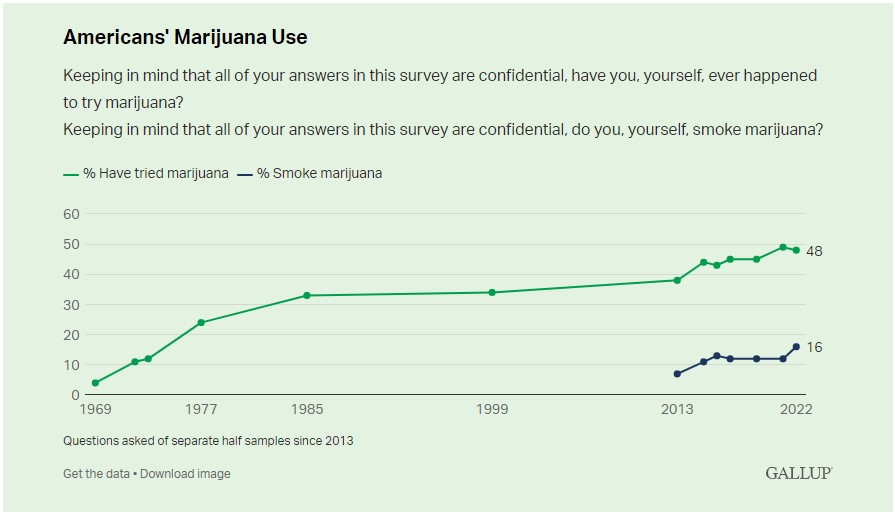
On the other hand, marijuana usage has climbed steadily since Gallup first asked about it in 1969. Some 16% of Americans say they currently smoke marijuana, while a total of 48% say they have tried it at some point in their lifetime:

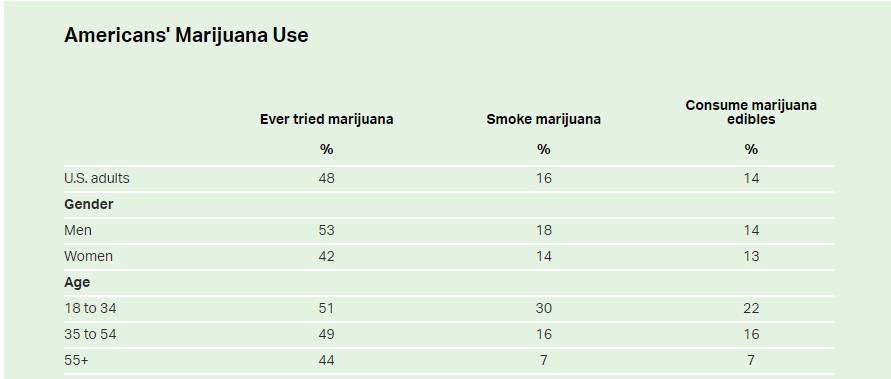
Younger adults (18-34) are much more likely to be current users, but the 55+ crowd tried it nearly as much (44%) as the younger cohorts:

Among all adults, opinion is about evenly split on whether marijuana has a positive or negative effect on society and on people who use it. However, opinion is skewed very positive among those who have actually tried it, and negative among those who have not:

(I can’t resist inserting a consistent anecdotal observation by reliable people I know or know of, that habitual smoking of MJ tends to be highly correlated with passivity / lack of initiative, especially among young men. When one young man I know of told his counselor, “Nothing happens [when I smoke weed]”, the response was, “That’s the problem, nothing happens [because with weed you just chill and don’t do the stuff you need to do].” Of course, correlation says nothing about the direction of causation here).

The big gorilla of substance usage is still alcohol. About 45% of Americans have had an alcoholic drink within the past week, while another 23% say they use it occasionally. Alcohol use has remained relatively constant over the years. The average percentage of Americans who have said they are drinkers since 1939 is 63%, which is close to Gallup’s most recent reading of 67%.

Saving a Rusted Car with Rust Bullet Paint and Cosmoline RP-342 Coating

Corrosion is estimated to cost about $250 billion per year in the U.S. alone, so it is economically significant. The impact of corrosion hit home for me when I noticed that near the bottom of the right rear wheel well of my little 2007 sedan, a 2-3” hole had rusted right through the metal, exposing some inner chambers to water and salt and sand thrown from the wheel. The rust does not look like it has compromised the vehicle’s mechanical integrity (a real concern, since today’s cars rely on the body sheet metal for strength), but if it keeps on going it could turn my chariot into a junker.

I called an honest local body shop, and the guy told me it would probably cost more than the car is worth to fix it properly (replace the rocker panels, etc.), and  it might run $1700 just to do a patch job.

Being a (retired) chemical engineer, I decided to read up on ways to deal with rusting metal. Especially, how to arrest the progress of rust. The most serious way is to do major surgery with cutting tools, and cut out all the rust, and weld good metal back in, and paint it all well. That is out of my league. So I looked for coatings that could stop the rusting progress.

I have written an article on a different blog describing the various classes of coatings and rust converters that are available. For my project, I chose to use Rust Bullet, ordered from Amazon.

This can be painted directly on rusty metal surfaced, after scraping away all the loose rust. This stuff chemically reacts with the remaining surface rust to make it more inert, and also forms an impermeable seal over the surface, to block further water and oxygen from reaching the metal. It sticks to rusty and non-rusty surfaces. It seems to get good reviews.

One peculiarity of Rust Bullet is that if many hours have elapsed after application its surface gets so smooth that that that the next layer of Rust Bullet or top coat paint will not stick unless you sandpaper the smooth, hard, silvery surface. It’s easiest, therefore, to leave only 2 hours or so between coats of paint, to avoid the bother of sandpapering.

After two coats of Rust Bullet, I applied a top coat of Rustoleum enamel paint (white on the outside of the car, black on interior surfaces).

Some rust had started on surfaces of the inner chambers of sheet metal that had been exposed by the rusted-out hole. I could not readily reach them with a paint brush to apply Rust Bullet. I wanted to spray something that would form a coating that would inhibit further rusting. I settled on Cosmoline RP-342, ordered from the manufacturer.

This stuff sprays on like a thick oily liquid, that should soak into any rust. After maybe 2 hours, it hardens up to a very impermeable, fairly tough waxy coating. It will keep water off surfaces, though I don’t know about oxygen. Anyway, I sprayed the Cosmoline into the available openings, to try to coat the surfaces of the inner chamber parts. (If I had known about it in time, I might have chosen Eastwood Internal Frame Coating instead of Cosmoline for this step.) I was able to coat most, though not all, of the vulnerable surfaces. This was all with me lying on my side, beside/under the car, without great ergonomic access.

I then used several layers of aluminum foil duct tape (learned this trick from YouTube) to seal up the holes in the car body, then added a final coat of white or black Rustoleum. This has pretty well protected the car body there from further exposure to water/sand/sand. It should give me a couple more years of use, all for two days of picky handwork plus the cost of materials.

Putin as the New Hitler: The Russian Political Philosophy Which Justifies Unlimited Atrocities (To Save the World)

When the Nazis in the mid-twentieth century carried out schemes to kill millions of people (soldiers and civilians), they did not say, “Yes, we are evil, but we have the most guns.” Rather, they espoused a political philosophy to justify their actions. According to this Wikipedia entry, the Nazis held that they were simply carrying out normal, healthy, natural selection (the strong eliminating the weak) by having the “superior” race kill and displace the inferior races of humans. Germans therefore felt justified in occupying lands in Eastern Europe, Russia, and Ukraine, to provide “living space” and agricultural production for the master race.

It seems that a somewhat similar political philosophy has taken hold among Russian elites. This became evident early on in Russia’s 2022 invasion of Ukraine, when the Russians bombed a children’s shelter and a maternity hospital. Since then, there have been innumerable bombings of apartment buildings, shopping malls, etc., as deliberate murderous attacks on civilians, rather than having any direct military benefit. The Russians are killing  Ukrainians with the sort of callous abandon displayed by the Nazis towards “undesirables”. The initial Russian complaints about Ukraine joining NATO have disappeared; it is clear that Russia wants to simply erase Ukraine as an entity. It seems that this has been Russia’s plan under Putin for many years. Reportedly, Russian textbooks since around 2014 have deleted discussion of Ukraine as a separate nation.

Where did this toxic outlook come from? According to many observers, a chief architect for this view is political philosopher Aleksandr Dugin. German professor Antony Mueller has summarized some of Dugin’s positions:

Russians are “eschatologically chosen.” They must stand against the false faith, the pseudoreligion of Western liberalism and the spread of its evil: modernity, scientism, postmodernity, and the new world order. This is the thesis of Aleksandr Dugin, the prominent Russian philosopher, and a mentor of the Russian president Vladimir Putin…His theory is a “crusade” against postmodernity, the postindustrial society, liberal thought, and globalization… For Dugin, America is a threat to the Russian culture and to Russia’s identity. He makes his position unmistakably clear when he declares:

“I strongly believe that Modernity is absolutely wrong and the Sacred Tradition is absolutely right. USA is the manifestation of all I hate—Modernity, westernization, unipolarity, racism, imperialism, technocracy, individualism, capitalism.”

Dugin apparently believes that the world, or at least Eurasia, can only be saved from the ravages of “modernity” and American influence by uniting under Russian leadership  and returning to the Sacred Tradition of “religion, hierarchy, and family.”

An independent Ukraine stands in the way of this grand vision. From the Guardian:

Dugin’s worldview is most clearly articulated in his 1997 publication “The Foundations of Geopolitics”, which reportedly became a textbook in the Russian general staff academy and solidified his transition from a dissident to a prominent pillar of the conservative establishment.

In the book, Dugin laid out his vision to divide the world, calling for Russia to rebuild its influence through annexations and alliances while proclaiming his opposition to Ukraine as a sovereign state.

“Ukraine as a state has no geopolitical meaning, no particular cultural import or universal significance, no geographic uniqueness, no ethnic exclusiveness,” he wrote.

… Twenty-five years later, Russia’s president repeated some of Dugin’s views on Ukraine in his 4,000-word essay “On the Historical Unity of Russians and Ukrainians”, which many saw as a blueprint for the invasion he launched just six months after it was published.

And as far as Ukrainians resisting Russia’s neo-imperial ambitions, Dugin said, “I think we should kill, kill, kill [Ukrainians], there can’t be any other talk.”

There you have it. The exact influence of Dugin on Putin is debated, but there is no doubt that Dugin’s views are influential in the circles of Russian decision makers. Many Westerners thought early on that Putin would be satisfied with conquering the Russian-speaking Donbas region in the east, and a narrow land bridge to connect that with the Russian-occupied Crimea. His attempts, foiled by heroic Ukrainian resistance, to take Kiev and to take Odessa in the southwest showed that he wants the whole enchilada.

This could be a long war.

~~~~~~~~~~~~~~~~~~~~~~~~~~~~~~~~~~~~~~~~~

Addendum: Dugin’s daughter was killed by a car bomb near Moscow on August 20, 2022. Reportedly the bomb was aimed at Dugin himself, since he was expected to be in the car with his daughter. Moscow accused Ukraine of the assassination, which Kiev plausibly denies. There is also reasonable speculation that a Russian government agency (presumably with Putin’s tacit approval) was aiming to bump off Dugin, for some Byzantine reason.

High Yield Investing, 2: Types of Funds; Loan Funds; Preferred Stocks

Types of Funds: Exchange-Traded, Open End, and Closed End

Some investors like to pick individual stocks, while others would rather own funds that own many stocks.  For bonds, investors usually own funds of bonds rather than taking possession of individual bonds.

A straightforward type of fund is the exchange-traded fund (ETF). This holds a basket of securities such as stocks or bonds, and its price is constantly updated to reflect the price of the underlying securities. You can trade an ETF throughout trading hours, just like a stock. If you simply hold it, there will be no taxable capital gains events. Many ETFs passively track some index (e.g. the S&P 500 index of large company stocks) and have low management fees.

An open end mutual fund also trades close to the value of the baskets of securities it holds, but not as tightly as with an ETF. You can place an order to buy or sell an open end fund throughout the day, but it will only actually trade at the end of the day, when the share price of the fund is updated to the most recent value of the net asset value. A quirk of open end funds is that buying and selling by other customers can generate capital gains for the fund, which get distributed to all shareholders. Thus, even if you are simply holding fund shares without selling any, you may still get credited with, and taxed on, capital gains. Also, if a lot of shareholders sell their shares at the bottom of a big dip in prices, the fund must sell the underlying securities at a low price to redeem those shares. This hurts the overall value of the fund, even for customers who held on to their shares through the panic.

Some open end mutual funds offer skilled active management which may meet your needs better than an index fund. For instance, the actively-managed Vanguard VWEHX fund seems to give a better risk/reward balance than the indexed junk bond funds.

Closed-end funds (CEFs) are more complicated. A closed-end fund has typically has a fixed number of shares outstanding. When you sell your shares, the fund does not sell securities to redeem the shares. Rather, you sell to someone else in the market who is willing to buy them from you. Thus, the fund is protected from having to sell stocks or bonds at low prices. The fund’s share price is determined by what other people are currently willing to pay for it, not by the value of its holdings. Shares typically trade at some discount or premium to the net asset value (NAV). The astute investor can take advantage of temporary fluctuations in share prices, in order to buy the underlying assets at a discount and then sell them at a premium. CEFs are typically actively managed, and employ a wider range of investment strategies than open-end funds or ETFs do. CEFs can raise extra money for buying interest-yielding securities by borrowing money. This leverage enhances returns when market conditions are favorable, but can also enhance losses.

Bank Loan Funds

One type of debt security is a loan. Banks can make loans to businesses, with various conditions (“covenants”) associated with the loans. Banks can then sell these loans out into the general investment market.

Most commercial loans are floating-rate, so the interest received by the loan holder will increase if the general short-term commercial interest rate increases. Thus, the loan holder is largely protected against inflation. Loans typically rank higher than bonds in order of payment in case the company goes bankrupt, and some loans are secured by liens on particular company-owned assets like vehicles or oil wells. For these reasons, in the event of bankruptcy, the recovery on loans is higher (around 70%) than for bonds (average around 40%).

Various funds are available which hold baskets of these bank loans, also called senior loans or leveraged loans. One of the largest loan funds is the PowerShares Senior Loan ETF (BKLN), which currently yields about 4.5%. Most of its loans are rated BB and B, i.e. just below investment grade.   There are also closed end funds which hold bank loans, which yield nearly twice as much as the plain vanilla BKLN ETF, by virtue of employing leverage, selling at a discount to the actual asset value of the fund, and expertly selecting higher yielding loans.  For instance,  the Invesco Senior Income Trust (VVR), which I hold,  currently yields 8% , which is enough to keep up with inflation.      

High-Dividend Common Stocks

Most “stocks” you read about are so-called  common stocks. Most company common stocks are valued for their potential to grow in share price or to steadily keep increasing the size of their dividend. The average dividend yield for the S&P 500 stocks is about 1.6%, which is lower than the current yield of the (risk-free) 2-year Treasury bond.

There are some regular (C-corporation) stocks which are not expected to grow much, but which pay relatively high, stable dividends. These include some telecommunication companies like AT&T (T; 6.5%) and Verizon (VZ; 5.9%), electric utilities like Southern (SO; 3.5%) and Duke (DUK; 3.7%), and petroleum companies like ExxonMobil (XOM; 3.6%). Investors might want to buy and hold some of these individual stocks, since these are among the highest yielding, high quality stocks. Broader funds which focus on large high-quality, high-yielding stocks tend to have lower average yields than the stocks mentioned above. For instance the Vanguard High Dividend Yield Index Fund (VHYAX) currently yields only about 3.2 % .  

Preferred Stocks

Companies, including many banks, issue preferred stocks, which behave more like bonds. They  often yield more than either bonds or common stock. Like bonds, most preferreds have a fixed yield; some convert from fixed to floating rate after a certain number of years. Unlike bonds, most preferreds have no fixed redemption date. Fixed-rate preferreds are vulnerable to a large loss in value if interest rates rise, since the shareholder is stuck essentially forever with the original, low rate. On the other hand, if interest rates drop, a company typically can, after a few years, redeem (“call”) the preferred for its face value (typically $25) and then issue a new, lower-yielding preferred stock.

Preferred shares sit above common stock but below bonds in the capital structure. Companies have the option of suspending payment of the dividends on preferred stock if financial trouble strikes. However, a company is typically not permitted to pay dividends on the common stock if it does not pay all the dividends on the preferred stock.

The largest preferred ETF is iShares US Preferred Stock (PFF). It yields about 5.8%, but holds mainly fixed-rate shares. The PowerShares Variable Rate Preferred ETF (VRP; 5.9%  yield) holds variable or floating rate shares, which helps insulate investors from the effects of interest rate raises. The First Trust Intermediate Duration Preferred & Income Fund (FPF) is a closed end fund with more than half its holdings as floating rate. Due to use of leverage and selling at a discount, the fund yield is a juicy 7.9%.

My favorite class of high yield investments is business development companies, discussed here.

Happy investing…

High Yield Investments, 1: Some Benefits of High Yield Stocks and Funds

A Case for High-Yield Investments

The data I have seen indicates that if you don’t need to draw down your investment for twenty years or more, you may do well to put it all in stock funds and just leave it alone. For reasons discussed here  the average investor will likely do better to buy an index fund like the S&P 500 rather than trying to pick individual stocks. The long term average return (including reinvested dividends) in the U.S. stock market has been about 10 %  before adjusting for the effects of inflation. (All my remarks here pertain to U.S. investments; hopefully some aspects may be applicable to other countries).

However, particularly as you age, financial advisors typically counsel investors to allocate some portion of their portfolio to more-stable fixed-income securities that generate cash to spend and keep you from having to sell stocks during a market downturn. Historically, long-term investment grade bonds have been used to provide steady cash, and to serve as an asset which often went up if stock went down. Thus, a 60/40 stock/bond portfolio was considered prudent. That model has been less useful in recent years, since bond yields have been so low, and since long-term bonds sometimes fall along with stocks, e.g. if long-term interest rates rise.

Another driver now for allocating some savings into non-stock investments is that after the large run-up in stocks last few years, which has far exceeded gains in actual earnings, the market may well muddle along flatter in the coming decade. In regular stock investing, you are banking primarily on stock price appreciation – you are counting on someone else paying you (much) more for your shares some years hence than you paid for them. But what if the “greater fools” don’t materialize to buy your shares?

Also, the inflation genie has been let out of the bottle, and it may be tough to get inflation back under say 4%; investment grade bonds are yielding appreciably less than inflation these days, so you are losing money to buy regular bonds.

Finally, if your stock is cranking out say 8% cash dividends, and you are holding it for those dividends rather than for price appreciation, when the market crashes (and this particular stock goes down in price, along with everything), you can be blithe and unruffled. In fact, you can be mildly pleased if the price goes down since, if you are reinvesting the dividends, you can now buy more shares at the lower price. Trust me, this psychological benefit is important.

Some High Yielding Alternative Investments

In this blog over the coming weeks/months we will identify several classes of securities which generate stock-like returns (around 7-10 % returns, if the dividends are continually reinvested) via dividend distributions rather than through share price appreciation. These securities often have short-term volatility similar to stocks, so they should be treated in the portfolio as partly as stock-substitutes rather than as substitutes for stable high-quality bonds. However, the better classes of high yield investments maintain their share prices over a long (e.g. 5-year) period, similar to bonds, but with much higher yields.

We will discuss High-yield (“junk”) bonds , senior bank loans, preferred stocks, Real Estate Investment Trusts (REITs), Business Development Companies, Master Limited Partnerships,   and selling options (put/calls) on stocks.  

I’ll close today with three examples of these high yield securities, which I have happily held for many years. They yield 8-9%, and their share prices have held relatively steady over the past five years:

Cohen&Steers Total Return Realty Fund (RFI). Current yield: 8.0 %

Ares Capital   (ARCC)   Current yield:  8.1%

Eaton Vance Tax-Managed Buy-Write Opportunities Fund (ETV). Current yield: 8.8%                    

(Charts from Seeking Alpha)

Some Countries Use Too Much Fertilizer, and Some Use Too Little

In a world where China and India continue to build huge, CO2-belching coal power plants, and a world where global supply chains can no longer be taken for granted, you might think that a small, crowded country like the Netherlands would prioritize home-grown food production over concerns about greenhouse gas emissions from a relatively small volume of cow manure. But this is Europe, the land of eco-utopianism, and so you would be wrong.

Cow poop does emit nitrous oxide (a greenhouse gas) and ammonia (which can potentially pollute local water if uncontained). In a burst of green virtue,  the Netherlands has, “unveiled a world-leading target to halve emissions of the gasses, as well as other nitrogen compounds that come from fertilizers, by 2030, to tackle their environmental and climate impacts.” This target is expected to result in a 30% reduction in livestock numbers and the closure of many farms. Dutch farmers are not amused, and have vented their ire by dumping hay bales on highways and smearing manure outside the home of the agricultural minister. Protests over green policies hobbling local farmers have spread to Germany and Canada.

All this raised in my mind the question, could we really get along with using much less nitrogen-based fertilizers? I found a great article by Hannah Ritchie on OurWorldinData.org, “Can we reduce fertilizer use without sacrificing food production?”, which provides lush tables and graphs on the subject.

First, it’s estimated that artificial nitrogen fertilizers (where hydrogen, mainly derived from natural gas, is reacted with atmospheric nitrogen at high pressure over catalysts to make ammonia and derivatives) allow the world’s population to be about twice as high is it would be otherwise. Put another way, take away nitrogen fertilizers, and half of us die. So any campaign to massively scale back on fertilizer usage would result in mass starvation. You first…

That said, Ritchie’s article pointed out that some countries such as China seem to be (inefficiently) using much more fertilizer than they need to get similar results, some countries (e.g. America) seem to be about in balance, and some areas (e.g. sub-Saharan Africa) would benefit from using more fertilizer. So globally we could probably use a bit less fertilizer if the profligate countries used (a lot) less, while the deprived countries used a little more.

I’ll conclude with two charts from Ritchie’s article. The first chart shows, for instance, that Brazil uses twice as much fertilizer per hectare or per acre as the U.S, and China uses three times as much, while Ghana uses about a tenth as much.

The second chart shows estimated nitrogen use efficiency (NUE). An NUE of 40%, for instance, shows that 40% of the nitrogen in the fertilizer is converted to nitrogen in the form of crops, while the other 60% of the nitrogen becomes pollutants. In China and India, only about a third of the applied nitrogen is fully utilized, compared to two thirds in places like the U.S. and France. ( Some countries have a very high NUE – greater than 100%. This means they are undersupplying nitrogen, but continue to try to grow more and more crops. Instead of utilizing readily available nutrients, crops have to take nitrogen from the soil. Over time this depletes soils of their nutrients which will be bad for crop production in the long-run).

Aging Populations = Inevitable Slow GDP Growth?

Last month Eric Basmajian published “Why Demographics Matter More Than Anything (For The Long Term)” on the financial site Seeking Alpha. He predicts that that the developed world plus China face a future of low economic growth (regardless of policy machinations) due simply to demographics. His key points:

Demographics are the most important factor for long-term analysis.

The young and old age cohorts negatively impact economic growth.

The prime-age population (25-64) drives the bulk of economic activity.

The world’s major economies are suffering from lower population growth and an older population.

Over the long run, the world’s major economies will have worse economic growth, which will negatively impact pro-cyclical asset prices (like stocks).

I will paste in some of his supporting charts. First, the labor force is more or less proportional to the 25-64 age cohort (U.S. data shown) :

…and GDP growth trends with labor force growth:

Also, on the consumption side, that is highest with the 25-54 age group:

And so,

Younger people are a drag on economic growth and older people are a drag on economic growth… The prime-age population is the segment that drives economic activity, so if the share of population that is 25-54 is shrinking, which it is, then you’re going to have more people that are a negative force than a positive force:

Once the working-age population growth flips negative, an economy is doomed…. Working age population growth in Japan flipped negative in the 1990s, and they moved to negative interest rates, QE, and they have never been able to stop. The economy is too weak.

After 2009, the working-age population in Europe flipped negative, and they moved to negative rates and QE, and they haven’t been able to stop. Even now, as the US is raising rates, Europe is struggling to catch up and has already abandoned most of its tightening plans.

In 2015, China’s working-age population flipped negative, and they’ve had problems ever since. They devalued their currency in 2015 and tried one more time to inflate a property bubble, but it didn’t work, and now they’re having to manage the deflation of an asset bubble that the population cannot support.

The US is in better shape than everyone else, but we’re not looking at robust growth levels in this prime-age population.

In conclusion, “ The real growth rate in most developed nations is collapsing because of those two factors, worsening demographics, and increased debt burdens.    In the US, as a result of the demographic trends I just outlined plus a rising debt burden, real GDP per capita can barely sustain 1% increases over the long run compared to 2.5% in the 60s, 70s, and 80s.”

That is pretty much where Basmajian leaves it. No actionable advice (besides subscribing to his financial newsletter). What isn’t addressed is whether productivity (production per worker) can somehow be accelerated. Also, one of his charts (which I did not copy here) showed a big trend down in 25-64 age fraction in the US population in the 1950’s-1960’s (as hangover from the Depression?), and yet these were decades of strong GDP growth. So these demographic trends are not the whole story, but his analysis is sobering.