The Transition to a Market Economy: Did Former Soviet Republics Fail?

This semester I am participating in a reading group with undergraduate students that focuses on the history and prospects for capitalism and socialism. Lately we have been reading Joseph Stiglitz, who has long argued that China’s transition to a market economy has gone much better than the former Soviet Union. Gradual transition is superior to “shock therapy,” according to Stiglitz.

There’s an extent to which this is true. If we just look at economic growth rates since, say, 1995, China has clearly outpaced Russia.

Source: Our World in Data

It’s hard to know exactly what year to start, since GDP figures for former planned economies immediately after transition aren’t reliable, but the start date is mostly irrelevant for everything I’ll say here (please play around with the start year in the charts to see if I’m cherry-picking years). 1995 seems a reasonable enough year to start for reliable post-transition starting point.

As we see above, while Russia has had a rough doubling of GDP per capita since 1995 (respectable, and yes, it’s all adjusted for inflation!), China has soared almost 600%. Wow! But this is something of a cheat. Despite all that growth, average income in China is still lower than Russia: only about 60% of Russia in 2020. China started from a much lower level, meaning that faster growth, while not guaranteed, is at least easier to achieve. In fact, if we go back to 1978, when China’s first reforms began, GDP per capita in the Former USSR was about 6 times as high as China (that’s according to the latest Maddison Project estimates, which will always be speculative for non-market economies, but are the best we have).

Furthermore, Russia hasn’t really transitioned to a democracy either. China clearly hasn’t, but no one doubts that. But despite having the outward symbols of democracy (elections, a legislature, etc.), Russia still scores low on most indexes of democracy and civil liberties. For example, Freedom House scores them at 19/100, a little better than China (9/100), but nothing like Western Europe.

So, did the quick transition to market economies fail? Not so fast. While it did fail in Russia, in most of Eastern Europe and the eastern part of the former USSR seems to have been a major success. Take a look at this chart, which shows the former Soviet Republics in and near Europe (I exclude Central Asian FSRs).

Source: Our World in Data
Continue reading

Russia, The US, and Crude Data

Overall, I’ve been disappointed with the reporting on the US embargo against Russian oil. The AP reported that the US imports 8% of Russia’s crude oil exports. But then they and other outlets list a litany of other figures without any context for relative magnitudes. Let’s shine some more light on the crude oil data.*

First, the 8% figure is correct – or, at least it was correct as of December of 2021. The below figure charts the last 7 years of total Russian crude oil exports, US imports of Russian crude oil, and the proportion that US imports compose.  That 8% figure is by no means representative of recent history. The average US proportion in 2015-2018 was 7.8%. But the US share as since risen in level and volatility. Since 2019, the US imports compose an average of 11.9% of all Russian crude oil exports.

As an exogenous shock, the import ban on Russian crude oil might have a substantial impact on Russian exports. However, many of the world’s oil importers were already refusing Russian crude. The US ban may not have a large independent effect on Russian sales and may be a case of congress endorsing a policy that’s already in place voluntarily.

Continue reading

Gas Prices are High — But Don’t Adjust Them for Inflation!

Gasoline prices are high and rising. Anecdotally, they seem to be increasing at the pump by the hour. And indeed, in nominal terms they are now the highest they have ever been in the US (this is true with both the AAA daily price level and the EIA weekly price level). At over $4.10 per gallon, the price now exceeds the peaks briefly hit in 2008, 2011, and 2012. And it’s looking like this peak might not be so brief.

But we all know you can’t compare nominal dollars over long periods of time. We need some context for this price! Plenty of news stories provide what they think is the right context: adjust it for inflation! For example, USA Today reports that today’s price “would come to around $5.25 today when adjusted for inflation.”

$5.25: that’s a pretty concrete number. But it’s not really useful. OK, so clearly that’s higher than the current price, about 20% higher in fact. Still, it doesn’t really give us the right context.

As I argued in a previous post on housing costs, inflation adjustments aren’t always the best way to contextualize a historical number. Yes, when you want to compare income or wages over time, it’s good to adjust for inflation. It’s necessary, in fact. And a good economist will always do that.

However, when comparing particular prices over time, it doesn’t really make sense to adjust for other prices. All you are really saying is “if the price of gasoline increased at the same rate as the average price level, here’s what it would be.” Perhaps slightly useful, but it doesn’t really get at the thing we’re really try to address: is gasoline more or less affordable than in the past?

The best approach is to adjust the prices for changes in wages or income. Which measure of wages or income you choose is important, but it’s the best adjustment to make. No need to make any inflation adjustments, are worrying about whether the index you choose is properly accounting for quality changes, substitution effects, etc. If you want to know how affordable something is, compare it to income.

Here’s what I think is the best simple comparison for gasoline, which I’ll explain it below. In short, it tells us how many minutes the average worker would need to work to purchase one gallon of gasoline.

Since the price of gasoline is rising sharply every day lately, my chart will surely be out of date very soon. But right now, it’s the most current data I could provide with a comparable historical series: EIA weekly data current through March 7th, 2022 (Monday). We can see that at current prices, it takes about 9 minutes of work at the average wage to purchase a gallon of gasoline. At the peak in 2008, it took over 13 minutes of work to purchase a gallon, and it fluctuated between 10 and 12 minutes of work for much of 2011-2014.

Continue reading

Two Decades of Real Estate Data

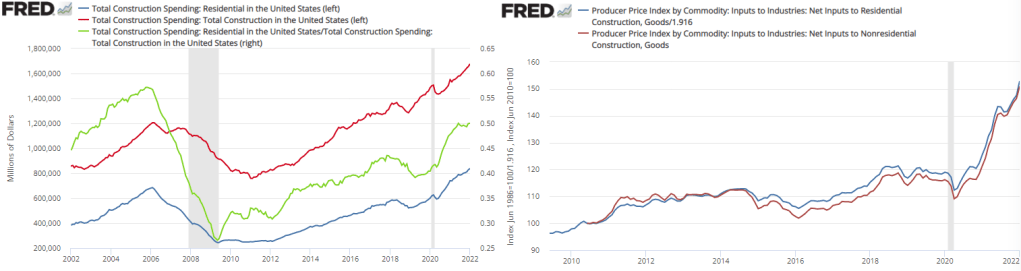
Total spending on real estate construction has been rising since 2011. By 2016 it had reached its previous 2006 peak. However, total spending on *residential* real estate construction didn’t reach its previous 2006 peak until November of 2020. The graph below also includes the proportion of residential construction spending (Green). It has been rising since 2009. In and of itself, nothing is good or bad about this figure. We might be spending less on non-residential construction because we are getting better at using less land per unit of good or service produced. Or, it could be that our real investment in future production is falling relative to our current residential consumption.  Regardless, the share of residential construction hasn’t been at this level since 2003.

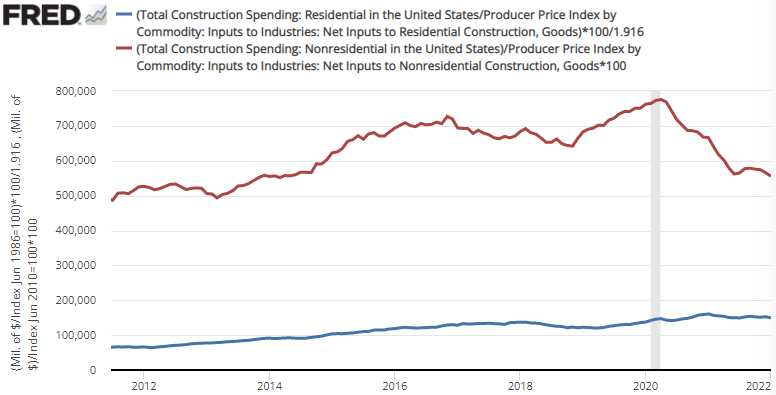
Importantly, the difference in spending has not been driven by different construction costs. Both residential and non-residential construction costs have moved in tandem since 2010. Therefore, the rise in residential construction spending is not merely nominal – a greater proportion of resources are being consumed by residential construction. Indeed, real residential construction is up about 25% from 2019. The figure below illustrates real residential and nonresidential construction.

That figure requires a double-take.

Continue reading

The Taxman Comes for Homer

Last week I wrote about the Simpsons’ mortgage payment. In short, I found that using a reasonable assumption of Homer’s income, the median housing price, and the rate of interest, the Simpsons are likely paying less of their household budget on housing today than in the 1990s.

But what about the family’s taxes? Are they getting squeezed by the taxman? Taxes are referenced throughout The Simpsons series. Here’s an article that collects a lot of the references. And that makes sense: the Simpsons are a normal American family, and normal American families love to complain about taxes.

Using the same reasonable assumption about Homer’s income from last week’s post (that Homer earns a constant percentage of a single-earner family, rather than merely adjusting for inflation), we can calculate the family’s average tax rate and how it has changed over the year. Conveniently, “average tax rate” is just economist speak for “how much of your family’s budget goes to the government.”

First, let’s just look at the federal income tax, since this is where most of the changes happen. Don’t worry, I’ll add in payroll taxes below, though this is a constant percent of the family’s budget since it is a flat tax on income!

The chart below shows the average tax rate the Simpsons paid for their federal income taxes. I didn’t go through every year, because: a) it’s a lot of work (I’m doing each year manually); and b) it’s more interesting to look at years right after or before major changes in the tax code. So no cherry picking here — the years selected are picked to tell a mostly complete story.

I’ll now briefly explain each of the years chosen, and what changes in the tax code impacted the Simpsons. But as you can see, just like their mortgage payment, the Simpsons are now spending less of their household income on federal income taxes (don’t worry, the trend is similar with payroll taxes included). In fact, they are now getting a net rebate from the federal government, and have been since the late 1990s!

Continue reading

How to Set Working Directory in R for Replication Packages

The AEA Data Editor kicked it all off with this tweet:

“Please stop using “cd” (in Stata) or “setwd()” (in R) all over the place. Once (maybe, not really), that’s enough.”

Replies proliferated on #EconTwitter this week. In this blog post I am collecting solutions for R.   These days you might share the code used to generate your results for an empirical paper. That code would ideally be easy for other people to run on their own computers. File paths are hard (as I blogged previously).

A project for a single paper might have multiple code files. The code interacts with data stored somewhere. Part of the task of the code is to point the statistical program to the data set. It is frustrating if an outsider is trying to replicate a result and must alter the code in multiple places to point to their own location of the data.

Here is a concise summary of good practice, for any code language: “cd and setwd() specify the directory. When you share code and run on a different computer, they don’t work. Therefore, good practice to only specify once, at the beginning”

Continue reading

Inflation Empirics

Way back in the late 1970s and early 80s, Kydland and Prescott proposed rational expectations theory. This line of research arose, in part, because the Phillips curve ceased to describe reality well. Amid increasing inflation, people began to anticipate higher prices to a relatively correct degree when making labor, supply chain, and pricing decisions. Kydland and Prescott argued that individuals understand the rules of the game or how the world works – at least on average.

An increase in the money supply would increase total national spending, and increase demand for goods. However, firms also experienced increasing revenues and demanded more inputs such as commodities, capital, and intermediate goods. Because there were no greater productivity earlier in the supply chain, price roses. Firms began to understand that greater demand would eventually find its way to causing greater costs. Therefore, firms began raising prices before the cost of resources rose, increasing their willingness to pay for inputs and, ironically, hastening the increase in input prices. As a result, increases in the money supply began having substantial short-run price effects and negligible output effects.

However, assuming that people understand the rules of our economic system and ‘how the world works’ is hard to swallow. It is not at all clear that the typical economist understands monetary theory, much less clear that the typical person has a good understanding. Fortunately, another theory of expectations can help carry some of the load and achieve similar results.

Adaptive Expectations

Continue reading

Economics of the Russia-Ukraine Conflict

Russia launched a full invasion of Ukraine last night. Most of the discussion I’ve seen has naturally focused on the fighting itself- what is happening, what is likely to happen, how did it come to this.

Since there are plenty of better sources to follow about that, I’ll simply offer a few observations on the economics of the conflict:

  1. Russia is not only more than 3 times as populous as Ukraine, it also more than twice as well off on a per-capita basis. This means its overall economy is more than 6 times the size of Ukraine’s. This gap has been growing since the fall of the Soviet Union, as Russia’s per-capita GDP growth has been much stronger, while its population has shrunk much less than Ukraine’s. Putting this together, Ukraine’s measured real GDP is actually smaller than it was in 1990, while Russia’s is larger.

2. Russia’s much larger economy allows it to spend much more on its military. Russia spends $60 billion per year, the 4th most of any country (after the US, China and India). Ukraine spends only $6 billion per year on its military. So Russia is starting with a big economic advantage here, though Ukraine has some of its own advantages, like fighting on their own ground and receiving more foreign support.

3. War is bad for business. Russian stocks are down 33% in a day, their biggest-ever loss; Ukraine shut down trading entirely, and their bonds are being hit even worse than Russia’s. Regardless of which side “wins” the fight for territory, both countries will be economically worse off for years as a result of the war.

4. Russia, though, expected that the war would lead to sanctions from the West that would harm their economy, and prepared for this by building up hundreds of billions of dollars worth of foreign reserves over many years.

5. US markets are down only slightly, much less than they would be if traders thought the US would get involved directly in the fighting. But this slight overall decline conceals huge swings. Companies that do business in Ukraine or Russia are big losers. But those that compete with Russian exports see their value rising given the expected sanctions. Because Russia’s biggest exports are oil and natural gas, the value of US-based oil & gas companies is rising, while alternatives like solar are also up substantially.

6. There is still some hope for Ukraine to expel Russian troops, but its not looking good, and even a victory would involve huge costs. This leaves people all over the world wondering, how did it come to this? How might future conflicts like this be avoided? There is of course a lot to say about military preparedness, nuclear umbrellas, and ways the West can impose costs on Russia as a deterrent. But what stands out to me is that a stagnant economy and shrinking population make a country weak and vulnerable. Ukraine has a worse economic freedom score than Russia; this combined with its relative lack of natural resources explains much of the stagnation. Political elites often focus on grabbing a large share of the pie, rather than growing the pie and risk empowering domestic opponents. But we’re now seeing how stagnation carries its own risks. A growing economy, and especially growing energy sources that don’t depend on hostile nations, is the path to independence and survival.

Home(r) Economics

Is it harder to buy a home today than in the past? Many seem to think so. Lately, some people have used the example of the fictional Simpsons family to make this claim. A recent Tweet with around 100,000 likes expressed the sentiment:

The unspoken implication is that today a “single salary from a husband who didn’t go to college” couldn’t buy a typical home in the US. Or at least, it would stretch your budget so thin that you would have to give up something else or need two incomes to support that lifestyle (famously dubbed “the two-income trap” by Elizabeth Warren).

And it’s not just a Tweet that caught fire. A December 2020 article in the Atlantic claimed “The Life in The Simpsons Is No Longer Attainable” and used housing as a prime example. And while a 2016 Vox article on Homer’s many jobs doesn’t mention the cost of housing, they draw a similar conclusion and implication: “Homer Simpson has gone nowhere in the past 27 years — and the same could be said of actual middle-class Americans.”

But is this an accurate picture of the Simpsons family over time? And does that picture accurately represent a typical family in the US? Let’s investigate. And let’s start by pointing out that as measured by the availability of consumption goods, the Simpsons do see rising prosperity over time. They have flat screen TVs now, instead of consoles with rabbit ears, as the late Steve Horwitz and Stewart Dompe point out in their contribution to the edited volume Homer Economicus. But with all due respect to my friends Steve and Stewart, I don’t think many would deny that TVs, cell phones, and computers are cheaper today than in the 1990s. The familiar refrain is “but what about housing, education, and health care?”

In this post I want to take on the question of housing, partially by using the Simpsons as an example. My main result is this chart, which I will present first and then explain.

Continue reading

Health Insurance Benefit Mandates and Health Care Affordability

My article on benefit mandates was published today at the Journal of Risk and Financial Management. It begins:

Every US state requires private health insurers to cover certain conditions, treatments, and providers. These benefit mandates were rare as recently as the 1960s, but the average state now has more than forty. These mandates are intended to promote the affordability of necessary health care. This study aims to determine the extent to which benefit mandates succeed at this goal

I began my research career by writing about these mandates, and my goal with this article was to tie up that whole chapter. I realized that all my articles on benefit mandates, as well as most of what other economists write about them, simply try to measure their costs- how much they raise health insurance premiums, raise employee contributions to premiums, lower wages, lower employment, or harm smaller businesses. Its good to know their costs, but to really evaluate a policy we should learn about its benefits too so that we can compare costs and benefits.

One key benefit that had yet to be measured was how much a typical mandate lowers out-of-pocket health care costs. In this article, I estimate that the average benefit mandate lowers costs by 0.8%-1%. I argue that combining this with a measure of how mandates affect total health spending by households could provide a sufficient statistic for the net benefits of mandates for households. I’m not totally confident this works in theory though, and it has a big challenge in practice- one of my empirical strategies finds that mandates reduce total spending, but the other finds they don’t. So I think the main contribution of the article ends up being the first estimate of how the average state health insurance benefit mandate affects out-of-pocket costs.

I’m currently planning to move on from writing about mandates- other topics are catching my eye, state policymakers don’t seem to particularly care what the research says about mandates, and changes in how economists use difference-in-difference methods are making it harder to publish articles like this that study continuous treatments. But I think there are still big opportunities here for anyone who wants to take up the torch. First, the ACA Essential Health Benefits provision changed the game for state mandates in a way that I have yet to see the empirical literature grapple with. Second, there are more than a hundred separate types of state benefit mandates; in most of my articles I aggregate them but they should really be studied separately. A handful have been, such as mandates for autism treatments, infertility treatments, and telemedicine. But the vast majority appear to be completely unstudied.

P.S. Writing this article gave me two wildly varying opinions of our federal bureaucracy. I tried to get both data and funding from the Agency for Healthcare Research and Quality for this article. The data side worked well- they were surprisingly fast, efficient and reasonable about the process of accessing restricted data. On the other hand, I applied for funding from AHRQ in March 2019 and still have yet to officially hear back about it (it is “pending council review” in NIH Commons). This sort of thing is why nimble organizations like Fast Grants can do so much good despite having much smaller budgets.

P.P.S. This article is part of a special issue on Health Economics and Insurance that is still accepting submissions. I’m the guest editor and would handle your submission, though my own got handled by other editors and put though multiple rounds of revisions.