According to the 2020 Census, Alabama’s population grew by 5% since 2010. Recently, the death rate started to exceed the birth rate in Alabama, as I think it has in most states. Tom Spencer of PARCA reports that most of the population growth in Alabama was driven by people migrating to the state. From 2011 to 2016, those new people were mostly immigrants from other countries. International migration slowed down in 2017, but that is exactly when Alabama experienced a surge (well, a few tens of thousands of people) in domestic migration. I arrived, as it happens, precisely at the start of the domestic migration surge. See my earlier post on the nice weather here.
It’s pretty humid currently in mid-summer. Could that be why Alabamians take summer vacation so seriously? This place really shuts down around the 4th of July so that people can be undisturbed at “the lake”.
You have probably seen the latest inflation data. The headline number is 5.4% increase in prices in the past year as measured by the CPI-U. That’s a lot! Even the Core CPI (removing volatile food and energy) is up 4.5%.
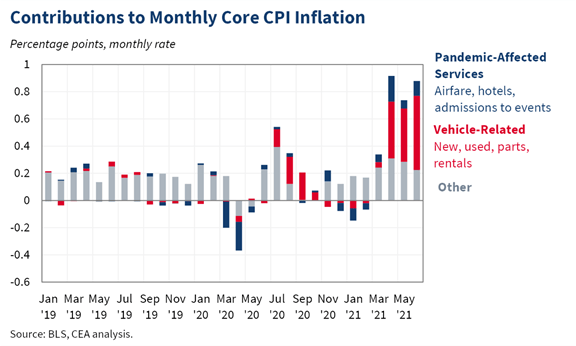
If you follow the data closely, you may also have heard that a big chunk of that increase comes from prices related to automobiles: new cars, used cars, rental cars, car parts. All way up!
If you are in the market to buy a car, or if you really need a rental, it’s a bad time for prices. (Conversely, if you have an extra car sitting around, it’s a great time to sell!)
But what if you aren’t in the market for a car? What does the inflation data look like? The White House CEA tweeted out this chart to deconstruct the factors in the recent CPI release.
Yesterday, co-blogger Jeremy asked “Should Andrew Yang Wait To Concede?” in the New York City mayoral race. He argued that while Yang finished 4th in 1st-place primary votes, the new Ranked Choice Voting system meant he could still win. This is of course true in theory- but today I argue it is very unlikely in practice.
I say this not because I have scrutinized all the polls to predict the exact distribution of 2nd- and 3rd-place votes, or because I think I know more than Jeremy about political science or New York. Instead, any time I’m wondering about whether something will happen and I don’t have a strong opinion based on my own knowledge, I simply check what markets have to say. In this case, there are prediction markets bearing on this exact issue. The odds from PredictIt, shown below, have Adams (who finished with the most 1st-place votes, 32%) as the heavy favorite, with Yang reduced to an approximately 1% chance of winning.
But Jeremy is right to highlight that the Ranked-Choice system makes it less obvious who will win. You can see PredictIt traders still think that Garcia, who finished with 19% of 1st-place votes, is substantially more likely to win than Wiley, who finished with 22% (though the new system didn’t matter in the Republican primary, where Sliwa won with a clear majority of 1st-place votes).
Crypto-based betting platform Polymarket has actually closed their market for Yang already, declaring that he lost, though they agree with PredictIt that the overall election isn’t over and that Garcia still has a real chance despite coming in 3rd for 1st-place votes.
Of course, prediction markets aren’t perfect- they are certainly less accurate (easier to beat) than the stock market, as my track record of betting in both shows. But they make for a great first approximation on subjects you don’t know well, and if you think you do know better, they offer you the chance to make money and to make the odds more accurate. If you think Yang will still win, you can go bet on PredictIt and potentially 100x your money. Or if you think this ranked choice stuff is nonsense and Adams obviously won, you can pick up an easy 10% return. Or if you’re like me in this case, you can stay out of it, take a quick glance at the markets, and get a good idea of what is likely to happen without having to read the news or the pundits.
Yesterday New York City held their mayoral primary elections. This was an exciting event for election system nerds (political scientists and public choice economists) because NYC is now using a form of ranked choice voting to determine the winner.
While this is not the first place in the US to use RCV (Maine, Alaska, and a handful of cities use it), it is still notable for a few reasons. First, this is America’s largest city. Second, there are a lot of viable candidates, which makes RCV especially interesting and useful.
Specifically, NYC is using a form of voting called instant runoff. There are currently 13 candidates, and voters indicate their top 5 in order. If no one has a majority (>50%) of the votes, then the rankings entered by voters come into play. And indeed that is what happened yesterday.
On the first round, only counting first place votes, Andrew Yang came in 4th with just under 12% of the votes. So last night he conceded.
But should Yang have conceded? Maybe not! Let’s explore how instant runoff works.
For population to be steady or rising, the average women needs to have at least two kids. In almost every rich country- including the United States, all of Europe, and all of East Asia- this isn’t happening. In the extreme case of South Korea, where total fertility averages about one child per woman, the population will fall by half each generation. If this were to go on for 10 generations, South Korea would go from a country of 50 million people- larger than any US state- to one of 50 thousand people, far smaller than any US state. This sounds crazy and I don’t expect it will actually happen- but I can’t say what exactly will stop it from happening.
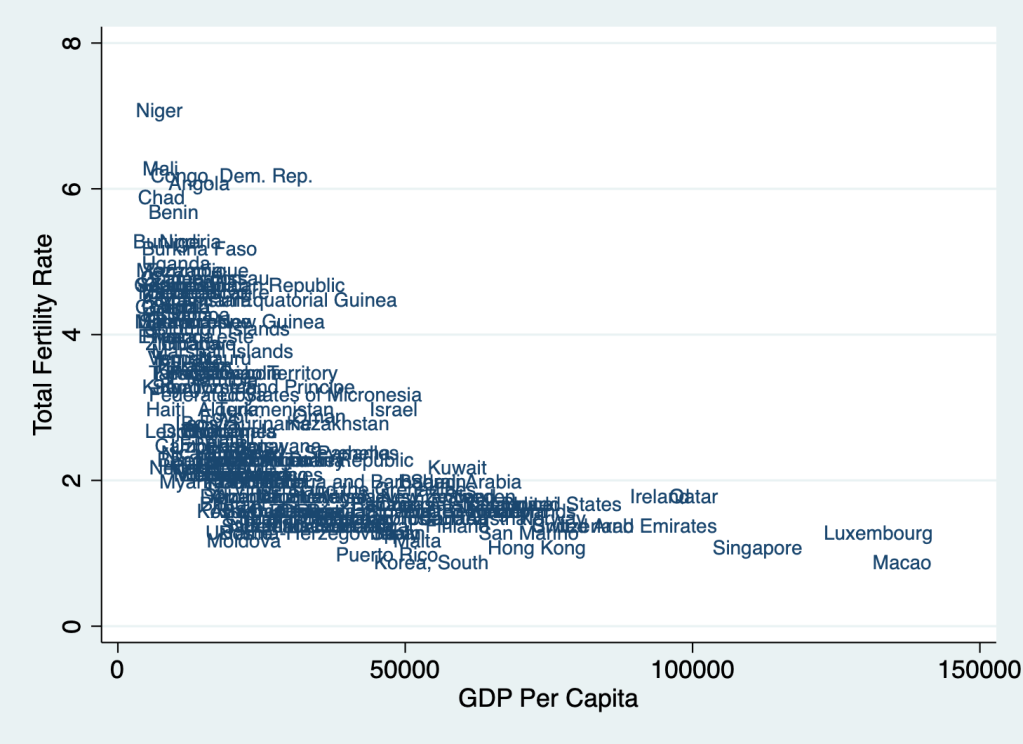
Global population growth has fallen from a peak of 2.1% per year to the current 1%, and is expected to fall to 0 by 2100. The remaining population growth will happen in poor countries, then stop for the same reasons it did in rich countries- the demographic transition from poverty, argicultural work, and high infant mortality to high incomes, high education, and low infant mortality. As the graph below shows, higher income is an incredibly strong predictor of low fertility- and so if economic growth continues, we should expect fertility to continue falling. But where does it stop?
2019 TFR from Population Reference Bureau vs 2019 PPP-adjusted GDP Per Capita fron World Bank
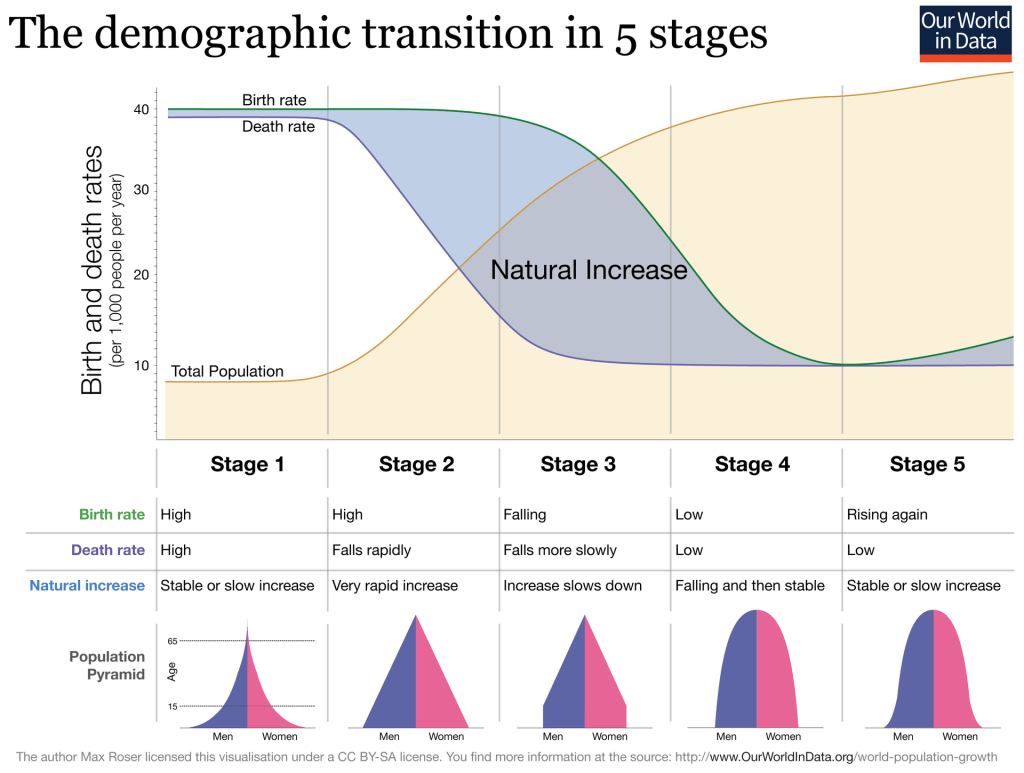
Some have theorized a “J-curve” relationship, where once incomes get high enough, fertility will start rising again. You can see this idea in “Stage 5” of Max Roser’s picture of the demopgraphic transition here:
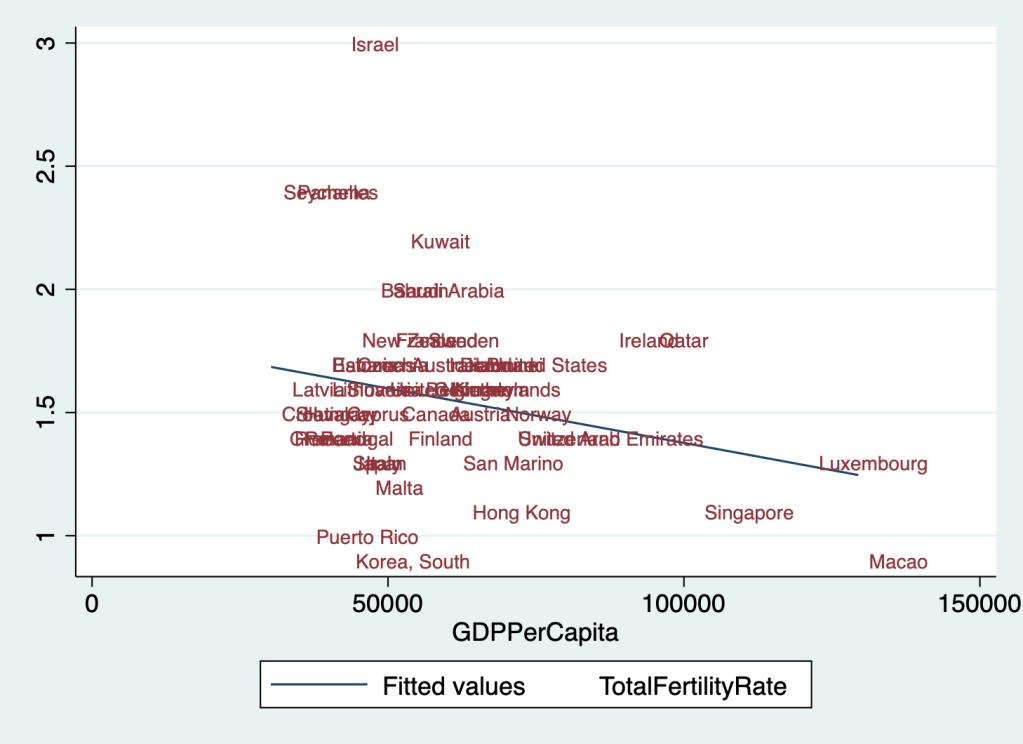
This makes sense to me in theory. As countries get richer, desired fertility (the number of kids each woman wants to have) has fallen, but realized fertility (the number of kids each woman actually has) has fallen faster. In a typical rich country women would like to have 2-2.5 kids, but actually ends up having about 1.5. There are many reasons for this, but some are clearly economic- the high cost of goods and services that are desired by rich-country parents, like child care, education, and spacious housing near high-paying jobs. Perhaps in a rich enough country all these could be obtained with a single income (maybe even from a part-time job). But it seems we aren’t there yet. Even zooming in on higher-income countries, higher incomes still seem to lead to lower fertility.
TFR vs GDP Per Capita in countries with GDP Per Capita over 30k/yr
The only rich countries with fertility above replacement are Panama and the Seychelles (barely meeting my 30k/yr definition of rich), Kuwait (right at replacement with 2.2 kids per woman), and Israel- the biggest outlier, with 3 children per woman at a 42k/yr GDP. This hints that pro-fertility religious culture could be one way to stay at or above replacement. But in most countries, rising wealth seems to drive a decline in religiousity along with fertility. Will this trend eventually come to Israel? Or will it reverse in other countries, as more “pro-fertility” beliefs and cultures (religious or otherwise) get selected for?
To do one more crazy extrapolation like the disappearance of South Korea, the number of Mormons is currently growing by over 50% per generation from a base of 6 million while the rest of the US is shrinking. If these trends continue (and setting aside immigration), in at most 10 generations the US will be majority-Mormon. Again, I don’t actually expect this, but I don’t know whether it will be falling Mormon fertility, non-Mormon fertility somehow rising back above replacement, or somethingelse entirely that changes our path.
What would a secular pro-fertility culture look like? For my generation, I see two big things that make people hold back from having kids: a desire to consume experiences like travel and nightlife that are harder with kids, and demanding careers. I see more potential for change on the career front. Remote work means that more quality jobs will be available outside of expensive city centers. Remote work, along with other technological and cultural changes, could make it easier to work part-time or to re-enter the work force after a break. Improving educational productivity so that getting better-education doesn’t have to mean more years of school would be a game-changer; in the short run I think people will spend even more time in school but I see green shoots on the horizon.
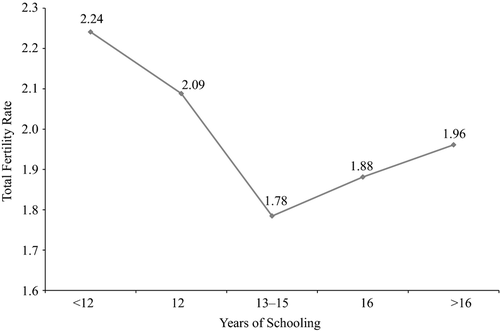
Looking within the US, we are just beginning to see what looks like the “J-curve” happening. Since about the year 2000, women with advanced degrees began to have more children than those with only undergraduate education (though still fewer than those with no college, and still below replacement):
From Hazan and Zoabi 2015, “Do Highly Educated Women Choose Smaller Families?”
We see a similar change with income. In 1980 women from richer households clearly had fewer children, but by 2010 this is no longer true:
Fertility of married white women, from Bar et al. 2018, “Why did rich families increase their fertility? Inequality and marketization of child care”
The authors of the papers that produced the two graphs above argue that this change is due to “marketization”, the increasing ability to spend money to get childcare and other goods and services that make it easier to take care of kids. If this is true, it could bode well for getting back to replacement- markets first figure out how to make more excellent daycare and kid-related gadgets, then figure out how to make them cheap enough for wide adoption.
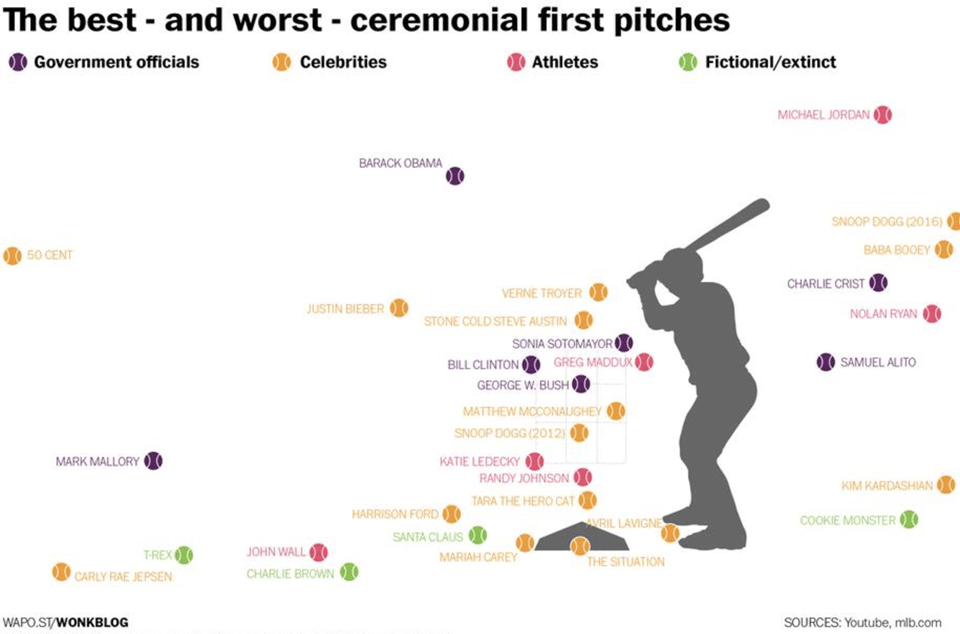
The Washington Post created a fun infographic of celebrity baseball pitches.
I use this graphic in my Data Analytics class. Students are tempted to draw inferences about individuals from this data set. John Wall and Michael Jordan are great athletes, but in this case they are underperforming Avril Lavigne and George W. Bush. Do we conclude that Sonia Sotomayor missed her calling as an MLB player?
The first lesson here is that we should not assume we can predict where Harrison Ford’s next pitch will go based on observing just one pitch. A single pitch should be considered a random draw from a distribution centered around Ford’s average ability. Any single pitch could be an outlier.
Snoop Dog features twice on this graph. In 2012 he got the ball in the strike zone. Had we only seen that, we would want to conclude that he is a great pitcher. However, in 2016 he was way off to the right. In either case, overconfidence that he is predictably near a single pitch would have been a mistake.
Lastly, I use this graph to illustrate the concept of overfitting (investopedia definition). I suggest a model that is obviously inappropriate. What if we conclude from these data that anyone with the last name of Bieber will not be able to throw the ball in the strike zone? That model surely will not generalize. The problem is that if we test that prediction on the same data we used to train the model, the misclassification rate will be zero. If possible, start with a large data set and set aside some portion of the data for validation, before training a model. Having validation data for assessment is a good way to check that you haven’t modeled the noise in your training set.
My article, coauthored with Sarah Kerrigan and published last week, tries to answer the question. In short, the answer seems to be yes- cohabitation before marriage is associated with a 4.6 percentage point increase in the rate of marital dissolution. This is in line with much of the previous literature, which notes one big exception- choosing right (or getting lucky) the first time: “cohabitation had a significant negative association with marital stability, except when the cohabitation was with the eventual marriage partner”.
But we found some even more interesting facts while digging through the National Survey of Family Growth.
You’ve probably heard the phrase that US states are often “laboratories of democracy.” The phrase comes from a Supreme Court case. It’s well known enough that it has a short Wikipedia page. The basic idea is simple: states can try out different policies. If it works, other states can copy it. If it doesn’t work, it only hurts that state.
The 2020-21 pandemic has provided a number of possibilities for the “states as laboratories” concept. Here’s three big ones I can think of (please add more in the comments!):
Do states that end unemployment benefits sooner have quicker labor market recoveries? Or are these not the main drag on the labor market?
Do states that offer incentives for vaccination have higher vaccination rates? And what sort of incentives work best?
These are all good questions, but let me throw some cold water on this whole concept: we might not be able to learn anything from these “experiments”! The primary reason: the treatments aren’t randomly assigned. States choose to implement them.
Let’s think through the potential problems with each of these three areas:
I blogged earlier about a new textbook that I am adopting for an analytics course. The first few chapters are primarily an introduction to using the R coding language within RStudio. One of the resources I’m posting for students this week is screen capture videos of me manipulating data in RStudio.
Sometimes I make mistakes, shockingly. I’m a professional, and yet sometimes I still make careless typos in R. I found out that my version of R was outdated, right when I was in the middle of recording a lecture.
I could have deleted the footage of my mistakes. I could have re-recorded a clean smooth video in which I run command after command without saying “ok… I got an error”.
Texas is one of the most regulated states in the country.
This is one of the surprises that emerged from the State RegData project, which quantifies the number of regulatory restrictions in force in each state. It turns out that a state’s population size, rather than political ideology or any thing else, is the best predictor of its regulations.
This is what I found, with my coauthors James Broughel and Patrick McLaughlin, when we set out to test whether a previous paper (Mulligan and Shliefer 2005) that showed a regulation-population link held up when we used the better data that is now available. We found that across states, a doubling of population size is associated with a 22 to 33 percent increase in regulation.




 Economist Writing Every Day