Joy on The Inductive Economy podcast

I got to be a guest of Vignesh Swaminathan who is based in Mumbai. It’s fun to have a deep conversation with someone on the other side of the world and share it with the whole internet (and the AI’s).

Apple podcast link: https://podcasts.apple.com/us/podcast/dr-joy-buchanan-on-understanding-economics-through/id1719744197?i=1000652541934

Blogpost with links and timestamps: https://www.inductive.in/p/dr-joy-buchanan-on-understanding

The first 10 minutes are about Tyler’s GOAT book. Vignesh asked me to name some influential economists who did not make Tyler’s list.

Around minute 12 we talk about the experimental economics methodology.

The middle (minute 15-42) is a discussion of the pipeline into tech and my Willingness to be Paid paper. He adds his perspective on tech jobs in India.

Around minute 42, Vignesh makes a switch over to the Barbie movie and then Oppenheimer. He observes that Oppenheimer is a “brand.” I speculate on careers in Barbieland. We recorded this before Christmas of ’23, right after everyone had seen these summer movies. Both movies ended up in the 2024 Oscars awards ceremony.

I predicted that people will eventually be able to create a custom movie from a verbal prompt, because of the AI content revolution. Here in Spring of ’24 that has already come true. Sora is shocking everyone and even caused Tyler Perry to halt a physical film studio expansion.

Around minute 55, we pivot to Hayek and competition, which leads to a postmortem on Google Plus (RIP).

1:05-1:16 features intellectual property and my IP experiment with Bart Wilson

Ended with rapid-fire and personal questions.

Skimming back through this conversation has me thinking about tech work. The market for IT workers and programmers has evolved since I first started the project that became “Willingness to be Paid: Who Trains for Tech Jobs?”

I like pointing people all the way back to this report on jobs from 1958. Learn to Code has been good advice for a long time, for the people who can tolerate the work. That does not mean it will be true forever, but I would argue that it is still true today.

Silicon Valley as a career might have peaked around 2021. It’s not going away, but it might not be growing anymore in terms of the number of talented people who can be absorbed there. (Might I suggest Huntsville instead?)

The WSJ recently ran a story “Tech Job Seekers Without AI Skills Face a New Reality: Lower Salaries and Fewer Roles”

The rise of artificial intelligence is affecting job seekers in tech who, accustomed to high paychecks and robust demand for their skills, are facing a new reality: Learn AI and don’t expect the same pay packages you were getting a few years ago.

Jobs in areas like telecommunications, corporate systems management and entry-level IT have declined in recent months, while roles in cybersecurity, AI and data science continue to rise, according to Janco’s data. The average total compensation for IT workers is about $100,000, making the position a target for continued cost-cutting.

One reason tech jobs are less attractive than some other professional paths is that the skillset changes. We mentioned this as a drawback in our policy paper. Computers are constantly changing. Vignesh and I discuss the issue of risk. I suggested that companies could pay less for talent if they were willing to offer packages that carry less risk of getting fired.

Nevertheless, tech still has decent job prospects. An unemployment rate of about 5% is about normal for work, even though tech had seen lower rates at the peak of demand. I do not know what programming as a career will look like in 10 years, but I’d say the same about screenwriting and live sports commentary. The LLMs are coming for everything or nothing or something in between.

I’ve been on tour (regionally) with our ChatGPT paper and getting opportunities to query different audiences about their LLM use. Last week I talked to a young man in our business school who is using ChatGPT to write SQL code at his job. I said in the podcast that I would still advise young people in Alabama to learn to code, even if they are not going to move to Silicon Valley. I think coding is more fun in the LLM-age or at least less miserable.
The Time it Took for Price to Rise

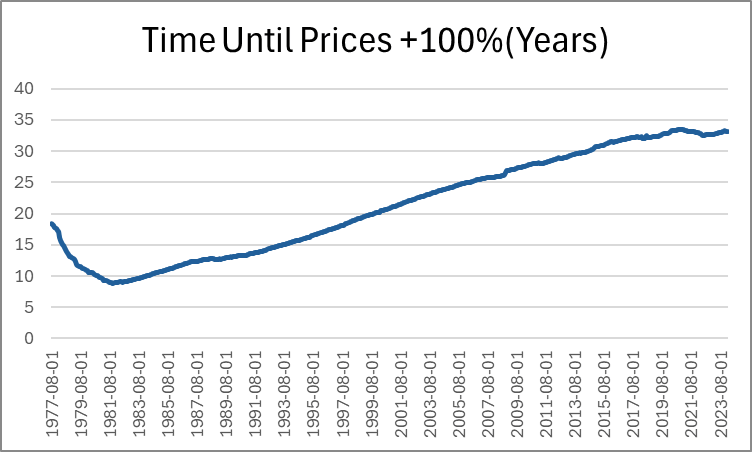
Last month, Jeremy wrote about how long it takes for prices to double. He identified a few intervals of time that are sensible. But I want to pick up the ball and move it further down the field. Not only can we identify how long it took for prices to double in particular eras, we can also do it for *every month*. Below, is a graph that shows us how many years had passed since prices were half as high (PCE Chained Prices).

Expectedly, the minimum time to double consumer prices was in the early 80s, taking just under 9 years for price to double. The prior decade included the highest inflation rates in the past 70 years.  Since that time, the number of years needed in order for prices to double steadily rose as the average inflation rate fell. That is, until after the pandemic stimuli which caused the time to plateau. But to be clear, that must mean that prices aren’t doubling any fast that they used to, despite what we’ve heard on the news.

Except… prices are in fact rising faster by 21st century standards. Indeed, measuring the time that it took prices to double covers up a lot of variation. After all, The PCEPI was 15.19 in 1959 and is 122.3 now. That’s only enough difference for three doublings. But as we lower the threshold for price changes, we can see more of the price level patterns. Below-left is the time that was necessary for prices to increase by 50% and below-right is the time that was necessary for prices to rise by 25%.

In these graphs we can see more of the action that happened post-Covid. The time needed for prices to rise by 50% has fallen by about five years since 2020. That’s a 20% shorter time necessary for a 50% increase in prices. The time needed for a 25% increase in prices is even more drastic. As of 2020, people were accustomed to experiencing upwards of 14 years before overall prices rose by 25%. That number fell below 8 years by 2024.

And finally, the most unnerving graph of all is below: the time that was needed for prices to rise by 10%.

Continue reading

Ten Years Gone: Temple University’s Economics PhD

Last weekend brought me back to Temple University, ten years after graduating, for a conference of econ PhD alums. I had so many reactions:

  1. Mixing a research conference with what is effectively a reunion or homecoming is a great idea for a PhD program, and more schools should do it. It brought together alumni from all different years, but it especially felt like a reunion to me since it’s been ten years since I graduated (not that I really know about reunions; I’ve never been to a high school or college one).
  2. Philadelphia in general and Temple University in particular have gotten much nicer (though still gritty). Some of this I expected; the country is getting steadily richer, and it seems like every college is always on a building spree. But as with New Orleans, it is a city still well below its peak population that I first got to know in the aftermath of the great recession. Unemployment in Philly is now well under half what it was the whole time I lived there, and it shows.
  3. Life is short. I was saddened, but not shocked, to hear that one of my professors had died. I was saddened and shocked to hear that one of my fellow students had.
  4. As a kid, whenever I went back to one of my old schools, I usually felt nostalgia mixed with the feeling that everything seemed small. Then I thought this smallness was only about me having grown taller, but now I wonder. At Temple the economics department has changed buildings, but when I went back to the old building everything seemed small, despite me being the same size I was in grad school. But at the time the building loomed so large in my mind; I was so focused on the things that happened there, the classes and tests, the study sessions and writing in the computer lab, what the professors thought, and everything that it all represented. All that apparently made the rooms seem physically larger in a way they now don’t once I have graduated and the professors moved.
  5. Temple PhDs are much more successful than I would have guessed at the time. It was hard for students attending what was then a bottom-ranked program during the Great Recession to be optimistic about our job prospects, especially when we worried we might fail out of the program (a valid concern when, afaik, only 4 of the 11 students in my year finished their PhDs). But things turned out great; just in the past 10 years from a small program there are many people who are tenured or tenure track at decent schools, who have research or important supervisory positions at the Fed, or who are making a name for themselves in the private sector (like Adam Ozimek).
  6. Why have we so exceeded our low expectations? The improving economy helped. Economics PhDs from anywhere turned out to be a valuable degree. Perhaps our training was stronger than we gave it credit for at the time. I see two main tracks for success coming out of a lower-ranked program, where the school’s name alone might not open doors:
    • publish a lot (my strategy), or
    • find some way to get your foot in the door of a major institution like the Fed system or a major bank, then work your way up. The initial way in could be something less competitive, like an internship or a job you don’t necessarily need a PhD for. But once you are in you will be judged mostly on your performance within the institution, not your credentials. In a panel on non-academic jobs, several alums emphasized that conditional on having enough technical skills to get hired, at the margin people/communication skills are much more important to advancement than further technical skills.
  7. Temple’s economics PhD program paused admissions back in 2020, but is aiming to restart with a redesigned program in 2025.

Wages Have Increased Faster Than Prices Since 2019 (Unless You are Rich)

While there are many factors to consider, ultimately whether living standards are rising is a race between prices and income. What does that race look like if we start the clock in December 2019, just before the pandemic?

Whether we use median weekly earnings (the purple line) or average hourly earnings for non-management workers (the blue line), they have clearly won the race with two commonly used price indexes (the CPI-U and the PCEPI). That’s good news, and probably not something you hear very often in the discourse about the economy (unless you spend a lot of time reading this blog).

Continue reading

Rate Cuts Looking Dubious for 2024

Fellow blogger James Bailey and I have noted earlier this year that with inflation having  plateaued well above the target 2% level, and with the ongoing strength in the U.S. economy, the three (initially six) rate cuts that pundits predicted for 2024 may not materialize. In fact, we may get no rate cuts at all. This has implications for many things, including housing markets and investing. Also, high interest on the federal debt, layered on top of insane peacetime budget deficits (neither party is willing to tell we the people that we cannot have big spending and low taxes), means the debt will balloon. Sorry about that, grandkids.

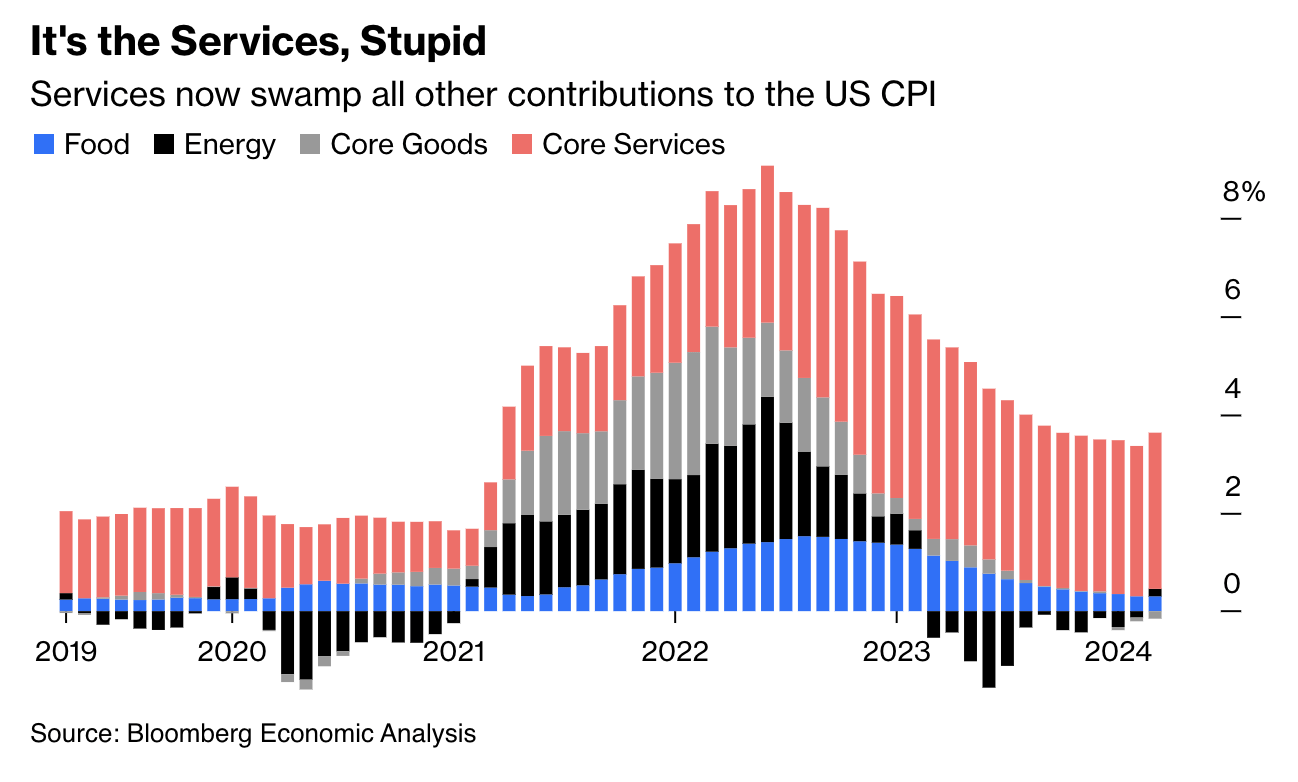
Here is a graphic which illustrates the course of inflation as measured by the Consumer Price Index:

It seems that inflationary expectations are now firmly embedded into wage growth (which is the driver for the increase in Service costs). This mindset way be tough to break. Such is the fruit of the Fed’s head in the sand, inactive approach to raging inflation back in 2021. Instead of nipping it in the bud, they blandly assured us, “It’s just a transitory response to supply shocks”.

One very recent (yesterday) data point is the Census Bureau’s Advance Report on Monthly Sales for Retail & Food Services. This report provides initial data on consumer spending at U.S. retail establishments for March 2024; this is a valuable, timely indicator of current economic activity. According to the Census, Retail Sales expanded by +0.72%, surprising to the upside by +0.32%. This economy just isn’t slowing down.

Slow Landing versus No Landing

The dominant expectation among economists as 2023 drew to a close was that the economy would slow down significantly, gradually enough to justify Fed rate cuts, but it would not crater so fast as to bring on a recession. Now there is more and more talk of a “No Landing” scenario, where GDP keeps chugging along and rates stay high, as the new normal.

Yahoo Finance summarized the recent thinking of Wells Fargo:

The Wells Fargo Investment Institute piled on to that narrative in a note Monday upgrading its outlook for the U.S. economy. While the bank didn’t specifically predict a “no landing” outcome, researchers lifted their gross domestic product growth forecast from just 1.3% for 2024 to 2.5%—the same as last year’s rate of 2.5%.

Wells also said the U.S. unemployment rate will sit at 4.1% instead of 4.7% by the end of 2024. The tradeoff will be slightly higher inflation. The bank now sees U.S. CPI inflation of 3%, instead of its previous 2.8% estimate.

Several factors have been named to account for the unexpected strength of the U.S. economy over the past few years, including record fiscal spending, particularly on infrastructure and semiconductors; the housing market’s resilience to higher rates owing to post–Global Financial Crisis policy changes and supply issues; and even “greedflation.”

But Wells Fargo said the economy has outperformed expectations because financial conditions—a measure of the availability and cost of borrowing, as well as risk and leverage in financial markets—are actually accommodative, despite the Fed’s rate-hiking campaign.

To that point, the Chicago Federal Reserve’s National Financial Conditions Index has been in accommodative territory throughout the Fed’s hiking cycle, and decreased to –0.53 in the week ended April 5—its lowest level since February 2022.

Unless there is a sudden change, it looks unlikely to me that the Fed can cut in May or June or July. If they do not cut by August, the thinking goes, it becomes likely that they will not cut at all this year, because of the optics around the fall election.

The Self-Correcting Property

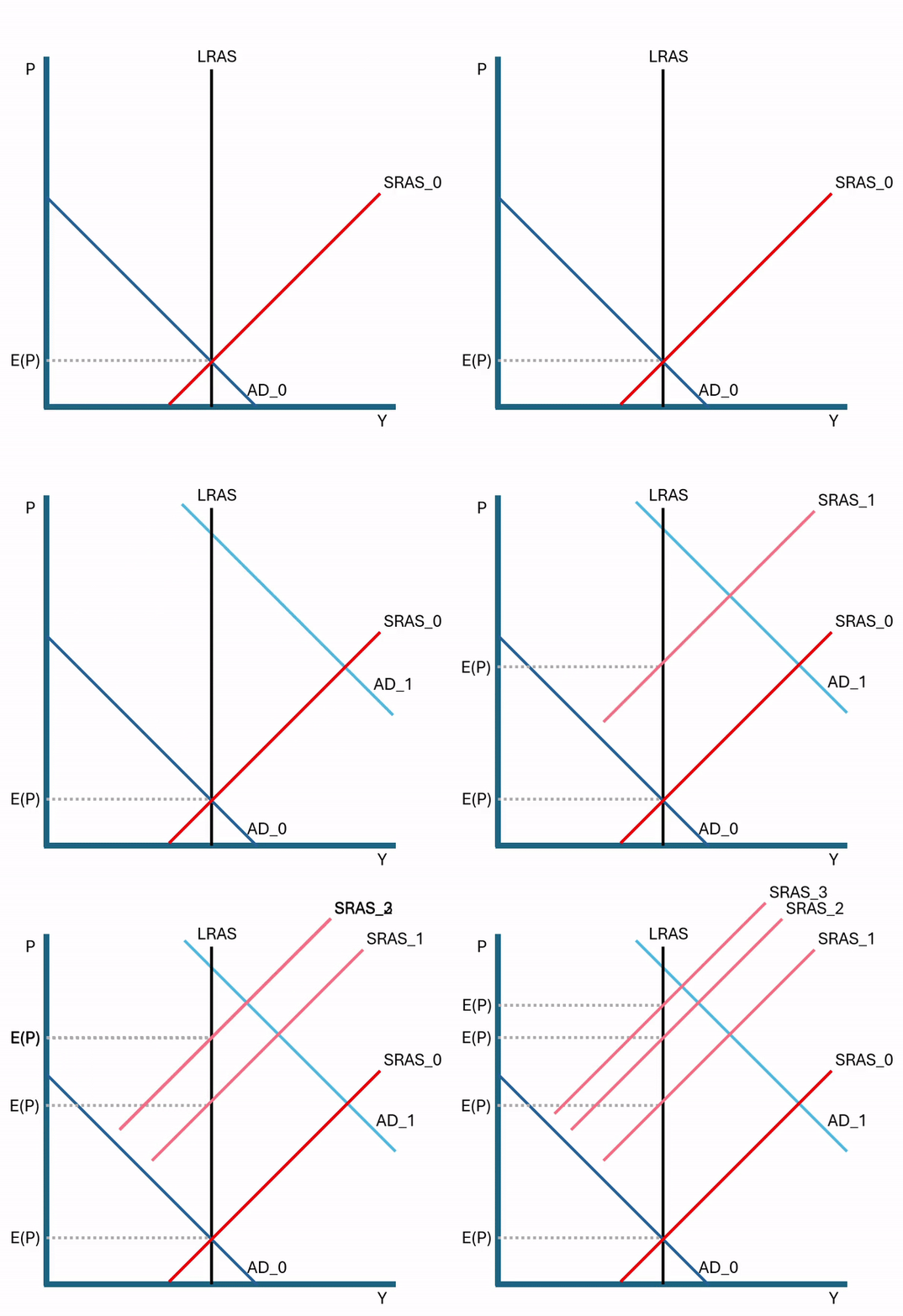
Say that the Federal Reserve Prints a boatload of money. We can use the AS-AD model (aggregate supply & aggregate demand) to evaluate the effect on prices and output.

Printing money results in more total spending in the economy. How much of that initial greater total spending is composed of higher prices versus higher output depends on business marginal costs and whether firms know or expected the greater demand to be due to a broad inflationary event (rather than just greater demand for their particular products).

If there is broad inflation, then the price level that is observed in the economy, including inputs, will deviate from what firms expected. Naturally, firms update their expectations. In so doing, they increase the price that they would require in order to produce every quantity of output. The vertically rising SRAS reflects both of these. The rising itself reflects the higher required prices, and the intersection with the LRAS reflects the expected price level. Notice that updating the expectations places upward pressure on prices, resulting in still higher than anticipated prices. This occurs repeatedly and each time that expectations are updated, the difference between the actual and the expected inflation gets smaller. 

This is what macroeconomists call the “self-correcting property’. The economy will adjust to an AD shock ‘automatically’. Of course, automatic isn’t quite the right word. It’s automatic from the perspective of a policy maker. But the self-correction is the result of an economy’s worth of people bidding for scarce goods and changing their price expectations. It’s automatic in the sense that people don’t need to be told to make the effort. The same results won’t occur if buyers and sellers do nothing, which sounds less automatic.

Since the fundamental productivity of the economy hasn’t changed, we eventually return to the original level of output. If monetary policy doesn’t change in the meantime, then prices will simply rise until the long-run price change composes 100% of the change in total spending. Indeed, given the AS-AD model above, half of the price difference between the current price and the long run price is eliminated each period. Similarly, half of the output gap is eliminated each period. This is why monetary and fiscal stimulus that just focuses on total spending only has short-run output and employment effects. The self-correcting property asserts itself and prices rise in the long run.


*In the figures above, I’ve illustrated an initial sharp price change, though sticky prices and very surprising inflationary stimulus can cause a delay in the initial price adjustment.

**Of course, all of this can be expressed in percent change rather than levels.

New Data on Labor, Income, Finances, and Expectations

The Federal Reserve Bank of Philadelphia just released the first report on a new survey they are conducting quarterly. Some highlights:

Respondents in January 2024 were more positive about their income prospects than respondents a year earlier; one-third believed their income will increase, compared with 29 percent in January 2023

Younger, more affluent, male, or non-White respondents report a more positive outlook, compared with one year prior. Those who are older than 55 or earn less than $40,000 report notably negative changes in their personal outlook, compared with respondents in the same demographic segments surveyed a year ago

When asked about their ability to pay all of their bills in full this month, 23.5 percent of respondents in January 2024 indicated that they could not pay some or any of their bills; this was 1.5 percentage points higher than in January 2023 (22.0 percent) and the highest rate in the last five quarters

Overall, I’d say it shows an economy with mixed performance, but leaning more positive than negative.

Source: My graph of LIFE Survey data

It will be interesting to see if this ends up taking a place in the set of Fed surveys that are always driving economic discussions, like the Survey of Consumer Finances and the Survey of Professional Forecasters. If they keep it up and start putting out some graphics to summarize it, I think it will. My quick impression (not yet having spoken to Fed people about it) is that it will be the “quick hit” version of the Survey of Consumer Finances. It asks a smaller set of questions on somewhat similar topics, but is released quickly after each quarter instead of slowly after each year. If they stick with the survey it will get more useful over time, as there is more of a baseline to compare to.

Grocery Inflation is Under Control, Fast Food Prices Aren’t

Thankfully for US consumers, grocery prices have leveled off. They haven’t fallen, of course, which will still lead to viral complaints about egg prices, etc. But over the past 4 years, wages have almost caught up with grocery prices.

Not so with fast food prices (“limited service meals”), which have definitely outpaced wages over the past 4 years, and continue to grow at an annual rate of about 5 percent (also more than wages).

Furthermore, if we go back to 2014, we see it’s not just a post-pandemic effect on fast food. Prices since 2014 are up 54 percent for fast food according to the BLS, more than the 31 percent overall CPI-U increase and more than average wages (46 percent).

An article from FinanceBuzz puts together some more specific data on a dozen fast-food chains in the US. Consumer favorites for a quick, cheap bite to eat like Taco Bell and McDonald’s have seen menu prices increase by 80 or even 100 percent!

Check out the article for even more specific food item data at each of these restaurants. For example, the most famous of fast-food sandwiches is the Big Mac, which is up from $3.99 in 2014 to $5.99 in 2024, a 50 percent increase. A Whopper meal at Burger King is up 79 percent. All the more reason to seek out deals in the apps, or just good-old in-store discounts, like the “buy one get one for $1” promo at most McDonald’s. This deal would get you two Big Macs for $7, or $3.50 each… less than in 2014! Or since today is Wednesday, you might want to head to Burger King, where Whoppers are $3 at most locations (regular price: around $6).

Price discrimination is alive and well at the drive-thru window, and if you are just ordering from the menu without any discounts, you are really going to feel the pain of inflation.

Cowen on Smith at AdamSmithWorks

I’m at AdamSmithWorks this week with “TYLER COWEN ON THE GREATEST ECONOMIST OF ALL TIME (GOAT)

To be on Cowen’s short list is a compliment. Of all the thinkers and writers in recorded history, Adam Smith is one of only six writers that Cowen gives serious consideration to. Next, readers will ask, “Did our guy win?”

Tyler’s book will make no one happy because he does not take anyone’s side unequivocally. A huge fan of Adam Smith (and I know several) might have wanted a book about why Adam Smith is designated as the GOAT. I don’t want to ruin the book for anyone who hasn’t read it. What you will get is very interesting and thoughtful, so I hope you’ll read the manuscript* sometime, even if your guy doesn’t win.

*completely free – can get it on your Kindle somehow I heard

My previous posts about Tyler’s GOAT book:

Tyler Supporting Women in the GOAT book 

What We Are Learning about Paper Books  – I did write the AdamSmithWorks post in collaboration with the GPT version of the book, as a first step, along with my own memory of having read the book. And then, secondly, I consulted the book manuscript. The GPT performed fairly well… considering that it’s a GPT. I suppose I thought that interrogating the GPT would save me time. However, I can now say authoritatively that Tyler’s actual writing is so much better than what you will get from the GPT. Among other things, the GPT is much more boring than Tyler’s actual manuscript.

Coffee’s Supply & Demand Dance during Prohibition

I’ve written about coffee consumption during US alcohol prohibition in the past. I’ve also written about visualizing supply and demand. Many. Times. Today, I want to illustrate how to use supply and demand to reveal clues about the cause of a market’s volume and price changes. I’ll illustrate with an example of coffee consumption during prohibition.

The hypothesis is that alcohol prohibition would have caused consumers to substitute toward more easily accessible goods that were somewhat similar, such as coffee. To help analyze the problem, we have the competitive market model in our theoretical toolkit, which is often used for commodities. Together, the hypothesis and theory tell a story.

Substitution toward coffee would be modeled as greater demand, placing upward pressure on both US coffee imports and coffee prices. However, we know that the price in the long-run competitive market is driven back down to the minimum average cost by firm entry and exit. So, we should observe any changes in demand to be followed by a return to the baseline price. In the current case, increased demand and subsequent expansions of supply should also result in increasing trade volumes rather than decreasing.

Now that we have our hypothesis, theory, and model predictions sorted, we can look at the graph below which compares the price and volume data to the 1918 values. While prohibition’s enforcement by the Volstead act didn’t begin until 1920, “wartime prohibition” and eager congressmen effectively banned most alcohol in 1919. Consequently, the increase in both price and quantity reflects the increased demand for coffee. Suppliers responded by expanding production and bringing more supplies to market such that there were greater volumes by 1921 and the price was almost back down to its 1918 level. Demand again leaps in 1924-1926, increasing the price, until additional supplies put downward pressure on the price and further expanded the quantity transacted.

We see exactly what the hypothesis and theory predicted. There are punctuated jumps in demand, followed by supply-side adjustments that lower the price. Any volume declines are minor, and the overall trend is toward greater output. The supply & demand framework allows us to image the superimposed supply and demand curves that intersect and move along the observed price & quantity data. Increases toward the upper-right reflect demand increases. Changes plotted to the lower-right reflect supply increases. Of course, inflation and deflation account for some of the observed changes, but similar demand patterns aren’t present in the other commodity markets, such as for sugar or wheat. Therefore, we have good reason to believe that the coffee market dynamics were unique in the time period illustrated above.


*BTW, if you’re thinking that the interpretation is thrown off by WWI, then think again. Unlike most industries, US regulation of coffee transport and consumption was relatively light during the war, and US-Brazilian trade routes remained largely intact.