Unpopular Grocery Opinions

You needn’t stop at stop signs in parking lots.

Road signs on private land are often not legally enforceable by the police. You can ignore right-of-way and most signage in a parking lot or a parking-lot-adjacent path. I’m not saying that signs don’t serve a useful function. The stop in front of a Target or Publix is there to help coordinate drivers and pedestrians. It’s mostly a prudential matter. If it’s crowded, then those signs act coordinate us where norms might differ. But, if it’s late and no one is around, then you can safely run all of the parking lot stop signs with impunity. Be careful, however. The police can’t get you. But if you harm someone or something, then you can still be liable for neglect in a civil suit. That’s because neglect is contextual and expectations matter. If people treat parking lot signs like there are real road signs, then flaunting them can be construed as neglect.

You Can Park in Handicap Spaces.

If you’re *really* anti-social, then you should look up your local or state handicap accessible parking rules. Usually, police do have the power to ticket vehicles lacking the proper disability tags. BUT, the handicap parking space must conform to specifications. Where I live, for example, there must be an minimum sized sign that stands completely above 5 feet high in order to clearly demark the space. Therefore, if you see a handicap spot that is only noted by asphalt paint, then you’re free to park there.

Return your Shopping Cart… Or Don’t

Nothing says that you must return your shopping cart to an outdoor, covered, or indoor corral. People say that they have strong feelings about this (it’s not clear to me that they actually do). I say it’s not a fruitful exhortation. Let’s consider multiple perspectives and set aside the issue of civil liability due to neglect that I outlined above.

Continue reading
Historical Price to Earnings Ratios By Industry

Getting long-run historical PE ratios of US stocks by industry seems like the kind of thing that should be easy, but is not. At least, I searched for an hour on Google, ChatGPT, and Bing AI to no avail.

I eventually got monthly median PEs for the Fama French 49 industries back to 1970 from a proprietary database. I share two key stats here: the average of median monthly industry PE 1970-2022, and the most recent data point from late 2022.

IndustryLong Run MeanEnd 2022
AERO12.1419.49
AGRIC10.759.64
AUTOS9.6517.52
BANKS10.3810.46
BEER15.2335.70
BLDMT12.0015.41
BOOKS12.9517.60
BOXES12.1810.69
BUSSV12.0713.03
CHEMS12.4019.26
CHIPS10.4817.47
CLTHS11.4510.94
CNSTR8.984.58
COAL8.042.92
DRUGS1.148.01
ELCEQ10.7817.85
FABPR10.2819.40
FIN11.1612.97
FOOD14.3025.03
FUN9.1021.06
GOLD3.18-5.95
GUNS11.505.05
HARDW7.9619.16
HLTH11.916.09
HSHLD12.6020.15
INSUR10.9516.33
LABEQ13.4625.18
MACH12.5120.27
MEALS13.8319.19
MEDEQ6.8127.64
MINES8.0616.27
OIL6.969.00
OTHER12.2027.68
PAPER12.5016.69
PERSV12.86-0.65
RLEST8.13-0.30
RTAIL12.268.58
RUBBR12.1112.81
SHIPS9.7917.42
SMOKE11.7417.79
SODA12.3832.09
SOFTW8.21-2.85
STEEL8.184.30
TELCM6.759.58
TOYS9.18-1.32
TRANS11.2513.11
TXTLS9.43-49.00
UTIL12.3417.41
WHLSL11.0813.13
Mean Industry Median10.5212.73

One obvious idea for what to do with this is to invest in industries that are well below their historical price, and avoid industries that are above it (not investment advice). Looking just at current PEs is ok, but a stock with a PE of 8 isn’t necessarily a good value if its in an industry that typically has PEs of 6.

By this metric, what looks overvalued? Money-losing industries (negative current earnings): Gold, Personal Services, Real Estate, Software, Toys, and Textiles. Making money but valuations 19+ above historical average: Medical Equipment, Beer, Soda. Most undervalued relative to history: Guns, Health, Coal, Construction, Steel, Retail (all 3+ below the historical average).

Of course, I don’t recommend blindly investing in these “undervalued” industries- not just for legal reasons, but because sometimes the market prices them low for a reason- that earnings are expected to fall. The industry may be in secular decline due to new types of competition (coal, steel, retail). Or investors may expect it to get hit with a big cyclical decline in an upcoming recession or rotation from the Covid goods/manufacturing economy back to services (guns, construction, steel, retail). Health services (as opposed to drugs and medical equipment) stands out here as the sector where I don’t see what is driving it to trade at barely half of its usual PE.

I’d still like to get data on long run market-cap weighted mean PE by industry, as opposed to the medians I show here. The best public page I found is Aswath Damodaran’s data page, which has a wide variety of statistics back to about 1999. Some of the current PEs he calculates are quite different from those in my source, another reason to tread carefully here. I’m not sure how much of this is mean vs median and how much is driven by different classification of which stocks fit in which industry category.

This gets at a big question for anyone trying to actually trade on this- do you buy single stocks, or industry ETFs? Industry ETFs make sense in principle (since we’re talking about industry level PEs overall) and also add built-in diversification. But the PE for the ETF’s basket of stocks likely differs from that of the industry as a whole. It would make more sense to compare the ETF’s current PE to its own historical PE, but most industry ETFs have very short track records (nothing close to the 53 years I show here). PE is also far from the only valuation metric worth considering.

All this gets complex fast but I hope the historical PE ratio by industry makes for a helpful start.

New Paper with Evidence that ChatGPT Hallucinates Nonexistent Citations

I posted a new working paper with systematic evidence for false citations when ChatGPT (GPT-3.5) writes about academic literature.

Buchanan, Joy and Shapoval, Olga, GPT-3.5 Hallucinates Nonexistent Citations: Evidence from Economics (June 3, 2023). Available at SSRN: https://ssrn.com/abstract=4467968 or http://dx.doi.org/10.2139/ssrn.4467968

Abstract: We create a set of prompts from every Journal of Economic Literature (JEL) topic to test the ability of a GPT-3.5 large language model (LLM) to write about economic concepts. For general summaries, ChatGPT can perform well. However, more than 30% of the citations suggested by ChatGPT do not exist. Furthermore, we demonstrate that the ability of the LLM to deliver accurate information declines as the question becomes more specific. This paper provides evidence that, although GPT has become a useful input to research production, fact-checking the output remains important.

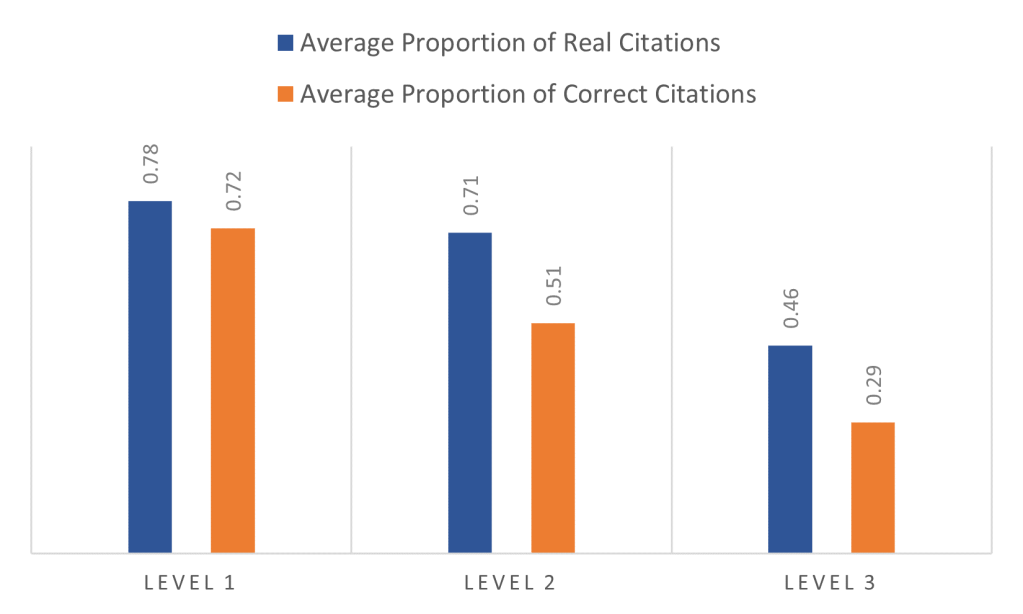
Figure 2 in the paper shows the trend that the proportion of real citations goes down as the prompt becomes more specific. This idea has been noticed by other people, but I don’t think it has been documented quantitatively before.

We asked ChatGPT to cover a wide range of topics within economics. For every JEL category, we constructed three prompts with increasing specificity.

Level 1: The first prompt, using A here as an example, was “Please provide a summary of work in JEL category A, in less than 10 sentences, and include citations from published papers.”

Level 2: The second prompt was about a topic within the JEL category that was well-known. An example for JEL category Q is, “In less than 10 sentences, summarize the work related to the Technological Change in developing countries in economics, and include citations from published papers.”

Level 3: We used the word “explain” instead of “summarize” in the prompt, asking about a more specific topic related to the JEL category. For L we asked, “In less than 10 sentences, explain the change in the car industry with the rising supply of electric vehicles and include citations from published papers as a list. include author, year in parentheses, and journal for the citations.”

The paper is only 5 pages long, but we include over 30 pages in the appendix of the GPT responses to our prompts. If you are an economist who has not yet played with ChatGPT, then you might find it useful to scan this appendix and get a sense of what GPT “knows” about varies fields of economics.

If SSRN isn’t working for you, here is Also a Google Drive link to the working paper: https://drive.google.com/file/d/1Ly23RMBlim58a7CbmLwNL_odHSNRjC1L/view?usp=sharing

Previous iterations of this idea on EWED:

https://economistwritingeveryday.com/2023/04/17/chatgpt-as-intern/ Mike’s thoughts on what the critter is good for.

https://economistwritingeveryday.com/2023/01/21/chatgpt-cites-economics-papers-that-do-not-exist/  This is one of our top posts for traffic in 2023, since this is a topic of interest to the public.  That was January of 2023 and here we are in June today. It’s very possible that this problem will be fixed soon. We can log this bug now to serve as a benchmark of progress.

A check in and comparison with Bing:

Pins to Patterns at AdamSmithWorks

I’m at AdamSmithWorks this week with “FROM PINS TO PATTERNS: FOLLOWING THE THREADS OF PRODUCTIVITY

In the tapestry of human progress studies, two authors, Adam Smith and Virginia Postrel, have left their mark on the story of productivity and innovation. Their books, written centuries apart, both explore the power of specialization and the division of labor.

Part of the reason this came out this week is that I’m reading The Fabric of Civilization. So good! It had come highly recommended before, but I finally have an excuse to read it because I’m working on an article about fashion.

Supply & Demand, with Tables?

When I was a graduate student, I paid for my tuition by tutoring for the university athletics department. I tutored stat, math, micro, macro, excel, and finance. I tutored the same students each week, so I got to know them pretty well over the course of the semester. I also got to know their strengths and weaknesses. It was at this time that I realized most quantitative or even analytical ideas could be described in 4 potentially equivalent ways:

  1. Mathematically
  2. Using logic in English
  3. Graphically
  4. With a Table

In this post I want to share the Supply & Demand cheat-sheet that I use to help my students learn about the effects of supply and demand.

Continue reading

EWED Highlights: Investing

I noticed that finance and investing have become one of our recurring themes here, and so I recently added an investing category for our posts.

Posts from before last week weren’t tagged with it, but I’ll take the chance now to highlight some of our investing posts:

Alternative Investing Ideas:

Is Equity Crowdfunding Beating Adverse Selection?

Potent Portfolio Diversifier: Managed Futures Funds Go Up When Both Stocks and Bonds Go Down

Series 65 for Economists

Unfashionable Investing

50% Endowment Returns Driven by Private Equity Investments: How Rich Universities Get Richer (But You Can, Too)

Safer / Yield-Based Investing Ideas:

Tough Year for Investing (with one little-known, totally safe exception)

Get Easy Government-Guaranteed 4% Interest on Your Money with Treasury Bills

High Yield Investments, 1: Some Benefits of High Yield Stocks and Funds

High Yield Investing, 2: Types of Funds; Loan Funds; Preferred Stocks

Posts on Economic Conditions Affecting Financial Markets:

Work From Home Sours Financing for Office Buildings, Which Threatens Regional Banks

Bulls and Bears Spar Over Pace of Inflation Decline and Rate Cuts

A Cornucopia of Financial Data from J. P. Morgan, Relevant to Investors

Raging Inflation, Spiking Rates, Plunging Stocks, Oh, My!

QE, Stock Prices, and TINA

Crypto Posts:

Bitcoin’s Dramatic Comeback: Resurrection or Dead Cat Bounce?

The Great Crypto Market Meltdown of 2022

The NFT Market Is Mushrooming – Why??

Crypto Drama: $40 Billon Vaporized as Terra “Stablecoin” and Luna Implode; Bored Ape NFTs Break Ethereum

On Famous Investors:

Get rich or get famous? Edward Thorp vs Myron Scholes

Warren Buffett’s Secret Sauce: Investing the Insurance “Float”

Big Picture / Economics of Investing:

What kind of return do we want on our investment?

Though the Market Is a Winner, Most Stocks Are Losers

Minor Investment

Dow 1,000,000?

Avoiding Intertemporal Idiosyncratic Risk

Social Security: Not a Great/Terrible Investment

Drivers of Financial Bubbles: Addicts and Enablers

Why Short Selling Is a Good Thing for the Stock Market and Investors Large and Small

South Carolina Repeals Certificate of Need

Last week South Carolina Governor McMaster signed a bill repealing almost all Certificate of Need (CON) laws in the state. If you want to open or expand a health care facility in South Carolina, you can now do so faster, cheaper, and with more certainty.

This is a bigger deal than West Virginia’s reform earlier this year because it applies to almost all types of facilities, and applies to both new facilities and expansions of existing facilities. Only two parts of the CON system remain: a 3-year sunset where hospitals still need special permission to add beds, and a permanent restriction on nursing homes (why? see my recent post on why states hate nursing homes).

As is often the case, this reform took years to enact. I wrote last year about a repeal bill passing the SC Senate; it didn’t make it through the House then, but did this time. As I said then:

This seems like good news; here at EWED we’ve previously written about some of the costs of CON. I’ve written several academic papers measuring the effects of CON, finding for instance that it leads to higher health care spending. I aimed to summarize the academic literature on CON in an accessible way in this article focused on CON in North Carolina.

CON makes for strange bedfellows. Generally the main supporter of CON is the state hospital association, while the laws are opposed by economistslibertariansFederal antitrust regulatorsdoctors trying to grow their practices, and most normal people who actually know they exist. CON has persisted in most states because the hospitals are especially powerful in state politics and because CON is a bigger issue for them than for most groups that oppose it. But whenever the issue becomes salient, the widespread desire for change has a real chance to overcome one special interest group fighting for the status quo. Covid may have provided that spark, as people saw full hospitals and wondered why state governments were making it harder to add hospital beds.

Why did reform succeed this time in South Carolina? From where I sit in Rhode Island I can only guess, but here are my guesses. First, the reform side really had their stuff together. See this nice page from SC think tank Palmetto Promise on why to repeal CON, and this paper from Matt Mitchell that does a comprehensive review of the literature on CON and explains what it means for South Carolina. Legislative supporters like Senator Wes Climer just kept pushing.

Second, the biggest opponent of CON reform is usually the state hospital association, but in this case they did not formally oppose repeal. Why not? Here I’m really speculating, but in general it has been faster-growing states that repeal CON. Population growth makes it obvious that new facilities are needed, and it means that existing facilities are thinking about how to grow to take advantage of new opportunities, rather than thinking about lobbying to maintain their share of a static or shrinking pie. You can see some hospital CEOs say they don’t mind repeal in this article (where I’m also quoted). South Carolina has been growing at a decent clip, as is Florida, which also almost-entirely repealed CON in 2019. On this theory, the next big CON reform would happen in a fast-growing CON state like Montana, Delaware, North Carolina, Georgia, or Tennessee. If I had to pick one, I’d say North Carolina.

Update: Apparently Montana already repealed all non-nursing home CON in 2021 and I missed it!

Inflation in G20 Countries

Most recent annual rates, compiled by Trading Economics. The US is right in the middle:


Argentina 109%
Turkey 43.7%
United Kingdom 8.7%
Italy 8.2%
Germany 7.2%
Australia 7%
Euro Area 7%
South Africa 6.8%
Mexico 6.3%
France 5.9%
Singapore 5.7%
Netherlands 5.2%
United States 4.9%
India 4.7%
Canada 4.4%
Indonesia 4.3%
Brazil 4.2%
Spain 4.1%
South Korea 3.7%
Japan 3.5%
Saudi Arabia 2.7%
Switzerland 2.6%
Russia 2.3%
China 0.1%

Why No Recession (Yet)

Where is that recession that pundits have been predicting for over a year now? The suspense is killing me. Despite savage hikes in interest rates that have led to a collapse in regional banks and in home buying, the economy just keeps chugging along, and inflation continues to run way above the targeted 2% level. What’s going on?

An article I just read on the Seeking Alpha applied finance website points to three interrelated factors. I will cite and credit the author (whose moniker is “Long-Short Manager”; he runs a couple of investment funds) for the content here, while noting that I agree with his points based on other reading. These points all relate to ongoing strong financial position of the (average) American consumer, who mainly drives the spending in our economy.

( 1 )  Reduced Debt Service

The article notes:

The graph above shows household debt payments as a percent of disposable personal income going back to 2000. Since peaking at 13% right before the financial crisis, it steadily improved to 2020, with a subsequent large drop due primarily to lowered mortgage rates (usually the largest debt obligation of a household). It is the lowest it has been this century.

(Although mortgage rates have jumped in the past year, most existing mortgages were taken out pre-2023, when interest rates had been pushed to near zero by the Fed.)

( 2 )  Robust Wage Growth

The next graph from the Atlanta Fed’s wage tracker (note that the methodology used by this tracker is fundamentally different from the Fed’s employment cost index …) shows that job hoppers on average are making about 3% more than core inflation (call that 5%) whereas the average stayer is making a half percent over core inflation. This is allowing people to catch up for the year that they got behind on inflation.

Likewise, the author notes that although job quits have come down in the past year, they remain well above re-COVID levels.

( 3 ) We Are Still Spending Down Gigantic Pandemic Stimulus Windfall

As we have noted earlier, the government/Fed combination dumped some $4 trillion into our collective pockets in 2020-2021. This includes enhanced unemployment benefits as well as direct stimulus payments, at a time when much of our normal spending (e.g., on travel, sports, commuting, etc.) was curtailed. We are still spending down these excess savings at a good clip, which seems to be a fundamental driver of the currently robust economy:

The last figure on the consumer shows how excess savings (defined as the extra savings consumers accumulated during the pandemic due to fiscal transfers and reduced spending due to lockdowns) has evolved – it should now be around 700 billion and ought to be fully depleted by the end of the year – leaving the consumer still with the lowest debt service ratios of the century and wages caught up with inflation. If you are wondering why we haven’t had a recession despite economists saying we will have it within 6 months for about 12 months now, these charts should tell you why. The tailwind from consumers has exceeded any headwinds from reduced investment due to higher rates. 

And there you have it.

Music Rights Are Surprisingly Cheap and Easy to Buy

When music rights make the news, it’s generally because a superstar’s entire catalog is selling for hundreds of millions of dollars. That may be why I always assumed that buying music rights would be difficult and expensive- that you’d both have to know the right people to even hear about potential deals, and have to be quite rich to afford them.

But this week I found out about Royalty Exchange, a site that currently lists hundreds of music rights for sale. They certainly appear to make the process of finding and buying rights, and collecting royalties, easy (I haven’t bought any yet so can’t say for sure). They currently list songs and partial catalogs from all sorts of artists you’ve heard of:

When I say I find many listings to be surprisingly cheap, I mean this relative to the hundred million dollar deals you hear about. Of those that offer a list price (as opposed to simply asking for offers), the vast majority are over $10,000, and many are over $100,000. Overall I’d put it in the “luxury car” bucket- expensive enough that its a bad idea for a normal middle-class person to buy one, but cheap enough that they could if they really wanted to. It’s a bit of a better idea than a luxury car, since its more investment than consumption. But if I actually bought the Flogging Molly catalog like I want to, I’d be taking an unnecessary risk by putting a large proportion of my net worth in a single investment. Their music is great and I think it will maintain its popularity, but if I’m wrong and people stop listening to it I’d lose out. So, for most people it’s a bad idea in the same way that putting half your retirement account into a single company’s stock is bad idea. But I’m surprised its even possible.

Why are these rights so affordable? Sometimes, of course, its because the artist isn’t that popular. But why are the rights to songs and musicians that are household names affordable? It seems to mainly be because the rights have been sliced and diced so that you’re only buying a small piece of them. Consider Miley Cyrus above. First of all its only the rights to one of her songs (admittedly a hit song). Second, you’re only buying the rights for ten years (lifetime rights are sometimes available but naturally they cost more). Finally, you’re only buying some of the rights, in this case the right to get paid when someone publicly performs the song (but not when someone streams it or buys a copy):

Even given all that though, I’m surprised how cheap the rights are. I expected that people would overpay for them because they like an artist, or for the bragging rights. But the yields seem pretty reasonable, often over 10%. Yields could rise or fall over time as an artist becomes more or less popular, or as the economics of the music industry change, but current prices generally seem justified by the income stream. I look forward to having enough money that this could make sense as an investment for me; I expect I might in 10 or 20 years, but maybe some of you are already there.

The cheapest listing from an artist I’ve heard of, Busta Rhymes (only performance rights, only certain tracks)