When I give talks about AI, I often present my own research on ChatGPT muffing academic references. By the end I make sure that I present some evidence of how good ChatGPT can be, to make sure the audience walks away with the correct overall impression of where technology is heading. On the topic of rapid advances in LLMs, interesting new claims from a person on the inside can by found from Leopold Aschenbrenner in his new article (book?) called “Situational Awareness.” https://situational-awareness.ai/ PDF: https://situational-awareness.ai/wp-content/uploads/2024/06/situationalawareness.pdf
He argues that AGI is near and LLMs will surpass the smartest humans soon.
AI progress won’t stop at human-level. Hundreds of millions of AGIs could automate AI research, compressing a decade of algorithmic progress (5+ OOMs) into ≤1 year. We would rapidly go from human-level to vastly superhuman AI systems. The power—and the peril—of superintelligence would be dramatic.
Based on this assumption that AIs will surpass humans soon, he draws conclusions for national security and how we should conduct AI research. (No, I have not read all if it.)
Isn't it true that the "smart high schooler" can just repeat what they learned in a textbook? Why is it a linear progression from there to an AI researcher who is producing novel brilliant papers?
I might offer to contract out my services in the future based on my human instincts shaped by growing up on internet culture (i.e. I know when they are joking) and having an acute sense of irony. How is Artificial General Irony coming along?
I recently did some business where I had a text file of names and email addresses that I wanted to send a group email to, in Gmail. Here I will share the steps I followed to import this info into a Google contact group.
The Big Picture
First, a couple of overall concepts. In Gmail (and Google), your contacts exist in a big list of all your contacts. To create a group of contacts for a mass email, you have to apply a label to those particular contacts. A given contact can have more than one label (i.e., can be member of more than one group).
To enter one new contact at a time into Gmail, you go to Contacts and Create Contact, and type in or copy/paste in data like name and email address for each person or organization. But to enter a list of many contacts all at once, you must have these contacts in the form of either a CSV or vCard file, which Google can import. So here, first I will describe the steps to create a CSV file, and then the steps to import that into Gmail.
Comma-separated values (CSV) is a text file format that uses commas to separate values. Each record (for us, this means each contact) is on a separate line of plain text. Each record consists of the same number of fields, and these are separated by commas in the CSV file.
A list of names and of email contacts (two fields) might look like this in CSV format:
We could have added additional data (more fields) for each contact, such as home phone numbers and cell numbers, again separated by commas.
For Gmail to import this as a contact list, this is not quite enough. Google demands a header line, to identify the meaning of these chunks of data (i.e., to tell Google that these are in fact contact names, followed by email addresses). This requires specific wording in the header. For a contact name and for one (out of a possible two) email address, the header entries would be “Name” and “E-mail 1 – Value”. If we had wanted to add, say, home phones and cell phones, we could have added four more fields to the header line, namely: ,Phone 1 - Type,Phone 1 - Value,Phone 2 - Type,Phone 2 – Value. For a complete list of possible header items, see the Appendix.
The Steps
Here are steps to create a CSV file of contacts, and then import that file to Gmail:
( 1 ) Start with a text file of the names and addresses, separated by commas. Add a header line at the top: Name, E-mail 1 – Value . If this is in Word, Save As a plain text file (.txt). For our little list, this text file would look like this:
( 2 ) Open this file in Excel: Start Excel, click Open, use Browse if necessary, select “All Files” (not just “Excel Files”) and find and select your text file. The Text Import Wizard will appear. Make sure the “Delimited” option is checked. Click Next.
In the next window, select “Comma” (not the default “Tab”) in the Delimiters section, then click “Next.” In the final window, you’ll need to specify the column data format. I suggest leaving it at “General,” and click “Finish.” If all has gone well, you should see an Excel sheet with your data in two columns.
( 3 ) Save the Excel sheet data as a CSV file: Under the File tab, choose Save As, and specify a folder into which the new file will be saved. A final window will appear where you specify the new file name (I’ll use “Close Friends List”), and the new file type. For “Save as type” there are several CSV options; on my PC I used “CSV (MS-DOS)”.
( 4 ) Go to Gmail or Google, and click on the nine-dots icon at the upper right, and select Contacts. At the upper left of the Contacts page, click Create Contact. You’ll have choice between Create a Contact (for single contact), or Create multiple contacts. Click on the latter.
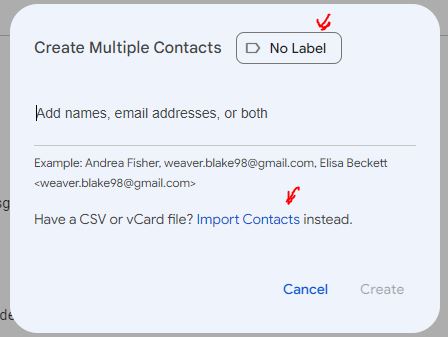
( 5 ) Up pops a Create Multiple Contacts window. At the upper right of that window you can select what existing label (contact group name) you want to apply to this new list of names, or create a new label. For this example, I created (entered) a new label (in place of “No Label”), called Close Friends. Then, towards the bottom of this window, click on Import Contacts.
Then (in the new window that pops up) select the name of the incoming CSV file, and click Import. That’s it!
The new contacts will be in your overall contact list, with the group name label applied to them. There will also be a default group label “Imported on [today’s date]” created (also applied to this bunch of contacts). You can delete that label from the list of labels (bottom left of the Contacts page), using the “Keep the Contacts” option so the new contacts don’t get erased.
( 6 ) Now you can send out emails to this whole group of contacts. If this is a more professional or sensitive situation, or if the list of contacts is unwieldy (e.g. over ten or so), you might just send the email to yourself and bcc it to the labeled group.
APPENDIX: List of all Header Entries for CSV Files, for Importing Contacts to Gmail
I listed above several header entries which could be used to tell Google what the data is in your list of contact information. This Productivity Portfolio link has more detailed information. This includes tips for using VCard file format for transferring contact information (use app like Outlook to generate VCard or CSV file, then fix header info as needed, and then import that file into Google contacts).
There is also a complete list of header entries for a CSV file, which is available as an Excel file by clicking his “ My Google Contacts CSV Template “ button. The Excel spreadsheet format is convenient for lining things up for actual usage, but I have copied the long list of header items into a long text string to dump here, to give you the idea of what other header items might look like:
I bolded the two items I actually used in my example (Name and E-mail 1 – Value), as well as a pair of entries ( Phone 1 – Type and Phone 1 – Value) as header items which you might use for including, say, cell phone numbers in your CSV file of contact information.
Twice in the past year, I have received robo notices from doctors’ offices, blandly informing me that their systems have been penetrated, and that the bad guys have absconded with my name, phone number, address, social security number, medical records, and anything else needed to stalk me or steal my ID. As compensation for their failure to keep my information safe, they offer me – – – a year of ID theft monitoring. Thanks, guys.
And we hear about other data thefts, often on gigantic scales. For instance, this headline from a couple of months ago: “Substantial proportion” of Americans may have had health and personal data stolen in Change Healthcare breach”. By “substantial proportion” they mean about a third of the entire U.S. population (Change Healthcare, a subsidiary of UnitedHealth, processes nearly half of all medical claims in the nation). The House Energy and Commerce Committee last week called UnitedHealth CEO Sir Andrew Witty to testify on how this happened. As it turned out:
The attack occurred because UnitedHealth wasn’t using multifactor authentication [MFA], which is an industry standard practice, to secure one of their most critical systems.
UnitedHealth acquired Change Healthcare in 2022, and for the next two years did not bother to verify whether their new little cash cow was following standard protection practices on the sensitive information of around a hundred million customers. Sir Andrew could not give a coherent explanation for this lapse, merely repeating, “For some reason, which we continue to investigate, this particular server did not have MFA on it.”
But I can tell you exactly why this particular server did not have MFA on it: It was because Sir Andrew did not have enough personal liability for such a failure. If he knew that such an easily preventable failure would result in men in blue hauling him off to the slammer, I guarantee you that he would have made it his business within the first month of purchasing Change Healthcare to be all over the data security processes.
Humans do respond to carrots and sticks. The behaviorist school of psychology has quantified this tendency: establish a consistent system to reward behavior X and punish behavior not-X, and behaviors will change. As one example, Iin one corporate lab I worked in, a team of auditors from headquarters came one year for a routine, scheduled audit of the division’s operations. If the audit got less than the highest result, the career of the manager of the lab would be deeply crimped. Our young, ambitious lab manager made it crystal clear to the whole staff that for the next six months, the ONLY thing that really mattered was a spotless presentation on the audit. It didn’t matter (to this manager) how much productivity suffered on all the substantive projects in progress, as long as he was made to look good on the audit.
Let me move to another observation from my career in industry, working for a Certain Unnamed Large Firm, let’s called it BigCo. BigCo had very deep pockets. Lawyers loved to sue BigCo, and regulators loved to fine BigCo, big-time. And it would be a feather in the cap of said regulators, or other government prosecutors, to throw an executive of BigCo in the slammer.
Collusion among private companies to fix prices does do harm to consumers, by stifling competition and thereby raising prices. So, back in the day when regulators fiercely regulated, statutes were enacted making it a criminal act for company agents to engage in collusion, and authorizing severe financial penalties. American authorities were fairly aggressive about following up potential evidence, and over in Europe, police forces would engage in psychological warfare using their “dawn raid” tactic: just as everyone had sat down at their desks in the morning in would burst a SWAT team armed with submachine guns and lock the place down so no one could leave. I don’t know if the guns were actually loaded, but it was most unpleasant for the employees. BigCo’s main concern was avoiding multimillion dollar fines and restrictions on business that might result from a collusion conviction, so they devoted significant resources to training and motivating staff to avoid collusion.
Every year or two we researchers had to troop into a lecture hall (attendance was taken) and listen to the same talk by the same company lawyer, reminding us that corporations don’t go to jail, people (i.e. employees) go to jail, by way of motivating us to at all costs avoid even the appearance of colluding with other companies to fix prices or production or divide up markets or whatever. This was a live issue for us researchers, since some of us did participate in legitimate technical trade associations where matters were discussed like standardizing analytical tests. If memory serves, the lawyer advised us that if anyone in a trade association meeting, even in jest, made a remark bordering on a suggestion for collusion, we were to stand up, make a tasteful scene to make it memorable, and insist that the record show that the BigCo representative objected to that remark and left the meeting, and then stride out of the room. And maybe report that remark to a government regulator. That maybe sounds over the top, but I was told that just such a forceful response in a meeting actually saved BigCo from being subjected to a massive fine imposed on some other firms who did engage in collusion
My point is that if the penalties (on the corporate or managerial level) for carelessness are severe enough, the company WILL devote more substantial resources to preventing fails. It seems to me that the harm to we the people is far greater from having our personal data sucked out of health care and other company databases, than the harm from corporate collusion which might raise the price of copier paper or candle wax. Thus, I submit that if someone in the C-suite, like the chief information officer or the CEO, were liable to say 90 days in jail, management would indeed apply sufficient resources to data integrity to thwart the current routine data theft.
If I were king, this would be the policy in my realm. I recognize that in the current U.S. legal framework, the corporate structure shields management from much in the way of personal liability, and there are good reasons for that. I suppose another way to get at this is to have automatic fines structured to strip away nearly all shareholder value or management compensation, whilst still allowing the company to operate its business. This would be another route to put pressure on management to prioritize protection for their customers. Sir Andrew’s total compensation package has been running about $20 million/year. To my knowledge, the impact of the recent gigantic data breach on him has been fairly minimal in the big picture. Sure, it was aggravating for him to have to tell the U.S. Congress that he had no idea why his corporate division screwed up so badly, and to have to devote a good deal of effort to damage control, but I am guessing that his golf game (if he is a golfer) was not unduly impacted. He is still CEO, and collecting a princely compensation. But what if the laws were such that a major data hack would automatically result in a claw-back of say 95% of his past two years of compensation, and dismissal from any further management role in that company? I submit that such a policy would have motivated the good Sir Andrew to have devoted proper diligence and company resources to data integrity, such that this data breach would not have happened.
I don’t mean to pick on Andrew Witty as being uniquely negligent. By all accounts he is a nice guy, but his behavior is paradigmatic of ubiquitous benign management neglect, which has consequences for us little people.
These are just some personal musings; I’m sure readers can improve on these proposals.
Well, it’s finally over. As noted in previous blog posts, back when interest rates were essentially zero, I started an account with cryptocurrency investing firm BlockFi. They paid me a hefty 9% per year for lending out my crypto coin to “trusted institutional counterparties”, backed by large collateral. However, when Sam Bankman-Fried’s FTX exchange went belly up, it took BlockFi with it. (Bankman-Fried, the former rock-star white knight of the crypto world, is now in prison for fraud). My funds at BlockFi disappeared into the black hole of bankruptcy proceedings for about a year and a half.
Last month, a judge finally allowed a settlement for clients to withdraw their assets from their interest-bearing accounts. There were two wrinkles. First, you get far less than 100% of your funds. Most of my money got chewed up in the corporate bankruptcy itself, and then was eaten by the law firm (Kroll) processing the bankruptcy and the client reimbursement process. So, I’m only getting about 27% percent of my money back.
As an aside, Kroll got hacked about a year ago, leaking the names and email addresses of us BlockFi clients, and so some scammer sent out a very well-crafted email that a number of people, including me (briefly) were taken in by, as I wrote earlier. if you responded to that scam email, you ended up connecting your wallet to a scam application, which could then suck everything out of your wallet. Fortunately, I had almost nothing in my wallet for the short time I had it connected, but other victims lost considerable sums. I guess the reason why criminals continue to run crypto scams is because they are profitable, like the legendary bank robber Willie Sutton who robbed banks because “that’s where the money is.”
The other wrinkle In the BlockFi reimbursement is that they will only reimburse you with the actual cryptocurrency coin that you held, not with its dollar value. So, I had to set up a cryptocurrency wallet (I used Trust wallet) to receive my crypto, which was all in the form of the stablecoin USDC.
I had to do considerable background work to make this happen. In order to test that that wallet worked to receive USDC, I had to also set up a cryptocurrency exchange account, which I did with Coinbase (which seemed to be the most solid crypto exchange). I had to connect that account with my bank, put some money into the Coinbase exchange, buy some USDC, and send it to my crypto wallet to make sure that it all worked.
As of a week ago, after some fairly intrusive ID verification, the reimbursement machinery did finally deposit the measly remnants of my USDC into my wallet. OK, I thought, I’ll just transfer that to my Coinbase exchange account, turn the USDC into cash and be done with it all.
But not so fast… Because USDC is transferred over the Ethereum network, I had to have enough ETH coin in my Trust wallet to pay for the transfer. The network transfer cost, called the gas fee, was about eight dollars at midday, going down to about three dollars by 10 o’clock at night.
So, I had to go into my Coinbase account, convert some USDC there into ETH (incurring a $1.49 fee for that), and then send some ETH to my Wallet, incurring yet another a transfer fee there. Then I could use that ETH in my wallet to pay for the transfer of the USDC to my Coinbase exchange. Then at long last I was able to convert my USDC to cash and transfer it to my bank account, to finally put this whole BlockFi drama to rest.
Looking on the bright side of all this uproar, I now have a functioning cryptocurrency exchange account and wallet, and am familiar with elementary crypto operations. This might prove handy if I ever want to dabble more in this area or if some other need arises. For now, however, I have had enough of crypto.
ADDENDUM: Finally got all my BlockFi funds back as of November, 2024. BlockFi was able to claw back its assets from FTX, and fully reimburse its customers. Yay! This post describes the process:
Why does Mark Zuckerberg want to solve general intelligence? Well, for one thing, if he doesn’t, one of his competitors will have a better chatbot. Zuckerberg wants to be the best (and good for him). At his core, he wants to build the best stuff (even the world’s best cattle on his ranch).
If AGI is possible, it will get built. I’m not the first person to point out that this is a new space race. If America takes a pause, then someone else will get there first. However, I thought the Zuck interview was an interesting microcosm for why AGI, if possible, will get made.
… We started FAIR about 10 years ago. The idea was that, along the way to general intelligence or whatever you wanna call it, there are going to be all these different innovations and that’s going to just improve everything that we do. So we didn’t conceive of it as a product. It was more of a research group. Over the last 10 years it has created a lot of different things that have improved all of our products. … There’s obviously a big change in the last few years with ChatGPT and the diffusion models around image creation coming out. This is some pretty wild stuff that is pretty clearly going to affect how people interact with every app that’s out there. At that point we started a second group, the gen AI group, with the goal of bringing that stuff into our products and building leading foundation models that would power all these different products. … There’s also basic assistant functionality, whether it’s for our apps or the smart glasses or VR. So it wasn’t completely clear at first that you were going to need full AGI to be able to support those use cases. But in all these subtle ways, through working on them, I think it’s actually become clear that you do. … Reasoning is another example. Maybe you want to chat with a creator or you’re a business and you’re trying to interact with a customer. That interaction is not just like “okay, the person sends you a message and you just reply.” It’s a multi-step interaction where you’re trying to think through “how do I accomplish the person’s goals?” A lot of times when a customer comes, they don’t necessarily know exactly what they’re looking for or how to ask their questions. So it’s not really the job of the AI to just respond to the question. You need to kind of think about it more holistically. It really becomes a reasoning problem. So if someone else solves reasoning, or makes good advances on reasoning, and we’re sitting here with a basic chat bot, then our product is lame compared to what other people are building. At the end of the day, we basically realized we’ve got to solve general intelligence… (emphasis mine)
Credit to Dwarkesh Patel for this excellent interview. Credit to M.Z. for sharing his thoughts on topics that affect the world.
“we’ve got to solve general intelligence” If a competitor solves AGI first, then you are left behind. No one would not want general intelligence on their team, on the assumption that it can be controlled.
I would like the AGI to do my chores for me, please. Unfortunately, it’s more likely to be able to write my blog posts first.
You know what the biggest problem with pushing all-things-AI is? Wrong direction. I want AI to do my laundry and dishes so that I can do art and writing, not for AI to do my art and writing so that I can do my laundry and dishes.
— Joanna Maciejewska—Myth-Touched is here! (@AuthorJMac) March 29, 2024
Speaking of microeconomics…I just learned of a hack that can save some money at home or in a business. It started with an email from an esteemed friend who leads an interesting life as a welder/rigger/artist. He helped build some of the giant sets at the Burning Man festival which, well, burned. His inquiry, with some personal references edited out, went like this:
…At burning man i once watched a man save the day by patching a hole in the plastic gas tank of a golf cart with super glue, toilet paper and vinegar… Suddenly we had a functioning golf cart. Although I’ve never gotten to use this I remember this trick dearly.
Just today [my brother] was telling me about … breaking his glasses. …he had already fixed his glasses. How? He said “I’m pretty good at super glue and baking soda.” … He said the baking soda acts as an accelerant and gets very hard when you add super glue to it.
Being a chemical engineer by background, and always curious about household chemistries, this got me poking about the internet. Here is what I found.
The main ingredient in most repair superglues is ethyl 2-cyanoacrylate, along with some polymethacrylate gel and a little sulfonic acid, which acts as a stabilizer. When the superglue comes in contact with moisture, that triggers the polymerization reaction, so the glue solidifies and bonds to surfaces. It works best as a very thin layer squeezed between two closely fitting surfaces. Thicker droplets of superglue may be very slow to harden or not harden at all, towards the middle.
Thus, superglue is notoriously bad for filling in gaps or spaces or holes. For gap filling, you would normally turn to epoxy glue (for strength) or silicone (for flexibility). These glues have their own advantages and disadvantages. I don’t think that either silicone or common epoxy would stand up well to gasoline.
My internet research found that porous paper, like toilet paper, tissue paper, or paper towel, can catalyze the hardening of superglue. You can stuff a hole with a wad of toilet paper, or make a shape out of paper towel, and saturate it with superglue, and it will instantly harden. For the nerds among us, I will note that paper is mainly cellulose, which is a polymer of sugar (glucose), which has water type -OH groups sticking out all over, which harbor a surface layer of adsorbed water. This YouTube video by Mr Made has excellent examples of using porous paper for super glue to instantly fill in a hole or build up a solid shape.
It is critical to use freshly opened superglue, and use a thin runny liquid formulation which will quickly saturate the paper, not a thick gel type superglue.
It turns out that baking powder can be used instead of porous paper with superglue to fill in holes or cracks or make solid shapes. You can sprinkle in a thin layer of baking soda, then saturate that with the glue, then add another layer of baking powder and glue, etc. This YouTube video , by The Maker, nicely demonstrates this technique.
So there you have it, hack away with your superglue.
Don’t Try This At Home:
The main loose end from my researches involves the role of vinegar in that fix of the golf cart fuel tank at Burming Man. Vinegar is usually mentioned as a solvent for superglue, and chemically vinegar is an acid whereas baking soda is a base, so vinegar seems like the opposite of an accelerant for the polymerization. I can only speculate that for making a very thick wad of paper plus superglue to fix the fuel tank, the vinegar may have been used deliberately to slow down the glue hardening a bit. But that is just a guess. I think the cyanoacrylate superglue would have a reasonable chance to withstand gasoline, but I sure would be nervous about relying on such a patch for a fuel tank. It would not take much of a gasoline leak to make Burning Man all that more memorable. Don’t try THIS at home.
I got to be a guest of Vignesh Swaminathan who is based in Mumbai. It’s fun to have a deep conversation with someone on the other side of the world and share it with the whole internet (and the AI’s).
The first 10 minutes are about Tyler’s GOAT book. Vignesh asked me to name some influential economists who did not make Tyler’s list.
Around minute 12 we talk about the experimental economics methodology.
The middle (minute 15-42) is a discussion of the pipeline into tech and my Willingness to be Paid paper. He adds his perspective on tech jobs in India.
Around minute 42, Vignesh makes a switch over to the Barbie movie and then Oppenheimer. He observes that Oppenheimer is a “brand.” I speculate on careers in Barbieland. We recorded this before Christmas of ’23, right after everyone had seen these summer movies. Both movies ended up in the 2024 Oscars awards ceremony.
I predicted that people will eventually be able to create a custom movie from a verbal prompt, because of the AI content revolution. Here in Spring of ’24 that has already come true. Sora is shocking everyone and even caused Tyler Perry to halt a physical film studio expansion.
Around minute 55, we pivot to Hayek and competition, which leads to a postmortem on Google Plus (RIP).
Skimming back through this conversation has me thinking about tech work. The market for IT workers and programmers has evolved since I first started the project that became “Willingness to be Paid: Who Trains for Tech Jobs?”
I like pointing people all the way back to this report on jobs from 1958. Learn to Code has been good advice for a long time, for the people who can tolerate the work. That does not mean it will be true forever, but I would argue that it is still true today.
Silicon Valley as a career might have peaked around 2021. It’s not going away, but it might not be growing anymore in terms of the number of talented people who can be absorbed there. (Might I suggest Huntsville instead?)
The rise of artificial intelligence is affecting job seekers in tech who, accustomed to high paychecks and robust demand for their skills, are facing a new reality: Learn AI and don’t expect the same pay packages you were getting a few years ago.
Jobs in areas like telecommunications, corporate systems management and entry-level IT have declined in recent months, while roles in cybersecurity, AI and data science continue to rise, according to Janco’s data. The average total compensation for IT workers is about $100,000, making the position a target for continued cost-cutting.
One reason tech jobs are less attractive than some other professional paths is that the skillset changes. We mentioned this as a drawback in our policy paper. Computers are constantly changing. Vignesh and I discuss the issue of risk. I suggested that companies could pay less for talent if they were willing to offer packages that carry less risk of getting fired.
Nevertheless, tech still has decent job prospects. An unemployment rate of about 5% is about normal for work, even though tech had seen lower rates at the peak of demand. I do not know what programming as a career will look like in 10 years, but I’d say the same about screenwriting and live sports commentary. The LLMs are coming for everything or nothing or something in between.
I’ve been on tour (regionally) with our ChatGPT paper and getting opportunities to query different audiences about their LLM use. Last week I talked to a young man in our business school who is using ChatGPT to write SQL code at his job. I said in the podcast that I would still advise young people in Alabama to learn to code, even if they are not going to move to Silicon Valley. I think coding is more fun in the LLM-age or at least less miserable.
As I noted last month, the crypto lending firm BlockFi has started to send back to its customers some of their funds which had been frozen for over a year, since the demise of Sam Bankman-Fried’s FTX exchange led to BlockFi likewise vanishing into the mists of Chapter 11. As BlockFi emerges from bankruptcy, they are reimbursing customers in two tiers. Those who had crypto sitting in their “wallet” on the platform (not lent out and not earning interest), got back 100%. In my case, nearly all my assets on BlockFi were on the lending platform, earning juicy interest. For that class of assets, only a partial recovery is expected. Also, BlockFi will only send to you the crypto (e.g. Bitcoin or USDC) you owned as the crypto coin itself, not as the liquidated dollar value.
Therefore, you must establish an outside crypto wallet, and give them the external wallet address, so they can transfer the coin over a blockchain. This prospect of a connection between BlockFi (or its bankruptcy agent, Kroll) and your crypto wallet has brought out the scammers in force: if they can trick you into connecting them to your wallet, they can suck it dry in a flash.
The first thing I noticed back in early March was the proliferation of web sites that looked legit, but weren’t. When I browsed for “BlockFi withdrawal” or “BlockFi recovery,” up came a number of sites that had “BlockFi” or “Kroll” somewhere in their names, as clickbait. I don’t see any of these sites now, a month later. I assume that either those sites have been taken down as the thieves move onto the next heist, or the search engines have blotted them out.
Bogus phishing emails have also been sent out. Most insidious was an expertly-crafted email that I and other BlockFi customers received. Here is a screen shot of the now-infamous message:
As folks have pointed out, this looks pretty good. It has got the official company logo, and no misspellings. The return address on the email was BlockFi Holdings at www.everbridge.com. Unless you were vigilant, this address did not immediately raise suspicions like a random Gmail address or .ru address might.
Plus, this email was targeted to BlockFi customers, and came right when we were expecting further emails to tell us what steps to take to recovery our funds. How did the thieves have our email addresses? One speculation centers around the “Mother of All Breaches” (MOAB) when the Mailer Lite database was hacked in January. But we know that Kroll’s database was breached last year, where the lost data includes BlockFi customers’ names, email addresses, and amounts held at BlockFi, so that seems a more direct source.
Anyway, lots of BlockFi customers clicked on the link in this email. The thieves were pretty clever. First, they had you scrawl your signature on the screen. So now they have that archived, in order to do further ID theft mischief. And then, they had you connect their app to your wallet, as a trusted dApp. Over on Reddit (here and here), you can read the howls of pain from folks who got their wallets cleaned out. They are not alone – -as of late March, this scam had netted something like $5 million in digital assets.
An eerie thing about crypto is that the holdings at any address on the blockchain are public knowledge, even though you don’t know who the owner of that address is. So crypto sleuth Plumferno was able to display at least one of the BlockFi scammer’s wallets in the process of accumulating stolen assets:
This wallet (0x6C0e83422cD73fFD3A5EC4506638F6A0A8e22b38) currently holds well over $1million in Eth + various tokens combined, and as you can see, this scam is still very active – new victims are showing up in the transaction list quite regularly. Current holdings on Debank:
I am embarrassed to admit that I got taken in by this email. I tried clicking on the links, but fortunately my wallet was empty and my anti-malware resisted having me connect to the phishing site, so I did not lose any coin. Some takeaways are:
( 1 ) Always be suspicious of emails; especially scrutinize the return address, to make sure it really is from a source you trust. Watch for almost-legit email addresses.
( 2 ) If at all possible, avoid clicking on links in emails; try to go to the actual company website and click links from there.
( 3 ) See ( 1 )
See here for the bittersweet ending to this saga (I did get some money back, but only 27% of my original funds at BlockFi).
It seems like we finally have anti-obesity drugs that are effective and come without deal-breaking side effects: GLP-1 inhibitors like semaglutide (Wegovy). But they are currently priced over $10,000 per year for Americans. Should insurance cover them?
So far Medicare has decided to cover these drugs only to the extent that they treat diseases like diabetes (which these drugs were originally developed to treat) and heart disease (Wegovy reduces adverse cardiac events by 20% in overweight patients with heart disease). Just based on the diabetes coverage, Medicare was already spending $5 billion per year on these drugs in 2022, making semaglutide the 6th most expensive drug for Medicare with prescriptions still growing rapidly. The addition of other indications for specific diseases, like heart disease coverage added last month, is sure to expand this dramatically, especially if trials confirm other benefits.
But with almost 3/4 of Americans now officially overweight, weight loss makes for a bigger potential market than any specific disease. Medicare currently spends about 15k per beneficiary for all medical care; if they actually paid for an 11k/yr drug for 3/4 of their beneficiaries, their spending could rise to 23k per beneficiary per year. The effect on Medicare Part D, which covers prescription drugs and currently spends about 2.5k per beneficiary per year, would be even more dramatic, with spending quadrupling. This would blow a huge hole in the federal budget, where health insurance already accounts for about 1/4 of all spending (and Medicare 1/2 of that 1/4).
Of course, the reality would not be nearly that bad. Not all overweight people would want to take a weight loss drug, even if it were covered by insurance; the side effects are real. To the extent people do take the drugs, the reduction in obesity could lead to lower spending on treatments for things like heart attacks. Rebates can already reduce the cost of these drugs to be less than half of their list price, and Medicare may be able to negotiate even lower prices starting in 2027. Key patents will expire by 2033, after which generic competition should dramatically lower prices. Competition from other brand-name GLP-1 drugs could lower prices much sooner.
Patents always come with a tradeoff: they encourage innovation in the future, but mean high prices and under-use of patented goods today. The government does have one option for how to lower the marginal price of a drug without discouraging future innovation: just buy out the patent. This would likely cost hundreds of billions of dollars up front, but this could be recouped over time through lower spending, while bringing large health benefits because the drug would be much more widely used if it were sold at a price near its marginal cost of production.
Of course, for now supply of these medications is the bigger problem than the cost. Even with the current high prices and insurers tending not to cover drugs of weight loss alone, demand exceeds supply and shortages abound. The manufacturers are trying to ramp up production quickly to meet the large and growing demand, but this takes time. Insurers like Medicare covering weight loss drugs wouldn’t actually mean more people get the drugs in the short run, it would simply change who gets to use them.
But once production ramps up, I do expect that it will make sense for Medicare to cover weight loss drugs. The health benefits appear to be so large that the drugs are cost effective even at current prices, and prices are likely to fall substantially over time. The big restriction I suspect will still make sense is to require that patients be obese, rather than merely overweight, since being “merely” overweight (BMI 25-29) probably isn’t that bad for you:
Update 4/18/24: I started thinking about this question because of an interview request from Janet Nguyen at Marketplace. She has now published an excellent article on the subject that also includes quotes from John Cawley of Cornell, who knows a lot more than I do on the subject.
What’s the connection between social media use and mental health, especially among young people? You’ve probably heard a lot about this recently, in the media, by politicians, and among friends chatting about their kids. Lots of assertions are made, but there is also a bit of research on this topic. As someone who frequently uses social media myself, as well as a parent of young children, and a teacher that works every week with young college students, I am particularly interested in this topic.
Jonathan Haidt and various co-authors have been trying to catalog all the research on the topic and figure out if there is a connection between the decline in teenage mental health and the rise of social media use. Haidt also has a new book on this topic, as well as the decline of “free play” among kids, which I have not yet read but I’ve looked through his documents that contain all of the underlying and summaries of the research he is citing. I’ll read the book soon, as I’m certainly part of the intended audience (see the last sentence of the above paragraph). And while this research is very much outside of my area of expertise, my training as an economist has taught me how to read academic papers and to be convinced by evidence, so once again I’m very much the intended audience on this score as well.
Please read this post as my attempt to understand the evidence and start to form conclusions and/or critique what Haidt is saying. It’s a work in progress, and I’ll write more as I read and think more about it.



 Economist Writing Every Day