Lot’s of economists use FRED – that’s Federal Reserve Economic Data for the uninitiated. It’s super easy to use for basic queries, data transformations, graphs, and even maps. Downloading a single data series or even the same series for multiple geographic locations is also easy. But downloading distinct data series can be a hassle.
I’ve written previously about how the Excel add-on makes getting data more convenient. One of the problems with the Excel add-on is that locating the appropriate series can be difficult – I recommend using the FRED website to query data and then use the Excel add-on to obtain it. One major flaw is how the data is formatted in excel. A separate column of dates is downloaded for each series and the same dates aren’t aligned with one another. Further, re-downloading the data with small changes is almost impossible.
Only recently have I realized that there is an alternative that is better still! Stata has access to the FRED API and can import data sets directly in to its memory. There are no redundant date variables and the observations are all aligned by date.
ChatGPT and related AI have been all the rage these past few months. Among other things, “AI” became the shiny object that companies have dangled before investors, rocketing upward the shares of the “Magnificent Seven” large tech stocks.
However, a recent poll by computer security firm Malwarebytes notes a marked turn in the public’s attitude towards these products:
It seems the lustre of the chatbot-that’s-going-to-change-everything is starting to fade….
When people explored its capabilities in the days and weeks after its launch, it seemed almost miraculous—a wonder tool that could do everything from creating computer programs and replacing search engines, to writing students’ essays and penning punk rock songs. Its release kick-started a race to disrupt everything with AI, and integrate ChatGPT-like interfaces into every conceivable tech product.
But those that know the hype cycle know that the Peak of Inflated Expectations is quickly followed by the Trough of Disillusionment. Predictably, ChatGPT’s rapid ascent was met by an equally rapid backlash as its shortcomings became apparent….
A new survey by Malwarebytes exposes deep reservations about ChatGPT, with optimism in startlingly short supply. Of the respondents familiar with ChatGPT:
81% were concerned about possible security and safety risks.
63% don’t trust the information it produces.
51% would like to see work on it paused so regulations can catch up.
The concerns expressed in the survey mirror the trajectory of the news about ChatGPT since its introduction in November 2022.
As EWED’s own Joy Buchanan has been pointing out specifically with regard to citations for research papers (here, here, and in the Wall Street Journal), ChatGPT tends to “hallucinate”, i.e., to report things that are not simply true. In the recent working paper “GPT-3.5 Hallucinates Nonexistent Citations: Evidence from Economics” , she warns of the possibility of a vicious spiral of burgeoning falsehoods, where AI-generated errors which are introduced into internet content such as research papers are then picked up as “learning” input into the next generation of AI training.
Real-world consequences of ChatGPT’s hallucinations are starting to crop up. A lawyer has found himself in deep trouble after filing an error-ridden submission in an active court case. Evidently his assistant, also an attorney, relied on ChatGPT which came up with a raft of “citations to non-existent cases.” Oops.
And now we have what is believed to be “the first defamation lawsuit against artificial intelligence.” Talk show host Mark Walters filed a complaint in Georgia which is:
…asking for a jury trial to assess damages after ChatGPT produced a false complaint to a journalist about the radio host. The faux lawsuit claimed that Mr. Walters, the CEO of CCW Broadcast Media, worked for a gun rights group as treasurer and embezzled funds.
…Legal scholars have split on whether the bots should be sued for defamation or under product liability, given it’s a machine — not a person — spreading the false, hurtful information about people.
The issue arose when an Australian mayor threatened to sue the AI company this year over providing false news reports that he was guilty of a foreign bribery scandal.
Wow.
Thousands of AI experts and others have signed an open letter asking: “Should we let machines flood our information channels with propaganda and untruth? Should we automate away all the jobs, including the fulfilling ones? Should we develop nonhuman minds that might eventually outnumber, outsmart, obsolete and replace us? Should we risk loss of control of our civilization?”. The letter states that “Such decisions must not be delegated to unelected tech leaders. Powerful AI systems should be developed only once we are confident that their effects will be positive and their risks will be manageable.” It therefore urges “all AI labs to immediately pause for at least 6 months the training of AI systems more powerful than GPT-4…If such a pause cannot be enacted quickly, governments should step in and institute a moratorium…AI labs and independent experts should use this pause to jointly develop and implement a set of shared safety protocols for advanced AI design and development that are rigorously audited and overseen by independent outside experts.”
Oh, the irony. There is reason to believe that our Stone Age ancestors were creating unreal images like this:
whilst stoned on peyote, shrooms, or oxygen deprivation. And here we are in 2023, with the cutting edge in information technology, running on the fastest specially-fabricated computing devices, and we get…hallucinations.
There is a community called #EconTwitter. This agglomeration of not-anonymous accounts links together professional economists, academics, and independent intellectuals. Twitter.com is the home base and origin of #EconTwitter. Mike wrote about turmoil in EconTwitter in December 2022. Find me on Twitter at @aboutJoy
The #EconTwitter group has experimented with leaving Twitter to join new networks. For some people, getting away from the billionaire owner is the explicit goal. Others join the new platform to be where the people are.
Mastodon launched in 2016 but it was not until recently that #EconTwitter made a go at that.
Mastodon is also part of the Fediverse ensemble of computer servers, which use shared protocols allowing users to interact with other users on computers running compatible software packages such as PeerTube and Friendica. Mastodon is crowdfunded and does not contain ads.
Fediverse? Protocols? The average Twitter user does not want to be bothered with “computer servers”. That’s part of the problem. On Mastodon I am @JoyBuchanan@econtwitter.net
When I joined, I was not confident that it would build on the initial momentum. The reason that the move to Mastodon was large and sudden is that Paul Goldsmith-Pinkham volunteered to set up econtwitter.net It’s paid for out of his research budget and he serves as the monitor. He can ban anyone who violates his speech/civility rules. So there is a moderator but not one paid by Mastodon.
Elon Musk buying Twitter is the big news this week. He wants to enhance free speech on the site and, according to him, make it more open and fun. Some fans are hoping that he will make the content moderation and ban policy more transparent.
me in April 2022
Some people thought Twitter would crash – as in go offline – because of Elon. That has not happened, but users and brands have been irked by his management and personal style.
EconTwitter at Mastodon is still going. As far as I can tell, most people have reverted to Twitter for their main feed because the audience is larger and writers want engagement. The level of engagement at Mastodon probably peaked about a month after Paul started the server for economists. One reason I think it never overtook real EconTwitter is that economists like having a big audience that includes journalists and sociologists. Silo-ing on an EconTwitter-dedicated server was less fun. People say they don’t want to have to deal with weird strangers online, but revealed preference indicates otherwise.
Another notable development was the launch of Bluesky. I’m there as @joybuchanan.bsky.social
Making a good handle at the beginning is easy and there is some upside if it turns out to attract a large community. A few “Twitter famous” people will join these new apps and commit to posting just in an attempt to unseat Twitter. This sort of works in the sense that both networks are still operating, however neither ever got close to the Twitter scale.
Threads, launched this week, might be different.
Mark Zuckerberg opened up Threads for anyone with an Instagram account, which most of us already have. Millions of people joined in just two days. If you already have an Insta, then you can download the free Threads app on your phone and port over your Insta account.
I’m @_Joy_Buchanan_ on Threads. The underscores might look awkward, but there is no “early adopter” phenomenon here, unless you were an early adopter of Instagram.
Brands and celebrities are comfortable on Threads, so it will be able to make money without asking users to pay for a Blue Check. I have no problem with Elon asking Twitter users to pay. Someone who is worried about free speech should want to be able to pay for service.
The Silicon Valley phrase is: “If you’re not paying for the product, you are the product.“
That’s going to be true on Threads, since I’m not paying for the product.
Threads will not kill Twitter, but it is going to make a bigger dent than Bluesky and Mastodon did. Nothing is free and nothing is perfect. I know a lot of people are upset about Twitter. However, there are some people who got a voice through it. People stuck inside authoritarian countries had a way to send messages out to a global audience.
Here is my most bullish case for Threads: it might unite the “TikTok generation” that never joined Facebook or Twitter but had Instagram with the older people from Twitter who never joined TikTok. The Twitterers will stay if they get enough attention.
Thus, Threads might put a dent in TikTok, too. Zuckerberg is probably sophisticated enough to make a “TikTok person” feel engaged by sending them more food videos and less BLS update charts.
This past week, smoke from wildfires in Canada once again drifted southward and gave very unhealthy air in parts of the U.S. Several sources I checked indicated that it is unrealistic to expect human effort to extinguish these fires (see here , here, and here). The Canadian forests are just too huge in relation to the fire-fighting resources. What usually happens, even during a normal fire season, is that summer fires just keep burning until they are dampened down by winter rain, snow, and cold. Most of the fire-fighting efforts are devoted to saving communities that are in the path of the flames.
Thus, we may expect periodic episodes of unhealthy air for the next several months. The most hazardous smoke particles are those less than 2.5 microns in size. Particles this small make it past your body’s defenses and penetrate deep into your lungs, promoting a number of serious medical conditions. These smoke particles are made of toxic chemicals like polycyclic aromatic hydrocarbons.
What to do to protect yourself? A first line of defense is to don an effective mask, even indoors. We all probably have Chinese KN95 or Korean KM94 masks left over from pandemic days, and (properly fitted around the nose) these should filter out most of the smoke, including the particles that are less than 2.5 microns. (I prefer the more-comfortable KM94 masks, as discussed here.) These masks are supposedly about as effective as the more-rigid N95 masks that are the U.S. standard.
Air Filters in Your Furnace
See here for some general tips on dealing with smoke in the home, e.g. damp-mop non carpet floors rather than vacuuming, to avoid shooting settled particles into the air. However, what is really needed is some means to filter the smoke out of the air in your home, otherwise over time the air inside may be as polluted as the air outside. All furnace/central air conditioning systems have a filter in the circuit. A simple solution would be to use an air filter which can catch the smoke particles. The problem here is that the better the filter is at catching small particles, the more restrictive of air flow it is.
Most air filters are rated according to MERV values. MERV 13 filters can remove most smoke particles in a single pass. Unfortunately, most home heating/cooling systems cannot handle that much restriction in air flow; the fan motor would get overloaded and perhaps burn out. One solution here is to install a parallel air filter, with its own booster fan, using a MERV 13 filter. Here, only part of the home air circulation goes through the MERV 13 filter on each pass, but with time most of the home air gets cleaned.
Another approach is to install a MERV 11 or (if your furnace is newer) MERV 12 filter in the furnace. A MERV 11 filter might only capture around 25% of smoke particles per pass, but in the course of a day your whole house air volume should pass through the filter several times. If you have a common size air filter, you can probably get a MERV 11 that would fit on Amazon or at a local big box store. For uncommon sizes, try here.
Make Your Own High-Capacity Filter Box
In addition to working with your furnace/air conditioning filter, you can buy a compact stand-alone air purifier for your home. This Shark HP202 model will provide a continuous read-out of air quality.
For even more air-cleaning muscle, you can make a box-style air purifier by duct-taping together four MERV 13 furnace air filters (four sides of a cube), and adding a box fan on top. Instructions (including YouTube links) for doing this are here, with further details here. These diagrams give the general picture:
An example of a finished product is below; note the red tape covering the outer part of the fan outlet. Blocking that outer area, giving a smaller diameter opening for the air to blow out, increases the net air flow significantly. (It prevents back-eddies of air around the edges).
It turns out that the air flow through one of these home-made air filters is so high that, even though the per-pass capture efficiency is lower than a HEPA filter, the home-made filter box can remove more particulates from a room than a store-bought HEPA filter.
I have made two of these filter boxes so far, using premium and regular filters. They have worked quite well in clearing the smoke from our rooms: the benefit is well worth the cost of parts and labor. See here for more on my experiences and construction tips.
Some on-line resources:
Accuweather seems to have straightforward reporting of air quality, including specifically the less than 2.5 micron particles. (Search on your location, then find Air Quality and click Details).
NOAA provides a real time satellite map of smoke patterns (click on “Surface Smoke”), but don’t rely on their color coding to decide whether your local condition is orange or red.
This web site from Natural Resources Canada shows locations of current wildfires in Canada. See Overlays for the meaning of the symbols; red denotes fires that are out of control. You can click Fire Perimeter Estimate to see the enormous extents of some of these fires.
I really don’t like the time and effort wasted in cleaning crudded-up frying pans, so I appreciate non-stick coatings. I have a small diameter Gotham ceramic pan that works well, and I was thinking of getting a larger one for cooking bigger loads. As usual, I went to the internet for wisdom on preferred ceramic pans to buy.
However, in the course of trying to get a fix on how they work, I fell down a rabbit hole. It turns out that this subject is complex and controversial. I will try to summarize my understanding in a brief post, with the caveat that I am not sure of everything here.
First of all, the “ceramic” coating is not really ceramic. Typical ceramics are made from firing powders of inorganic materials like silicon/aluminum oxides (including clays) at extremely high temperatures to where the particles fuse together. For the ceramic coatings on pans, this is not the case. I looked pretty hard on line without success to pin down the actual process or composition of the pan coating. It seems to involve some sort of silicone or silica polymer, applied using a sol-gel process. (Silica is just silicon and oxygen – quartz and white sand are pure silica – while silicone is typically a Si-O-Si-O-Si polymer with two extra hydrocarbon side groups attached to each Si).
100% silicone, in the form of rubbery sheets or cupcake papers for cooking on or in, is known to give a non-stick cooking surface. The “ceramic” coating in pans appears to be a solid equivalent of silicone cookware. A key factor mentioned in why it is slick and why it loses its slickness is that (supposedly) a thin layer of silica or silicone comes off with each cooking episode, and that thin layer is what gives the non-stick effect. (I would not mind ingesting a little adventitious silica, but eating random silicone worries me a little – but I don’t know if all this is actually true).
See this link for further discussion of the safety of ceramic versus teflon coatings. Be aware that makers of teflon coatings often choose names for their coatings that include the words “stone” or “granite”, perhaps to make the unwary consumer believe that these are ceramic coatings. My teflon pans have usually started to flake (into my food!) after a couple years’ use. A happy exception is a newer electric skillet which has temperature control so it never gets above about 425 F (high temperature destroys teflon). We do keep it oiled in use. Its teflon coating is still good as new after two years.
There seems to be general agreement that ceramic pans start off super slick, that fried eggs slide right out, but that after some months of use, food starts sticking noticeably. It helps to use a little oil every time you cook, and to avoid using metal utensils or abrasive cleaning pads, and to avoid very high temperatures or the use of cooking sprays (which deposit something harmful to the ceramic coating) or olive oil (which can burn on). Some users say it is important to clean the pan well between uses, e.g., using salt as a mild abrasive.
Why Do Ceramic Pans Lose Their Non-Stickiness?
There seem to be two main schools of thought as to the deterioration of performance. One school points to the (alleged) continual loss of silica particles or (presumably oily) silicone from the surface; perhaps once this surface layer is depleted, it’s game over. Another camp points to the buildup of burned-on deposits, even very thin, nearly invisible deposits, that then become a locus of food sticking.
What Can Be Done to Restore a Ceramic Pan Coating?
It is common to read that you just have to be prepared throw the pan away every 1-2 years. However, this does not seem economical. Can these pans be salvaged? One author claims that slickness can be restored by “seasoning” a ceramic pan, similar to how cast-iron pans are treated: after cleaning the pan, rub a very thin layer of a recommended oil (e.g. soybean oil, not olive oil) on the pan and then heat it to the smoke point. This should bond a polymerized oil layer to the surface. I have not tried this, but it might be worth a try.
A diametrically opposite approach is recommended by the maker of GreenPan ceramic pans. Here the theory is that if an offending film of cooked-on crud is removed, the native, clean ceramic layer beneath will once again be non-stick. A wet Magic Eraser type cleaning pad is recommended.
A similar remedy touted on the internet (e.g. here and here) is to rub with coarse salt (for long time, but not too hard) to get down to a pristine ceramic surface. Good results are claimed.
As a (retired) experimental scientist, I was itching to try something like this. At a family member’s house, I found an older ceramic pan that was not in really bad shape, but had lost its primal non-stick.
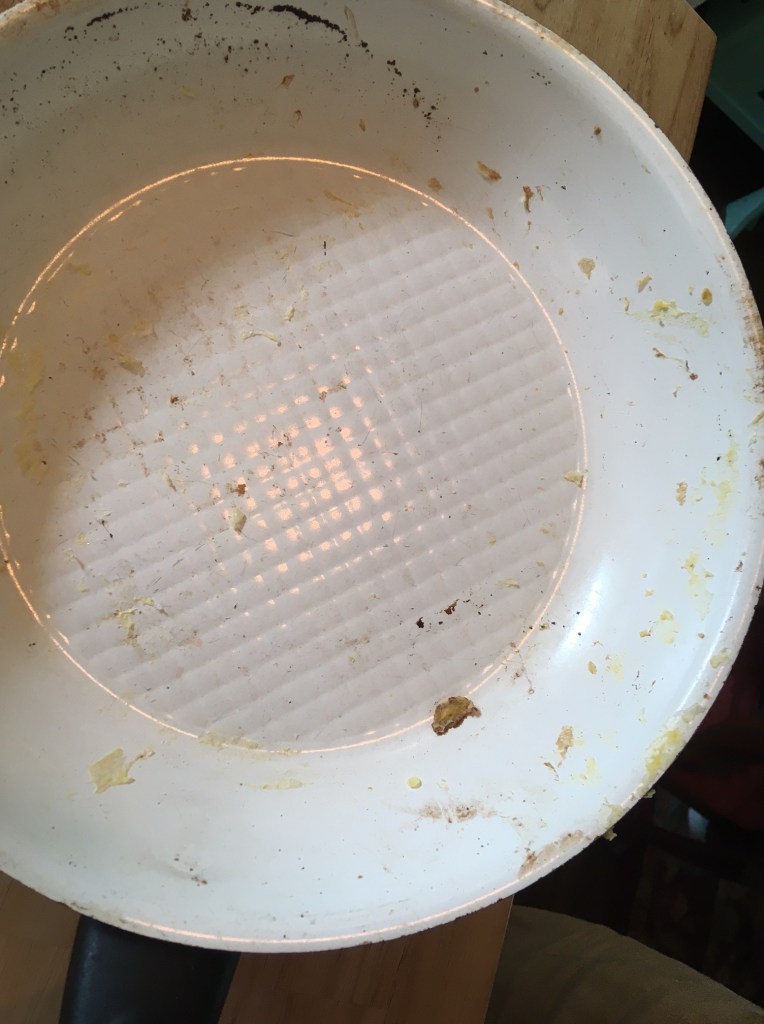
The BEFORE picture is above. There was a persistent brown film in parts of the pan, and cooked omelets (my test vehicle) did not simply slide out. I cleaned the pan with soap and water and a sponge, then went at it with a wetted Magic Eraser. I got the brown film off, though you could still see some pitting in the coating due to the use of metal utensils.
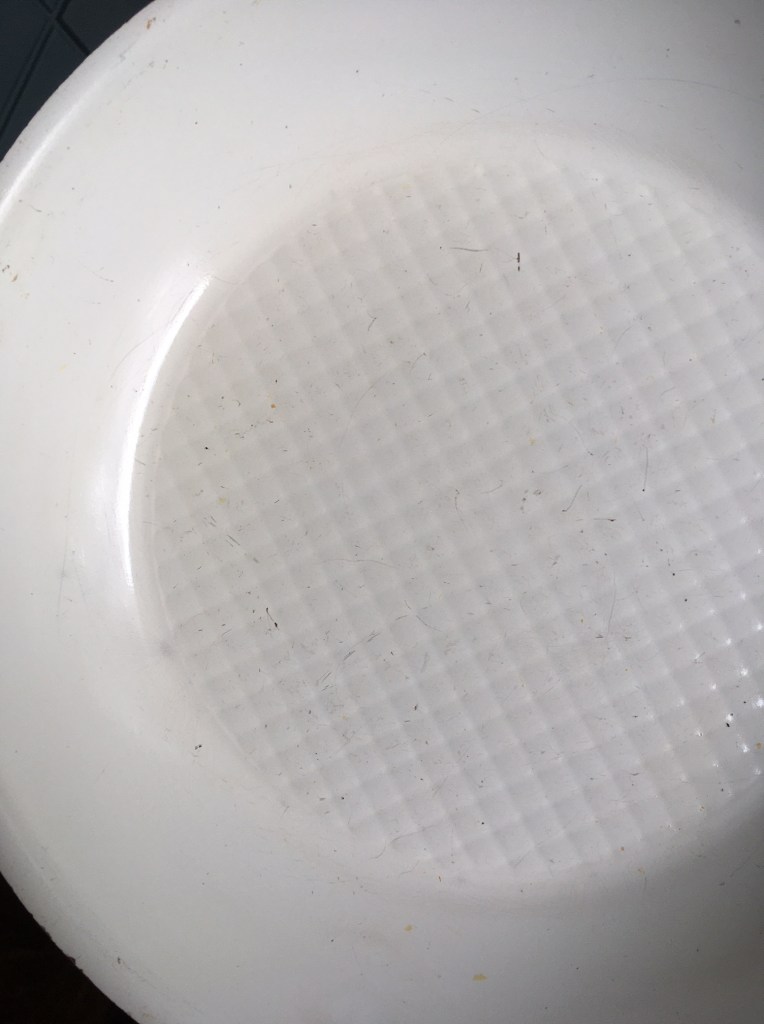
The AFTER picture is below. This is after cooking yet another omelet (with oil), and just wiping the pan with paper towel afterward. I can’t say that it was a night and day difference, but the Magic Eraser treatment definitely seemed to improve the performance. Score one for sustainability.
APPENDIX: Finally Understanding What Make Ceramic Pan Coatings Non-Stick
As noted in the original article above, I was puzzled over how the ceramic coatings worked. The descriptions in articles I could find on-line talked of forming these coatings from sol-gel solutions, using ingredients such as tetraethoxysilane. Without going into details, my chemical intuition led me to believe that, yes, you could form a dense silica pan coating from that, but the final outer surface would have Si-OH groups, like quartz or glass or ordinary “enamel” ceramic pan coatings. This would not give the oily, silicone-like surface that is evident with the nonstick ceramic pan coatings.
My “Aha” moment came when examining a patent application ( United States Patent Application No. 20180170815) for making a GreenPan ceramic pan coating. Among the ingredients for making the coating is methyltrimethoxysilane (MTMS). And THAT should give Si-CH3 groups on the outer surface, which is exactly the type of oil-like outer surface that silicone has. (The -CH3 methyl group is a fairly nonpolar, “oily” hydrocarbon type group).
A restless itch has now been scratched. I think I now understand why fresh ceramic pan coating can have such fine non-stick properties, and perhaps why they might be vulnerable to losing their non-stick properties. With Teflon type pan coatings, it is plasticky, oily Teflon all the way down, so if you abrade off a hundred molecular layers, it should make no difference. But with the ceramic coatings, it is not clear to me whether the oily Si-CH3 groups are only in the topmost atomic layer; maybe if that gets abraded off, there is only the quartz-like Si-OH groups to be found; or maybe there is a substantial (in atomic terms) topmost layer rich in Si-CH3 groups. Anyway, it makes sense to keep using oil when cooking on ceramic pans, to keep a hydrocarbon-type surface coating going there, and to avoid using metal utensils that can scrape and scratch the coating.
Abstract: We create a set of prompts from every Journal of Economic Literature (JEL) topic to test the ability of a GPT-3.5 large language model (LLM) to write about economic concepts. For general summaries, ChatGPT can perform well. However, more than 30% of the citations suggested by ChatGPT do not exist. Furthermore, we demonstrate that the ability of the LLM to deliver accurate information declines as the question becomes more specific. This paper provides evidence that, although GPT has become a useful input to research production, fact-checking the output remains important.
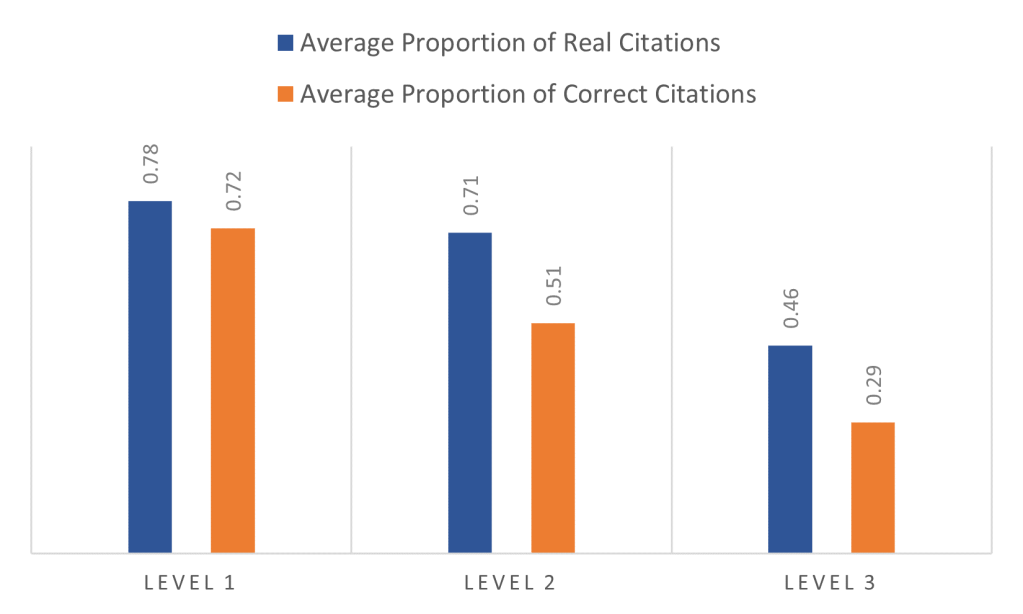
Figure 2 in the paper shows the trend that the proportion of real citations goes down as the prompt becomes more specific. This idea has been noticed by other people, but I don’t think it has been documented quantitatively before.
We asked ChatGPT to cover a wide range of topics within economics. For every JEL category, we constructed three prompts with increasing specificity.
Level 1: The first prompt, using A here as an example, was “Please provide a summary of work in JEL category A, in less than 10 sentences, and include citations from published papers.”
Level 2: The second prompt was about a topic within the JEL category that was well-known. An example for JEL category Q is, “In less than 10 sentences, summarize the work related to the Technological Change in developing countries in economics, and include citations from published papers.”
Level 3: We used the word “explain” instead of “summarize” in the prompt, asking about a more specific topic related to the JEL category. For L we asked, “In less than 10 sentences, explain the change in the car industry with the rising supply of electric vehicles and include citations from published papers as a list. include author, year in parentheses, and journal for the citations.”
The paper is only 5 pages long, but we include over 30 pages in the appendix of the GPT responses to our prompts. If you are an economist who has not yet played with ChatGPT, then you might find it useful to scan this appendix and get a sense of what GPT “knows” about varies fields of economics.
I have done various maintenance and repairs on my cars over the decades. Usually, they turn out to be harder and more time-consuming than I thought. Changing the engine oil and oil filter has become genuinely harder since the oil filters have migrated deep up under the engine, where it is hard to access them without putting the car on a lift, and disposing of a milk jug of used oil has gotten more difficult. I used to be able to easily change out a light bulb in the headlight, but the last car where that needed doing required you to take apart much of the front end of the car to get at the headlight. However, I recently found that changing the cabin air filters in my two vehicles (van and sedan) is so easy, I wish I had started doing it years ago.
Why Change the Cabin Air Filter?
The cabin air filter filters the air coming into the passenger section of the car. It knocks out road dust and pollen, and other bits of whatever that might get sucked into your air system as you are going down the road. So, it protects your and your family’s lungs as well as the components of the air handling system. Typical recommendations are to change out the filter about once a year or every 15,000-20,000 miles.
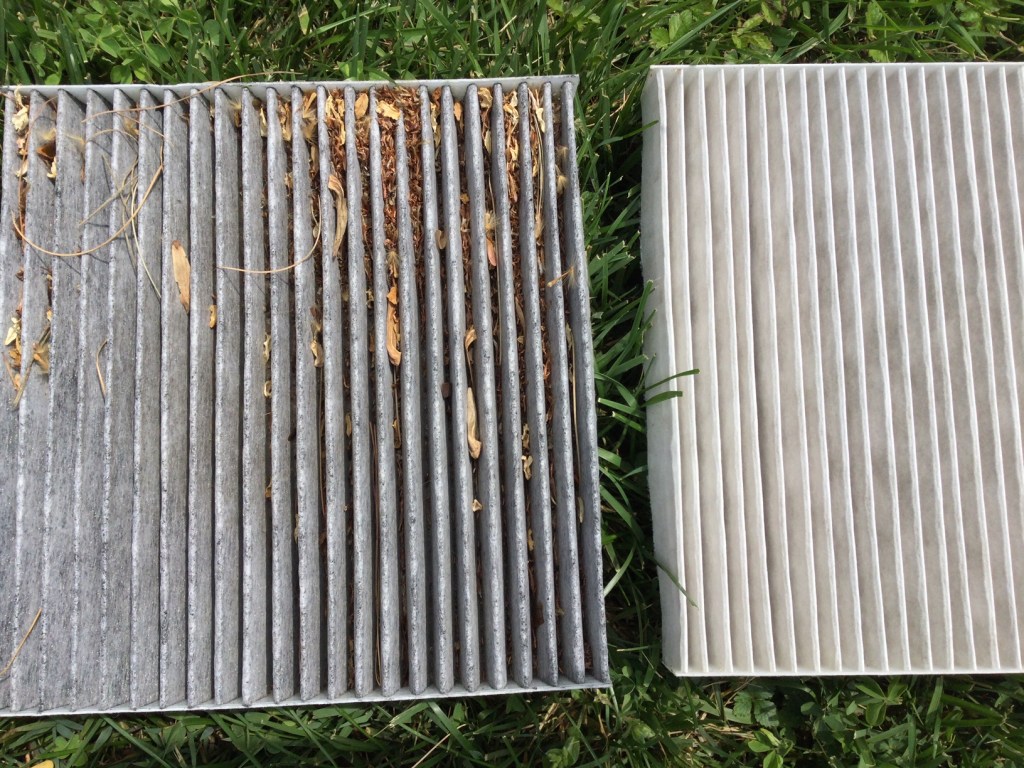
The photo below shows the cabin air filter I just pulled out of my van after maybe 2 years and 25,000 miles, next to a relatively clean filter. Obviously, I let this one go a bit too long: it is grey with dust/dirt, and partly blocked with plant debris.
I have not been quick to change out these filters because garages or dealers often charge something like $80-$100 for this. And until recently, I never considered doing it myself, because for some reason I thought it was a hard job. I had read of people having to contort in unnatural positions with heads inserted under dashboards as they disassemble layers of car to get at the filter.
It Is (Often) Super Easy to Change a Cabin Air Filter
It all depends on where the filter is located. For most models of cars, you can find guidelines on line, including YouTube videos. There are some models where you indeed may have to unscrew a cover plate somewhere below the dashboard to expose the filter. But in most cars, you remove the glove box to expose the filter. That may involve undoing come screws or a snap or strut, and squeezing the edge of the glove box inward. For my Hondas, all I had to do was empty the glovebox, (authoritatively) squeeze in the edges, and the glove box pivoted down, and behold, there was the filter in its little holder. Then slide out the holder, pull out the old filter and put in the new filter (purchased at AutoZone for $20 each), slide the holder back in place, and finally tilt the glovebox back up until it snapped in place.
Ten minutes max, easy-peasy. Obviously, this saved money, but it also felt empowering. I highly recommend trying it.
Rare earths are a set of 17 metals with properties which make them essential to a swathe of high-tech products. These products include lasers, LEDs, catalysts, batteries, medical devices, sensors, and above all, magnets. Rare earth magnets are used in electric motors and generators and vibrators, making them essential to electric cars, wind turbine generators, cell phones/tablets/computers, airplanes, phones, and all sorts of military devices.
China happens to have large amounts of rare earth oxide ores for mining, relatively lax environmental standards, and a large, compliant workforce. The Chinese government has harnessed these resources to make the nation by far the largest producer of rare earths. Their massive, relatively low-cost production has suppressed production in other countries. This has been a conscious policy, to achieve global control over a vital raw material.
The first time China used this effective monopoly as a political weapon was in a maritime dispute with Japan in 2010. China cut off exports of rare earth metals to Japan for two years, crimping the Japanese electronics industry. Other nations took note of this threat, and since then have been a number of half-hearted (in my opinion) efforts in various Western nations to develop some domestic capacity and to redesign motors to reduce dependence on rare earth materials.
China’s share of rare earth ore mined is down to 60%, but they totally dominate processing the ore to metals, and subsequent fabrication of magnets from the metal. Nearly all of the ore mined in the U.S. is shipped over to China for processing, mainly because of environmental regulations here.
The PRC still dominates the entire vertical industry and can flood global markets with cheap material, as it has done before with steel and with solar panels. In 2022, it mined 58% of all rare earths elements, refined 89% of all raw ore, and manufactured 92% of rare earths-based components worldwide.
There is no other global industry so concentrated in the hands of the Chinese Communist Party, nor with such asymmetric downstream impact, as rare earths.
It seems the only way for the West to blunt the Chinese monopoly in rare earths is with large, long-term subsidies (since the Chinese can always undersell the rest of the world on a free market basis) and probably some pushing past environmental objections.
Alarmed by the rapid buildup of Chinese military forces (towards a possible invasion of Taiwan), the U.S. and its allies have begun restricting exports of the highest-power silicon chips to China. In retaliation, China has reportedly made plans to restrict exports of rare earths, starting in 2023. If they follow through, that move would crush fabrication of magnets and of magnet-dependent devices like motors and generators in other countries; the rest of the world would have to come crawling to China for all these items.
This move would in turn cause the rest of the world to accelerate its plans to produce rare earths outside China, but there would be several years of great disruption, and Chinese-made final devices like motors and generators would always have a huge price advantage, due to their cheaper raw material inputs.
I suspect there may be a high-stakes game of brinksmanship going on behind the scenes. The Chinese leadership presumably knows that they can only play this rare earth export ban card once, and the West does not really want to plow a lot of resources into producing large amounts of rare earths much more expensively than they can be bought from China. So maybe we will see some relaxation in chip export controls for China in exchange for them not pulling the final trigger on a rare earth export ban.
In the past year, one cryptocurrency firm after another has gone bust, culminating in the grand implosion of the FTX exchange. The crypto vortex also contributed to some of the recent banking failures.
The prices of cryptocurrencies shot up in 2021, probably fueled by pandemic stimulus money sloshing around in the bank accounts of restless 20- and 30-somethings. All this came crashing back to earth in 2022, giving ample scope for skeptics to say, “I told you this was all foolishness.” Last rites were said, and crypto was left for dead.
But wait… in 2023, when no one was looking, the lid of the crypto coffin started to rattle, a bony hand reached out, and…crypto is back!!
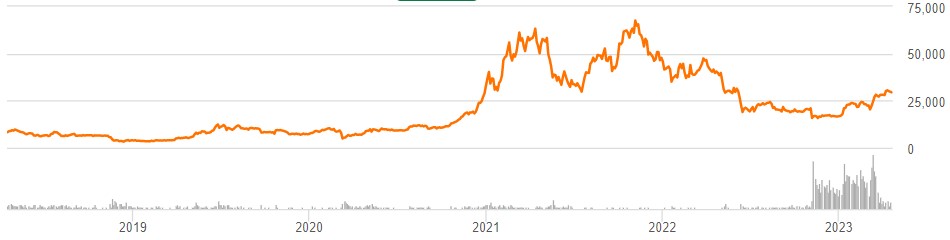
Well, sort of. Here is a five-year chart of Bitcoin from Seeking Alpha, in U.S. dollars:
And here is the past six months:
We can see that Bitcoin took its final big leg down in November, 2022, with the FTX collapse. Its price stayed fairly plateaued down there (with heavy trading volume) until January. Since then, it has nearly doubled.
What has triggered this rise in 2023? Observers such as Michael Grothaus at Fast Company suggests some four factors:
( a ) A shift to “risk-on” with the prospect of the Fed easing off with interest rate hikes this year.
( b ) A flight to alternative assets in the wake of the turbulence in the banking sector. Also, since the total amount of bitcoin is programmed to never increase over a certain number, Bitcoin should be a hedge against inflation. (Many observers believe that the Fed will live with 3-4 % inflation indefinitely, to help inflate away the gigantic debt that the federal government incurred with pandemic relief).
( c ) Buying of Bitcoin by traders who were short, and now need to cover their positions.
( d ) The usual rise in Bitcoin values as a bitcoin “halving” event is on the horizon. (About every four years, with the next time scheduled for May 2024, the rewards for mining new bitcoins drops by 50%).
Will the rise in Bitcoin prices continue? Is this truly a resurrection from the dead, or just a “dead cat bounce”? [1] Nobody knows. But this latest, sustained rally seems to have helped it recover some luster of legitimacy as an asset class. Here is a list of some popular crypto exchanges that are still in operation.
My personal take: I hold a sliver of the Bitcoin fund GBTC, just to have some skin in the game. I have been too lazy to learn about and activate an actual crypto wallet. I think Bitcoin in particular is an intriguing entity. Many other cryptos at some level depend on some centralized administration, but Bitcoin embodies the ideal of a decentralized, power-to-the-people form of something like money.
[1] From Wikipedia: In finance, a dead cat bounce is a small, brief recovery in the price of a declining stock. Derived from the idea that “even a dead cat will bounce if it falls from a great height”, the phrase is also popularly applied to any case where a subject experiences a brief resurgence during or following a severe decline. This may also be known as a “sucker rally”.




 Economist Writing Every Day
