The non-fiction book for adults I recommend this year is Liberty Power by historian Corey Brooks. If you have ever cared about social justice or affecting change, then wouldn’t you be curious to know how the abolitionists really did it around 1850? How, practically speaking, did a handful of people with moral convictions rid the United States of legal slavery? Abolitionists were striving and scheming to use the newly minted American democratic political system to their advantage even though they were in the minority. One of their big decisions was to start a third political party after they grew frustrated with slavery-complicit Northern Whig politicians. I blogged here about the connection with current politics.
I had a huge gap in my knowledge of American history before reading this book. Nothing that happened between George Washington and the Civil War seemed interesting, until this book created a narrative that I cared enough about to follow. History books might not be the perfect gift for everyone, but I bet no one in your family already has it!
Another book I reviewed earlier is Emily Oster’s The Family Firm, which any parent of young children would probably find helpful if they like research.
When I’m not reading for work, I read to my kids. I strongly recommend, for kids aged 6-12, The Voyage of the Dawn Treader. This ties into Liberty Power, because the main characters abolish the slave trade on one of the islands they sail to!
Before reading Dawn Treader, you should certainly start with the book that sets up the world, The Lion The Witch and the Wardrobe. I have a tip for younger kids: start reading this book right at the point where Lucy walks into the wardrobe for the first time. Younger kids won’t miss the first few pages that explain how the 4 children came to be in the old house.
For 4yo and 5yo kids, I recommend Aesop’s fables. These are short and self-contained. There are many versions of fable books for kids with good illustrations.
In addition of my specific plug for the Narnia series, I encourage parents to read fantasy with children. I see a lot of children’s books that promote science or STEM-readiness. My son enjoys learning about dinosaurs and nature, however I am certain that he’s learned the most from the conversations we have had about adventure stories.
Reading to your kids is costly in terms of time. We have limited time, so let me make an argument for dropping some of the other competing activities. I speak as someone who professionally teaches hundreds of college students to program. Those games that try to trick 5-year-olds into “programming” are less valuable than reading and discussing fantasy stories.
Inspire them with the story of a ship sailing to unknown islands. Talk about how a lovable band of flawed characters can escape from a clever magician. What your child will need to be able to do when they are 20 is read and comprehend a textbook that explains a totally new technology that no one alive today understands. Then they will need to think of creative ways to apply that technology to real world problems.
Late October is a nice time to get outside in Alabama. I have answered the primal call to suburban moms and signed up for a 5K running race at the end of the month. To make running practice safe and fun, I dropped a few hundred dollars this month on products.
Now that I’m old, my first concern is not injuring myself. Having good new shoes that absorbs some of the impact from running is important. I went to a local running store and ended up getting Asics Gel Nimbus.
I really like them. Amazon link. It seems like the price ($150) in the boutique store and the Asics website and Amazon is all the same.
Assuming you are not considering getting these shoes for yourself, do not buy a woman running shoes for Christmas, obviously, unless you’ve discussed it with her. You could buy a family member the other big purchase I made for running: AirPods.
Many people already have AirPods but I’ll review them anyway. I bet there are at least 10 people out there just like me who view them as newfangled and unnecessary.
My primary reason for getting them was so that I can listen to music while I run and not have the annoying headphones cord in my face. They are great for running. By the way, I got the cheapest version since I only use them occasionally.
AirPods are more than wireless headphones. They are smart. They allow you to take hands free phone calls when your phone is two rooms away (which can be a reason to keep them in even when you are not listening to music). They respond to voice commands and prompt you on what to say. Maybe I shouldn’t be, but I was surprised by how easy it was to start using them.
I use a free application called RunKeeper. Without any fiddling from me, the AirPods give me useful feedback on my run from RunKeeper. I don’t have to stop the music or pull out my phone to get this feedback. It just knows, and the AI is correct about what I want to hear when.
While I was at the Apple store getting AirPods, I considered getting an Apple Watch. It turns out that the Apple Watch does not have a long range from the phone. So, I cannot run a mile away from my phone and still get all services on the Watch. Since I’m not a serious runner, I did not want to spend hundreds of dollars on a new watch plus pay for a separate cellular plan for the device. I run while holding my small-ish iPhone.
Apple Watch records your heart beat. I can be a privacy grump, even though I use a lot of tech. Apple Corp. can C it’s way right out of my vital signs. I don’t even want data on my heart rate and sleep patterns, for myself. I’m already mentally overloaded, so I don’t want more data to think about.
Lastly, for your holiday shopping list, I will make one plug for the shirts in our Blog Store. These make a fun gift for math majors or Econ Ph.D. folk.
I did an informal survey among undergraduate students. This is not a representative sample of American youth. Before answering the question “How is TikTok affecting your peers?” they had just heard about the TikTok recommendation algorithm. Answers might have been slightly different if they had not been primed to think about the app from a business perspective.
Most of the answers were negative, both among students who use TikTok themselves and especially from students who are staying off of the app. Some answers presented both a positive and a negative reply.
Here is one of the more positive replies:
“TikTok is affecting my peers in a few different ways. On the positive side, people can learn very useful things on the app. On the negative side, it can be very time consuming. I have heard from many friends how they have wasted a lot of their time on TikTok when they could have been doing something more productive.”
Some students emphasized the social aspect:
“TikTok is one of the biggest social platforms amongst my friends and I. When we hangout, we are creating our own TikToks, but when we are apart we are able to share videos with each other. TikTok for me is a big rabbit hole that I find myself spending way too much time on.”
Also, they believe that this platform, more so than the original social networks, allow a new user to break out. “The idea that a normal, average person can post on TikTok and have a likelihood of it becoming viral is what has launched the platform.” I can see how a 20-year-old today would think Twitter is less fun because it is hard for a newcomer to get noticed.
Some students mentioned the addictive aspect of TikTok:
“I see a lot of my peers stay on the app for long periods of time. I can’t count the amount of times people say something about how they didn’t realize they were scrolling for an hour before they looked at the clock.”
“I have three friends back home who are being affected by Tik Tok in the worse way possible. All they do is watch Tik Toks all day and has even affected their sleep schedule cause they can’t put their phone down. It’s hard to see my friends sucked in the rabbit hole.”
“Personally, I have had to set screen time limits for TikTok through my phone’s settings because I can easily spend extended periods of time of the app without even realizing it; and even then, sometimes, I even override the limits I have set in place because I want to see even more content.”
The funniest line award goes to: “I personally hate TikTok and think it is rat poison.”
I wonder how the responses might have differed if I had asked a similar question to college students about TV and video games 20 years ago.
I use Twitter frequently. Maybe I spend more time on it than I should, and I don’t support as many paid media outlets as I might otherwise. Thus, the non-Twitter world is less rich for today’s college students.
For balance, here’s how Big Tech helped me in the past week. I needed to help my son build a model rocket from a kit. Some stranger kind young man had made an excellent YouTube video detailing how to make this rocket. This video really helped me, and the man should get the satisfaction of one more watch on his views count.
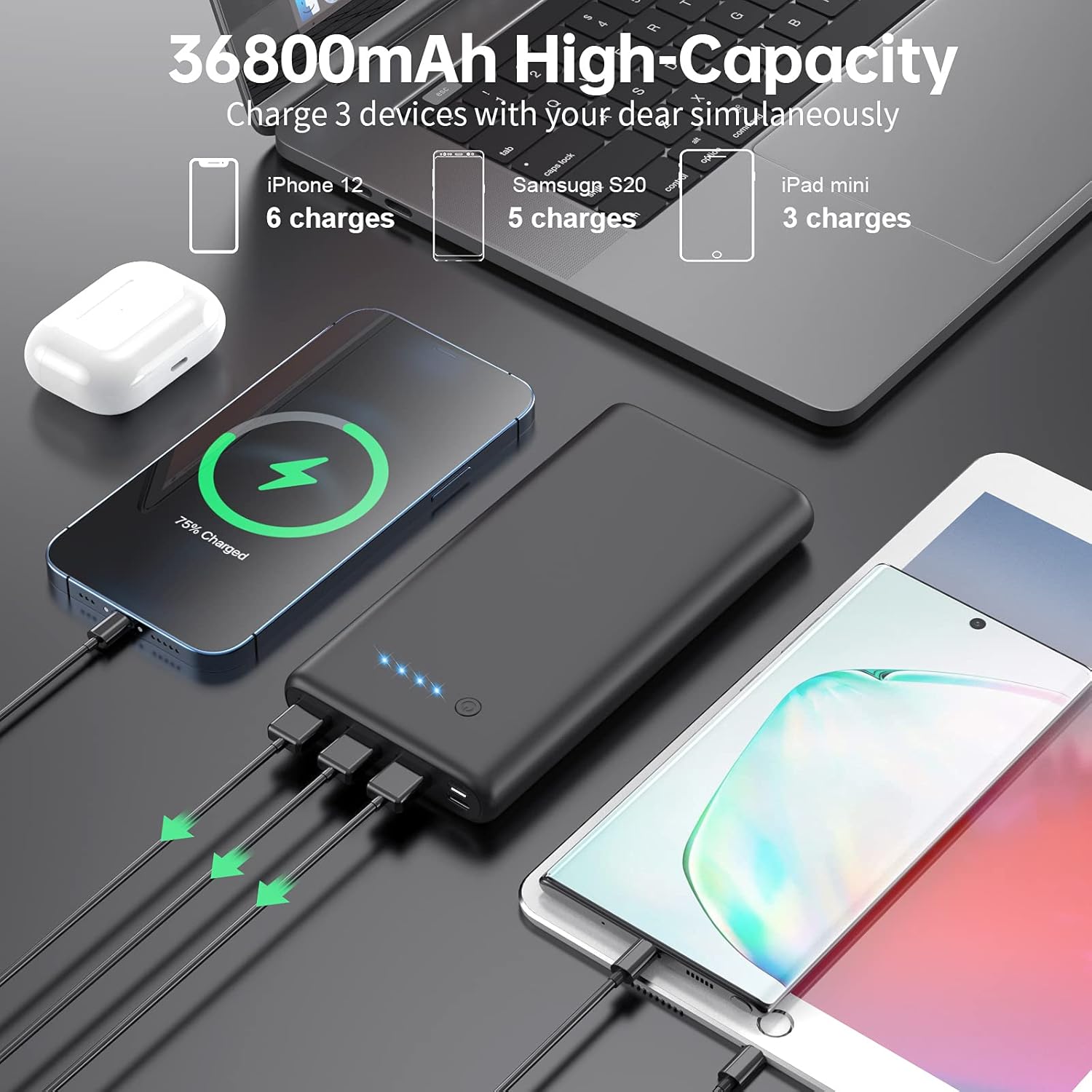
As we did last year, Joy has asked us to recommend some gifts for our readers. My recommendation is simple: a battery.
But not just any battery. I’m not talking about adding to your cardboard box full of AAs, AAAs, and weird watch batteries.
Instead, what you and everyone on your gift list needs is a portable battery for charging your many devices. There are plenty of good options out there, but anything under 30 bucks with at least 20,000mAh (the standard measure for battery life) is what you want. Here’s a good one on Amazon right now which should be $25 after a coupon and gives you 36,800mAh of charging power.
How much battery life is that? An iPhone has around 3,000mAh of power. You can charge an iPhone over 10 times with this thing! That may sound like overkill, but if you are charging multiple devices on a long trip, this battery is worth its weight in gold (it weighs about 13.4 ounces, which would be about $24,000 worth of gold — maybe I’m exaggerating a little).
For better or worse, our devices are how we communicate, navigate, and entertain ourselves on a daily basis. Especially on long trips. You don’t want your phone to die when you land at a strange, new airport. You also don’t want your friend’s phone to die: more than once, I have been the “battery hero” by loaning my portable battery to a friend at a conference.
Bryan Caplan recently wrote about public goods theory, how we teach it, and the unrealistic nature of how we classify goods as either/or, rather than on a continuum. I explored similar themes in a blog post that I wrote back in January, but Caplan brings up another important point about public goods theory that I forget.
In a short 2002 paper, and then in a 2003 book with the same title, Foldvary and Klein proposed the idea of “the half-life of policy rationales.” In brief, the justification for many market failure arguments is contingent on the current state of technology. They apply this to concepts such as natural monopoly and information asymmetries, but for public goods theory the most important application is to the concept of excludability.
Here’s the basic idea: it is costly to exclude non-payers for using some goods. If it is so costly that it would not be profitable for a private enterprise to produce the good in question, it won’t be produced privately. But it still may be efficient for government to produce the good, if the benefit from the good exceeds the cost of raising the revenue to pay for it (likely out of general revenue, since we have already admitted it is infeasible to charge the users directly).
But here’s the Foldvary and Klein point: all of the above paragraph is dependent on the current state of technology! Take roads for example. When you had to pay someone to physically take a few coins for a toll road, plus force all motorists to slow down to a complete stop to pay the toll, it was probably cost prohibitive to operate limited-access private toll roads. But technology changes. We now have the technology for electronic tolling done at highway speed (and even coin buckets were slightly faster than handing some dude your change). The argument for government provision of highways, which was strong when technology was ancient, is significantly weakened now that technology has reached its modern state.
(There may be lots of other reasons you think that roads should be publicly provided, such as equity, but these are separate questions and distinct from the argument made in standard public goods theory.)
Foldvary and Klein go through many more examples in their book, but we can already see the key insight. And I think this is extremely important for teaching public goods to undergraduates. It’s normal for us to say that goods are either excludable (in which private provision is best) or non-excludable (in which there is a strong case for some government intervention). But this either/or framing is wrong (a continuum is a better way to think about it), and crucially it can change over time depending on technological changes. Excludability is not some inherent feature of a good or service, it is a function of the state of technology.
Someone wrote a story about my life. It’s a report from The Verge called “File Not Found: A generation that grew up with Google is forcing professors to rethink their lesson plans”.
When I started teaching an advanced data analytics class to undergraduates in 2017, I noticed that some of them did not know how to locate files on a PC. Something that is unavoidable in data analytics is getting software to access data from a storage device. It’s not “programming” nor is it “predictive analytics”, but you can’t get far without it. You need to know what directory to point the software to, meaning that you need to know what directory contains the data file.
As the article says
the concept of file folders and directories, essential to previous generations’ understanding of computers, is gibberish to many modern students. It’s the idea that a modern computer doesn’t just save a file in an infinite expanse; it saves it in the “Downloads” folder, the “Desktop” folder, or the “Documents” folder, all of which live within “This PC,” and each of which might have folders nested within them, too. It’s an idea that’s likely intuitive to any computer user who remembers the floppy disk.
I am a long-time PC user. Navigating File Explorer is about as instinctive as drinking a glass of water for me. The so-called digital natives of Gen Z have been glued to mobile device screens that shield them from learning anything about computers.
Not everyone needs to know how computers work. I myself only know the layer that I was forced to learn.
My Dad, to whom I owe so much, kept a Commodore 64 in a closet in our house. About once a year, he would try to entice me into learning how to use it. I remember screwing up my 9-year-old eyes and trying to care. Care, I could not. It’s hard to force yourself to do extra work without a clear goal. The Verge article explains
But it may also be that in an age where every conceivable user interface includes a search function, young people have never needed folders or directories for the tasks they do. The first internet search engines were used around 1990, but features like Windows Search and Spotlight on macOS are both products of the early 2000s. Most of 2017’s college freshmen were born in the very late ‘90s. They were in elementary school when the iPhone debuted; they’re around the same age as Google. While many of today’s professors grew up without search functions on their phones and computers, today’s students increasingly don’t remember a world without them.
One area in which I do minimum archiving is my email. I rely heavily on the search function. I could spend time creating email folders, but I’m not going to put in the time unless I’m forced to.
Here’s where the “problem” lies:
The primary issue is that the code researchers write, run at the command line, needs to be told exactly how to access the files it’s working with — it can’t search for those files on its own. Some programming languages have search functions, but they’re difficult to implement and not commonly used. It’s in the programming lessons where STEM professors, across fields, are encountering problems.
Regardless of source, the consequence is clear. STEM educators are increasingly taking on dual roles: those of instructors not only in their field of expertise but in computer fundamentals as well.
Personally, I don’t mind taking on that dual role. I didn’t learn to program until I really wanted to. The only reason I wanted to was that I had discovered economics. I wanted to be able to participate in social science research. Let these STEM or business courses be the motivation for students to learn to use computers as tools instead of just for entertainment.
Allen Downey wrote a great blog on this topic back in 2018 that is more practical for teachers than the Verge report. He argues that learning to program will be harder for the 20-year-olds of today than it was for “us” (old people as defined by entering college before 2016). He recommends a few practical strategies, while acknowledging that there is “pain” somewhere along the process. He thinks it is sometimes appropriate to delay that pain by using browser-based programming interfaces, in the beginning.
I gave my students a break from pain this week with a little in-browser game that you can play at https://www.brainpop.com/games/blocklymaze/ They got 10 minutes to forget about file paths, and then it was back to the hard work.
I have found that a lot of students need individual attention for this step – the finding a file in their hard drive. I only have to do that once per student. Students pick the system up quickly. File Explorer is a pretty user-friendly mechanism. Everyone just has to have a first time. Sometimes, Zoomers just need a real person who cares about them to come along and say, “The file you downloaded exists on this machine.”
One way around this problem is to reference data that lives on the internet instead of in a local machine. If you are working through the examples in Scott Cunningham’s new book Causal Inference, here’s a piece of the code he provides to import data from his public repository into R.
The nice thing about referencing data that is freely available online is that the same line of code will work on every machine as long as the student is connected to the internet.
As more and more of life moves into the cloud, technologists might increasingly be pointing programs to a web address instead of the /Downloads folder on their local machine. Nevertheless, the kids need to have a better sense of where files are stored. He or she who can understand file architecture is going to get paid a lot more than their peers who only know who to poke and scroll on a smartphone.
There is a future scenario in which AI does most of the programming for us. When AI can fetch files for us, then File Explorer may seem obsolete. But I worry about a world in which fewer and fewer humans know where their information is stored.
Bo Burnham is a comedian and musician who, like so many of the artists I enjoy, produces art that I can only describe as extremely specific to him. His newest special on Netflix features a song, “Welcome to the Internet” (some NSFW lyrics), that I liked so much I thought it was worth writing as a formal model.
No, really. Hey, we all need a hobby.
The whole song is a meditation on the overwhelming nature of the internet and is, in my opinion, fantastic. I think if we zero in on two pieces of refrain in the lyrics, we can get some traction in what Burnham believes is the underlying problem, if not outright crisis, that resides within the internet and those that are “extremely online”:
First, the lure:
Could I interest you in everything? All of the time? A little bit of everything All of the time
This is the value-add of the internet and why we can never, and will never, leave it behind willingly. This is also the “cognitive overload” hypothesis of why the internet is bad. Sure, for the infovores of the world there hasn’t been a bigger technological shift since the printing press, but there certainly exists the possibility that most human minds (if any) aren’t built to handle the deluge of information they are drowning in. That’s one theory, but I think that’s the kind of problem that isn’t actually a problem. Some will consume more of the internet, some will consume less, c’est la vie.
It’s in the second half of the refrain, however, that we see the actual problem.
Apathy’s a tragedy And boredom is a crime Anything and everything All of the time
And therein lies the rub. You can’t opt out. But is that true? Well, that depends on who you are and how you live your best life i.e. how you optimize your utility function. So let’s do it. Let’s write down the utility function that lives inside the song. What we’re going to do is this- we’re going to lay out the simple components as natural language, then turn it into formal math, and then bring it back to natural language.
In our Burnhamian mode, people need two things: Private goods like food and shelter and Social Goods like friendship and camraderie. How much Utility you enjoy will always be increasing in both, but the optimal mix will depend on your constraints (wealth, time, accessible population) and the mathematical function determining how much Utility you get from a mix of Private and Social goods i.e. are they additive, multiplicative, or something else. Utility equal to zero is equivalent to death.
Let’s add one last layer of complexity. Let’s say that your Social goods are a function of two kinds of elements: Friends and Clubs. Friends are direct, one-to-one relationships. Clubs are large social groups. We will define and differentiate between the two as such: if you cease to be part of a friendship (whether between 2,3, or 5 people), then that friendship no longer exists in the same form. If you drop out of a club, on the other hand, that club will persist without you.
So what a person has to do is, within their constraints, try to optimize how much of their resources they invest in their Private goods, their Friends, and their Clubs.
The first line is our base model, the second is an expanded version with our two-input model of Social goods. The function we are using is called a Constant Elasticity of Substitution utility function. The key parameter, α, determines how Private and Social goods interact. If α=1, then they are what economists call perfect substitutes. All that matters is how much you have in total of the two inputs, and if you want you could specialize in just one of them. They are perfectly additive. If, on the other hand, α=-∞ (negative infinity), then they are perfect complements, like right and left shoes. There is no point in adding even one more unit of Private goods until you have another unit of Social goods to pair with it. In a sense, they are multiplicative, meaning if either value is zero, then your utility is zero. The value of α will tell us whether the best life requires more of a mix of Social and Private inputs (if they are more complementary), or simply the most of whatever is the easiest to come by (if they are good substitutes for each other).
We’ve nested in our Friends and Clubs production of Social goods as a CES function within the second equation, with a similar story, only here β will determine how much of a mix of Friends and Clubs we want, or whether we can specialize more in one over the other. In the third and last line of the model, we’ve reduced it down to the underlying questions that will tell our story represented by addition and multiplication signs:
Are Private and Social Goods complements (multiplicative) or substitutes (additive) when we internally produce utility? Are Friends and Clubs complements or substitutes when we internally produce our Social goods?
Assumption 1: α= -0.1 Private and Social goods are weak complements. What this means is that there are diminishing returns to Private and Social goods, you need some of both, but you can have less of one or the other and its fine. Let’s just assume wealthy people need other people in their lives to stay sane while, at the same time people with rich social lives and supportive communities still need food and shelter. You can specialize a bit more on one side, depending on what’s available, but you can’t live without at least some of both.
We’re all different in how we build our social lives and, in turn, how we internalize the internet in our lives. I think we can gain some insight into this process by working out the stories in this simple model through our second parameter, β. Let’s consider three broad types of people.
Person Type 1: Friends and Clubs are Strong Substitutes (high β)
These people are either relatively offline (e.g. they still use their phones as phones to make phone calls) or extremely online (e.g. they get a panic attack unless they have 80% battery and a charge pack on their person). These are the people who can become hyper-specialized in new clubs if they are extricated from prior social networks or club settings. This is why cults recruit people who move to new places where they don’t know anyone. This is how your diehard hippie socialist friend grew up to be a conservative evangelical after they moved to the Texas suburbs.
With regards to our original question, people who hyperspecialize in their club and club identity will be constantly contributing grist to the club’s identity: evidence of the necessity of the club and it’s mission, rage at non-members, disappointment in members who aren’t committed enough, and constant vigilance in the monitoring of everyone else’s commitment. They are in it, they are of it, and they are ready to purge.
Apathy’s a tragedy(You must care about everything the club cares about) And boredom is a crime(All of your time must be allocated to the club) Anything and everything All of the time
Type 2: Friends and Clubs are strong complements (low β)
These are the people that I think Burnham’s song is targeted at, for whom he has the most sympathy, and with whom I suspect he would count himself. These are people for whom the internet is the most taxing, the most exhausting to navigate.
Type 2 folks want to have personal friendships and friend groups while still feeling a part of something bigger, whether it’s a community, a political movement, or spiritual affiliation. Type 2 people will have preferences towards one or more social identities manifested as clusters on the internet, but they don’t want to purge people who don’t share those preferences from their circle of friends. Type 2 folks are interested in civil rights and social justice, but they want to diversify their emotional and material resources across their personal relationships and private wellbeing as well.
The deluge of the internet, with its stark images, focus on extreme outcomes, battle cries, and public reputation mauling, are constantly admonishing and shaming Type 2’s. Type 2 people are tired. Perhaps most importantly, the pandemic has been especially hard on Type 2’s. While Type 1 club-specialists have thrived by focusing the totality of their efforts to the online arena, their voices have been tearing the Type 2 social-portfolio diversifiers to shreds.
Type 3: Friends and Clubs are weak complements (middle β)
Type 3 people are a lot like Type 2’s, but it is easier for them to compartmentalize the production of their social goods. Type 3 people are often in clubs, but they are rarely ofclubs. They’re not joiners. Whether you’re looking at sacrifice-demanding religious cults or extremely-online political culture warriors, if the social associations of the world demand too much of Type 3 people, they are happy to half-ass their contribution or opt-out entirely. They might be on Twitter or Facebook, but they don’t need to reply to anyone. They might go to church on Sunday with the family, but if the minister tells them their sister is going to hell for their sexual preference, it’s just not that costly to stop going. For them clubs will always remain a luxury good, never a necessity.
To be clear this post is an exercise in building a toy model of something big and complex and important. It’s a gross abstraction and shouldn’t be taken too seriously. The process of formalizing your thinking on a social mechanism, however, is something that I think you should take very seriously. Formal models are useful because there is no hiding what your idea actually is. There’s no “sorry, you misread me” or reliance on obscure jargon. Formal models force you to clarify and reveal your thinking to everyone, including yourself. They can open up new avenues for explorations and even generate empirically testable predictions. Formal models have in many ways been the principal force behind economic imperialism in the social sciences. Not because the math is perfect or all encompassing or even correct. It’s because it’s all out there, ready to be judged and dissected and tested. That transparency makes it a useful.
I don’t know if my interpretation of Bo Burnham’s theory of the internet is correct or even necessarily what he intended it to be. But this is one way we can take it a step forward and see what we can actually learn from it. Which is pretty much all I want to do for the rest of my research life, on every topic, all of the time.
When there’s only one employer in town who hires for jobs like yours, they have labor-market power, and can pay less and have worse working conditions than a competitive firm would. Economists call this “labor market monopsony” but I like the term “employer power”, which is simpler and makes sense when there are a few employers as well as when its literally just one. This keeps down the wages of machinists at the only factory in town, nurses at the only hospital in town, and professors at the only university in town.
Of course, workers in this situation could always move and get a better job elsewhere, and this does put some limits on employer power, but many workers have strong preferences to stay in their home, which means the balance of power is with the employers- or at least, it has been.
The growth of remote work means that workers can get jobs all over the world (or at least all over nearby time zones) without having to leave their town. Which means that monopsony is over, at least for jobs where remote work is possible.
I’m going up for tenure at my college soon, meaning that by next June they will tell me either that I have a job for life or that I’m fired. This “up or out” system naturally causes a lot of anxiety for professors. Partly this is because many professors’ identities are wrapped up in our jobs to an unnecessary and unhealthy extent, and so we take it as a judgement on our worth as human beings. But partly there was always the very practical problem that failing tenure almost certainly meant you would either need to move, accept a substantially worse job, or both.
The thinness of the academic labor market means that unless you live in a major city, its probably the case that no university nearby is hiring tenure-track academics in your subfield this year; and even if you are in a major city, there are probably only 2-3 searches in your field, and they will be so competitive that you almost certainly won’t get the job. To have a real chance at another good academic job, people need to apply nationwide (when I got my first job I sent out 120 applications all over the country to get 1 offer). Getting another job locally generally means taking a job with much worse pay, worse conditions, or both- like high school teacher, adjunct professor, or entry-level business analyst. Those in relatively practical fields like economics were able to get decent jobs outside of academia (PhD economists in private sector and government jobs typically earn better salaries than academics, at the cost of working more hours with less freedom), but such jobs were plentiful only in a few major cities (DC, SF, NYC, Boston), which usually still meant moving. Even in a mid-sized state capital like Providence, I don’t think I’d have an easy time finding something here- or I didn’t think so, until remote work became ubiquitous last year.
Now I won’t be losing any sleep over the possibility of losing my job next year. Partly I think my odds of getting tenure are good, but even a 1% chance of losing my job would have been worrisome in the pre-remote world. Now instead of worrying I just think about the huge range of opportunities in tech, finance, consulting, business, think tanks, and even government. Remote also addresses one big reason I ignored those jobs in the first place and only applied in academia- flexibility. I didn’t want to be stuck in an office 40+ hours/wk; I wanted to be able to pick my kids up from school. Now flexible hours and the ability to be evaluated on output rather than time spent at the office seem to be increasingly common.
To the extent that remote work puts a dent in employer power we would expect to see higher employment, higher wages, and fewer people feeling trapped in their jobs. We’ve seen all of these in 2021- quits in particular are at an all-time high, a good sign that workers don’t feel trapped- though much this could simply be due to the rapid economic recovery. The real test will come when we see how much this is sustained past the initial recovery, and whether it is mainly in remote-able jobs or is a broad improvement.
We picked up a yard sale book: People and Places: A Random House Tell Me About Book.* When I saw that the U.S.S.R. was a huge swath across the northern hemisphere (drawn as a Mercator projection), I checked the publication date. It was published in New York in 1991 by Random House.**
This content would have been considered uncontroversial knowledge for children. It was written by Boomers for Millennials, one year before The End of History came out.***
The first fact discussed is that the earth had about 5 billion people and they saw no end to population growth. The book states that the world could be up to 15 billion people within 60 years (which would be 2050). Today, it is predicted that world population will peak soon and then decline. Fertility rates in most rich countries are currently below replacement and birth rates are falling everywhere. I guess the authors didn’t see that coming.
On the next page is a matter-of-fact explanation that A.D. stands for Anno Domini. If there was a new edition printed today, they would likely follow the academic trend of using BCE/CE, to avoid referencing religion.
Much of the book is about culture, with illustrations. In today’s terminology, this might be considered an attempt at color-blindness. All of the major world religions are presented next to each other with a neutral/positive spin on each. Racial and gender representation is carefully balanced, like the stock images I grew up with in American public school.
Considering how many students were forced to learn remotely this year, I liked the section on the Australian School of the Air. Remote farm children talked to a teacher by radio and sent written work by mail.
At the end is the answer to, “How will we live in the future?” Jeff Bezos might be happy to know that they predict space travel will be more common and people will live in space colonies. The stated reason for space colonization was the predicted unrelenting population growth. There wasn’t a hint of pessimism about, for example, global warming.
Their diagram of a futuristic house has a “Main computer” prominently featured. They predicted that computerized machines would do more work for humans, which has already happened in the past 30 years. The idea of mobile computers and internet services was probably not considered. They imagined house-bound clunky robots that could follow simple instructions.
We all recognize that in the Internet Age, it is easy to communicate and to access information.
For the infovores, this is a cause for celebration.
Others worry that this leads to “information overload”, and to the spread of “disinformation” and “misinformation”. While this is clearly true, complaints about it typically seem to come from elites longing for the days when they had the only microphone, before the Revolt of the Public. Its hard to banish “misinformation” without screening out differences of opinion and correct contrarians even if you want to- and for some, such “collateral damage” would in fact be the main goal. But clearly something is wrong with the current information environment.