Recent Podcasts about Data Analytics

My students recently assembled a list of podcasts about data analytics that are a click away if this is a topic of interest.

The show they pulled from the most was In Machines We Trust produced by the MIT Technology Review.

Attention Shoppers, You’re Being Tracked

Hired by an Algorithm” (“I would recommend this podcast to anyone who will be applying for a job in the near future.”)

Encore: When an Algorithm Gets It Wrong

Can AI Keep Guns out of Schools

How retail is using AI to prevent fraud

Other episodes, not from In Machines We Trust:

More or Less Behind the Statistics: Can we use maths to beat the robots?  (Might be of interest to the folks who like to debate “new math” in schools.)

How Data Science Enables Better Decisions at Merck

Data Science at Home: State of Artificial Intelligence 2022

Emoji as a Predictor – Data skeptic

Data Skeptic: Data Science Hiring Process 

True Machine Intelligence just like the human brain” (Ep. 155)

How to Thrive as an Early-Career Data Scientist” – Super Data Science

No matter how you feel about intelligent machines, you’ll be talking to them soon.

They are delivering food already.

The Shrinking Allied Social Science Association

For many decades the Allied Social Science Association (ASSA) meetings, anchored by the American Economic Association, have been by far the world’s largest gathering of economists each year, typically attracting well over ten thousand. But the meetings went virtual-only for the past two years, and when they finally return in-person in 2023 they will likely be substantially diminished.

Some of this is due to potentially one-off factors; some people don’t want to travel to Louisiana because of its state laws, some still want to avoid large conferences because of Covid, others want to avoid the ASSA’s response to Covid:

All registrants will be required to be vaccinated against COVID-19 and to have received at least one booster to attend the meeting…. High-quality masks (i.e., KN-95 or better) will be required in all indoor conference spaces.

But the AEA made one big, apparently permanent change that means it could be a long time before we see a meeting as big as January 2020’s in San Diego- they gave up the job market. Prior to Covid the vast majority of first-round interviews to be a full-time US economics professor took place at ASSA. Naturally interviews moved online during Covid, but surprisingly the AEA has asked that they stay online, and in fact has specifically asked schools NOT to schedule interviews during ASSAs. This removes a huge source of demand for the meetings- the ~1200 new PhDs looking for their first jobs, the thousands of people there to recruit them (each hiring school typically sends 2-4 interviewers), and everyone trying to switch jobs. This was THE big thing that made AEAs special, that other conferences didn’t really have.

I’ll let everyone else debate whether this makes the job market better or worse; I’m agnostic there, but I’m sure it will shrink the conference. One silver lining to a smaller conference is that it is much easier to find a hotel room. Like usual I was waiting on the AEA website this Tuesday to book a hotel room on the first minute the AEA’s deeply discounted hotel blocks opened, because the good hotels tend to fill up near-instantly. But it appears this was unnecessary this year- two days later and even the headquarters hotel is still wide open:

I got the room I wanted at the Hotel Monteleone; I’ll be looking to grab a spot on the Carousel Bar, maybe see some of you there. I’ll present a poster at AEA, but mostly I’m just looking forward to spending real time in New Orleans for the first time since I moved away in 2017.

Yes, it rotates while you sit and drink

So I’m still looking forward even to a diminished AEA, but it does make me wonder- which other conferences will benefit most from AEA’s decline? I don’t know that anyone has put together the numbers for all the conferences enough to know what the 2nd-largest is, but my bet both for the 2nd-largest and most likely to benefit is the Southern Economic Association; I’ll be there too, in Ft. Lauderdale this November.

Grocery Prices and Wages, in the Short Run and the Long Run

From the recent CPI inflation report, one of the biggest challenges for most households is the continuing increase in the price of food, especially “food at home” or what we usually call groceries. Prices of Groceries are up 13.5% in the past 12 months, an eye-popping number that we haven’t seen since briefly in 1979 was only clearly worse in 1973-74. Grocery prices are now over 20% greater than at the beginning of the pandemic in 2020. Any relief consumers feel at the pump from lower gas prices is being offset in other areas, notably grocery inflation.

The very steep recent increase in grocery prices is especially challenging for consumers because, not only are they basic necessities, if we look over the past 10 years we clearly see that consumer had gotten used to stable grocery prices.

The chart above shows the CPI component for groceries. Notice that from January 2015 to January 2020, there was no increase in grocery prices on average. Even going back to January 2012, the increase over the following 8 years was minimal. Keep in mind these nominal prices. I haven’t made any adjustment for wages or income! (If you know me, you know that’s coming next.) Almost a decade of flat grocery prices, and then boom!, double digit inflation.

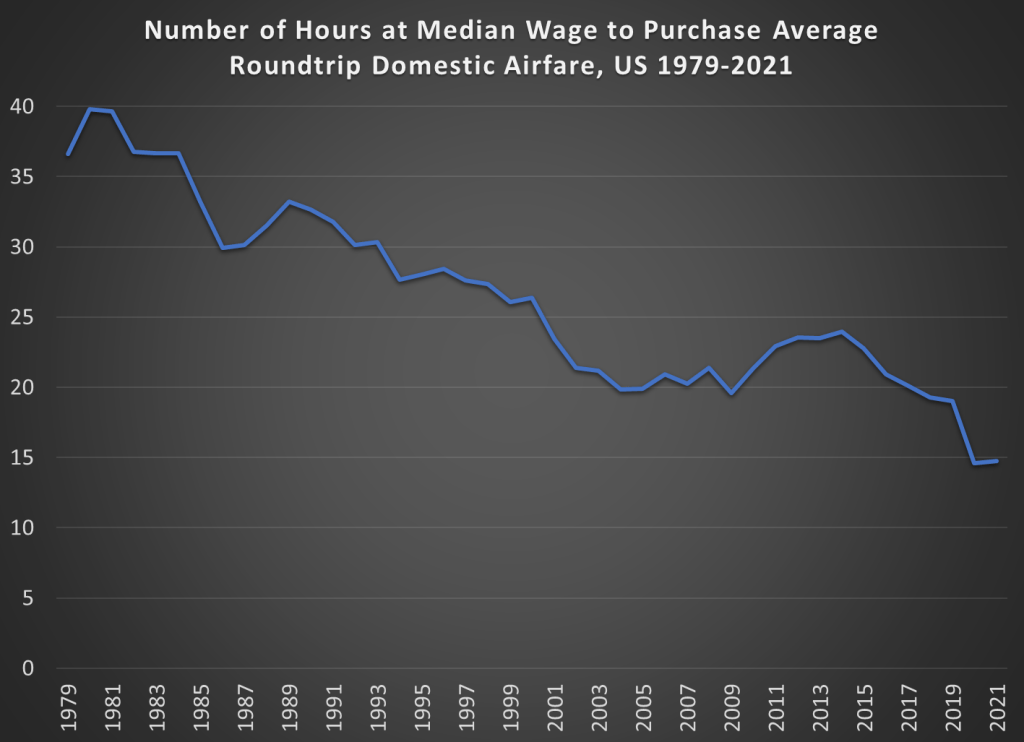
But what if we compare grocery prices to wages? That trend becomes even more stark. I use the average wage for non-supervisory workers, as well as an annual grocery cost from the Consumer Expenditure Survey (for the middle quintile of income), to estimate how many hours a typical worker would need to work to purchase a family’s annual groceries. (I’ve truncated the y-axis to show more detail, not to trick you: it doesn’t start at zero.)

Continue reading

Saving a Rusted Car with Rust Bullet Paint and Cosmoline RP-342 Coating

Corrosion is estimated to cost about $250 billion per year in the U.S. alone, so it is economically significant. The impact of corrosion hit home for me when I noticed that near the bottom of the right rear wheel well of my little 2007 sedan, a 2-3” hole had rusted right through the metal, exposing some inner chambers to water and salt and sand thrown from the wheel. The rust does not look like it has compromised the vehicle’s mechanical integrity (a real concern, since today’s cars rely on the body sheet metal for strength), but if it keeps on going it could turn my chariot into a junker.

I called an honest local body shop, and the guy told me it would probably cost more than the car is worth to fix it properly (replace the rocker panels, etc.), and  it might run $1700 just to do a patch job.

Being a (retired) chemical engineer, I decided to read up on ways to deal with rusting metal. Especially, how to arrest the progress of rust. The most serious way is to do major surgery with cutting tools, and cut out all the rust, and weld good metal back in, and paint it all well. That is out of my league. So I looked for coatings that could stop the rusting progress.

I have written an article on a different blog describing the various classes of coatings and rust converters that are available. For my project, I chose to use Rust Bullet, ordered from Amazon.

This can be painted directly on rusty metal surfaced, after scraping away all the loose rust. This stuff chemically reacts with the remaining surface rust to make it more inert, and also forms an impermeable seal over the surface, to block further water and oxygen from reaching the metal. It sticks to rusty and non-rusty surfaces. It seems to get good reviews.

One peculiarity of Rust Bullet is that if many hours have elapsed after application its surface gets so smooth that that that the next layer of Rust Bullet or top coat paint will not stick unless you sandpaper the smooth, hard, silvery surface. It’s easiest, therefore, to leave only 2 hours or so between coats of paint, to avoid the bother of sandpapering.

After two coats of Rust Bullet, I applied a top coat of Rustoleum enamel paint (white on the outside of the car, black on interior surfaces).

Some rust had started on surfaces of the inner chambers of sheet metal that had been exposed by the rusted-out hole. I could not readily reach them with a paint brush to apply Rust Bullet. I wanted to spray something that would form a coating that would inhibit further rusting. I settled on Cosmoline RP-342, ordered from the manufacturer.

This stuff sprays on like a thick oily liquid, that should soak into any rust. After maybe 2 hours, it hardens up to a very impermeable, fairly tough waxy coating. It will keep water off surfaces, though I don’t know about oxygen. Anyway, I sprayed the Cosmoline into the available openings, to try to coat the surfaces of the inner chamber parts. (If I had known about it in time, I might have chosen Eastwood Internal Frame Coating instead of Cosmoline for this step.) I was able to coat most, though not all, of the vulnerable surfaces. This was all with me lying on my side, beside/under the car, without great ergonomic access.

I then used several layers of aluminum foil duct tape (learned this trick from YouTube) to seal up the holes in the car body, then added a final coat of white or black Rustoleum. This has pretty well protected the car body there from further exposure to water/sand/sand. It should give me a couple more years of use, all for two days of picky handwork plus the cost of materials.

Welcome to Wrexam

I want to write about the economics of the Wrexam football club. They have docu-series currently airing on FX weeking until late October. They have two celebrity owners whose level of wealth falls squarely within the range of optimum dramatic tension i.e. rich enough to buy and improve a tiny Welsh football club, but so rich that they can buy their way out of every problem without utterly ruining themselves and their families.

I want to write about it, but I won’t. I’ll be patient and wait until the first season is over. Instead, I want to encourage you to watch all or part of the season with an eye towards the drama and risk there is to be found in solving such a complex economic problem. Pay attention, there will be a quiz in two months:

  1. How do you optimize your committment to an investment whose financial payoff is gaining access to a higher revenue stream via a process as unpredictable as finishing at or near the top in a 24 team football league? How do you cope with that much noise in a system with such poor underlying odds?
  2. How do you optimize your committment to an investment whose payoff has an enormous non-pecuniary element (i.e. joy from the success of the team) and that non-pecuniary element is a true local public good (non-excludable and non-rival) that represents a significant portion of total utility in local households?
  3. How should local stake holders treat their relationship to the team? The supporters group has significant voting power when transitioning ownership. What should they be maximizing when they cast their votes? On what observables should they base their decisions?
  4. In what ways are the owners failing to optimally allocate resources within the team?
  5. In what ways is the manager and coaching staff failing to optimally manage the player resources they have?
  6. Are incentives aligned top to bottom in the organization? Within the team?
  7. How do you measure success and failure with a sports club? Should these metrics, or the relative weights on these metrics, change with the scale of the club, it’s resources, and its fan base?

When the season is over we will revisit these questions and more. Running a sports team is an incredibly complex problem to solve. Most previous inside looks have been pure PR projects for the very biggest clubs, worth billions of dollars. These clubs/teams are enormous enterprises, with vast hierarchies and narrowly divided tasks. They are in many ways simply too big to fit into frame for an intimate documentary. If that’s what you’re interested in, fiction is the better channel because it can abstract away from all the field maintence and beer pricing, and just show you Brad Pitt cutting deals over the phone while stuffing food into his beautiful face.

To really understand this business from the inside, you gotta go small. To places where a small number of individuals are making an inefficiently vast range of decisions. Welcome to Wrexam so far looks to be one of the very best views into that world. I can’t wait to see more.

I just hope they find someone to update their zonal marking system on set pieces. I don’t know, maybe much some YouTube videos or something. Yikes.

Patrick Henry Blog

I wrote about Patrick Henry for OLL this week.

Can [the President] not at the head of his army beat down every opposition? Away with your President, we shall have a King: The army will salute him Monarch; your militia will leave you and assist in making him King, and fight against you: And what have you to oppose this force? What will then become of you and your rights? Will not absolute despotism ensue?” It is noted in the manuscript that the stenographer could not keep up with the torrent of terrible possible consequences that Henry was shouting about concerning a chief executive.

Most of his apocalyptic scenarios have not happened … yet. What inspired me in his speech was his energy more than his arguments. As much as he praised the American spirit of the past that ousted British rule, he was not complacent. He models a kind of patriotism that embraces an American project without holding to any fantasies about the morality of particular American leaders or soundness of American institutions. He would not have been disillusioned by the scandals and crimes of the American political class. He anticipated it. 

Read the rest at The Reading Room.

McDouble vs Big Mac: Why Inflation Hits the Bottom Harder

Since they were first introduced as part of the Dollar Menu in 1997, the McDouble and the McChicken have been my go-to choices when I visit Mcdonald’s. It was always hard to justify getting one of the fancier sandwiches like a Big Mac or Quarter Pounder, since they were 4-5x the cost of a McDouble but only about twice the size. This is part of why the McDouble has been called “the greatest food in human history“. But as we’ve seen with the plagues and wars of the 2020s, history doesn’t always progress in the direction you’d hope.

I hadn’t been to a McDonald’s for a while until last weekend, when I was shocked to see the McDouble and McChicken listed at $2.99. This wasn’t at an airport restaurant either, or even in an expensive big city; I stopped in Keene, New Hampshire on a drive home from Vermont. The price is up 200% from the days of the Dollar Menu! Meanwhile, the Big Mac has also got more expensive, but much less dramatically; it was $5.89, compared to the ~$5 I expect. So, 200% price increases at the bottom, vs 18% at the top.

This location may be a bit of an anomaly, but the big picture is clear; a typical McDouble now costs well over $2 in most of the US, while a typical Big Mac is still well under $6. You used to be able to get 4-5 McDoubles for the price of a Big Mac; now you typically get less than 3 and sometimes, as in Keene, less than 2.

What’s going on here? First, the McDouble was always absurdly cheap. Second, prices rise most quickly where demand is inelastic, and demand is less elastic for goods that are cheaper and goods that are more like “necessities” than “luxuries”.

This is why I think the McDouble is worth highlighting- its part of a more general trend of where inflation hits. I’ve noticed this in the grocery store as well; the price of standard ground beef is up much more than grass-fed organic beef, likewise with standard eggs vs free-range organic. How different would the Economist’s Big Mac Index look if it used the McDouble instead?

With falling inflation we may see the end of this necessity vs luxury price compression. But I doubt we’ll ever see the glory of the standard $1 McDouble again.

The New Hampshire McDonalds was disappointing, but Vermont was nice

The Cost of Raising a Child

Raising kids is expensive. As an economist, we’re used to thinking about cost very broadly, including the opportunity cost of your time. Indeed, a post I wrote a few weeks ago focused on the fact that parents are spending more time with their kids than in decades past. But I want to focus on one aspect of the cost, which is what most “normal” people mean by “cost”: the financial cost.

Conveniently, the USDA has periodically put out reports that estimate the cost of raising a child. Their headline measure is for a middle-income, married couple with two children. Unfortunately the last report was issued in 2017, for a child born in 2015. And in the past 2 years, we know that the inflation picture has changed dramatically, so those old estimates may not necessarily reflect reality anymore. In fact, researchers at the Brookings Institution recently tried to update that 2015 data with the higher inflation we’ve experienced since 2020. In short, they assumed that from 2021 forward inflation will average 4% per year for the next decade (USDA assumed just over 2%).

Doing so, of course, will raise the nominal cost of raising a child. And that’s what their report shows: in nominal terms, the cost of raising a child born in 2015 will now be $310,605 through age 17, rather than $284,594 as the original report estimated. The original report also has a lower figure: $233,610. That’s the cost of raising that child in 2015 inflation-adjusted dollars.

As I’ve written several times before on this blog, adjusting for inflation can be tricky. In fact, sometimes we don’t actually need to do it! To see if it is more or less expensive to raise a child than in the past, what we can do instead is compare to the cost to some measure of income. I will look at several measures of income and wages in this post, but let me start with the one I think is the best: median family income for a family with two earners. Why do I think this is best? Because the USDA and Brookings cost estimates are for married couples who are also paying for childcare. To me, this suggests a two-earner family is ideal (you may disagree, but please read on).

Here’s the data. Income figures come from Census. Child costs are from USDA reports in 1960-2015, and the Brookings update in 2020.

Continue reading

Putin as the New Hitler: The Russian Political Philosophy Which Justifies Unlimited Atrocities (To Save the World)

When the Nazis in the mid-twentieth century carried out schemes to kill millions of people (soldiers and civilians), they did not say, “Yes, we are evil, but we have the most guns.” Rather, they espoused a political philosophy to justify their actions. According to this Wikipedia entry, the Nazis held that they were simply carrying out normal, healthy, natural selection (the strong eliminating the weak) by having the “superior” race kill and displace the inferior races of humans. Germans therefore felt justified in occupying lands in Eastern Europe, Russia, and Ukraine, to provide “living space” and agricultural production for the master race.

It seems that a somewhat similar political philosophy has taken hold among Russian elites. This became evident early on in Russia’s 2022 invasion of Ukraine, when the Russians bombed a children’s shelter and a maternity hospital. Since then, there have been innumerable bombings of apartment buildings, shopping malls, etc., as deliberate murderous attacks on civilians, rather than having any direct military benefit. The Russians are killing  Ukrainians with the sort of callous abandon displayed by the Nazis towards “undesirables”. The initial Russian complaints about Ukraine joining NATO have disappeared; it is clear that Russia wants to simply erase Ukraine as an entity. It seems that this has been Russia’s plan under Putin for many years. Reportedly, Russian textbooks since around 2014 have deleted discussion of Ukraine as a separate nation.

Where did this toxic outlook come from? According to many observers, a chief architect for this view is political philosopher Aleksandr Dugin. German professor Antony Mueller has summarized some of Dugin’s positions:

Russians are “eschatologically chosen.” They must stand against the false faith, the pseudoreligion of Western liberalism and the spread of its evil: modernity, scientism, postmodernity, and the new world order. This is the thesis of Aleksandr Dugin, the prominent Russian philosopher, and a mentor of the Russian president Vladimir Putin…His theory is a “crusade” against postmodernity, the postindustrial society, liberal thought, and globalization… For Dugin, America is a threat to the Russian culture and to Russia’s identity. He makes his position unmistakably clear when he declares:

“I strongly believe that Modernity is absolutely wrong and the Sacred Tradition is absolutely right. USA is the manifestation of all I hate—Modernity, westernization, unipolarity, racism, imperialism, technocracy, individualism, capitalism.”

Dugin apparently believes that the world, or at least Eurasia, can only be saved from the ravages of “modernity” and American influence by uniting under Russian leadership  and returning to the Sacred Tradition of “religion, hierarchy, and family.”

An independent Ukraine stands in the way of this grand vision. From the Guardian:

Dugin’s worldview is most clearly articulated in his 1997 publication “The Foundations of Geopolitics”, which reportedly became a textbook in the Russian general staff academy and solidified his transition from a dissident to a prominent pillar of the conservative establishment.

In the book, Dugin laid out his vision to divide the world, calling for Russia to rebuild its influence through annexations and alliances while proclaiming his opposition to Ukraine as a sovereign state.

“Ukraine as a state has no geopolitical meaning, no particular cultural import or universal significance, no geographic uniqueness, no ethnic exclusiveness,” he wrote.

… Twenty-five years later, Russia’s president repeated some of Dugin’s views on Ukraine in his 4,000-word essay “On the Historical Unity of Russians and Ukrainians”, which many saw as a blueprint for the invasion he launched just six months after it was published.

And as far as Ukrainians resisting Russia’s neo-imperial ambitions, Dugin said, “I think we should kill, kill, kill [Ukrainians], there can’t be any other talk.”

There you have it. The exact influence of Dugin on Putin is debated, but there is no doubt that Dugin’s views are influential in the circles of Russian decision makers. Many Westerners thought early on that Putin would be satisfied with conquering the Russian-speaking Donbas region in the east, and a narrow land bridge to connect that with the Russian-occupied Crimea. His attempts, foiled by heroic Ukrainian resistance, to take Kiev and to take Odessa in the southwest showed that he wants the whole enchilada.

This could be a long war.

~~~~~~~~~~~~~~~~~~~~~~~~~~~~~~~~~~~~~~~~~

Addendum: Dugin’s daughter was killed by a car bomb near Moscow on August 20, 2022. Reportedly the bomb was aimed at Dugin himself, since he was expected to be in the car with his daughter. Moscow accused Ukraine of the assassination, which Kiev plausibly denies. There is also reasonable speculation that a Russian government agency (presumably with Putin’s tacit approval) was aiming to bump off Dugin, for some Byzantine reason.

Who’s afraid of ranked choice voting?

Alaska had it’s first election with a new voting rule and Tom Cotton is pissed.

I want very badly to be snarky here and make fun of the Senator for being so nakedly Trumpian in an effort to discredit any democratic institution the instant it doesn’t produce exactly the result he prefers. Fun aside, snark at Senator’s expense misses the bigger and more important mechanisms that are in play. I think the current instantiation of the Republican party is afraid of ranked choice voting. The Senator, in his angry little tweet, only lends greater credence to the theory. More broadly, its often worth unpacking when incumbents get upset about legitimate institutions, particularly when that anger is asymmetric across parties and coalitions.

What is ranked choice voting?

Quickly, ranked choice voting is any system where voters are asked to rank some number of candidates, n, from 1st to nth. Those rankings are then used to implement a runoff system, where a winner isn’t declared until a candidate he or she has a majority of the top choice votes. If someone has 50% of the first place votes, they win and it is effectively no different that a standard plurality system (i.e the standard system in most US elections). If no one has >50% of the first place votes, then the candidate with the fewest first place votes is eliminated and all of their votes are then divvied up amongst the candidates based on those voters’ 2nd choices. The process then iterates, tallying up the votes, eliminating the last place candidates, and allocating votes from the eliminated candidates based on their 2nd, 3rd, etc choice preferences. The election isn’t called until someone has greater than 50% of the counted votes.

It’s not a point system, like a Borda count, so it doesn’t grant a specific weight to being a 2nd or 3rd choice, so the balance of outcomes is still heavily tilted towards a voter’s top choice candidate. It’s not explicitly an approval system, though voters are under no obligation to rank all of the candidates i.e. if you only want to choose a 1st and 2nd choice out of 10 candidates, that is fine. What the system is explicitly designed to do is reduce the impact of large numbers of candidates splitting the electorate so thinly as to increase electoral noise while also reducing the impact of otherwise irrelevant candidates. It’s not a perfect system (nothing is), and it certainly doesn’t magically nullify the irrefutable math of Arrow’s impposibility theorem. It’s just another way of counting votes, and one that is in no way controversial or even especially complicated compared to the variety of voting rules used in established democracies around the world.

So why the fuss?

Political fragility

Overspecialization is an ecological trap, just ask the koala. Sure, it’s great if you can digest and subsist off of a food source that no one else can, that sounds like a swell way to avoice resource competition. But if you overspecialize in that food such that you can no longer live off anything else, well, then you aren’t likely to survive any meaningful shift in you environmental context. What someone like Nicolas Taleb extolls the virtues of anti-fragility, a lot of what he is talking about is akin to adaptability to and tolerance for unforecastable events.

At the moment, if we can put aside policy positions entirely for a moment, there is an argument to be made that the Republican party is looking incredibly fragile. A sequence of events, some slow progressions over the last 20 years, others shocking events of the last 20 months, have left the Republicans looking highly specialized. Senator Cotton’s response to the outcome in Alaska leads me to wonder if they are electorally specialized to succeed in a context that doesn’t exactly exist anymore.

When I think of the Republican coalition and electoral base, what stands out in sharpest relief is:

  1. The urban-rural divide
  2. Single-issue voters, predominantly regarding abortion and firearms
  3. Trump

The urban-rural divide, specifically the overwhelming dominance of Republicans in rural settings, is the fulcrum upon which Republicans leverage their advantage through gerrymandered district maps. By cracking and packing districts, they’ve ceded a large number of landslide urban districts to Democrats for the express purpose of leaving them thinner elsewhere. The catch with gerrymandering as a minority party in the broader population, though, is that if you get greedy you can go grow accustomed to lots of predictable, but nonetheless narrow victories. Narrow victores, no matter how previously safe and easy to forecast, do not grant a lot of leeway for absorbing electoral shifts. Like, for example, significant numbers of educated urban voters moving to medium-sized cities in red and purple states.

Abolishing abortion has long been a rally cry to turn out voters, and seemingly a pretty good one at that. While pro-choice voters may be just as passionate, protecting the status quo has rarely the same draw as tearing down a cruel and unjust system. Voters may have remained the same, but the status quo has changed and, with it, the prospects for drawing voters to the polls.

Bizarre as it would have seemed to say this 10 years ago, Trump is a bonafide cult of personality. His people love him and he has as much influence with at least half the Republican party as anyone since Reagan, and probably more than even he did. I wouldn’t have said this 10 months ago, but there is a very real chance that he is going to prison. Even if he doesn’t, though, the investigation and trials are unlikely to put Republicans in a positive light with moderate and independent voters, and without the office of the presidency, Trump lacks the same power to shape the narrative that he previously enjoyed.

Actually, let’s revisit the Trump as Republican icon for a quick moment.

One of Seventeen

In the aftermath of Trump’s surprising win of the Republican presidential nomination in 2016, there was floated the possibility that Trump was a Condorcet loser. That is to say, in a head to head election he would have lost to every other major candidate. A retrospective analysis challenged this idea, suggesting that Trump had far broader support in the party than just a loyal and dedicated minority, but I’m not sure how much of that is a product of post hoc endogeneity.

What is not argued is that the 2016 Republican primary still had a lot of candidates late in the game. Seventeen candidates qualified for the first debate. By the fifth debate there were still 13 candidates sufficiently viable to claim a spot on stage. Even if we can’t perfectly adjudicate who Trump would or would not have beaten head to head, the outcome of the eventual election was highly sensitive to the voting rule given the sheer number of candidates. If the primary had been subject to anything other than standard plurality rule voting, it is highly possible, if not probable, that a different winner would have emerged.

The thing about a polarizing candidate is that you are that much less likely to be anyone’s second choice. Under a plurality system you rely on the people who love you, attack the ones that hate you, and comfortably ignore the rest. But some voting rules increase the cost of those you ignore.

About that Alaska Primary

Did I mention that Alaska didn’t just change the voting system for the general election? They had an open primary (meaning candidates from any party competed to be one of the final four candidates). Through a simple plurality rule election, everyone voted for their favorite candidate and the top 4 advanced to the general election where the ranked choice rule was employed.

What would have happened if such a rule were applied in the Republican primary of 2016? What would happen if such a rule were applied across the country where

  1. Roe vs Wade has been overturned
  2. Trump may very well be going to prison.
  3. A lot of people are moving from big blue cities to low housing costs and adequate amenties of medium size cities in purple states

A Democrat hadn’t won a statewide election in Alaska since 2008. Less than a week ago they did it in an election against a former Alaskan governor and Republican vice presidential nominee who’s been on Saturday Night Live. In the second round of vote counting, the eventual Democratic winner received 29% of the votes redistributed from the Republican who finished in 3rd place. There are, it seems, a lot of Republicans who preferred a Republican to a Democrat, but nonetheless preferred a Democrat to Sarah Palin.

Cotton is right. Republicans should be freaked out

I don’t expect ranked choice voting to sweep the nation (though I do think it is better than a standard plurality rule). But I think it is one more sign that Republicans have become overspecialized as a party and are not well-suited to adapt to changing political landscapes. Big things, like Roe being overturned, happen. The public can turn on any celebrity, including your party’s talisman. Rural voters might still mathematically individually be weighted more in the broad political calculus (cough Senate cough), but there’s still the problem that fewer voters live there, which means it only takes a small percent of the population moving to break your map. And what happens when the baby boomers don’t dominate electoral math anymore?

No, the Republican’s aren’t doomed to irrelevance. Yes, they will adapt and rebrand…eventually. But the reality is that there is no greater sign that a party is forecasting electoral difficulty for themselves than declarations that the system is rigged against them, regardless of whether they are railing against fictional corruption or actual institutions that really do work against them. In both cases, however, they are signaling the same thing: we’re in trouble. The Republican strategy of recent decades has been to terrify and pander to the base, attack and ignore the rest. And it’s worked. Ranked choice voting is a threat to that strategy because it increases the cost of attacking and ignoring voters outside of your base.

Maybe that alone is a sufficient argument for ranked choice voting – it increases the cost of attacking people outside of your political base. Given the evidence of political polarization and associated social fracturing, anything that shifts the balance of political incentives from outgroup antipathy to big-tent inclusion is proabably a good thing for all of us in the long run.