What Will End The AI Bull Market?

It’s feeling like the late ’90s, with an impressive new technology pushing tech stocks and the broader US market to all-time highs. Retail investors are using new platforms to get in on the action, tech companies are doing more IPOs to take advantage of the higher stock prices, and other companies are trying to boost their stocks by saying they are pivoting to the new technology (though often they aren’t really changing).
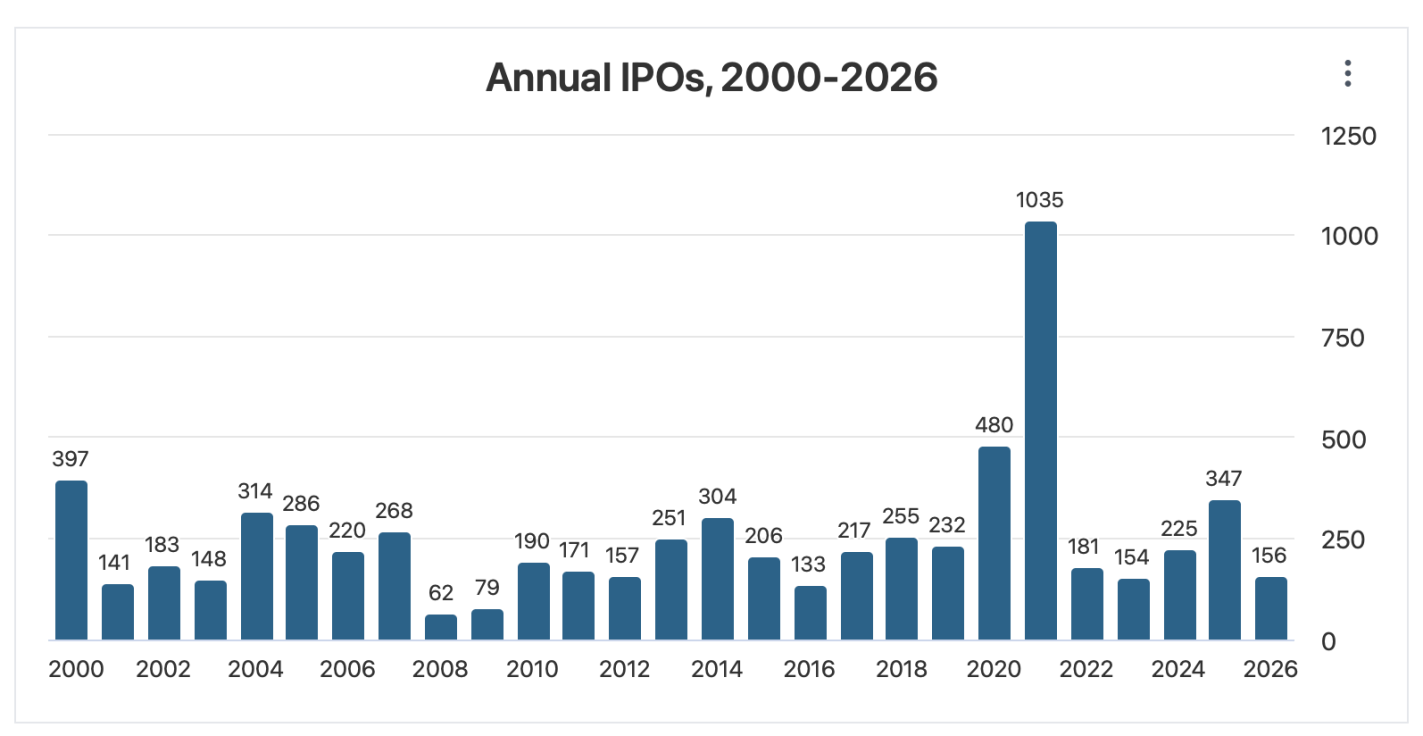
The excitement drives valuations to record levels:
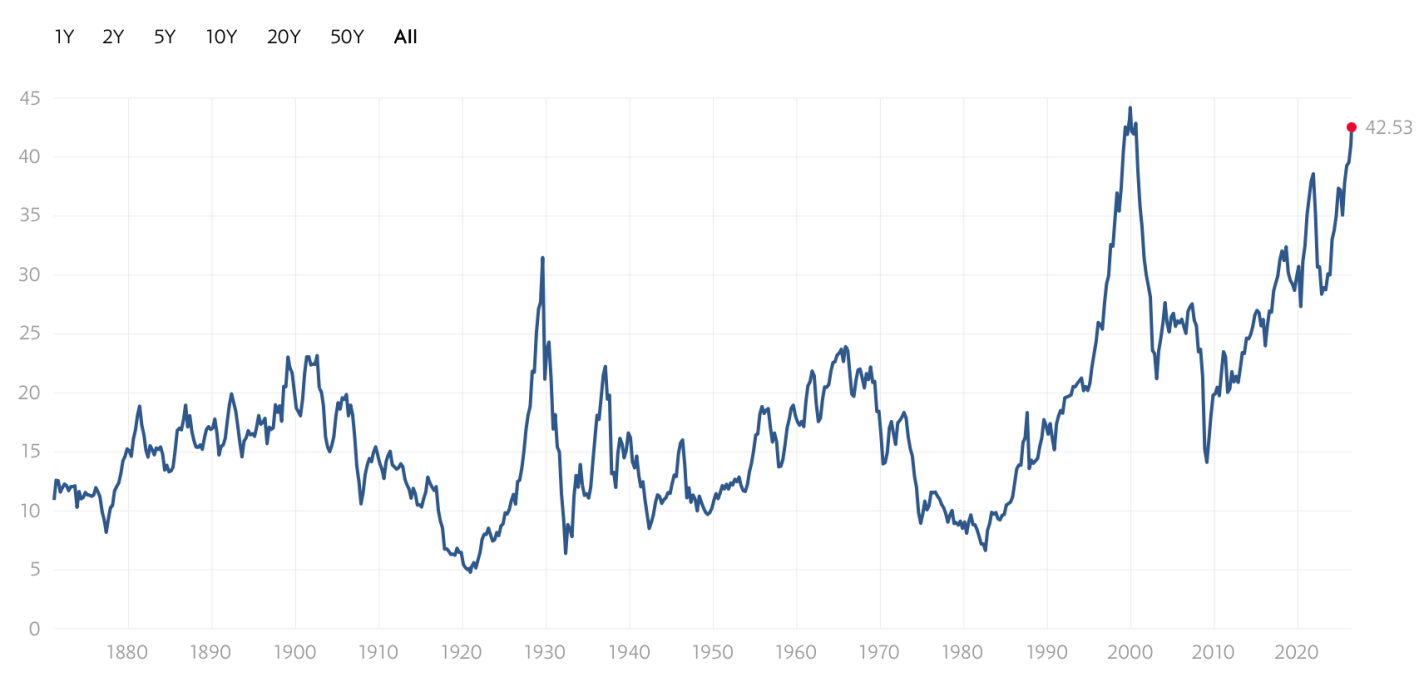
Shiller CAPE Ratio

In the ’90s, the internet really was a transformational new technology that would enable lots of profitable new companies. But the market got ahead of itself, a bubble that led to a crash- the S&P fell by almost half, while the tech-heavy NASDAQ fell by over 3/4 and took 15 years to recover.

History rhymes, but it doesn’t repeat exactly. I don’t currently expect a big crash driven by AI stocks; it helps that unlike in the ’90s, many of the big players are currently profitable. But I also don’t expect the NASDAQ to keep posting 20+% returns every year.

If the AI bull market doesn’t end in a dramatic crash, how will it end? It’s already shrugged off a war. A US recession is unlikely this year, though plausible next year.

The end I see slowly approaching comes from crowding out. What Robert Solow said about computers in 1987 is true about AI today: you see the AI age everywhere except the productivity statistics. There’s only so much money to go around in markets when productivity growth is unexceptional and savings rates are falling.

We’re already seeing the war hit certain markets (if not US stocks). Iran’s gulf neighbors are now putting lots of money into missile defense, money they now won’t be spending on data centers or gold (down 16% from pre-war), and everyone else has to spend more on oil.

Interest rates have been rising- partly due to central bank attempts to fight inflation, partly due to ongoing high rates of government borrowing, and partly due to financing the AI buildout itself. Higher rates make it more expensive for companies to invest in the physical AI buildout, and make investors discount future AI revenues more while making bonds a more attractive substitute for stocks today. 10-year TIPS now yield 2% over the inflation rate, a sharp contrast to the 2021 stock boom when they yielded less than inflation. If I were older I’d be loading up on TIPS, and even at 38 I’m starting to get tempted.

Trying to call the top exactly is a fool’s errand, but if I were feeling foolish, I’d point to the big upcoming IPOs. SpaceX just filed for an IPO that would be the biggest ever both for the amount of money raised ($75 billion) and the total company valuation ($1.77 trillion). This shatters the previous records for the biggest overall raise ($29 billion raised by Saudi Aramco when it went public in 2019) and the biggest raise by an American company ($18 billion raised by Visa in 2008). OpenAI and Anthropic are likely to follow with IPOs that would also break the previous records- making 3 companies each trying to raise more than the $45 billion raised by the entire US IPO market in 2025. Even if the process of going public doesn’t reveal any flaws in the companies, that money has to come from somewhere- and it takes up a substantial proportion of all net inflows to US stocks in a typical year (IPOs plus new money into existing stocks).

In short- where will the money come from? What are investors going to sell in order to buy into these IPOs? Technically they could do it all with cash, but I think it’s at least plausible that they start selling other stocks. The selling pressure will continue after the IPOs as employees of the newly-public companies see their stocks vest and other early investors become able to sell off.

I’m not trying to time the market. Even if this is a ’90s re-run, we could easily still be in the 1998 buildup, not the 2000 peak and crash. But I am diversifying. US stocks are currently the world’s most expensive. Investors value US stocks that highly because there’s a real chance that US companies are profitably building the technologies that will drive the future. But there’s also a real chance they aren’t– and if that state of the world comes to pass, I’d prefer to own a significant chunk of bonds, foreign stocks, and real assets.
My First Exit

I invested in my first private company in 2022; my first opportunity to cash out of a private investment came this year when Our Bond did an IPO, now trading on Nasdaq as OBAI.

I’m happy to get a profitable exit less than 4 years after my first investment, given that I’m investing in early-stage companies. Venture funds tend to run for 10 years to give their companies time to IPO or get acquired, and WeFunder (the private investment platform I used) says that “On average, companies on Wefunder that earn a return take around 7 years to do so.” The speed here is especially striking given that I didn’t invest in Our Bond itself until April 2025.

Most private companies that raise money from individual investors are very early stage, what venture capitalists would call “pre-seed” or “seed-stage” companies looking for angel investors. Later-stage companies often find it simpler to raise their later stages (Series B, et c) from a few large institutional investors. But a few choose to do “community rounds” and allow individuals to invest later. This is what Our Bond did right before their IPO, allowing me to exit in less than a year.

This helps calm my biggest concern with equity crowdfunding- adverse selection:

The companies themselves have a better idea of how well they are doing, and the best ones might not bother with equity crowdfunding; they could probably raise more money with less hassle by going to venture funds or accredited angel investors.

My guess is that the reason some good companies bother with this is marketing. Why did Substack bother raising $7.8 million from 6000 small investors on WeFunder in 2023, when they probably could have got that much from a single VC firm like A16Z? They got the chance to explain how great their company and product is to an interested audience, and to give thousands of investors an incentive to promote the company. Getting one big check from VCs is simpler, but it doesn’t directly promote your product in the same way.

All this is enough to convince me that the equity crowdfunding model enabled by the 2012 JOBS Act will continue to grow.

Still, things could have easily gone better for me, as these markets are clearly inefficient and have complexities I’m still learning to navigate. Profitability is not just about choosing the right companies to invest in, but about managing exits. I expected the typical IPO roadshow would give me months of heads-up, but Our Bond surprised its investors with a direct listing. The first thing I heard about the IPO was a February 4th email from “VStockTransfer” that I thought was a scam at first, since it was a 3rd-party company I’d never heard of asking me to pay them money to access my shares. But Our Bond confirmed it was real- VStockTransfer was the custodian for the private shares, and charges $120 to “DRS transfer” them to a brokerage of your choice where they can be sold.

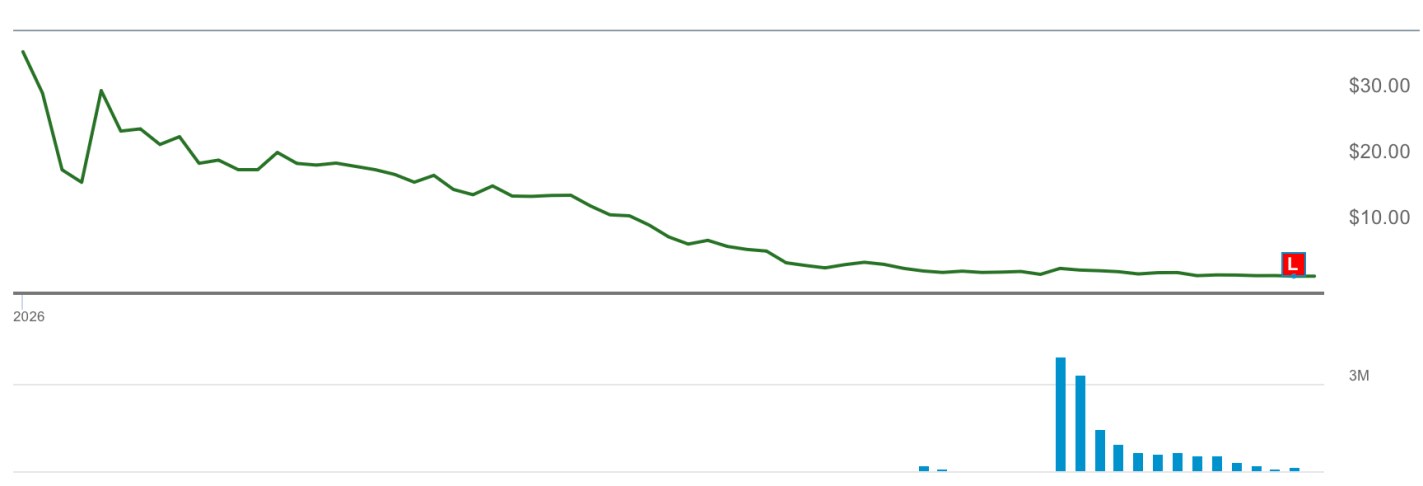
I submitted the request to move the shares to Schwab the same day, but Schwab estimated it would take a week to move them. Neither Schwab nor VStockTransfer ever sent me a notification that the shares had been transferred, and by the time I noticed they had moved a week later, the stock price had fallen dramatically:

As I write this on February 18th, the OBAI price represents a 1.3x return on the price I invested in the private company at last April. When I was first able to sell some stock on February 11th, the price represented a 3x return; if I’d been able to sell right away on the 4th without waiting for the brokerage transfer process, it would have been a 10x return.

By the Efficient Market Hypothesis this timing shouldn’t be so critical, but I knew there would be a rush for the exits as lots of private investors would want to unload their shares at the first opportunity, an opportunity some would have waited years for. Sometimes old-fashioned supply and demand analysis is a better guide to markets than the EMH: demand for OBAI stock had no big reason to change in February, but freely floating supply saw a big increase as private shares got unlocked and moved to brokerages.

Getting a 10x return vs a 1.3x return on one of your winners is the difference between a great early investor and a bad one. I always thought such differences would be driven by who picks the best companies to invest in, but at least in this case it could be driven by who is fastest on the draw with brokerage transfers.

If I ever find myself holding shares in another company that does a direct listing, I’ll be doing whatever I can to make sure the transfer goes as fast as possible (pick the fastest brokerage, check on the transfer status every day, et c). This process also seems like one reason to do fewer, larger private investments- a fixed $120 transfer fee is a big deal if the initial investment was in the low hundreds but wouldn’t matter much for a larger one.

Being accredited would help there, allowing access to additional later-stage, less-risky companies. But I’ll call OBAI a win for equity crowdfunding, and a big win for asset pricing theories based on liquidity and flows over efficient estimation of the present discounted value of future cashflows.

Disclaimer: I still hold some OBAI