A Canned-Beer Kind of Guy

An  ex-co-worker was once complaining to me that the prices of things that he liked kept going up.

He was an economics major. Of course he knew that wages also increase. He wasn’t simply cantankerous about inflation. He knew all about improving productivity, income, and price level changes. He was being more specific. The *particular* items that *he* liked were getting more expensive. He was complaining about what, to everyone else, were relative price changes.

Unrelatedly, I was floating around the bls.gov website and examining their Producer Price Index (PPI) FAQs (I learned a bunch). The content is extensive. CPI is broken up into some subcategories. But PPI, being used by multiple industries and trade groups for real-life costs and benefits, is excitingly granular.

You want to know what happened to the price of red, white, rose, and carbonated wines each in particular?  They’ve got you covered. It really is amazing.

Back to my co-worker. I tried to explain that relative price changes reflected underlying economic value and scarcities. We wasn’t having any of it. He just didn’t want his prices to go up. We economists are known for being kind of dispassionate. We see relative prices change and we shrug. Man-on-the-street sees a relative price change and, boy, does he care about it – if it’s the purchasing price that *he* faces.

See the below graph. What kind of consumer are you? Since the start of the pandemic, canned, bottled, and kegged beer have all changed in price. Or maybe you’re a teetotaler and you’ve noticed the increasing price of bottled water.  For interpretability, let’s consider what had cost $10 at the start of the year 2020. Bottled water has gone up to $10.50 and bottled beer has gone up to almost $10.30.  You may not blink at a 3% price increase – unless it’s for 6 bottles of your favorite craft beer.
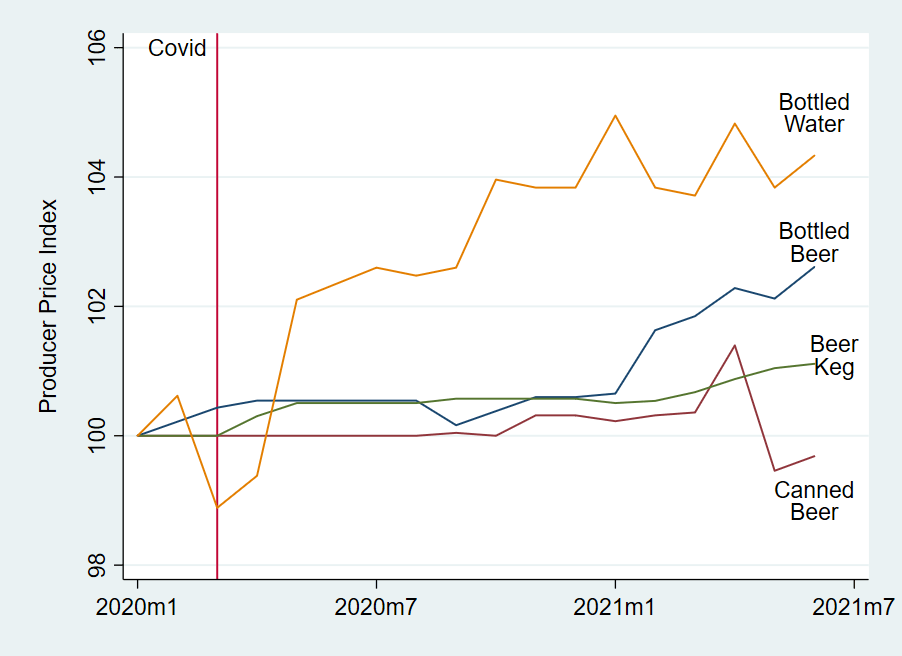
The price of canned beer, on the other hand, hardly increased at all. And in the last couple of months, the price *fell*. I sure hope that my co-worker is a canned-beer kind of guy. Otherwise, someone is sure to hear a lot of belly-aching.

Flying the Friendly Skies (Today and in the Past)

It’s almost summer. About half the US population has at least one dose of a COVID vaccine. For many Americans that haven’t had their employment impacted by the pandemic, their bank accounts are flush with cash and they are ready to do one thing with that cash: travel. See family and friends. See something other than the inside of your own home.

And for many Americans traveling this summer, they will fly. The airlines, no doubt, will appreciate your business. At this time last year, the world had so radically shifted that Zoom’s market cap was bigger than the 7 largest airlines in the world. In May 2020, air passenger traffic in the US was less than 10% of traffic in 2019. Today, we’ve recovered a lot, but we are still only back to about two-thirds of normal levels. And since airplanes are just a marginal cost with wings, flying all their planes at close to full capacity is crucial for airlines to return to profitability. They really need you to fly the friendly skies this summer.

One of the reasons that so many Americans are able to fly in today is because flying is, compared to historical prices, very cheap.

How cheap is flying to today compared to the past? Let’s look at some historical price data for flights.

Continue reading

The Pappy Pricing Puzzle

If you drink bourbon whiskey (or even if you don’t) you’ve probably heard of Pappy Van Winkle. Bourbon has experienced something of a revival in the past two decades, after being in decline for much of the 20th century. As part of this revival, some bourbons have become very highly sought after by the nouveau bourbon enthusiasts. And the various offerings of Pappy Van Winkle are arguably the most highly sought after. Finding Pappy is almost impossible these days, though this was also true a decade ago so it’s not really a “new” phenomena.

So here’s the “puzzle” for economists: why aren’t Pappy and other rare whiskies sold at market prices? No one in the “legal” market seems willing to do so. I put “legal” in quotation marks because there is a robust secondary market for these bottles, and the legal status of these sales is entirely unclear to me as an economist (alcohol markets are, to say the least, highly regulated).

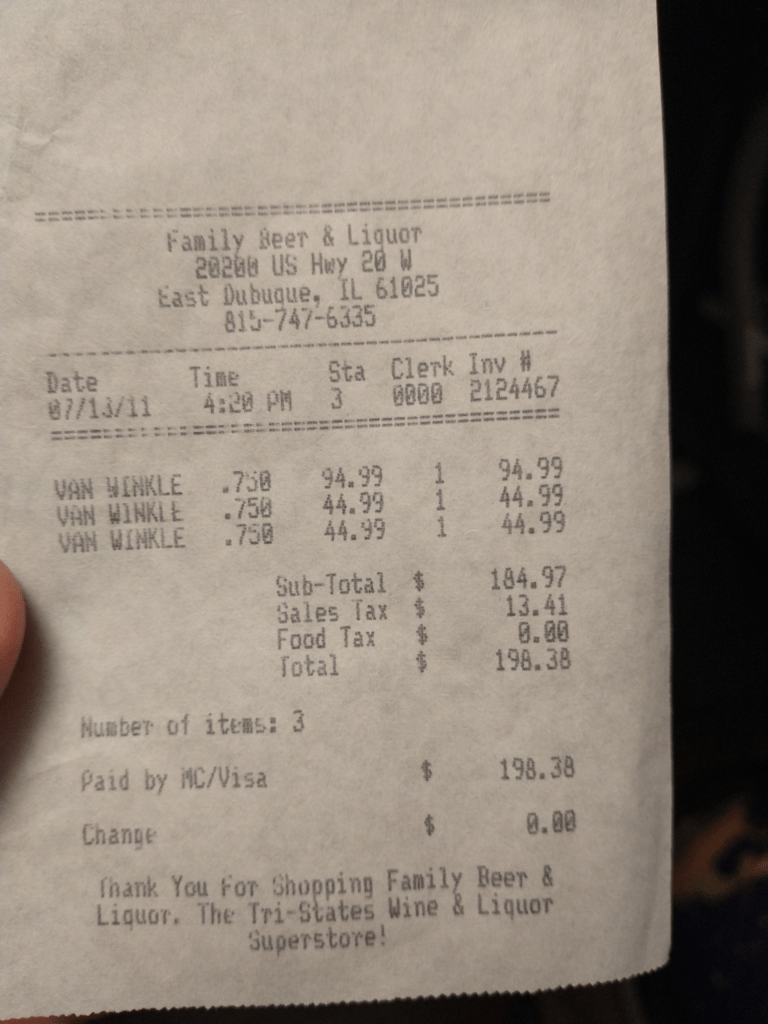
In these secondary markets, it is not unusual for a 20-year bottle of Pappy Van Winkle to sell for $2,000. The “manufacturer’s suggested retail price” is $199.99. But you will never find this bottle on the shelf for that price. The bottles are held by retailers, either to sell to friends, auction off for charity, or conduct a lottery for the right to purchase the bottle at well below market prices.

So why doesn’t the distillery raise the MSRP? Clearly, they do this from time to time. Ten years ago, if you were lucky enough to find this bottle it was around $100 (I was lucky enough, on occasion). Clearly, they recognize that prices can increase. And that’s not just “keeping up with inflation”: $100 in 2011 is about $120 in current dollars. By 2016, they had raised the MSRP to $169.99. But why doesn’t the distillery raise the price more, perhaps all the way up to the market clearing price? By doing so, they would, perhaps, be able to ramp up production so that in 2041 there might be a lot more Pappy on the shelf. At the very least, they could dramatically increase their profit.

Receipt for 1 bottle of 20-year Pappy and 2 bottles of 12-year Van Winkle “Special Reserve” from 2011.

Also, why don’t retailers just put bottles on the shelf at $2,000? Stores occasionally do this, but mostly because they are fed up with all of the customers calling about rare bottles. Sometimes they will price it even higher than secondary markets. But usually, they allocate the bottles by something other than the price mechanism. Why? Businesses don’t usually leave dollar bills, especially $1,000 dollar bills, on the table.

Continue reading

Hyperinflationary Efficiency?

I’m advising a senior thesis for a student who is examining the strength of Purchasing Power Parity in hyper-inflationary countries. Beautifully, the results are consistent with another author* who uses a more sophisticated method.

For those who don’t know, absolute purchasing power parity (PPP) depends on arbitrage among traders to cause a unit of currency to have the same ability to acquire goods in two different countries. If after converting your currency you can afford more stuff in foreign country, then there is a profit opportunity to purchase there and even to re-sell it in your home country.

Essentially, when you make that decision, you are reducing demand for the good in your home country and increasing demand in the foreign country (re-selling affects the domestic supply too). Eventually, the changes in demand cause the prices to converge and the arbitrage opportunities disappear. At this point the two currencies are said to have purchasing power parity – it doesn’t matter where you purchase the good.

So does PPP hold? One way that economists measure the strength of PPP is by measuring the time that it takes for a typical purchasing power difference to be arbitraged away by 50% – its ‘half-life’.  The more time that is required, the less efficient the markets are said to be.

The ex-ante question is: Is PPP be stronger or weaker during hyperinflationary periods?

Continue reading