Home(r) Economics

Is it harder to buy a home today than in the past? Many seem to think so. Lately, some people have used the example of the fictional Simpsons family to make this claim. A recent Tweet with around 100,000 likes expressed the sentiment:

The unspoken implication is that today a “single salary from a husband who didn’t go to college” couldn’t buy a typical home in the US. Or at least, it would stretch your budget so thin that you would have to give up something else or need two incomes to support that lifestyle (famously dubbed “the two-income trap” by Elizabeth Warren).

And it’s not just a Tweet that caught fire. A December 2020 article in the Atlantic claimed “The Life in The Simpsons Is No Longer Attainable” and used housing as a prime example. And while a 2016 Vox article on Homer’s many jobs doesn’t mention the cost of housing, they draw a similar conclusion and implication: “Homer Simpson has gone nowhere in the past 27 years — and the same could be said of actual middle-class Americans.”

But is this an accurate picture of the Simpsons family over time? And does that picture accurately represent a typical family in the US? Let’s investigate. And let’s start by pointing out that as measured by the availability of consumption goods, the Simpsons do see rising prosperity over time. They have flat screen TVs now, instead of consoles with rabbit ears, as the late Steve Horwitz and Stewart Dompe point out in their contribution to the edited volume Homer Economicus. But with all due respect to my friends Steve and Stewart, I don’t think many would deny that TVs, cell phones, and computers are cheaper today than in the 1990s. The familiar refrain is “but what about housing, education, and health care?”

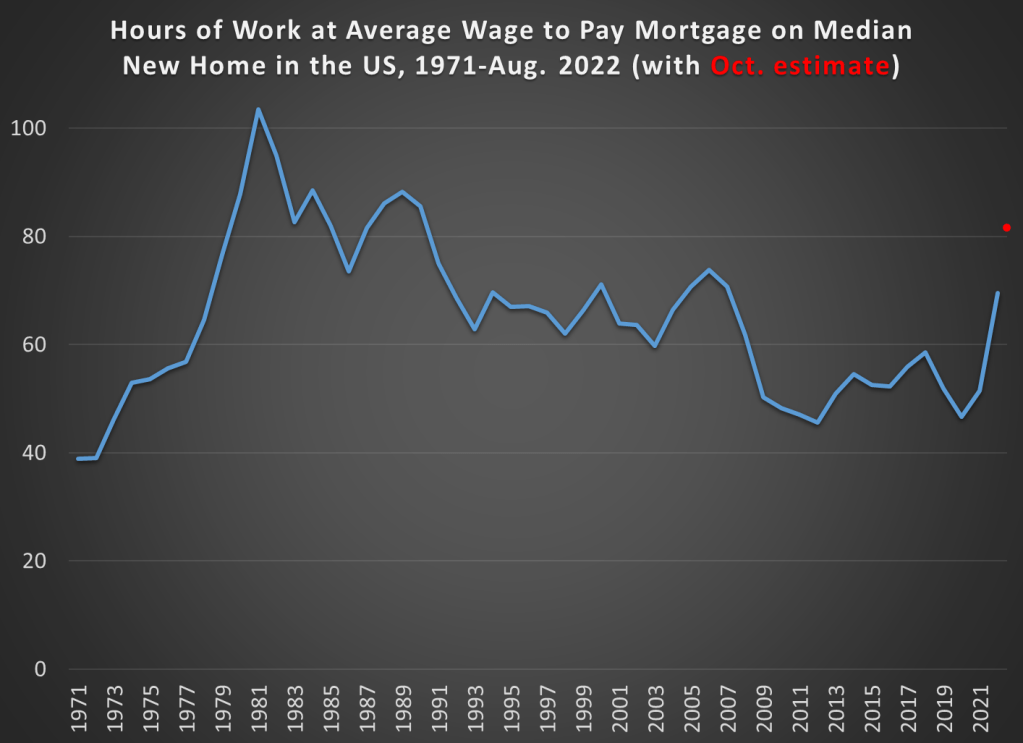
In this post I want to take on the question of housing, partially by using the Simpsons as an example. My main result is this chart, which I will present first and then explain.

Continue reading

This Is Not the Most Expensive Thanksgiving Ever

“Thanksgiving 2021 could be the most expensive meal in the history of the holiday.”

That’s the first sentence of a recent New York Times story. The Times and the New York Post rarely agree on editorial matters, but on this topic the Post ran a very similar story the same week. You can find many such headlines.

But is it true? In short: no. I’ll explain why, but my larger goal is to get you to think more clearly about inflation.

How should we measure the cost of a Thanksgiving meal? A widely used measure comes from the Farm Bureau, which shows that the cost of a traditional turkey-centric meal costs about 14% more than last year. In dollar terms it is $53.31 for a turkey, a pumpkin, cranberries, sweet potatoes, stuffing, etc. That’s more that it has ever been, in dollar terms. Farm Bureau has been tracking the cost of this same meal since 1986.

So in one sense, it seems like the headline claim is true. Most expensive Thanksgiving ever!

But we need to think deeper. A nominal price doesn’t actually tell us much. If a long-lost cousin from the Republic of Horpedahl told you it costs 1 million Jeremys to buy a Thanksgiving dinner, what would your reaction be? The first and best reaction is: how much do people earn in the Republic of Horpedahl?

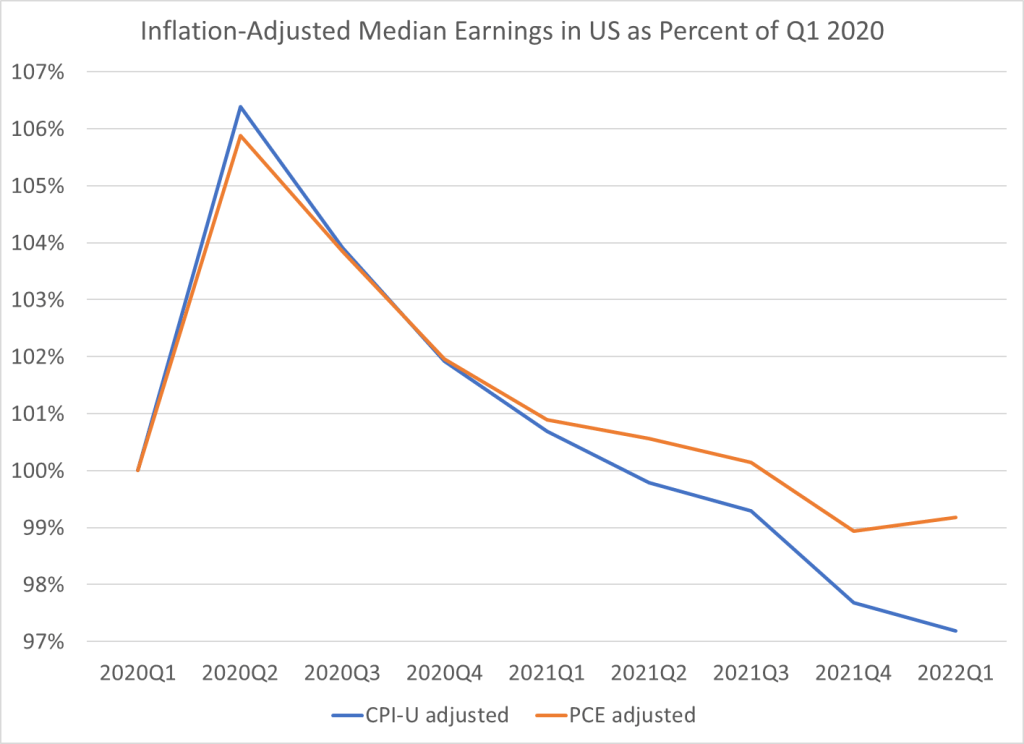
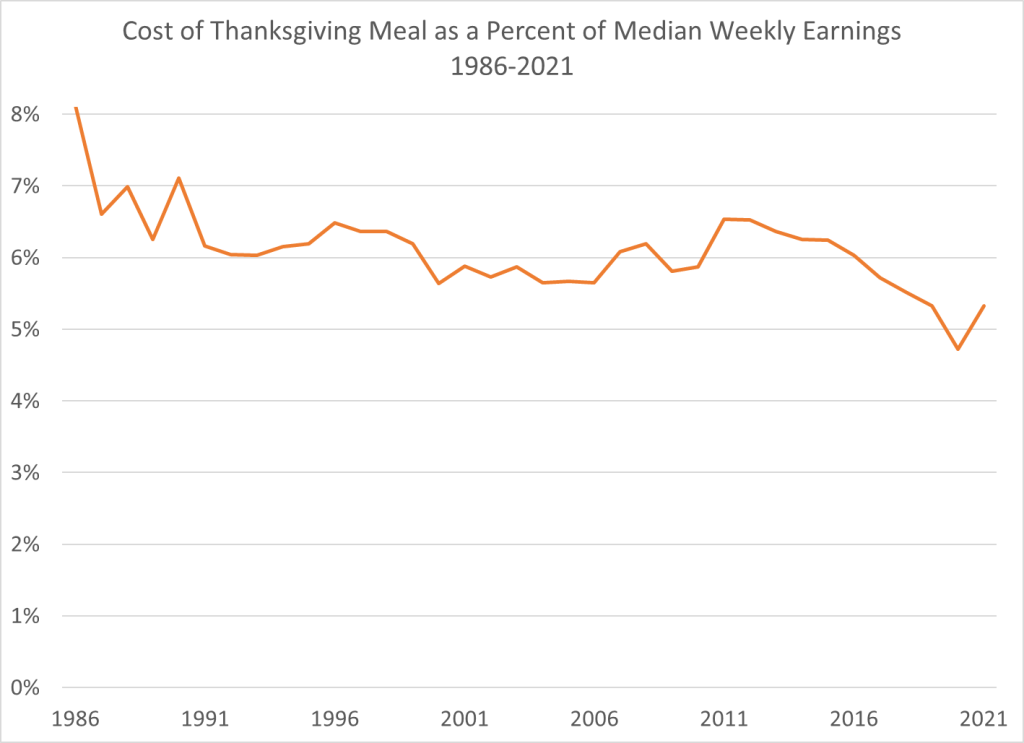
We should ask the same question in the United States today: how do incomes today compare to incomes in the past? Which measure of income you use is important, but if we use median usual weekly earnings of full-time workers, we can make a simple comparison of how much of your weekly earnings would be needed to buy a traditional Thanksgiving meal. This chart shows exactly that. In 2021 that meal will be the second lowest it has ever been as a percent of median earnings — higher than last year, but tied with 2019 for the second lowest. And much less than in the late 1980s and early 1990s (I use third quarter data for each year, the most recent available).

Adjusting for income is the best way to look at this question. It’s not perfect — part of this depends on what income measure you use — but it’s much better than the alternative. The worst approach is to just look at nominal prices. This tells you virtually nothing.

Continue reading