Soccer has become a Tragedy of the Commons

Players are breaking down breaking down, which may not be of any particular interest to you, but it seems odd considering that modern nutrition and sports medicine has NBA and NFL players competing at later ages than previously considered possible. I’ll go farther and suggest there is a growing sense in soccer that outfield players (i.e. not goalies) are peaking earlier, particularly in the physically demanding English Premier League. What is happening in soccer that isn’t happening in other sports?

A professional soccer players runs about 6 miles (10 km) a game. They do so in a series of sprints and stops, all while humans with deadly pistons for legs kick at them repeatedly. Even without getting into the costs of repeatedly of striking the ball (and sometimes other craniums) with your skull, it is hard to overstate the cumulative toll on soccer players and their bodies.

Over the course of the 2020-21 English Premier league season, Pierre Emil-Hojbjerg played 53 games for his club and 12 games for the Danish national team. Son Heung-Min has flown 140,000 miles over the past 3 years to play for his club and the South Korean national team. The most prominent coaches in the world are adamant that their players are being asked to do too much. So, if we know that the players are breaking down, some of the most prominent figures in the sport think they know why they are breaking down, and the players are highly compensated employees who are themselves highly valued assets for their contracting clubs, why hasn’t this problem already been fixed? In two words: property rights.

Professional footballers have become a common pool resource. And if there is one thing we know about commons is that they often suffer a tragic outcome. See what I did there?


Long story short, the “Tragedy of the Commons” occurs when property rights to a good are either lacking entirely (i.e. fishing rights in the Atlantic Ocean) or incomplete (i.e. irrigation systems, professional soccer players). While it would be everyone’s interest to limit total usage to maintain the long-run sustainability of the resource in question, without property rights any individual has incentive to claim as large a portion of the resource as possible in the short run (i.e. catch as many fish as much as possible, use a player as much as possible), even if that means the resource in question is destroyed, preventing future use.

The English Football Association pays it’s national team players about 2,000 pounds per match played. When you consider that nearly all of it’s players earn in excess of 100k pounds per week from their club teams, it’s a pittance. How does the English FA get these players so cheap? Partly because they are paying the players in honor and prestige and glory and even more honor, partly because of the stigma and shame that would be levied against them if they refused the social obligation to play for their country. It’s a pretty amazing racket for FIFA (International) and UEFA (European) associations, through which 100s of millions of dollars/pounds are funneled while paying pennies to the players.

For a top player, each year is filled with final and qualifying matches for international tournaments (World Cup, European Championships, Confederations Cup, the League of Nations,…), two or three different league tournaments, and 38 games of regular league play. On top of this are the international “friendlies” that are played whenever the players might actually enjoy a break. As if designed to prove my point, FIFA has proposed having the World Cup every 2 years (instead of 4), which would only increase the load. If this sounds ridiculous, consider it from FIFA’s point of view. As far as they are concerned, player bodies are the lowest cost input in their enterprise. They don’t value the players because they don’t have to.

We shouldn’t let the clubs off the hook completely, either. Yes, they have contracts with the players, which makes them an resource that should be valued accordingly. But that assumes that the managers of a team’s resources have time horizon’s aligned with the team and it’s players, which is often very much not the case. Coaches last less than 3 years on average. Sporting Directors come and go. Even ownership can find itself looking to add short-term shine to a club so they can sell it today, even at the expense of it’s long term value. Don’t be shocked when a coach who needs to win this year to keep his or her job runs their players into the ground. What do they care about preserving their star forward’s rapidly decaying ankles if they can’t count on being around to benefit from their long term value? Hell, it’s more likely the coach will be playing against those ankles in 5 years!

At some point clubs will begin to push back – they simply have too much capital invested in these players, and international tournaments are imposing too much risk on them as franchises. But don’t expect this problem to be solved quickly or easily. The Tragedy of the Commons is an economic cliché for a reason, doubly so when one side stands to lose a lot from the (re) establishment of property rights. Fortunately in this case, there are two parties that stand to benefit from a better property rights: players and their employers. The only side that stands to lose are the wasteful grifters of FIFA and the individual national team associations, and all they have on their side is nationalist pride and populist indifference to professional athlete health….

Oh no.
Calling Behavioral Economics a Fad

Josh Hendrickson and Brian Albrecht have a Substack called Economic Forces that is a source of economics news and examples. We have linked to EF before at EWED.

Albrecht just published an op-ed titled “Behavioral Economics Is Fine. Just Keep It Away from Our Kids”. I’ll to respond to this, just as I responded to that other blog. I think the group of people who are pitting themselves against “behavioral economics” is small. They might even think of themselves as a minority embattled against the mainstream. So, why bother responding? That’s what blogs are good for.

I agree with Albrecht’s main point. The first thing an undergraduate should learn in economics classes is the classic theory of supply and demand. Even in its simplest form, the idea that demand curves slope down and supply curves slope up is powerful and important.*

Albrecht points out that there are some results that have been published in the behavioral economics literature that turned out not to replicate or, in the recent case of Dan Ariely, might be fraudulent. Then he makes a jump from there by calling the behavioral field of inquiry a “fad”. That’s not accurate. (See Scott Alexander on Ariely and related complaints.)

In his op-ed, Albrecht names the asset bubble as a faddish behavioral idea. Vernon Smith (with Suchanek and Williams) published “Bubbles, Crashes and Endogenous Expectations in Experimental Spot Asset Markets” in Econometrica in 1988. Bubbles have been replicated all around the world many times.  There is no doubt in anyone’s mind that the “dot com” bubble had an element of speculation that became irrational at a certain point. This is not a niche topic or a very rare occurrence. Bubbles are observed in the lab and out in the naturally occurring economy.

Should we start undergrads on bubbles before explaining the normal function of capital markets? No. Lots of people think that stock markets generally work well, communicate reliable information, and should be allowed to function with minimal regulation.  Behavioral Finance is usually right where it should be in the college curriculum, which is to be offered as an upper-division elective class for finance and economics majors. I am not going to do research on this, but I looked up courses at Cornell, and there it is: Behavioral Economics is one of many advanced elective classes offered for economics students. I don’t know how they teach ECON101 at Cornell, but it would seem like they are binning most of the behavioral content into later optional courses.

In a social media exchange, Albrecht pointed me to one of the posts by Hendrickson on how they handle the situations where it seems like economic forces are not explaining everything. Currently, for example, it seems like the labor market is not clearing right now because firms want to hire but wages are not rising. The quantity supplied seems lower than the quantity demanded at the market wage. Hendrickson claims that this market condition is temporary. He says that firms are cleverly paying bonuses to attract workers so that they won’t have to lower wages in the future when conditions return to normal post-Covid. This would be a perfect time to discuss downward nominal wage rigidity, a pervasive behavioral phenomenon.** It has been studied extensively in lab settings. Nominal wage rigidity has implications for monetary policy. Wage rigidity might be a “temporary” thing, but it helps to explain unemployment. Some of the research done by behavioral economists in this area follow the Akerlof 1982 paper on the gift exchange model. It was published 40 years ago by a Nobel prize winner and cited extensively.*** The seminal lab study of that theory is Fehr et al. 1993. There have been hundreds of replications of the main result that people will trade out of equilibrium due to positive reciprocity.

Continue reading

Forecasting that Job Growth Would Continue

The number of new jobs is being heralded (example in picture) as disappointing relative to the expectation that we would march steadily back to pre-Covid employment levels. (Ben Casselman is a good Twitter source for the data.)

One of the reasons for a slow recovery is that the Delta variant of Covid hit hard at the end of the summer and people are not getting vaccinated, so the health threat of going out to work and consume did not decline as much as we had expected. Covid was hard on family caregivers, often women. The disruptions to childcare from Covid still are not over. We are seeing a reversal of the massive influx of women into the formal workforce that started in the previous century.

Some people are saying that workers no longer want “dead end jobs,” and there has been a permanent shift in the labor supply, although it is hard to disentangle that from the effect of temporary Covid subsidies.

I am reminded of two very different sources who claimed, before 2019, that what we had in the early 21st century was not sustainable.

First, there were agitators for a $15/hr minimum wage. They marched in the streets while leading Democrats voiced approval. They were pointing out that families in America who depend on $8/hr jobs do not feel like they have a part of the American Dream.

Someone who, I am certain, would be against a federally mandated $15/hr minimum wage was also pointing this out. Tyler Cowen published Average is Over in 2013, when unemployment was still high following the Great Recession. Chapter 1 of Average is Over is called “Work and Wages”. Tyler was concerned that market forces were creating a world where some people have the best jobs that humanity has ever conceived of, by virtue of their compatibility with intelligent machines, while the rest of the workforce is left with jobs that are not so great. At the time, I don’t think people realized how many jobs could be done from the comfort of home or from a hip coffee shop. Covid exposed that. The “not so great” jobs feel especially crappy when you know that people in your city get paid 6 figures to sit at a laptop.

Tyler might have been surprised when unemployment dropped so low in 2019, right after he had written The Complacent Class, which warns us that America isn’t working well for a large group of people.

We are not great at predicting the future.* Some of Tyler’s predictions have come true already, but even he did not try to put a date on things. The point is that maybe the latest job numbers are not as surprising for the reason that the forecasts were more wrong than we thought. Covid has moved us far out of equilibrium, so it is still hard to tell where we are going to land.

Personally, I thought prices at the grocery store, one of the few places you could go in early 2020, would shoot up faster. It seemed to me like we would need to start paying cashiers more as hazard pay.

*In one of my experiments, I asked subjects in the role of employers to predict what their employees would do. They failed to predict how strongly employees would respond to wage cuts. We are not great at predicting.

Inflation: Not Merely a Monetary Phenomenon

I’m a big fan of Milton Friedman. I’m also a big fan of easy-to-remember phrases that impart great wisdom. It honestly made me wince the first time I said the following:

Inflation is *not* everywhere and always a monetary phenomenon“.

The reasoning is as plain as day. Consider the quantity equation:

MV=PY

For the uninitiated, M is the money supply, V (velocity) is the average number of times dollars transacts during a period, P is the price level, and finally Y is real output during a period. This equation is often called the “equation of exchange” or “the quantity equation”. Strictly speaking, it is an identity. It is a truism that cannot be violated. All economists agree that the equation is true, though they may disagree on its usefulness.

Inflation is simply the percent change in price. We can rearrange the quantity equation, solving for price, in order to see the relationship between the price level and its determinants.

P= MV/Y

What does this mean? It means that more money results in more inflation, all else held constant. It means that higher velocity results in more inflation, all else held constant. It means that less output results in more inflation, all else held constant.

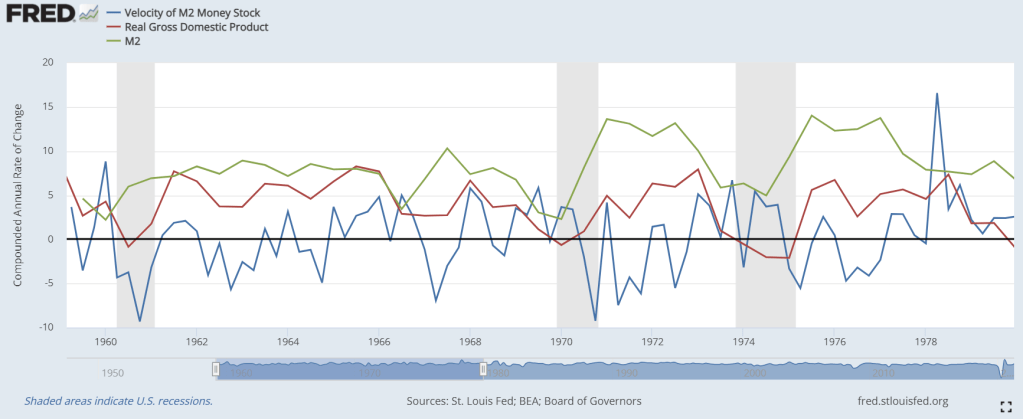
Why would Milton Friedman say that inflation is always caused by changes in the money supply if it is clear that there are two other causes of the price level? When Milton Friedman said his famous quote, output growth was relatively steady. Velocity growth was relatively steady. For his context, Milton Friedman was right. The majority of price and inflation volatility was found in changes in M. See below.

Strictly speaking however, Milton Friedman knew better and he knew that the statement was not strictly correct. Friedman was a public intellectual and he was a great simplifier. He taught many people many true things. At the time, people were blaming inflation on a great variety of things: taxes, fish catches, and unions, to name a few. Arguably, Friedman got them closer to the truth.

Now, there are economists that are pointing to total spending as the driver of inflation. After all, both sides of the equation of exchange describe NGDP (a.k.a. – Aggregate Demand or Aggregate Expenditure). Replacing M and V in the equation with NGDP yields:

P=NGDP/Y

What does this mean? It means that higher NGDP results in more inflation, all else held constant. It means that less output results in more inflation, all else held constant.

But economists dismissing M in lieu of AD are committing the same oversimplification. Y can also change! Maybe economists figure that our recent history is full of relatively stable Y growth and that we ought not pay attention to it. And indeed, unsurprisingly, RGDP growth has been less than NGDP growth.

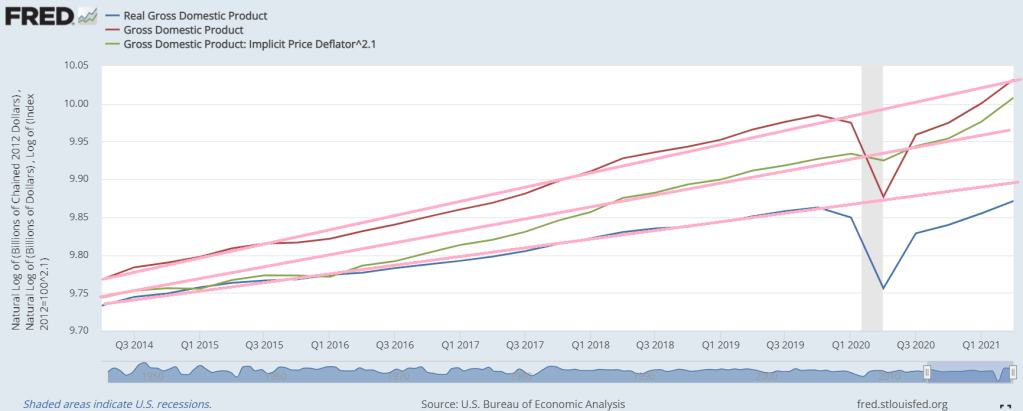
But what is driving the current bought of inflation?

Pardon the crude image. The pink lines are eye-balled trend lines on natural logged data for AD, Y, and P. Prices are up. Is it because of exceptionally high NGDP? Nope. Total spending is back on pre-2020 trend. Does Y happen to be down? Yep, it sure is.

Right now, assuming the previous trend was anywhere close to potential output, inflation is not being driven by excess aggregate demand. It’s being driven by inadequate real output. The news tells the story. There have been supply-chain bottle-necks, difficulty employing, lockdowns, and fear of covid. Right now we have an output problem and higher prices are a symptom. We do not have an aggregate spending problem.

PS – In fact, it is my belief that the Fed successfully avoided a debt-deflation aggregate demand tumble that would have been catastrophic. Inflation is expected when supplies of goods decline.

Weigh costs, benefits, and evidence quality

Living means making decisions with imperfect information. But Covid provides many examples of how people and institutions are often still bad at this. A few common errors:

  1. Imperfect evidence = perfect evidence. “Studies show Asprin prevents Covid”. OK, were the studies any good? Did any other studies find otherwise?
  2. Imperfect evidence = “no evidence” or “evidence against”. In early 2020, major institutions like the WHO said “masks don’t work” when they meant “there are no large randomized controlled trials on the effectiveness of masks”
  3. Imperfect evidence = don’t do it until you’re sure Inaction is a choice, and often a bad one. If the costs of action are low and the potential benefits of action high, you might want to do it anyway. Think masks in 2020 when the evidence for them was mediocre, or perhaps Vitamin D now.
  4. Imperfect evidence = do it, we have to do something Even in a pandemic, it is possible to over-react if the costs are high enough and/or the evidence of benefits bad enough (possibly lockdowns, definitely taking up smoking)

Any intro microeconomics class will explain the importance of weighing both costs and benefits. But how do we know what the costs and benefits are? For many everyday purchases they are usually obvious, but in other situations like medical treatments and public policies they aren’t, particularly the benefits. We have to estimate the benefits using evidence of varying quality. This creates more dimensions of tradeoffs- do you choose something with good evidence for its benefits, but high cost? Or something with worse evidence but lower costs? Graphing this properly should take at least 3 dimensions, but to keep things simple lets assume we know what the costs are, and combine benefits and evidence into a single axis called “good evidence of substantial benefit”. This yields a graph like:

Applied to Covid strategies, this yields a graph something like this:

This is not medical advice- I say this not merely as a legal disclaimer, but because my real point is the idea that we should weigh both evidence quality and costs, NOT that my estimates of the evidence quality or costs of particular strategies are better than yours

Judging the strength of the evidence for various strategies is inherently difficult, and might go beyond simply evaluating the strength of published research. But when evaluating empirical studies on Covid, my general outlook on the evidence is:

Of course, details matter, theory matters, the number of studies and how mixed their results are matters, potential fraud and bias matters, and there’s a lot it makes sense to do without seeing an academic study on it.

Dear reader, perhaps this is all obvious to you, and indeed the idea of adjusting your evidence threshold based on the cost of an intervention goes back at least to the beginnings of modern statistics in deciding how to brew Guinness. But common sense isn’t always so common, and this is my attempt to summarize it in a few pictures.

Racial Gaps and Data Gaps

Are there racial gaps in the distribution of the COVID-19 vaccine? This is an important and interesting question in its own right. But I’ll talk about this question today because it’s an interesting example of how confusing and sometimes misleading data can be.

How do we answer this question? One is by surveying people. There are a number of surveys that ask this question, but a recent one by the Kaiser Family Foundation finds that among adults 70% of Blacks and 71% of Whites report being vaccinated. And given the sampling error possible with surveys, we would say that these are virtually identical. No racial gap! (Note: there was a racial gap when they did the same survey back in April, with 66% of Whites and 59% of Blacks vaccinated.)

But, surveys are just a sample, and perhaps people are lying. Maybe we shouldn’t trust surveys! And shouldn’t there be hard data on vaccines? Indeed, the CDC does publish data on vaccinations by race. That data shows a fairly large gap: 42.3% of Whites and only 36.6% of Blacks vaccinated. This is for at least one dose, and the percentages are of the total population (which is why it’s lower than the survey data). So maybe there is a racial gap after all!

But wait, if you look closely at the footnotes (always read the footnotes!), you’ll see something curious: the CDC admits that the race data are only available for 65.8% of the data. We don’t have the race information for over one-third of those in this data. Yikes! And given the exist disparities we know about in terms of income and access to healthcare, we might suspect that the errors are not randomly distributed. In other words, if there is probably good reason to suspect that Blacks are disproportionately reflected in the “unknown” category. But we just don’t know.

So what can we do? Since this data comes from US states, we can look at the individual state data and see if perhaps some of it is better (fewer unknowns). What does that data show us?

Continue reading

China Cracks Down on Cryptocurrencies

The Chinese Communist Party (CCP) is all about control. In the well-known words of Chairman Mao:

Every Communist must grasp the truth, “Political power grows out of the barrel of a gun.” Our principle is that the Party commands the gun, and the gun must never be allowed to command the Party.

These days political power is linked to economic power and control of information, as well as raw military firepower. Cryptocurrencies have assumed financial importance and they entail information processing and tracking.

On the other hand, a key driver for cryptocurrencies is precisely to escape from the domination of big central authorities, such as the CCP. Proponents of crypto revel in the fact that anyone with a PC can get in on “mining” and that the crypto universe does indeed operate on the web as a largely democratized enterprise. Anybody can transact large sums with anybody, with a moderate degree of anonymity.

These two different visions of life collided on Sept. 28 when the Chinese government banned nearly all crypto-related transactions:

China’s central bank said on Friday that all cryptocurrency-related transactions are illegal in the country and they must be banned, citing concerns around national security and “safety of people’s assets.” The world’s most populated nation also said that foreign exchanges are banned from providing services to users in the country.

In a joint statement, 10 Chinese government agencies vowed to work closely to maintain a “high pressure” crackdown on trading of cryptocurrencies in the nation. The People’s Bank of China separately ordered internet, financial and payment companies from facilitating cryptocurrency trading on their platforms.

The central bank said cryptocurrencies, including Bitcoin and Tether, cannot be circulated in the market as they are not fiat currency. The surge in usage of cryptocurrencies has disrupted “economic and financial order,” and prompted a proliferation of “money laundering, illegal fund-raising, fraud, pyramid schemes and other illegal and criminal activities,” it said.

Offenders, the central bank warned, will be “investigated for criminal liability in accordance with the law.”

The Chinese government will “resolutely clamp down on virtual currency speculation, and related financial activities and misbehaviour in order to safeguard people’s properties and maintain economic, financial and social order,” the People’s Bank of China said in a statement.

Well, those are the bare facts. It’s good to know the CCP is so diligently safeguarding people’s assets and public order. And as noted, Mao’s successors would not naturally favor systems that allow people to just do what they want to do, free from guidance from the Party. But inquiring minds want to know or at least speculate further regarding the reasons for this move and its consequences.

Brian Liu and Raquel Leslie highlighted two other motivations for this crackdown. One motivation  concerns China’s desire to launch its own state-controlled digital currency. This will give the government heightened ability to track every single transaction by every single user. It would also provide China with a new means of exerting influence over other nations and corporations:

The ban comes as the People’s Bank of China (PBOC), China’s central bank, is piloting its own digital currency, the eCNY or “digital yuan.” Unlike private cryptocurrencies, the eCNY is issued directly by the central government and is being designed to provide the PBOC with near-real-time financial data on user transactions. Some observers fear that the eCNY will be used as a tool to strengthen the Chinese Communist Party’s domestic surveillance. Others worry that the eCNY will be used to retaliate against international companies that speak out on human rights issues. Fan Yifei, a deputy governor of the PBOC, announced last week that the eCNY has entered a “sprint stage” ahead of the February 2022 Winter Olympics in Beijing.

Another motivation may be to help prevent wealthy Chinese from taking their money abroad:

The crypto ban may also be intended to deter capital flight. Despite past crypto crackdowns and strict capital controls, wealthy Chinese have used cryptocurrencies to funnel more than $50 billion overseas in 2020. As China is in the middle of an economic slowdown that has been exacerbated by other regulatory crackdowns on the tech and education sectors, China may be redoubling its efforts to ward off skittish entrepreneurs from exporting their money overseas.

Will this crackdown fully succeed? Many observers doubt it. They think that people will find ways to do what they want to do, using platforms that are hosted outside China.

As for the digital yuan, well, it kind of goes against most of the reasons people have gravitated to crypto. It represents a move back to government control and surveillance. It is not really a “crypto” currency at all, but simply another form of regular money.  It could get traction, however, in international trade among countries who have reasons to try to escape from the current U.S. dollar dominance. Also, China could hand out its digital currency like candy to impoverished nations, to get them on board. Millions, maybe billions of people live without regular banking access, and so a medium of exchange and store of value that requires only a cell phone to move funds around town or around the world could be attractive. At any rate, count on China to make the digital yuan a big “thing” for international visitors due at the February 2022 Olympics.

The price of Bitcoin took this news in stride. It continues to bounce around in the same $40,000-$50,000 range that it has been in for the past three months. And being banned by China is not a death-knell for a financial entity.  Indeed, it could be a contrarian indicator. Consider that China has also banned Youtube, Facebook, Google, Instagram, Pinterest, and even (because of his uncanny resemblance to President Xi) Winnie the Pooh.

Grade inflation is making our students too risk averse

Grade inflation in the US education system is a common observation, one that is, at least at the college level, largely undeniable. A couple recent interactions with students has brought it to the front of my mind again. When discussing their majors and what classes they were taking, there was considerable hesitation to take what were perceived as difficult classes. What I thought this called for, in the moment, was a bit of confidence building, for a professor such as myself to say “You can do it!”

It turns out confidence in their ability to learn the material was not the issue. What they were unsure of was their ability to get an A. No, to guaranteed get an A. It was the risk of a sub-A grade that concerned them (likely exacerbated by the fact that my university does not award + and – grades in undergraduate classes). So I went through my usual pitch:

You take 5 classes a semester for 8 semesters. That’s 40 classes. The cost of couple B’s or even a C will pale in comparison to the benefit acquiring more technical skills, which would pay out for a lifetime. A couple courses in computer science, econometrics and statistics, maybe real analysis for those thinking about a PhD in economics – these would all have huge payoffs. There was a problem with my logic, however, that quickly became apparent.

They weren’t sure what they wanted to do after their bachelors. They didn’t know what advanced degrees they might pursue, whether law or medical school was something they were interested in. What they did know, however, is that GPAs were really important. That students were applying to things they might be interested in, and doing so with 3.8 and 3.9’s. When they saw classes that regularly handed out C’s (not D’s or F’s mind you, just C’s), what they saw was pure downside risk. If they were great at something, no one would ever be able to tell. But if they weren’t, or if they had a bad day on a hard final exam, that it could close doors. What I inferred was that they were trying to maximize their expected outcomes, and in order to do so they had to minimize the number of hard classes in their portfolio. Each path had a handful of unavoidable hard classes, so to take a an additional hard class beyond the requirements of the path they chose was suboptimal.

I don’t know that they’re wrong.


I’ve told this story before. When I was considering getting a PhD in economics I planned on just going to my local school. I was visiting a friend on the opposite coast, though, and thought I’d stop in at a really good local school there. I met with the director of graduate studies in the economics department and was flatly informed that my application would not be read because my GPA (3.2, if you’re curious) was below their cutoff. I said thanks and left. It was some time later that it dawned on me that this was ludicrous. Did they simply never admit students from (the famously uninflated grades of) CalTech? Were they discriminating against math and engineering majors? Likely not. But this is deeper knowledge than that held by your typical undergraduate. All they know is the average admissions statistics and the implied (or in my case explicitly stated) cutoffs.

When we inflate grades and get rid of standardized tests, we put greater pressure on students to curate their education to expected grade outcomes and, more important, to minimize risk. There’s no upside to shining in a difficult class if the best 50% all get A’s. The signal value of success has been attenuated. The signal value of failure, however, has not just been left intact, it’s been heightened. There’s no positive variance to balance it out. There’s no way to be an excellent B+ student whose occasional C in risky classes are balanced out by some exemplary A’s. We’ve effectively raised the costs of taking challenging classes and in doing so discouraged students from acquiring the skills that are most rewarded in the marketplace.

The problem only becomes all the worse when we think about the cultural biases in the confidence we cultivate in different groups of students. If a deficiency in math and science has been low-key implied at every stage of your education, you’re that much less likely to incur the risk of “hard classes”. There’s much pearl-clutching over “everyone winning a trophy” and school being too easy from folks who walked to and from school through 12 months of snow, uphill both ways. Those arguments, which are often little more than a sort of grumpy money illusion, miss the real problem entirely. Undoing grade inflation to make school harder is like giving 7 points for every goal in soccer to make it more exciting.

The actual grades don’t matter. What matters is the the shape of the distribution of grades . If we bunch everyone in the A’s and then disproportionately select into institutions based on those grades, we’re incentivizing students to stay in the herd. To risk your GPA for the sake of hard classes is to risk being isolated. To risk being cutout by admissions committees trying to sort through 1000 applications, half of with have near-perfect GPA’s, and for whom the fastest way to make their workload manageable in an acceptable manner is cut out everyone with less than 3.7.

I’m not sure students are wrong in their grade-mongering. They got into college in many cases based on nothing but those GPAs. They’ll be able to go to grad school without taking the GRE. There will come a day, however, when the next step isn’t school, and after which no one will ever ask them their GPA again for the rest of their life. After which the only thing that will matter is what they know. And who will know more: the overconfident student of upper-middle class parents who graduated with a 2.8 BS in electrical engineering or the pragmatic student who curated courses to maximize their 3.7 GPA while preparing for the MCATS and medical school? I don’t know who will leave with more skills, but I also don’t worry about either. Who I worry about is the first-gen college student, the child of a working class household with a 4.0 BA and 4.0 MA in communications who, desperate to prove to others that they belonged in school, made sure to protect that perfect GPA at every turn. What have we done to ensure that they know enough when they enter the job market?

The high cost of day care and demographics

When I moved half-way across the country to take a new job, I had no local support system for my 2-year-old. Putting him in a full-time day care was the plan. I wanted a day care center with a good reputation that is located near work and home. My story, like so many others, includes phone calls and long wait lists. At first, it was hard to understand how I could be willing to pay for a service and it could just not exist.

Opening a large daycare center is risky. Who wants to take that risk? I joked that I’d quit my professor gig and start a daycare in response to the huge demand. Of course, I did not. Fortunately, I don’t live in one of the American counties that lost population over the past ten years.

The WSJ on demographics describes this situation in a shrinking county:

In Lincoln County, Kan., pop. 2,986, about 40 miles west of Salina, Kan., economic development director Kelly Gourley set out to build the county’s first day-care center not run out of someone’s home. A child-care shortage was making it difficult to work and raise children, she saw. The town’s handful of in-home daycares were the only options, and they tended to come and go.

Ms. Gourley estimated it could cost as much as a half-million dollars to build the facility, and she didn’t think it could weather fluctuations in demand. “In a rural community, you lose one kid and you might be in the red all the sudden,” she said. She shelved the plan and instead is working to increase the supply of in-home caretakers.

Allison Johnson, a 32-year-old nursing home speech pathologist, grew up in Lincoln County and hoped one day to have three children. She no longer thinks that is feasible after she had to wait a year to get an in-home daycare spot when her first child was born. Now she and her husband, who owns a residential-construction business, are trying to figure out how they would juggle having a second child.

Her father, a farmer, watches her son, now 2, when her in-home daycare provider isn’t available. But he and her brother are in their busy season, and “they’re not going to be able to do anything but throw him in the tractor.”

There are attractive economies of scale for day-care centers. This economic fact is part of the reason that young people are leaving rural areas, which in turn makes it harder for rural areas to support services for young families.

There has always been a huge amount of value created at home within families that is not fully captured by GDP. As more childcare is moving to the formal market, we are starting to see just how valuable those services are that used to be provided in the family.

Whatever your views on the matter, it’s not surprising that politicians are talking about subsidized day care.

Allowing for flexibility through policy moves like vouchers and de-regulating in-home daycares is important. Some communities can’t support a day-care center facility, like the one in this article. I think the if you build it they will come philosophy, if applied too widely, would be hugely expensive and not efficient. On the other hand, there could be situations in which more day care would be provided if the local government would take on some of the risk currently faced by entrepreneurs.

Markets in Everything for Christmas Decorating

Last year I blogged about a service to create your kid’s school Valentine’s cards.

Now, the temperature in Alabama has dropped to a chilly 71 degrees and the pumpkins are out. It’s time for parents to start worrying about who is going to create holiday magic at home.

You can pay someone to do this. An enterprising local has already posted this in a neighborhood group.

Creating holiday magic is a wonderful thing. There are huge positive externalities to even a simple string of lights around your front door. I love it. Creating the magic is also a lot of work. As someone who is forever swamped at work and has already booked three weekend work trips for Fall 2021, my willingness to pay for this service is positive. (I can’t afford this particular service, nor do I need my Christmas tree to look like the one in her picture.)

The rich have always had extra hands to manage their estates. I have a feeling that the percent of households for which this might be a paid service is expanding. There are women in the comments asking this crew to come over.