Inflation Has Wiped Out Average Wage Gains During the Pandemic (maybe)

The latest CPI inflation report didn’t have a huge surprise in the headline number, with 8.3% being very similar to last month. But with the two most recent months of data, we can now see something very unfortunate in the data: cumulative inflation during the pandemic as measured by the CPI-U (11.6%) has now almost matched average wage growth (12.0%), as measured by the average wage for all private workers. I start in January 2020 for the pre-pandemic baseline.

What this means is that inflation-adjusted wages in the US are no greater than they were before the pandemic. They are almost identical to what they were in February 2020 (just 2 cents greater). But as regular readers will know, the CPI-U isn’t the only measure of inflation, and there’s good reason to believe it’s not the best. One alternative is the Personal Consumption Expenditures price index. Cumulative inflation for the PCE is slightly lower during the pandemic (9.0%, though we don’t have April 2022 data yet).

This chart shows average wage growth adjusted with both of these different measures of inflation, expressed as a percent of January 2020 wages. The CPI-U adjusted wages (blue line) have been falling steadily since the beginning of 2021, though the declines have accelerated in 2022. The PCE-adjusted wages (orange line) have also not performed superbly, but at least they are still 2-3% above January 2020. Still, the picture is not rosy: they’ve basically been flat since mid-2020 and have started to drop in early 2022.

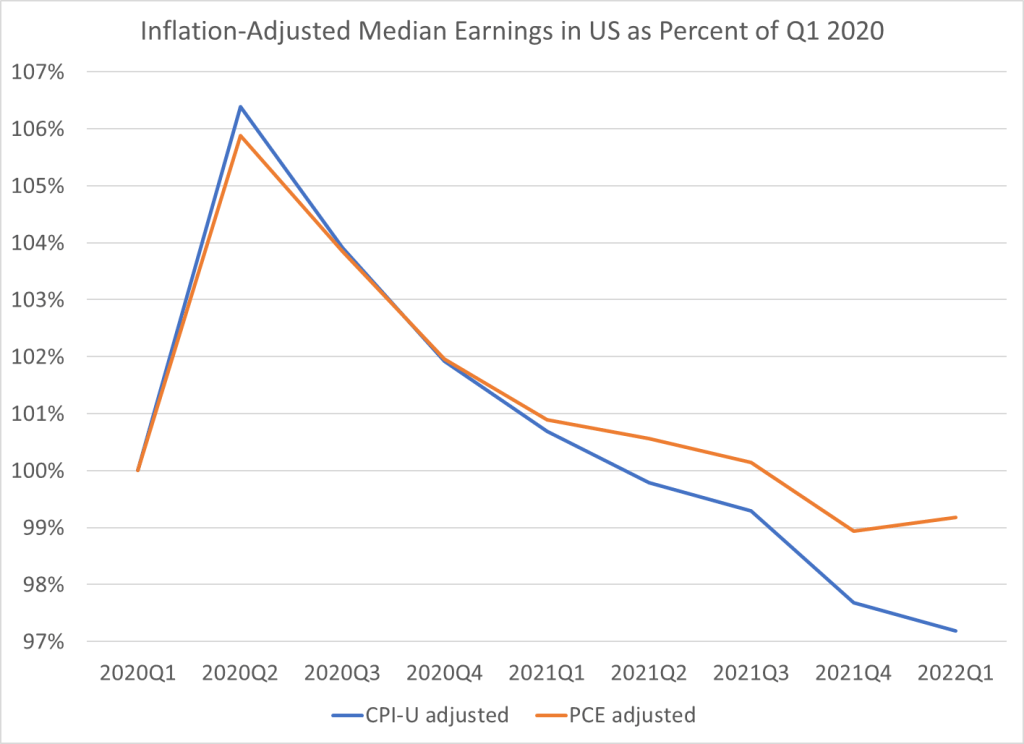
Of course, average (mean) numbers can be tricky and sometimes misleading. What if instead we used median wages? Unfortunately, there is no hourly median wage data that is updated every month. The closest data that I usually look at is median weekly earnings, which is available on a quarterly basis. Here’s what that data looks like, expressed as a percent of the first quarter of 2020. I limit the data to full-time workers, since that should give us a roughly comparable number to the hourly data (hours of work may have changed, but using full-time workers should make it roughly constant).

For median weekly earnings, we can see that the picture is even less rosy. Median earnings have been declining consistently since the second quarter of 2020, regardless of which inflation adjustment we use. The decline in the PCE-adjusted measure isn’t quite as steep since early 2021, but both figures are below the pre-pandemic level, and have been for the past two quarters.

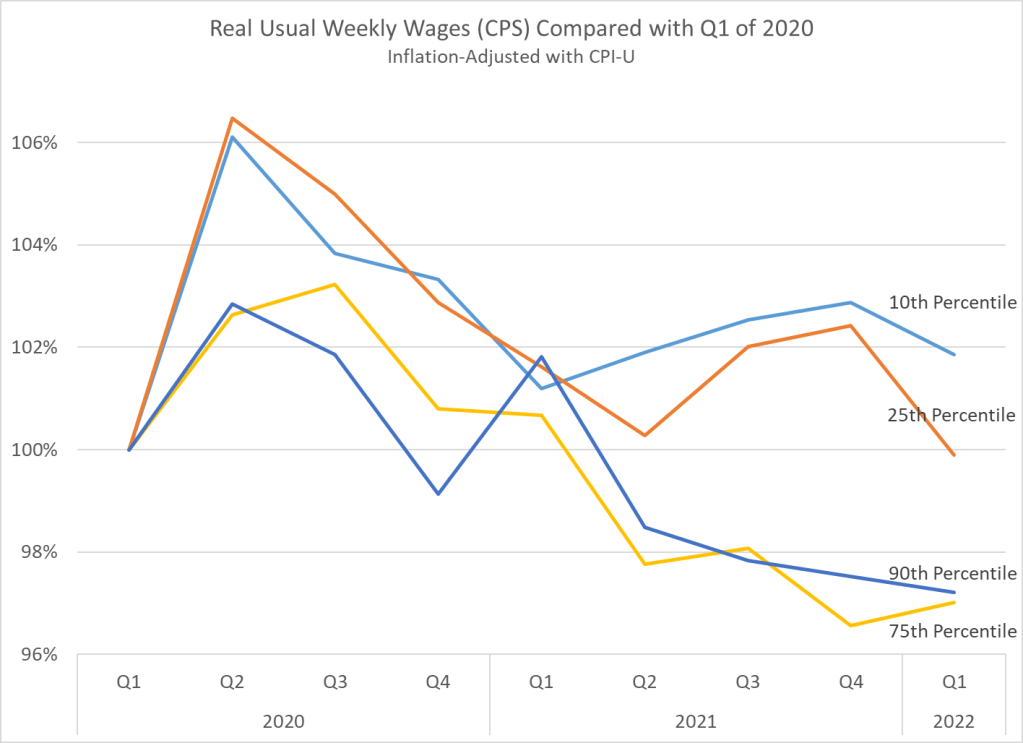
One final note: if we look at weekly earnings across the distribution, and not just at the median, we see something very interesting. Earnings at the bottom of the distribution seem to be performing better than those at the top. In fact, the 10th percentile weekly wage is the only category that is still above pre-pandemic levels. I’m only adjusting using the CPI-U here, but the patterns for the PCE-adjusted earnings would be roughly similar.

We should be cautious about interpreting this data too: if workers dropping out of the labor force are primarily at the bottom of the distribution, it will artificially push up the 10th percentile earnings level. It would be good to know how much of that is going on here. Still, I think this is an important result in the current data.

Raspberry Pi 400 Review: A $100 Desktop PC?

The Raspberry Pi 400 is billed as a complete desktop PC for under $100 ($99.99). Is this for real, considering the cheapest regular computers are around $300 (plus paying for Word and Excel)? Your intrepid correspondent here dives deep to bring you the truth.

The Raspberry Pi series of microcomputer have been around since 2011. A typical  Raspberry Pi is a printed circuit board, about 3 inches by 5 inches, with  a microprocessor chip, some RAM memory, and many input/output  ports. These ports include four USB ports, two micro-HDMI monitor ports, an Ethernet LAN port, a 3.5 mm audio/visual jack, and special camera-related ports (which can also handle a touchscreen). Also, a port for a micro-SD memory card, which is where the operating system and apps and data reside. But wait, there’s more: in addition to Bluetooth and wi-fi capability, the Pi has a 40-pin port for input and output to interact with the physical world.   All this for around $35! [1]

Raspberry Pi Model 4 B

Developed by the British nonprofit Raspberry Pi Foundation as an affordable educational tool,  millions of Raspberry Pi units have been purchased by students and techies to learn-as-you-play and to do some useful projects. I have been aware of these devices for years, but I have been put off by how many peripherals you have to add to get an actual working unit – you have to add a USB-C type power supply, a keyboard, a mouse, and a monitor or other display. And you have to make or buy a case to put the circuit board in. All of which seems like a sprawling mess of wires and stuff. Also, the Pi does not have the computing power and memory to graciously run Windows and Microsoft Office apps like Word. Instead, it uses a Linux operating system instead of Windows, and LibreOffice apps for word processing and spreadsheets. I have never used Linux; it sounded exotic, maybe with a steep learning curve.   

However, the good folks at the  Raspberry Pi Foundation have come out with a new package for the Pi. This is the Raspberry Pi 400. The computing guts are housed inside a keyboard, with all the ports in the back. Thus, they provide the case and a keyboard, all in one tidy package, for about $70. The 400 lacks a few of the input/output ports found on the regular Pi, namely the camera-related I/O and the 3.5 mm headphone/video jack, but retains the 40-pin I/O port.  For $100 you can get the complete Raspberry Pi 400 Personal Computer kit which includes a power supply, a mouse, a micro-SD card with operating software, a cable for the monitor, and a thick manual. I finally succumbed and bought the complete kit. [2]  (Tip:  To get the $100 price, you may do better to find a physical store location like Micro Center, since sellers on Amazon mark it way up to around $160, or sometimes they substitute the bare keyboard for the full kit). You just need to supply a monitor or a TV that has an HDMI input. [3]

Raspberry Pi 400 Personal Computer Kit

The User Experience

So, how good is the Raspberry Pi 400? I have been pleasantly surprised. First, there was almost no learning curve on using the operating system. The version of Linux that is on the microSD card and which gets booted into the working RAM has a very Windows-like visual interface. I did not have to type in any arcane commands. It was all obvious point and clicks to open apps and documents. It helps that this is a pretty simple system, so not a lot of choices to wade through.

I entered my LAN wi-fi password, and was immediately on the internet using the built-in generic Chrome (not Google Chrome) browser. With the recent, improved software on the Pi, it happily streamed YouTube videos, etc.  The LibreOffice suite includes apps which have most of the capabilities of Microsoft Office Word, Excel, and PowerPoint. You can configure some settings in LibreOffice to get the appearances, menus, etc., to even more closely match the Office apps. LibreOffice can save and open files in standard Office formats ( .docx, .xlsx, etc.) so as to share files with the rest of the world. This is pretty good for free software.

I’d rate the keyboard experience as “OK”. The keys are full size, but the feel and the keyboard angle are enough different from my laptop that my typing was slow. Maybe that would improve with use. If I were going to do a lot of typing on this, I would  prop it at a more horizontal angle and rest my wrists on a pad sitting in front of the keyboard, to replicate my hand position on my laptop.

I have not yet played around with the 40-pin I/O port on the Pi 400. That sets it apart from a regular PC, giving the user a means to read inputs from the physical world, analyze them, and output desired actions (e.g., operate the watering hoses in a greenhouse or garden, depending on temperature and dryness of the ground). There are zillions of plans available on line for projects controlled by Raspberry Pi’s. Some are practical, some involve robots, and some are just whimsical, like retro video games and like this sugar cube launcher, which measures the distance to a coffee cup and shoots a sugar cube through the air with a trajectory calculated to land it in the cup. And here are another 26 Awesome Uses for a Raspberry Pi , including stop-motion and time-lapse videos (may not work on Pi 400 because it lacks regular Raspberry camera interface) and turning your Raspberry into a Twitter bot or web server that can host your own blog site.

The Verdict: Is This a Real PC?

Would I recommend this as a primary computer? Well, maybe, for someone on an extreme budget or living in a low-income country, or for someone in a situation where their computer is liable to get lost or broken or stolen. After all, it can do practically anything that a regular PC can do (email, YouTube, word processing, etc.). One area it falls way short in is compute-intensive gaming, so it is not for you if you need realistic spatters on your screen for Call of Duty. Also, if you have to go out and buy a new $150 monitor to use it, the value proposition starts to fall apart, but usually you have an old monitor or TV  around or can borrow one from someone.

The LibreOffice apps will do most of what Microsoft Office does. The Pi cannot download Office and run it offline. However, if you can’t live without the authentic Microsoft Word experience, you can use the Pi as a terminal to log into Microsoft 365 and pay for and  run the Web version of Word, Excel, etc.  Also, you can plug in a USB microphone and USB webcam and use the Pi with Zoom.  

Here is a list of further recommended programs ( all open source, Linux compatible) to install on a Raspberry Pi. These include programs for photo editing, media streaming, gaming, and connecting to a VPN. Here are more tips on the Pi 400 for home office use, including printing and online collaboration tools.

So, yes, a Pi 400 can do most of what desktop PC does, all for $99.99 plus tax [4]. Not to mention not paying an extra $150 or so for Microsoft Office. That said, most of us already have a portable laptop as our primary computer. We can carry it anywhere, and it has built-in display, camera, and speakers. And we have a large monitor on our desk for the desktop experience. For most of us, it is worth spending say $600 for our laptop-plus-monitor versus using an underpowered desktop PC tethered to a monitor and power cord.

So, realistically, most adults in the West would not probably choose the Pi 400 as their primary computer. However, it is a great little spare machine to have around for guests or for kids or for if something happens to your main PC.  It can be a second PC on the corner of your desk to use while your main computer is tied up on a Zoom call. Multiple people (e.g. students in a classroom) can share a Pi, especially if each person has their own microSD card or USB to store their individual documents. You could use a Pi to stream music or video over some random speaker or monitor or TV or dedicate it to some similar specific purpose.

The software load includes Python, a popular programming language which may be worth learning. Also, the Linux  operating system is very widespread in the computer world, powering most servers, so it can be useful to learn Linux as well. Although the newbie user will likely just use the Windows-like graphical user interface, the command line text Linux commands are available for use and practice on the Pi. The Pi 400 software also includes “Scratch” (good tutorial here):

Scratch is an easy to use block-based visual programming software that can run on a Raspberry Pi. Using this tool, you will be able to create your very own animations, games, and more using a straightforward drag-and-drop interface. The Scratch software is a great way to get young people started with programming and develop a general interest in computing.

The Raspberry Pi is a powerful tool for interfacing with the physical world, in the “internet of things.”  A tech-inclined person (including a high school student) can find or invent a variety of fun and useful projects which make use of the input/output capabilities of the Pi. Since the internet can be problematic for kids, these sorts of projects with the Pi can keep them busy and learning on a real computer without necessarily having routine internet access.

Endnotes

[1] Some even cheaper, more stripped-down Raspberries have recently become available, such as the Pico and the Zero 2 W, to use as dedicated microprocessors for some specific application.

[2] I think one reason I got the Pi 400 was sheer nostalgia; my very first personal computer, purchased around 1985, was a Commodore 64. Like the Pi 400, the Commodore 64 was a low-cost keyboard with interface ports that you hooked up to a TV or monitor. I used the I/O port on the Commodore to control a Radio Shack robot arm, using relays on a printed circuit board that I etched myself. Good times.

[3] Normally, the sound output from the Pi 400 is transmitted to the monitor/TV along with the video in the HDMI.  If you have some old monitor or TV that only has VGA video input, you can buy an adapter cable that converts HDMI to VGA (make sure you specify male/female correctly), but that only gets you the visual output. To hear the sound in this case, you’d have to either pair up an external Bluetooth speaker with the Bluetooth in the Pi, or plug in a USB speaker. (The other Raspberry Pi models, like the 4 B, include a 3.5 mm jack that sends both sound and video, so you could just plug in a headphone and skip the USB speaker).

A couple of random tips on the Pi 400 keyboard: The Raspberry key, near lower left, brings up the main menu. To get a clean shutdown, properly saving and closing documents and apps, use  Fn F10. Another observation: You can run the Pi off a USB thumb drive instead of the micro-SD card, which can give faster performance and more storage.

[4] One learning I got from doing this review is that you could use your phone as a desktop PC: with an iPhone or iPad, for instance, you can drive an external monitor with a cable from the Lightning port, and use a Bluetooth keyboard/mouse for inputs. There are word processor and other apps that run on phones and tablets, including Microsoft Office. This should give a computing experience similar to that on a Raspberry Pi, although using iOS or Android-specific forms of the various apps.

The propaganda premium puzzle

Beliefs I currently hold:

  1. In the past we have been surprised by the capacity of blatantly false information to persuade large groups of people.
  2. In the future we will continue to be surprised by the ability of blatantly false information to persuade large groups of people.

From the point of view of classic economic theory, this is almost a two-way paradox. First, why aren’t people rationally updating their beliefs to be more skeptical of the information presented to them by state and private media with fairly transparent agendas? If we accept the premise of the first, though, it invites a second question: why is anyone surprised by the efficacy of propaganda and the credulity of large swaths of the public? Shouldn’t we, the meta-observers, also be updating our beliefs?

My preferred explanations, as they stand, are:

  1. Preference Falsification i.e. people are not fooled, they just happen to believe that at the moment it is safer and more rewarding to appear as though they believe the lies.
  2. Social coordination i.e. narrowly held false beliefs make more better coordination mechanisms for solving collective action problems than broadly held truths

The first is a classic theory that originated with Timur Kuran’s seminal work. Whenever the median voter, or median would-be voter in an autocracy or failed democracy, seems to be held in sway by particularly transparent propaganda, I usually start from the default assumption of preference falsification. These people know the media regime they live within is a menagerie of lies that exist solely to flatter leadership and disrupt any opposition, but they also know that their short run futures remain more secure if they not only publicly accept, but actively parrot the lies.

For now at least. Preference falsification is an inherently fragile equilibria. As effective and impenetrable as propaganda can appear at a given moment, public support for those lies can collapse in the blink of an eye, a dynamic only intensified by modern communication technology.

The ability of false beliefs to solve coordination problems is more subtle, but no less salient to the propaganda premium puzzle, particularly when a regime is dependent on a small subset of a society to hold on to power (a “selectorate“) or the support of a political “base” who would otherwise have difficulty signaling their identity to one another. The reality is that obvious or widely shared truths have almost no value when trying to signal mutual affinity and trustworthiness to individuals trying to solve collective action problems. Patently ridiculous beliefs, on the other hand, work precisely because the only people who would publicly commit to holding such beliefs are those who are committed to the collectively produced club good.

So why does propaganda continue to work better than we think it should? Because we’re using the wrong metrics. Or, more precisely, because the right metrics aren’t available to us. We can ask people what they believe, but we can’t make them tell us the truth. And even if we could make them tell us the truth, we can’t measure the benefits motivating their reasoning, the value of the club goods they are gaining access to because they’ve performed the mental gymnastics necessary to hold those beliefs. Sure, it was cognitively costly to convince yourself the earth is likely flat, but those costs are trivial in the face falling out of the tightest network of friends you’ve ever been a part of.

All of this armchair theorizing is really just a long-winded way of suggesting that fighting propaganda is decidedly not about curing people of their false beliefs. If you want to unravel preference falsification, people don’t need the truth. They already know the truth. What they need are safe channels to express it to one another. If subgroups are forming around false beliefs, the answer is not to shame them for their beliefs. That will only strengthen their group and members’ committment to one another. Rather, the answer is to provide superior substitutes for the club goods they are currently receiving. When in doubt, if you want to break a social equilibrium, you’re better off giving people what they need rather than demeaning what they have.

Come to think of it, that’s probably pretty good life advice in general.

Automation report from 1958

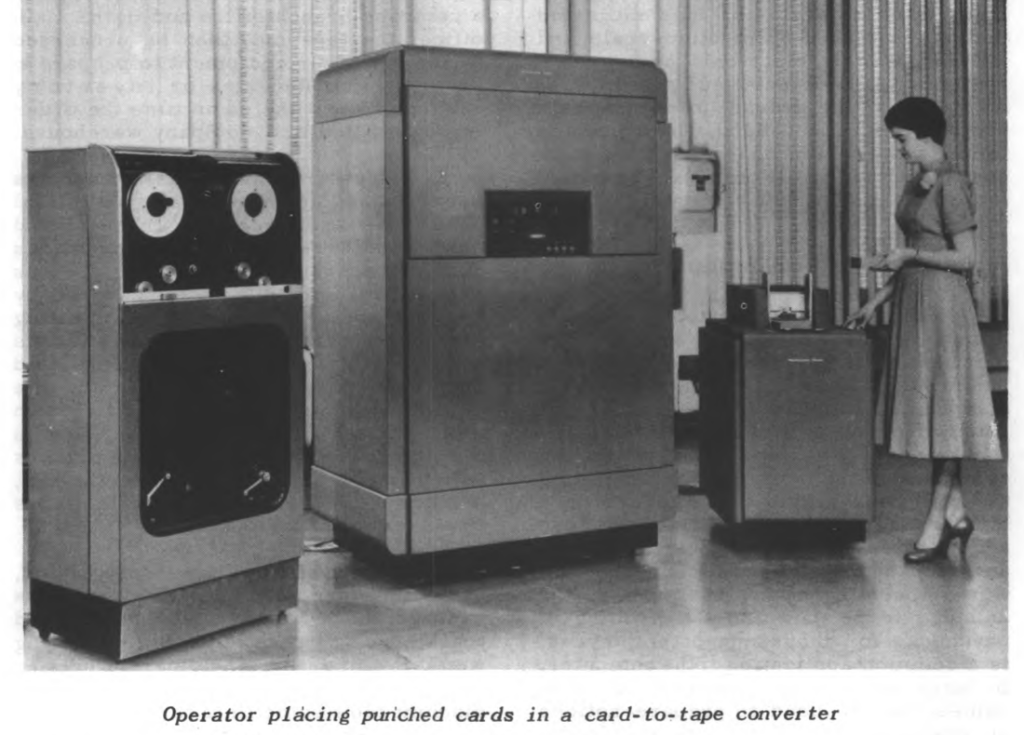
Courtesy of the St. Louis Fed, you can download a report published in 1958 titled “Automation and Employment Opportunities for Office-Workers: A Report on the Effect of Electronic Computers on Employment of Clerical Workers, with a Special Report on Programmers.”

I teach students about data and software to prepare them to enter the hot field of business analytics. It has been a growing field for a few years, especially since the advent of “Big Data”. Something I explain in class is how brand-new technology has changed business.

Reading this report forced me to re-think just how new data analytics is. The authors saw machines in use for data processing and correctly predicted that this would be a dynamic source of new jobs.

The introduction states that millions of “clerical workers” were employed in the United States. That fact would have been obvious at the time, but today we might not realize just how many humans would be needed to store and fetch the files we access regularly on our computers. The creation of clerical jobs was especially important for women.

https://fraser.stlouisfed.org/files/docs/publications/bls/bls_1241_1958.pdf

In view of the volume of work that needed to be done, installing new computers was economical. “A computer system can automatically do such jobs as prepare payrolls for thousands of employees, control inventory on a multitude of items…”

“Although computers are often described as machines that can “think,” that is, of course, not so. Like other machines, they must be operated or controlled by people… The people who prepare the instructions are called programmers.”

“Electronic computers were developed during World War II as an aid in solving intricate scientific and engineering problems such as gunfire control, but their application to the processing of office data is more recent. The Federal Government lead the way in 1951, when an electronic computer was installed by the Bureau of the Census…”

The authors see the primary role of computers in business as a way to automate the routine work that could be performed by clerks. Secondly, they state that computers can by used for solving complex math problems “such as those related to launching and tracking earth satellites.”

The report was created for young people who are considering their own choices for education and careers. The authors describe the programming but also various machine support roles. For example, the Coding Clerk’s job is to convert the programmers’ instructions into “machine language”.

The authors recognize that computers will replace some of the traditional clerk roles. “These developments will not only increase the output of clerical workers and slow down growth in clerical employment, but will also change the character of many jobs… Many of the new jobs … will generally pay better and require higher levels of skill and training than most other clerical jobs.” The next sentence is where the authors fail to predict PCs and the internet: “Moreover, a continued increase is expected in the number of officeworkers in jobs not greatly affected by office automation – for example, secretary, stenographer, messenger, receptionist, and others involving contacts with customers and the public.”

The discussion of women in the workplace is clinical in tone. Turnover is high in the clerical fields because many young women stop working when they get married or have children.

There is a special report on “programmers”, one of the newest occupations in the country. Programmers specialize in either of the following: 1) “processing the great masses of data which have to be handled in large business and government offices” 2) “solving scientific and engineering problems”.

The authors describe typical training and career paths. At the time, a college student could not major in computer science. Companies were filling most positions by selecting employees familiar with the subject matter and giving them training in programming. A few colleges purchased computers and provided some training opportunities.

The culture was different back then. “Although many employers recognize the ability of women to do programming, they are reluctant to pay for their training in view of the large proportion of women who stop working…” The authors tip off their female readers that they are more likely to get training in government than industry, if they aspire to be programmers in the 1950’s. Today, the risk and cost of training has largely shifted from the employer to the worker. If you are interested in the topic of bootcamps and STEM pipelines, read the document for their discussion of education.

These authors made a good long-term prediction because they anticipated the business analytics boom. “Continued expansion in employment of programmers is expected over the long run… In offices where the volume of recordkeeping is great, there will continue to be need to reduce the cost of processing tremendous amounts of data and to produce more timely reports on which management decision can be based.”   After explaining salary, they talk about perks: “Programmers usually work in well lighted, air-conditioned, modern offices. Employers make special efforts to provide better than average surroundings for programmers, so that they may concentrate to achieve the extreme accuracy necessary for programming.” The nap pods of Silicon Valley have a long history that can be traced back to the Census Bureau.

Covid-19 Didn’t Break the Supply Chains. You Did.

This is my last post in a series that uses the AS-AD model to describe US consumption during and after the Covid-19 recession. I wrote about US consumption’s broad categories, services, and non-durables. This last one addresses durable consumption.

During the week of thanksgiving in 2020, our thirteen-year-old microwave bit the dust. NBD, I thought. Microwaves are cheap, and I’m willing to spend a little more in order to get one that I think will be of better quality (GE, *cough*-*cough*). So, I filtered through the models on multiple websites and found the right size, brand, and wattage. No matter the retailer, at checkout I learned that regardless of price, I’d be waiting a good two months before my new, entirely standard, and unexceptional microwave oven would arrive. I’d have to wait until the end of January of 2021.

¡Que Ridiculo!

Continue reading

Eat 20 Potatoes a Day…. For Science

Several people have tried eating an all-potato diet for a few weeks and reported losing lots of weight with little hunger or effort. Could this be the best diet out there? Or are we only hearing from the rare success stories, while all the people who tried it and failed stay quiet?

Right now we don’t really know, but the people behind the Slime Mold Time Mold blog are trying to find out:

Tl;dr, we’re looking for people to volunteer to eat nothing but potatoes (and a small amount of oil & seasoning) for at least four weeks, and to share their data so we can do an analysis. You can sign up below.

I was surprised to see that they are the ones running this, since they are best known for the “Chemical Hunger” series arguing that the obesity epidemic is largely driven by environmental contaminants like Lithium. The conclusion of that series noted:

Bestselling nutrition books usually have this part where they tell you what you should do differently to lose weight and stay lean. Many of you are probably looking forward to us making a recommendation like this. We hate to buck the trend, but we don’t think there’s much you can do to keep from becoming obese, and not much you can do to drop pounds if you’re already overweight. 

We gotta emphasize just how pervasive the obesity epidemic really is. Some people do lose lots of weight on occasion, it’s true, but in pretty much every group of people everywhere in the world, obesity rates just go up, up, up. We’ll return to our favorite quote from The Lancet

“Unlike other major causes of preventable death and disability, such as tobacco use, injuries, and infectious diseases, there are no exemplar populations in which the obesity epidemic has been reversed by public health measures.”

That said, they did still offer some advice based on the contaminant theory that is consistent with the potato diet:

1. — The first thing you should consider is eating more whole foods and/or avoiding highly processed foods. This is pretty standard health advice — we think it’s relevant because it seems pretty clear that food products tend to pick up more contaminants with every step of transportation, packaging, and processing, so eating local, unpackaged, and unprocessed foods should reduce your exposure to most contaminants. 

2. — The second thing you can do is try to eat fewer animal products. Vegetarians and vegans do seem to be slightly leaner than average, but the real reason we recommend this is that we expect many contaminants will bioaccumulate, and so it’s likely that whatever the contaminant, animal products will generally contain more than plants will. So this may not help, but it’s a good bet. 

Overall though I think the idea here is to ignore grand theories and take an empirical approach. The potato diet works surprisingly well anecdotally, so lets just see if it can work on a larger scale. Seems worth a try; I’m sure plenty of my ancestors in Ireland and Northern Maine did 4-week mostly-potato diets and lived to tell about it. You can read more and/or sign up here. Let us know how it goes if you actually try it!

What if You Didn’t Have to File a Tax Return?

Now that we’ve all made it through the 2021 tax filing season, it’s worth thinking about a recurring question in tax policy: is it possible that most of us wouldn’t need to go through this annual ritual? Couldn’t the government just tell us how much we owe (or are due as a refund), or better yet, just deduct the correct amount from our paycheck so we’d have paid the right amount?

We need to imagine such a system: it exists in many developed nations around the world! And it’s true that, at least for many taxpayers, the IRS already has all the information on you it needs to calculate your taxes.

But how many US taxpayers would this be beneficial for? A new working paper which tries to quantify this question. In “Automatic Tax Filing: Simulating a Pre-Populated Form 1040,” the authors use a large sample of tax returns to estimate how many taxpayers a pre-filled return would work for. The results are almost split down the middle: it would work well for maybe half of US taxpayers (41-48% of taxpayers, depending on how we are defining successful). For the other half, it wouldn’t give you an accurate estimate of how much tax you owed.

And the errors can be large. For example, the authors report that “two-thirds of the cases where the lower bound approach is inaccurate, the pre-populated liability is higher than the reported liability, with a median gap of $4,200.” Note: looking at the tables, I think they mean to say “mean,” not “median” here, with the median being $1,400. Still, that’s a lot of errors in a direction that would hurt taxpayers if they didn’t fill it out on their own or pay someone to do it. And it’s not just one thing that’s causing pre-filled returns to be wrong. You might think itemized deductions are a big issue, and they are, but only for about 11% of returns (and in only 4% of returns is this the only issue). They find that 9% of returns didn’t even have the reported wages matching what the IRS showed!

Does this mean that pre-filled returns are doomed in the US? Perhaps not! They seem to work much better for younger, single filers, and as well as filers with very low income, as Figure 1 from the paper shows. Even so, the 60-80% success rate (depending on criteria) for very low income taxpayers isn’t especially encouraging. But one upshot of a pre-filled return is that there are possibly millions of taxpayers (maybe 8 or 12 million?) that don’t file a return because they aren’t legally required to (too low income), but they would benefit if they did because of refundable credits like the EITC and Child Tax Credit.

Maybe there is a compromise position. The IRS could send you a “suggested tax return,” but allow you to modify it. I suspect that, in most cases, those who are currently paying for a person or software to do their taxes would still do it. You can’t know if you are in the one-half of taxpayers where this information is accurate! The IRS could provide a list of “common reasons why you may be in the half of pre-filled tax returns that are wrong,” but we’re still shifting the burden back to the taxpayer.

I would like to suggest, instead, that there are a few changes we could make to our tax system (“simplifications,” if you will) that might make pre-filled returns much more viable.

Continue reading

How to Read Aloud Kindle and Other Text on iPhone, iPad, and Android

What if you could get your phone or tablet to read Kindle or other text aloud to you? I have recently come across an easy way to do this. This is an economics blog, so I will note that this approach saves considerable money versus paying for audio books like Audible, or paying for the Narration option on Kindle.  Most of us already have text books we have bought from e.g. Kindle. Also, if you search on the subject, there are various sources for free on-line books, including hundreds of thousands titles available through Libby/Overdrive via your public library. This text-to-voice method should work with all of these e-books.

Directions for iPhone/iPad: A short YouTube video “How to get your iPhone to read Kindle books aloud” by Kyle Oliver tells you all you need to know. The key step is to go to Settings, then Accessibility, then Spoken Content. At that screen, turn on Speak Screen. With Speak Screen ON, whenever you are on a page with text (including Kindle or other e-book), you swipe down from the top of the screen with two fingers. That will activate reading of that page of text. Also, a little speech control panel will appear. That panel will allow you to play/pause/jump forward and back. It will also allow you to  you toggle between multiple speeds: 1x, 1.5x, 2x, & 1/2x. 

If you want, while you are in the Spoken Content screen you can also turn on Speak Selection. That will give a Speech option to read aloud just whatever text that you have select, and then stop.

Also, on in the Spoken Content screen there is a Voices link, for selecting what voice you want to hear. You can experiment with various voices. I have found that the male Siri voice (“Siri voice 1”) is preferable. The female Siri is too syrupy sweet listen to for long, and most of the other voices are robotic. I find that if I select a new voice, I have to turn the reading off, then on again to get the new voice to start working. One more tip from that YouTube is to dim your screen, since with continuous reading of Kindle pages, the screen will stay on, and drain the battery quickly if the screen is bright.

Once you do the two-finger swipe down to commence reading, it should keep reading onto following pages as well. For unknown reasons that does not work sometimes. I find that using the jump forward then jump back buttons on the little speech control panel unsticks this functionality.

For Android: The YouTube How to Turn On Text To Speech Read Aloud on Android/Samsung – 2022 by ITJungles has comparable directions for Android. This involves installing the Android Accessibility Suite from the Play Store.  The 2020 video Text To Speech Options On Android – TalkBack, Select To Speak, Voice Assistant, Screen Reader by The Blind Life gives several different options for getting text read aloud on Android phones.

(In this blog post I originally referenced 2017 video Kindle Android Text to Speech . This got rave comments back when it was first put on YouTube, but more recent comments there suggest that Android may have changed so that this approach no longer works well).

There is a harder way to do all the above, which is to download a separate text-to-speech app like Speechify or Voice Dream Reader. These apps will read most text that is on your screen, but NOT Kindle or other e-books that have Digital Rights Management (DRM) protection. For these e-books, you’d have to download yet another app such as Epupor Ultimate on your computer, download your Kindle files onto your computer, then run Epupor on these files to create unprotected versions. Then, I suppose, load these files back onto your phone/tablet where the text-to-speech app can access them to read aloud. This does not seem worth it (compared to the simple method above using built-in iPhone/Android capabilities) unless you want to utilize some extra feature of the outside text-to-speech app.

Note: Under the subject of low cost text to speech, there are apps like Librivox or (using your local library) Overdrive or Libby that offer free audiobooks – see this article by LifeWire. Also, you can find audio versions (which probably violate copyright) of many popular and classic books on YouTube. If a book is already available as an audiobook, it is probably better to use that format for listening to it, rather than downloading it in text form and then using the approach here for listening.

Let’s Talk about the NBER

The National Bureau of Economic Research (NBER) sent out its membership invitations this week. My twitter timeline quickly filled with explicit congratulations and oblique commentary. My private messages filled with…less than oblique commentary. Academia has always been hierarchical and economics has never been an exception. Talk of “top” departments and people is ubiquitous, but those categorizations remain fuzzy – “There are 40 departments in the Top 25” is a common adage. Aside from the obvious humor, I think there is also some healthy truth to it. There are lots of good departments and no one has any final say on who they are. Departments compete for recognition of contributions and the rewards that come from status in the profession. Having 40 or 50 “top 25” departments just means more status for everyone, which strikes me as nothing but welfare enhancing.

The NBER, on the other hand, has hard boundaries of membership. Though I doubt it was founded with any such intention, it has become the club within the broader profession that comes with more prestige than any other. Exclusionary clubs are not unto themselves problematic, but it is hard to shake the feeling that the advantages exclusive to NBER members are greater than ever.

For those who are sick of preamble, let’s start building a hypothesis. Academic economics has acquired some pathologies of publication and promotion that are creating an increasingly grumpy and anxious profession, particularly amongst our junior colleagues. These pathologies are manifest as broad public goods (e.g. timely evaluation and dissemination of research to inform tenure and promotion decisions, professional network development, the transition into a discipline more dependent on significant outside funding, etc.) that the discipline is consistently failing to produce.

The NBER is producing exactly these public goods. They didn’t create any of these problems, but for their members they may have solved them.


Originally founded as a research institute in 1920, largely to produce and disseminate macroeconomic data, the NBER has evolved into a collection of 20 research programs and 14 working groups, all built around a bureaucratic hub that has 100 years of institutional experience running research groups, disseminating research, and organizing events. It has a storied history and deserves every ounce of the prestige it both enjoys and bestows.

From the point of view of any scholar looking to get a research agenda off the ground, an affiliation with the NBER offers 4 key advantages or “club goods”:

  1. The prestige of listing an NBER affiliation at the top of your CV and on every paper you write and submit.
  2. Invitation to NBER conferences, most importantly the Summer Institute collection of meetings every July in Cambridge, MA.
  3. The option to channel your grants through the NBER instead of your home institution’s bureaucracy.
  4. Permission to disseminate your new papers through the NBER working paper series.

I would like to contend that all 4 of these privileges confer enormous advantages for any scholar, doubly so for young faculty. I am not contending that these advantages are unearned or even necessarily unfair, but I do think that they are often underappreciated in their magnitudes, and that this under-appreciation offers some insight into the frustration expressed by those on the outside. So let’s talk about them.

Signal value #1 may be the most or least important, depending on your point of view, but it’s definitely the least interesting. Every CV is filled with myriad signals, the NBER is just another one. In fact, the only aspect worth discussing is its seeming correlation with another key signal: PhD-granting institution. It seems, with nothing more than a glancing ocular regression, that being invited to join as a faculty research fellow (i.e. a pre-tenure affiliation) correlates heavily with having a Cambridge, MA PhD or having an PhD advisor at an elite institution who is themselves an NBER Research Associate (i.e. post-tenure member). There’s nothing inherently bad here, but this compounding of highly correlated signals is a little ominous for the outsider trying to get their own career off the ground. If exclusion from the club is unto itself what bothers you the most about the NBER, you’re missing the point and you should probably just get over it. And yourself, for that matter.

Conferences. #2 is more interesting because the NBER conferences, including the Summer Institute, are widely appreciated for the important networking events that they are. What I don’t think is as appreciated are how they relate to the journal reviewing process. First, if you hang out there long enough people will learn your name and face. While academic economics is famously rigorous and occasionally brutal in its seminar and reviewing culture, the fact remains that humans are more forgiving, more generous of the benefit of the doubt, once we put a face to a name. It’s just harder to be mean or assume the worst in someone once you’ve had a real conversation with them and confirmed their genuine humanity. Second, and this is probably more important, to present a paper at an NBER conference is to present to the pool your eventual reviewers will be drawn from and receive pre-submission referee reports. Being able to learn the perceived weaknesses of your paper before submitting to the magical top-5 and elite field journals is a prodigious advantage, particularly for scholars who don’t yet have a decade of experience trying to publish in their field.

Grant Management. Being able to funnel grants (#3) is probably both the most boring and most underappreciated of member advantages, particularly for scholars building research agendas at smaller schools that place more teaching and service demands on faculty. Being awarded a significant grant can be something of a curse to the pre-tenure scholar if their institution doesn’t have the internal human resources and institutional experience to manage a grant properly. Losing 15 hours a weeks to bureaucratic transaction costs is crippling. If I were trying to start a career running field experiments, I’d probably spend my first semester camped out on the NBER’s front porch like I was petitioning for admission to a Buddhist monastery.

Working Papers. Access to the working paper series (#4) is probably what would strike non-professors, or even just non-economics professors, as trivial, but is actually the most important. I know it’s what I want access too. Lets explain why:

Academic economics has a publishing problem. This is nothing new. What I think is underappreciated is that the NBER solved it for its members.

When the authors of a paper feel that its contribution has been established, that it can exist independent of any supplemental explication with tolerable risk of significant changes between now and its final form, they put it out into the world as a working paper. As the submission and review process has lengthened over the past few decades, the working paper stage of a project’s life cycle has grown in importance. It’s not crazy to suggest that most economics papers reach their total citations “half-life” while they are still working papers.

Whether that sounds crazy to your or not, however, doesn’t actually matter. What matters is that the timeline from first submission to acceptance at a journal continues to expand while the tenure clock remains fixed at 6 years. I’ve written before about how we might mitigate some of the problems in the journal publication process, but that’s a far less pressing concern if you are an NBER member because your papers enter the field as contributions through their NBER-branded working paper series years before acceptance at a journal. The prominence of NBER working papers is sufficient to the point that publication for members exists solely to provide additive signals of quality for long-term career tracks. The contribution itself, how it is internalized in the field and propogated forward within the authors’ research agendas, is adjudicated by the jury of the authors’ peers years before an editor acquiesces and agrees to sacrifice invaluable journal real estate as tribute unto the paper’s now long established contribution. Published papers are old news.

It is no less important that research also enters the seminar, media, and policy cycle as soon as it is disseminated as an NBER working paper. I’ve been in discussions where whom to invite to a workshop reduced for many to nothing more than scrolling through the previous 3 months of NBER working papers. Journalists subscribe to the series for ideas on columns and features. Thinktanks similarly fill their calendars of lunch talks and policy events. The authors will know if their project is a success, or if they are on the wrong track, months before their first rejection and years before their final acceptance. The world learns of them, their research, and their specific expertise through a channel entirely separate of formal peer review or historic outlet prestige.

The NBER solved the economics journal problem by disintermediating scientific debut and evalutation from the publication process. But again, only for their members.

Have I said enough about the working paper series? Let me summarize with a only a touch of hyperbole: if I ran a regression to find the determinants of expected citations, I would expect nothing on the right hand side of the equation, not university affiliation, not PhD-granting institution, not even journal ranking, would have a bigger coefficient than a binary indicator for was it an NBER working paper.

So what should we do?


First of all, I’m not a member, so there is no we about it. Second, I’m not sure we should do anything. It’s not my club, it’s been wildly successful, and just because some of us don’t get to enjoy it’s benefits doesn’t mean it should be changed. So, rather than complaining about the NBER or telling them what to do, I would like to suggest that the discipline has some public goods problems. and that the NBER might be able to contribute to mitigiating them.

One more thing to keep in mind – the club goods provided by the NBER are broadly characterized by decreasing returns to scale. Personal time and attention simply do not scale, which means the answers to most concerns will rarely lie in increasing broad membership or access (though I agree fully that the solution is without question inclusive of letting you in, as you are very smart and grossly underappreciated).

That all said, let’s now revisit the four NBER club goods currently exclusive to members.

#1. The prestigate of membership. I hope you didn’t read this far hoping I’d try to “solve status” in academia. That said, when an exclusive club acquires this much value, you have to expect that the process of admission is going receive all the more scrutiny. As a grossly uninformed outsider, the shadows I see on the wall of a cave from a considerable distance through a crack in the wall is an irregular nomination process that probably bottlenecks in some places while spreading idiosyncratically across networks in others. My guess is that a lot of people who are asked to provide 100 hours of attention in an already 70 hour work-week are effectively being tasked with filling in the next round of nominations. This leaves them with little choice but to take the path of least cost, and that path is making nominations of the former students they came across in their own hallways and those of their closest peers. Occasionally this also grants opportunties for gratuitous favortism and subsequent resentment. More importantly, though, in increases the tightness and redundancy of academic networks, furthering the gap between insiders and outsiders.

How do we fix this? We probably don’t, but here’s one thought: delay the nomination process. If this is the most prestigious club in economics, why are we nominating new PhD recipients before they’ve produced a research agenda? One way to make an institution’s admission process seem more transparent is to have criteria that are at least partially realized, rather than just subjective potential. It probably wouldn’t hurt to make nominators into publicly observable sponsors of record. Never underestimate shame as a tool for mitigating the various ills than can characterize an institution. (NB: these could actually be internally transparent. Remember: just because I am writing this doesn’t mean I am particuarly well informed)

#2. Conferences. An insider has sugggested to me that the Summer Institute used to be far easier to crash, but relented in the face of skyrocketing costs, flooded sessions, and problematic favoritism of local schools. Reiumbursing travel costs extended the radius of access, but also dramatically increased the cost per attendee to the NBER.

One suggestion: the NBER should only pay for the expenses of graduate students and junior faculty. Everyone else, including members, should pay their own way (or at least expense the trip to their home deparments). The hope is that this will make it easier for the NBER to subsidize access to non-members outside of the immediate ring of members. It may also be beneficial to prioritize non-members who have never previously attended. I’ll give you one more, and this works even better if membership nominations are delayed until later in careers: reserve presentation slots in the winter meetings exclusively for junior scholars and non-members.

#3 Grant organization I got nothing except maybe allow non-members to apply for grant-organization access. I mean, if there’s a scholar from a smaller school who’s already established a track record of outside funding in desperate need of institutional support for their research, this sure seems like a hell of a public good that the NBER could provide. Would a lot of people take advantage of it? I have no idea. But it certainly sounds promising and my guess is that it would actually net add to the NBER coffers.

#4 The working paper series. I’ve thought about it a lot, and this is what I’ve got: allow non-members to apply for “working paper series (NBER WPS) membership.” There’s simply no way around the fact the NBER itself cannot possibly scale to include every scholar who “deserves to be a member”. That said, I can’t help but think decreasing returns to scale are going ramp up a lot later for the working peper series.

The changes I imagine are relatively straight-forward. Scholars are allowed to apply for NBER WPS membership, submitting a CV and a recent working paper. If they are denied they cannot apply again for 3 years. If they are admitted they may submit papers to the WPS, on the understanding that the NBER reserves the right to apply a more rigorous review process than with full members and to deny any paper at their discretion. This isn’t a trivial cost proposition, mind you, and it would be entirely borne by the NBER, but they have access to sufficient human resources (cough graduate students) to provide cursory reviews of papers to make sure they are up to basic snuff, pushing potential questions up the chain when a paper might not be of a high enough standard. This would be an enormous service to the profession that they are in a unique position to provide.

In a final closing sentiment, let me state a few things that are probably obvious, but hell, you read this far. I have the luxury of being a tenured professor, so the consequences of these institutions are pretty minimal to me. But I’ve also been a bit of an outsider in the profession since the beginning. I was 9 years and two “top-5″s into my career before I got my first seminar invite, 10 years before I attended my first NBER summer institute. Which is to say I am sensitive to the frustrations of younger scholars who feel like there are walls between them and what they need to get their careers off the ground. We shouldn’t dismiss their genuine (and not unreasonable) anxiety as prestige envy or a grotesquely privleged version of populism. The discipline of academic economics has real problems, and if the NBER has figured out internal solutions to some of those problems, then I’d like to think they might be interested in spreading access just a little farther.

Content moderation strategy

Anyone can comment on this blog. We’d love to see more comments. Challenging our ideas is fine. Telling us that you like our work is encouraging.

If you are in the know, then you assume we have a comment moderation policy, because everyone needs one. If you have never run a website then you might think it is possible to simply have an open form that anyone could type into and get immediately published on the platform.

Comments come in every day, but most of them never get posted. We are not against free speech or silencing an opposition. Most of the comments, if you can even call them comments, are spam. Sometimes spammers try to get posted by saying that they love the site, and sometimes the text seems like AI-generated pornography. The words are not written by humans or at least not humans who have actually read our content.

I don’t think it’s smart to be 100% transparent about our “algorithm” for filtering out this spam. That would make it easier to for bad actors to accomplish what they want to accomplish.

To our human readers, please comment. Your comment will get posted, although sometimes it might take a minute or even hours to get through. We are not censoring ideas, yet we need a moderation policy or else this place would not be fun. People would not want to wade through spam.

Elon Musk buying Twitter is the big news this week. He wants to enhance free speech on the site and, according to him, make it more open and fun. Some fans are hoping that he will make the content moderation and ban policy more transparent. Maybe that’s possible. Maybe he can improve the site.

My point is that if you have not been on the admin side of an internet forum then you might not realize the challenge it presents. There are trade offs involved. I believe that there can be improvements to the current system at Twitter. However, if you want to be taken seriously be tech folk then ask for a system that is possible. A substantially better experience might be incompatible with the site being free to users.

In our case, we could improve our system at EWED. Real people who comment will not like the lag, and fixing that is a technical problem. More time and money could solve it, but this site makes no money.

The economics insight is that you get what you pay for. Studio executives make the movies they believe you will pay for. We get the politicians we bother to vote for. Journalists report what they get paid to write.

Twitter could create a paid user tier. Paid users would be entitled to speak to a human on staff at Twitter in the event that they get censored and have the option of an appeals process.

I am used to getting a lot of services for free online. New companies roll out a huge free initial offering to harvest users and data. I have spent most of my adult life in that roll out phase. Eventually the party stops and investors want to see a revenue stream. Maybe I should start paying for the internet services I value. Maybe part of the reason the conversation is so rancorous is that we are transitioning away from everything being free. Inventing social media is sort of like humans discovering fire and cocaine at the same time! We are still figuring out how to use these tools effectively and safely.

I think a bad scenario happens if we cannot transition over to a patronage model. Remaining trapped in a free stuff mentality would be worse in the long run. I hope Napster didn’t ruin me. In an ideal world, I would be willing to pay for social media and also never spend more than 2 hours a day scrolling on any open platform. We should try for that. We should supplement our online reading with content that has made it past a publisher. For now, one way to get around Twitter censorship is to buy and read books.