Somewhere in the vast metropolis that stretches from Boston to Washington lives a friend of ours with a long-term dream. To protect her privacy, I will not give her name or town. For over thirty years she has wanted to do some form of homesteading, where you raise most of your own food, plus some extra to sell for cash. She and her husband contemplate moving someday to a rural area in the South, where they could buy cheaper land in a warmer climate to raise goats or pigs or cattle, and grow more extensive crops.
However, that move just never happened (so far), what with the usual limitations on jobs and finances. She decided a few years ago, though, to not just keep putting food production off forever. She is doing what she can, with considerable help from her husband, on an urban/suburban lot of just over a quarter acre. He constructed numerous raised beds in an area that was formerly just grass, and had many trees taken down to admit more sunlight. She sprouts seeds into plants indoors, to get a head start in the spring.
It started about ten years ago, with just two raised beds. Now the garden area looks like this:
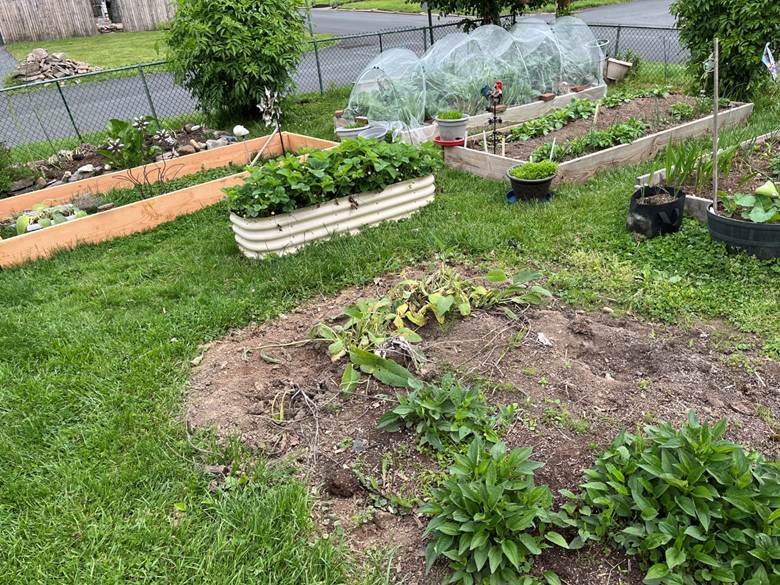
….
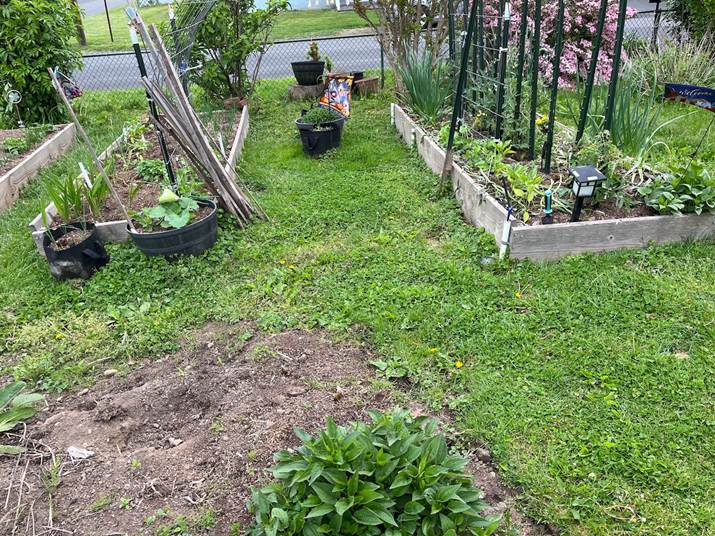
Those are pictures I took near the beginning of May. By the end of May, the gardens had exploded:
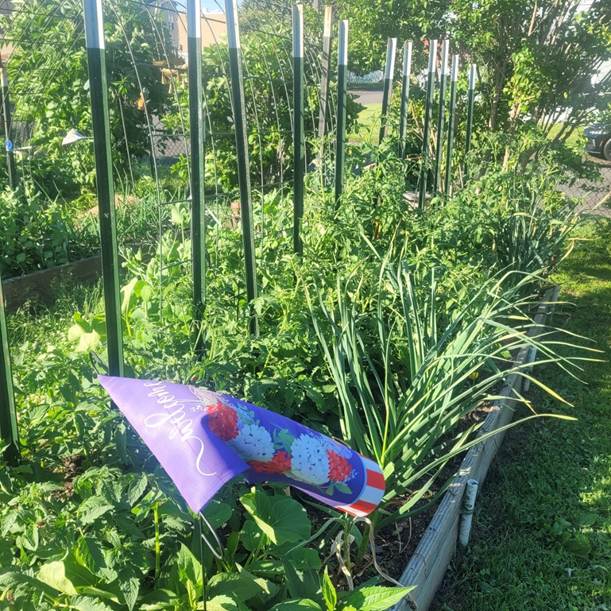
Plantings there include potatoes, onions, squash, peas, peppers, garlic, tomatoes, strawberries, arugula, and lettuce. The brassicas such as cabbage, broccoli, kale, and cauliflower are covered with a tent; otherwise, cabbage moths can decimate these plants. In a rock bed they have horseradish and comfrey. They have four blueberry bushes. The next big project would be an asparagus bed.
For livestock, they put in chickens about four years ago. In the foreground is a self-contained coop with about 8 birds, and behind it is a second coop with a run behind it, which houses about 18 birds:
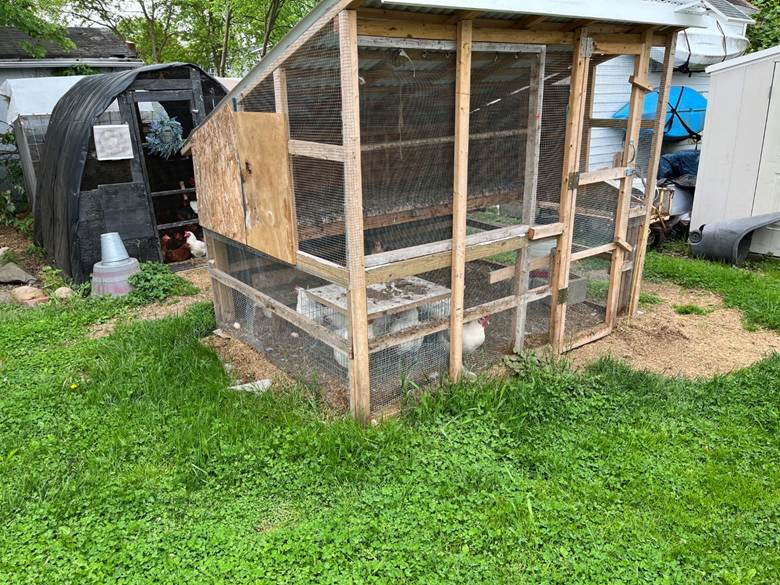
They are raising dual-purpose chickens, which are pretty good egg layers, and OK for meat. (There are some breeds that are champs at laying eggs, and others like Cornish Cross whose purpose in life is to grow to eating size in an astonishing 8 weeks). All told, they get some 7-10 dozen eggs a week, spring/summer/fall. This is enough for them to eat and have plenty to sell or give away. In winter, with the cold and shorter daylight, egg production drops to 1-2 dozen/week. To transform a walking, clucking bird with feathers into breasts and drumsticks is a task I will gloss over here, but that is something that homesteaders also must do.
The main ongoing work with their chickens is filling the 7-gallon waterers every couple of days, and throwing a scoop of feed onto the floor of each coop every day. These birds get a “salad” of greens at least once a week, for variety. Here is a shot of the “girls” eagerly pecking away at their dinner; I see at least one egg on the ground in the background:
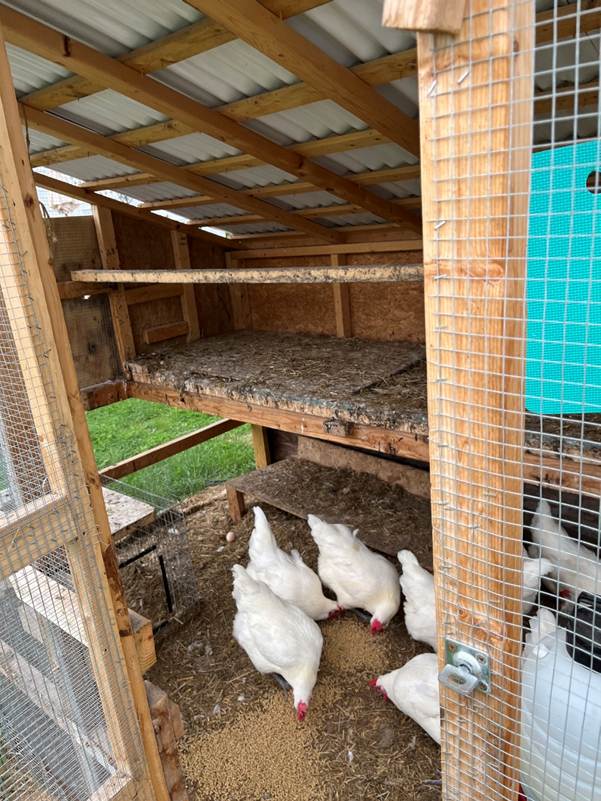
Chicken poop is pretty nasty, but it is managed by a deep bed system. There are several inches of straw in the bottom of the coops and the run. The birds continually dig around in the straw and mix it. That seems to dilute and dry the poop enough that the “farmers” only need to change out the litter a couple times a year. It just goes on the compost pile, to become fertile planting soil.
Chickens seem to be the most popular animal for budding homesteaders. They are called the “gateway animal”, to get you started/hooked. They tend to require little management, and are versatile eaters, so you don’t need to feed them just purchased grain. Some homesteaders feed them select table scraps, and even raise worms to feed the birds. If you have a large yard or pasture, you can put chickens in a movable “tractor” coop during the day, to forage for insects and greens in the fresh grass under the tractor for that day’s position.
Regulations on selling slaughtered meat are onerous, but it is easy to sell fresh eggs. In their township, chickens are allowed, but no roosters. (No one wants to hear crowing at 3:00 AM). So, our friend’s chicks that hatch out as males end up going to “freezer camp” just before they fully mature. Livestock such as goats and pigs are legal. Our friend wanted to raise a couple of pigs (pigs can also put on weight at an impressive rate, mushrooming from a 50-pound piglet to a harvestable 400-pound hog in 6-7 months). Her husband, however, declined to support that odiferous project.
Growing food is one thing, preserving it for later eating is another. She wrote me:
I can everything. Fruit, jams, veggies, potatoes, meat, fish, and meals. I have chili in jars, along with lamb stew, and onions for Frech onion soup. I make spaghetti sauce too. Yes, I’ve canned our own homegrown chicken.
Since [the storage room] stays cool in the winters (60ish F) I can store hard skin squash and keep fresh potatoes for frying or baking til January or February. I also dehydrate herbs/veggies and meat and fruit. Some veggies don’t can well, they get mushy like zucchini.
“Canning” in this context does not mean sealing into metal cans like you see in stores. It usually means putting the food in special glass “Mason” jars, heating them in a hot water bath (or, better but more work, in a pressure cooker) to sterilize the contents, then sealing them with a lid. Seems like a lot of work, but I am told by friends from the old South that canning your vegetables was a normal household activity there well into the 1960s or so.
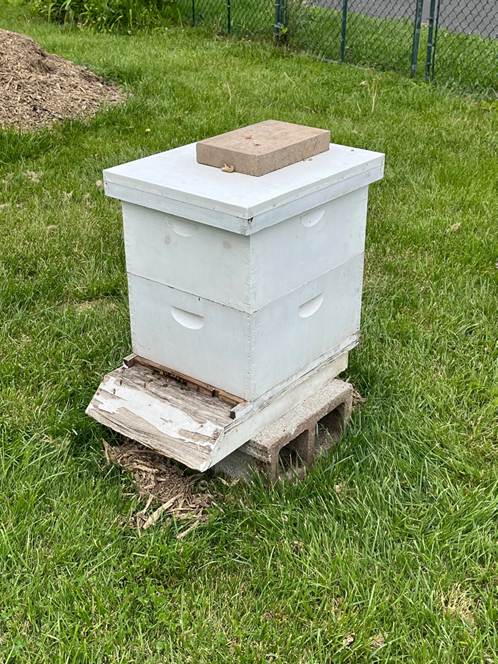
Finally, our friends have a beehive on loan from a neighbor. Zoom in to see the bees going in/out at the bottom:
I found it inspiring to see what this couple was able to accomplish in the way of food sufficiency in a quasi-urban setting, and I wish them well in their quest to relocate to where they can grow their own red meat and hear their rooster crow.
 Economist Writing Every Day
So (this being an econ blog…) how economically efficient (or not) is the whole enterprise? I assume the couple are working other jobs at least part time? Are they self-sufficient enough to feed themselves (including bartering their surplus)?
While it all sounds pretty cool, I don’t know how close to scalable allotting every family a quarter acre to each family would be, even with modern technology, modern feed, optimized breeds, etc.
LikeLike
AFIEMB, That is an excellent question, which I put to AI. The answer, at least on one level, is that raising animals yourself saves zero money over buying meat in the store, taking into account feed and other ongoing costs, plus some amortization of investment. On the other hand, growing your own veggies does save considerable money (as long as your labor is free).
To fully garden 1/4 acre intensively would raise way more veggies than one family needs, so would have more to sell. But of course, man shall not live by rabbit food alone; need calories and protein. For reference, intensive hand planting of 0.15 acre can yield enough corn to feed a family of four, per https://economistwritingeveryday.com/2022/02/01/pfumvudza-planting-technique-revolutionizes-crop-yields-in-zimbabwe/ . In northern US, beans and potatoes in garden would give calories and some protein.
My opinion is that it would be unrealistic to completely support yourself on 1/4 acre, but it would make for a more resilient society if most people grew at least say 20% of their food needs. It’s also a happy, bonding subject for neighbors to talk about.
And in answer to your other question, yes, the usual model is one partner has a “real” job in the regular (high, industrialized productivity) economy, while the other does most of the essentially low-productivity hand labor ag work. The model for making a full go of your homestead is to monetize the cachet — either you produce a YouTube monetized channel or sell your products for way over retail price to customers who value the homegrown vibe.
LikeLike
Thank you for the response. My work is in urban planning, and while these urban agriculture programs are net positive on social, environmental, sustainability, and public health metrics, I still don’t know if it’s a better use of a given quarter-acre than, say, green space, affordable housing, or mixed-use zoning.
LikeLike
Maybe we can do both…e.g., rooftop gardens (little danger of vandalism, and make for cooler roof), or a strip of community gardens on the sunny side of a green space. The latter might have a vandalism problem if it is in a lower income neighborhood; but in wealthier but densely populated suburbs, I have seen very successful community gardens adjacent to parks. Maybe 0.1 acre, divided into many 20 x 20 ft plots by chain link fencing (can let beans climb fence), and with water spigots available. In denser areas, even a 10 ft x 20 ft plot could grow a reasonable fraction of a family’s veggies.
I reviewed a book, “The Well-Watered Garden”, which gives detailed instructions on preparing and planting a 20×20 ft (or bigger or smaller) garden plot: https://letterstocreationists.wordpress.com/2025/01/09/review-of-the-well-watered-garden-handbook-by-noah-sanders/
LikeLike