Abstract: Language models increasingly settle real resource tradeoffs on behalf of principals yet their economic preferences remain unobserved. We demonstrate their generation rule is isomorphic to the random utility model of discrete choice. This allows internal logit scores to structurally identify preferences. Estimating risk attitudes across twelve models in a portfolio task reveals universal but heterogeneous risk aversion. Although models reject strictly dominated options, their elicited preferences fail invariance tests and violate the independence of irrelevant alternatives across varying experimental prompts. Finally, fine tuning establishes that a principal can explicitly engineer a target risk attitude.
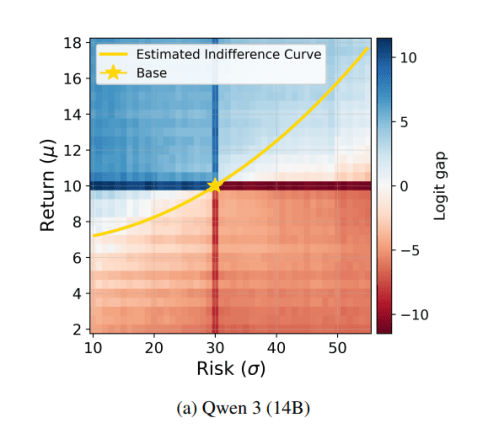
I hope you will refer to the manuscript for details, but I will share one picture here. This is panel (a) of Figure 3: Empirical indifference curves for open-weight models mapped over the portfolio space.
In simple language, what the red/blue picture shows is that the Qwen language model is picking the portfolios that offer more money (in expectation, with a distaste for excessive risk). That’s basically what a rational actor should do. We find that the language models make fairly consistent choices and rarely violate the monotonicity requirement for a well-behaved utility function.
How we describe this figure in the paper: “Starting from a base bundle with expected return µ = 10 and risk σ = 30, we sweep over the dense grid of alternative portfolios from our experimental protocol and record the position-corrected logit gap between each grid portfolio and the base. The yellow dashed line overlays the indifference curve implied by the mean-variance structural estimates, and the heatmap colors encode the sign and magnitude of the logit difference, with blue regions preferred to the base and red regions dispreferred. Several patterns emerge from these plots. All six models produce upward-sloping indifference curves, confirming that higher risk must be compensated by higher expected return.”
We think this basic research on behavior is important, for alignment research and for business applications with delegating work to AI agents. The first question to ask, before testing whether we can impose our preferences on AI agents, is whether those agents have preferences at all in a consistent sense.
Suggested citation: Buchanan, J., & Foster, J. (2026). The innate economic preferences of language models [Preprint]. arXiv. https://doi.org/10.48550/arXiv.2607.26288
Zachary Bartsch: “A skill can be just plain text written conversationally, it can be a list of rules, mathematical expressions, or even the foundational code that you want your AI to readily modify and apply. Essentially, saying ‘skill’ is the same as saying ‘pre-prompting’ with various degrees of specificity. Rather than writing a prompt each time, you can recycle a set of prompts that you’ve stored in a file. That’s all that a skill is.”
Plus, Zachary provided some useful history of “Explainer text files”
“Not a single one of these foods is an ‘incomplete protein’. Yes, the mass that you’d need to eat differs, but there is not much that is exciting about legumes and grains as a combination.”
Anyone who has gone grocery shopping in 2026 knows this is the year of protein.
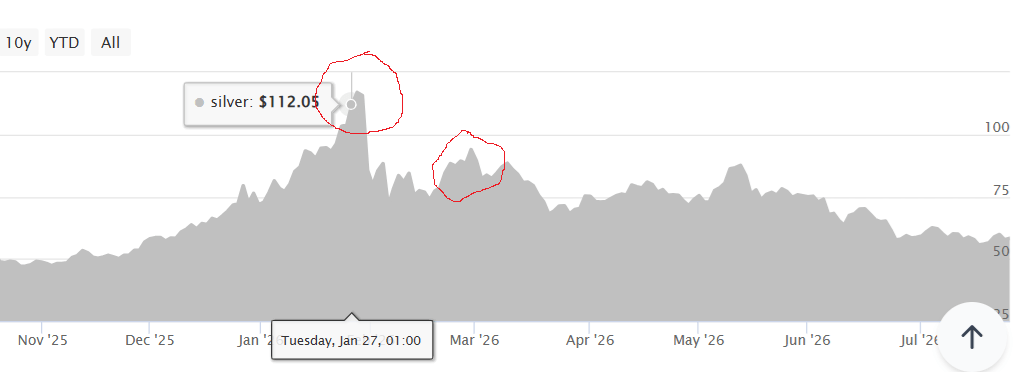
Out of curiosity, I checked the price. Within a week of this post, the price of silver had actually gone up. But after a final peak in late January, the price has declined. As of today, it is down from any of the prices posted in January of 2026.
“Gleeful researchers, competitors, and hackers promptly downloaded zillions of copies. Anthropic issued broad copyright takedown requests, but the damage was done.”
He talks about the referee process, since that is where the main decisions happen, as much as the “writing process.” No one has all the answers, but Mike is doing us all a favor by getting some of this real talk out in the open. Please comment if you have more ideas on where to go from here.
I’ve seen chatter about this topic on Twitter/X, but I’d love to see some more blog posts from tenured folk because it helps with the hidden curriculum problem.
“Would you have guessed that in the “good old days” of the 1950s and 1960s, the average US family was spending 30-40% of their income on food and clothing, something that today we spend barely over 10% on? To understand the challenges we face today, it’s important to have the context of how bad the past was.”
Jeremy has been telling this story for years. Interestingly, world cup tourist discourse seemed to push a few more people over the fence (why hadn’t they just read our blog?). Most Americans are rich.
Since the ChatGPT launch, I have heard conflicting stories on the impact of AI on white collar jobs such as software engineering. There have been layoffs and, for example, ex-Meta employees who struggle rematch in at their old salary. I have also heard claims that the demand for software engineers is actually increasing, perhaps because AI makes them more productive.
The problem echos Makowsky’s post, which ultimately rests on readers and the referee process. I like to say “readers are that which is scarce,” meaning that it’s not difficult to produce writing.
Blogs are not niche anymore. More people than ever, including many researchers at top schools, have decided to start a Substack. Of course, peer-reviewed and prestige-published research still has a primary place in the discourse. Many of the blog posts are ABOUT the primary objects of research.
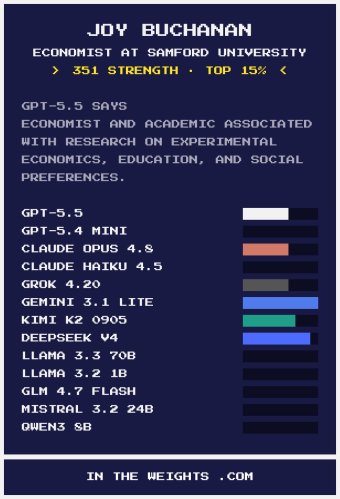
I saw something called InTheWeights in 2026 that made me think folks at research schools might be strategic in starting to blog now. ChatGPT reads our blog. One reason I think that to be true is that some of our reader traffic comes from ChatGPT.com and Claude. I think our work is getting repackaged as LLM answers to millions of people, some small percentage of those answers provide attribution to us, and then a small sliver of those answers results in users clicking over to us as the primary source for an answer.
It will be a long time before tenure decisions are based on where you are In the Weights. But our crew would do well on that metric. Our work is legible to AI because we have been blogging ungated here for years.
This is per the 2026 discussion of AI “slop” writing.
One of the things I buy at an annual local rummage sale is cheap physical media like books. This year, I picked up a book by a cartoonist who I like and respect. I thought his book would be funny and prescient from the standpoint of the publication date (1995). The book is 250 pages of mostly slop. Humans wrote lots of slop and it got printed by publishers who had a captive audience.
Why did I have such high expectations for a printed book? I think it is because, as of 2026, we are more selective about what we print. A filtering has happened. Many novels printed 100 years ago were junk.
When I think of “books” today, what it really makes me think of is “classics” or the top 0.01% of books.
So, score one point for the slopistas. Human writing was not universally smart or inspiring.
What I hate about slop is seeing it in spaces I used to trust. There was a time when I could log in to LinkedIn and see human writing from people who I had chosen to follow because I like them as people. There was a contract for my attention that is broken with slop.
I sense some push and pull in the algorithm whereby the sites might be suppressing slop, right now, relative to what I was seeing weeks ago. I went to LinkedIn on 7/17/26 to do a slop check and saw none. They might be trying to preserve the lead that James identified earlier this year: The Hot Social Network Is… LinkedIn?
Oddly, one of the worst bot-infested spaces I tread into is Facebook groups about sourdough bread making. I think the space is not important enough for Facebook to police, and the human users are not very sophisticated when it comes to tech. I logged this observation back in January.
Claude Fable is Anthropic’s most capable publicly available “Mythos-class” model. It is optimized for long-running autonomous tasks and deep knowledge work. The roll out of this product has been dramatic. Little people like me have access to it for only two weeks, and I doubt I will be able to afford it thereafter. With my window of access, I posed it the following prompt:
“This article indicates that a much smarter model might not be possible because the universe is opaque. Since Tyler Cowen made this statement, AI has helped people make breakthroughs in math and biology. Write this again in 2026 using the latest state of technology. Is the smartest LLM today much smarter than GPT-4? And is the universe legible?” and I copied in my blog post Is the Universe Legible to Intelligence?
One line from Fable’s response: “Notice where the wins clustered: mathematics with checkable proofs, protein structures with experimental ground truth, contest problems with known answers. These are the maximally legible domains — places with a fixed target and a way to verify that you hit it.”
The writing is coherent and contains no obvious hallucinations. Is the answer true, and does it tell the whole truth?
Whenever you read something think about who wrote it, and keep in mind that every author/model has a bias and limitations. In my paper with Will Hickman, we found that just reminding people that a paragraph has an author (whether the author is human or AI) increased the demand for fact checking from readers. LLMs will become more persuasive and closer to (but never completely) correct. Keep reading all things with some skepticism whether they are written by scientists, politicians, or AI.
Regardless, there is definitely such a thing as making the known world more legible to AI today. Thus, people are talking about increasing funding for data availability and the possible demise of the “research paper.”
One of my strongest AI/research takes is that it dramatically increases the value of building new descriptive datasets, digitizing archives etc.
Analysis might be free now, but Fable can’t deduce historical city sewer budgets from first principles. https://t.co/PiJngivhqK
Research papers are more like stories than facts. The demand for stories is not going away, but I definitely cannot predict the future of the write-for-pay scientist.
AI, potentially, could go and get its own new data, instead of waiting for humans to archive it. Thus, the self-improving AI might take us beyond the current models… unless they run up against something that is not legible to intelligence…
We made it to 250! Some people didn’t even think we would make it this long. Happy 4th of July!
I have seen America 250 merchandise and banners all over this year. American patriotism was not so cool a decade ago, and it’s interesting to see the displays back in.
An example of the “USA Merch” seen all over this year. This was near Chattanooga, TN (which is the city the Spanish national team picked for their World Cup training base).
Something that has been fun this year was watching the 2026 Winter Olympics and the ongoing World Cup hosted here (Remember we went around the moon? People are just watching soccer now). People have told me how much fun they had either witnessing or hearing about Scottish World Cup fans partying in Boston. Fun is back, at least in one sense.
Americans enjoy winning. Getting knocked out of the World Cup early would have been disappointing. But most Americans don’t care if we completely win the World Cup. In fact, fun mode is highest if we get to watch someone else enjoy a victory. A nontrivial percent of Americans were genuinely rooting for Cape Verde.
For EconLog, I wrote a piece about Freddy the German World Cup tourist.
At the link, I present Freddy and his Twitter/X posts as evidence that some of Tocqueville’s highest hopes have been fulfilled, so far.
If you go looking for Freddy, as of when I checked on July 3, he has deactivated his X account. With nearly a million followers he probably could have become a paid influencer, but he does not want to. I suppose he wants to return to Germany and live a more stable life. He never expected to get this much attention.
The brilliant content creator economist Matt Hill has posted a video “How Piracy Accidentally Created AI” to the @EconNerds channel on YouTube.
The video is so funny (and smart!) that I encourage you to sit back and watch it all the way through. Around minute 2, he gets to the topic of online piracy.
The @EconNerds channel on YouTube has over 100 engaging videos like this to help you learn economics. You can also find Econ Nerds updates on X/Twitter
I summarized our findings in a previous blog “Summary of You Wouldn’t Steal a Car,” but Matt’s video is more fun and quite technically accurate, so now everyone can just watch it.
Lately I’ve been experiencing personal advertising barrages. Sometimes, I actually buy a product online before realizing that I had been living in a fake information environment complete with fake AI-generated product reviews. What I want for myself right now is to hear more product reviews from real people. I’m not against earning money from affiliate links, but I will earn nothing from this post. Here’s what I’m using right now.
Sourdough Bread Baking gear kit – I got a kit with “bannetons” (if you’re not interested, don’t ask) back when I decided to get into sourdough baking. The appeal was the savings from buying it all in a bundle (i.e. “dough whisk,” etc.). The investment is worthwhile if you are going to make your own sourdough bread. As I wrote earlier, this is a big investment of time. I do not recommend starting the process at all if you will make homemade bread less than 5 times a year.
Homemade Driveway Pickleball Court – if you have a paved level driveway or large patio, you might be able to create a non-regulation-sized Pickleball court. It used to be that billionaires could have their own tennis court and the rest of us could have ping pong tables. Now there is a Third Thing. You will likely need to rig up nets as a backstop by piecing together sports gear meant for baseball backstops. The actual mid-court net can come cheap from Amazon (I went with 14 feet wide). A small Pickleball court is fun for children/teens, but adults will prefer going to a real court where you can hit the ball much harder. Pickleball facilities are appearing all over the country and many cities now provide free courts in parks and gyms.
Canvas LMS and New Quizzes – Samford University uses Canvas, and I have always liked the interface. Finally, in the year 2026, I have decided to build a new course using “New Quizzes” instead of Classic Quizzes. The rollout of this product has been so awkward, but if you are starting from scratch, Item Banks and “New Quizzes” works well now.
The book Misbehaving by Richard Thaler is about his career and the field of Behavioral Economics. I think anyone could learn from how the field evolves in the face of new evidence. It’s been helpful for me with my project on LLMs and financial decision making.
Codex – Thanks to Codex, I can finally do something teaching-related that ChatGPT had failed to do for me in summer of 2025. Codex can write straight to a subfolder on my computer, with coaching. For technical details, follow Aniket. What I used to say to people who wanted to “learn computer programming” is that it’s impossible to learn from reading books. Build something that you care about, even if it is just a tiny website. I would say the same for Codex. Use it to build something, even if that’s something for your personal life like a sourdough bread baking scheduling assistant.
Ozempic is not new anymore, and my friend is now losing weight on Wegovy. The miracle of science has been incredible to watch, because I know how difficult it was to lose weight by just trying to change habits before while the cravings persisted. (None of this is medical advice. These drugs are not for everyone.)
I have written about how the global apparel industry created something historically remarkable: a world in which almost everyone has abundant clothing in many styles. For most of human history, clothing was expensive and scarce. Today, Shein sells a dress for $8 and ships it to your door in a week.
Food abundance has some parallels with textile abundance. Once food became cheap, many people started complaining that we consume too much of it. We cannot seem to get it just right with consumption.
For most of human history, the primary nutritional problem was not having enough to eat. Famine was recurring and childhood hunger was normal. Innovation and globalization resulted in food abundance for most people. Caloric availability per person has risen dramatically.
The unintended consequence of that success is the fast-food era: a world in which cheap calories are engineered for palatability in ways that overwhelm the body’s natural satiety mechanisms. We solved scarcity, but now we have to deal with the abundance paradox.
These two abundance problems (clothes and calories) are at different stages of resolution.
The fast fashion critics are still waiting for their solution. The alternatives to disposable clothing seem to be either to get more expensive clothes or to change an entire culture (which rarely happens without violence). The political response of implementing bans or taxes amounts to restricting the abundance rather than addressing its side effects. Nobody has invented the equivalent of a metabolic thermostat for textile waste.
Fast food, by contrast, has just received something extraordinary: a drug that quietly recalibrates the neurochemical machinery driving overconsumption.
I have put a working paper on SSRN describing three ways I incorporated AI into my Business Statistics 200-level class for undergraduates at Samford University in Spring 2026. Read the paper at the link.
Abstract Economics education almost always includes a component of statistics. Most undergraduate economics curricula require an upper-division econometrics course, and many economists teach data analysis. These courses help students become conversant with major contributions in economics research, but they can be challenging to teach. On its own, the mathematics of regression, error minimization, and statistical software may not feel exciting to students, especially compared with the intuitive economic reasoning that often draws them into the discipline. At the same time, students are increasingly interested in artificial intelligence and large language models. This note describes three practical teaching exercises designed to connect ordinary least squares, Excel training, and LLMs. The goal is to use students’ curiosity about AI to motivate classic statistical reasoning and practical spreadsheet skills.
The image is from ChatGPT 5.5 Thinking mode and it took over a minute to generate. The fact that their laptop screen is pointing away from them is funny (unrealistic). The portrayal of Tom Holland and Zendaya is good, which is what the audience cares about. So, this seems like a case of AI hallucinating up the thing that people want.
Citation: Buchanan, Joy, “Connecting Classroom Econometrics and Excel Training with Large Language Models” (May 27, 2026). Available at SSRN: https://ssrn.com/abstract=6839039
Note: I have been posting my papers to SSRN for a long time as a way to distribute them faster and more widely. I have heard rumors that SSRN might stop working, for my purposes. If anyone has suggestions for what I should do about the papers I have up there, please let me know! Or, if you are readying this post-summer-2026 and want a copy, send me a message at my Samford email so I can send you a copy.
Click the link above to read but here are some quotes:
Hasan Piker implied that he might steal a car if it carried no consequences. In the interview, author Jia Tolentino also casually admits to shoplifting lemons from Whole Foods. Although petty theft is common, the interview clip spread quickly …