Compulsory Schooling by Sex

My previous posts focused on the aggregate school attendance and literacy rates for whites before and after state century compulsory schooling laws were enacted. When aggregates fail to deviate from trend after a law is passed, the natural next step is to examine the sub groups.

How did attendance rates differ by sex before and after compulsory school attendance? I’ll illustrate a plausible story. Prior to law enactments, boys attended more school because girls were needed to perform domestic duties and the expectations for female education was lower. As a result, boys had higher literacy rates due to higher school attendance. After law enactments, both girls and boys attended school more and the difference between their attendance rates is eliminated. Similarly, literacy rates converge and differences are eliminated. In short, the story is consistent with an oppressed – or at least disadvantaged – position for girls that was corrected by compulsory schooling.

Formally, the hypotheses are:

Continue reading

Wait for the Lower Cost Version of Policy

I’ve written previously about initial US state compulsory schooling laws in regard to literacy and in school attendance rates. I ended with a political economy hypothesis. Here’s the logic:

  1. Legislators like lower costs, all else constant (more funding is available for other priorities).
  2. Enforcing truancy and educating an illiterate populous is costly.
  3. Therefore, state legislatures that passed compulsory attendance legislation will already have had relatively high rates of school attendance and literacy.

That’s it. Standard political economy incentives. But is it true? Well, we can’t tell what’s going on in politician heads today, much less 150 years ago. Though, we can observe evidence that might corroborate the story. In plain terms, consistent evidence for the hypothesis would be that school attendance and literacy rates were rising prior to compulsory schooling legislation. The figures below show attendance and literacy rates for children ages 10 to 18.

Continue reading

School Attendance as State Capacity

Who knows what state capacity was 150 years ago? After all, DMV jokes are only a little out of date. There is a lot of richness and specificity to state capacity. That’s why we can’t look at an identical law in two different places or times and assume that their enforcement and evasion are the same.

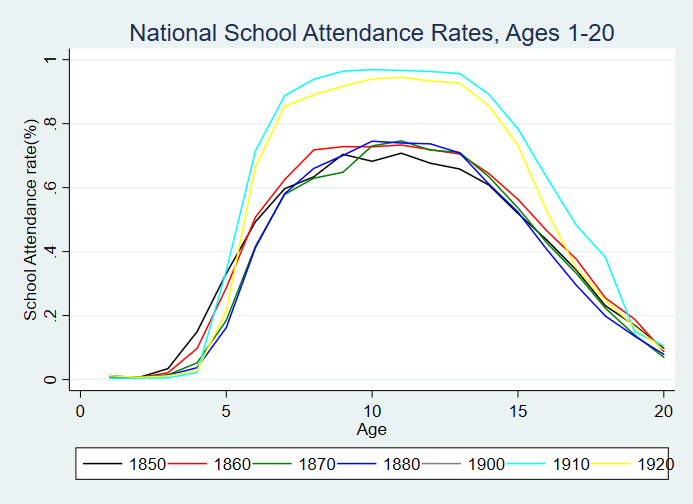
Interested readers can see my previous post for a figure that illustrates the timing of compulsory education legislation across US states. The effects on literacy were a bit ambiguous. The explanation might be that effective enforcement by the various states might have differed (substantially). The figure below illustrates the average rates of attendance by age and census year.

Just as an increasing number of states began to enact compulsory school attendance, we can see that school attendance rates rose over time. But we can’t tell from the figure whether attendance laws caused or were merely coincident with increasing attendance.

One hint is to group the people by whether their state had compulsory attendance laws on the books. See the figure below.

Continue reading

Reading Literacy Data

The story that I’ve heard is this:

            In the US, we care about education. We believe that all people should receive one, regardless of their family status. Therefore, states provide education directly.

There you have it. We provide education in the US so that everyone gets a more fair shake at education. We might disagree about the purpose of an education. Maybe it’s for improved job prospects, for a more informed citizenry, or for more unified values and experiences. One socially awkward answer is that state schools are, in part, a childcare service that permit parents to work. Except for these couple of reasons, school provision and compulsory education should, at the very least, increase literacy. That’s a low bar.

Given the above reasoning states began to pass compulsory school legislation. Massachusetts was first in 1852. Followed by DC and Vermont in the 1860s. Thirteen more adopted compulsory education legislation by 1880. By the year 1900, most states had compulsory schooling legislation on the books that was applicable to at least some age groups. See the figure. Thus, did the US achieve more equality, so goes the story.

The reasoning behind the story is sound. Without education of some sort, people will surely have less human capital. The vulnerability of the reasoning is that formal schooling is not the only form of education. A person who doesn’t attend school may help a parent at work or have a private tutor – or simply grow in a milieu of thoughtful exposure. Therefore, requiring that a child attend school may not improve human capital by a degree greater than what the child would have been doing otherwise. That’s an empirical matter.

The figure below illustrate the data for ‘white’ people and illustrates literacy between the ages of 20 and 30. Why that interval? At the lower end, we don’t have literacy data for people under the age of 20 in 1850 & 1860. On the higher end, any effects of compulsory schooling will only affect those who were children and subject to the law – older people are immune to compulsory schooling legislation.

The graph illustrates that state literacy rates were rising throughout the period. The main exception is 1870. Maybe the demands of the civil war caused children to work at home or otherwise and forego schooling. So the increase from 1870 to 1880 is more of a catch-up to a previous trend than anything else. While it’s true that several states passed compulsory schooling laws in the 1870s, that doesn’t explain the widespread literacy improvements across most states.

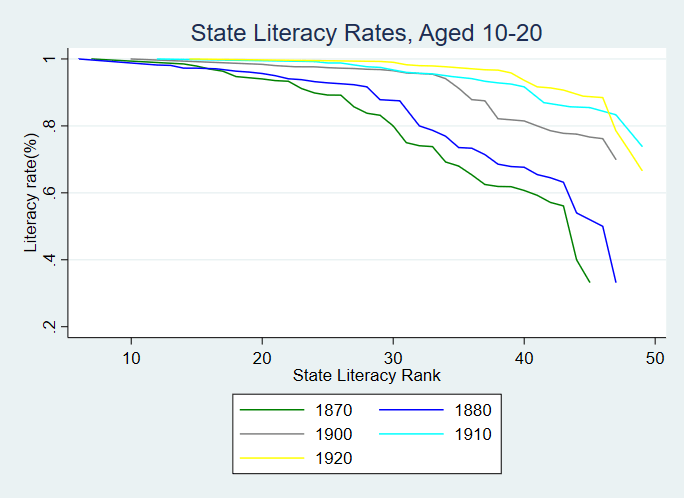
After 1860, we can examine the younger people who were subject to the schooling laws. The figure below for people ages 10-20 tells a similar story to the one above.

My biased reading of the data is that initial compulsory schooling laws had at least an ambiguous effect on the overall trend of improving literacy. I’ll delve deeper in future posts.

PS – The literacy data is from IPUMS.

PPS – The compulsory schooling law dates are allegedly from “Department of Education, National Center for Educational Statistics, Digest of Education Statistics, 2004.” But I couldn’t find the original source. Kudos to anyone in the comments who can find it.

An Economist Learns Piano: Part 1

My life didn’t change all that much due to Covid-19 pandemic. I live in a small university town. I mostly continued to go to work and my kids mostly continued to play with their neighbor friends. After a brief hiatus, I ended up growing much closer to my neighbors. One nearby couple are even the godparents my most recently born child.

The university at which I teach is a liberal arts school…. And I teach economics. I knew that these music-type of students and professors were out there, but I didn’t have much exposure. I recently obtained a zero-priced piano and had a good 2-hour conversation with a music major. This post illustrates part of I’ve learned so far. First, a graph.

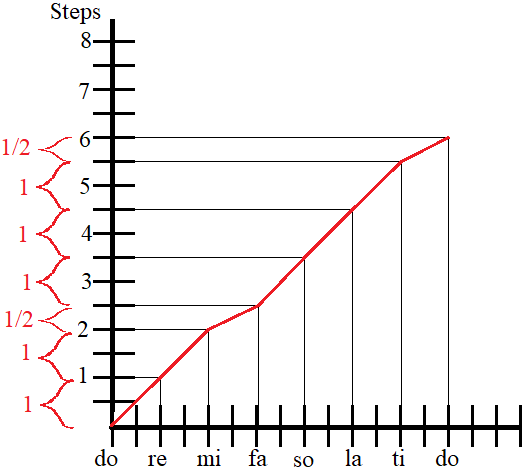
Whether we want to or not, many of us know the musical scale thanks to The Sound of Music. What I didn’t know was that there is not a uniform distance between all of those notes. Along the x-axis is the note labels (do re mi fa so la ti do). The pitch is characterized by an increment called a step. Given some arbitrary pitch for the first note, do, each subsequent note is a specific number of steps away. The pattern is that each increment between notes is 1 step, except the step from mi to fa and from ti to do. Those are half steps. The result is a segmented function.

Now, this pattern can be applied to a piano.

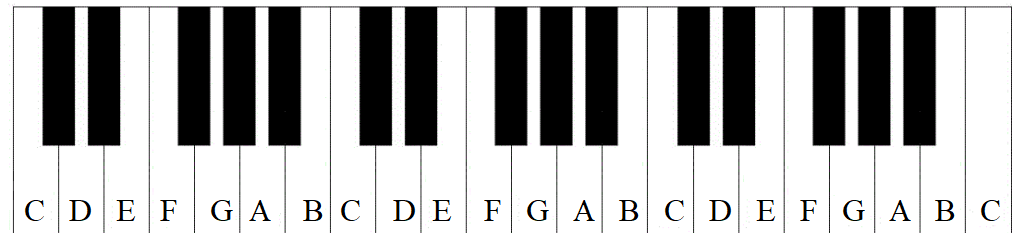
There are a total of 88 keys on a piano. Some are black, others are white. But all of them are a half-step increment from the prior and subsequent key. IDK why there are small black keys and big white ones. But pianos would be a lot bigger without the narrower black keys. Every single white key on a piano is labeled with a letter. The letter *does not move*. A ‘C’ is always a ‘C’.

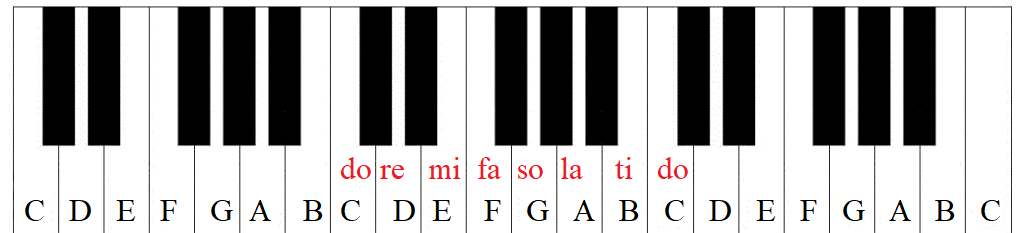
What can move is the scale label, do, which can be any key. The pattern identified in the graph above must be maintained. To play ‘in the key of C’ means that ‘C’ is identified as do. The remaining keys can be labeled.

The key of ‘C’ is easy because the entire scale can be played on all white keys.

Those two half steps that we mentioned earlier? Those might have been on a black key – except that there is no black key between ‘B’ and ‘C’ or between ‘E’ and ‘F’. The B-C keys are adjacent. That means that their pitch is a half-step apart – exactly what is necessary for the pitch difference between mi and fa. The same is true for the E-F step and the pitch difference between ti and do.

What about the black keys? We can see their roll by placing do on a different lettered key. We can start on ‘D.  

do to re is a full step, from ‘D’ to ‘E’ – skipping the black half-step that’s between them. For re to mi we need to skip a key, all keys are a half step apart. So? To the black key! We skip ‘F’ and land on the subsequent black key. Then, fa falls on ‘G’, a half step and a single key higher in pitch. ‘A is a full step away from ‘G’, so that’s so. la is another full step away on ‘B‘. Recall that all of the keys are separated by a half-step – the key colors are 100% unimportant. ti is a full step higher – but there is no key separating ‘B’ and ‘C’. So, we skip up to the black key again just as we did with mi. Finally, do is a single key and a half step more.

There you have it! One of the things that a pianists can do is play the entire scale, from do to do, starting from any lettered key on the piano. I can’t do that yet, but golly I certainly feel like I have a better handle of what I’m even looking at.

PS – My conversation took a long time and I had to nail down the difference between 1) The note label, 2) the pitch step increments, & 3) the piano key letter labels. Key letter labels and the note labels are ordinal variables while the steps are cardinal. So, the graph at the top of this post isn’t the only important relationship. The graph below includes the relationship between the step and key letter labels. A graph of the note label and the key letter labels requires a rudimentary knowledge of flats and sharps (with two different do’s).

Sunk Costs and The Sense of Self

My 3 year-old will scream. She will lay on the floor, thrash about, and make demands as an infant would if they could communicate and develop the motor control adequate to do so. It doesn’t matter whether she can remember the reason for her disposition – she will continue. My wife and I usually sense the situation. We could get angry and threaten punishments. Alternatively, we know that no amount of reasoning and attempts at persuasion will convert our daughter’s behavior into the sweet, desirable sort. We have found that smothering her with love works best. And when the demands of other children prevent such single-minded attention, we at least try to act lovingly toward her.

My wife is quite beside herself. Why is this happening? (Truth be told, it’s all my fault. It’s in the genes.) Sometimes we see the momentary consideration of a calmer world in our daughter’s face. Then, she rejects it like there is no goodness left in the world. To be clear: I see my daughter know that she can stop her comprehensive riot and instead enjoy some other activity, then definitively decline the opportunity. She has cognitive dissonance.

My child is not crazy. One might say that she is irrational. The entirety of her behavior up to that point is a sunk cost. She could just stop the outburst and feel better. But she doesn’t. Why the heck doesn’t she?

Continue reading

Age-Old Dads

Do you know how old you are?

I’m 33. Specifically, I’m 33 years, 29 days old. I don’t know the time of day that I was born, but my mom probably remembers within a couple of hours. My dad did not keep track of my age. Growing up, it was normal for him to take me to a sports registration event and need to ask me for plenty of my details in order to complete the paperwork.

Do you know the age of your children? Is it normal for parents to lose track? Or is it just the dads?  …Or just my dad? I have no idea what is typical.

But I do have some decent evidence that, had my dad lived in 1850, he would not have been such an anomaly. Consider exhibit A: A histogram of US ages in 1850. The population was only about 23 million at the time and we have the age for about 19 million of those people. So the graph is relatively representative (IPUMS census data).

Do you notice anything weird about the graph?

That’s the question I asked my Western Economic History class.

Continue reading

Vegetarian Culpability Part 2 (Economics of Information Edition)

Previously, I wrote about the paralysis that a vegetarian would face if confronted with a broad view of production inputs. Namely, that hunting Cecil the lion was part of the dentist’s maintenance of his own labor. Given that preferences are diverse, we’re all perpetually facing a similar dilemma: If we trade with someone, then we are definitely, 100% helping them to do immoral things with which we disagree.

After a good night’s rest, I awoke and realized an age-old tool that humans have used to address the issue. As humans, we care and know most about those people who are closest to us. My previous analysis took as given that all of the relevant information concerning our trade partners was available. However, as Stigler knew well, information is a good and it’s costly to obtain.

When you know that your local lawyer is also a drug-dealer and a lecher, you don’t employ his services. Of course, your moral taste dictates a boycott as appropriate because his actions would be aided by your cooperative trade. The information about his divergent moral preferences is cheap and easy to obtain.

Continue reading

Vegetarian Culpability

Do you remember that dentist who went to Africa and shot Cecil the lion? I had a vegan friend who said that she would boycott him – had he been her dentist.

I can’t tell you how many questions I had. Why boycott him? In a competitive market, it would have no long-run impact on his economic profits. Was it important that his murder of Cecil was part of his consumption/leisure behavior rather than part of his provision of dental services? Does trading with people who have different preferences make one morally culpable for their consequently afforded activities?

A Trip Down Reasoning Lane

Let’s take some things as given. 

  • My friend is vegan and didn’t want Cecil to be on the receiving end of homicide (leon-icide?). 
  • Big-game hunting was a consumption activity for, who I’ll call, the dentist.
  • Everyone has unique preferences – including moral tastes.
  • Voluntary trade makes both parties better off.
  • There are a variety of input combinations that a firm can adopt in order to create output.
  • Humans are responsible for their own behavior to varying degrees.

My understanding of my friend’s would-be boycott is that lion-hunting was a direct result of the dentist’s inappropriate preferences and economic empowerment. Therefore, boycotting the dentist would reduce the dentist’s budget, and consequently reduce his spending on improper activities. Knowing that the dentist would spend his income in this manner makes each transaction with him a contribution to satisfying his illicit preferences.

Mo’ Money Mo’ Problems

Continue reading

Vegetarians and Profits

Like most people, vegetarians have some weird opinions. Let’s assume that they have the ultimate goal of fewer live-stock deaths and less chattel cattle. Ask a vegetarian what they are achieving by choosing not to eat meat and you’ll hear the explanations let loose. By abstaining from meat they’re “reducing factory farm profits” or “helping to keep the price of beef low and unprofitable”. While being a vegetarian may save more cows from the butcher’s blade, it’s not at all clear that vegetarians have a good understanding of their sometimes perpetual boycotts.

What do vegetarians even do?

The decision to consume meat or not falls nicely into the supply-and-demand framework. Fewer people willing to eat meat means fewer purchases of meat products – no matter the price. A decline in meat demand lowers both the number of cows that ranchers will raise a slaughter and the price that they receive. There you have it. By lowering demand for meat, vegetarians reduce both the quantity and price of meat, reducing profits for those evil, animal-carving businessmen.

Not so fast.

Continue reading