Context and age and soft skills

It is hard to know when oneself does not have enough context to appreciate a piece of art. When someone else lacks context, it is easier to see.

Consider my children watching last week’s Super Bowl halftime show. Snoop Dogg was performing on a stylized urban-themed stage. My kids could see the same thing I could see. They did not, remotely, “get it”.

You better lose yourself in the music…

“Lose Yourself” performed by Eminem

Children have little context for anything. But this half time show was a cultural moment. Millennials and Gen X experienced an awakening, or perhaps a collective crisis.

The following tweet got 60 thousand likes about how old the performers are. Everyone was calculating how many years had gone by since this hip hop and rap music was new. Decades have passed and now we who have the context to understand this music are feeling old.

In some nursing home in the year 2070, school children will trudge in and sing “Lose Yourself” because it makes the old people happy. The kids will not understand the appeal.

Matt and Ben are tweeting about music in code, but it happens to be a code I know. There are many codes that I do not know. I think that is part of what Tyler means in his latest posts about how “context is scarce”.

The real reason for writing about context this week is not the Super Bowl. I was reading yet more articles about tech skills and labor demand.* Once again, I came across the issue of soft skills. Could we say, “Soft skills are that which is scarce”?

When workers lack hard skills, it seems straight-forward to pack them off to a bootcamp. Teach them, for example, some functions in a programming language. The solution to a lack of soft skills is less clear, although maybe that is what decades of modern education is for. Corporate workers today need to know when to apply their skills and what tone to use in their email communication. They must not embarrass the company.

If a manager tells a worker to do “X task,” they cannot explain every detail. The worker needs to have the context to carry out the work on their own. Workers need to know the code.**

Could that be why so many employers desire a bachelor’s degree? Tyler wrote:

9. So much of education is teaching people context.  That is why it is hard, and also why it often does not seem like real learning.

Does this explain why there is simultaneously age discrimination and the ubiquitous “5 years of experience” hurdle for good jobs? Managers are looking for the sweet spot of current technical savvy and institutional context.

* I was reading a report by Quinn Burke. Here’s a published paper on soft skills and STEM. Here’s a blog of mine in which I wrote, “Trust falls and Tolkien is the prescription for this workforce.”

**funny Elf clip on The Code and dating

“Pfumvudza” Planting Technique Revolutionizes Crop Yields in Zimbabwe

Birth of a New Farming Method

Brian Oldreive is a Zimbabwean, born there in 1943. A star cricket player as a young man, he moved on to become a successful tobacco farmer. In 1978, he became convinced (given the harm that tobacco causes) that he should no longer grow tobacco. When he tried to switch to food crops like corn (called maize in Africa), using standard agricultural practices, he could not make a go of it. He ended up losing his farm and his livelihood due to his moral stand against growing tobacco. He went to work for another large farm, but even there it was a struggle to grow food at a profit. Soil was eroding and crop yields were falling.

He began to think that maybe there was a better way to farm than the usual Western model. One day in 1984 when he was walking in the forest, he noticed that the trees and bushes there grew just fine, with no help from humans, no plowing or irrigation. How was that possible? He observed two things. First, the ground was covered with a thick layer of leaves and other debris, which formed a natural mulch. Beneath this mulch layer (“God’s blanket”), the soil was moist. This was while the region was experiencing drought, and regular farmers’ fields were parched. Secondly, the undisturbed mulch layer naturally decayed to return nutrients to the soil.

Oldreive parlayed those observations into a system of no-till agriculture which mimics the created order. He called this “Farming God’s Way”. The emphasis is on high productivity from a small plot. This involves precision planting at the proper time, crop rotation (corn/beans), and deep mulching to retain moisture and keep weeds down. Nutrients are supplied by both compost and chemical fertilizers.

This method can be practiced by farmers owning no tool other than a hoe. This breaks the cycle of farmers or nations going into debt to purchase expensive Western agricultural machinery, which then may become useless due to inadequate maintenance out in the bush.    

This approach contrasts with conventional farming practice which plows up the soil, leaving it to erode away when it rains and to dry out when it doesn’t rain. Plowing also disturbs the natural ordering of the microbial communities within the upper and lower soil layers. (There is aerobic metabolism near the surface, and a whole different anaerobic community in the soil lower down).

Oldreive started by planting one small plot using this approach in the estate he was then managing:

I decided to copy what God does in natural creation and I observed that the leaves fall down on the ground and the grass dies down and there is a protective blanket over the earth, and that is how God preserves soil to infiltrate the water that we receive…

Many people did not believe me and said I was wasting time. But I was not deterred because I was convinced that this method would work. I decided to put the model into practice by starting with just two hectares. I prayed for wisdom and God showed me how to plant maize into wheat straw residue. This is just the same as what God does in nature.

That two-hectare (about 5 acre) plot confounded the skeptics, yielding about ten times more corn per hectare than the local average yields. He then planted more acreage using this approach. Over the next few years, while a number of conventionally-run farms around him went broke, he kept expanding and growing more food with his system.

Oldreive believed these insights were gifts from God which were meant to be shared with others. Therefore, he shifted his effort towards teaching other Africans how to farm with this method.

Things Fall Apart in Zimbabwe

Continue reading

The Return of Independent Research

Universities have been around for about a thousand years, but for much of that time it was typical for cutting-edge research to happen outside of them. Copernicus wasn’t a professor, Darwin wasn’t a professor. Others like Isaac Newton, Robert Hooke, and Albert Einstein became professors only after completing some of their best work. Scientists didn’t need the resources of a university, they simply needed a means of support that gave them enough time to think. Many were independently wealthy (Robert Boyle, Antoine Lavoisier) or supported by the church (Gregor Mendel). Some worked “real jobs”, David Ricardo as a banker, Einstein famously as a patent clerk.

Over time academia grew and an increasing share of research was done by professors, with most of the rest happening inside the few non-academic institutions that paid people to do full time research: national labs, government agencies, and a few companies like Xerox Parc, Bell Labs and 3M. In many fields research came to require expensive equipment that was only available in the best-funded labs. “Researcher” became a job, and research conducted by those without that job became viewed with suspicion over the 20th century.

But the Internet Age is leading to the growth in opportunities outside academia, opportunities not just economic but intellectual. Anyone with a laptop and internet can access most of the key tools that professors use, often for free- scientific articles, seminars, supercomputers, data, data analysis. Particularly outside of the lab sciences, the only remaining barrier to independent research is again what it was before the 20th century- finding a means of support that gives you time to think. This will never be easy, but becoming a professor isn’t either, and a growing number of people are either becoming independently wealthy, able to support themselves with fewer work hours (even vs academics), or finding jobs that encourage part time research. If you work for the right company you might even get better data than the academics have.

Particularly in artificial intelligence and machine learning, the frontier seems to be outside academia, with many of the best professors getting offers from industry they can’t refuse.

Even in the lab sciences, money is increasingly pouring in for those who want to leave academia to run a start-up instead:

I think it’s great for science that these new opportunities are opening up. A natural advantage of independent research is that it allows people to work on topics or use methods they couldn’t in academia because they are seen as too high risk, too out there, make too many enemies, or otherwise fall into an academic “blind spot“.

I’m still happy to be in academia, and independent research clearly has its challenges too. But over my lifetime it seems like we have shifted from academia being the obvious best place to do research, to academia being one of several good options. Even as research has begun to move elsewhere though, universities still seem to be doing well at their original purpose of teaching students. Almost all of the people I’ve highlighted as great independent researchers were still trained at universities; most of the modern ones I linked to even have PhDs. There are always exceptions and the internet could still change this, but for now universities retain a near-monopoly on training good researchers even as the employment of good researchers becomes competitive.

As an academic I may not be the right person to write about all this, so I’ll leave you with the suggestion to listen to this podcast where Spencer Greenberg and Andy Matuschak discuss their world of “para-academic research”. Spencer is a great example of everything I’ve said- an Applied Math PhD who makes money in private sector finance/tech but has the time to publish great research, partly in math/CS where a university lab is unnecessary, but more interestingly in psychology where being a professor would actually slow him down- independent researchers don’t need to wait weeks for permission from an institutional review board every time they want to run a survey.

Using Economics to Save Presents from the Economists

Economists like to hate on gift giving. Many of them consider purchasing a gift for another person as a futile attempt at imagining the preferences of another person. Given that you can’t perfectly know another person’s preferences, your gift selection will be sub-optimal. The argument goes that your friend or spouse or whomever would have been better off if you had given them money instead. Then they could have made the gift decision fully equipped with the information that is necessary to make them happiest.

There are some obvious things that are glossed over. Purchasing a good gift – or even writing a card – carries a big load of signaling value. People like to be liked and receiving a good gift signals that the giver cared enough to research appropriate gifts. Also, receiving money as a gift puts the onus of research and transaction costs on the receiver. If the recipient’s value of time is adequately high, then cash payments are even more resource destructive than giving a non-pecuniary gift. Especially if there is an expectation that the giver will later enquire about how the funds were used. At that point, the giver is saddling the recipient with all of the anxieties and costs of choosing a gift that makes another person happy.

But I want to talk about a non-obvious benefit of gift giving.

First, I want to talk about student loans (I promise, it’s relevant). Plenty of people argue that college students don’t understand debt and that they therefore don’t understand the future cost that they will bear by borrowing. When the lender is the department of education, there is no defaulting with the hope of bankruptcy. The debt will get repaid…. So far anyway.

If it’s true that students don’t understand debt, then we can appropriately construe future student loan payments as lump-sum costs. Of course there is deferment and forbearance – but put those to the side. The bottom line is that, almost regardless of a debtor’s activities, they must repay their debt. It doesn’t matter how the debtor earns or consumes, the debt must be paid. This fits the description of a lump-sum cost. Usually, things like lump-sum taxes are hypothetical and unpopular among the laity. But, if we accept that the decision-making-student has incomplete information in regard to the debt’s future payment implications, then the debt payments are exogenous and unavoidable from the future debtor’s perspective.

This is a good thing for the productivity of our economy. Because people are making tradeoffs between the two goods of leisure and consumption, a lump-sum tax causes individuals to work more than they would have worked otherwise. Lump-sum taxes don’t reduce the marginal benefit of working. Essentially, a debtor’s first several hours of work pay-off his debt first and then he gets to work for his own consumption.

Importantly, this ignores any human capital effects of the education. It doesn’t matter whether education actually makes people more productive. The seemingly exogenous debt payments cause debtors to work more and produce more for others. The RGDP per capita of our economy rises and we know that most of the benefits of work do not accrue to producers. Student debt, with the accompanying assumptions laid out above, therefore increases our incomes because it acts as a lump-sum tax.

Now it’s time to save presents from the economists.

As families get older and siblings drift apart, gift-giving begins to become less exciting. I’m tempted to say there is a natural process in which the first couple of adult-sibling Christmases include decent gifts. Then, the gifts become not-so-great as siblings become less familiar with each others’ preferences. Knowing this and still wanting to give a suitable gift, siblings may turn to gift cards. The less that a sibling knows the preferences of another, the more general the gift card.

If you’ve grown more distant from your brothers/sisters and you know that you’ll receive a gift, then it’ll probably be an Amazon, or Walmart, or some other gift card that permits spending on a broad variety of gifts. There comes a point when you’re spending $X on gift cards each year where $X = $x(n). That is, you’re spending some amount on each sibling for a total of $X each year. And for the sake of social cohesion and norms, all of your siblings are doing the same thing and spending the same amounts.

Importantly, you don’t control the social norms, nor your number of siblings. It might seem like you’re all just trading dollar bills at a unitary exchange rate, leaving no-one better or worse-off. But, trading cash is gauche. So, distant siblings trade broadly attractive gift cards in order to achieve that gift-like aura.

Social norms also say that gift giving is not a trade. If you don’t receive a gift, then you’re supposed to be ‘ok’ with that. So, each year you will spend $X on gift cards for your distant siblings and there is some probability that you get nothing in return. If you can’t control the number of siblings that you have and you can’t control whether you receive a gift card in return, then giving cash or cash-like gift cards to your siblings each year is a lot like a lump-sum cost. Socially – or maybe morally – you shouldn’t just ignore your siblings and it is incumbent upon you to give a gift.

Having to give away a lump-sum of money or money-like things no matter what else you do is a lump-sum cost. If people bear lump-sum costs, then they will work a little bit more and produce a little bit more for society. If gifts suboptimal but at least considered a ‘good’, then we’re better off: we work more to make others somewhat better off with resources that wouldn’t exist if we hadn’t chosen to give to others.

There are some caveats, of course. Economists are often not so popular at parties for a variety of reasons. One reason is that they flout social conventions. An economist might scoff at the social constraints as unbinding. Others would disagree. Another point of contention may be that an individual can choose to work no more, but to invest less instead. But this really just pushes the problem off until the individual has less income in the future and works more to compensate for it at a later time. A 3rd caveat is that we can choose the amount that we spend in others. But that just implies that at least part of the gift giving ritual isn’t a lump-sum cost. It does not imply that none of gifting giving is a lump sum cost.

Regardless, the social convention of giving gifts can provide for a Schelling point that makes us a more productive as a society. We spend on others, to a great degree beyond our individual control, in order to avoid severe social stigma. And, if we can’t control all of who counts as a worthy recipient of gifts, then we have a lump-sum cost to some degree. Giving gifts makes sense as a productive convention because it makes us a richer as part of a general equilibrium – if not a partial equilibrium. Merry Christmas.


Watching Get Back

I enjoyed watching Get Back, the new documentary about making a Beatles album. Sometimes I skipped over rehearsal scenes. The streaming format allows you to treat Get Back like a coffee table book, if you choose, as opposed to a feature film that you watch all the way through in one sitting.

I know very little about The Beatles, aside from recognizing their hit songs. Here are my impressions after watching most of Get Back.

Paul McCartney is a rock star. His hair could have its own line in the closing credits. When Paul goofs off, he appears to be entertaining his bandmates because he loves playing for any audience. Conversely, John Lennon seems to joke around because he does not take their music seriously. Paul is motivated to make the Beatles excellent. Ringo’s ability to show up and be quiet is almost as important as Paul’s ability to lead.

I’ll put up my tribute. Then I’ll add more casual observations.

Continue reading

Has Economic Growth Really Slowed Since 1970?

In the post-WW2 era, by many different measures the US economy performed better before about 1970 than after. You can apparently see this in many different statistics. For example, the productivity slowdown is a well-known and well-studied phenomenon. And even given the productivity slowdown, median wages don’t seem to have kept pace with productivity growth.

I think there are good reasons to doubt these particular statistics. For example, on wages and productivity see this working paper by Stansbury and Summers.

But even considering all these criticisms of the statistics, we do observe that overall GDP growth has been slower since about 1970. Why might this be?

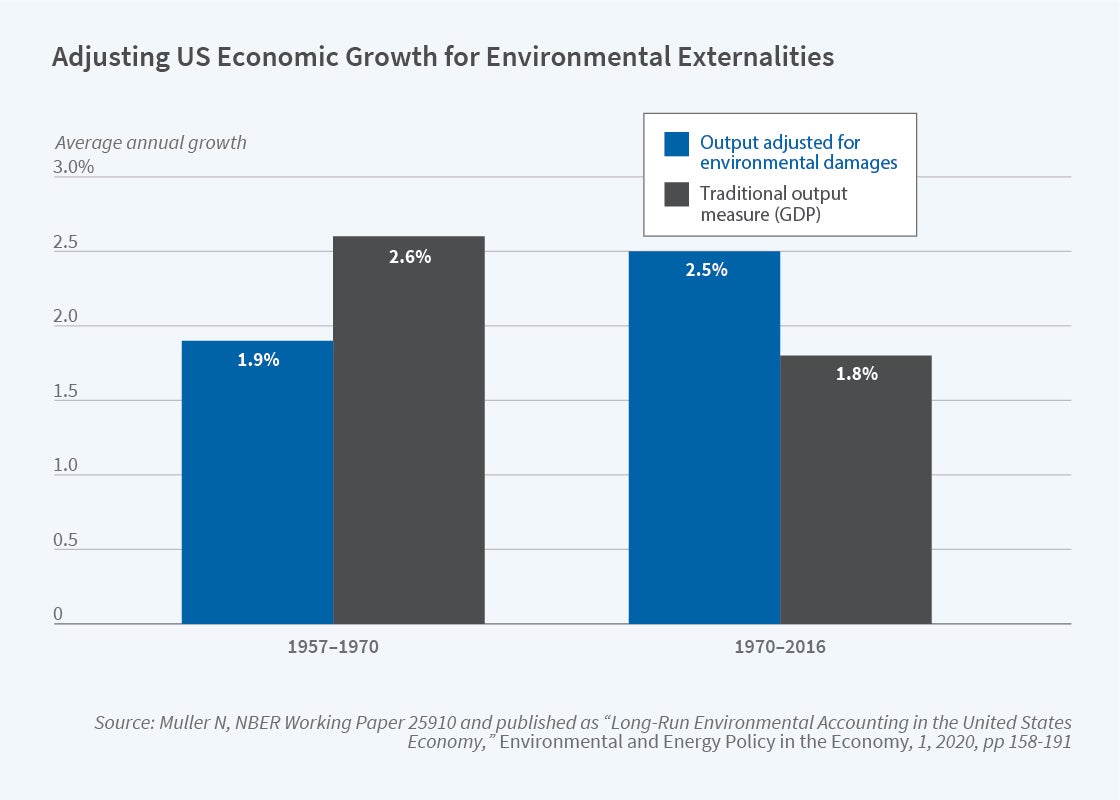
In an NBER summary of his research, Nicholas Muller argues that a big part of the GDP growth slowdown is because we aren’t including environmental damage in the calculation. This is not a new argument (Muller is an important contributor to this literature), and the exclusion of environmental damage is a well-known flaw of GDP, but Muller’s paper does a great job of quantifying how much we are mismeasuring GDP. The following figure is a nice summary of what GDP growth looks like when we consider environmental damage.

2021number3_muller1.jpg

If we use the standard measure of GDP, growth indeed slowed down after 1970. If instead we augment GDP for environmental damages, the period after 1970 was actually faster! The adjustment both slows down growth from 1957-1970, and speeds up growth after 1970.

There are lots of things we can draw from this, but if the results are close to accurate, there is a clear implication: environmental regulations (such as the Clean Air Act) do reduce GDP growth, as traditionally measured. So the skeptics of regulation are partially right: regulation reduces growth!

However, this seems to be a clear case where standard critiques of GDP (as you can find in just about any Econ 101 textbook — yes, really!) need to be incorporated into the complete cost-benefit analysis of the impacts of environmental regulation.

Free Money, Courtesy of Credit Cards

In grad school, I learned about the overlapping-generations model. The idea is that we simplify people down to the fundamental parts of their life-cycle. Each person lives for 2 periods. In the first period, they can produce only. In the second period, they can consume only. A popular conclusion of the model pertains to old-age benefit programs such as Social Security.

The first beneficiaries receive a gift that is free to them, then each subsequent generation accepts the debt, pays it off, and then passes on new debt to the proceeding generation. In this manner, the program benefit of the current generation is limited by the income of the following generation. Therefore, every single generation can consume as if they lived a generation later – and a generation richer – in time. That’s exciting.

But this model is not unique to governments. With a little bit of finance, we can model every person as their own self-encapsulated overlapping-generations model – with two similarly exciting conclusions. Let’s consider a person who has monthly consumption expenditures of $1k per month and let’s assume a discount rate of half a percent per month.

Life is pretty good for this person. They earn income each month and they spend $1k of it during the same period. Now let’s give the person a credit card. It doesn’t matter what the interest rate is – they’re going to pay it off each subsequent month. Now let’s see what’s possible.

What’s going on here? The difference in the consumption pattern is that the first month with a credit card can enjoy twice the consumption. How’s that? $1k of that January consumption is just the typical monthly spending. The other $1k is running up a month’s worth of spending on the credit card. So long one pays-off the card in the following month, there are no interest charges. But wait – if one pays-off the credit card in February, then how does one consume in February? By borrowing from March’s income, of course! And so the pattern repeats ad-infinitum. With a credit card one can borrow against next month’s spending. You too can borrow from your future self. And your future self won’t mind because they’ll do the same thing.

Conclusion #1: Having a credit card entitles you to one free month of double consumption.

The above example includes identical income over time. But, what if your income grows? Let’s assume that your income and commensurate consumption grow at a rate of one quarter percent per month. Our consumption without a credit card is tabulated below.

Obviously, having income and consumption that grow is more enjoyable than ones that are constant each period. Now let’s observe below what happens when we again introduce a credit card that one pays-off each month.

What’s going on here? Just as happened previously with a credit card, one can enjoy an extra boost to consumption in the first period. But what does growing income do for us besides greater complication? Just as previously, one can pay their debt each period and consume by borrowing against the next month’s income. But with growing income, having a credit card means that one can enjoy the next month’s level of consumption today. That is, next month’s higher consumption is shifted sooner in time by one month. Notice that, with growing income, consumption for July without a credit card ($1,018) is the same as the consumption in June with a credit card. Even without the first-month-gift, credit cards increase the present value of one’s consumption by making next month’s greater income available today – and the same is true for every single month.

Conclusion #2: Having a credit card today entitles you to next month’s greater income.

How big a deal is this? Obviously, it will differ with the discount rate and the rate of income growth. Using the numbers above, having a credit card permits one to consume with a present value that is 10.5% higher. Let that sink in. People who have access to credit consume as if they are 10.5% percent richer. Access to credit can make the difference between a pleasant Christmas, having quality internet, paying for car repairs, and so on. Being poorer is one thing. Being poorer and lacking access to credit is like taking an instant haircut to one’s quality of life. On the flip side, people can be made better-off without additional improvements to their productivity. Increasing access to credit may be a less costly improvement to the value lifetime consumption than many of the other less politically feasible improvements to labor productivity.

Data continues to improve sports performance

Joy: As a Data Analytics teacher, I often think about the applications of machine intelligence to work processes. Samford undergraduate Copeland Petitfils has written the following blog, which is a reminder to me that there are still many potential areas for growth.

Since “Moneyball”, we have seen the growth of analytics throughout sports. However, many teams have stuck to the same old way of playing baseball, like the Braves. This past May, the Braves took a new innovative approach and saw room for growth on their defensive side.

The general manager, Alex Anthopoulos, implemented a radical strategy and improved the defense by using shifts with data analytics. While “Moneyball” looked at the statistics of acquiring cheaper players who had good batting averages and improved the offensive side, the Braves looked at improving the defensive side and the way they shift between pitches to improve their chances of getting a ground ball out. A defensive shift in baseball refers to the infield changing positions from normal to a certain area of the infield based on the pitches and using stat cast to predict where the batter is most likely to hit the ball depending on the type of pitches. Shifting can increase the probability for players to get ground balls out rather than hits.

Statistically, the Braves ranked at the bottom of defensive shifts in the MLB, and Anthopoulos, the general manager, saw this as an opportunity to improve. The Braves started the 2021 season with no shifting at all to shifting on 50.6% of pitches by the end of the year, which was the highest in baseball this year only behind the Dodgers. The shifting ultimately allows the Braves to improve in converting ground balls to out rather than turning into hits. At the start of the season, the Braves converted under 75% of ground balls into outs which ranked middle of the pack in defense. However, since implementing the shift the number jumped to 77%, which was the second-best in baseball. Although these jumps in percentages seem small, they allowed the Braves to field 25 more ground balls into outs rather than hits.

The data analytics the Braves used allowed the players to be put in a better position to succeed, and as the season progressed, they started to get better and better at it. These decisions turned around the Braves’ season, and now they are on their way to the World Series for the first time since 1999 after beating the Dodgers in the NL Championship.

Coda by Joy: That said, guess who failed at data driven decision making? Zillow!

In a statement Tuesday, Chief Executive Rich Barton said Zillow had failed to predict the pace of home-price appreciation accurately, marking an end to a venture the company once said could generate $20 billion a year. Instead, the company said it now plans to cut 25% of its workforce… “We’ve determined the unpredictability in forecasting home prices far exceeds what we anticipated and continuing to scale Zillow Offers would result in too much earnings and balance-sheet volatility,” Mr. Barton said.

Gen Z on TikTok

I did an informal survey among undergraduate students. This is not a representative sample of American youth. Before answering the question “How is TikTok affecting your peers?” they had just heard about the TikTok recommendation algorithm. Answers might have been slightly different if they had not been primed to think about the app from a business perspective.

Most of the answers were negative, both among students who use TikTok themselves and especially from students who are staying off of the app. Some answers presented both a positive and a negative reply.

Here is one of the more positive replies:

“TikTok is affecting my peers in a few different ways. On the positive side, people can learn very useful things on the app. On the negative side, it can be very time consuming. I have heard from many friends how they have wasted a lot of their time on TikTok when they could have been doing something more productive.”

Some students emphasized the social aspect:

“TikTok is one of the biggest social platforms amongst my friends and I. When we hangout, we are creating our own TikToks, but when we are apart we are able to share videos with each other. TikTok for me is a big rabbit hole that I find myself spending way too much time on.”

Also, they believe that this platform, more so than the original social networks, allow a new user to break out. “The idea that a normal, average person can post on TikTok and have a likelihood of it becoming viral is what has launched the platform.” I can see how a 20-year-old today would think Twitter is less fun because it is hard for a newcomer to get noticed.

Some students mentioned the addictive aspect of TikTok:

“I see a lot of my peers stay on the app for long periods of time. I can’t count the amount of times people say something about how they didn’t realize they were scrolling for an hour before they looked at the clock.”

“I have three friends back home who are being affected by Tik Tok in the worse way possible. All they do is watch Tik Toks all day and has even affected their sleep schedule cause they can’t put their phone down. It’s hard to see my friends sucked in the rabbit hole.”

“Personally, I have had to set screen time limits for TikTok through my phone’s settings because I can easily spend extended periods of time of the app without even realizing it; and even then, sometimes, I even override the limits I have set in place because I want to see even more content.”

The funniest line award goes to: “I personally hate TikTok and think it is rat poison.”

I wonder how the responses might have differed if I had asked a similar question to college students about TV and video games 20 years ago.

I use Twitter frequently. Maybe I spend more time on it than I should, and I don’t support as many paid media outlets as I might otherwise. Thus, the non-Twitter world is less rich for today’s college students.

For balance, here’s how Big Tech helped me in the past week. I needed to help my son build a model rocket from a kit. Some stranger kind young man had made an excellent YouTube video detailing how to make this rocket. This video really helped me, and the man should get the satisfaction of one more watch on his views count.

La Dolce Vita Economica

I thought about writing about soccer (again). I thought about writing about time management and personal production functions. I considered writing about Lebron James or how I manage multiple research projects. I thought about writing about a classic, and entirely addictive to the point of career ruination, video game. They all seem a little redundant at the moment, though, because they are all the same basic story.

One soccer manager is over-exhausting their resources because of a confluence of bad contractual incentives while another team is witnessing a renaissance in a player they essentially forced to take 7 weeks off. While so many NBA careers of the 80s evaporated in a cloud of cocaine and clubbing, Lebron James’ entire life is built around managing the only two resources whose limits are salient to his life: his body and relationship with his family. Playing baseball growing up I watched pitchers blow out their arms before they finished puberty in service to Little League glory, while modern professional pitchers are (finally) on strictly managed pitch counts to maximize their expected output.

There are two manners in which I armchair quarterback the rest of the world. One is the things in which I have just enough knowledge to be frustrated by others decisions, but no so much as to actually know what I am talking about. These frustrations are ephemeral, they flatter myself to the point of mild embarrassment upon reflection, and, if I am being honest with myself, are fun.

The other manner is resource management. These are the times when armchair quarterbacking is less fun and more exasperating because they are the moments when outsiders, with inferior levels of narrowly-applicable expertise, are often actually right. Which is not to say the knowledge that resources are being poorly managed is uniquely held by outsiders. Insiders are more often than not quite aware of the suboptimal deployment and conservation of resources, but are unable to overcome the status quo institutions, incentives, or inertia of decision-making power loci. It’s obvious to lots of people that athletes, CEOs, doctors, and congressional representatives are over-extended. What’s not obvious is how to get out of these equilibria.

When I see most attempts at self-improvement, I am generally skeptical of anything that doesn’t start with the identification of a key resource that is salient to outcomes and the options available to better manage it. Maybe its calories and how to budget them. Maybe its time and how to better partition and conserve it. It could always be money, but in general I find that money is so immediately identifiable as a finite resource and entirely fungible that people who ostensibly are managing it poorly are, in actuality, failing at managing a different resource (time, emotional energy, vices, etc) that is intertwined with financial resources.

When I see successful firms, teams, and individuals, what I most often find myself admiring is not (just) a worldly talent, but a facility with managing resources that others haven’t yet adopted or mimicked. An appreciation for sleep, a protection of time blocked for creativity, an adeptness trading low opportunity competitive minutes for higher opportunity cost moments on the biggest stages. Or even just the ability to recognize that this is the moment to savor a 600 calorie dessert with a loved one because the emotional sustenance will make it easier to walk away from three vending machine Hostess pies during the high-stress moments in the week to come.

Once you learn to manage your donut-based caloric intake, the spreadsheet of your life will be revealed before you, an endless cascade of resources to be managed and optimized. A life with the right donuts at the right time. The dolce vita economica.