CEA on Inflation Today and WWII

This week the Biden Council of Economic Advisers blogged about “Historical Parallels to Today’s Inflationary Episode”.

Consumer demand in 2021 is roaring back after pandemic shutdowns. Demand for airline travel is exceeding expectations. Car dealer lots are empty.

The authors argue that, of all the periods of rapid inflation in American history, the boom after WWII has the most parallels to today.

During WWII, Americans were obviously in war mode. Price controls and supply shortages led to deprivation on the Homefront. Families had trouble buying cars, just like today.

Instead of focusing on consumer or industrial durable goods, manufacturing capabilities were concentrated on military production. Today’s shortage of durable goods is similar—a national crisis necessitated disrupting normal production processes. Instead of redirecting resources to support a war effort, however, manufacturing capabilities were temporarily shut down or reduced to avoid COVID contagion.

Remember when oil had a negative price in 2020? While people in the US were staying home, many were building up personal savings. As soon as the “war” ends, consumers compete as buyers and drive up the prices of the limited available goods.

They present the post-war inflationary episode as dramatic but temporary, because it only lasted for two years. It’s short compared to inflation of the late ‘70’s. They are standing behind the Powell “transitory” story, in their conclusion.

On the other hand, they say that the most comparable moment in history to today involved the price level spiking 20% and taking two years to come down. I’m pondering a very expensive repair on our car, just make sure I don’t have to buy a new one soon.
You Shouldn’t Be Writing (All the Time)

Many people get the idea that they should be working all the time. Certainly many academics do, which for us means a continuous internal reminder that “you should be writing”.

I thought this way in grad school but I don’t anymore. I now almost never work on nights & weekends, and often not on afternoons. Yet I get just as much work done, maybe more, and I’m much happier about it. How can this be?

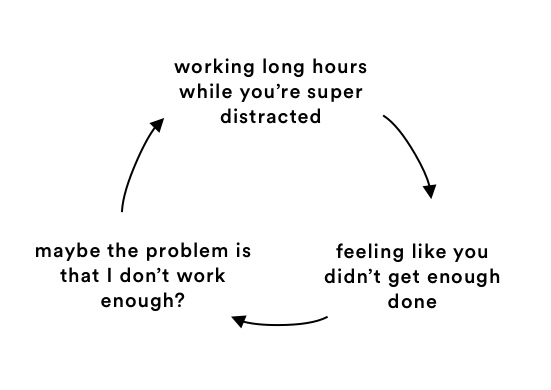
This post from Ava provides a great explanation. Its very short and you should read it, but I think it illustrates best through its literal illustrations:

Today is a good example. I’m writing this at noon, having just finished the revisions requested by a journal after 3 hours of solid work. Now, rather than start revising the next article & doing a bad job of it, I’ll take the rest of the day off. Real original thought is hard- I know I can do it for about 3 hours on a typical day, I have no one to impress by pretending to work longer, and one way or another the output will speak for itself. As remote work grows, this ability to do the real work and then stop rather than fill time “working” should be available to more people outside of academics.

“Zoning Taxes” — The Cost of Residential Land Use Restrictions

Fascinating new working paper on why housing prices are so high in some markets, by Gyourko and Krimmel: “The Impact of Local Residential Land Use Restrictions on Land Values Across and Within Single Family Housing Markets.”

Key sentence from the abstract: “In the San Francisco, Los Angeles, and Seattle metropolitan areas, the price of land everywhere within those three markets having been bid up by amounts that at least equal typical household income.”

Economists, libertarians, and more recently “neoliberals” have long complained about land-use restrictions as a primary factor contributing to unaffordable housing. This paper provides some pretty solid data, at least for some housing markets.

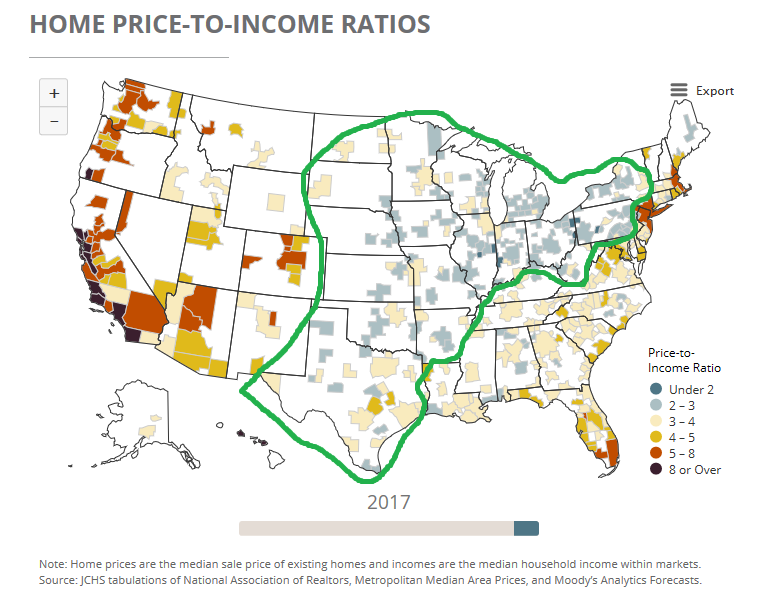
Here’s a key chart from the paper, Figure 5. Notice that there is a lot of heterogeneity across cities. In San Francisco, land use restrictions add roughly four times the median household income to the price of housing. But in places like Columbus, Dallas, and Minneapolis, there is essentially no zoning tax. That’s not because these cities have no land use restrictions! It’s just that they aren’t currently binding.

The paper also notes that “zoning taxes are especially burdensome in large coastal markets.”

This is similar to what I showed in a very non-scientific map that I created (in about 5 minutes) for a Twitter thread that I wrote in January 2020 on housing prices. In that map and thread I pointed out that there are still lots of fine US cities where you can purchase homes for roughly 3 times median income (a commonly used rule of thumb for affordability).

Image
Cities where you can buy the median house for about 3 times median income.

Will these cities continue to be affordable in the future? As demand increases, and supply-side restrictions remain in place, we would predict the same thing will happen to Columbus as happened to San Francisco. But probably not for decades.

So if you seek housing affordability, move to the Zone of Affordability! But let’s also work on reforming the rest of the country to make everywhere affordable.

Condo Building Collapse in Miami: Causes and Consequences

Everyone has heard of the terrible tragedy in Surfside, a suburb of Miami, where a large portion of a twelve-story beachfront condominium building suddenly collapsed. As of July 5, 32 people were confirmed dead, with over 100 still missing and likely dead in the rubble. As an engineer (not a structural engineer) I am interested in what caused this structural failure. I’ll share what seems to be the latest intelligence on that. I will also offer a speculation on possible economic ripples of this event: what if confidence is lost in the structural integrity of other Miami beachfront condos?

Here is the before:

Source: Wikipedia

Continue reading →

Happy Fourth of July

Like most works of genuis, the Hamilton soundtrack is the result of much deliberate work. I just watched the documentary called “Hamilton: One Shot to Broadway”.

In one of the interviews with creater Lin-Manuel Miranda, he explained how he wrote each character with a different msuical style. George Washington has lines that sound militaristic, as opposed to the synchopated complex raps that Alexander Hamilton spits out. Hamilton is not merely undifferentiated “hip hop” music. Miranda used jazz music to inspire the Thomas Jefferson solos.

If you have already enjoyed the Disney+ recorded version and/or the soundtrack, then I recommend the documentary as an extension of the fun.

Happy Independence Day from EWED!

Results on stability and gift-exchange

Bejarano, Corgnet, and Gómez-Miñambres have a newly published paper on gift-exchange.

Abstract: We extend Akerlof’s (1982) gift-exchange model to the case in which reference wages respond to changes in economic conditions. Our model shows that these changes spur disagreements between workers and employers regarding the reference wage. These disagreements tend to weaken the gift-exchange relationship, thus reducing production levels and wages. We find support for these predictions in a controlled yet realistic workplace environment. Our work also sheds light on several stylized facts regarding employment relationships, such as the increased intensity of labor conflicts when economic conditions are unstable.

Next, I will provide some background on gift-exchange and experiments.

Continue reading →

The Question of When to Act

The collapsed condo building in Florida has been in the headlines for days. Two recent reports come from USA Today and the WSJ.

This is a tragedy that will be associated with many deaths. A steady decay in the concrete structure appears to the be the cause, although there is no professional consensus on the reason for the sudden collapse (see WSJ).

In 2018, an engineering firm recommended repairs in a report. Every 40 years, a building like that needs to be re-certified, and the tower happened to be 40 years old when it collapsed. The recommended repairs had not started.

According to USA Today, a letter circulated in April 2021 (two months before the collapse) warned condo residents that expensive repairs were necessary. Meetings were being held. The condo board was gathering information from engineers and lawyers.

A line from the letter is chilling (see USA Today):

We have discussed, debated, and argued for years now, and will continue to do so for years to come as different items come into play.

Continue reading →

Editing: You Figure It Out

If you want to change how a field works, you have a few options. You can do what you want to see more of, but you are only one person, and perhaps not the one best equipped to make things better. Or you can encourage others to work differently- but why would they listen to you?

Academics often serve as peer reviewers for the work of others. If a reviewer recommends that a paper be rejected, it usually is; if you recommend specific minor changes they usually get made. But you can’t really tell people that they should work on a totally different topic. Journal editors for the most part simply have a scaled-up version of the powers of peer reviewers to steer the field. But unlike reviewers, their positions are public and fairly long-lasting. This means they can credibly say “this is the sort of work I’d like to see more of- if you do this kind of work, there’s a good chance I’ll publish it”.

This is part of why I’ve been hoping to be a journal editor some day, and why I’m excited to be guest-editing for the first time: a special issue on Health Economics and Insurance for the Journal of Risk and Financial Management. The description notes:

Continue reading →

Steve Horwitz on “The Graduate Student Disease”

On Sunday the world lost a great teacher, economist, and all-around fantastic person in Steve Horwitz. If you don’t know about Steve, I recommend reading the tributes from Pete Boettke and Art Carden.

Pete and Art speak to Steve’s overall legacy and greatness. But I will tell you about a very specific piece of advice that Steve gave me about teaching undergrads.

Steve called it “the graduate student disease.” By this he meant the tendency of newly minted PhD economists to teach undergraduate courses as if they were mini versions of graduate courses. Steve insisted this was the wrong approach.

Continue reading →