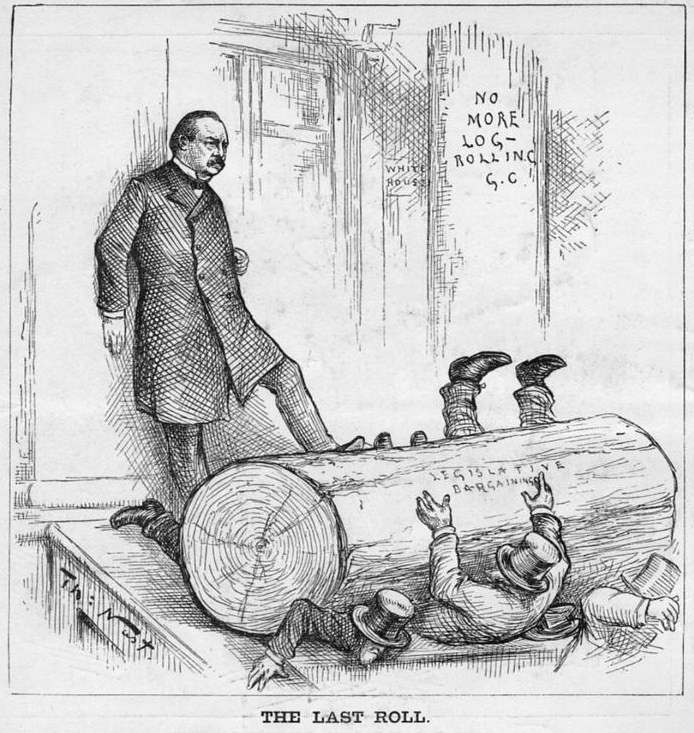
Along with the colorful phrase “pork barrel” spending, logrolling is a term used to describe the process of vote trading in elected legislative bodies. The process has long been maligned by political scientists, pundits, and the general public. It’s also come up in the debate about the proposed Budget/COVID Relief Bill.
President Grant tried to stop logrolling. He failed.
What’s bad about logrolling? I think there are two general lines of argument. First, it just seems immoral. Citizens can’t legally trade their votes, and many see any attempt to do so as wrong. You get one vote, and one vote only. For someone to have more votes than others rubs our intuitions the wrong way, similar to the ability for wealthy individuals or corporations to essentially have more votes by influencing politicians through campaign contributions.
More pragmatically, logrolling gets a bad name because it could lead to wasteful spending, particularly the “pork barrel” type that Americans really hate (unless it is coming to their district, of course). If you vote for my bill, I will vote for yours, even though I might not care about your bill. Maybe even I think your bill is kinda bad, but I think my bill is really good, so I am willing to hold my nose and vote for your bill, if it gets me what I want.
Buchanan and Tullock (1962) turned this logic on its head. Logrolling is efficient because it allows members to express their preferences, specifically the intensity of their preferences. Moreover, it allows legislative bodies to get things done that are beneficial for society, even if none of those things would pass in a simple referendum.
Money can be simplistically defined as “A medium that can be exchanged for goods and services and is used as a measure of their values on the market, and/or a liquifiable asset which can readily be converted to the medium of exchange”. Earlier we described the amounts of various classes of “money” in the U.S. Here is a chart showing the amount of currency in circulation (coins and bills; lowest line on the chart) for 2005-2020, and also M1 (green), M2 (upper curve, purple) and “monetary base” (currency plus reserves at the Fed; red line).
To recap what M1 and M2 are:
M1: Physical currency circulating outside of the Fed and private banking system, plus the amount of demand deposits, travelers’ checks and other checkable deposits. This is highly “liquid” money, i.e. accepted and used for transactions in the private economy.
M2: M1 + most savings accounts, money market accounts, retail money market mutual funds, and small denomination time deposits (certificates of deposit of under $100,000).
The funds in these additional savings and money market accounts can in general be easily transferred to checkable accounts, and thus could go towards making purchases if desired.
Physical currency is made and put into circulation by the government or quasi-governmental agencies (the Treasury mints coins, and the Federal Reserve prints bills). But what about all the other money (M1, M2, etc.), which dwarfs the physical currency? How does it grow?
Without getting into all the weeds, it turns out that the major driver of money creation in modern economies is the process of bank loans. The vast majority of money in countries like the U.S. is not created directly by government or central bank operations, but is created in the private sector when commercial banks make loans. When individuals or companies decide to take out more loans (including loans for cars, houses, or business investment), the effective money supply in the nation increases. This is true for other modern economies. For instance, the Bank of England states:
There are three types of money in the UK economy:
3% Notes and coins
18% Reserves
79% Bank deposits
A typical scenario of how bank lending increases money might go something like this: Fred would like to add an enclosed back porch to his house, but doesn’t have the money in hand to pay a carpenter to build it for him. So the base case is no payment to the carpenter and no porch for Fred. However, Fred realizes he can go the bank and get a loan to pay for the porch. So he obtains a $20,000 loan from the bank, which first shows up as a $20,000 credit to Fred’s checking account. The bank credits Fred’s account, and in exchange obtains a contract from Fred promising that Fred will pay it back, with interest.
Fred writes a check for $20,000 to the carpenter, who in turn pays $10,000 to a lumberyard for materials and keeps the other $10,000 as his fee. The lumberyard is able to pay its workers for that day, and order replacement lumber from a mill. The workers spent their pay on various items. The carpenter puts $5000 of his $10,000 fee in a savings account, and pays the rest to a car dealer for a used car.
The initial loan to Fred set off a chain of spending and economic activity, which would not have otherwise occurred. Fred has his porch, the lumberyard workers continue to be employed and supporting their local merchants, the carpenter gets a second car, and this money keeps ricocheting around until it gets drained away into stagnant savings, or is used to pay down prior debt. Although they are not aware of it, part of the lumberyard workers’ pay for that day came out of the debt incurred by Fred.
The granting of that loan created $20,000 of spending capability, i.e. money. As far as the economy is concerned, that $20,000 did not exist as effective money prior to the loan. Thus, the money came into existence simultaneously with the debt associated with the loan. Fred received the capacity to spend $20,000 today, but in turn accepted the obligation to pay back this money, with interest. It is assumed that Fred had a stable income, such that he would in fact be able to pay back the loan in the future.
In general, increasing debt increases the money supply, and paying down debt extinguishes money. For simplicity, suppose Fred repays the $20,000 loan (with $2000 interest added) in one big lump, two years later. In that year, he will presumably spend into the economy something like $22,000 less than he would have otherwise. Thus, his paying down of his debt will act as a decrease in the circulating money.
In normal times, as one person is paying down his loan (and thereby shrinking the money supply), someone else is taking out a new and even larger loan, so total debt and the amount of money in circulation stays about the same, or grows somewhat. A feature of the 2008-2009 recession, however, was a big drop in consumer demand for credit; folks decided to pay down debts and not borrow so much money to buy stuff. The effect was a big drop in spending and thus in overall economic activity (GDP) and in employment.
Where was that $20,000 before Fred borrowed it? We might think that it was sitting unused in the bank vaults, just waiting to be borrowed. That turns out to be an incorrect picture of the lending process.
Bank loans differ in key ways from, say, an interpersonal loan. If I lend you money, I might draw down my checking deposit and give you a check which you would deposit in your bank account. No new money is created. You may hand me an I.O.U. slip stating when you will pay me back and with what interest, but that would still be just the same funds being traded back and forth between the two of us. I would have to have the money in my account to start with before I could loan it to you.
Bank lending is different. A bank can lend money and hence create a new deposit, which amounts to brand-new money, even if the bank does not have that money to start with. This is counterintuitive. In a later post we may flesh out this seemingly magical aspect of bank lending. See Overview of the U. S. Monetary System for a more complete discussion.
If you can tolerate a moment’s grandiosity, there’s no more important application of game theory than the evolutionary transition from prokaryotic cells to eukaryotic cells. All due deference to every game theorist ever, but the solution to the Prisoner’s Dilemma is literally in our DNA. One day cells were swimming around the primordial soup competing with each other in a zero-sum fight to the death for resources, the next they’re bonding together to form tissues to jointly acquire them. A couple billion years later and you’ve got hyper-specialization to the point of which cellular differentiation remains a bleeding-edge subject of biological research.
But this isn’t a post about the miracle of a body when it’s functioning perfectly. It’s about what happens when a cell goes rogue. When it defects on its neighbors and a cooperative strategy literal eons in the making. It starts gobbling up resources and reproduces at rates that threaten the whole enterprise, growing into a terrible little tumor of defection. The cooperative strategy in question moved passed simplicity countless generations ago: tissues employing Tit-for-Tat disaggregated back into the soup the first evolutionary round through. No, the strategy now is so fine-tuned it hasn’t had to deal with a major defector in eons of its collective evolutionary memory. If it is to succeed, it will have to selectively cut out those defecting cells without abandoning its core strategy, and do it fast, before it’s too late.
Which naturally brings me to the Republican party.
Political parties succeed based on two achievements. 1) They solve the collective action problem and, in doing so, achieve a scale of cooperation and exceed some critical mass threshold sufficient to self-perpetuate through the electoral process. The number of parties that can succeed at once, and the critical mass necessary to get to that point, are determined by the governing political institutions. 2) They maintain their cooperation at a scale sufficient to thwart the emergence of an alternative rival party.
Staying a dominant party is much easier than becoming one, but that doesn’t mean continued success is guaranteed. The weakness(es) of a party will depend on how it got there in the first place. The strategies for solving the collective action problem of this scale will be far more complicated than Tit-for-Tat or “Walk Away” and similar solutions distilled to the point of abstraction. They will involve all the solutions employed by cartels, religious groups, military forces, and every other collective dependent on high-levels of persistent cooperation. With that complexity comes weaknesses. Fault lines and backdoors that are typically guarded through a variety of social and legal barriers.
And they must be guarded, because the combination of scale and success will never cease to attract defectors. Those roaming cells, ostracized and cast out, always met with a wary eye, looking for a way in. Just imagine you are that rogue cell and you come across a population trained to always cooperate no matter what so long as it is deemed a member of the group. They seems so naïve! So vulnerable. But that’s how we succeeded! Always cooperate within the group. How big might your greed grow knowing you could defect and defect for all eternity, growing fatter and fatter off this suddenly maladapted globule of political ambition that can’t help but tear itself to shreds while giving you everything you ever wanted? It’s not just about the weakness of the party, but the kinds of agents these prospects are likely to attract.
In the coming weeks I’ll revisit this and ramble more about discuss some of the specific strategies employed by political parties, and the kinds of invasive agents and strategies they should expect. I’ll also speculate on how groups might institutionally respond and better protect themselves from both invading sociopaths, as well as their own hubris.
Inspiring articles:
Aimone, Jason A., et al. “Endogenous group formation via unproductive costs.” Review of Economic Studies 80.4 (2013): 1215-1236.
Aktipis, C. Athena, et al. “Cancer across the tree of life: cooperation and cheating in multicellularity.” Philosophical Transactions of the Royal Society B: Biological Sciences 370.1673 (2015): 20140219.
One of the many things I meant to do and did not have time for this Fall was a photo study of the political signs in my neighborhood. I did snap a few pictures, such as this one of a conservative house:
The next one is not a Biden/Harris sign, but they are supporting the Democrat senator Doug Jones.
The Biden signs far outnumbered the Trump signs. It’s a safe assumption that most Trump voters did not put out signs.
Tonight, you cannot tell which households supported which candidate. I think my election photo journalism failure might actually turn into a different story. Observe this street
Something CUTE that my Alabama neighbors do is put up an outdoor Christmas tree with white lights, like so:
When you drive down a street past dozens of these in a row, the effect is wonderful (and hard to capture adequately with my phone camera). It’s neither a political statement nor an anti-political statement. It’s a community that thrives despite their differences. This is something beautiful they do to enjoy together.
Like many neighborhoods, we also have “that house”:
Forget “The Christmas Prince” or “The Prince Christmas” or whatever is on Netflix. Why not spend your holiday refreshing this new vaccine dashboard?
Here’s the announcement:
Launching a new dashboard to track local news reports and state press releases on how many vaccine doses will be allocated to each state, since there seems to be no public federal effort. Browse each state's allocations and a map of doses per capita.https://t.co/CUP2W2ph7X
I personally know a few health care workers who got their shots (do not say “jab” to me) this past week. It’s all very exciting! Here at University of Alabama at Birmingham (UAB), the medical community has freezers, fortunately.
Jeremy and Doug have both talked about allocation this week. Economists get really jazzed about allocating scarce resources. It’s been frustrating to watch first tests and now vaccines not be available on a market. Excellent points are also made every week over at Marginal Revolution on how we are missing an opportunity to get the incentives right. Supply. Curves. Slope. Up. (Thousands. Dying. Every. Week.)
If you haven’t read Jeremy’s earlier post on vaccine allocation take a few minutes, it’s worth the read. We have fewer vaccines than people who want vaccines. Also, who actually gets vaccines is being decided through a priority system established by the federal government.
People do not seem outraged about the priority system. Probably this is because the priority queue has some grounding in our moral intuitions. In the absence of market allocation, you are forced into some allocation criteria other than price. What would the “right” allocation be? People seem to gravitate towards principles of merit, need, and equality (see my earlier post here) and one could view the allocation to healthcare workers as meeting the criteria of merit. These individuals are currently on the frontlines of exposure to the virus and have endured significant stress the last nine months.
At the same time, it is worth asking whether a switch to the allocation of vaccines through a market mechanism is better. Markets are appealing because there is so much information to take into account (e.g. should an X-Ray tech get the vaccine before a teacher). The presence of externalities complicates the story and implies that non-market allocation could do better. Though there appear to be substantial coordination problems with our current central planning approach.
Like other economists, I see the power of markets to coordinate plans and that makes me lean towards an auction format. I am not confident the government can centrally plan towards a more efficient allocation. However, I admit the ethics of distribution according to willingness to pay makes me reluctant to use auctions. I would favor randomization of who gets the vaccine (all have an equal chance which is morally appealing) with opportunities for side-payments where people can take advantage of their local information. Jeremy suggested a lump sum transfer for the poor but it seems this would introduce new complications like who counts as poor (what percent of FPL) and the correct size of the lump sum transfer.
This approach of randomization likely has the added benefit that it randomizes potentially adverse shocks. Because the vaccines were expedited in clinical trials, there could be unique and unknown long term consequences due to the nature of our current situation and how studies are conducted. If something bad does happen, shocks will be less concentrated within industries and medical distrust will be less concentrated within a subgroup. That seems like a valuable outcome that I haven’t seen people discuss (though I have been busy this week submitting grades and preparing for a new semester).
In the short term, there are only a few million doses of the COVID vaccines available, but well over 100 million adults in the US that want to take the vaccine if offered for free to the consumer. There are also billions worldwide that would like the vaccine.
So who should get it first? In practice in the US, the allocation method has already been determined politically: the federal government will allocate vaccines to the states, and states will allocate them to individuals based on a priority list: health workers and the most vulnerable first, then teachers, etc. The NY Times has a tool that shows you your probable place in line.
But essentially the allocation method being used is central planning.
John Cochrane has proposed a “free market” solution: sell the vaccine to the highest bidder. Or at least, sell some doses to the highest bidder.
As an economist, there is always some appeal in thinking about a free market solution. But there is a problem in this case: there are positive externalities from taking the vaccine. It not only benefits me, but it also benefits others. My willingness to pay only reflects the benefit to me, the private benefit. The social benefit is mostly ignored by a simple auction, and in the aggregate for a vaccine most of the benefits are likely to be social benefits. But positive externalities don’t imply we need to use central planning!
If you haven’t been living under a rock, you probably saw at least one image of Elon Musk’s “Starship” rocket blowing up last week. This is a really big rocket, some 165 ft high, which Musk intends to use to ferry humans to Mars, as early as 2026. And before that, paying passengers like you and I are to climb aboard for brief tourist excursions to outer space.
The rocket is designed to land back on its launchpad, to be ready for its next flight. That part is what went wrong last Wednesday. I snagged three screenshots from the live-streamed SpaceX video on YouTube to show what happened. The first image shows the vessel descending on its rocket jets, obviously dropping way too fast as it neared the ground.
This is what happened upon impact:
Ouch. It turns out that not enough fuel was getting to the rocket engines to slow the vessel’s descent.
Here are the smoking ruins:
Another man may have been chagrined over this outcome, but not the indomitable Musk. He had given this flight only one in three odds of landing intact, and he was ecstatic over the vast majority of things that went right, and the useful data collected. After all, the rocket did successfully take off, ascend to 40,000 ft (12 km), and mainly descend in the desired horizontal orientation to minimize overheating. Right after the blast he tweeted:
“Fuel header tank pressure was low during landing burn, causing touchdown velocity to be high & RUD, but we got all the data we needed! Congrats SpaceX team hell yeah!!”
When you are Elon Musk, a little RUD (Rapid Uncontrolled Disassembly) is all in a day’s work. Which may be partly why he accomplishes so much more than most of us.
I’m relatively new to Birmingham, Alabama. I was nervous about moving to a place with famously long hot humid summers. My intuition since moving here is that there are many days throughout the year when, at some point in the day, the weather is nice for doing something outside with my kids.
Yesterday, Sunday, was very nice. To have such a nice warm sunny day in mid-December is strange to me. I grew up further north where Decembers are chilly. Here is a picture of a neighbor’s son enjoying the summer-like feel of this technically-winter day. This picture was taken at noon.
Although I am grateful for this particular day, I also think about the hot summer days when noon is a time to hide indoors with air conditioning. Is it nice here? How can that question be answered scientifically?
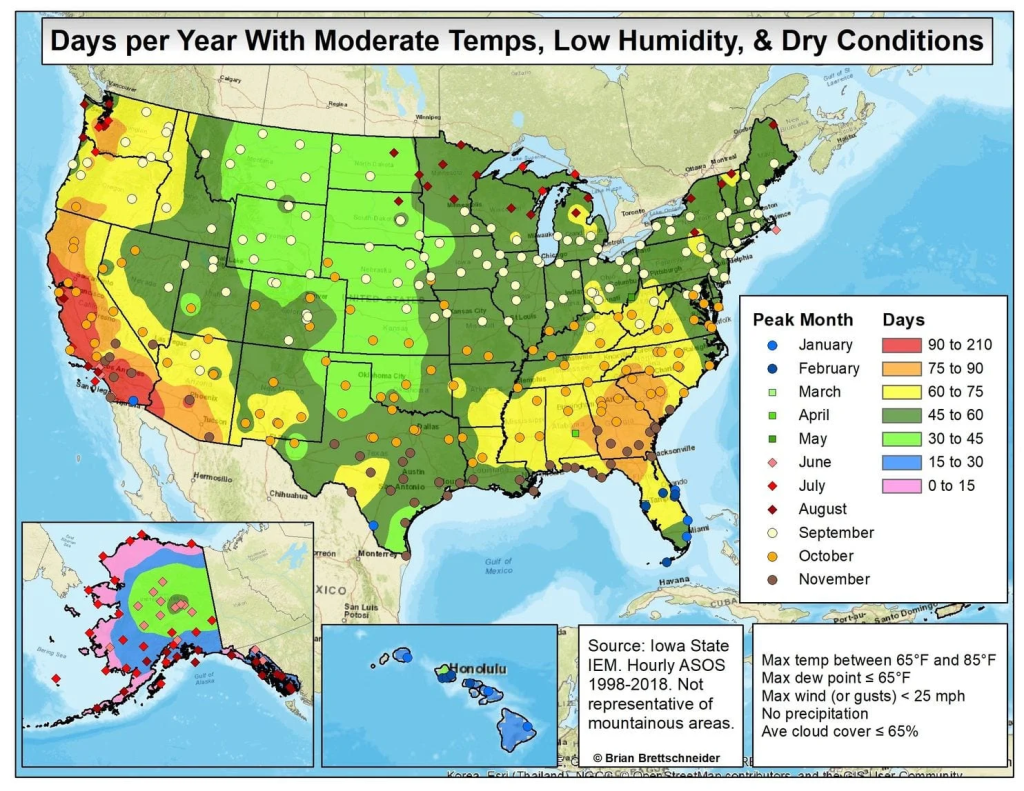
There is actually a great map of answers, available on several websites, credited to Brian Brettschneider, thanks to data from Iowa State.
This map confirmed my intuition. My old life in New Jersey was in the dark green zone, and my new life in Alabama is one level better, in terms of how many “nice” days you can expect in a year.
If you don’t have climate control, then you might be more worried about weather extremes. If you are lucky enough to have a regulated indoor environment, then a nice place to live is largely a question of how many days you get when it’s nice to “go out”.
This map accounts for “nice days”. I wonder if New Jersey would seem closer to Alabama if the measure changed to “nice daylight hours”. Yesterday was beautiful, but it was dark by 5pm. When I get time, I’m going to make a map of where in the lower 48 you can enjoy dinner outside after work many times per year (and why is it Southern California?).
In the course of research work, I read “Sticky Prices as Coordination Failure” today, published in 1991 by L. Ball and David Romer.
They suggest that “coordination failure is at the root of inefficient non-neutralities of money”. They write an elegant theory of price setting and adjustment that includes a menu cost. A menu cost is imposed on an individual who adjusts prices. The name comes from the fact that some restaurants face a literal cost for switching the paper menus.
If changing prices is costly then there is inertia. People tend to stay where they were before, even if adapting to fluctuating external conditions is more efficient.
According to their model of rational individual agents, people will change if the expected benefit of adjustment is larger than the menu cost. In some cases, the optimal action for an individual depends on what others are doing. Thus
Increases in price flexibility by different firms are strategic complements: greater flexibility of one firm’s price raises the incentives for other firms to make their prices more flexible. Strategic complementarity can lead to multiple equilibria in the degree of nominal rigidity, and welfare may be much higher in the low-rigidity equilibria.
An implication is that if you are surrounded by people who are open to constantly changing, then you yourself will be more likely to adapt. The world is always fluctuating, so welfare is higher for communities that can adapt quickly. Example of changing circumstances include global warming and novel safety procedures suddenly needed during the time of Covid.
In this paper, “multiple equilibria” means that a community might settle at a high-wealth level or a low-wealth level simply because of what everyone else is doing. Ball and Romer don’t try to figure out which equilibrium is more likely to be the outcome in reality.
No one in their model would be out of equilibrium (unnecessarily poor) if it were not for the “sticky” prices. As the title implies, coordinating the optimal levels of production and consumption is difficult because of the inertia of prices.
In their conclusion, they reflect on the role of government when multiple equilibria are possible:
… with multiple equilibria, policy can be less coercive. Instead of prohibiting certain contract provisions, the government could simply convene meetings of business and labor leaders to coordinate adjustment … Second, by moving the economy to a new equilibrium, temporary regulations can permanently change the degree of nominal rigidity.
They assume that after a recession, the price adjustment that needs to happen is “for decentralized agents to reduce nominal wages in tandem.” It’s interesting to see, culturally speaking, how hesitant they seem to strongly recommend government intervention through inflation. I feel like writers in econlit today would not be shy about saying they think governments should intervene through monetary policy, if they believe that to be true.
In my JEBO paper, I found that a little inflation caused workers to not lower production so much in response to a real wage cut after a recession. In our environment, I would say “cooperation” was more important than “coordination”, because there were only two agents and their decisions were sequential.