Last week I posted about Bart Wilson’s talk on his new book “The Property Species” and promised to share a class demonstration about the emergence of property rights in the classroom. But first let me tell you why I did this demonstration.
When I was a student I hated assignments that go through the motions of learning, but provide no learing. Building a paper maché volcano, while fun for some, teaches little about volcanic eruptions. Shaking and opening a soda bottle (pop?) is more instructive: it’s the fall in pressure as the bottle is opened that leads to the rapid release of the gas disolved in the liquid, the same thing happens to magma. And while being able to algebraically solve for the equilibrium price given supply and demand functions is a very necessary evil (to a point), it teaches little about the process of competition and price formation.
This is why I was reluctant to having my first Intro to Economics class write their own version of “I pencil”, quite a few years ago. Driving the point of how largely anonymous exchange and specialization, coordinated peacefully through property, prices, and profits and loss makes the modern world possible is very important. But how much can you really learn about this by watching and transcribing an episode of “How It’s Made”? For most students, not much at all. Partly in dread of reading and grading 80 versions of “I whiteboard marker”, or “I toothbrush”, and partly following my conscience I decided to throw in a twist.
The twist may seem evil and arbitrary at first. Students still had to choose a good and write their own version of “I _____” , but if two students wrote about the same good I would divide their grade by 2. If three students wrote about the same good I would divide their grade by 3 and so on. I did not give any additional prompts about how they should sort out potential conflicts or coordinate amongst themselves. These were just the rules of the assignment.
Without this seemingly arbitrary grading rule, goods to write about were not scarce. By changing the grading rules, goods to write about became scarce. While there are many more goods to write about than students, certain goods stand out in the mind, and extra effort must be devoted in thinking up a new good, and finding out if someone had already looked around their room and chosen the same good. Now students also had to coordinate amongst themselves or run the risk of a fairly severe penalty to their grade.
As expected, I have never had to enforce the the harsh grading penalties (anecdotal, I know). Students always find a way to coordinate and establish property rights over suddenly scarce goods. The point of the assignment was no longer about I pencil, but about the emergence of property rights and social coordination (and hopefully a little bit about I pencil as well). I didn’t act as a central authority that imposed and enforced property rights. I merely changed the incentives and constraints, hoping that the costs of coordinating and setting up agreements was smaller than the costs of not doing this.
When they turned in their assignment, we discussed how they had actually coordinated. Over the years I have seen multiple ingenious mechanisms. From class forums using the university platform, to a simple spreadsheet circulated amongst the students via email or WhatsApp. In the good old times before the pandemic they would sometimes meet after class and sort it out in person. Sometimes they created a common pool of goods and one of their classmates is chosen to distribute them among their peers. Leaders emerge to fill various roles from dispute resolution to registering claims. How this person is chosen also varies from class to class. Some students volunteer, others have it thrust upon themselves. The use of a homesteading rule is fairly common, first to choose gets the good in cases where there are multiple claims. In class we discuss why they use this rule, rather than last to choose gets the good, and the problems this alternative would entail.
I have only had one instance of a strong and contested dispute among “property owners”. That semester students had to not only write but present their work. Two groups (that semester “I _____” was a group assignment) wanted to do a good they thought would be amusing to present in class. I’ll leave it up to your imagination what good students in their late teens and early twenties might find to be amusing to present in class. The two groups of students underwent a rather complicated dispute resolution system with the rest of the class playing the role of arbiters of the multiple claims to the same good. Neither group wanted to budge, but one group ended up ceding the rights in the end.
What I like about this little classroom demonstration is that it makes it easier to teach the emergence of institutions as the products of human action but not human design. Order without design is a difficult concept to grasp, but maybe even more importantly it is a concept that is difficult to accept. But after this demonstration, not anymore, students experience the emergence of property rights. An added bonus is that in this case scarcity is clearly a product of the relation between their minds and how they relate to the world, not about objective quantities of goods.
I later learned of the fish game (I am not an experimentalist). But, no disrespect intended, it seems a little contrived. I still like my assignment better. While the goldfish game teaches the tragedy of the commons, the “I _____” assignment teaches how the tragedy can be solved without a centralized authority by having students solve if for themselves and come to grips with the real limitations and problems they faced, albeit on a much smaller scale. I am still hoping for an experimentalist that thinks something serious can be made out of my little classroom demonstration.
How much research do economists devote to the topics of gender, race and ethnicity, and inequality? In a recently published article in Econ Journal Watch, Arnold Kling and I looked at articles published in the American Economic Review as well as the conference papers of the American Economic Association on this topics. We find that economists devote a large amount of space to the topics combined in recent years: over 10% of published articles and over 20% of conference papers. We also find that the share of research on this topics, as measured in these two AEA outlets, has been increasing over time (we go back to 1991, when the current JEL Code system was introduced).
Of the three areas we looked at, papers on gender saw the clearest increase, rising as both a share of published articles and conference papers. Published AER articles addressing inequality have also been increasing over this time period, though AEA conference papers on inequality have been stable. Both published articles and conference papers on race and ethnicity have been stable over the period we studied as a share of the total, though the absolute number has increased.
What is the significance of our results? Our main motivation was to challenge other economists who suggest, in various ways, that economists ignore these topics or don’t study them enough (for examples see these popular writings on gender, race and ethnicity, and inequality). Our research clearly shows that economists devote a good deal of attention to these topics, and for many areas it has shown a clear increase.
It is still possible that economists don’t dedicate enough time to these topics. We make no strong claim in the paper about what the correct amount of time for each topic would be. However, we do note the opportunity cost that comes with an increasing focus on these topics.
More importantly, those who suggest in public venues that economists ignore these areas are doing a disservice to all the scholars that have devoted their careers to studying these important topics and publishing their results in one of the top journals in the discipline. We have much more to learn about gender, race and ethnicity, and inequality, but dismissing the research that has already been done is unfair to a discipline that has increasingly focused on these areas.
The sudden shutdown of much of the economy of the U.S. and of the world starting in February and March of 2020 led to deep concern, if not panic, in world financial markets. Millions of people were suddenly unemployed or furloughed, millions of small businesses faced bankruptcy, and stocks plunged some 30% in the fastest fall of global markets in history. Demand collapsed, and prices for nearly all financial assets fell. Trillions of dollars of financial transactions were in danger of unravelling.
The Federal Reserve immediately rode to the rescue, slashing interest rates and buying up all kinds of financial assets. These purchases of bonds and similar products injected cash into the markets to provide much-needed liquidity, and kept the system on track. In late March, the U.S. federal government authorized trillions of dollars of payments to individuals and businesses to stave off bankruptcy, and forbade foreclosures on mortgages, to keep people from losing their homes (at least in the near term). Banks and governments in other nations took similar measures. By May, it was clear that the worst scenarios had been averted, even though there will be significant lingering consequences of the Covid shutdowns.
The speed and scale of the Fed and government responses in March, 2020, may be attributed in part to learnings from the 2008-2009 Global Financial Crisis (GFC). In that crisis, the severity of the problem was not understood at first. There was naturally reluctance to take unprecedented actions to do what was perceived as bailing out of irresponsible banks and other companies. Over a period of many months, various measures were implemented to address some immediate needs, but then more and more problems kept cropping up. It was a macroeconomic game of whack-a-mole.
As a bit of a history lesson, here is a timeline of the main financial events of January-September, 2008. These descriptions are taken, with only minor editing, from an article by Kimberly Amadeo in The Balance.
Easy credit and expectations of always-increasing home prices led to a speculative run-up in housing in 2002-2006. Mortgages were given to people who really could not afford them, and billions of dollars of those unsound sub-prime mortgages were repackaged and sold into the broad financial system. That all began to unravel in 2006-2007. In response to a struggling housing market, the Federal Market Open Committee began lowering the fed funds rate. It dropped the rate to 3.5% on January 22, 2008, then to 3.0% a week later. Economic analysts thought lower rates would be enough to restore demand for homes.
February 2008: Bush Signs Tax Rebate as Home Sales Continue to Plummet
President Bush signed a tax rebate bill to help the struggling housing market. The bill increased limits for Federal Housing Administration loans and allowed Freddie Mac to repurchase jumbo loans.
February’s homes sales fell 24% year-over-year. It reached 5.03 million according to the National Association of Realtors. The median resale home price was $195,900, down 8.2% year-over-year. Foreclosures were up.
March 2008: Fed Begins Bailouts
The Fed Chair realized the Fed needed to take aggressive action. It had to prevent a more serious recession. Falling oil prices meant the Fed was not concerned about inflation. When inflation isn’t a concern, the Fed can use expansionary monetary policy. The Fed’s goal was to lower the LIBOR benchmark interest rate, and keep adjustable-rate mortgages affordable. In its role of “bank of last resort,” it became the only bank willing to lend.
It increased its Term Auction Facility program to $50 billion. It also initiated a series of term repurchase transactions. These were 28-day term repurchase agreements with primary dealers. The Fed’s goal was to pump $100 billion into the economy.
No one knew who had the bad debt or how much was out there. All buyers of debt instruments became afraid to buy and sell from each other. No one wanted to get caught with bad debt on their books. The Fed was trying to keep liquidity in the financial markets.
But the problem was not just one of liquidity, but also of solvency. Banks were playing a huge game of musical chairs, hoping that no one would get caught with more bad debt. The Fed tried to buy time by temporarily taking on the bad debt itself. It protected itself by only holding the debt for 28 days and only accepting AAA-rated debt.
March 14: The Federal Reserve held its first emergency weekend meeting in 30 years. On March 17, it announced it would guarantee Bear Stearns‘ bad loans. It wanted JP Morgan to purchase Bear and prevent bankruptcy. Bear Stearns’ had about $10 trillion in securities on its books. If it had gone under, these securities would have become worthless. That would have jeopardized the global financial system.
March 18: The Federal Open Market Committee (FOMC) lowered the fed funds rate by 0.75% to 2.25%. It had halved the interest rate in six months. That put downward pressure on the dollar, which increased oil prices.
That same day, federal regulators agreed to let Fannie Mae and Freddie Mac take on another $200 billion in subprime mortgage debt. The two government-sponsored enterprises would buy mortgages from banks. This process is known as buying on the secondary market. They then package these into mortgage-backed securities and resell them on Wall Street. All goes well if the mortgages are good, but if they turn south, then the two GSEs would be liable for the debt.
The Federal Housing Finance Board also took action. It authorized the regional Federal Home Loan Banks to take an extra $100 billion in subprime mortgage debt.The loans had to be guaranteed by Fannie and Freddie Mac.
Fed Chair Ben Bernanke and U.S. Treasury Secretary Hank Paulson thought this would take care of the problem. They underestimated how extensive the crisis had become. These bailouts only further destabilized the two mortgage giants.
April – June: Fed Lowers Rate and Buys More Toxic Bank Debt
April 30: The FOMC lowered the fed funds rate to 2%.
April 7 and April 21: The Fed added another $50 billion each through its Term Auction Facility.
May 20: The Fed auctioned another $150 billion through the Term Auction Facility.
By June 2, the Fed auctions totaled $1.2 trillion. In June, the Federal Reserve lent $225 billion through its Term Auction Facility. This temporary stop-gap measure of adding liquidity had become a permanent fixture.
July 11, 2008: IndyMac Bank Fails
July 11: The Office of Thrift Supervision closed IndyMac Bank. Los Angeles police warned angry IndyMac depositors to remain calm while they waited in line to withdraw funds from the failed bank. About 100 people worried they would lose their deposit. The Federal Deposit Insurance Corporation (FDIC) only insured amounts up to $100,000. This was later raised to $250,000.
July 23: Treasury Secretary Paulson made the Sunday talk show rounds. He explained the need for a bailout of Fannie Mae and Freddie Mac. The two agencies themselves held or guaranteed almost half of the $12 trillion of the nation’s mortgages.
Wall Street’s fears that these loans would default caused Fannie’s and Freddie’s shares to tumble. This made it more difficult for private companies to raise capital themselves. Paulson reassured talk show listeners that the banking system was solid, even though other banks might fail like IndyMac.
July 30: Congress passed the Housing and Economic Recovery Act. It gave the Treasury Department authority to guarantee as much as $25 billion in loans held by Fannie Mae and Freddie Mac.
September 7: Treasury Nationalizes Fannie and Freddie
The FHFA placed Fannie and Freddie under conservatorship. It allowed the government to run the two until they were strong enough to return to independent management.
The FHFA allowed Treasury to purchase preferred stock of the two to keep them afloat. They could also borrow from the Treasury. Last but not least, Treasury was allowed to purchase their mortgage-backed securities.
The Fannie and Freddie bailout initially cost taxpayers $187 billion. But over time, they two paid back all costs plus added $58 billion in profit to the general fund.
September 15, 2008: Lehman Brothers Bankruptcy Triggered Global Panic
Paulson urged Lehman Brothers to find a buyer. Only two banks were interested: Bank of America and British Barclays.
Bank of America didn’t want a loan. It wanted the government to cover $65 billion to $70 billion in anticipated losses. Paulson said no. The U.S. Treasury had no legal authority to invest capital in Lehman Brothers, as Congress hadn’t yet authorized the Troubled Asset Relief Program. Barclays announced its British regulators would not approve a Lehman Brothers deal.
Since Lehman Brothers was an investment bank, the government could not nationalize it like it did government enterprises Fannie Mae and Freddie Mac. For that same reason, no federal regulator, like the FDIC, could take it over. Moreover, the Fed couldn’t guarantee a loan as it did with Bear Stearns. Lehman Brothers didn’t have enough assets to secure one.
When Lehman’s declared bankruptcy, financial markets reeled. The Dow fell 504 points, its worst decline in seven years. U.S. Treasury bond prices rose as investors fled to their relative safety. Oil prices tanked.
Later that day, Bank of America announced it would purchase struggling Merrill Lynch for $50 billion.
September 16, 2008: Fed Buys AIG for $85 Billion
The American International Group Inc. turned to the Federal Reserve for emergency funding. The company had insured trillions of dollars of mortgages throughout the world. If it had fallen, so would the global banking system. Bernanke said that this bailout made him angrier than anything else. AIG took risks with cash from supposedly ultra-safe insurance policies. It used it to boost profits by offering unregulated credit default swaps.
October 8, 2008: The Federal lent another $37.8 billion to AIG subsidiaries in exchange for fixed-income securities.
November 10, 2008: The Fed restructured its aid package. It reduced its $85 billion loan to $60 billion. The $37.8 billion loan was repaid and terminated.The Treasury Department purchased $40 billion in AIG preferred shares. The funds allowed AIG to retire its credit default swaps rationally, stave off bankruptcy, and protect the government’s original investment.
September 17, 2008: Economy Almost Collapsed
Due to losses from Lehman’s bankruptcy, investors fled money market mutual funds. That’s where companies obtain their short-term cash.
September 16: The Reserve Primary Fund “broke the buck.” It didn’t have enough cash on hand to pay out all the redemptions that were occurring.
September 17: The attack spread. Investors withdrew a record $172 billion from their money market accounts. During a typical week, only about $7 billion is withdrawn. If it had continued, companies couldn’t get money to fund their day-to-day operations. In just a few weeks, shippers wouldn’t have had the cash to deliver food to grocery stores. We were that close to a complete collapse.
September 19, 2008: Paulson and Bernanke Meet with Congress
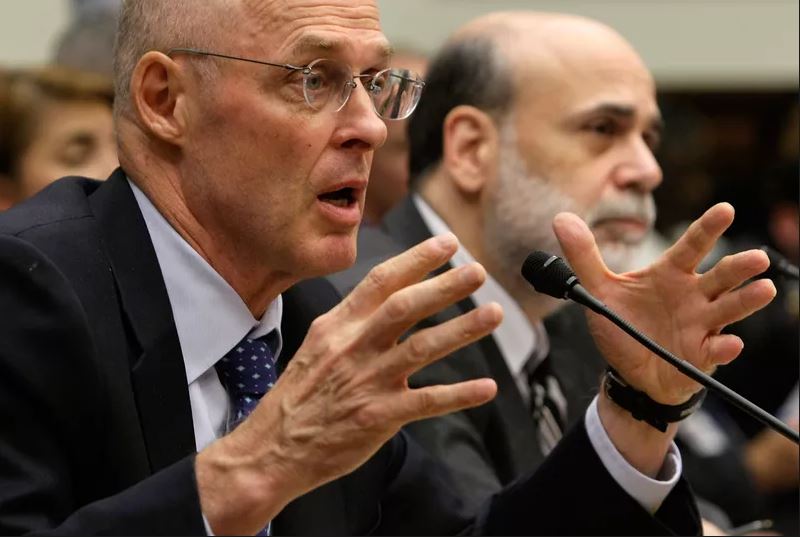
U.S. Treasury Secretary Henry Paulson (L) speaks as Federal Reserve Board Chairman Ben Bernanke (R) listens during a hearing before the House Financial Services Committee on Capitol Hill September 24, 2008 in Washington, DC. Photo: Alex Wong/Getty Images
September 19: Paulson and Bernanke met with Congressional leaders to explain the crisis. Republicans and Democrats alike were stunned by the somber warnings. They realized that credit markets were only a few days away from a meltdown.
The leaders were prepared to work together in a bipartisan fashion to craft a solution. But many rank-and-file members of Congress were not on board.
Bernanke announced the Fed would lend the money needed by banks and businesses to operate so they wouldn’t have to pull out the cash in money market funds. This, along with the announcement of the bailout package, calmed the markets enough keep the economy functioning.
September 20, 2008: Treasury Submits Legislation to Congress
On September 20, Paulson submitted a three-page document that asked Congress to approve a $700 billion bailout. Treasury would use the funds to buy up mortgage-backed securities that were in danger of defaulting. By doing so, Paulson wanted to take these debts off the books of banks, hedge funds, and pension funds that held them.
When asked what would happen if Congress didn’t approve the bailout, Paulson replied, “If it doesn’t pass, then heaven help us all.”
September 21, 2008: The End of the “Greed Is Good” Era
Goldman Sachs and Morgan Stanley, two of the most successful investment banks on Wall Street, applied to become regular commercial banks. They wanted the Fed’s protection.
September 26, 2008: WaMu Goes Bankrupt
Washington Mutual Bank went bankrupt when its panicked depositors withdrew $16.7 billion in 10 days. It had insufficient capital to run its business. The FDIC then took over. The bank was sold to J.P. Morgan for $1.9 billion.
September 29, 2008: Stock Market Crashes as Bailout Rejected
A trader gestures as he works on the floor of the New York Stock Exchange September 29, 2008 in New York City. U.S. stocks took a nosedive in reaction to the global credit crisis and as the U.S. House of Representatives rejected the $700 billion rescue package, 228-205. Photo by Spencer Platt/Getty Images
The stock market collapsed when the U.S. House of Representatives rejected the bailout bill. Opponents were rightly concerned that their constituents saw the bill as bailing out Wall Street at the expense of taxpayers. But they didn’t realize that the future of the global economy was at stake.
To restore financial stability, the Federal Reserve doubled its currency swaps with foreign central banks in Europe, England, and Japan to $620 billion. The governments of the world were forced to provide all the liquidity for frozen credit markets.
[Again, these descriptions are taken nearly verbatim from 2008 Financial Crisis Timeline, by Kimberly Amadeo. See her article for coverage of the rest of 2008, and the ending of the recession in 2009.]
How likely is it that an opinion critical of [topic] will get expressed by someone on the internet?
My good friend (call her Anne) texted me this week. Anne sent me a link to a blog that declared some of her preferred works of art (i.e. musicals) to be inferior. She loves art, so to be told that her tastes were not exceptionally good was disappointing.
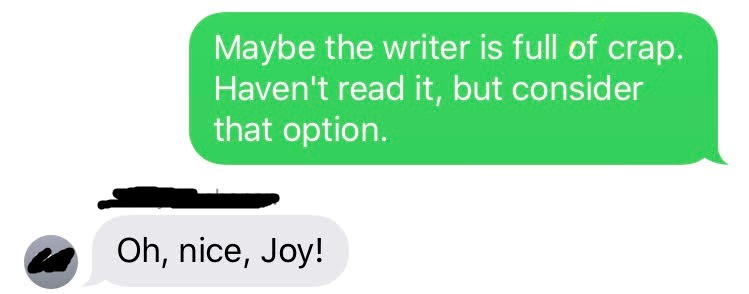
In my reply I wanted to make sure that Anne wasn’t putting too much weight on this new evidence:
How should we incorporate blogs into our beliefs about reality? (I see the irony – I’m writing a blog right now.)
The non-technical summary: you should be skeptical of what you read online.
The technical summary: the fact that some writer said “H” on the internet, should make you only slightly more confident that “H” is true.
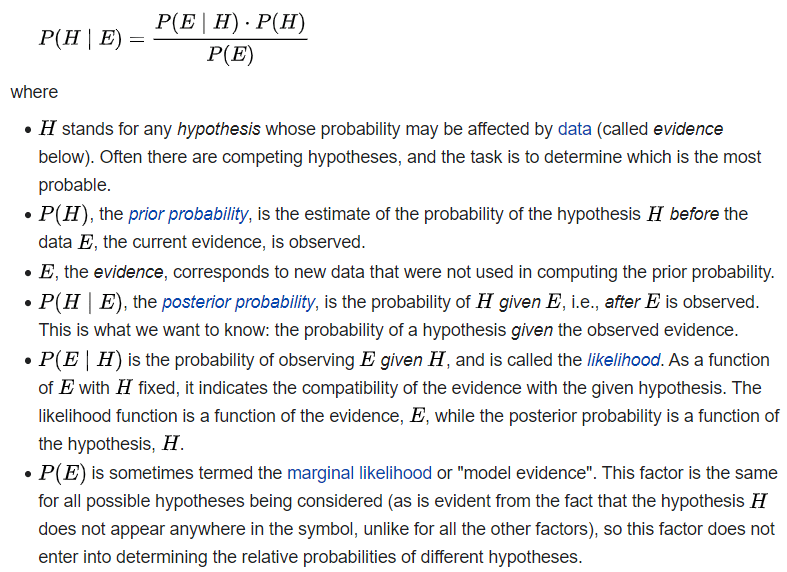
I can’t improve on the Wikipedia presentation of Bayes’ theorem, so I’ll just paste in:
Let’s consider the probability that it is true that Anne’s favorite musical is bad. We’ll call that hypothesis “H”. What’s the probability of H, given that one person wrote an article stating that the musical is bad?
The evidence, E, is the article.
Instead of just evaluating whether the article is convincing or not, Bayesian inference requires that we consider
Were we confident that H was true BEFORE seeing the article? Was there good data up until this point that convinced us H is true?
If H is true, what’s the probability of this article being written?
What’s the overall probability of this article being written, regardless of whether H is true?
The probability that musical is bad given that someone wrote an article saying so is :
P(H|E) = P(bad|article)
P(bad|article) = ( P(article|bad) x P(bad) )/ P(article)
The right side of the equation asks whether we are likely to see the article if the musical is bad. If the musical is actually bad, then we are likely to see it condemned in print. HOWEVER, if we had a prior belief that the musical is not bad, then the numerator gets smaller.
Finally, we consider the denominator, P(E) or the probability of seeing an article that is derogatory towards the musical. If that probability is high, then the probability of the musical actually being bad goes down.
Here’s how Anne should think:
P(bad|article) = ( likely that article will be written if bad x prior evidence suggests not bad) / snobby think pieces get written regardless
so
P(bad|article) = (big x small)/ big = small probability that Anne’s favorite musical is actually bad
You should be just the right amount of skeptical when it comes to internet content. Be Bayesian.
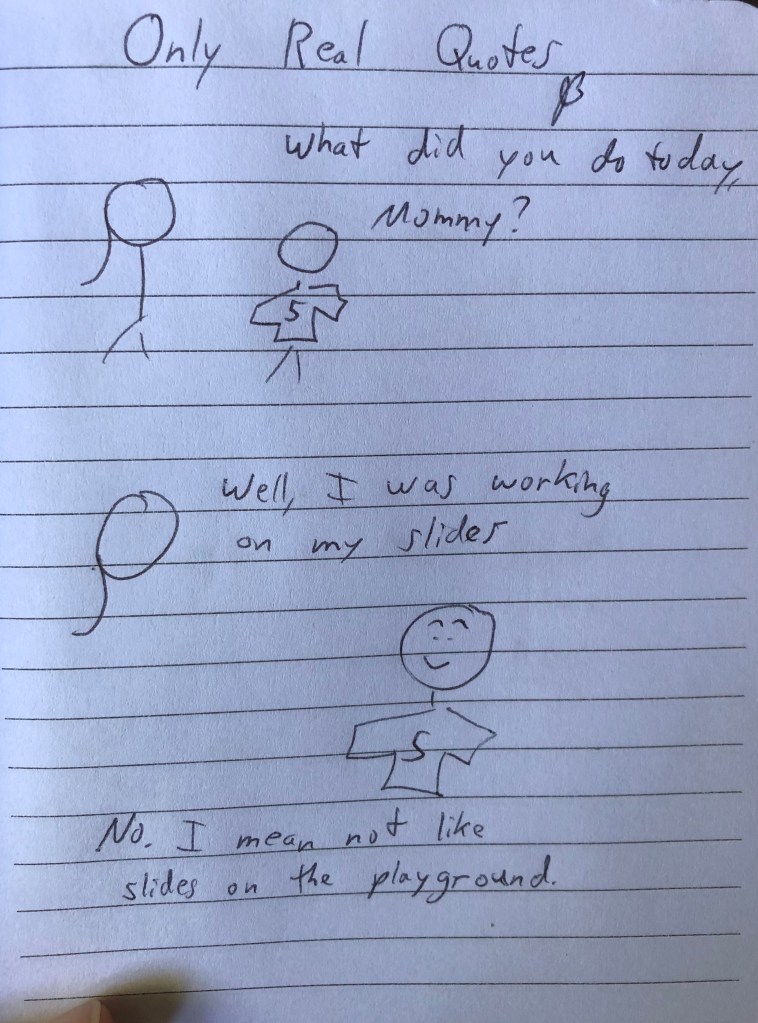
I’m going to occasionally make cartoons of actual things that people have said. The real world can be very entertaining. I was a graduate student at George Mason University, so I got to take a class from Bryan Caplan.
He broke up his 3-hour lectures with Caplan-jokes. I only remember one. Maybe it stuck with me because of the funny voices. He was talking about happiness and consumption in the context of microeconomics. He impersonated a German philosopher debating a British philosopher.
Do people do what makes them happy? What do we make, as economists, of people who claim that they want to write a novel but never do? If someone claims to prefer sad songs, can we really call them sad songs?
Next, here’s one from me and my son. I put his age on his cartoon shirt. I always ask him about the details of his day while I was away at work. He’s old enough to understand a little bit about how I spend my time, but sometimes I don’t get it right when I attempt two-way communication.
I love the Gastropod podcast. The hosts do a great job of trying to explain the historical debates concerning food in a charitable and careful manner. Their guests also tend to be very careful.
But the guest from the September 15th, 2020 episode about beef in the US was not nearly so careful. It’s a curse, really, to listen to a great podcast, only to have a portion of an episode ruined because a guest was allowed to spout on a topic outside of their expertise.
John Specht, a history professor at Notre Dame, committed such an offense that irked the heck out of me:
“Any reform is likely to make beef more expensive. So what that means is, I think, to avoid a charge of elitism, we have to recognize that changing how we produce our food has to happen in concert with building a more just society. We need to think of ways to make people better able to afford better-produced food. And we can’t just focus on one facet of that story. We have to think holistically about that. And what that means is that this is an even bigger challenge of what already was a big challenge. But it’s also perhaps even more powerful and even more important.”
Let me first say that I have no doubts concerning Dr. Specht’s knowledge concerning the history of beef in the US. If it’s like the rest of his Gastropod interview, I look forward to reading his book and I suspect that it is stellar. But the above quote has nothing to do with history and everything to do economics, public choice, and political economy. The above quote is why I can’t take seriously many people’s claims about what the ‘good’ is and how to achieve it.
Any regulation or legislation that introduces additional requirements for beef producers will, almost certainly, increase production costs. I’m not sure what a ‘just society’ means to Dr. Specht, but I’m sure that it’s not an objective thing (knowable or not) that aids in analysis.
“We need to think of ways to make people better able to afford better-produced food.” Luckily *we* don’t need to think of that. We don’t have the local knowledge of the beef market, nor the potential markets that beef-processing laborers face as alternatives (it’s different for everyone). The age-old, classical econ answer for improving people’s real incomes is to increase their productivity. Even if the labor supply for beef processing is perfectly elastic, and all increases in productivity accrue to the firm, the result of constant wages is a *partial* equilibrium conclusion. In general equilibrium, beef processing skills are probably partial substitutes for some other labor activity. This means that skilled employees can move to other sectors, employers, and industries. *We* don’t have much say aside from policy that makes productive innovation and skill accumulation easier.
Dr. Specht makes the problem out to be worse than it is and the solution to be more difficult than it is. We don’t need to reform an entire social and economic system. We don’t need a new political system that somehow, against all incentives, reflects compassion for beef processing laborers. That’s more than government can achieve.
Government *can* get out of the way. It can ease pathways to working legally in the US, which would reduce the labor abuses in which beef firms can indulge. Legal employment alternatives increases the opportunity cost of laborers. Government can stop subsidizing cattle hydration through water subsidies to ranchers. Reducing the number of cattle, and demand for meat processing laborers would cause fewer of these workers to be employed in what many consider an unpleasant job. With perfectly elastic labor supply, there is no decrease in wages. In general equilibrium, the decline in wages is small if there are many other firms that would demand the unemployed manual labor. Further, the decline in the quantity of beef produced would make the marginal carcasses more valuable. Employers will likely desire more skilled and better-compensated labor to carve the more valuable inputs. Importantly, the better compensation comes, not from a re-orientation of societal values, rather, from the higher opportunity cost enjoyed by labor that is more skilled.
But removing subsidies and permitting more foreign-born workers aren’t the reforms that are proposed by the likes of do-gooders. Do-gooders want to feel responsible for their good. It’s not enough for them to get out of the way – no one receives praise for permitting others to engage in hard work. Typically, it’s the hard-workers who get that credit. Do-gooders mistake proactivity with good intentions. The result is a desire to employ government in activities that are doomed to failure due to imperfect design and adverse incentives. The incentives provided by markets are inadequate – not for firms, but for the people who desire a prominent role as caring managers.
In an earlier post, I discussed the idea that memorable and persuasive arguments have the force of logic, credibility, and emotional appeal. Economists who stink at emotional appeal do so to their own detriment. One strategy to make an emotional appeal is to use the power of beauty to promote a sense of wonder and awe (see here). In this post, I discuss the use of experience in the classroom.
This idea really hit home with me in an EconTalk podcast with Milton Friedman. In that episode, Friedman suggested that public appetite for price controls was low — not because economists educated the public on their dangers — but because people still remembered the long waiting lines for gasoline. Once those memories faded, or the people who experienced those lines died, there would be a renewed desire for price controls.
Experience is important. But, the gas lines were a costly way to learn that lesson, especially if the lesson needs to be re-learned in every generation. How can we give students experience at a lower price? We can tell them stories from experiences around the world. I am in favor! I love case studies and their thick descriptions. At some point I will blog about my favorite stories to tell. But, for this post, let me propose the widespread use of classroom experiments.
The basic idea of a classroom experiment is to embed students inside an economic environment and give them a goal to maximize. For example, in an experiment on supply and demand students are embedded in a market institution and serve as either a buyer or seller. Their goal is to buy something at a low price or sell at a high price. These experiments can be run either with paper-and-pencil or electronically.
To show how these experiments can result in emotional appeal, let me recount a story. In a unit on price controls, I had students participate in a market without price controls followed by a market with a price ceiling. Back when I taught the Economics of Compassion class at FSU — specifically to the Social Justice Living Learning Community — I remember the following (quoted from here):
“The market without a price control demonstrated smooth convergence to the equilibrium prediction. The double auction with the price ceiling was chaos. Once the frenetic burst of trades stopped, buyers started yelling at sellers, “Post some asks!” and “Why aren’t you selling anything? We’re posting bids, why aren’t you doing anything?” The sellers of course shot back, “If we sell [at the max price] we will lose money!” It was chaos! I remembered that visceral reaction, the frustration, and the silence as all students waited with no trades happening … tick-tock, tick-tock, until the clock timed out. They felt the shortage. Students would stop me on campus (sometimes years later) saying they remembered playing that game.”
Experiments enhance credibility through engaging students in theory testing. But, to close I want to emphasize that experiments also help provoke visceral reactions and audible sighs. Experiments can help provide experiential punch in different institutional contexts at a low price. All of that connects students to the material in a way our logic and credibility alone cannot do.
As part of the spectacular lineup of seminars this semester at the USFQ School of Economics, we had the honor hosting the amazing Bart Wilson from Chapman University yesterday to present his book “The Property Species: Mine, Yours, and the Human Mind”. It was a very interesting talk and it definitely made me think differently about the traditional “bundle of rights” conception of property rights. One of the major perks of the switch to virtual conferences due to the pandemic, is having great international speakers (mostly US and UK based) present in our seminar.
The presentation made me rethink a small experiment (more a classroom demostration really) about the emergence of property rights I do with my intro students each semester. I can’t tell about the experiment just yet, just in case one of my students is reading this, because we are doing it in class today. You’ll have to wati until my next post.
You can watch the zoom presentation via Facebook Live (and like the USFQ School of Economics page in the process). Link: htps://www.facebook.com/watch/?v=626917664660173
How do young people fare when it comes to household wealth? The recently released Survey of Consumer Finances from the Federal Reserve provides some insights. One major takeaway: the much-maligned Millennials are doing pretty good! Ernie Tedeschi created this informative chart on Twitter:
Looking at household net worth at roughly the same age, Millennials today have roughly the same household wealth as Boomers did in the past. And both of these generations beat the generation between them, Gen X, as well as the “microgeneration” creatively labeled Oregon Trail.
And it’s something of a running joke on Twitter, but I must add: Yes! It’s adjusted for inflation!
Part of this may be driven by the increase in dual-income households. Certainly that matters. While wealth data by number of earners is harder to track down, income data is more readily available. What if we look at single-income households? Millennials are still in the lead! (Once again, the chart comes from Ernie Tedeschi.)
And before you ask: Yes! It’s adjusted for inflation!
None of this means that Millennials don’t face challenges, including financial ones. This data is current through 2019, so 2020 will almost certainly make these numbers look worse, for a time. But all things considered and anecdotes aside, the kids today seem to be as well or better than past generations.
I recently read C. S. Lewis’ The Discarded Image: An Introduction to Medieval and Renaissance Literature for a Zoom reading club at Samford University. It is based on his course lectures given at Oxford. I had expected a somewhat boring discussion of one obscure manuscript after another. But the book went in a different, highly engaging direction.
The Medieval Model
Lewis spends much of his time in describing the general mindset and methodology of the medieval writers, what Lewis terms their “Model”, to give us the necessary background for understanding and appreciating medieval literature. This helped me to better understand how people were thinking back in the Middle Ages (c. 500-1500 A.D.). Obviously, the particulars of their model of the universe were incorrect. But having a comprehensive model of reality which worked at the time helped to ground them, so they did not experience the sort of alienation which characterizes our age.
Medieval and early Renaissance authors did not generally just make things up. They very much relied on whatever Greek and Roman texts they had from pre-Middle Ages or early Middle Ages, which included a mix of philosophical/scientific (e.g. Platonic, Aristotelean, neo-Platonic), historical, and mythological treatises. In the medieval model of the universe (which was pieced together from readings of pre-500 A.D. authors), things below the orbit of the moon were contingent and corruptible and somewhat unpredictable. This was the realm of which we would call “nature”.
From the moon upward, was a more exalted realm, where the seven visible “planets”, which included the moon and sun, was each carried on its own transparent sphere. And also there was a sphere holding the stars. All these concentric spheres moved regularly (with some complications) and predictably. Beyond that was the “prime mobile” sphere, invisible to us, which gave motion to all the other spheres within it. God is the “Unmoved Mover” who gives motion to everything else.
Above the moon the space was filled with rarefied “aether”, instead of the thick, sometimes noxious air down closer to earth. Up there, it was always light, not dark, as we now think of “space”. (They understood the darkness seen when we look up at night as simply the relatively narrow shadow cast by the earth; everyplace else in the heavens was bathed in light). The heavens rang with the beautiful “music of the spheres”, and was inhabited only by good, incorruptible beings such as angels and the stars and planets, and, of course, God. Any daemons or other evil spirits were down in the thick air closer to earth, below the level of the moon.
The planets (which included the sun and moon) and the stars were perhaps not fully conscious beings, but they were not dead lumps of rock and gas. They were, in some sense, intelligent beings who were happy doing what they were made for as they danced their patterns in the heavens over and over again. They had effects or “influences” on the affairs of men. The moon could make people a little crazy, Venus called forth romance, Mars promoted warring passions, and so on. This influencing was not some kind of creepy, occult operation, but just the way things are, a more or less natural principle like gravity.
Some people could take this to a fatalistic determinism. The more judicious thinkers held that, while the planets and stars did indeed exert such influences, humans could and should exercise their reason and free will to resist being driven solely by such propensities. This nuanced notion carries down into Shakespeare, writing around 1600: “Men are at some time master of our fates: The fault, dear Brutus, is not in our stars, but in ourselves, that we are underlings.” (Julius Caesar)
Feeling at Home in the Universe
Medieval folks were aware that the universe was really, really huge. The earth was a tiny speck compared to the whole universe. However, the universe was finite, not infinite. That meant when they looked up, it was like looking up into a huge towering cathedral, not into empty space. So they would not experience what Pascal referred to as the frightening infinite dark empty silences of space. Also, they were looking up at a realm which was essentially happy and orderly, with each planet and star fulfilling its proper destiny.
I will close with a set of excerpts which convey their sense of being at home within a well-functioning universe and also their feeling of relatively seamless continuity with many previous centuries of interesting and often honorable human history. Their technology of plows drawn by oxen and of wars fought with swords and shields was not too different from the physical world of ancient Greece and Rome, and their culture of honor was likewise similar. I italicized some phrases which seemed particularly illuminating:
“Because the medieval universe is finite, it has a shape, the perfect spherical shape, containing within itself an ordered variety. Hence to look out on the night sky with modern eyes is like looking out over a sea that fades away into mist, or looking about one and a trackless forest – trees forever and no horizon. To look up at the towering medieval universe is much more like looking at a great building. The great ‘space’ of modern astronomy may arouse terror, or bewilderment or vague reverie; the spheres of the old present us with an object in which the mind can rest, overwhelming in its greatness but satisfying in its harmony. …This explains why all sense of the pathless, the baffling, and the utterly alien – all agoraphobia – is so markedly absent from medieval poetry when it leads us, as so often, into the sky. ”
“Thanks to his deficiency in the sense of period, that packed and gorgeous past [i.e., of classical myth and history] was [i.e., seemed or felt] far more immediate to him than the dark and bestial past could ever be to a Lecky or a Wells [i.e. modern science or science fiction of cave men, etc.]. It differed from the present only by being better. Hector was like any other knight, only braver. The saints looked down on one’s spiritual life, the kings, sages, and warriors on one’s secular life, the great lovers of old on one’s own armours, to foster, encourage, and instruct. There were friends, ancestors, patrons in every age. One had one’s place, however modest, in a great succession; one need to be neither proud nor lonely.”
“Other ages have not had a Model so universally accepted as theirs, so imaginable, and so satisfying to the imagination…. Every particular fact and story became more interesting and more pleasurable if, by being properly fitted in, it carried one’s mind back to the Model as a whole.”
“If I am right, the man of genius then found himself in a situation very different from that of his modern successor. Such a man today often, perhaps usually, feels himself confronted with a reality whose significance he cannot know, or a reality that has no significance… It is for him, by his own sensibility, to discover a meaning, or, out of his own subjectivity, to give a meaning – or at least a shape – to what in itself had neither. But the Model universe of our ancestors had a built-in significance.”
“I doubt they would have understood our demand for originality… [Why would one want to] spin something out of one’s own head when the world teems with so many noble deeds, wholesome examples, pitiful tragedies, strange adventures, and merry jests which have never yet been set forth quite so well as they deserve? The originality which we regard as a sign of wealth might have seemed to them a confession of property. Why make things for oneself like the lonely Robinson Crusoe when there is riches all about you to be had for the taking? The modern artist often does not think the riches is there. He is the alchemist who must turn base metal into gold.”