I have been reading Matt Yglesias’s book. I’m going to quote his podcast with Tyler here:
I also think that a lot of the way society is structured disincentivizes educated professional people from having a second or third child, even though it’s not that the objective financial cost of doing it is so high. But you think about Democratic Party micro-targeting of everything. They’ll say, “Well, okay. If this little extra boost will help lift some people over the poverty line, we should do that. But if you’re making $140,000 a year, you don’t ‘need’ help with your childcare costs.” That’s how the people in the think tanks think.
Matt Y
On the margin, people who don’t live in poverty still feel financial pressure. They still worry about whether they can “afford” more children.
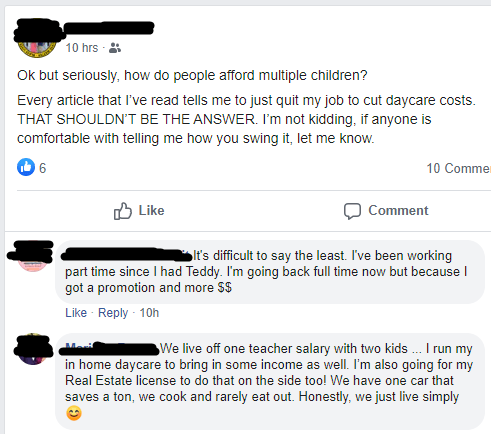
The following Facebook post stood out to me yesterday. I went to high school with this woman (call her Rachel). She teaches at a public elementary school in New Jersey. She is married with one daughter.
It sounds like Rachel wants another child, a sibling for her daughter. As a working mom, I can sympathize with her desire to not quit her job.
More answers from her peers include “I’ve been also looking for this answer. Anyone I know who has had more than one, one usually stays home and the partner works. I don’t know how people do it!” and “I have to say this month has been TERRIBLE! Paying $250 a month for my baby at daycare and then having my oldest there a few days a week bc my in-laws can’t handle zoom 😳 I’m literally working for health benefits.”
This response is probably from someone who is one stage of life ahead of Rachel, “It was hard but we lived off one salary till the kids were 5 years old. We didn’t go out or do much at all. Cost of daycare for twins was insane. Once they were in school most of the day I got my job…”
Matt Yglesias wants Rachel to have another child, and a third if she wants a “big family”. That’s not how we get to one billion Americans, it’s simply how we avoid population shrinkage.
I’ll probably deal with more of Matt’s ideas in future posts. Even if you disagree with all his policy recommendations, it’s a great book to get you thinking.
I did some quick Googling and it seems like Rachel’s job pays over $40,000 per year. It wouldn’t be crazy to assume that Rachel’s household income is “6 figures”. If their daughter is currently in daycare and they have a second child who needs daycare, then they could be looking at a daycare bill over $20,000 per year during the crunch time. That crunch time wouldn’t last very long, BUT that is a daunting bill to pay when you are also paying for rent and diapers and don’t want to eat beans every day. New Jersey has relatively high property taxes, rents, and daycare costs.
In Ecuador we bullfight with cars, literally. It’s not a game, its the name we give to the strategy we use when we cross the street. As in a bullfight, you stand on the edge of the curb, waiting for the car/bull to pass and then run behind the passing car to succesfully cross the street.
This is true no matter what the right of way legislation says (pedestrians have the right of way, de jure, in Ecuador as elsewhere), and as such is a very useful example to teach the difference between law and legistlation when talking about institutions. Although the actual phrase has fallen out of fashion lately, along with the falling popularity of bullfights (cue nostalgic music for dying traditions), the strategy remains as strong as ever.
Both pedestrians and drivers are familiar enough with the strategy that it is not uncommon to see pedestrians motioning angrily at the innocent driver that stops at a crosswalk, usually a foreigner, so that the car can pass and they can safely cross the street. Drivers speed up at crosswalks where people are waiting to cross, not in attempt to run them over, but as a courtesy, so as to get out of pedestrian’s way faster (at least many people I’ve talked to have shamefully confessed that is why they do this!). When a driver does stop at a crosswalk to give the people on the sidewalk the right of way there is a marked delay and drivers and pedestrians are incovenienced by the delay.
From conversations I have had with people from other developing nations, the strategy used by drivers and pedestrians to cross the street is nearly identical to bullfighting with cars we use in Ecuador. Although it’s not the best possible strategy for coordinating street crossing, it is an effective strategy that allows for social coordination since everyone knows that game that is being played. It is an institution of the developing world.
Moving to the US for my undergraduate degree, many years ago, I packed this institutional baggage along with me, which led me to be late for the first class of the semester. When I arrived at the crosswalk in front of a big red brick building in Boston’s suburbs, a car pulled up to the stop sign and stopped. My mind was lost thinking about what college in the US would be like, as I patiently waited at the edge of the curb for the car to pass so that I could bullfight the car to cross the street. A sudden honk of the horn startled me as I looked around to see an angry driver waving for me to cross the street. Partly because I was startled, but also because I was used to bullfighting with cars, instead of jumping out immediatly to cross, my feet began to do an akward one-step-forward one-step-back shuffle. It wasn’t until I made eye contact with the now exasperated driver, that I was confident enough I wouldn’t be run over to gathered my courage, break out of my developing-country meet developed-country shuffle, and finally cross the street.
Talking to a classmate from Central America later that day, he told me that he was all too familiar with what had happened to me, and with the one-step-forward one-step-back shuffle being discovered by tourists, immigrants, and foreing students all over the developing world. Many years later I have informally confirmed the shuffle still exists in conversations with students that have traveled abroad to the US and Europe.
When I tell this story in class, the question of how to switch to the obviously superior institutions of the US and Europe for street crossing, where pedestrians have the right of way, de jure and de facto always comes up. For institutional change to succeed without pedestrian bloodshed, the new institution would need to become common knowledge rather quickly. In more technical language, bullfighting with cars is the equilibrium now in the developing world, and we know a better equilibrium exists, but the path to the new equilibrium is difficult to traverse.
When I ask what students would do to change to this superior equilibrium, the most common first response is very economic in orientation. Increase monitoring and impose larger fines they say. But given the costs of these policies in an already poor and corrupt institutional environment, I doubt this is necesarily the path to superior institutions, for street crossing or anything else. This is especially true when we consider the relative cost effectiveness of changing this institution vs. other potential institutional investments in the developing world.
I also doubt that larger fines and increased monitoring are the main reasons that superior institutions for street crossing have emerged in the developed world. I have rarely seen police monitoring crosswalks (with the excpetion of school crossings) in the US and Europe, and while fear of punishment is definately an important influence, I don’t know how heavily the expectation of punishment weighs on the minds of drivers in developed countries.
Institutions are important for development but we know very little about how to change them. More thoughtfull students also suggest that a superior institutional arrangement could be reached by convincing people to change their perceived payoffs of playing different strategies. The hard and long process of social entrepreneurship, seems more effective and conducive to robust success.
When contentious cultural and political issue arise in the USA, foreign intellectual elites invariably align themselves along partisan lines that try to mimick those of the cultural center of the world, the USA. The incomplete, and often contradictory overlap between foreign social reality, and that of the USA never fails to offer interesting paradoxes.
The intelectual battles, fought on foreign intellectual soil, are part of what I will call the proxy culture wars. The resulting paradoxes tend to stiffle local debate on local issues (I will use local as in local to a foreigner, i.e. not in the USA) by locking the participants into paradoxical positions. While the situation is amusing it causes real problems when trying to reach consensus on local solutions to local problems, communicating across the local partisan divide, or even thinking clearly about local issues.
For example, with the nomination of Amy Coney Barrett to the Supreme Court of the USA, legal twitter in Latin America has exploded in support or condemnation of her nomination. Those on the local/foreign right express their admiration for originalist interpretations, while those on the left local/foreign begin reciting Dworkin and praise interpretations of a living constitution. The ensuing battle would be relatively harmless if commentary on the goings-on in the USA was all that was at stake. But this is seldom the case as the parties bring out full battle regalia and engage in terms of the underlying merits of these positions as if they were general positions, applicable to local reality. In the fog of war, the local conditions and the contentious issues in the USA get mixed together.
The paradox arises when the debate turns local. For example consider Ecuador, where the constitution adopted in 2008 largely reflected the policy preferences of the self described twenty first century socialist president Rafael Correa (local left, now conviceted for corruption to 8 years of prison). Do those on the local right really admire originalism as a judicial doctrine? Do those on the Ecuadorean right really wish local judges would faithfully apply our constitution with its 99 constitutionally protected rights? Mind you, these rights include a right to universal access to information and communication technologies (Art. 16), recreation, the practice of sports and free time (Art. 24), and permanent and secure access to heathy and nutricious food, preferibly produced locally and in correspondence to the diverse identities and cultural traditions (Art. 13). Interesting side note: as documented by the Comptarative Constitutions Project, Ecuador ranks #1 in number of codified constitutional rights. But the nature of these rights and the problems they bring about are topics for future posts.
Does democracy require codified constitutional rights? Evidence from Latin America.
The most democratic countries in Latin America have few codified constitutional rights.
And the least democratic countries in Latin America have many codified constitutional rights. pic.twitter.com/fw2GZWusfV
Are those on the Ecuadorean left, oponents of originalism and supporters of a living constitution really arguing for a more expansive interpretations of these rights? For example when the fiscal reality of the Ecuadorean government makes it impossible for the government to guarantee one of the 99 rights codified in the constitution, do those on the left argue for an expansive interpretation? Do they really want an expansive interpretation so that the government is let off the hook when it fails to provide access to smart phone technology for all Ecuadoreans, because of unsustainable fiscal position?
Of course what is really going on is a great example of motivated reasoning. Conclusions are arrived at, and arguments follow to support those conclusions. The paradox arises as the arguments that support “things I would like in the USA” do not necesarily map well to “things I would like at home”. The lack of coherence between local reality and comentary on the affairs of the USA leads to paradoxical positions that muddy local debate, and lead to incoherence and sloppy thinking.
People have a lot of opinions about diet. For many, dietary opinion is individual – they don’t prescribe that anyone else adopt their beliefs and practices. Others have a more universal bent. Some people are dead-set against starches and others think that meat is taboo – for themselves and others. There are a lot of beliefs about diet.
The reasoning that people use for their dietary beliefs are just as diverse. Motivations range from religious beliefs, moral systems, social signaling, personal experimentation, anecdotal evidence, and so on.
Some people use the theory of evolution. They reason that we have canine teeth, like carnivores, so our ancestors had advantages in meat-eating. Others reason that we have relatively long small intestines, like herbivores, so our ancestors had advantages in plant-eating. Expert scientists from any one of a plethora of subjects are interviewed or write as authorities on the matter.
The problem, of course, is that using words like ‘meant’ or ‘designed’ implies one who ‘means’ or one who ‘designs’. For most religious people, there is no conflict. For an atheist, it’s strange turn of phrase. Why? Because evolution has two parts: 1) mutations that introduce variety and 2) natural selection. The former occurs prior to an animal’s birth. The latter occurs as a result of environmental reproductive pressure and opportunity.
In other words, to an atheist, there is no designer. So, what gives? I’ve settled on several plausible good-intentioned explanations that I order by increasing charity.
Poor Evolutionary Understanding: The atheist scientist’s understanding of evolution is flawed. Maybe their theory includes first-person or third-person intentionality. An example would be that giraffes stretched and intended that their necks would become longer over the generations. An alternative poor belief is that environmental pressures, including predators and vegetation, intended that giraffe necks would lengthen. Environmental pressures achieved their goal through reward of the long-necked and the punishment of the short-necked. I like to think that scientists have a better handle on their area of expertise rather than having beliefs such these.
Poor Grasp of English: The atheist scientist has a perfect grasp of evolution, but they are unpracticed at English in contexts of emergent order. Economists often have similar challenges and often refer to speaking allegorically as a crutch. Economists will say that prices ‘want’ to change or that a government desires social outcomes. Neither of which is true. Suppliers lower prices as their sales become lackluster. Policy outcomes are desired by someone within a governing process – though the social outcomes may be desirable by nobody. Similarly, predators desire to eat and unknowingly exert selective pressure for genetic traits. Or, a drought causes smaller lizards to survive and larger ones to dehydrate and die. English speakers have difficulty discussing biological processes without intention-denoting verbiage.
Implicit Theism: The atheist is really no atheist at all, but has belief in God that they cannot shake, despite their professions and logic otherwise. Using the past perfect tense in regard to the design of humans is case of parapraxis – a Freudian slip.
An Expertise Gap: Specialists in arts and sciences utilize highly specific jargon so that very specific concepts can be expressed concisely. But such jargon muddies communication with those who aren’t specialists in the field. The specialist grapples with this expertise gap. Although the struggle deserves sympathy, anthropomorphizing is far different from the expert’s idea of the truth.
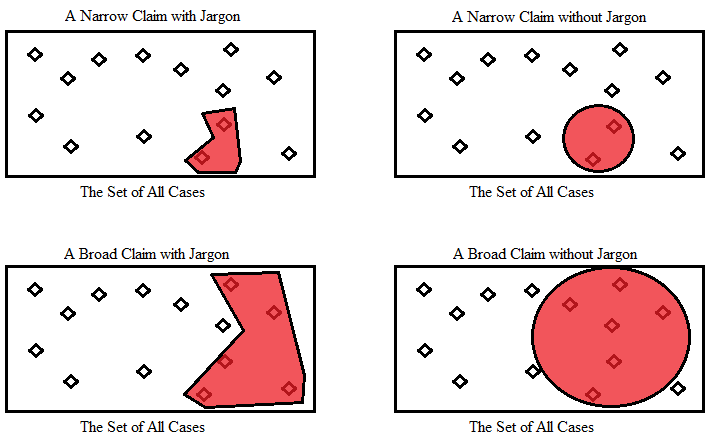
The problem is that jargon has highly a specific meaning. So, when a specialist makes a claim with jargon, the claim is also specific. A narrower set of applicability has less room for credible challenges at the margins of a claim and ideas can be clearly communicated precisely – though, the applicable cases may not be interesting. As the breadth of a claim increases, jargon can help to ensure that the breadth is limited to appropriately specific cases.
When the listener is not an expert, the scientist is uncertain of the gap in knowledge. They attempt to make relatively broad and interesting claims, but without the aid of their case-narrowing jargon. The result is that the expert says something which is clearly false to another specialist, but may be mostly true – or true enough for the listener.
Again, these four interpretations of misspeaking and miscommunicating experts are ordered by charity. I especially sympathize with the last interpretation. Imagine trying to teach a student that inflation is always costly, but sometimes more beneficial than costly. And that the costs still exist when the benefits outweigh the costs. So, should we have a policy of inflation? The true answer is highly specific.
Does an atheist scientist understand that there is no designer of human bodies – much less one that had diet in mind? Very much. Does the same atheist scientist know how to communicate unintentional biological advantages to the non-specialist? They do not. What’s more is that they are not alone. Specialization introduces a knowledge gap and the unavailability of common jargon prevents adequately finessed broad claims.
Political polarization has been rising in the United States in recent years. There are two key reasons contributing to the polarization. First, we naturally hold different beliefs over objective matters. Furthermore, we trust different news sources. According to the 2020 Pew Research Survey around 75% conservative Republicans say they trust the information from Fox News, while 77% liberal Democrats say they distrust it.
Media outlets and politicians on the right and left sent divergent messages about the severity of the crisis during Coronavirus pandemic. A joint study by economists from NYU, Stanford and Harvard university find evidence for partisan differences in social distancing (Allcott et al. 2020). They combined a survey study with GPS location data, where GPS data record daily and weekly visits to the points of interest (POIs). The GPS data shows the strong partisan differences in social distancing behavior that emerged with the rise of COVID. The analysis carefully controlled for local policy, health, weather, and economic variables, the result remains statistically and economically significant. They also used a nationally representative survey to measure the individual behavior and belief differences about social distancing. Demographics, beliefs regarding the efficacy of social distancing, self-reported distancing, and predictions about future COVID cases. They find compare to Republicans, Democrats believe the pandemic is more severe and report a greater reduction in contact with others.
Reference:
Allcott, Hunt, Levi Boxell, Jacob Conway, Matthew Gentzkow, Michael Thaler, and David Y. Yang. “Polarization and public health: Partisan differences in social distancing during the Coronavirus pandemic.” NBER Working Paper (2020).
In my undergraduate training, I never came across the term “co-production” but after learning about it a few years back, I find I return to the concept frequently. Co-production is the idea that a consumer’s input is important to production. The term was coined by Nobel Laureate Elinor Ostrom. Examples include:
Police protection – We lock our doors, buy security systems, and engage in neighborhood watch groups.
Fire protection – We buy appliances with improved safety features and have fire extinguishers in our homes.
Education – Parents involve themselves in the education of their children through practice, ensuring the child does their homework and gets plenty of sleep.
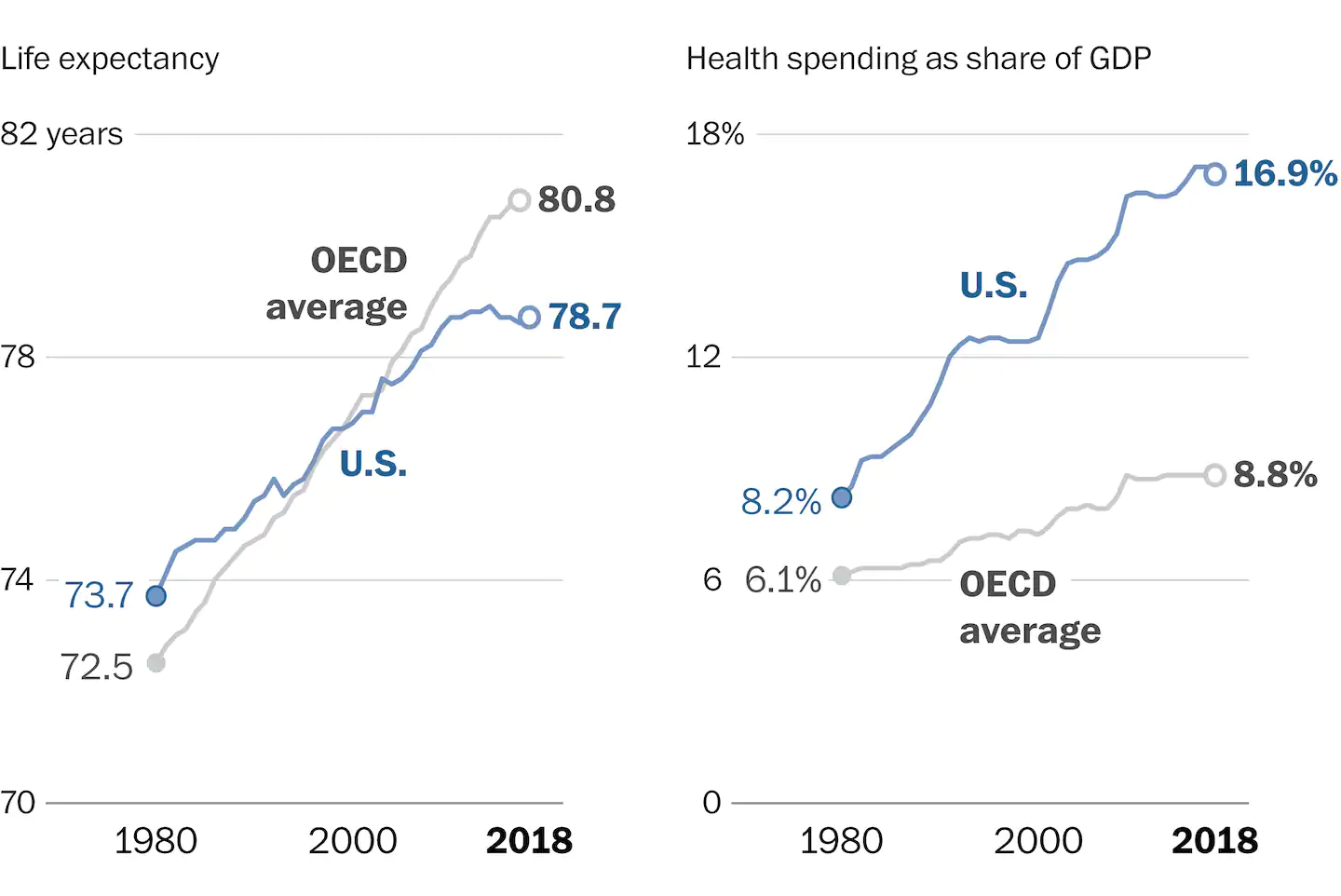
Once you start to think about co-production, you see it everywhere. For example, I am currently teaching health economics and it is not uncommon to come across graphs like this (see below) from The Washington Post. Some suggest these differences highlight how the U.S. needs a less market-oriented health system. But, when I see the graph, I think of all the ways in which the United States is different. Specifically, I question the extent to which we are good co-producers of our health.
In the United States, 36 percent of adults were considered obese in 2016. The most among OECD countries. You can present similar data on drug use disorders, alcoholism, mental health disease burden, and so forth. I do not mean to suggest we have equal control over all of these outcomes but we are often not powerless.
The debate about government v. market provision of health services is a discussion for another time and sure to feature in the upcoming presidential debates. But, I do think any intervention in the health sector that does not address co-production will oversell and underdeliver.
Katherine Abraham and Melissa Kearney just published “Explaining the Decline in the US Employment-to-Population Ratio: A Review of the Evidence” in the Journal of Economic Literature.
The unemployment rate measures people who are actively looking for work and can’t find a job. The authors are not examining short term fluctuations in unemployment (which shot up in pandemic times). They are looking at at long term decline in employment rates of working-age adults in the US. The trend began in 1999. Employment of adults in the US dipped after the Great Recession and still has not recovered a decade later. Less-educated males have experienced the largest drop in employment.
I’m reviewing the entire paper with my Labor Economics class. Most of what the authors talk about can be found throughout our Labor Econ. textbook, but I like using the paper to organize and motivate the collection of facts and theories.
Here’s a summary of their thorough examination of possible causes of the decline in working.
They estimate, drawing on other empirical work, that two factors have a considerable and measurable impact on the decline in formal employment. Import competition from China (the US changed their position on trade with China in 2000) and automation (industrial robots) both result in lower demand for US workers.
There are three contributing forces that the authors declare them to be minor casual factors. Increased receipt of disability benefits disincentivizes working, higher minimum wages results in less jobs, and the increased incarceration rate in the past few decades takes adults out of the labor force.
The paper is called “A Review of the Evidence”. The following is a list of factors that could in theory be responsible for the decline for working but for which data is scarce: Lack of child care Changes in leisure options (i.e. young men play video games) Changes in social norms (i.e. young people can stay “in the basement”) Increased use of opioids (could be a result of diminished job opportunities) Rise in occupational licensing Frictions or matching issues
All of those indeterminate items represent research opportunities.
I categorize this as “News”, because I don’t know if we will have enough posts on medicine to justify a whole category for Medicine. Because the coronavirus is affecting life so much, it’s well worth writing about currently.
R0 is the average number of people who will contract a contagious disease from one person with that disease. If you want, you can pronounce it “R naught”.
If R0 is less than 1, and stays that way for a while, the disease will disappear. That means that the virus can still be passed around between a few people (for example, if 1 out of 1,000 people forgets to bring a mask into the grocery store), but over time it will run out of targets and we will be done with this whole thing. If R0 is above 1, that means that a few cases produces more cases and eventually most people will get infected. Once you understand the potential of R0<1 it does become tempting to engineer a lockdown.
We understand the spread of the virus better than we did when lockdowns were first discussed in the US in March 2020. It’s not as simple as every infected person giving the virus to two new people. The way the virus spreads is often through “superspreaders” and superspreader events. That’s why so many large gatherings have been cancelled and continue to be cancelled. With this wrinkle in mind, there is still the overall R0 score of whether the virus is increasing or decreasing.
If you fail to stop the initial spread of the virus (R0 > 1) then a great many people can be infected and eventually the spread will slow simply because the virus is running out of hosts. One of the more controversial topics in Spring 2020 was whether “herd immunity” is or is not something we should want to achieve as a society.
One of the absolute best places to get virus news is MarginalRevolution.com. Today, Tyler has written a new post about herd immunity. I’ll provide some quotes. Much more at the link of course.
… these same herd immunity theorists tended to be less pessimistic than many of the mainstream forecasts…
Now, I don’t recall many of those theorists early on making a prediction about a specific number required for the herd immunity threshold to be reached. Nonetheless, when deaths and hospitalizations collapsed in Sweden, London, and New York at about 20 percent seroprevalence, obviously it seemed that might be the critical level for herd immunity to kick in.
…
Then things started to go askew in the last few weeks. First, it seems like a bad second wave came to an already fairly hard hit Madrid. OK, you could say Madrid was never had 20% seroprevalence to begin with. And then what appears to be a second wave has started coming to Israel, with rising hospitalizations. Finally, it is believed that in Britian R equals about 1.7, and that a second wave of cases is on the verge of hitting London and Southeast England.
Tyler Cowen
Even though no one has all the answers, this is the conversation we should be having. In fact, I’m starting to wonder if we should make a Medicine blog post category.
It was just yesterday that the dreaded and long foreseen 200,000 deaths was confirmed.
Preheat the oven to 440-450°F (230 °C). Position a rack on a lower-middle shelf. The top of the fully risen popovers should be about midway up the oven. You don’t want the tops of the popping popovers to be too close to the top of the oven, as they might burn.
Use 12 cup nonstick popover pan, e.g. Chicago Metallic. Lightly grease the cups (may not be necessary every time). It is possible to use a standard, i.e. non-popover 12-cup metal muffin tin, one whose cups are close to 2 1/2″ wide x 1 1/2″ deep, though results may not be quite as good unless you preheat the muffin tin in the over for five minutes. As noted above, reduce recipe size for 6-cup popover pan (where each cup is somewhat larger than with the 12-cup popover pans).
Use a wire whisk or beater on low speed to beat together the eggs, milk, and salt. Whisk till the egg and milk are well combined, with no streaks of yolk showing.
Add the flour all at once, and beat till frothy; there shouldn’t be any large lumps in the batter, but smaller lumps are OK.
Stir in the melted butter, combining quickly. Best to let batter then rest at least 10 minutes, e.g. while oven preheats.
Pour the batter into the popover cups, evenly; about 2/3 full. [For 12 standard muffin cups: fill them about 2/3 to 3/4 full. ]
Make absolutely certain your oven is heated, 440- 450°F.
Bake the popovers for 19-20 minutes without opening the oven door. Reduce the heat to 360 °F [180 °C] (again without opening the door), and bake for an additional 15-20 minutes, until they’re a deep, golden brown. [If using muffin tins, for second phase cook only 10-15 min at 350 F]. Preferable: pierce them about 2 minutes before removing from oven to release steam.
If the popovers seem to be browning too quickly, reduce temperature a little.
NOTES ON MAKING POPOVERS:
( A ) These are fairly healthy and easy to make, and taste delicious split open and served warm, with butter and jelly, for dessert or snack. Can also serve with things like chili or stew. Get creative and fill with pudding or whipped cream and fruit. Popovers taste almost like pastry, but without all the fat. The larger popovers from the 6-cup pans look more dramatic, and have big cavity inside them, especially when made with all white flour.
( B ) These are best cooked in special popover pans. These have typically six or twelve metal cups, joined by fairly thin metal rods, so heat can get quickly to the cups. It is possible to cook popovers in regular muffin tins.
( C ) The oven needs to be hot, and the oven door kept closed to keep moisture in, in order for the popovers to rise. They rise because steam gets trapped in sticky eggy dough.
( D ) You can make these with all white flour. Use a full 1.5 c white flour. (I cut back a little with the amount of whole wheat flour, since it absorbs more liquid than white flour). Using all white flour tends to make the popovers rise more, with thinner, drier walls. I like them a little thicker and chewier, hence the whole wheat.
( E ) Popovers are best when eaten within an hour or two of cooking. With time, the crispness of the outer wall gets softened by moisture from the inside. They can be re-crisped by heating in an oven or electric skillet or large covered frying pan at say 350 F for ten minutes or so. They can also be frozen, then gently thawed in microwave and then re-crisped.
( 2 ) TRADITIONAL IRISH SODA BREAD (NO YEAST)
INGREDIENTS
4 cups (580g) all-purpose flour
1½ teaspoons baking soda
1 teaspoon salt
Scant 2 cups (470ml) cold buttermilk
INSTRUCTIONS
( 1) If you don’t have buttermilk, first make it by adding 3.5 T vinegar or fresh lemon juice to measuring cup, and filling to two cups with whole or 2% milk (i.e. a scant 2 T vinegar per cup of milk). Stir and let sit for at least ten minutes for milk to sour. I used apple cider vinegar for a faint fruity aura.
(2) Preheat oven to 425 degrees F (218 degrees C) , or slightly hotter if your oven runs cool. Line a baking sheet with parchment paper or grease well; set aside. You can also use an 8″ cake pan or oven proof skillet.
(3) In a large bowl whisk together the flour, baking soda, and salt. Stir in the buttermilk just until combined and the dough starts to become too stiff to stir. Transfer to work surface and with floured hands lightly knead the dough 5-10 times or until all the flour is moistened and the dough comes together.
(4) Form dough into a 1 ½” (4 cm) high round, approximately 8” (20 cm) diameter. Place on prepared pan. With a serrated or very sharp knife cut a deep cross on the top from side to side, cutting about a third of the way deep into the dough. Bake for 30-35 minutes or until golden brown and it sounds hollow when tapped on the bottom. Alternatively, bake at 425-440 F for 20 min, then turn down to 400 F for last 15 or so minutes.
RECIPE NOTES FOR SODA BREAD
( A ) Note the dough for soda bread is NOT kneaded to the point of being smooth, but just enough to barely hold together, still looking “shaggy”. The reason is that with the baking soda, all the CO2 is released in a relatively short time as the dough heats up, so the dough has to be soft (not tough and cohesive) so it can quickly stretch. (This is the opposite from yeast bread, where you knead the dough long and hard to build gluten chains to strengthen the dough, so the CO2 produced slowly from the yeast during rising will not escape.)
( B ) The deep cross cut in the dough helps it expand, and helps heat to get to the center of the loaf.
( C ) This is authentic, basic Irish soda bread. The crust comes out pretty hard. It is great for dipping in stew or soup, or just spread with butter while warm and chew carefully. I like to have the crust a bit softer, so I brush the loaf with buttermilk or butter just before baking. When cooling the loaf, cooking on rack will make crust crispy, while being covered with tea towel will soften the crust.
( D ) As with most real bread, this goes stale very fast. I suggest cutting off whatever portion you will not eat that day, and freezing it. It is fine thawed. Bread that is not too stale can be partly, temporarily resuscitated by wetting the crust, and baking it for say 12 minutes at 350 F.
This is a slightly more complex recipe for Irish soda bread, including butter, egg, a little sugar, and currants or raisins. Gives softer, sweeter version, verging on scone, instead of plain soda bread with tough crust. Has nice short confidence-building video showing how to work the dough. And has good photos of what dough should look like at each stage.
Currently, I subscribe to Bloomberg Businessweek. Instead of ranking MBA programs, this year they decided to report on a survey of students about switching to online classes. (in the Sept. 21 issue)
Overall, the reaction from students has been negative. They believe an online MBA is not as valuable as the traditional in-person experience.
Something MBA students state, which I have already heard from my own undergraduates, is that it’s difficult to focus during online instruction hours. If your face isn’t being watched through your webcam, then it’s tempting to “multitask” and not pay attention to the professor. I feel the same temptation when I join online research seminars.
What’s the most sympathetic view of this situation? Doing your online classes “isn’t that hard”. I feel like the scold looking over my bifocals at millennials saying, “going to a dry cleaner isn’t that hard”. (We millennials cannot be bothered to go to a dry cleaner.)
Here’s my first and brief thought: College students today have been taught to use screens for recreation by their parents.
Parents put kids in front of screens to get rid of them. I get rid of my own kids by putting them on screens. I ensure that they are not watching something evil.
I hope parents are diligently ensuring that their preteen daughters are not chatting up predators. What responsible parents have been told is to try to limit total screen hours and also to try to keep your child out of the digital equivalent of dark alleys.
That kind of guidance doesn’t teach students how to use screens constructively. They are suddenly being asked by teachers to be constructive on the screen. Some of them can hack it. Some of them can’t. None of them were prepared for this.
Your typical 20-year-old college student today must have done well in traditional classrooms because they did, after all, get admitted to college. But when they were on their screens, they were scrolling and gaming and indulging their impulses. As long as they physically showed up to class on Monday morning and turned in enough homework assignments, no adult was going to make them do chores on screens.
Since screens are here to stay, we need a lot more research on how to raise humans who know how to be responsible on screens.
No answers came to me when posed this question to the hive mind:
Should we gamify more good things or teach our species to do good things without gamification? (If there is a right answer to this question, then many implications follow for teachers.)