How HOAs are Born

I live in Florida and there is a lot of residential construction down here. It’s not typically people just deciding to build a house on some isolated plot of land. A large portion of construction is private or semi-private neighborhoods built by developers. They often include manicured common spaces and strict Home Owners Association (HOA) rules.

The typical procedure is that a developer purchases a large parcel of land, and then starts building. Before the first house is even sold, the HOA is established and the governing board is packed with developer representatives.  Written into the HOA bylaws is that the developer maintains a preponderance of the HOA representation during construction. This makes sense. ‘Nice’ neighborhoods command higher property prices and the developer has often invested *very* large sums of money. Certainly more money than it’s willing to risk at the hands of a sloppy, owner-controlled HOA.

Best practice differs by developer.

Typically, the residents will have seats on the HOA board in some proportion of development project completeness. For example, if 75% of the total planned lots have been built and sold, then the developer may retain 2/3 or 3/5 control of an HOA board. The developer finally relinquishes all HOA control after 100% of the planned units are completed and sold.

Ignoring policies for beautification and such, a HOA boards under developer control act differently from those that are resident controlled. As I said, the developer has full discretion on HOA policy, practically speaking, because it maintains a majority of the voting members. But, HOA fees are *not paid* by the developer.[1] Only homeowners pay HOA fees.

For example: Not everyone wants cable TV. But the developer knows that home-buyers want the option for cable TV. Typically, one of the first HOA orders of business is to pay for monthly cable TV. Every single unit pays for cable TV through their HOA fees – whether they use it or not – in exchange for the cable company laying cable lines and providing access. Typically, these contracts are often a decade in duration, after which time the contract can be cancelled and owners can individually decide whether to pay for cable. It’s not obvious that an owner-controlled HOA would pay for cable and have lines laid in the first place (Satellite TV anyone?).

To be clear: The developer sets the HOA policy priorities and determines the HOA budget. Then, the owners pay the quarterly HOA fee. Can you say Principal-Agent problem? Early HOA activities include less resident engagement because residents don’t much affect outcomes. The developer also doesn’t mind higher HOA fees because it doesn’t bear the cost. Do you expect your HOA to put contracts up for bid, say, to do landscaping, pressure washing, etc.? If your HOA is developer-controlled, then you should expect no such thing. Putting contracts ‘up for bid’ is time consuming and reflects a concern for costs. Not to mention that the quality of the bid work may be variable. Developers want high property values and they want them dependably. HOA fiscal prudence, besides solvency, is not a priority.

Having said all this – it’s true that your neighborhood may be ‘nicer’ due to developer control of the HOA. Depending on you preferences, this might align nicely with your priorities. If that’s true, however, you can expect to be less happy in the long-run when your neighbors ultimately gain control of the HOA.

I’m on my HOA board and it’s now 100% privately owned. There are still principal-agent problems. But they are much easier to address now that everyone on the board pays HOA fees. Our problems and our opportunities are truly ours.


[1] Sometimes, the developer will provide a loan to the HOA to provide for initial management costs.

Economists, look to beauty

When you mention you teach economics, who among us hasn’t heard someone blurt out, “Oh, I hated that class!” or sigh, “I just never ‘got it’”? There are probably many reasons for this but I suspect their teacher did not have an appreciation for the “rhetorical triangle” or Aristotle’s modes of persuasion: Logos (logic), ethos (credibility), and pathos (emotion). Economists often act like logos and ethos are enough. They are not!  When we construct arguments with only the two it’s like trying to create a stable two-legged stool. Good luck, something is missing.

Economists need pathos to create an argument that is memorable and doesn’t fall apart. In this short post, I want to explore the role of beauty to make that emotional appeal.

Christian author Donald Miller writes, “Sometimes you have to watch somebody love something before you can love it yourself. It is as if they are showing you the way.” How can we show students our love for economics and the beauty of the economic way of thinking? Through discussion of what excites us. From helping students to see economics “in the wild” of everyday life to helping students see the magic of markets. All of this improves their understanding of principles and economic concepts. First, let me discuss the mundane and then we can discuss the magic.

When I was an undergraduate, every Friday night I would head to Sonny’s BBQ with some buddies. On Friday nights they had the all-you-can-eat baby back ribs. Normally, the rib re-orders came promptly and the sweet tea refills flowed. But, on one particular Friday night the service was pretty bad and we talked over empty plates and cups.

Why? It wasn’t busier than normal. They didn’t seem understaffed. Our waitress was paying attention to other tables but not our table. Why? Well, our normal group was a party of four but we invited a couple more friends that week. For six person tables, automatic gratuity kicked-in and the waitress was paying attention to tables where her gratuity could still rise or fall with the quality of service. She had us locked in at 18 percent, and being poor college students, she likely didn’t expect us to tip more than 18% if she gave good service. Economics in the wild! The power to explain the mundane.

Share your own stories with your students (or on this blog!). When is the first time you saw economics in the wild? When is the first time you realized you were an economist? For inspiration on the mundane, check out Robert Frank Economics Naturalist and his conversations with Russ Roberts on that book as well as dinner table economics.

For a transition from the mundane to the magic consider having students read, “I, Pencil” by Leonard Reed. Though the video with Uncle Milt is wonderful too. The remarkable journey of a simple pencil!

Build on those ideas either before or after you have them read “I, Pencil” or watch Milton Friedman. Hand out chocolate chip cookies to students and ask them to describe in as much detail as possible how to make a chocolate chip cookie (no, not their grandma’s recipe). Then, help them to see something so simple like a cookie required vast networks of exchange coordinated through a price system that nobody controlled. Inconceivable!

For another great magical treatment of economics, check out Russ Roberts’ poem, “It’s a Wonderful Loaf” (accompanying video on the same site). The emergence of order from seeming chaos is profound.  

We rarely feel more human than when we are on a journey. Beauty has the power to place us on that path of inquiry that awakens a desire to know more. In that search for beauty, we shouldn’t discount the mundane. I tell students there are few things more exhilarating than seeing economics in the wild. You feel like you have a decoder ring to explain the puzzles of our social world. On the other hand, I have always found the magical explanations special and profound, to be appreciated like works of art. Yes, they increase understanding but they also evoke a sense of awe. Both the mundane and magical are beautiful and economists should look to beauty more. Our arguments will be better if we do.

Thoughts on “The Social Dilemma” Documentary

I rarely watch things right when they come out. For once, I’m fairly current on something: the Netflix documentary “The Social Dilemma”.

Former employees of tech companies are using their talents to try to make sure that technology takes our society in a good direction. They appear to feel guilty for creating a product that is so fun it has become addictive.

They call attention to the negative effects of social media, which were difficult to foresee. The guy who claims to have created the Facebook “Like” button says that his intention had been to spread happiness. They didn’t realize that the lack of likes could exacerbate teen depression. They worry that in some cases it has even led to suicide.

They mention early on that social media has actually done some good. I know personally someone who was adopted from a foreign company and then reconnected with his birth family by searching his family name on Facebook.  That’s neat.

I think they underrate Facebook as a utility for adults. Parents are using Facebook to notify neighborhood residents of school fundraisers. Adults are using Facebook to sell used furniture.

Facebook is a place to turn for entertainment, but it’s really become more than that for my generation. We don’t have physical address books. We have a phone Contact list and we have our Facebook accounts.

Facebook is not the only service being scrutinized. Former employees of Google and Pinterest, among others, came forward to talk about how those services use customer data to sell advertisements.

One of the good points they make is that the algorithms that maximize ad revenue do not have user well-being in mind and can unintentionally lead to spreading false “news” stories. It’s important for users to know this. I am glad that more people are aware, thanks to the documentary.

The fact that radio is funded by ad revenue never caused us to shut down radio. Maybe it was always more transparent to listeners, and the fact that it is less individualized makes it feel less creepy.

Speaking of creepy, this documentary is creepy. It’s full of creepy music and long pauses in which your mind goes to dark places. They should have made it one hour instead of 1.5 hours. It was very manipulative, which makes sense because it was made by people who confess that they are professional manipulators.

My conclusion is that we should treat social media like alcohol. Most people can live with alcohol, but it kills. Every year, alcohol kills people. The US government estimates that alcohol kills 88,000 people every year in the US. We should be more careful with alcohol and we should all be more educated on the potential for harm.

Some people would be better off if we completely banned alcohol, but currently the strategy is to manage harm through EMTs and medical treatment. There are support groups for people such as Alcoholics Anonymous.

We think young people are more likely to hurt themselves with this dangerous item, so we restrict the sale to youth.

The internet can be very harmful to children and teens. It’s important to point out that respectable social media services like Pinterest are not the only places where kids can go. Kids and “screens” is a whole ball of twine. Regulating Facebook may actually do very little to protect children.

We can do a public health campaign, sort of like what’s going on with sugary sodas right now. I think this documentary is the beginning of a productive conversation.

It’s hard to say that I disagree with the conclusions of the filmmakers. I suspect that I do, and yet they mostly just tell stories and ask open questions and fidget quietly on screen. So, it’s hard to pin them down on precise policy recommendations. Although I resent having to watch them fidget for so many minutes, I also don’t want to sound ungrateful for the effort they made to raise awareness of an issue they feel strongly about.

Let’s have more documentaries, and more blogs, and more in-person conversations about how to make a better world now that the internet genie is out of the bottle. Let’s keep middle school students off of social media. It starts at home and in the neighborhood.

Can I Borrow Your Reference Point?

That is the title of a blog I wrote for a new publication Works in Progress.

I summarize an article I published in 2020 and relate it to the current polarized political environment, which is not an extension I made as explicitly in the article.

We often talk of a moral obligation to sympathize with others and “walk a mile in his/her shoes”. We do not often “walk a mile” in the shoes of our neighbors just to be nice, and we can’t even do it for money. In a lab experiment, I put people in an environment where they could earn money for accurately guessing what others did. I found that people tend to transfer their own reference point on to other people, which causes them to make bad predictions.

There is more at the blog. I end with a conclusion that some might say is too optimistic or too generous to the opposing side:

If people of opposing political persuasions spent more time learning each other’s life stories, then we would end up with a less toxic climate.

How Much Money Is There?

It is not straightforward to define what “money” is in a modern national economy. Simply tallying the amount of coins and paper currency is inadequate. Most buying and selling is now done by shifting numbers between abstract bank accounts, not by pushing a bundle of bills across a table.  Thus, these bank accounts serve the functions of money (medium of exchange and store of value). The question then arises as to which of these financial accounts to regard as money.

Among financial assets, there is a broad spectrum of liquidity. Typically you can write a check on your checking account which, when it clears, provides immediate and final settlement for a purchase.  On the other hand, if you want to tap your brokerage account with its holdings of Apple stock to buy a television, you would typically have to sell (liquidate) your stock. A third party would have to be willing to give you something more money-like (e.g. credit your money market fund at your brokerage) in exchange for the stock at some negotiated price. Then you might have to transfer the funds from your brokerage fund into your bank checking account before you can actually buy that TV.  Because of all these intermediate steps, and the fluctuating value of the stock before you complete the sale, the stock holding would not be counted as “money”, even though its value enabled you to ultimately make your purchase.

There are a number of measures of money in modern economies. In the U.S. some of these are:

M0: The total of all physical currency (coins and paper bills).

MB (“Monetary Base”): The total of all physical currency (coins and bill) plus Federal Reserve  Deposits (special deposits that only banks can have at the Fed). This is money essentially created by the government plus the Federal Reserve, which does not necessarily enter the private economy to be spent.

M1: Physical currency circulating outside of the Fed and private banking system, plus the amount of demand deposits, travelers’ checks and other checkable deposits. This is highly “liquid” money, i.e. accepted and used for transactions in the private economy.

M2: M1 + most savings accounts, money market accounts, retail money market mutual funds, and small denomination time deposits (certificates of deposit of under $100,000). The funds in these additional savings and money market accounts can in general be easily transferred to checkable accounts, and thus could go towards making purchases if desired.

MZM: “Money Zero Maturity” is one of the most popular aggregates in use by the Fed because its velocity has historically been the most accurate predictor of inflation. It is M2 – time deposits + institutional money market funds.

Below is a chart showing the growth in the U.S. in the past fifteen years of M0 (total currency, labeled “currency in circulation), MB, M1, and M2. The grayed areas are recessions, i.e. 2008-2009 and the present.  [1]

Various Measures of “Money” in the U.S.

The M1 money supply (green line) was about $1.4 trillion ( $1,400 billion on the chart) in 2005, was fairly steady for several years, then started a steady ramp up to $4 trillion by January, 2020. Due to the extraordinary events associated with the Covid-19 shutdown (government stimulus package plus Fed purchases of securities), M1 jumped up to $ 5.4 trillion by August of this year. M2 followed similar trends, though on a much larger scale, rising to$18.3 trillion this year. This compares to a current U. S. total GDP of about $21 trillion.

The lowest line on the chart is the physical currency (blue line), which has grown slowly but steadily. The “Total MB” (red) line, was essentially on top of the blue line up until the 2008-2009 recession. Since MB = physical currency plus reserves, this meant that the amount of money in the reserve balances at the Fed of the private banks was nearly zero before 2008. The reserves jumped up (difference between the red and blue lines) in 2009, with the onset of massive purchases of securities by the Fed (“quantitative easing”). The Fed buys these securities from the banks, and credits their reserve accounts. The Fed has tried to taper down its holdings in recent years (red line declining 2015-2019), but suddenly purchased trillions more this spring (red line jumping up in 2020).  Most pundits hold that all this Fed money injected into the financial system has been the major cause of the enormous rise in stock prices in the past decade, especially in the past six months.

[1] Chart produced on the St. Louis Fed “FRED” site, https://fred.stlouisfed.org/categories/24 . This site has a wealth of economic data. Unfortunately, it is not easy to change units, so I was stuck with “billions” instead of “trillions” for the axis labels. Also, the M0 and MB numbers were only available in “millions”, so I had to divide those numbers by 1000 to get them to fit on the plot with M1 and M2. The grayed out spots on the graph labels is where I blotted out the “ /1000 ” which the plotting software put in. It would have been cleaner, in retrospect, to have exported the data to Excel and replotted it there.

Two short polls on work habits

I ran two polls on Twitter about work habits. These are not scientific polls that are representative of the American public. The people connected to me on Twitter are mostly economists and data scientists. The strongest claim that I could make is that these results tell us something about the kind of professionals who check Twitter regularly. We are all working from home even more than usual because of coronavirus restrictions.

The first poll was about when and if people who are working from home break for lunch. I usually want to break for lunch at 10:30am but push myself to hold out until at least 11am. I wondered if there is anyone else like me.

The next week, I was reading about a new fancy software that helps you organize your own notes and writing schedule. I mostly write notes in Notepad, a text editor from the 1980s! Should I get with the times? First, I thought I’d ask my respectable friends whether they have bothered to schedule their writing times.

Most of them don’t schedule writing. So, I’m just going to stick with Notepad for now. I’m definitely open to the idea that I would be more productive if I worked harder on productivity. Maybe next year I’ll start doing every thing right.

Kids Helping with Chores and Adult Time Use

This past weekend, my 5-year-old son helped us clean the house. Tasks include emptying the dishwasher, picking up clutter ahead of the robot vacuum, and cleaning bathroom surfaces.

Here’s the advice I bet you have heard before: Get your child involved in chores by the age of 2. It will take more work to get them to help than to just do the job yourself. However, you want to raise a child who can help. It’s good for them.

Something I have my two year old do is sort clean silverware. She pulls spoons out of the dishwasher basket and puts them with the other spoons in our silverware tray that we keep in the drawer. Redirecting her and motivating her to stick with this task takes a lot of energy. It would be much easier to just do it myself.

[I am writing this from a perspective of a “suburban mom”. If you live in a tiny apartment or a big farm, then this might not apply to you at all.]

There are two benefits to having kids do chores with you that I think are underrated.

  1. Your kids have to be entertained, and we are all trying to limit screen time. My son spent at least 2 whole hours total this weekend cleaning. Those are 2 hours that I would have had to fill somehow. The “easier to just do it yourself” argument fails to take that into account. It’s true that I could have parked in him front of a screen while I did all the cleaning myself, but to me that would have presented an additional challenge of getting him off the screen. I use TV as a reward for when the cleaning is done. And then no one feels guilty about anything.
  2. It’s more fun to do chores with your kid. I can fold laundry myself, but if my kid is helping me, then it becomes quality time. As a working parent, I really value quality time. When you do chores together, you get to know each other.

Imagine that I spend 10 minutes folding laundry by myself and then I seek out my son for 10 minutes of quality time with him. That’s 20 minutes total. I could just fold laundry with him. If it takes 20 minutes, then the laundry is done and the quality time has been had. Will he spend most of his time rolling around in the clothes and whining that it’s hard to match socks? Sure, he will. But that presents opportunities for us to chat and overcome obstacles together. I could pay $1,000 for a white water rafting trip when all I wanted was some quality time and some obstacles to overcome. Folding laundry together is free. The only antic I will not tolerate is for the child to destroy a pile of clothes that I have already folded. Other goofy antics are allowed.

I understand that some of my readers outsource housework. I believe in the specialization of labor. More power to you. Some of my readers probably should be outsourcing more than they do.

My advice is, if you are doing thing like laundry and dishes and cleaning in-house, don’t do it alone. Getting your kids involved is less costly in terms of your own time than you might think.

Tip A: Do not expect your child to be efficient and hurry through their job. She might lie on the floor for 20 minutes before even starting. If you try to hurry kids you are setting everyone up for miserable failure.

Tip B: Be flexible. Technically, we are supposed to clean the whole house together on Saturdays. Sometimes the jobs bleed into Sunday if Saturday is busy. Sometimes I’ll do one task myself on Friday. Routine is helpful, but do what works for you.

Probably Proportions

Statistics is hard…

I want to share a conversation about proportion Vs. probability.

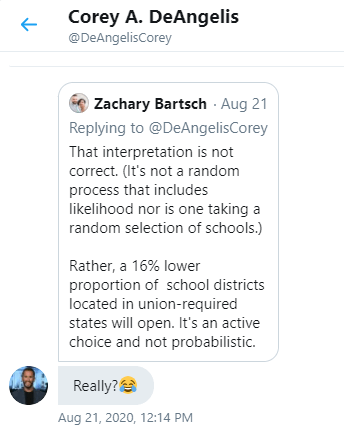
My friend, Corey DeAngelis, has a new research paper that measures the link between school district unionization and in-person re-opening in the time of Covid-19.

He promoted it on Twitter – but little did he know that a member of the statistics police was on patrol…

Am I splitting hairs? Of course I am. Do most people know what he means? I think so. Is the distinction important? You betchya.

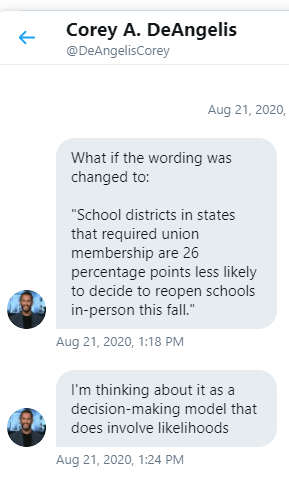
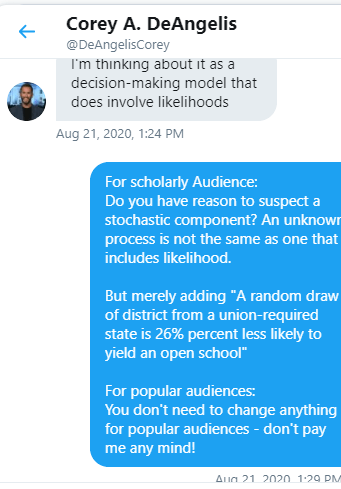
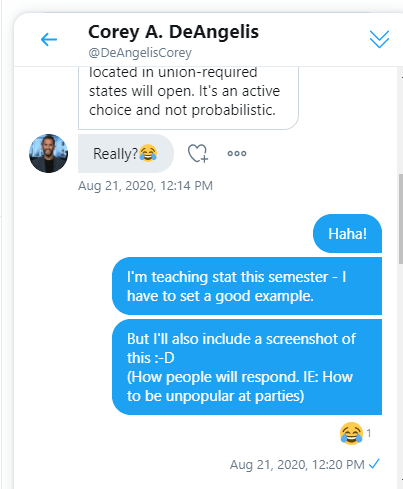
Corey, sent me a private message with the appropriate response:

Oh, yes – really.  Speaking probabilistically when we don’t have all of the information is so very tempting. To us the observer, lots of things appear probabilistic to us that are deterministic in nature (Have you ever played the board game “Don’t Wake Daddy!”, “Hot Potato”, or “Musical Chairs”? There is a process that determines when daddy will awaken or when the music ends). Not knowing the underlying process makes the experience appear probabilistic. But appearances can be deceptive.

Often, people speak as if they are taking a random draw from a sample. That can be probabilistic.  Given a draw of school districts, the likelihood of selecting an opening school from non-union districts is greater than choosing an opening school from a union district. This is entirely right. What is not right is saying that teacher-unionized districts are “more likely” to stay closed.

The decision to stay closed or to open is a product of collective choice – the decisions of several parties with diverse interests. Of course, we don’t know every single influence on the decision. But we do know that the outcome follows a pattern. A lower proportion of schools open in teacher-unionized districts than the proportion in non-union-districts.

Researchers often talk about their sample as if it is reality. A random draw from a sample has a probability. Nobody is randomly drawing an actual school district and expecting a probabilistic process to determine the policy outcome. Just ask yourself: “Does the sample proportion tell me an empirical probability?”

*Note: This is why we have different language when using a standard normal distribution.

“What proportion of area is to the left of z*=1.5?”

“Given a random draw from a standard normal distribution, what is the probability of selecting a value that is less than 1.5?”

One describes randomness. The other describes an already determined outcome.

Note: Yes, this kind of behavior does have implications for one’s popularity.

Thoughts from the 55 hour non-stop ESA Conference

I am a long-time member of the Economic Science Association, if someone my age can be a long-time member of anything. This is an excellent group of people. The leadership team designed a virtual replacement for what would have been an annual in-person conference.

The first time I saw the schedule it seemed epic. The schedule runs for 55 continuous hours. There is an Asia-Pacific period, which from my perspective in the US starts at night and goes “late”. I would stay up to tune into some of those events. The European time period was during the very early morning in the US. People were given a presentation slot that occurred as a good time of “day” for them.

Here’s a tweet quote to demonstrate the dedication to helping us all keep track of what was going on:
Another #2020ESAGlobal Conference Hang-out. For 2 hours at 6am L.A., 9am New York, 3pm Paris, 9pm Bejing, 11pm Melbourne.

The willingness to think outside the box and take advantage of the virtual format impressed me. It seemed like there were trying to make everyone in the world feel included.

Virtual conferences are not the same as in-person. I prefer in-person conferences and I will return to in-person experiences when I can.

There are advantages to virtual conferences. I’m not the first person to notice this, nor am I the first person to wonder if there will be more virtual conferences after the pandemic has completely subsided.

Working parents face certain costs and benefits to leaving for a conference. Working parents enter a totally different world when they fly away from their domestic responsibilities and attend an in-person conference. The flying is expensive and the domestic responsibilities have to be taken over by someone. Nothing if free. The benefit is that the working parent has an opportunity to focus on their profession which I consider to be valuable.


In a special social session, I had a chance to hear Ryan Oprea talking. I’m going to make a plug here for all of his work. He’s incredibly smart and dedicated to his craft. He’s generous with good ideas and practical help. Maybe you haven’t heard of him if you are Very Online, because instead of tweeting out hot takes he’s writing enduring research papers and doing professional service.

Birmingham Mayor Randall Woodfin Interview

Birmingham, Alabama Mayor Randall Woodfin is one to watch. The city of Birmingham has been on the rise, although like all cities Covid has presented a major setback. Here’s a Rolling Stone feature on his role in removing a confederate monument from the city in the summer of 2020.

My university president recently sat down for an interview with him (35 minutes long). Mayor Woodfin talks about influences that shaped him and how he ended up in politics. He emphasizes personal experience in community service and politics as customer service. They discuss governance in the time of Covid, both the health and financial angle.


https://www.youtube.com/watch?v=YbsfS3MSoUk&feature=youtu.be

There are lots of books on race going around these days. Mayor Woodfin’s recommendation is Caste.

The city does not get much attention on the international stage. The fact that we share a name with a much larger city in the UK is problematic in a way. It’s our fault, because we stole the name from them in an attempt to assert our dominance in the steel industry over one hundred years ago.