Henrik Karlsson read lots of biographies of geniuses and tried to sum up the things their childhoods had in common here. Some highlights:
At least two-thirds of my sample was home-educated (most commonly until about age 12), tutored by parents or governesses and tutors. The rest of my sample had been educated in schools (most commonly Jesuit schools).
As children, they were integrated with exceptional adults—and were taken seriously by them.
They had time to roam about and relied heavily on self-directed learning
A common theme in the biographies is that the area of study which would eventually give them fame came to them almost like a wild hallucination induced by overdosing on boredom. They would be overcome by an obsession arising from within.
They were heavily tutored 1-on-1
An important factor to acknowledge is that these children did not only receive an exceptional education; they were also exceptionally gifted.
There is lots of discussion of John Stuart Mill and John Von Neumann, who each had major contributions to economics:
When they were done, James Mill took his son’s notes and polished them into the book Elements of Political Economy. It was published the year John Stuart turned fifteen….
There is a moving scene in John Stuart Mill’s biography, when John Stuart is about to set out into the world and his father for the first time lets him know that his education had been . . . a bit particular. He would discover that others his age did not know as much as he did. But, his father said, he mustn’t feel proud about that. He’d just been lucky.
Let’s make more people lucky.
Other nice posts along similar lines are Erik Hoel’s “How Geniuses Used to Be Raised” (linked in Karlsson’s piece), and Scott Alexander’s review of Laszlo Polgar’s book “Raise a Genius” (about raising his 3 daughters to be chess grandmasters). Karlsson’s post, worth reading in full, is here.
Has the US tax and transfer system reached an egalitarian ideal? That’s one reading of this new working paper “How Progressive is the U.S. Tax System?” by Coleman and Weisbach. After accounting for all taxes and transfers (red lines in the charts), Americans across the income distribution saw roughly 250% real gains in income since 1966:
While market income has grown faster at the top of the income distribution (especially the top 1%), we also tax the rich heavily and use much of that tax revenue to fund direct transfers to poorer Americans and fund programs (such as Medicaid) which benefit poorer Americans. Put it all together, and everyone has seen similar gains over the past five decades, and these gains are fairly large: no Great Stagnation!
I recently did some business where I had a text file of names and email addresses that I wanted to send a group email to, in Gmail. Here I will share the steps I followed to import this info into a Google contact group.
The Big Picture
First, a couple of overall concepts. In Gmail (and Google), your contacts exist in a big list of all your contacts. To create a group of contacts for a mass email, you have to apply a label to those particular contacts. A given contact can have more than one label (i.e., can be member of more than one group).
To enter one new contact at a time into Gmail, you go to Contacts and Create Contact, and type in or copy/paste in data like name and email address for each person or organization. But to enter a list of many contacts all at once, you must have these contacts in the form of either a CSV or vCard file, which Google can import. So here, first I will describe the steps to create a CSV file, and then the steps to import that into Gmail.
Comma-separated values (CSV) is a text file format that uses commas to separate values. Each record (for us, this means each contact) is on a separate line of plain text. Each record consists of the same number of fields, and these are separated by commas in the CSV file.
A list of names and of email contacts (two fields) might look like this in CSV format:
We could have added additional data (more fields) for each contact, such as home phone numbers and cell numbers, again separated by commas.
For Gmail to import this as a contact list, this is not quite enough. Google demands a header line, to identify the meaning of these chunks of data (i.e., to tell Google that these are in fact contact names, followed by email addresses). This requires specific wording in the header. For a contact name and for one (out of a possible two) email address, the header entries would be “Name” and “E-mail 1 – Value”. If we had wanted to add, say, home phones and cell phones, we could have added four more fields to the header line, namely: ,Phone 1 - Type,Phone 1 - Value,Phone 2 - Type,Phone 2 – Value. For a complete list of possible header items, see the Appendix.
The Steps
Here are steps to create a CSV file of contacts, and then import that file to Gmail:
( 1 ) Start with a text file of the names and addresses, separated by commas. Add a header line at the top: Name, E-mail 1 – Value . If this is in Word, Save As a plain text file (.txt). For our little list, this text file would look like this:
( 2 ) Open this file in Excel: Start Excel, click Open, use Browse if necessary, select “All Files” (not just “Excel Files”) and find and select your text file. The Text Import Wizard will appear. Make sure the “Delimited” option is checked. Click Next.
In the next window, select “Comma” (not the default “Tab”) in the Delimiters section, then click “Next.” In the final window, you’ll need to specify the column data format. I suggest leaving it at “General,” and click “Finish.” If all has gone well, you should see an Excel sheet with your data in two columns.
( 3 ) Save the Excel sheet data as a CSV file: Under the File tab, choose Save As, and specify a folder into which the new file will be saved. A final window will appear where you specify the new file name (I’ll use “Close Friends List”), and the new file type. For “Save as type” there are several CSV options; on my PC I used “CSV (MS-DOS)”.
( 4 ) Go to Gmail or Google, and click on the nine-dots icon at the upper right, and select Contacts. At the upper left of the Contacts page, click Create Contact. You’ll have choice between Create a Contact (for single contact), or Create multiple contacts. Click on the latter.
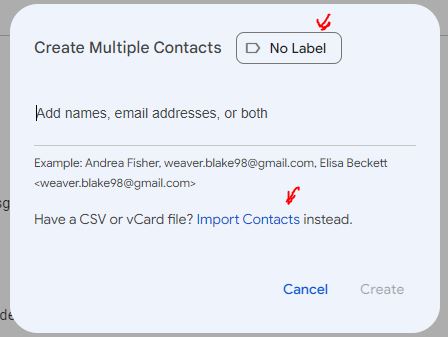
( 5 ) Up pops a Create Multiple Contacts window. At the upper right of that window you can select what existing label (contact group name) you want to apply to this new list of names, or create a new label. For this example, I created (entered) a new label (in place of “No Label”), called Close Friends. Then, towards the bottom of this window, click on Import Contacts.
Then (in the new window that pops up) select the name of the incoming CSV file, and click Import. That’s it!
The new contacts will be in your overall contact list, with the group name label applied to them. There will also be a default group label “Imported on [today’s date]” created (also applied to this bunch of contacts). You can delete that label from the list of labels (bottom left of the Contacts page), using the “Keep the Contacts” option so the new contacts don’t get erased.
( 6 ) Now you can send out emails to this whole group of contacts. If this is a more professional or sensitive situation, or if the list of contacts is unwieldy (e.g. over ten or so), you might just send the email to yourself and bcc it to the labeled group.
APPENDIX: List of all Header Entries for CSV Files, for Importing Contacts to Gmail
I listed above several header entries which could be used to tell Google what the data is in your list of contact information. This Productivity Portfolio link has more detailed information. This includes tips for using VCard file format for transferring contact information (use app like Outlook to generate VCard or CSV file, then fix header info as needed, and then import that file into Google contacts).
There is also a complete list of header entries for a CSV file, which is available as an Excel file by clicking his “ My Google Contacts CSV Template “ button. The Excel spreadsheet format is convenient for lining things up for actual usage, but I have copied the long list of header items into a long text string to dump here, to give you the idea of what other header items might look like:
I bolded the two items I actually used in my example (Name and E-mail 1 – Value), as well as a pair of entries ( Phone 1 – Type and Phone 1 – Value) as header items which you might use for including, say, cell phone numbers in your CSV file of contact information.
I was watching the most recent episode of Welcome to Wrexam and was horrified to see another athlete with the wisdom to start planning for their future only for their time and money to be guided into a high risk, low payoff investment.
Stop!
If you are a professional athlete, actor, musician- if you are anyone in a career whose dollar rewards are front-loaded within careers that are short and hard to forecast – please, in the name of Shaquille O’Neal and all that is holy, do not take the money that needs to be the foundation of your family’s financial wellbeing and throw it into endeavors that are more likely to melt it down than grow and prosper.
Ok, Mr Know It All Economist, What should I do with myself and my money?
Great question, let’s start with what you shouldn’t do.
Don’t invest your money in anything cool. Your peak income earning years are likely behind you. You can’t afford to be paid in cool. Everything balances out in the wash. If something is cool to invest in (art, music, memorabilia, fashion, film, etc) then it pays out that much less monetarily.
Don’t invest your time or money in anything that priortizes the economic outcomes of everyone but you. You’re heavily specialized, which means you may have managers, agents, publicists, etc. You’re a gravy train for others and that train is going to slow down one day. Your job is to ensure your future, not theirs.
Don’t insist on maintaining the same economic trajectory. Trying to match or beat your peak athletic earnings is going lead you to taking on too much risk. Look for skills and opportunities that accessible that offer a career you can imagine doing for 20 years. Leverage your connections, skills, public awareness, and interests.
Try to tame your instincts towards overconfidence. You were in the top 0.01% of the population for your previous athletic endeavor. You are highly unlikely to be at the same level of elite excellence at your next profession. Look for something you are likely to be good at. Good can and may turn into great, but don’t assume it from the start.
Ok, but what does that add up to? What should I actually do?
Fine, here you go.
Invest most of your money in S&P 500 index funds.
Buy a house in a place you want to live long term. However much house you think you should buy, get 25% less.
Look for a job. Don’t overconcern yourself with the salary, focus on skill acquisition. If need by, take an internship or two.
If there is a field you want to work in, yes, even a cool one, and someone gives you an opportunity to work and learn, by all means go for it. But if they ask you for money, run away as fast as you can.
Take risks with your time and your feelings (it’s been a long time since you were bad at something!), not with your money.
It’s ok to make less money and in less exciting ways. Ninety-nine percent of people can’t be wrong.
I’m going to explore a passage from The Dawn of Everything about whether humans reject Western civilization.
The introductory chapter of The Dawn of Everything is called “Farewell to Humanity’s Childhood.” The authors are idealists wrestling with big questions.
We can take [Steven] Pinker as our quintessential Hobbesian. (page 13)
For instance, if Pinker is correct, then any sane person who had to choose between (a) the violent chaos and abject poverty of the ‘tribal’ stage in human development and (b) the relative security and prosperity of Western civilization would not hesitate to leap for safety. (page 18)
Over the last several centuries, there have been numerous occasions when individuals found themselves in a position to make precisely this choice – and they almost never go the way Pinker would have predicted.
I’ve written about IPUMS before. It’s great. Among individual details are their occupations and industry of their occupation. That’s convenient because we can observe how technology spread across America by observing employment in those industries. We can also identify whether demographic subgroups differed or not by occupation. There’s plenty of ways to slice the data: sex, race, age, nativity, etc.
But what do we know about historical occupations and what they entailed? At first blush, we just have our intuition. But it turns out that we have more. There is a super boring 1949 report published by the Department of Labor called the “Dictionary of Occupational Titles”. The title says it all. But, the DOL published another report in 1956 that’s conceptually more interesting called “Estimates of Worker Trait Requirements for 4,000 Jobs as Defined in the Dictionary of Occupational Titles: An Alphabetical Index”. The report lists thousands of occupations and identifies typical worker aptitudes, worker temperaments, worker interests, worker physical capacities, and working conditions. Below is a sample of the how the table is organized:
I was writing up something for my graduating seniors about how to keep learning economics after school, and realized I might as well share it with everyone. This may not be the best way to do things, it is simply what I do, and I think it works reasonably well.
Blogs by Economists: There are many good ones, but besides ours Marginal Revolution is the only one where I aim to read every post
Podcasts on the Economy: NPR’s The Indicator (short, makes abstract concepts concrete), Bloomberg’s Odd Lots (deeper dives on subjects that move financial markets)
Podcasts by Economists: Conversations with Tyler and Econtalk (note that both often cover topics well outside of economics). Macro Musings goes the other way and stays super focused on monetary policy.
Twitter/X: This is a double-edged sword, or perhaps even a ring of power that grants the wearer great abilities even as it corrupts them. The fastest way to get informed or misinformed and angry, depending on who you follow and how you process information. Following the people I do gives you a fighting chance, but even this no guarantee; even assuming you totally trust my judgement, sometimes I follow people because they are a great source on one issue, even though I think they are wrong on lots of other things. Still, by revealed preference, I spend more time reading here than other single source.
Finance/Investing: Making this its own category because it isn’t exactly economics. Matt Levine has a column that somehow makes finance consistently interesting and often funny; unlike the rest of Bloomberg, you can subscribe for free. He also now has a podcast. If you’d like to run money yourself some day, try Meb Faber’s podcast. If you’d like things that touch on finance and economics but with more of a grounding in real-world business, try the Invest Like the Best podcast or The Diff newsletter.
Economics Papers: You can get a weekly e-mail of the new papers in each field you like from NBER. But most econ papers these days are tough to read even for someone with an undergrad econ degree (often even for PhDs). The big exception is the Journal of Economic Perspectives, which puts in a big effort to make its papers actually readable.
Books: This would have to be its own post, as there are too many specific ones to recommend, and I don’t know that I have any general principle of how to choose.
This is a lot and it would be crazy to just read all the same things I do, but I hope you will look into the things you haven’t heard of, and perhaps find one or two you think are worth sticking with. Also happy to hear your suggestions of what I’m missing.
Inflation continues to remain stubbornly high in the US. While Core CPI is down to 3.6%, the lowest it has been in 3 years, this is still well above the Fed’s 2% target (the Fed’s preferred Core PCE is a bit lower at 2.8%). But consumers are tired of the cumulative inflation, which, depending on your preferred gauge of inflation, is somewhere around 20% in the past 4 years. Consumers want to know: will prices ever go down again?
The answer is: Yes, and some prices already have declined!
For example, you can look at broad categories of consumer purchases, such as durable goods, which are down almost 5 percent since the peak in August 2022. Durable goods include items such as used cars (down 17.3 percent since February 2022), furniture (down 6 percent since August 2022), and appliances (down 7.2 percent since March 2023).
We can even jump into the nondurables category and look at specific items, such as groceries which seem to be on everyone’s mind. Here’s a list of items and the price decrease since their peak (I ignore a few items where it is only a purely seasonal cycle that made them cheaper in April 2024):
Spaghetti and macaroni: -4.3% (Feb 2023)
Bacon: -12.8% (Oct 2022)
Chicken legs: -10.6% (Aug 2023)
Chicken breasts: -14.4% (Sept 2022)
Eggs: -40.6% (Jan 2023)
Milk: -8.3% (Nov 2022)
Cheddar cheese: -9.4% (Sep 2022)
Bananas: -2.6% (Sept 2022)
Oranges: -14.7% (Sept 2022)
Lemons: -12.3% (May 2022)
Strawberries: -12.9% in the past year (and down 34.6% since seasonal peak in Dec 2022)
Ground coffee: -6.2% (Dec 2022)
It’s true that this is a cherry-picked list: lots of items are at all-time highs! My goal here is to show that, Yes!, some prices will fall. Others may too in the near future. And while it’s also true that most prices are still well above 2019 levels, that’s not universally true. The April 2024 prices of lemons, strawberries, and tomatoes are roughly equal to their April 2019 prices.
And it’s not just food. Natural gas this January was 20% cheaper than January 2023. Regular unleaded gasoline is down 11.6% from 2 years ago (and down 25% from the peak in Summer 2022, but we’ll wait to see what this summer looks like). Even some services, such as airline fares, are down 6.7% from 2 years ago (and down 16% from June 2022).
Some of these price decreases could be due to factors specific to the production and supply of those goods, but another factor is monetary policy. Broad measures of the money supply such as M2 show a decline of about 4 percent in the past 2 years. That hasn’t yet produced overall deflation, but it has probably contributed to the decline in the goods and services mentioned.
Looking at price changes can only tell us so much though, especially focusing on individual item prices. The big picture is that over the past 4 years, wages have increased more than prices overall across most of the income distribution (only the highest quintile lost out on the race between wages and prices). Falling prices would certainly help this trend continue, but most consumers have more buying power than they did in 2019, even if they don’t feel like they do.
Back in early 2021, when we were still locked down, bored and restless, and trillions of pandemic stimulus dollars were pouring into our bank accounts to fund speculative investments, Keith Gill took to social media to argue that the stock of videogame retailer GameStop (GME) was deeply undervalued. He appeared on YouTube as “Roaring Kitty,” and on Reddit under an unsavory moniker. He rallied an army of retail investors on Reddit to buy up shares of GME, which was heavily shorted by big Wall Street firms. As hoped by the Redditors, this led to a “short squeeze,” where the shorts were forced to buy shares to cover, which drive GME price to the stratosphere. We discussed this phase of the drama here.
The drama continued as the jubilant retailers sucked so much money from short-selling hedge fund Melvin Capital that it ultimately shut down; the Robin Hood brokerage firm widely used by Redditors suspended trading in GME for a crucial couple of days, leading to suspicions it caved to pressures from the Wall Street firms and threw the retail investors under the bus; and key parties, including Roaring Kitty himself, were called before a Congressional committee to explain themselves. The story of Roaring Kitty and the meme stock craze was turned into a movie last year called “Dumb Money.”
Keith Gill largely vanished from messaging boards in early 2021. But he came roaring back on Sunday (May 11), posting on X a sketch of a man leaning forward in a chair, a meme among gamers that things are getting serious:
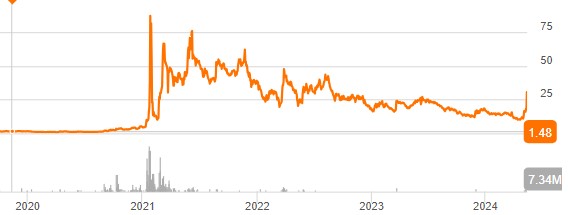
It seems that the Kitty has not lost his magic. That X post has garnered over 20 million views, and apparently triggered a new surge in GME stock (and in other heavily shorted stocks as well, which is a significant knock-on effect). Here is a five-year chart of GME, showing the craziness in early 2021, which then died down over the next couple of years:
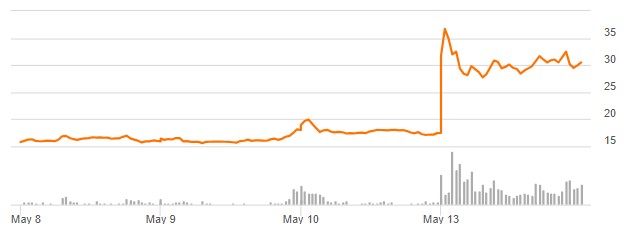
GME stock had finally approached something approximating fundamental fair value, with occasional ups and downs, then Roaring Kitty posted his sketch, and, blam, the next day, the stock nearly doubled:
Keith Gill has followed up with tweets of video clips with a fight theme, including Peaky Blinders, Gangs of New York, Snatch, Tombstone, X-Men Origins: Wolverine, V is for Vendetta and The Good the Bad and the Ugly ; get that testosterone out there roiling (typical meme stock Redditors are youngish males).
As of Tuesday morning, GME had nearly doubled again, up to $57. (I am reasonably sure it will plunge again within the next few months, but I am not into shorting, and the options pricing structure does not make it easy to set up a favorable bearish trade here).
This response is not like the world-shaking short squeeze of 2021, but it still shows an impressive power of social media influencers and memes to move markets.
I’m going to be in Montana later this summer and I’d like to solicit our readers for travel suggestions. Three days in Helena, two and a half in Bozeman. I will have a car, but Glacier and Yellowstone National Parks are likely going to be too difficult to squeeze in given the brevity. Where should I go? Should food be a consideration beyond basic caloric needs? I know 5 days is shockingly brief for big sky country, but that’s why I’m coming to you!