Update to readers after doing the CPE (read Internal Audit of AI Agents and Risk for background )
It’s not every day that you get to present to 36 genuine internal auditors for an hour. Not the rowdiest crowd, true to form, but they did answer my poll questions. Many of them work at a regional bank here in Birmingham, AL. Here is the result of an (unscientific) poll from the session:
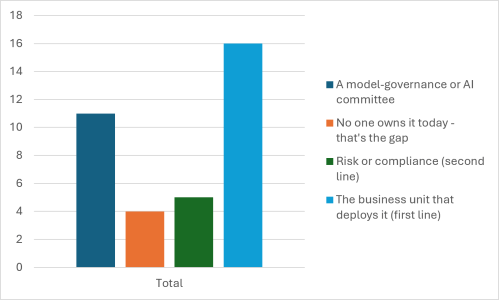
Opinion Poll: Who should own the risk appetite built into an AI model?
Claude has a better understanding of internal audit procedures than I do and actually helped me come up with the question. The interpretation of the graph is a collaboration between me and Claude, so I will not suppress the em dashes.
The plurality (first line) is the “textbook-correct” instinct — but it’s hollow without capability. Putting ownership on the business unit that deploys the model matches the Three Lines Model cleanly: the first line owns and manages the risks it takes. Good instinct, and worth affirming. The catch is the whole premise of your talk: the deployers usually can’t see the risk preference embedded in their model, let alone measure or set it. So “the business owns it” is right in principle but nominal in practice unless that owner is given the tools to actually recover and govern the appetite. That’s the gap between the poll’s ideal and the room’s reality.
The committee vote (31%) reflects real emerging practice, with a trap. Nearly a third reached for a dedicated AI-governance body — consistent with where NIST’s AI RMF and ISO 42001 point. But a committee can quietly dilute accountability: “everyone owns it” becomes “no one owns it” if it isn’t paired with a clearly accountable first line. Worth naming that risk out loud.
The most important result is the one that isn’t in any single bar: there’s no consensus. If you had asked this room “who owns credit risk?” you’d have gotten a tight, near-unanimous answer. The fact that ownership of a model’s risk appetite scatters across all four choices tells you this accountability is genuinely unsettled in their organizations.
The settled view: credit risk is owned by the first line — the business that originates the exposure. The lending or client-facing unit that decides to extend credit owns the risk of that decision. This is the textbook first-line ownership case, and it’s why credit risk is often the cleanest example used to teach the Three Lines Model.
So, congrats to me and Claude for coming up with a question that split opinion in a room of expert practitioners?

