Who owns model risk?

Update to readers after doing the CPE (read Internal Audit of AI Agents and Risk for background )

It’s not every day that you get to present to 36 genuine internal auditors for an hour. Not the rowdiest crowd, true to form, but they did answer my poll questions. Many of them work at a regional bank here in Birmingham, AL. Here is the result of an (unscientific) poll from the session:

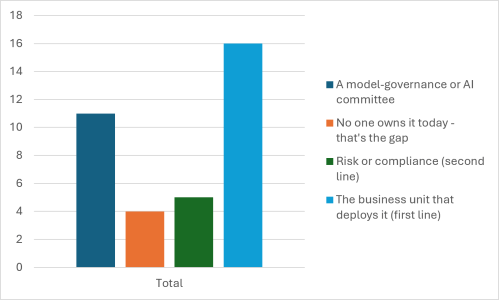
Opinion Poll: Who should own the risk appetite built into an AI model?
Claude has a better understanding of internal audit procedures than I do and actually helped me come up with the question. The interpretation of the graph is a collaboration between me and Claude, so I will not suppress the em dashes.

The plurality (first line) is the “textbook-correct” instinct — but it’s hollow without capability. Putting ownership on the business unit that deploys the model matches the Three Lines Model cleanly: the first line owns and manages the risks it takes. Good instinct, and worth affirming. The catch is the whole premise of your talk: the deployers usually can’t see the risk preference embedded in their model, let alone measure or set it. So “the business owns it” is right in principle but nominal in practice unless that owner is given the tools to actually recover and govern the appetite. That’s the gap between the poll’s ideal and the room’s reality.

The committee vote (31%) reflects real emerging practice, with a trap. Nearly a third reached for a dedicated AI-governance body — consistent with where NIST’s AI RMF and ISO 42001 point. But a committee can quietly dilute accountability: “everyone owns it” becomes “no one owns it” if it isn’t paired with a clearly accountable first line. Worth naming that risk out loud.

The most important result is the one that isn’t in any single bar: there’s no consensus. If you had asked this room “who owns credit risk?” you’d have gotten a tight, near-unanimous answer. The fact that ownership of a model’s risk appetite scatters across all four choices tells you this accountability is genuinely unsettled in their organizations.

The settled view: credit risk is owned by the first line — the business that originates the exposure. The lending or client-facing unit that decides to extend credit owns the risk of that decision. This is the textbook first-line ownership case, and it’s why credit risk is often the cleanest example used to teach the Three Lines Model.

So, congrats to me and Claude for coming up with a question that split opinion in a room of expert practitioners?

Internal Audit of AI Agents and Risk

Members of the Institute of Internal Auditors know that they can “Join the Birmingham IIA on September 23, 2026 for an insightful CPE webinar featuring Dr. Joy Buchanan… “

I am pleased to get a chance to translate Buchanan and Foster (2026) to an industry audience. I have been reading up on audit controls to prepare.

Some help from Claude with the following: Enterprise risk management rests on a simple discipline: an organization decides how much risk it is willing to take in pursuit of its objectives — its risk appetite — sets tolerances around that level, and then works to keep actual decisions inside those limits. Under COSO ERM, the appetite statement and its tolerances are the structure; the ongoing question is one of conformance. It’s part of the IIA’s AI Auditing Framework and the Three Lines Model: management sets and owns the appetite, risk and compliance build guardrails and monitor, and internal audit provides independent assurance that what the organization actually does matches what it said it would tolerate. A systematic gap between the two is a finding.

For human decision-makers, we’ve built machinery to check this — credit policies, delegated authorities, four-eyes review, documented rationale, an auditable paper trail. We know how to reconstruct whether a loan officer’s or portfolio manager’s judgment stayed inside the lines.

Here is where our paper connects. When an LLM makes a risk-and-return decision — approving credit, weighting a portfolio, ranking procurement options — it too has a risk appetite. But almost none of that oversight infrastructure exists for it. We argue that AI agents are already making decisions with economic consequences and an element of risk.

By showing that the softmax mechanism inside an LLM is McFadden’s random utility model, Buchanan and Foster (2026) establish that the model’s choices reveal a genuine utility function — a measurable risk preference. Our portfolio experiment then recovers the parameters: the slope of the indifference curve we report is the model’s risk appetite, quantified.

I know an Internal Auditor. Some of their old functions will probably get automated. But they have new work to do: auditing the AI agents! Our paper is a step toward both measuring and manipulating the risk appetites of AI agents.

Buchanan, J., & Foster, J. (2026). The innate economic preferences of language models [Preprint]. arXiv. https://doi.org/10.48550/arXiv.2607.26288

Image by Grok. I don’t sell that mug but EWED does have merch at https://shop.spreadshirt.com/economist-writing-every-day/