What’s the Best Major to Prepare for Law School?

  • This is post coauthored with Jack Cavanaugh, Ave Maria University Graduate of 2025.

Say that you want to become a successful lawyer. What does that mean? One possible meaning is that you are well-compensated. Money is not everything, but it does give people more options for how to spend their time and resources. Law degrees are a type of graduate degree. So, what bachelor’s degree major should one choose in preparation for law school? We lack rich administrative data on college majors and LSAT scores.

Luckily, the 2023 American Community Survey (ACS) comes to the rescue. It has all of the typical demographic covariates, income, occupation, and college major. So, if we make the small leap that well-prepared law school students become high-performing lawyers who are ultimately paid more, then what college major puts you on the right path? What should your major be?

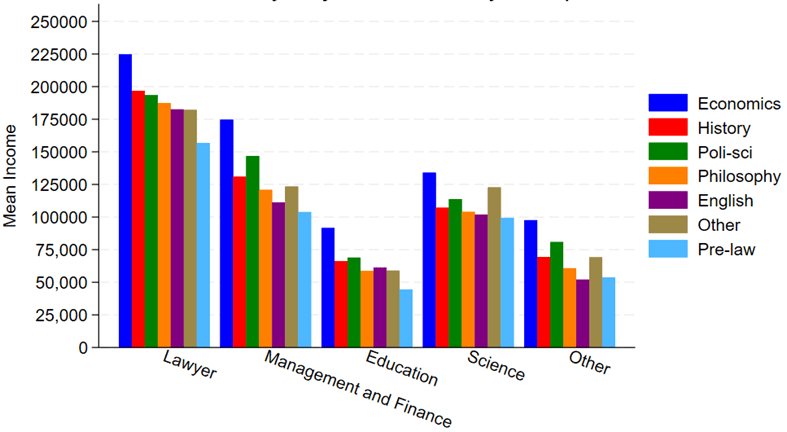
We don’t look at an exhaustive list. We place several occupations into bins and examine only a few alternative majors. Any unlisted major falls under ‘other’. Below are the raw average incomes by occupational category and college major. Note two majors in particular. First, Pre-law literally has the word ‘law’ in the name and is marketed as preparation for law school. However, it is the undergraduate major associated with the lowest paid lawyers. For that matter, Pre-law majors have the lowest pay no matter what their occupation is. Second, Economics majors are the most highly paid in all of the occupations.

Continue reading

I’m Chair! 😬

As of July 1st of this year, I am the Chairman of the Department of Economics at my university. It’s one of those positions that includes more work and not much compensation. Depending on who I tell, I’m given both congratulations and condolences. Generally, at my university there is an expectation that department faculty ‘take turns’ being chair. So, we’re expected to serve whether the pay is good or not. There’s a lot of informal practice around this process.

In addition, Economics Majors have been less popular at liberal arts institutions over the past several years. No one knows why and there are probably multiple reasons. At my institution, our department has healthy enrollment among the peripheral majors. So, the Economics BA and BS have lower enrollment, but the Business Economics and the Global Affairs majors are more popular than ever.

All the same, I’d like to increase the number of students who have declared majors in our department and the number of Economics graduates. How do I do that?

Continue reading

Tariffs: Bad for Revenue

Economists are pretty united against tariffs. There are lots of complicated arguments. Keeping things simple, one reason is that they are bad for welfare. President-elect Trump seems to imply that tariffs can raise a lot of government revenue. But in lieu of what? The Tax Foundation estimates that there is absolutely no way that tariffs can replace all revenue from income taxes. The primary reason that they cite is that imports compose a tiny portion of the potential tax base. There are plenty of goods and services produced domestically that wouldn’t be subject to the tariffs. Any time we add a tax exemption, we’re adding complication, higher compliance costs, and distorting consumption patterns, etc.

For this post I singularly focus on the tax revenue.  In fact, let’s demonstrate what *maximizing* tax revenue looks like under three cases: 1) Closed economy with a tax, 2) Open economy with a tax, & 3) Open economy with a tariff. I’ll use some simple math to demonstrate my point. None of the particulars affect the logic. You’ll reach the same general results with different intercepts, slopes, etc. Let’s start with a domestic demand and domestic supply.

Closed Economy with a Tax

Whenever tax revenue is raised, there is a difference between the price paid by demanders and the price received by suppliers. In a closed economy a tax might be imposed on all goods. In these examples, I treat the tax as some dollar per-unit of output tax. But it’s a short jump to percent of spending taxes, and then another short jump to percent of income taxes. With this in mind, demanders pay more than the suppliers receive by the amount of the tax. Tax revenue is the tax rate times the number of units of output that are subject to the tax. That’s the thing we want to maximize.

Continue reading

Florida Ballot Initiatives 2024

The November election in Florida will include 6 proposed amendments to the Florida State Constitution. They only pass if at least 60% of voters vote YES. Here are some brief takes from an economic perspective.

Amendment 1: Partisan Election of Members of District School Boards

Currently, school district boards are locally elected and they do not have a party affiliation listed on the ballot. If passed, the amendment would permit party affiliation to be on the ballot. Partisan primaries would also be introduced, reducing the number of candidates in the general elections. The argument in favor is that party affiliation itself communicates information to voters. Removing that information forces voters to abstain, vote randomly, or to vote based on other information.

An argument against is that, in Florida, only registered party members may vote in primaries. If passed, parties will endorse particular candidates according to the primary results, winnowing the field. I happen to live in a county with an overwhelming republican majority, so the party-endorsed candidate will probably win. The outcome will be that the median republican primary-voter will choose the winning candidate in the primary rather than the median voter during the election. Voting “YES” aggregates information from a smaller set of voters.

I’ll vote NO.

Continue reading

Cleaning Data and Muddying Water

I’ve praised IPUMS before. It’s great.

The census data in particular is vast and relatively comprehensive. But, it’s not all perfect.

Consider three variables:

  • Labforce, which categorizes whether someone is employed
  • Occ1950, which categorizes occupation types
  • Edscor50, which imputes a relative education score based on occupation

These all seem like appropriate variables that a labor economist might want to control for when explaining any number of phenomena. There is a problem. Edscor50, and the several measures like it, are occupation based. Specifically, the scores use details about 1950 occupations to impute educational details. There are similar indices used for earnings, income, status, socioeconomic status, and prestige.

Cool.

Continue reading

Inflation, Information, & Logic

Most economists know that the CPI is overestimated and therefore prefer the PCE price index. However, monthly CPI data is consistently released before PCE data for a given month. One would think that they move in the same direction and be highly correlated. Indeed, in the past five years, the correlation is 0.96. Therefore, it stands to reason that the there is less new relevant information on the PCE release dates than on the CPI release dates. Yes, CPI is biased, but it still contains some information about prices and it is known well prior to the more accurate PCE numbers.

Supply and Demand react to new information. Sometimes the new information changes our expectations about the future, and other times we learn that our beliefs about goods and assets were previously not quite right. So, with new relevant information comes new prices as people update their beliefs and expectations.

Let’s get financial.

Continue reading

A Gauche Gift

We’ve written about gifts before.

  1. We’ve written posts recommending Christmas gifts (here and here and here and here).
  2. I wrote that gifts might be good for the macroeconomy.
  3. Joy Wrote about birthday presents at school parties.
  4. James wrote about considering supply chain status when ordering a gift.

Michael Maynard and I wrote about giving a good gift. A good gift is one in which the giver has an information advantage. Gifting an object or a service can provide a consumption bundle to the recipient that they didn’t know was even possible or that they didn’t know that they would prefer. They would have chosen the items themselves, if only they had known about them. Giving a gift card can be similar if the recipient did not know about the vendor previously. Cash is a good gift when the giver does not have an information advantage over the recipient.

In our previous post, we showed diagrammatically that ‘better off’ was indicated by the higher utility. But this spurs an important question:

Can good gifts cost the giver zero dollars?

Continue reading

Inflation for Thee, But Temporarily Not for FL

On May 6, 2022, the governor of Florida, Ron DeSantis, signed House Bill 7071. The bill was touted as a tax-relief package for Floridians in order to ease the pains caused by inflation. In total, the bill includes $1.2 billion in forgone tax revenues by temporarily suspending sales taxes that are levied on a variety of items that pull at one’s heartstrings. Below is the list of affected products.

A minor political point that I want to make first is that the children’s items are getting a lot of press, but they are only about 18.4% of the tax expenditures. The tax break on hurricane windows and doors received 37% of the funds and gasoline is receiving another 16.7%. There are ~$150 million in additional sales, corporate, and ad valorem tax exemptions. Looking at the table, it seems that producers of hurricane windows and doors might be the biggest beneficiary and that that the children’s items are there to make the bill politically palatable. Regardless, this is probably not the best use of $1.2 billion.


There are at least three economic points worth making.

Continue reading

The Economics of Good Gift Giving

This post was co-authored with a recent AMU Economics Graduate, Michael Maynard (Linkedin here). It is based on his senior thesis entitled “The Highest Virtue: Re-examining gift Giving and Deadweight Loss”

When my older sister was in middle school, she received a book of baby animal stories. She loved that book and read it every day. A couple of years later my mother accidentally donated it, and my sister was heartbroken. We went to the thrift store repeatedly that week hoping to encounter it before it sold, but we never found it. Years later, our father scoured the internet trying to find the lost book – to no avail.

Years after that, I stumbled onto the exact same copy of the book in the for-sale corner of a nearby library. For a single dollar and negligible effort, I purchased the book that had long frustrated my family’s searching. Shortly before the birth of her first child, I gave the book to my sister for Christmas. It was one of the best Christmas gifts she had ever received.

Economic theory typically assumes that individuals have perfect information. Therefore, they are best suited to purchase their own gifts. That’s what motivates the not-so-romantic economist prescription to give a gift card or cash for birthdays, Christmas, graduations, etc. The theory states that, if we do not intimately know the receiver’s preferences, then we have incomplete information and it’s better to give a money-gift rather than to give a gift from which the receiver would enjoy less additional utility.

Continue reading

It’s Still Hard to Find Good Help These Days

Consumption is the largest component of GDP. In 2019, it composed 67.5% of all spending in the US. During the Covid-19 recession, real consumption fell about 18% and took just over a year to recover. But consumption of services, composing 69% of consumption spending, hadn’t recovered almost two years after the 2020 pre-recession peak.  For those keeping up with the math, service consumption composed 46.5% of the economic spending in 2019.

We can decompose service consumption even further. The table below illustrates the breakdown of service consumption expenditures in 2019.

I argued in my previous post that the Covid-19 pandemic was primarily a demand shock insofar as consumption was concerned, though potential output for services may have fallen somewhat. When something is 67.5% of the economy, ‘somewhat’ can be a big deal. So, below I breakdown services into its components to identify which experienced supply or demand shocks. Macroeconomists often get accused of over-reliance on aggregates and I’ll be a monkey’s uncle if I succumb to the trope (I might, in fact be a monkey’s uncle).

Before I start again with the graphs, what should we expect? Let’s consider that the recession was a pandemic recession. We should expect that services which could be provided remotely to experience an initial negative demand shock and to have recovered quickly. We should expect close-proximity services to experience a negative demand and supply shock due to the symmetrical risk of contagion. Finally, we should expect that services with elastic demand to experience the largest demand shocks (If you want additional details for what the above service categories describe, then you can find out more here, pg. 18).

Continue reading