Quasi-Relative Measures of Portfolio Performance

Last week I discussed absolute measures of portfolio performance and management, specifically between two portfolios that are composed of different assets (utilities and tech). I began with comparing the basics of return, standard deviation, and Sharpe ratio to some other possible portfolio in the Markowitz cloud. But, simply comparing the difference between these possible portfolios can be sensitive to the spread of stats within a specific Markowitz cloud. In other words, it’s not scale independent. A larger spread of possible stats can make a portfolio look bad due to the spread return/standard deviation/Sharpe ratio alone.

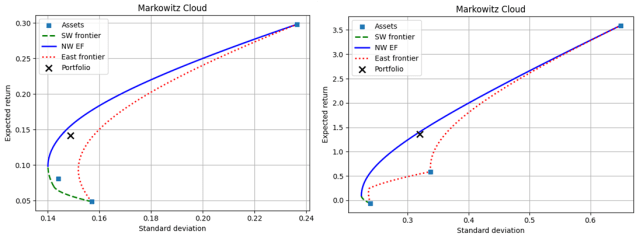
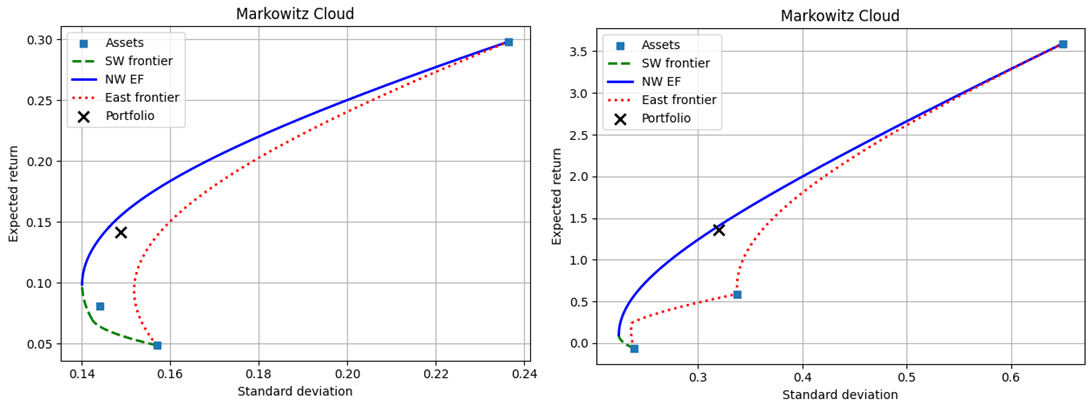
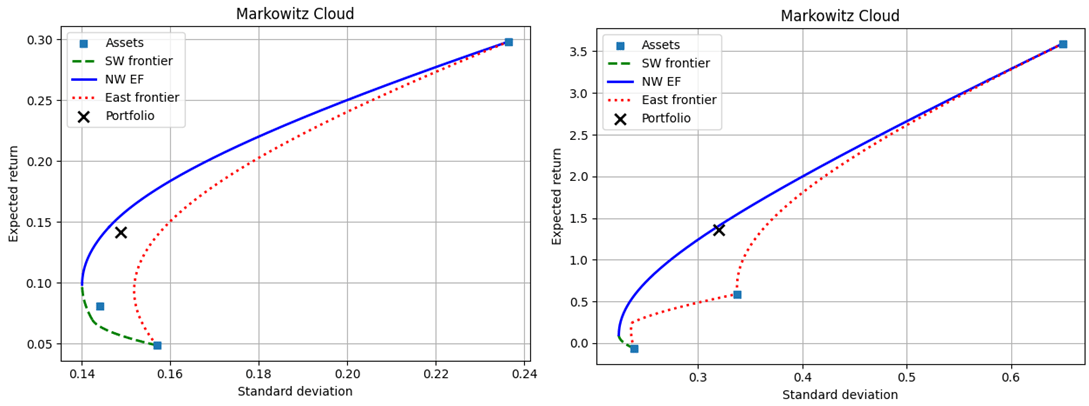
In this post I introduce quasi-relative measures. Again, I lean on the Markowitz cloud. They’re pasted below (Utilities on the left, tech on the right).

If we can somehow express the returns, volatilities, and Sharpe ratios on a common scale that is independent of the level values, then we can make the realized portfolios more comparable. One thing that we can do is to express a stat as a weighted linear average between the maximum and minimum possible values. Conditional on the realized standard deviation, there exists a maximum and minimum of possible return. Something like the below. Rho is the weight on the maximum return. It’s also the proportion of possible conditional returns that are lower than the realized return.

The unconditional version is the same, but would be relative to the global maximum and minimum stats. We can represent the weigh on the maximum return and the percentile among possible returns as gamma.

A final quasi-relative measure of performance is the dissimilarity index between the realized portfolio weights and some reference portfolio weights. This provides a measure of how much the asset weights would need to change in order to adjust the portfolio.  If changing portfolio weights is costly, then it’s also a measure of the transaction cost of reallocation. It’s quasi-relative because it is independent of the spread of possible performance stats.

Below are the quasi-relative measures for each the utility and tech company portfolios.

Continue reading

Absolute Measures of Portfolio Performance

The basic idea is that we want to compare the performance of different portfolios or their managers. This is relatively easy as long as the portfolios contain the same assets. Then, the portfolios are simply characterized by the different weights among the different assets. But how do we compare the performance of portfolios whose assets are different? In finance, we usually assume that everyone can invest in everything. But there are plenty of cases in which that’s a bad assumption: when clients want exposure to particular industries, when there are statutory limitations on holding certain assets, or when an individual company is considering specific projects within the same company under conditions of scarce financing.

The most primitive step is to compare the return and standard deviation of two different portfolios. However, higher risk investments tend to have higher returns in dynamic equilibrium. So, if we were to compare the returns of a tech company to a utility company, then we’d often see the tech companies performing better. But, if we compare the volatilities, then the utility companies would tend to perform better. Sharpe stepped in with a ratio to express the excess return (benefit) per standard deviation (the cost). This way, we can compare the price of volatilities between two portfolios. We’ll stick with just these basic 3 measures: return, standard deviation, and Sharpe ratio. (Others do exist)

Let’s put some meat on this with an example. Say that we have two portfolios, each composed of different assets. There’s a utility portfolio that’s composed of NEE, DUK, and SO. There’s also a tech portfolio that’s composed of AMD, MSFT, and NVDA. Both portfolios have weights of (0.33, 0.33, 0.34).  The results of the utility versus the tech portfolio are:

  • Returns: 14.2% vs 136.3%
  • Standard Deviation: 14.9% vs 32%
  • Sharpe: 0.684 vs 4.134

Goodness me! The tech portfolio returns much more in absolute terms and much more per unit of risk. It’s twice as volatile as the utility portfolio, but the returns are almost ten times as high. If you could, then many of us would choose the tech portfolio over the utility portfolio. But, what if, for one reason or another, you can only invest in one of the two industries? Or, what if you want to invest your money with a skilled manager, rather than a risky one?

One way to tackle this problem is to introduce the Markowitz cloud. Specifically, we can essentially list out all of the possible portfolios along with their return and standard deviations. Then, we can compare the actual performance to the entire menu of possible performances within each set of assets. Below are the possible performances for the utility (left) versus the tech (right) portfolio. The actual portfolios are marked with an X.

One way to evaluate the two portfolios is to compare their return, standard deviation, and Sharpe ratio to the other candidates that were achievable with the same assets. As we can see, conditional on the assets, neither portfolio minimized the volatility, maximized return, nor maximized the Sharpe ratio. Furthermore, assuming that the realized rate of return was the goal, neither portfolio minimized the conditional volatility. Assuming that the realized volatility was the goal, neither portfolio maximized the conditional return. Below are two tables that describe some candidate alternatives and how they differ from the realized portfolio.

Continue reading

Are Your Portfolio Weights Right?

What do portfolio managers even get paid for? The claim that they don’t beat the market is usually qualified by “once you deduct the cost of management fees”. So, managers are doing something and you pay them for it. One thing that a manager does is determine the value-weights of the assets in your portfolio. They’re deciding whether you should carry a bit more or less exposure to this or that. This post doesn’t help you predict the future. But it does help you to evaluate your portfolio’s past performance (whether due to your decisions or the portfolio manager).

Imagine that you had access to all of the same assets in your portfolio, but that you had changed your value-weights or exposures differently. Maybe you killed it in the market – but what was the alternative? That’s what this post measures. It identifies how your portfolio could have performed better and by how much.

I’ve posted several times recently about portfolio efficient frontiers (here, here, & here). It’s a bit complicated, but we’d like to compare our portfolio to a similar portfolio that we could have adopted instead. Specifically, we want to maximize our return given a constant variance, minimize our variance given a constant return or, if there are reallocation frictions, we’d like to identify the smallest change in our asset weights that would have improved our portfolio’s risk-to-variance mix.

I’ll use a python function from github to help. Below is the command and the result of analyzing a 3-asset portfolio and comparing it to what ‘could have been’.

Continue reading