I listen to a lot of podcasts, but many are forgettable, and even the good ones can be hard to share, since they get their point across slowly and gradually. But on the latest Conversations with Tyler, I found foreign policy thinker Walter Russell Mead to be eminently quotable. Some highlights:
On Germany:
Kennan’s goal for Germany was to have a united, neutral, disarmed Germany at the heart of Europe. In some ways, [laughs] Kennan’s goal looks, maybe, closer than ever.
China’s development plan, much more than its Taiwan policy or its human rights, is a gun pointed at the head of German business
On America:
Over the last 40 years, there’s been an enormous increase in the number of PhD grads engaged in the formation of American foreign policy. There’s also been an extraordinary decline in the effectiveness of American foreign policy. We really ought to take that to heart.
One of the teachers at Groton used to take aside some of the boys — it was an all-boys school at the time — and explain to them how their family fortune was made. He might say, “Well, George, we’ve been reading a lot about war profiteers in World War I. You need to know that your grandfather . . .”
I think neoconservatism reflected a sense of people who’ve never been wrong and never been beaten, at least in their own minds
On the Middle East:
In the Arab world, the Middle East, Islamism, and jihad — just call it jihadi ideology more broadly — is seen to have failed. Like socialism, like Arab nationalism, it’s one more in a long list of failed ideological movements. Not that there still aren’t terrorists, or for that matter, Arab socialists, but it’s not the same.
Nobody really thought, in 2008, as George W. Bush left office, that you could possibly mess up the Middle East worse than the Bush administration. But President Obama proved that that was wrong and that you could actually take the Middle East at the end of 2008 and make it almost infinitely worse, both for American interests and for the safety and happiness of the people in the region
On Ukraine:
The message, actually the totality of the message that we sent to Putin [through the intelligence we released] is, “You are going to win if you do this”.
I read Mead’s book Special Providence in college and enjoyed it then, but have’t kept up with his work since. The book’s title comes from another great quote, this time attributed to Otto von Bismarck:
God has a special providence for fools, drunks and the United States of America.
Its Nobel Prize season- the economics prize will be announced Monday, while most prizes are announced this week. My favorite so far is the Medicine prize being awarded to Svante Pääbo “for his discoveries concerning the genomes of extinct hominins and human evolution”. He figured out how to sequence DNA from Neanderthal remains despite the fact that they were 40,000 years old.
As recently as 2010 it was controversial to suggest that Neanderthals might have mixed with humans, until Pääbo’s DNA definitively settled the debate, showing that “Neanderthals and Homo sapiens interbred during their millennia of coexistence. In modern day humans with European or Asian descent, approximately 1-4% of the genome originates from the Neanderthals”
While the Neanderthal genome settled an existing controversy, Pääbo’s other big discovery came entirely unlooked for. The Nobel Foundation explains:
In 2008, a 40,000-year-old fragment from a finger bone was discovered in the Denisova cave in the southern part of Siberia. The bone contained exceptionally well-preserved DNA, which Pääbo’s team sequenced. The results caused a sensation: the DNA sequence was unique when compared to all known sequences from Neanderthals and present-day humans. Pääbo had discovered a previously unknown hominin, which was given the name Denisova. Comparisons with sequences from contemporary humans from different parts of the world showed that gene flow had also occurred between Denisova and Homo sapiens. This relationship was first seen in populations in Melanesia and other parts of South East Asia, where individuals carry up to 6% Denisova DNA.
Pääbo’s discoveries have generated new understanding of our evolutionary history. At the time when Homo sapiens migrated out of Africa, at least two extinct hominin populations inhabited Eurasia. Neanderthals lived in western Eurasia, whereas Denisovans populated the eastern parts of the continent. During the expansionof Homo sapiens outside Africa and their migration east, they not only encountered and interbred with Neanderthals, but also with Denisovans
The same techniques that enabled these discoveries have been applied much more widely throughout the field of Paleogenomics, which continues to rewrite what we thought we knew about history and pre-history. The field has been advancing so quickly over the last decade that its hard to keep up with it. I’ve found the best introduction to be David Reich’s Who We Are and How We Got Here, though again the field is moving so fast that a 2018 book is already a bit out of date. Razib Khan is always writing about the latest updates at Unsupervized Learning. If you haven’t kept up with this stuff since school, this post and diagram give a quick introduction to how much our understanding of human origins has recently changed:
I was in DC last weekend for the Effective Altruism Global conference. I met a lot of smart people who are going to have a huge impact on the world, and some who already are. I’ll share a few of my favorite highlights here, with the disclaimer that most quotes won’t be exact:
The mistake every do-gooder makes is coming to a country and thinking ‘I’m just here to help people, I’m not a political actor.’ Guess what? You are. What you do changes the balance of power, often toward the center
I’m funding the Yale spit test? The world doesn’t make sense [Yale, NIH, et c should be on it]… its like, if I won an academy award or NBA MVP, how screwed up would the world be?
You should all be political independents, both parties are terrible. You should be voluntary social conservatives, behave like Mormons…. we need a marginal revolution toward the better parts of the Mormon / social conservative package
Tyler Cowen
“Keep right” indeed
Tyler later specified that the main things he meant by this were to marry young and not drink, though I don’t think he realized how common the latter already is:
As he often does, Tyler recommend that people travel more:
If I meet someone who’s been to 40 countries I tell them they should travel more, and to weirder places
Tyler Cowen
But when someone asked “How much travel is too much”, he came up with this limiting principle:
How much travel is too much travel? 10% after your significant other gets mad at you
Tyler Cowen
I asked Matt Yglesias how much of his policy influence comes just from writing things online, and how much from personal connections and being in DC. He said something like:
Personal connections matter a lot given how real people change their minds, but there’s also less of a dichotomy than you’d think. For instance, a WaPo column of mine was getting passed around the White House, but I wrote it because someone in the WH suggested the topic. Politicians often communicate with each other via the media, though I wish they wouldn’t. Just talk to each other, you work in the same building!
My tweets are more influential than my columns & substack, because they are read so much more & I’m followed by many journalists. Overall though now is a great time for specialists, obsessives and weirdos. Construction Physics is a great blog now but if he’d written it in 2003 people would just be like, WTF. On the other hand my [generalist] college blog did well in 2003 but if a college student wrote the same kind of things today people would say, who cares?
Matt Yglesias
Journalists are suspicious haters, that’s our function in society
Can’t remember if this was Matt Yglesias or Kelsey Piper
Tyler and Matt were both telling people that you can accomplish your goals more effectively by being more “normie” in some ways. This can be a bit of a sacrifice, but:
If you can give a kidney, you can learn to tie a tie, give a firm handshake, and look people in the eye
Matt Yglesias
I’m some combination of smart enough and arrogant enough that its normally rare for me to meet someone and think “oh, you’re smarter than I am”. But at EAG it was common; not just because of the ridiculous numbers of top-university degrees and real-world accomplishments, but the breadth and depth of the conversations, everything from mental math to number theory, AI to finance, to a surprisingly convincing pitch for the relevance of metaphysics for political theory.
The othermain place I think this is SSC / ACX meetups
It wasn’t a step up for everyone though; I talked to someone at a top hedge fund who said the people he worked with were “are the smartest, most dedicated people I’ve been around…. smarter than EAs, more able to execute than mathematicians at [top PhD program he was at]”. They work 12 hour days, actually working the whole time (no long lunch break, small talk with colleagues, reading social media on their computers)… but all in a ruthless, selfish, impressively successful quest to outsmart the market and make more money.
Overall it was a great time and helped me narrow down my plans for what to do with my time and brainpower post-tenure. If you’re interested there are more conferences ahead.
Yesterday Federal Reserve researcher Nathan Blascak presented a paper at my Economics Seminar Series that was a surprise hit, with the audience staying over 40 minutes past the end to keep asking questions. So today I’ll share some highlights from the paper, “Decomposing Gender Differences in Bankcard Credit Limits”.
The challenge here is that its hard to get data that includes both gender and credit card limits (its illegal to use gender as a basis for allocating credit, so credit card companies don’t keep data on it, as they don’t want to be suspected of using it). The paper is original for managing to do so, by merging three different datasets. But even this merged data only lets them do this for a fairly specific subgroup- Americans who hold a mortgage solely in their name (not jointly with a spouse). Even this limited data, though, is quite illuminating.
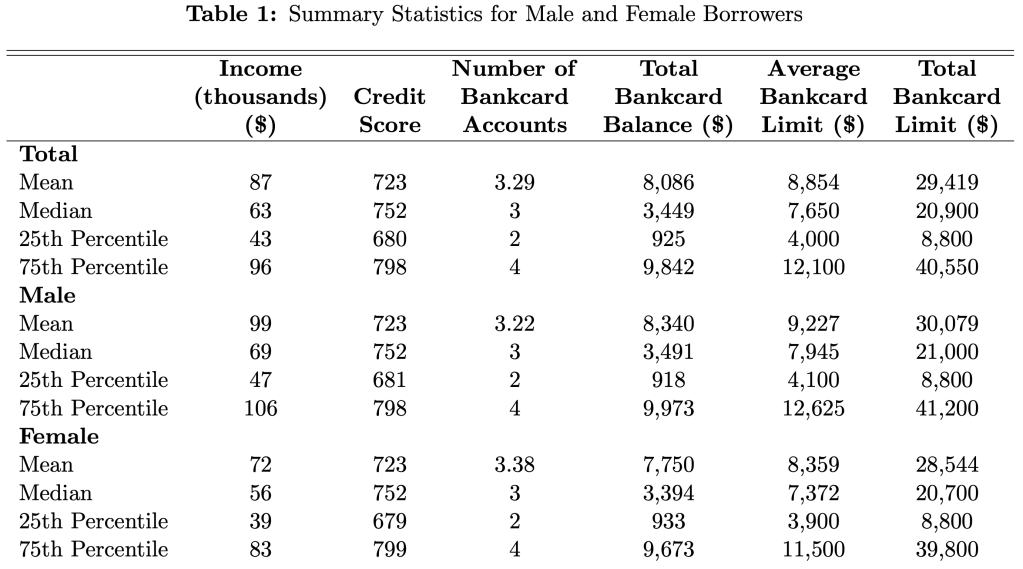
Their headline result is that men have 4.5% higher credit limits than women. Women actually have slightly more credit cards (3.38 vs 3.22), but have lower limits on each card; summing up their total credit limit across all cards yields an average of $28,544 for women vs $30,079 for men.
Two of the big factors that determine limits, and so could cause this difference, are credit scores and income. The table above shows that men and women have remarkably similar credit scores, while men have higher incomes. Still, when the paper tries to predict credit limits, controlling for credit scores, incomes, and other observables explains only about 13% of the gender gap.
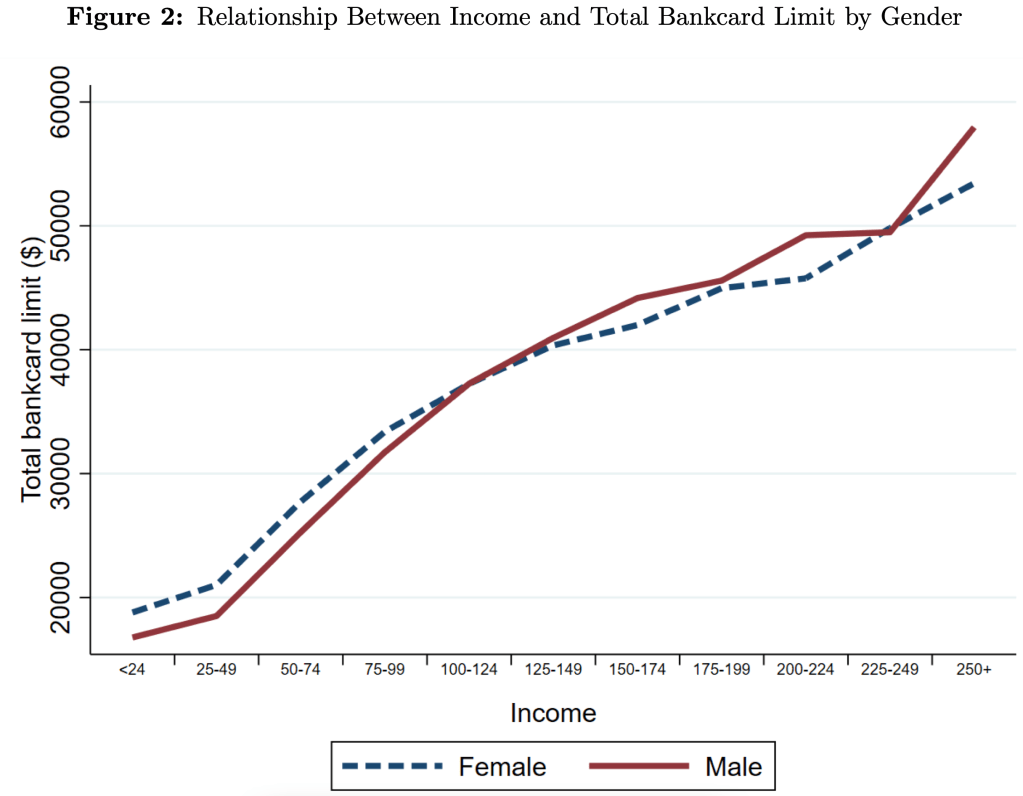
Men have 4.5% higher credit limits on average, but this difference varies a lot across the distribution. For credit scores, the gap is narrow in the middle but bigger at the extremes. For income, we see that men get higher limits at higher incomes, but women actually get higher limits at lower incomes- and not just “low incomes”, women do better all the way up to $100,000/yr:
The papers data covers 2006-2018, so they also show all sorts of interesting trends. The average number of credit cards held by men and women plunged after the 2008 recession and remains well below the peak. Total credit limits plunged too, though they were almost totally recovered by 2018.
There’s lots more in the paper, which is a great example of the value of descriptive work with new data. If anything I’d like to see the authors push even harder on the distribution angle. Its nice to see how limits vary across all incomes and credit scores, but why not show the full distribution of credit card limits by gender? My guess is that the 1st and 99th percentiles are very interesting places, because there’s all sorts of crazy behavior at the extremes. Finally, I wonder if higher limits are actually a good thing once you get beyond a relatively low amount- do you know of anyone who ever had a good reason to get their personal credit card balances over $20,000?
For many decades the Allied Social Science Association (ASSA) meetings, anchored by the American Economic Association, have been by far the world’s largest gathering of economists each year, typically attracting well over ten thousand. But the meetings went virtual-only for the past two years, and when they finally return in-person in 2023 they will likely be substantially diminished.
Some of this is due to potentially one-off factors; some people don’t want to travel to Louisiana because of its state laws, some still want to avoid large conferences because of Covid, others want to avoid the ASSA’s response to Covid:
All registrants will be required to be vaccinated against COVID-19 and to have received at least one booster to attend the meeting…. High-quality masks (i.e., KN-95 or better) will be required in all indoor conference spaces.
But the AEA made one big, apparently permanent change that means it could be a long time before we see a meeting as big as January 2020’s in San Diego- they gave up the job market. Prior to Covid the vast majority of first-round interviews to be a full-time US economics professor took place at ASSA. Naturally interviews moved online during Covid, but surprisingly the AEA has asked that they stay online, and in fact has specifically asked schools NOT to schedule interviews during ASSAs. This removes a huge source of demand for the meetings- the ~1200 new PhDs looking for their first jobs, the thousands of people there to recruit them (each hiring school typically sends 2-4 interviewers), and everyone trying to switch jobs. This was THE big thing that made AEAs special, that other conferences didn’t really have.
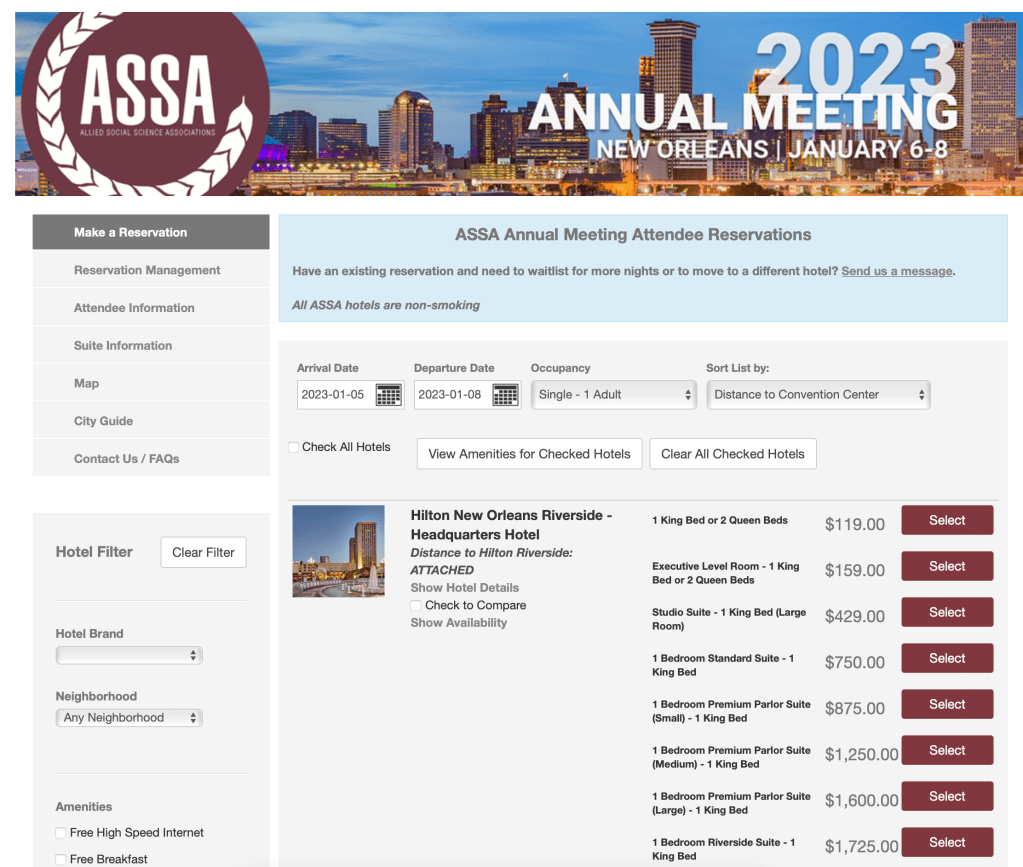
I’ll let everyone else debate whether this makes the job market better or worse; I’m agnostic there, but I’m sure it will shrink the conference. One silver lining to a smaller conference is that it is much easier to find a hotel room. Like usual I was waiting on the AEA website this Tuesday to book a hotel room on the first minute the AEA’s deeply discounted hotel blocks opened, because the good hotels tend to fill up near-instantly. But it appears this was unnecessary this year- two days later and even the headquarters hotel is still wide open:
I got the room I wanted at the Hotel Monteleone; I’ll be looking to grab a spot on the Carousel Bar, maybe see some of you there. I’ll present a poster at AEA, but mostly I’m just looking forward to spending real time in New Orleans for the first time since I moved away in 2017.
Yes, it rotates while you sit and drink
So I’m still looking forward even to a diminished AEA, but it does make me wonder- which other conferences will benefit most from AEA’s decline? I don’t know that anyone has put together the numbers for all the conferences enough to know what the 2nd-largest is, but my bet both for the 2nd-largest and most likely to benefit is the Southern Economic Association; I’ll be there too, in Ft. Lauderdale this November.
Since they were first introduced as part of the Dollar Menu in 1997, the McDouble and the McChicken have been my go-to choices when I visit Mcdonald’s. It was always hard to justify getting one of the fancier sandwiches like a Big Mac or Quarter Pounder, since they were 4-5x the cost of a McDouble but only about twice the size. This is part of why the McDouble has been called “the greatest food in human history“. But as we’ve seen with the plagues and wars of the 2020s, history doesn’t always progress in the direction you’d hope.
I hadn’t been to a McDonald’s for a while until last weekend, when I was shocked to see the McDouble and McChicken listed at $2.99. This wasn’t at an airport restaurant either, or even in an expensive big city; I stopped in Keene, New Hampshire on a drive home from Vermont. The price is up 200% from the days of the Dollar Menu! Meanwhile, the Big Mac has also got more expensive, but much less dramatically; it was $5.89, compared to the ~$5 I expect. So, 200% price increases at the bottom, vs 18% at the top.
This location may be a bit of an anomaly, but the big picture is clear; a typical McDouble now costs well over $2 in most of the US, while a typical Big Mac is still well under $6. You used to be able to get 4-5 McDoubles for the price of a Big Mac; now you typically get less than 3 and sometimes, as in Keene, less than 2.
What’s going on here? First, the McDouble was always absurdly cheap. Second, prices rise most quickly where demand is inelastic, and demand is less elastic for goods that are cheaper and goods that are more like “necessities” than “luxuries”.
This is why I think the McDouble is worth highlighting- its part of a more general trend of where inflation hits. I’ve noticed this in the grocery store as well; the price of standard ground beef is up much more than grass-fed organic beef, likewise with standard eggs vs free-range organic. How different would the Economist’s Big Mac Index look if it used the McDouble instead?
With falling inflation we may see the end of this necessity vs luxury price compression. But I doubt we’ll ever see the glory of the standard $1 McDouble again.
The New Hampshire McDonalds was disappointing, but Vermont was nice
Financial discussions often give the disclaimer “this is not investment advice” for legal reasons. I would always see this and wonder, is anyone ever willing to say “this *is* investment advice”?
I decided to take the Series 65 because I thought it would be a good learning opportunity, that it could be fun to tell people “this is investment advice”, and because it also provides the fast track to becoming an accredited investor. I’d like to have the option to invest in startups or hedge funds, but the SEC doesn’t let people do that unless they are rich (consistently over $300k/yr HH income, or $1mil in assets) or a licensed financial professional. I didn’t want to wait years to pass the income or asset tests, and so decided to pass the literal test instead.
I hoped that as a PhD economist who sometimes reads about finance for fun, I could pass the Series 65 without studying. This turned out not to be true, but it also wasn’t wildly wrong. You need to get at least 72% of questions correct to pass; taking a practice test cold I got 62%. I decided to first take the slightly easier Security Industry Essentials exam as a warmup. For both exams, I passed after spending ~ 2 weeks reading through the ~500 page study guides from the Securities Institute of America in my spare time.
For someone with an economics background, the exams will feature a few true econ questions you’ll know cold, a lot of “common sense” finance questions you probably know, some more specific finance questions you probably don’t know, and some specific questions about laws and regulations for investment advisers you almost certainly don’t know. This means you can speed through some parts of the study guide, but will need to slow way down in others. I found myself learning a roughly equal mix of things I’m happy to know for their own sake, things that would only be helpful to the extent I actually work as an investment adviser, and things that seem completely pointless.
Overall this seems like a decent way to spend a bit of time and money. Economists love to complain about people asking us for financial advice, and we tend to either reply “I don’t know, that’s not what economics is about” or give uninformed answers. But it doesn’t take that much time to educate yourself enough to be able to give people good, informed answers, so I think we should do so, especially when the alternatives people turn to tend to either be uninformed (friends or internet randos) or biased (advisers who get paid for steering them to high-fee investments).
That said, if your goal is actually to make money as an adviser or as an accredited investor, the Series 65 exam is only the first hoop to jump through. You still need to get licensed, which means either starting an investment advisory firm or joining one. I haven’t tried to do this yet despite passing the Series 65 in June, as I’ve been busy with my main job. I’d be interested to hear from anyone who has done this, especially anyone who got a part-time or consulting role just to get licensed to make accredited investments. How hard was it, how long did it take, what did you think of the actual work?
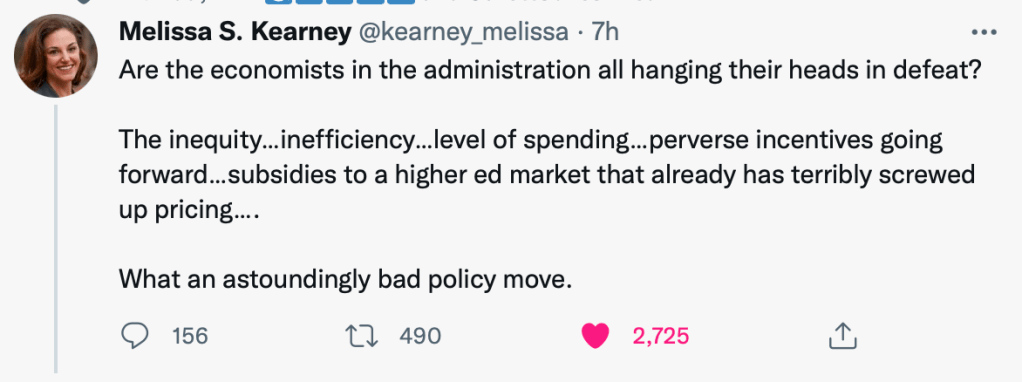
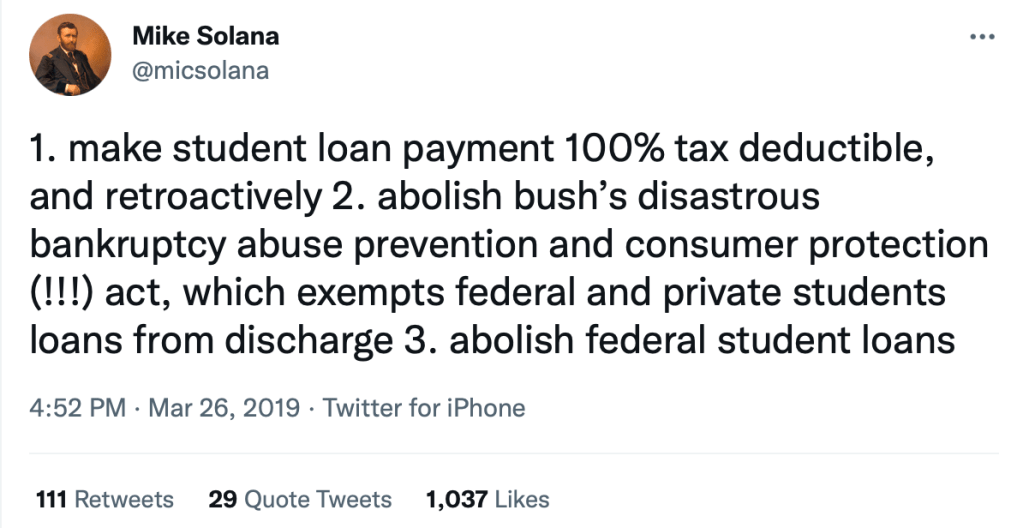
Yesterday the Biden administration announced that is forgiving up to $20k per person in student debt. So far we’ve seen lots of debate over whether this was a good/fair idea; as an economist who paid back his own debt early, you can probably guess what I have to say about that, so I’ll move on to the more interesting question of what happens now.
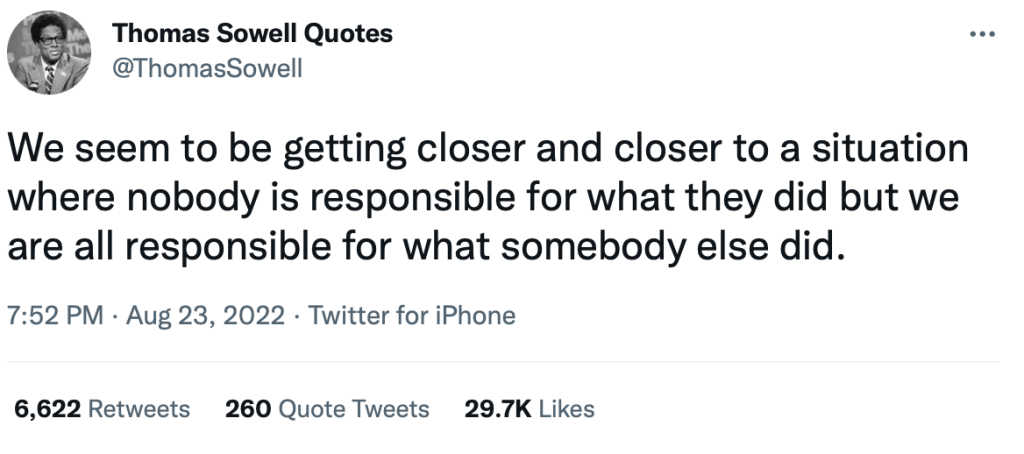
…after sharing one tweetOK one more, but I promise its relevant
The above is a quote from Thomas Sowell as a political commentator, but he was also a great economist. His book Applied Economics says that the essence of the economic approach to policy analysis is to not just consider the immediate effect, but instead to keep asking “and then what?” So let’s try that here.
We’ll start with the immediate effects. Those whose debt just fell will be happy, and will have more money to spend or save in other ways. The federal government is on the other side of this, they’ll receive less in debt payments and so will have to fund themselves in other ways like borrowing money or raising taxes. People are still trying to estimate how big this transfer from the government to student debtors is, but let’s take the Penn Wharton Budget Model estimate of $330 billion (the actual cost is likely higher, since that estimate is for $10k of loan forgiveness, but the actual program forgives up to $20k for those who had Pell grants). Dividing by US population tells you the cost is roughly $1000 per American; dividing by $10,000 tells you that roughly 33 million debtors benefit.
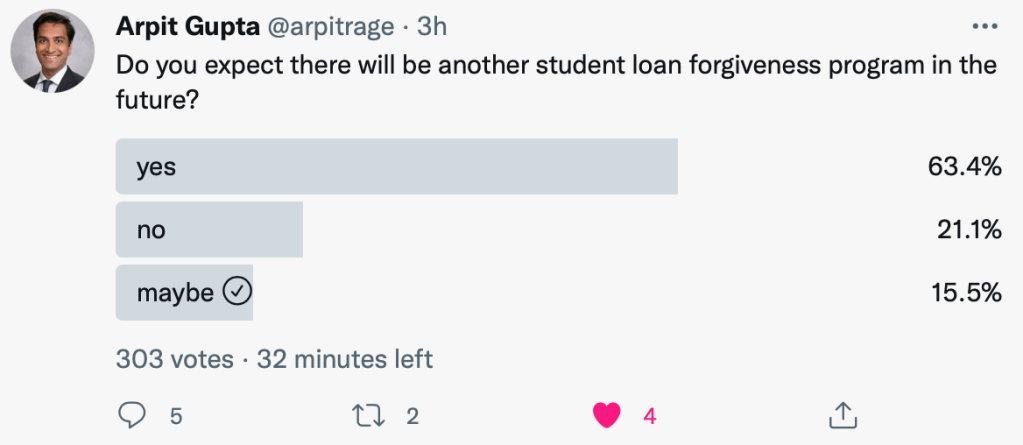
OK, what happens next? The big question is: is this a one-time thing, or does it make future loan forgiveness more or less likely? Later I’ll make the argument for why the answer could be “less”. But right now most people seem to think the answer is “more”, and that belief is what will be driving decisions.
If current and future students think loan forgiveness is likely, they have an incentive to take out more loans than they otherwise would, and to pay them off more slowly (particularly since income-based repayment was just cut from 10% to 5% of income). This higher willingness to pay from students gives colleges an incentive to raise tuition; historically about 60% of subsidized loans to students end up captured by colleges in the form of higher prices:
We find a pass-through effect on tuition of changes in subsidized loan maximums of about 60 cents on the dollar, and smaller but positive effects for unsubsidized federal loans. The subsidized loan effect is most pronounced for more expensive degrees, those offered by private institutions, and for two-year or vocational programs.
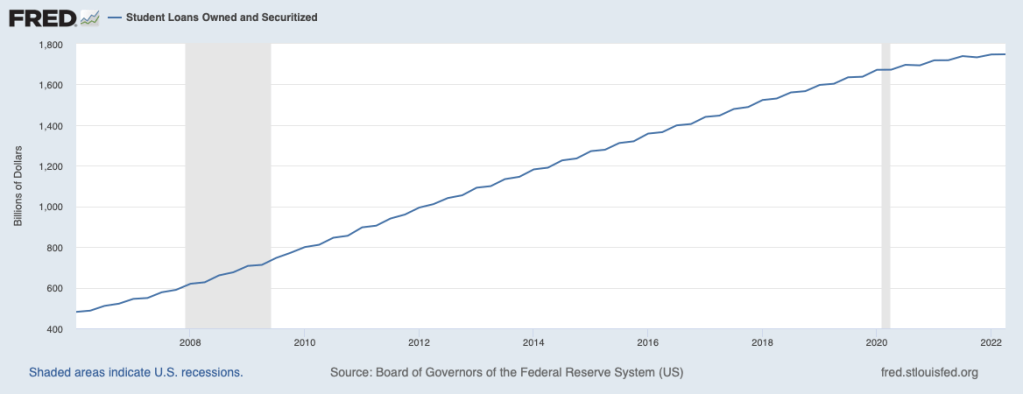
To the extent that you think student debt is a national problem, this action didn’t solve the problem so much as push it back 6 years; wiping out roughly 20% of all student debt brings us back to 2016 levels. So we could end up right back here in 2028, possibly faster to the extent that students borrow more as a result.
That, together with the “normalization” of student loan forgiveness, is why people think a similar action in the future is likely. But I’ll give two reasons it might not happen.
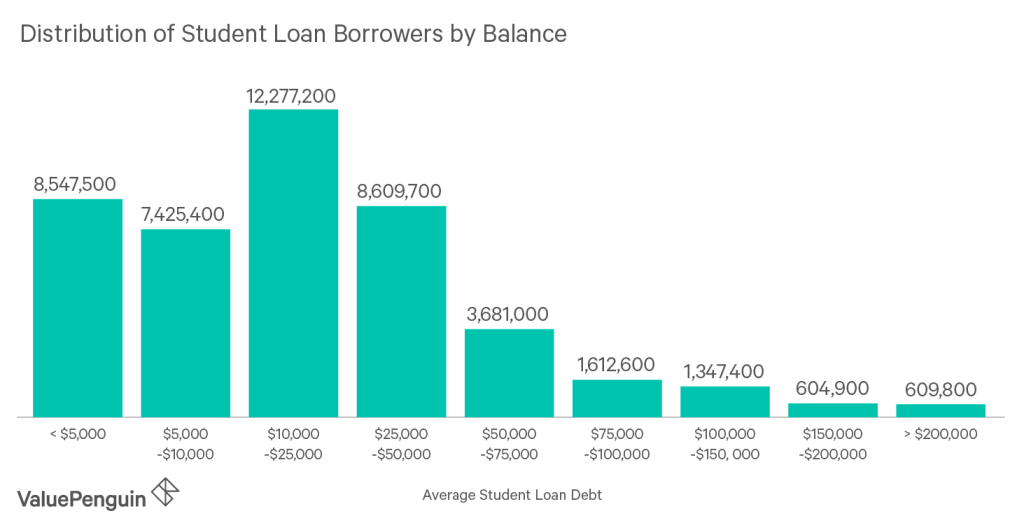
First, this action may have only reduced student debt by about 20%, but it reduced the number of student debtors much more (at least 36%), because most debtors owed relatively small amounts. It will take more than 6 years for the number of voters who’d benefit from loan forgiveness to get back to what it was in 2022, reducing support for forgiveness in the mean time.
That also gives Congress plenty of time to do something, even by their lethargic standards. Part of what bothers many people about this loan forgiveness is that it not only doesn’t solve the underlying issue of the Department of Education signing kids up for decades of debt, it will likely worsen the underlying issue through the moral hazard effect I describe above. Forgiveness would be much more popular if it were paired with reforms to solve the underlying issue. While we aren’t getting real reform now, I do think forgiveness makes it more likely that we’ll see reform in the next few years. What could that look like?
Let’s start with the libertarian solution, which of course won’t happen:
More realistic will be limits on where Federal loan money can be spent, and shared responsibility for colleges. Colleges and the government have spent decades pushing 18 year olds to sign up for huge amounts of debt. While I’d certainly like to see 18-year-olds act more responsibly and “just say no” to the pushers, the institutions bear most of the blame here. The Department of Education should raise its standards and stop offering loans to programs with high default rates or bad student outcomes. This should include not just fly-by-night colleges, but sketchy masters degree programs at prestigious schools.
Colleges should also share responsibility when they consistently saddle students with debt but don’t actually improve students’ prospects enough to be able to pay it back. Economists have put a lot of thought into how to do this in a manner that doesn’t penalize colleges simply for trying to teach less-prepared students.
I’d bet that some reform along these lines happens in the 2020’s, just like the bank bailouts of 2008 led to the Dodd-Frank reform of 2010 to try to prevent future bailouts. The big question is, will this be a pragmatic bipartisan reform to curb the worst offenders, or a Republican effort to substantially reduce the amount of money flowing to a higher ed sector they increasingly dislike?
I just published a paper on CON laws and spending in Contemporary Economic Policy. As frequent readers of this blog will know, CON laws in 34 states require healthcare providers in 34 US states to get permission from a state board before opening or expanding, and one goal of the laws is to reduce health care spending. The contribution we aim for in this paper is to lay out a theoretical framework for how these laws affect spending.
There have been many empirical papers on this, typically finding that CON laws increase spending, but the only theory explaining why has been simple supply and demand. Health care markets are hard to model for a few reasons, but one big one is that most spending is done through insurers, so the price consumers pay is typically quite a bit lower than the price producers receive. This leads to “moral hazard”- i.e. overuse and overspending by consumers. Normally economists hate monopolies because they lead to underproduction, so in a market with overuse its fair to ask (as Hotelling did about nonrenewable resources)- could two market failures (moral hazard overuse and monopoly underuse) cancel each other out?
Political betting has long been in a legal grey area. It seems that the Commodities Futures Trading Commission wants to make everything black and white, but at least for now it has simply made everything murkier.
PredictIt is the largest political betting site in the US; if you want to know who is likely to win an upcoming election, its the best place to find a quick answer. Prediction markets have two great virtues- they are usually right about what’s going to happen, and if they aren’t you can bet, making money and improving their accuracy at the same time.
PredictIt has operated since 2014 under a “no-action letter” from the CFTC. Effectively, the regulators told them “we’re not saying what you’re doing is definitely legal, but we know about it and have no plans to shut you down as long as you stick to the limits described in this letter”. But last week the CFTC withdrew their letter and ordered PredictIt to shut down by February 2023.
My first question was, why? Why shut them down now after 8 years when all their operations seem to be working as usual? The CFTC said only that “DMO has determined that Victoria University has not operated its market in compliance with the terms of the letter and as a result has withdrawn it”, but did not specify which of the terms PredictIt violated, leaving us to speculate. Did the scale simply get too big? Did they advertise too heavily? Did Victoria University, the official operator, let too much be handled by a for-profit subcontractor? Did some of their markets stray too far from the “binary option contracts concerning political election outcomes and economic indicators” they were authorized for?
PredictIt hasn’t been much clearer about what happened, simply putting a notice on their site. Their CEO did an interview on the Star Spangled Gamblers podcast where he said there was no one thing that triggered the CFTC but did mention “scope” as a concern- which I interpret to mean that they offered some types of markets the CFTC didn’t like, perhaps markets like “how many times will Donald Trump tweet this month”.
The other big question here is about PredictIt’s competitors. In 2021 it seemed like we were entering a golden age of real-money prediction markets, with crypto-based PolyMarket and economics-focused Kalshi joining PredictIt. I looked forward to seeing this competition play out in the marketplace, but it now seems like we’re headed toward a Kalshi-only monopoly where they win not by offering the product users like best, but by having the best relationship with regulators. Polymarket had offered markets without even a no-action letter, based on the crypto ethos of “better to ask forgiveness than permission”; this January the CFTC hit them with a $1.5 million fine and ordered them to stop serving US customers.
If the CFTC doesn’t reverse their decision to shut down PredictIt, then February 2023 will see a Kalshi monopoly. This has led to speculation that Kalshi is behind the attack on PredictIt; their cofounder issued this not-quite-a-denial. But it certainly looks bad for the CFTC that they are effectively giving a monopoly to the company that hires the most ex-CFTC members.
For now you can still bet on PredictIt or Kalshi (or even Polymarket if you’re outside the US). If you’d like to petition the CFTC about PredictIt you can do so here. It might actually work; while the CFTC’s recent actions certainly look cronyistic, they’ve been reasonable compared to other regulators. They’re giving PredictIt no fines and several months to wind down, and even Polymarket gets to keep serving non-US customers from US soil. I’d likely make different decisions if I were at CFTC but the ideal solution here is a change in the law itself, as we’ve seen recently in sports betting. Prediction markets are impressive generators and aggregators of information, and politics and policy are at least as valuable an application as sports. To go meta, suppose we want to know- will PredictIt survive past February? There’s a prediction market for that, and its currently saying they’ve got a 20% chance.