Europe Natural Gas Shortage: Factories Shut, Maybe Worse to Come

Shut down your old reliable coal and nuclear power plants. Replace them with wind turbines. Count on natural gas fueled power plants to fill in when the breeze stops blowing. Curtail drilling for your own natural gas, and so become dependent on gas supplied by pipeline from Russia or by tankers chugging thousands of miles from the Middle East. What could possibly go wrong?

That is what Europe is discovering now as natural gas prices have quintupled, taking electricity prices up with them. Europe is having a hard time finding enough gas supply to fill up storage facilities to get them through the winter. If consumers are prioritized, widespread industry shutdowns are possible if there is a cold winter. Prices for many things will rachet up, with implications for inflations and in turn for central banks’ response to inflation. (The Fed’s Powell has been talking down the current inflation as merely transitory).

 In the UK, energy companies are going bankrupt because the wholesale price that at which they purchase gas is higher than the government-mandated cap on gas price they can charge consumers. Plants which use natural gas as a feedstock like fertilizer plants are shutting down, which impacts farmers. Carbon dioxide is a byproduct of some of these operations, and the resulting shortage of CO2 is affecting meat-packers who use it in their operations. Indeed, a food producer has warned that the Christmas dinner could be “cancelled.” That’s just how bad it is. The Brits are even delaying the shutdown of the country’s largest remaining coal-burning power plant.

Jason Bordoff of the Columbia Climate School and the Center on Global Energy Policy just published a long article giving his perspective on all this. He identifies several contributing factors:

( 1 ) Cold and hot weather affected gas consumption this year. Winter in much of the Northern Hemisphere was unusually cold earlier this year, which boosted gas demand for heating. And then a hot summer consumed more gas to make electricity for air conditioning. 

( 2 ) Other sources of electricity have been hampered. “Wind generation in Europe has been far below average this year due to long periods of less windy weather. …Demand for fossil fuels is set to spike further as Germany takes another three nuclear reactors off the grid this year as part of its nuclear shutdown. Meanwhile, drought conditions in China and South America have led to reduced hydropower output, drawing supplies of globally traded gas into those markets instead.”

( 3 ) The post-COVID economic recovery has boosted industrial demand.

( 4 ) Russia has restricted gas deliveries to Europe though the existing pipeline that runs through Ukraine. (Many observers see this as a pressure tactic to get Europe to switch over to a northern pipeline route, which would then remove the importance of Ukraine for Russian gas marketing, which would then give Russia a freer hand to resume military harassment of that country.) Also, European countries have restricted their own gas production. The Dutch are curtailing the production rate at their big Groningen gas field because local residents fear earthquakes from ground subsidence, and the Brits have restricted fracking of promising gas fields due to public protests.

As might be expected in our interconnected world, the European supply crunch has affected U.S. prices, which are at their highest level in five years. America exports gas via liquified natural gas (LNG) tankers, but U.S. gas supplies so far have not responded much to the price increase. The hostility of the Biden administration and pressure from green-leaning investors has discouraged petroleum companies from expanding drilling.

Meanwhile, California is running its own experiment in green energy  adoption:             

California, for example, is having trouble keeping the lights on as it rapidly scales the use of intermittent solar and wind power. It recently requested an emergency order from the U.S. federal government to maintain system reliability by, among other actions, allowing the state to require certain fossil fuel plants scheduled to retire to stay online and by loosening pollution restrictions. California is also proposing to build several temporary natural gas plants to avoid blackouts, even as the state shuts down the Diablo Canyon nuclear power plant, which produces more zero-carbon electricity than all the state’s wind turbines combined.

Professor Bordoff notes that “Many projections for how quickly and how much clean energy can be scaled are based on stylized models of what is technically and economically possible”, and unsurprisingly calls for policies which mitigate volatility, e.g., “…regulatory and infrastructure policies can facilitate more integration, flexibility, and interconnectedness in the energy system—from power grids to pipelines—so there are more options to pull energy supplies into a market when needed.”

Oh, and this restatement of the obvious:  

Uncertainty about the pace of transition may lead to periodic shortfalls in supply if climate action shutters traditional fossil fuel infrastructure before alternatives can pick up the slack—as may be starting to happen in some places now. And if fossil fuel supply is curbed faster than the pace at which fossil fuel demand falls, shortfalls can result in market crunches that cause prices to spike and exacerbate existing geopolitical risks. In fact, this is what the International Energy Agency just warned is happening in oil markets—a striking contrast to what it said only a few months ago, when it warned that new fossil fuel supplies would not be needed if nations were on track to achieve net-zero emissions by 2050.

Me? After working through  all this material, I’m going to go buy me some shares of ExxonMobil, the largest natural gas producer in the U.S.

Clemens and Strain on Large and Small Minimum Wage Changes

In my Labor Economics class, I do a lecture on empirical work and the minimum wage, starting with Card & Kreuger (1993). I’m going to quickly tack on the new working paper by Clemens & Strain “The Heterogeneous Effects of Large and Small Minimum Wage Changes: Evidence over the Short and Medium Run Using a Pre-Analysis Plan”.

The results, as summarized in the second half of their abstract are:

relatively large minimum wage increases reduced employment rates among low-skilled individuals by just over 2.5 percentage points. Our estimates of the effects of relatively small minimum wage increases vary across data sets and specifications but are, on average, both economically and statistically indistinguishable from zero. We estimate that medium-run effects exceed short-run effects and that the elasticity of employment with respect to the minimum wage is substantially more negative for large minimum wage increases than for small increases.

The variation in the data comes from choices by states to raise the minimum wage.

A number of states legislated and began to enact minimum wage changes that varied substantially in their magnitude. … The past decade thus provided a suitable opportunity to study the medium-run effects of both moderate minimum wage changes and historically large minimum wage changes.

We divide states into four groups designed to track several plausibly relevant differences in their minimum wage regimes. The first group consists of states that enacted no minimum wage changes between January 2013 and the later years of our sample. The second group consists of states that enacted minimum wage changes due to prior legislation that calls for indexing the minimum wage for inflation. The third and fourth groups consist of states that have enacted minimum wage changes through relatively recent legislation. We divide the latter set of states into two groups based on the size of their minimum wage changes and based on how early in our sample they passed the underlying legislation.

The “large” increase group includes states that enacted considerable change. New York and California “have legislated pathways to a $15 minimum wage, the full increase to which firms are responding exceed 60 log points in total.” Data comes from the American Community Survey (ACS) and the Current Population Survey (CPS).

Continue reading

Covid, Cars, China, Crypto, Corruption

We generally do long “effort posts” on specific topics here, but today I’m mixing things up with 5 quick updates.

  1. Covid My daughter got sent home with a cough Tuesday, which meant I cancelled classes Wednesday to hang out with her until we get a Covid-negative PCR. Last Thursday my son’s public school was closed for Yom Kippur, and I got so focused on hanging out with him I forgot to post here.
  2. Cars My wife bought a new used car last week. We’ve covered here how car prices have jumped up while inventories fell this summer, and the latest numbers show that used car prices are now falling slightly from very high levels while new car prices continue to rise. While actually buying a car, the low inventories stood out even more than the high prices. Several times we saw a promising car online, only to call or visit the dealer and find out it had sold the day before. The new Nissan Leaf sounds like an excellent value at its sticker price, but none were available in Rhode Island, and no blue ones anywhere in New England.
  3. China Scott covered the collapsing Chinese real estate market on Tuesday. I’ll just pass along the takes I’ve seen from Western economists and China-watchers Michael Pettis and Christopher Balding, which is that this is a big deal that will slow Chinese growth for years but is unlikely to precipitate a 2007-style financial crisis. I find Balding’s argument that financial contagion will be limited to be convincing partly because of his actual arguments about quasi-bailouts, and partly because he almost always argues that “things in China are worse than you think”, so if he says “Evergrande isn’t Lehman Brothers” I listen.
  4. Crypto Tuesday I met the co-founder of a new crypto-based prediction market, Melange, which sounds promising. The prediction market space is growing rapidly with PolyMarket and Kalshi joining the older PredictIt.
  5. Corruption Last week the World Bank announced it is discontinuing the Doing Business report/ranking due to apparent corruption; top Bank officials in the middle of raising money from countries including China pushed to raise the rankings of those countries beyond what the data justified. I hope another organization steps up do continue the good parts of the Doing Business report in a more trustworthy way.

Selectivity and Selection Bias: Are Selective Colleges Better?

If you have ever been through the process of applying to colleges, you have almost certainly heard the term “selective colleges.” If you haven’t the basic idea is that some colleges are harder to get into, for example as measured by what percentage of applicants are accepted to the school. The assumption of both applicants and schools is that a more selective college is “better” in some sense than a less selective college. But is it?

In a new working paper, Mountjoy and Hickman explore this question in great detail. The short version of their answer: selective colleges don’t seem to matter much, as measured by either completion rates or earnings in the labor market. That’s an interesting result in itself, but understanding how they get to this result is also interesting and an excellent example of how to do social science correctly.

Here’s the problem: when you just look at outcomes such as graduation rates or earnings, selective colleges seem to do better. But most college freshmen could immediately identify the problem with this result: that’s correlation, not causation (and importantly, they probably knew this before stepping onto a college campus). Students that go to more selective colleges have higher abilities, whether as measured by SAT scores or by other traits such as perseverance. It’s a classic selection bias problem. How much value is the college really adding?

Here’s how this paper addresses the problem: by only looking at students that apply to and are accepted to colleges with different selectivity levels, but some choose to go to the less selective colleges. What if we only compare this students (and of course, control for measurable differences in ability)?

Now this approach is not a perfect experiment. Students are not randomly assigned to different colleges. There is still some choice going on. But are the students who choose to attend a less selective college different in some way? The authors try to convince us in a number of ways that they are not really that different. Here’s one thing they point out: “nearly half of the students in our identifying sample choose a less selective college than their most selective option, suggesting this identifying variation is not merely an odd choice confined to a small faction of quirky students.”

Perhaps that alone doesn’t convince you, but let’s proceed for now to the results. This chart on post-college earnings nicely summarizes the results (see Figure 3 in the paper, which also has a very similar chart for completion rates)

Continue reading

Likely Collapse of Chinese Real Estate Conglomerate Evergrande Roils World Markets

Nearly a year ago, on this blog we described the sequence of events that led to the Great Recession ( or “Global Financial Crisis”) of 2008-2009. The underlying problem was real estate-related debt: as inflated housing prices collapsed, many people couldn’t (or wouldn’t) pay their mortgages. Various financial dominos fell, but the one that gets singled out as the single most critical event was  the collapse of Lehman Brothers investment bank on September 15, 2008. The Dow Industrial average fell 504 points that day, and loss of confidence in the financial markets led to a freeze-up in credit, which was/is the lifeblood of business.

The likely bankruptcy of the gigantic Chinese real estate conglomerate Evergrande is being discussed as another possible “Lehman Moment”. It is hard to comprehend just how big this outfit is. It owns more than 1,300 real estate projects across China, directly employs 200,000 people, and is indirectly sustains some 3.8 million jobs. It got that big by borrowing (including selling bonds) and spending enormous amounts of money. The problem now is that it seems like it cannot service its $300 billion debt. Once things like this start to go bad, they often get much worse, quickly. Other parties stop wanting to do business with you, and it all goes downhill. (A famous reply in Ernest Hemingway’s The Sun Also Rises to the question, “How do you go bankrupt?” was “Gradually, and then suddenly”). The market prices on Evergrande’s bonds indicate that the market expects bankruptcy, with bondholders getting only about 25 cents on the dollar.

If this collapse materializes fully, a lot of investors will lose a lot of money, a lot of suppliers of building materials to Evergrande will not get paid and may go broke, and a lot of real estate development in China will freeze up for the time being.  Goldman Sachs estimates a 1-4% hit to China’s GDP, which is huge, and would reverberate across the whole world.

Wall Street seems to have been ignoring this drama, until yesterday (Monday). Blam, stocks fell around 2%, and were still headed south at the end of trading. Is this the start of The Big One? Well, that makes for dramatic commentary, but most observers seem to take a more nuanced approach. First, the all-powerful Chinese government could order the People’s Bank of China to “fix this”. We all now know that central banks have magical powers to create as much money as needed to, e.g., buy all outstanding Evergrande bonds at near-par. On the other hand, the Chinese government lately has been clamping down on speculation. So there may be some sort of compromise, a semi-orderly unwinding, with bondholders feeling some pain, but actual real estate operations being sold off and continuing under some other names.

Wall Street may be more worried about whether the Fed announced on Wednesday that it will take away the punch bowl by tapering of its bond purchases. The last time the Fed did that, in 2018, stocks took a long and hard tumble. Again, a range of outcomes is possible here.

Ironically, all these concerns, as long as they don’t really turn into something serious, may be a bullish indicator for stocks. Stocks are said to “climb a wall of worry”; it is when everyone is totally complacent that is a setup for a crash. Time will tell whether the Evergrande difficulties end up being part of  a bullish wall or a bearish cliff.

An Economic Model of Loneliness and Being Extremely Online

Bo Burnham is a comedian and musician who, like so many of the artists I enjoy, produces art that I can only describe as extremely specific to him. His newest special on Netflix features a song, “Welcome to the Internet” (some NSFW lyrics), that I liked so much I thought it was worth writing as a formal model.

No, really. Hey, we all need a hobby.

The whole song is a meditation on the overwhelming nature of the internet and is, in my opinion, fantastic. I think if we zero in on two pieces of refrain in the lyrics, we can get some traction in what Burnham believes is the underlying problem, if not outright crisis, that resides within the internet and those that are “extremely online”:

First, the lure:

Could I interest you in everything?
All of the time?
A little bit of everything
All of the time

This is the value-add of the internet and why we can never, and will never, leave it behind willingly. This is also the “cognitive overload” hypothesis of why the internet is bad. Sure, for the infovores of the world there hasn’t been a bigger technological shift since the printing press, but there certainly exists the possibility that most human minds (if any) aren’t built to handle the deluge of information they are drowning in. That’s one theory, but I think that’s the kind of problem that isn’t actually a problem. Some will consume more of the internet, some will consume less, c’est la vie.

It’s in the second half of the refrain, however, that we see the actual problem.

Apathy’s a tragedy
And boredom is a crime
Anything and everything
All of the time

And therein lies the rub. You can’t opt out. But is that true? Well, that depends on who you are and how you live your best life i.e. how you optimize your utility function. So let’s do it. Let’s write down the utility function that lives inside the song. What we’re going to do is this- we’re going to lay out the simple components as natural language, then turn it into formal math, and then bring it back to natural language.

In our Burnhamian mode, people need two things: Private goods like food and shelter and Social Goods like friendship and camraderie. How much Utility you enjoy will always be increasing in both, but the optimal mix will depend on your constraints (wealth, time, accessible population) and the mathematical function determining how much Utility you get from a mix of Private and Social goods i.e. are they additive, multiplicative, or something else. Utility equal to zero is equivalent to death.

Let’s add one last layer of complexity. Let’s say that your Social goods are a function of two kinds of elements: Friends and Clubs. Friends are direct, one-to-one relationships. Clubs are large social groups. We will define and differentiate between the two as such: if you cease to be part of a friendship (whether between 2,3, or 5 people), then that friendship no longer exists in the same form. If you drop out of a club, on the other hand, that club will persist without you.

So what a person has to do is, within their constraints, try to optimize how much of their resources they invest in their Private goods, their Friends, and their Clubs.

The first line is our base model, the second is an expanded version with our two-input model of Social goods. The function we are using is called a Constant Elasticity of Substitution utility function. The key parameter, α, determines how Private and Social goods interact. If α=1, then they are what economists call perfect substitutes. All that matters is how much you have in total of the two inputs, and if you want you could specialize in just one of them. They are perfectly additive. If, on the other hand, α=-∞ (negative infinity), then they are perfect complements, like right and left shoes. There is no point in adding even one more unit of Private goods until you have another unit of Social goods to pair with it. In a sense, they are multiplicative, meaning if either value is zero, then your utility is zero. The value of α will tell us whether the best life requires more of a mix of Social and Private inputs (if they are more complementary), or simply the most of whatever is the easiest to come by (if they are good substitutes for each other).

We’ve nested in our Friends and Clubs production of Social goods as a CES function within the second equation, with a similar story, only here β will determine how much of a mix of Friends and Clubs we want, or whether we can specialize more in one over the other. In the third and last line of the model, we’ve reduced it down to the underlying questions that will tell our story represented by addition and multiplication signs:

Are Private and Social Goods complements (multiplicative) or substitutes (additive) when we internally produce utility? Are Friends and Clubs complements or substitutes when we internally produce our Social goods?

Assumption 1: α= -0.1 Private and Social goods are weak complements. What this means is that there are diminishing returns to Private and Social goods, you need some of both, but you can have less of one or the other and its fine. Let’s just assume wealthy people need other people in their lives to stay sane while, at the same time people with rich social lives and supportive communities still need food and shelter. You can specialize a bit more on one side, depending on what’s available, but you can’t live without at least some of both.

We’re all different in how we build our social lives and, in turn, how we internalize the internet in our lives. I think we can gain some insight into this process by working out the stories in this simple model through our second parameter, β. Let’s consider three broad types of people.

Person Type 1: Friends and Clubs are Strong Substitutes (high β)

These people are either relatively offline (e.g. they still use their phones as phones to make phone calls) or extremely online (e.g. they get a panic attack unless they have 80% battery and a charge pack on their person). These are the people who can become hyper-specialized in new clubs if they are extricated from prior social networks or club settings. This is why cults recruit people who move to new places where they don’t know anyone. This is how your diehard hippie socialist friend grew up to be a conservative evangelical after they moved to the Texas suburbs.

With regards to our original question, people who hyperspecialize in their club and club identity will be constantly contributing grist to the club’s identity: evidence of the necessity of the club and it’s mission, rage at non-members, disappointment in members who aren’t committed enough, and constant vigilance in the monitoring of everyone else’s commitment. They are in it, they are of it, and they are ready to purge.

Apathy’s a tragedy (You must care about everything the club cares about)
And boredom is a crime (All of your time must be allocated to the club)
Anything and everything
All of the time

Type 2: Friends and Clubs are strong complements (low β)

These are the people that I think Burnham’s song is targeted at, for whom he has the most sympathy, and with whom I suspect he would count himself. These are people for whom the internet is the most taxing, the most exhausting to navigate.

Type 2 folks want to have personal friendships and friend groups while still feeling a part of something bigger, whether it’s a community, a political movement, or spiritual affiliation. Type 2 people will have preferences towards one or more social identities manifested as clusters on the internet, but they don’t want to purge people who don’t share those preferences from their circle of friends. Type 2 folks are interested in civil rights and social justice, but they want to diversify their emotional and material resources across their personal relationships and private wellbeing as well.

The deluge of the internet, with its stark images, focus on extreme outcomes, battle cries, and public reputation mauling, are constantly admonishing and shaming Type 2’s. Type 2 people are tired. Perhaps most importantly, the pandemic has been especially hard on Type 2’s. While Type 1 club-specialists have thrived by focusing the totality of their efforts to the online arena, their voices have been tearing the Type 2 social-portfolio diversifiers to shreds.

Type 3: Friends and Clubs are weak complements (middle β)

Type 3 people are a lot like Type 2’s, but it is easier for them to compartmentalize the production of their social goods. Type 3 people are often in clubs, but they are rarely of clubs. They’re not joiners. Whether you’re looking at sacrifice-demanding religious cults or extremely-online political culture warriors, if the social associations of the world demand too much of Type 3 people, they are happy to half-ass their contribution or opt-out entirely. They might be on Twitter or Facebook, but they don’t need to reply to anyone. They might go to church on Sunday with the family, but if the minister tells them their sister is going to hell for their sexual preference, it’s just not that costly to stop going. For them clubs will always remain a luxury good, never a necessity.


To be clear this post is an exercise in building a toy model of something big and complex and important. It’s a gross abstraction and shouldn’t be taken too seriously. The process of formalizing your thinking on a social mechanism, however, is something that I think you should take very seriously. Formal models are useful because there is no hiding what your idea actually is. There’s no “sorry, you misread me” or reliance on obscure jargon. Formal models force you to clarify and reveal your thinking to everyone, including yourself. They can open up new avenues for explorations and even generate empirically testable predictions. Formal models have in many ways been the principal force behind economic imperialism in the social sciences. Not because the math is perfect or all encompassing or even correct. It’s because it’s all out there, ready to be judged and dissected and tested. That transparency makes it a useful.

I don’t know if my interpretation of Bo Burnham’s theory of the internet is correct or even necessarily what he intended it to be. But this is one way we can take it a step forward and see what we can actually learn from it. Which is pretty much all I want to do for the rest of my research life, on every topic, all of the time.

Behavioral Economist at Work

A blog post titled “The Death of Behavioral Economics” went viral this summer. The clickbait headline was widely shared. After Scott Alexander debunked it point-by-point on Astral Codex Ten, no one corrected their previous tweets. I recommend Scott’s blog for the technical stuff. For example, there is an important distinction between saying that loss aversion does not exist versus saying that its underlying cause is the Endowment Effect.

The author of the original death post, Hreha, is angry. Here’s how he describes his experience with behavioral economics.

I’ve run studies looking at its impact in the real world—especially in marketing campaigns.

If you read anything about this body of research, you’ll get the idea that losses are such powerful motivators that they’ll turn otherwise uninterested customers into enthusiastic purchasers.

The truth of the matter is that losses and benefits are equally effective in driving conversion. In fact, in many circumstances, losses are actually *worse* at driving results.

Why?

Because loss-focused messaging often comes across as gimmicky and spammy. It makes you, the advertiser, look desperate. It makes you seem untrustworthy, and trust is the foundation of sales, conversion, and retention.

He’s trying to sell things. I wade through ads every day and, to mix metaphors, beat them off like mosquitoes. Knowing how I feel about sales pitches, I don’t envy Hreha’s position.

I don’t know Hreha. From reading his blog post, I get the impression that he believes he was promised certain big returns by economists. He tried some interventions in a business setting and did not get his desired results or did not make as much money as he was expecting.

According to him, he seeks to turn people into “enthusiastic purchasers” by exploiting loss aversion. What would consumers be losing, if you are trying to sell them something new? I’m not in marketing research so I should probably just not try to comment on those specifics. Now, Hreha claims that all behavioral studies are misleading or useless.

The failure to replicate some results is a big deal, for economics and for psychology. I have seen changes within the experimental community and standards have gotten tougher as a result. If scientists knowingly lied about their results or exaggerated their effect sizes, then they have seriously hurt people like Hreha and me. I am angry at a particular pair of researchers who I will not name. I read their paper and designed an extension of it as a graduate student. I put months of my life into this project and risked a good amount of my meager research budget. It didn’t work for me. I thought I knew what was going to happen in the lab, but I was wrong. Those authors should have written a disclaimer into their paper, as follows:

Disclaimer: Remember, most things don’t work.

I didn’t conclude that all of behavioral research is misleading and that all future studies are pointless. I refined my design by getting rid of what those folks had used and eventually I did get a meaningful paper written and published. This process of iteration is a big part of the practice of science.

The fact that you can’t predict what will happen in a controlled setting seems like a bad reason to abandon behavioral economics. It all got started because theories were put to the test and they failed. We can’t just retreat and say that theories shouldn’t get tested anymore.

I remember meeting a professor at a conference who told me that he doesn’t believe in experimental economics. He had tried an experiment once and it hadn’t turned out the way he wanted. He tried once. His failure to predict what happened should have piqued his curiosity!

There is a difference between behavioral economics and experimental economics. I recommend Vernon Smith’s whole book on that topic, which I quoted from yesterday, for those interested.

The reason we run experiments is that you don’t know what will happen until you try. The good justification for shutting down behavioral studies is if we get so good at predicting what interventions will work that the new data ceases to be informative.

Or, what if you think nudges are not working because people are highly sensible and rational? That would also imply that we can predict what they are going to do, at least in simple situations. So, again, the fact that we are not good at predicting what people are going to do is not a reason to stop the studies.

I posted last week about how economists use the word “behavioral” in conversation. Yesterday, I shared a stinging critique of the behavioral scientist community written by the world’s leading experimental researcher long before the clickbait blog.

Today, I will share a behavioral economics success story. There are lots of papers I could point to. I’m going to use one of my own, so that readers could truly ask me anything it. My paper is called “My reference point, not yours”.

I started with a prediction based on previous behavioral literature. My design depended on the fact that in the first stage of the experiment, people would not maximize expected value. You never know until you run the experiment, but I was pretty confident that the behavioral economics literature was a reliable guide.

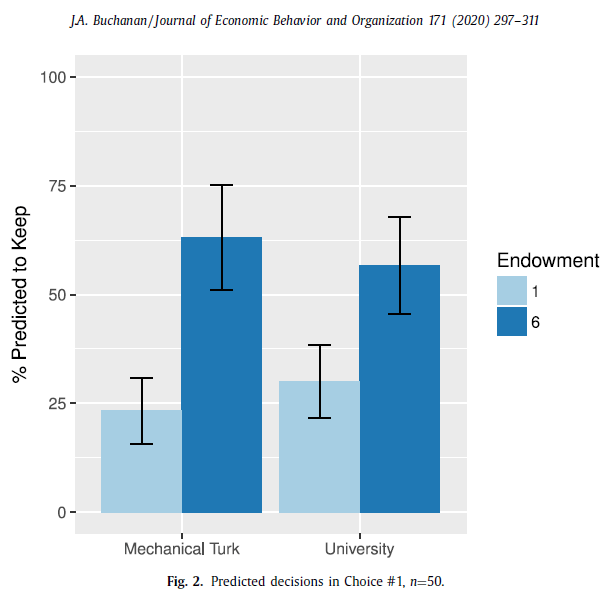
Some subjects started the experiment with an endowment of $6. Then they could invest to have an equal chance of either doubling their money (earn $12) or getting $1. To maximize expected value, they should take that gamble. Most people would rather hold on to their endowment of $6 than risk experiencing a loss. It’s just $5. Why should the prospect of losing $5 blind them to the expected value calculation? Because most humans exhibit loss aversion.

I was relying on this pattern of behavior in stage 1 of the experiment for the test to be possible in stage 2. The main topic of the paper is whether people can predict what others will do. High endowment people fail to invest in stage 1, so then they predict that most other participants failed to invest. The high endowment people failed to incorporate easily available information about the other participants, which is that starting endowments {1,2,3,4,5,6} were randomly assigned and uniformly distributed. The effect size was large, even when I added in a quiz to test their knowledge that starting endowments are uniformly distributed.

Here’s a chart of my main results.

Investing always maximizes expected value, for everyone. The $1 endowment people think that only a quarter of the other participants fail to invest. The $6 endowment people predict that more than half of other participants fail to invest.

Does this help Mr. Hreha get Americans to buy more stuff at Walmart, for whom he consults? I’m not sure. Sorry.

My results do not directly imply that we need more government interventions or nudge units. One could argue instead that what we need is market competition to help people navigate a complex world. The information contained in prices helps us figure out what strangers want, so we don’t have to try to predict their behavior at all.

Here’s the end of my Conclusion

One way to interpret the results of this experiment is that putting yourself in someone else’s shoes is costly. We often speak of it as a moral obligation, especially to consider the plight of those who are worse off than ourselves. Not only do people usually decline to do this for moral reasons, they fail to do it for money. Additionally, this experiment shows that, if people are prompted to think about a specific past experience that someone else had, then mutual understanding is easier to establish.

I’m attempting to establish general purpose laws of behavior. I’ll end with a quote from Scott Alexander’s reply post.

A thoughtful doctor who tailors treatment to a particular patient sounds better (and is better) than one who says “Depression? Take this one all-purpose depression treatment which is the first thing I saw when I typed ‘depression’ into UpToDate”. But you still need medical journals. Having some idea of general-purpose laws is what gives the people making creative solutions something to build upon.

Vernon Smith on Behavioral in 2008

Like last week, this post is adjacent to the internet chattering over whether behavioral economics is “dead”.

Vernon Smith wrote a book Rationality in Economics that came out in 2008. I’m going to pull some quotes from that book that I think are relevant. This is not an attempt to summarize the main point of the book.

I began developing and applying experimental economics methods to the study of behavior and market performance in the 1950s and 1960s…

Preface, pg xiii

Repetitive or real-time action in incomplete information environments is an operating skill different from modeling based on the “given” information postulated to drive the economic environment that one seeks to understand in the sense of equilibrium, optimality, and welfare. This decision skill is based on a deep human capacity to acquire tacit knowledge that defies all but fragmentary articulation in natural or written language.

Preface, pg xv

I think that improved understanding of various forms of ecological rationality will be born of a far better appreciation that most of human knowledge of “how,” as opposed to knowledge of “that,” depends heavily on autonomic functions of the brain. Human sociality leads to much unconscious learning in which the rules and norms of our socioeconomic skills are learned with little specific instructions… Humans are not “thinking machines” in the sense that we always rely on self-aware cognitive processes…

Introduction, pg 5, emphasis his

Research in economic psychology[footnote 6] has prominently reported examples where “fairness” and other considerations are said to contradict the rationality assumptions… Footnote 6: I will use the term “economic psychology” generally to refer to cognitive psychology as it has been applied to economics questions, and to a third subfield of experimental methods in economics and recently product-differentiated as “behavioral economics”… Behavioral economists have made a cottage industry of showing that SSSM assumptions seem to apply almost nowhere… their research program has been a candidly deliberate search “Identifying the ways in which behavior differs from the standard model…”

Introduction, pg 22, italics mine

Vernon Smith doesn’t always like the direction of the behavioral economics literature as a whole, however he agrees in the book that humans don’t always behave rationally. Chapter 6 has the very un-fuzzy title FCC Spectrum Auctions and Combinatorial Designs. Here’s an example of the way Vernon uses the word behavioral, which I offer like I did last week as an example of how “behavioral” is never going away.

I will provide a brief review of the theoretical issues and some… experimental findings that bear most directly on the conceptual and behavioral foundation of the FCC design problem.

Chapter 6, pg 116

Unfortunately, the popular press… has often interpreted the contributions of Kahneman as proving that people are “irrational,” in the popular sense of stupid… In the Nobel interview, Kahneman seems clearly to be uncomfortable with this popular interpretation and is trying to correct it.

Chapter 7, pg 150

Chapter 7 is about loss aversion and fairness and any other “behavioral” phenomenon of interest. I recommend anyone who is following the current conversation to read all of Chapter 7 for yourself. Vernon sees the best in all whenever possible, despite being annoyed that certain academics have used a tool he developed to make points that he believes are wrong. He forges a way forward for everyone in this book.

Experiments help us understand how human beings who are prone to error can arrive at good outcomes when they are working within good/effective institutions.

Why Do We Care About Inflation?

The title question may seem obvious. “We” care about inflation because, ultimately, any dollars we have saved will purchase fewer real goods and services. Additionally, we might worry that our incomes are not keeping pace with the increase in the prices of good and services that we want to purchase.

But the answer to that question is a little more nuanced. “We” also care about why prices are increasing. I keep putting “we” in quotation marks because who the we is crucial for answering the question. For example, individuals and families primarily care about inflation for the reasons I stated in the first paragraph.

But central bankers care about inflation for different reasons. In broad terms, monetary policy is an attempt to smooth out the fluctuations in the economy, especially to make recessions shorter and less deep. But monetary officials want to know: is the policy they are putting in place leading to prices rising in general? If so, especially if inflation gets above certain target levels, it may mean that monetary has been “too loose.”

However, if particular prices are rising, say the price of cars (due to a lack of computer chips), central bankers don’t really care about this: it gives them no indication of whether they’ve done “too much” or “too little” with regards to stimulating the economy. Similarly, if gasoline prices rise, consumers really care about this. Central bankers, not so much: it doesn’t really tell them much about their goal (stimulating the economy with stimulating it too much).

And because some prices are so volatile, historical context is important for understanding what a recent increase or decrease means. For example, gasoline prices are up 45% in the past 12 months. That’s a lot! But it’s an increase from a very low base, and the historical reality is that gasoline prices today (around $3.00/gallon on average) are at similar levels to what they were way back in 2006, and are lower than they were for almost all of 2011-2014. And these are all in nominal terms, median household income has gone up a lot since 2006 (up 40% in nominal terms) and even since 2014 (up 25%).

All of this is important background for thinking about the latest release of the CPI-U data this week. The headline inflation number of 5.3% is indeed startling, similar to last month. We haven’t touched that level since mid-2008, and that was only for a few months. If consumer price inflation were to stay at around 5% for a sustained period of time, it would be a new, harsh reality for most consumers today: we haven’t had a year with 5% inflation since 1990, and for the past decade the average has hung around 2%.

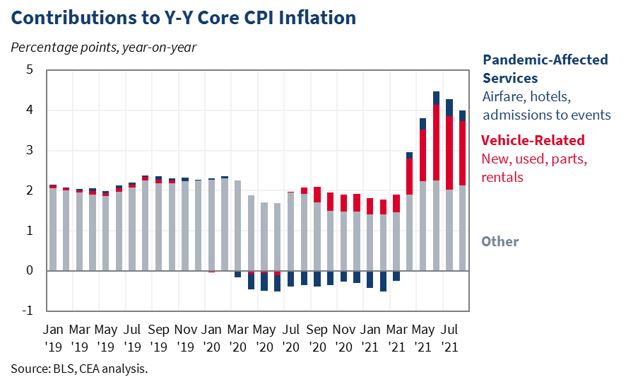
So will it stay this high? Sadly, I have no crystal ball and I will just reiterate what I said last month: the picture is just too muddled right now to say anything concrete. Perhaps by the end of the year we will have a better picture. But is there anything we can say right now even with the muddled picture? I continue to like this chart from the Council of Economic Advisors:

Image

Bottom line: if we strip out the unusual supply chain disruptions to automobiles as well as airline/hotel prices making up for lost ground during the pandemic, inflation is at completely normal levels. It’s almost exactly 2%

But is this cheating? Can we really strip out the things that are increasing at rapid rates?

Continue reading

In States that Ended the Extra $300/Week Unemployment Benefits, People Returned to Work at Over Twice the Rate than in the Other States

Anecdote # 1. In June we stayed a couple nights in a motel in western Massachusetts. The proprietor was outside watering flowers and trimming shrubs. I asked about business. He told me, “Well, we are starting to get customers back, though we are still hurting. But my bigger problem is that I cannot find a single person who wants to come back and work. Between federal and state unemployment benefits, they are making $850 a week, which is over $21 per hour. Anybody can claim those benefits, you don’t even have to prove that you were laid off. I cannot match that money, much less beat it.  My wife and I are doing all the work. I don’t know how we will manage long term.”

I murmured something sympathetic, and opined hopefully that if these benefits run out in September, folks might come back to work. This area has been economically depressed for decades, and normally people would jump at any kind of job. He shook his head and said that the state benefits would continue, and that his key workers have told him that they have saved so much money from unemployment and stimulus funds (and perhaps being allowed to skip rent or mortgage payments due to federal “forbearance” laws) that they may never come back to work.

Anecdote #2. In July my wife and I went into a hardware store in northern Virginia to buy some stuff. The employees were helpful and efficient. My wife complimented them, and said something like it must be nice working in an environment where everyone seemed to have a good attitude. The clerk’s response was yes, but they were having to work more overtime than they really wanted. And why was that? Because  the other workers won’t come in, because they were making about as much money staying home on unemployment – – so why should they bother working?

Those are a few personal data points on the effects extending the big unemployment benefits. I have read numerous other anecdotes from small businessmen and women that they cannot operate as fully as they would like because they cannot get help. And really, anybody with eyeballs can see the Help Wanted signs everywhere today.

Deeper thinkers than I will have to tease out all the ramifications of this situation. In GDP growth terms, it seems clear that incentivizing people to not work is a bad thing. On the one hand, we could say, “Just pay the workers more and they will come”. That is fine, if a business can raise the prices it charges for its products to cover the added labor costs, but that can only go so far. What is more likely is that businesses will figure out ways to get by permanently with fewer workers. This may lead to higher nominal productivity per worker, but also more structural unemployment.

Without further ado, here are some data which may illuminate the extent to which extended unemployment benefits have kept people from working. The nation has been running a real time experiment over the past several months. 27 states (“red” states, as you would have guessed) stopped the extra $300/week benefits in June, while 23 states and DC retained them.

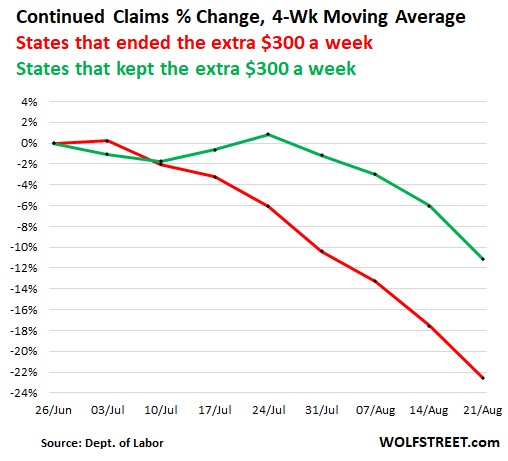
Wolf Richter has compiled some numbers on unemployment insurance (UI) claims by state, reported weekly by the Department of Labor. A data point of “continued claims” reflects the number of people that have claimed UI for at least one week. A drop in continued claims would indicate that they have started working again. He lumped the states into two groups, “Enders” who terminated the extra unemployment benefits, and “Keepers” who retained them. Here are the results through the end of August:

These results seem to speak for themselves. Far more people went back to work in the “Ender” states (32% vs. 14%).  Here are the same results, reported as four-week rolling averages for smoothing, though that introduces a time lag:

Richter quotes the Wall Street Journal to the effect that:

Economists at Goldman Sachs analyzed the behavior of workers in the July jobs report after adjusting for age, gender, marital status, education, household income, industry and occupation of a respondent’s current or prior job. They said they found “clear evidence that benefit expiration increased the rate at which unemployed workers became employed.”

Goldman Sachs estimated that if all states had ended benefits, July payroll growth would have been 400,000 stronger. Economists at the firm projected the nationwide benefit cutoff this month will account for 1.5 million job gains through the end of the year.

Richter notes that after the federal cutoff, some states will continue to offer the $300/week funded with leftover stimulus money, but he expects overall more people to report for work this fall. I think that is likely, but I am concerned that conditioning a lot of people to not work for 1.5 years may have given us a long-lasting step downward in the percentage of adults who are willing to work. Some other post, some other time, maybe I will explore how we saw that effect in the wake of the 2008-2009 Great Recession where again people got conditioned to getting by without working.

P.S. Zachary Bartsch’s recent post on this blog, Redesigning Unemployment Insurance, speaks to some of these issues of incentivizing people to (not) work.