Behavioral Economics Conversation: Cutler and Glaeser

I haven’t written a formal response, yet, to the “behavioral economics is dead” claim going around Twitter. I’m too busy doing my referee reports on behavioral papers to write in depth about why behavioral is not dead. Incidentally, I’m not loving the most recent paper I was sent, so maybe that’s a point in the column of Team Death. I’ll write a few posts intersecting with the arguments being had.

First, I’ll point out two places in a CWT discussion of health and cities where the phrase “behavioral” was used. This is obviously a current conversation. David Cutler probably wouldn’t say that behavioral economics is his field, but here’s how he describes puzzles in decision making over health issues. (bold emphasis mine)

Everything that we know in healthcare is that people have difficulty choosing on the basis of price and quality. It goes back a little bit to some of the behavioral issues that we were talking about, but I think it’s slightly different. If you go to the doctor, and the doctor says you should take medication X, and you go to the pharmacy, and the pharmacy says that’ll be $30, a fair number of people will walk away and say, “I don’t have $30.”

What we would hope they would do is go to their doctor and say, “Doctor, is there any way that there could be a cheaper medicine that might work because $30 is hard for me this month?” In practice, people are extremely uncomfortable doing that. They really don’t like to go to their doctor and say, “Doctor, how do I trade off the money here versus the medicine?”

David Cutler

The previous issues Cutler mentioned had to do with time preference and delayed gratification. The turmoil over dieting alone is evidence that people don’t always make the best decisions.

Here’s the second of two appearances of the word “behavioral”, in response to Tyler’s question about how to make cities healthier.

I certainly join the crowd of economists who have argued that congestion pricing is the best way to deal with urban traffic jams. There’s no reason not to charge people for the social cost of their actions on that. And giving away street space for free is just crazy, especially since we now have technologies that can handle this.

And if we introduce autonomous vehicles without congestion pricing, you have just lowered the cost of sitting in traffic, which means the first-order behavioral response is that more people will sit in traffic, and our congestion will get even worse unless we introduce this from the beginning. So I think pricing is really good.

Ed Glaeser

In the second use of the word, it sounds like an individually-rational decision to sit in your autonomous vehicle and read blogs until your arrive at your destination. Maybe we can use mechanism design to reduce traffic congestion and improve life for all.

Whether or not you think behavioral economics is dead, economists are going to keep using the word “behavioral” for a long time.

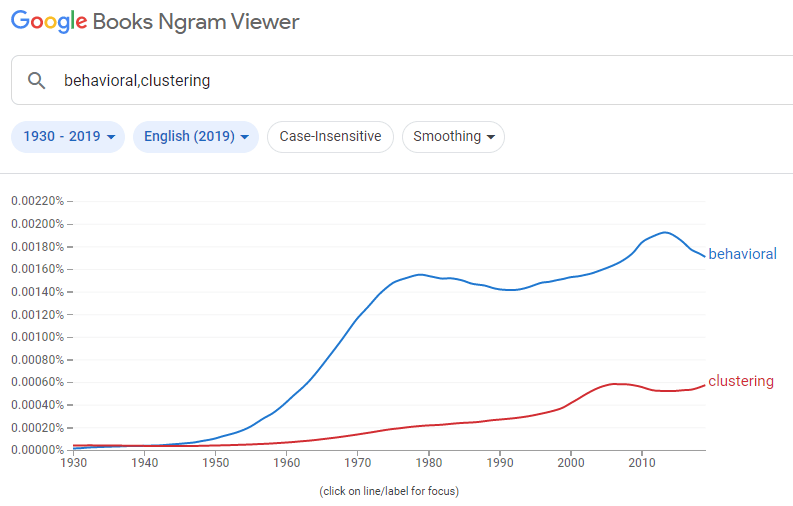
I did a quick Ngram to get a sense of how common the word is, although this does not restrict the search to books about economics. Ngrams are easier to interpret if there is a comparison word. I choose the word “clustering” because it’s also a relatively new technical term. Both words were quite rare before 1930.

If you missed the small discussion about behavioral econ, Mike Munger did a link round-up here. Tomorrow’s post will be Vernon Smith’s view of behavioral economics.

Redesigning Unemployment Insurance

How does unemployment insurance work?

From the worker’s perspective, unemployment insurance isn’t detectable unless the worker loses their job. Once that’s happened, the person can apply for benefits – a check that you can cash or deposit into your bank account. These benefits vary by state, with the composition of your family, and your income prior to separation. The most generous maximum benefit is provided by Massachusetts at $823 per week for an individual and the least generous is provided by Mississippi at $235 per week. States also vary by the length of time for which a person can collect benefits. Montana is the most generous at 28 weeks and North Carolina ties with Florida for the least generous at 12 weeks. If you find a job and become employed before the maximum benefit duration, then you stop receiving payments.

From the employer’s perspective, unemployment insurance is the premium that you pay per employee each year. The premium is not optional – so it’s a tax. Employers pay it for the privilege employing workers. There are two components of the tax: a state and federal portion. The federal portion is more or less constant per employee. The state portion changes with the incidence of unemployment claims and payments that a state makes in the prior year. When a lot of people get fired, state unemployment taxes rise as a policy response.

Why provide UI benefits?

There are two typical reasons for governments to provide unemployment benefits – and a 3rd not-so-typical reason. The first is as a matter of relief. People often lose a job through no fault of their own, and we don’t want those people to become destitute or to forego the bare essentials that money can afford. The second reason to provide benefits is as a matter of macroeconomic spending stimulus. Contrary to popular belief, this stimulus is not about encouraging greater production through greater sales. The stimulus is meant to encourage total spending in the economy to be higher than it would have been otherwise (See Irving Fisher on debt deflation and Scott Sumner on NGDP targeting). The 3rd and not so typical reason for governments to provide unemployment insurance is to keep people from going to work (See Tyler Cowen for why this might be desirable during a pandemic).

Incentives Matter

The 3rd reason above hints at a problem. People lose benefits when they become employed again. It is exactly because benefits provide relief that they reduce the incentive to find a job. Importantly, this is not a judgment of propriety or moral chastisement. It simply is the case that UI payments make being unemployed a little more tolerable. The tenacity with which people search for a job becomes a little less urgent. Anyone well acquainted with human nature (outside of a textbook) will tell you that it is good for humans to work. There are economic, social, and psychological benefits – not to mention the material benefits enjoyed by society. So, longer periods of unemployment are a problem.

Not only does the receiving UI benefits cause longer unemployment spells, losing benefits when you find a job acts as a penalty to finding a labor market match. It’s not happenstance that people who lose their UI benefits tend to become employed shortly thereafter. In terms of economic activity and gains from trade, society is materially better off when people find jobs more quickly (probably socially better off too). If you can get people to acknowledge the above logic, then there is plenty of room for people to disagree on the propriety of the UI benefits system.

Remove Disincentives – Keep the Relief

As Thomas Sowell is known for saying “There are no solutions – only trade-offs.”  That’s true. It’s also true that there is also no such thing as a free lunch. But some things are a lot more like a free lunch than others.

Wouldn’t it be nice if we could just help unemployed people and not disincentivize them from finding a job? In part it’s impossible. The UI payments do both and there is no separating them. But, the disincentive provided by removing payments when a job is found can be addressed. Why not just permit UI benefits even after someone has found a job?

An Outlay Neutral Prescription

What does the social program designer consider? Simply, the policy maker considers government outlays, government revenues, and economic impact. All else constant, policy makers like small outlays, high revenues, and good economic impacts.

I propose that states adopt the following policy. First, eliminate variables benefits. This part of the policy is not essential, but it clarifies the exposition. Now, it doesn’t matter whether you were an executive at a bank or a janitor at the bank – both receive the same weekly UI payment if they lose their job. What should the benefit be? For the purposes of outlay neutrality, the new benefit is the same as the average benefit was last year. The average benefit and total outlay across all claimants is unchanged.

When a person finds a job under the current system they are paying an implicit tax when their benefits get pulled. Let’s eliminate the employment disqualification. That’s right. When a person finds a job, they just continue to receive benefits. They don’t receive UI benefits indefinitely, however. In order to maintain outlay neutrality, the duration of UI benefit payments will be equal to the average duration last year.

Say what?!

Put yourself in the shoes of the person looking for a job under the current system. Say that your UI benefit is $800 per week and that you job-search for 10 hours each week. Say that you find a job that pays $1,000 per week. If you take the job, then you will go from working 10 hours per week to working 40 hours per week. And, you go from having an income of $800 per week to having an income of $1,000 per week. In other words, you get to work 30 more hours per week for $200 more income. The unemployed person is making the decision to take the job at $25 per hour, or stay home at $80 per hour ($1,000/40 Vs $800/10).

But what’s the perspective under the outlay neutral proposal in which the benefits continue even after employment? The decision is substantially different.  The unemployed person is making the decision to take the job at an average of $45 per hour, or stay home at $80 per hour ($1,800/40 Vs $800/10).

Of course, staying home still might look attractive. But it looks relatively less attractive than it did under the standard system of work-disqualifying benefits. If a person has 4 weeks of remaining benefits when they find the job, then continuing to receive UI benefits would mean that the total income over that month would be $7,200, versus $3,200 from staying home, or $4,000 under the standard system. Again putting yourself in the shoes of the unemployed, doesn’t this decision look different? Might you feel enticed to accept the job?

Under the proposed policy, government outlays are constant – there is no change in expenditures. Revenues increase because more employed workers means more employer-paid UI tax payments (not to mention other tax payments). Economic performance improves because greater employment increases total output. Let’s go ahead and throw in the additional social benefits too.

People Have Feelings

…And they’re complicated. Part of the sympathetic idea of unemployment insurance benefits is to provide relief. As a matter of gut instinct, this is why many people favor the UI transfer program over others. They can imagine themselves in such a circumstance through no wrong-doing of their own. But once we say that benefits will continue – even after someone finds their job – the UI program becomes less obviously a matter of sympathy-inducing relief. There is a political problem.

I say: put your feelings aside. Let’s get people employed again. Let’s increase tax revenues and increase economic activity. Let’s address the problem of unemployment in a better way – and spend not a dime more doing it.
Why do Costa Ricans outlive Americans?

Which country in the Western Hemisphere has the longest life expectancy?

Unsurprisingly its Canada, at 82.2 years (pre-Covid).

But which country in the Americas comes in second?

Surprisingly, its Costa Rica at 80.8 years.

Source

The United States, by far the richest country in the Americas, had a life expectancy of 78.4 years that was falling even before Covid.

How is it that Costa Rica outperforms not only the much richer United States, but also other somewhat richer countries like Panama, Mexico, Argentina, and the Dominican Republic?

Clearly they don’t do it by outspending us- Costa Rica spends the equivalent of $1600 dollars per person per year on health care, compared to nearly $12000 in the US (7.3% of their GDP goes to health care vs 16.8% for the US).

Source

So what exactly is Costa Rica doing right? Atul Gawande tackles this question in his latest article for the New Yorker.

He argues that the key has been Costa Rica’s investment in primary care and public health. The US might may have many more of the world’s best (and most expensive) hospitals, but the easiest and cheapest health benefits come from keeping people out of hospitals in the first place.

the country has made public health—measures to improve the health of the population as a whole—central to the delivery of medical care. Even in countries with robust universal health care, public health is usually an add-on; the vast majority of spending goes to treat the ailments of individuals. In Costa Rica, though, public health has been a priority for decades.

In the nineteen-seventies, Costa Rica identified maternal and child mortality as its biggest source of lost years of life. The public-health units directed pregnant women to prenatal care and delivery in hospitals, where officials made sure that personnel were prepared to prevent and manage the most frequent dangers, such as maternal hemorrhage, newborn respiratory failure, and sepsis. Nutrition programs helped reduce food shortages and underweight births; sanitation and vaccination campaigns reduced infectious diseases, from cholera to diphtheria; and a network of primary-care clinics delivered better treatment for children who did fall sick. Clinics also provided better access to contraception; by 1990, the average family size had dropped to just over three children.

The strategy demonstrated rapid and dramatic results. In 1970, seven per cent of children died before their first birthday. By 1980, only two per cent did. In the course of the decade, maternal deaths fell by eighty per cent. The nation’s over-all life expectancy became the longest in Latin America, and kept growing. By 1985, Costa Rica’s life expectancy matched that of the United States.

Gawande goes on to describe how every Costa Rican gets a home visit from a health care worker at least once per year. This is quite the contrast to the US, where even getting primary care doctors to let you see them in their office can be a fight. I moved to Rhode Island last year and this week finally tried getting a primary care doctor here. I looked through the list of doctors covered by my insurance that my insurer said were accepting new patients and started making calls (by the way, why calls? do any doctors book appointments online?). 2 said that they actually weren’t taking new patients. 9 never answered the phone. The 12th doctor I tried, one farther away and lower-rated than I’d like, finally agreed to see me- in 3 months.

For anyone with less free time, determination, or insurance coverage, it would be natural to just give up after the 5th or the 10th “no”. Clearly many Americans do, leading manageable conditions like diabetes or high blood pressure to turn into acute health crises and expensive hospital visits.

I do think individual doctors could do better here by thinking through their appointment process from the patient’s perspective. But at its core this is simply a numbers issue- we don’t have enough primary care doctors to go around. We actually have fewer doctors per capita than Costa Rica, and relatively high share of specialists means that we have even fewer primary care doctors to go around. More medical school spots, more primary care residency spots, and fewer restrictions on immigrant doctors could go a long way way toward helping to US catch up to…. Costa Rica.

That, or their secret is just the volcanoes. This is surprisingly plausible- the US state with the longest life expectancy is also the one best known for volcanoes, Hawaii.

GDP Losses and COVID Deaths (6 month update)

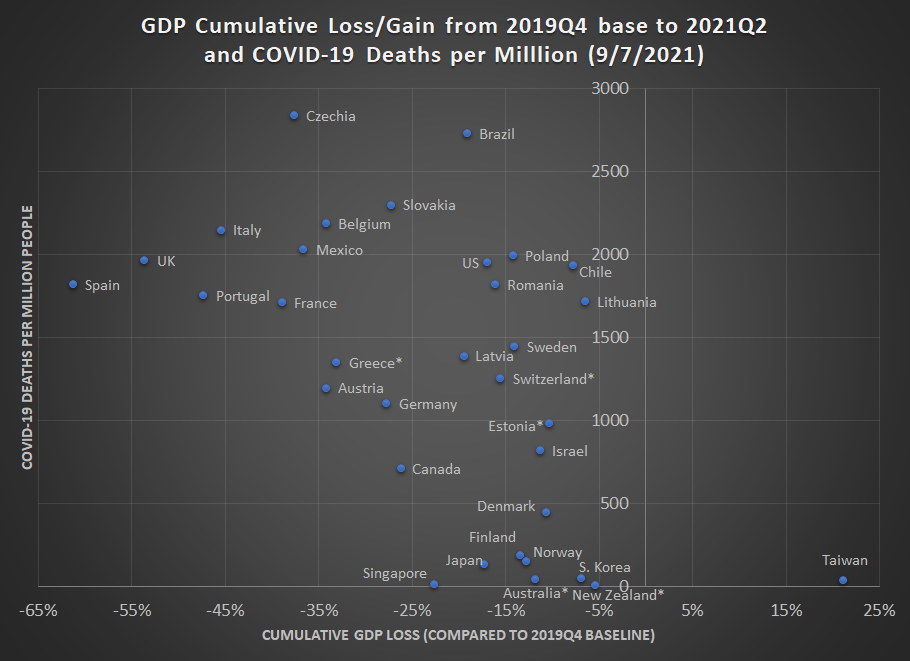
Back in March of this year, I wrote blog posts providing data on GDP losses and COVID-19 deaths for 2020, both for selected countries and US states. Since we’ve now had another 6 months of GDP data and the pandemic continues to take lives, I thought it would be useful to update that data.

I will update the data for US states in a future post, but here is the most recent data for about 3 dozen countries (mostly European and North American countries, since they have the most believe COVID data).

*indicates that the GDP data is only through the first quarter of 2021
Continue reading

Streaming Content: Scattering Vs Dumping

Like a good millennial, I don’t have cable. Instead I have Netflix, Amazon, Hulu, Disney+, YouTube, and a free trial of Apple TV. And before you say that I’m spending just as much as I would have spent on cable, just – no. First, I am not. Second, I have way more capability and discretion than I ever had with cable. Each of these streaming services now has their own studio(s) and competition is causing them to produce some content of exceptional quality. And, they differ in their decisions to scatter vs dump. Amazon and Apple TV scatter their new episodes on a weekly schedule. You can still watch the episodes whenever your heart desires once they’re released. But if you are up-to-date, then you must wait 7 days until new episodes are available. Netflix, on the other hand, dumps out a new series all at once. You can spend the afternoon (or morning, or night) watching an entire season of the newest content from a high-end studio.

If we take a look through the way-way-back machine, then we can observe must-see-TV on NBC in the 1990s. Networks followed the scattering model. Most people didn’t own a DVR and on demand wasn’t really a thing except for pay-per-view. VCR (video cassette recorders) were ubiquitous, but people enjoyed watching their shows as they were released rather than later watching a recording. The 90s and early 00s were a special time for NBC in particular: Friends, Seinfeld, Frasier, 3rd Rock from the Sun, and ER were all a part of the weekly line-up – with Will & Grace and Scrubs soon following the finale of Seinfeld.

New weekly episodes that were released during a literal ‘season’ of the year had been the model for as long as television signals had been broadcasted. Several of today’s streaming services still adhere to the 80-year-old practice.

Why?

I’ve got 3 reasons for why streaming services still scatter new releases. The first is the one I that have the least to say about: Buzz. It’s good marketing for a show to be released over a longer period of time. In a world of social media, the longer the time that a show is salient in your life, the greater the opportunity for you to share the show with your friends or for critics to acclaim (or pan, as the case may be). It’s a marketing tactic. If all of the episodes in a season were released all at once, then a show would be in-and-out of your life like a stray ice cube that goes rogue from the refrigerator ice-dispenser. You care for a bit. But soon, it’ll evaporate and never be a concern again. I’m not an expert in marketing. So I’ll just leave it at that.

The second reason is due to the time value of money. The sooner that we can enjoy revenues and the later that we can push costs, the better. It’s true for multiple reasons. Financially, every day sooner that you receive a dollar is an additional day during which you can earn a return by investing it elsewhere. For ease, let’s hold the schedule of costs constant and just worry about the revenues. If a streaming service releases episodes weekly, then episodes can start dropping before the season finale is even completed. There’s nothing that says that the whole season has to be ready by the time the first episode is released.  And, when episodes are released earlier, would-be viewers are sooner willing to sign-up and become paying customers. Releasing episodes weekly allows a studio to increase revenues before the whole product has finished production.

The 3rd and final reason for streaming services to release on a weekly schedule is due to the subscription structure of marginal revenue. Streaming services earn *no* additional revenue per episode viewed by customers. The marginal revenue earned from paying customers comes from subscriptions. That is, each month of a subscription is revenue for the streaming service provider – no matter how many episodes a subscriber watches. Therefore, if a season is released piecemeal, then it increases the number of weeks during which the streaming service receives revenues from the customer. Of course, people could just wait until all of the episodes are released and then subscribe for a single weekend of lethargic binging. But that can only happen when a viewer is comfortable with forsaking the frontier of new video content. That would mean that a viewer is out of fashion and out of the conversation that their friends and co-workers are having. And if this sounds like small potatoes, then keep in mind that such conversations are often about signaling belonging, comradery, and cultural sophistication. Many people are inclined to stay up-to-date on TV, the news, and sports and therefore have a greater willingness to pay.

There you have it. The 3 reasons for streaming by scattering over weeks rather than dumping all at once are 1) More persistent saliency among viewers and potential viewers, 2) Sooner rather than delayed revenues, and 3) More periods for which streaming service can charge their customers for new content.

I only have one explanation for why some streaming services do in fact dump an entire season at once. Netflix does it on the regular and Amazon started doing it in the past several years too. I suspect that they do it as a means of attracting a particular market segment: binge-watchers. There being two players who compete on this margin may make either provider appear less attractive for consumers who desire new, binge-worthy content. But, luckily for Netflix, streaming content providers aren’t in a perfectly competitive market. That content is an imperfect substitute means that it’s monopolistically competitive. And, for the moment, that means higher profits. The keen reader will recognize, however, that zero long run economic profits are also implied.

Who is the Wealthiest Generation?

Have you seen this chart?

I have seen it many times. It comes from this Washington Post article, but it seems to go viral on Twitter about every 6 months or so.

The implication of the chart seems to confirm what many young people feel in their bones: Boomers had it much easier, and it’s getting harder and harder for later generations to catch up and build wealth. For many the graph… explains a lot, as one recent viral Tweet put it (in the weird world of social media, 5 short words and a recycled chart are all it takes for 20,000 retweets).

But wait. A few questions probably come to mind. For example, when Boomers were young they comprised a much larger share of the population. The original article makes an attempt to adjust for this, by calculating a few ratios towards the end of the article. However, there’s a much more straightforward way to adjust for this, which also nicely fits into a chart: put wealth in per capita terms!

If we do that, here’s the chart we get (also, of course, adjusted for inflation).

Data is for 1989-2021 from the Federal Reserve’s Distributional Financial Accounts, but only the first quarter is available right now for 2021. For 1989, it is the average of the third and fourth quarters. Population data comes from Census single-year of age estimates for various years. 2020 and 2021 population estimated using growth rate from 2010-2019.
Continue reading

We need City-States

What happens when the world changes sufficiently that a subset of the institutions that laid the groundwork for the most successful nation of the last 200 years becomes becomes maladapted to their context? Well, thanks to a couple billion year of evolutionary biology, we know the possible outcomes. The classic evolutionary answer is that the species in question will either adapt, migrate, or die. Repurposed for the modern nation-state, the country in question will either:

  1. Adapt it institutions
  2. Change the context (i.e. whole nations can’t migrate)
  3. Steadily decline into some combination of irrelevance or chaos

Omar Wasow put together a nice thread, where each individual tweet stands wholly on it’s own as an acute observation, on the current state of the Senate as an elected institution:

So let’s think about our options here.

Decline into Irrelevance and Chaos

I mean, it’s a choice, but it’s not one I’m particularly excited about.

Adaptation

We could amend the constitution to change how the Senate is apportioned in some clever way that still maintains the mandated suffrage of every state. We could change/abolish the electoral college. I’ll be blunt: I don’t ever see a path forward for constitutional change that will entirely undermine the political power of the one of the major parties (good luck getting 2/3 of Senators to push through an Amendment that will undercut the careers of at least half of them). The resistance to it, at every level, will be extreme. The last time we tried to make an institutional change with that much impact on the balance of power, we had to fight a war to resolve it. There may be a path forward here, but not on a timescale that I’m interested in. I’m only interested in solutions that could be feasibly enacted in my lifetime.

Change the Circumstances

Unlike your typical seed-eating bird of the Galapagos Islands, we do have the means to change the map upon which the Senate is selected. In other words, more states. I don’t mean just granting statehood to Puerto Rico and DC (though it is mildly unconscionable that we haven’t done so already). And I don’t just mean (the very good and perfectly reasonable idea) of splitting California and Texas into 5 and 3 states. I mean a lot more states.

Let’s think about the underlying problem for a second. The Senate biasing representation towards a small minority of voters is a symptom of a larger phenomenon: the continued movement of Americans to dense urban areas. People keep moving to cities, and often from states without a major urban center, and into states with multiple large cities. The rural areas that they are emptying out from maintain their pool of slots for elected Senators, while the cities gain none. So what’s the answer?

Welcome to the great state of Seattle! [state motto: “If it’s not caffeinated, send it back”]

The Vinegar-Tomato Sauce State of Raleigh! [state color: halfway between Duke blue and UNC blue]

The Beechwood Aged State of St. Louis![ state left fielder: Lou Brock]

The Always Hustling State of Atlanta [state anthem: written and performed by Outkast]

City-states. Remember city-states!? Yes, I know, when we speak historically of city-states we mean entities independent of any other nation state – classic Venice, current Singapore or Monaco, but that doesn’t mean we can’t piggyback on their awesomeness. Texans already joke about the “People’s Republic of Austin” – let’s make it official! We can set a size minimum as either an explicit population threshold (e.g. 500k) or a moving bar, such as the population of the smallest state in the previous census. It’s essentially adding another option for a city to apply for inclusion in the next tier of our federalist system.

This is more feasible than you might think and vastly more feasible than amending the constitution.

Consider:

  1. These cities already have government infrastructures. The governor on day 1 is the current sitting mayor.
  2. The citizens of most medium- and large-sized cities derive the bulk of their regional identity from their city, not their state. Most urbanites will be thrilled at the notion of elevating the political status of their city while losing the affiliation of their previous state.
  3. New state coffers will be heavily subsidized with flag and swag sales the first few years (only mostly kidding)
  4. The remaining rural states will have the far more manageable task of trying to serve rural citizens without having to serve an urban voter base with radically different needs and preferences. Public goods will be better matched with the citizens of rural states as well.
  5. States will often look like Swiss cheese, which will be both hilarious and, slightly less importantly, will allow for constituents to even more easily vote with their feet when elected officials fall short in their duties.

Are there downsides? Sure.

  1. The speed traps before you enter and as you exit city-states into their rural envelopers will be aggressively extractive. There will be rampant attempts at exporting taxes across borders.
  2. Reconstituting water supplies as special districts supporting multiple states will be tricky.
  3. Coordinating interstate public goods will, no doubt, at times become even more farcical than the status quo.
  4. Decent chance this turns into a Neal Stephenson novel within 100 years.

But, in the medium and long run, I believe the benefits will greatly outweigh the costs. Throughout the pandemic there has been a constant tension, particularly in “red states”, between the public goods desired by the citizens in cities versus rural areas. While urbanites have been desperate for mask and vaccine mandates, rural citizens have been far more interested in consuming personal liberty and symbolic group-identity goods, at the expense of greater Covid cases and deaths for those in denser areas.

I’ve said it before and I’ll keep saying it tomorrow: there isn’t a red-blue divide, a religious divide, or a class divide. America is currently defined by an urban-rural divide. If we don’t adapt our institutions to reflect it and balance the equal political enfranchisement of people on both sides of that divide, it will continue to erode the integrity of our political infrastructure.

I imagine I don’t have to persuade many people that the integrity of the franchise is not something to be taken lightly. Regardless of the mathematical salience of an individual vote to any election, the fact remains that the less people believe their vote has at least the potential to be realized in the form of representation that serves them, the more they will look to alternative channels to the political process. And maybe, for the libertarian inside of you, the alternative you imagine might exist in the private marketplace for goods and services. But history informs us that the dominant alternatives to democracy are heritable lineage and bloodshed, and I don’t see any benevolent American scions laying in wait.

Inequality VS the Environment

What do we know?

We know that density is good for most environmental measures. With greater density comes less water runoff, less carbon emissions, less burned fossil fuel. With density, fewer people own vehicles, implements of yard curation, and we require fewer roofs per person.

What else do we know?

We know that in a static economy, progressive taxation makes after-tax incomes more equal. There are formal models that say the same thing about dynamic economies. Progressive taxation results in more income equality, and regressive taxation results in less. For clarity, income tax progressivity is determined by percent of income paid in taxes. When the rich pay a higher percent tax rate, that’s more progressive.

Are you ready?

Wealthy people tend to have more valuable land. That is, they improve the land and the things built on it. Do you want to tax land progressively? Then what you want is a property tax with a sliding tax rate. This way, you can make those rich people pay their ‘fair share‘. Even without a sliding scale, rich people will pay more dollars for their improved land.

Uh-oh.

Now that we are taxing property on land proportionally, rich people are seeking alternatives. They’re trying to avoid taxes! What do they do? Well, a smaller and cheaper house is a nonstarter. What is all that wealth for, if not to enjoy it partly through one’s home environment? The rich are going to find a place to live where they can be comfortable and where their property taxes are lower. Maybe a place where the land is not so expensive. Hello rural estate!

Do you want a proportional property tax so that rich people pay for the value of their property? Be ready to say hello to suburbanization and sprawl. All those benefits of urbanization mentioned above? Invert all of them to see the results.

Okay…

I see the attraction of taxing immovable property. Taxing a residence is nice for the government because the tax revenues are nice and stable, given the relatively inelastic demand for real property.

If only there were a real property tax scheme that provided stable revenues and encouraged urbanization… Well, the answer is not to try taxing the value of the land without taxing the value of property. What am I? A Georgist?

A Georgist I am not. But, I do have an affinity for lump sum taxes.

If, as a polity, you want urbanization, then impose lump sum taxes per area of land owned. Doesn’t matter if it’s a house. Doesn’t matter if it’s commercial. Doesn’t matter if it’s unimproved farm land. Just sit back and watch the skyline rise, our environmental footprint shrink, and plenty of land being turned into wildlife preserves and parks.

Oh dear.

People have feelings. Consider a beautiful multi story single-family home on an acre. Now consider a mobile home with a large yard and some trees – also on an acre. With a standard, flat proportional property tax, the owner of the big pricey house pays more. With lump sum taxes per square foot of land, they pay the same dollar figure. In other words, the less wealthy person pays a higher proportion of his properties value in taxes. In case you missed it, this beautiful solution to sprawl and environmental degradation comes hand-in-hand with proportional regressivity.

BTW:

I live in Collier County Florida. If all of the land, excluding surface water, in the county was taxed at the same lump sum per square foot, then we would need to pay about $1,600 per acre in order to replace all revenues currently collected from a variety of sources. If we assume that government property is excluded from the tax and we assume that the government owns a very liberal 10% of all property, then it is more like $1,780.

I haven’t even discussed all of the improved economic performance that an already developed counties might enjoy by eliminating the distortionary excise taxes and ad valorem taxes. I don’t know about you, but $1,600 doesn’t sound too bad in exchange for eliminating all the other nickel and dimes that add up to quite a bit.

(Just as I am not a Georgist, I am also not a revolutionary. We need not jump in head-first. We could ease our way into such a system. We’d just add a fixed lump-sum portion to existing property tax bills that increases over time. Property taxes bills would be calculated slope-intercept style with a portion being constant and a portion being dependent of property value.)

Remote Work vs Employer Power: Why I’m Not Sweating Tenure

When there’s only one employer in town who hires for jobs like yours, they have labor-market power, and can pay less and have worse working conditions than a competitive firm would. Economists call this “labor market monopsony” but I like the term “employer power”, which is simpler and makes sense when there are a few employers as well as when its literally just one. This keeps down the wages of machinists at the only factory in town, nurses at the only hospital in town, and professors at the only university in town.

Of course, workers in this situation could always move and get a better job elsewhere, and this does put some limits on employer power, but many workers have strong preferences to stay in their home, which means the balance of power is with the employers- or at least, it has been.

The growth of remote work means that workers can get jobs all over the world (or at least all over nearby time zones) without having to leave their town. Which means that monopsony is over, at least for jobs where remote work is possible.

I’m going up for tenure at my college soon, meaning that by next June they will tell me either that I have a job for life or that I’m fired. This “up or out” system naturally causes a lot of anxiety for professors. Partly this is because many professors’ identities are wrapped up in our jobs to an unnecessary and unhealthy extent, and so we take it as a judgement on our worth as human beings. But partly there was always the very practical problem that failing tenure almost certainly meant you would either need to move, accept a substantially worse job, or both.

The thinness of the academic labor market means that unless you live in a major city, its probably the case that no university nearby is hiring tenure-track academics in your subfield this year; and even if you are in a major city, there are probably only 2-3 searches in your field, and they will be so competitive that you almost certainly won’t get the job. To have a real chance at another good academic job, people need to apply nationwide (when I got my first job I sent out 120 applications all over the country to get 1 offer). Getting another job locally generally means taking a job with much worse pay, worse conditions, or both- like high school teacher, adjunct professor, or entry-level business analyst. Those in relatively practical fields like economics were able to get decent jobs outside of academia (PhD economists in private sector and government jobs typically earn better salaries than academics, at the cost of working more hours with less freedom), but such jobs were plentiful only in a few major cities (DC, SF, NYC, Boston), which usually still meant moving. Even in a mid-sized state capital like Providence, I don’t think I’d have an easy time finding something here- or I didn’t think so, until remote work became ubiquitous last year.

Now I won’t be losing any sleep over the possibility of losing my job next year. Partly I think my odds of getting tenure are good, but even a 1% chance of losing my job would have been worrisome in the pre-remote world. Now instead of worrying I just think about the huge range of opportunities in tech, finance, consulting, business, think tanks, and even government. Remote also addresses one big reason I ignored those jobs in the first place and only applied in academia- flexibility. I didn’t want to be stuck in an office 40+ hours/wk; I wanted to be able to pick my kids up from school. Now flexible hours and the ability to be evaluated on output rather than time spent at the office seem to be increasingly common.

To the extent that remote work puts a dent in employer power we would expect to see higher employment, higher wages, and fewer people feeling trapped in their jobs. We’ve seen all of these in 2021- quits in particular are at an all-time high, a good sign that workers don’t feel trapped- though much this could simply be due to the rapid economic recovery. The real test will come when we see how much this is sustained past the initial recovery, and whether it is mainly in remote-able jobs or is a broad improvement.

Would You Pay $3,000 to Not Wear a Mask?

How well do masks work at preventing disease transmission? This is a question that many of us have been asking throughout the pandemic. I have been trying to read as much about mask effectiveness as I can (for example, here’s a Tweet of mine from way back in June 2020). I think the bottom line is that, if you want really good RCTs of mask use during the COVID pandemic, there is surprisingly little evidence in any direction. But there are lots of studies, less well done but still OK, suggesting that masks do provide some protection.

I don’t want to wade into all of that research here, because Bryan Caplan has been doing that lately himself. His reading of the literature is that masks aren’t a silver bullet, but he suspects “that masks reduce contagion by 10-15%.” Still he thinks that the costs of masks (inconvenience, discomfort, and dehumanization) are large enough that they don’t pass a cost-benefit test. But this seems like a very strange conclusion given that he suspects masks reduce contagion by 10-15%! So let’s be explicit about the cost-benefit analysis.

[I am assuming that reducing contagion by 10-15% means 10-15% fewer cases and deaths. I see this as a bare minimum, since contagious disease can follow exponential growth trends, so 10-15% less contagion could mean that cases/deaths are reduced by more than 10-15%, but I’m making a simplifying assumption and the hard case.]

Quantifying the costs of the pandemic deaths is tricky, and it’s something that Bryan and I have debated before. Perhaps this is just a rehash of that debate (Bryan is highly skeptical of the VSL estimates), but I think it’s worthwhile to plug in some numbers.

What numbers should we use?

Continue reading