Gifts for a Time of Inflation and Supply Bottlenecks

I’ve never been great at gifts, and don’t have much in the way of specific ideas now. But I’ve been thinking about what the macroeconomic environment means for gift-giving.

First, as you’ve probably heard by now from us or elsewhere, if you want to get any physical gift I’d order it now, since shipping is a mess and prices are only going up. I’d especially recommend this for complex electronics that could become hard to find- its part of why I got my wife an iPad for her birthday this summer. Foreign food and drink that can be stockpiled is always a good idea, but perhaps especially now; think wine, Scotch, or Beirao liqueur (a Portuguese drink that was my favorite discovery this year). Wine and liquor make good stores of value in an time of inflation.

Alternatively, you could avoid the scarcity of physical goods by turning to the digital realm. If your economistic heart yearns to give cash, consider giving some your favorite stock or cryptocurrency instead- its both more personalized and less subject to inflation. Or if you think you can judge the recipient’s taste well enough, subscribe them to one of your favorite Substacks or podcasts. My recommendations:

Unsupervised Learning, Razib Khan– Genomics and History

The Diff, Byrne Hobart– Finance and Strategy

Astral Codex Ten, Scott Alexander– Rationality, Psychiatry, Everything

The Readers Karamazov– Funny podcast on literature and philosophy (now seems entirely free though)

Or if you really have money to burn, go for the Bloomberg subscription. I always run out of free reads on the Tyler Cowen articles and so can’t read Matt Levine, even though he has the magic ability to teach you finance while making you laugh. But the subscription is expensive and Mike Bloomberg doesn’t need the money, while the Substacks are relatively cheap and enable talented writers to spend a lot more time writing instead of needing to focus on a real job.

La Dolce Vita Economica

I thought about writing about soccer (again). I thought about writing about time management and personal production functions. I considered writing about Lebron James or how I manage multiple research projects. I thought about writing about a classic, and entirely addictive to the point of career ruination, video game. They all seem a little redundant at the moment, though, because they are all the same basic story.

One soccer manager is over-exhausting their resources because of a confluence of bad contractual incentives while another team is witnessing a renaissance in a player they essentially forced to take 7 weeks off. While so many NBA careers of the 80s evaporated in a cloud of cocaine and clubbing, Lebron James’ entire life is built around managing the only two resources whose limits are salient to his life: his body and relationship with his family. Playing baseball growing up I watched pitchers blow out their arms before they finished puberty in service to Little League glory, while modern professional pitchers are (finally) on strictly managed pitch counts to maximize their expected output.

There are two manners in which I armchair quarterback the rest of the world. One is the things in which I have just enough knowledge to be frustrated by others decisions, but no so much as to actually know what I am talking about. These frustrations are ephemeral, they flatter myself to the point of mild embarrassment upon reflection, and, if I am being honest with myself, are fun.

The other manner is resource management. These are the times when armchair quarterbacking is less fun and more exasperating because they are the moments when outsiders, with inferior levels of narrowly-applicable expertise, are often actually right. Which is not to say the knowledge that resources are being poorly managed is uniquely held by outsiders. Insiders are more often than not quite aware of the suboptimal deployment and conservation of resources, but are unable to overcome the status quo institutions, incentives, or inertia of decision-making power loci. It’s obvious to lots of people that athletes, CEOs, doctors, and congressional representatives are over-extended. What’s not obvious is how to get out of these equilibria.

When I see most attempts at self-improvement, I am generally skeptical of anything that doesn’t start with the identification of a key resource that is salient to outcomes and the options available to better manage it. Maybe its calories and how to budget them. Maybe its time and how to better partition and conserve it. It could always be money, but in general I find that money is so immediately identifiable as a finite resource and entirely fungible that people who ostensibly are managing it poorly are, in actuality, failing at managing a different resource (time, emotional energy, vices, etc) that is intertwined with financial resources.

When I see successful firms, teams, and individuals, what I most often find myself admiring is not (just) a worldly talent, but a facility with managing resources that others haven’t yet adopted or mimicked. An appreciation for sleep, a protection of time blocked for creativity, an adeptness trading low opportunity competitive minutes for higher opportunity cost moments on the biggest stages. Or even just the ability to recognize that this is the moment to savor a 600 calorie dessert with a loved one because the emotional sustenance will make it easier to walk away from three vending machine Hostess pies during the high-stress moments in the week to come.

Once you learn to manage your donut-based caloric intake, the spreadsheet of your life will be revealed before you, an endless cascade of resources to be managed and optimized. A life with the right donuts at the right time. The dolce vita economica.

Purchasing Drinks with Push-ups.

Early in the summer of 2021, I was having fun. The semester was ended and traveling was on the horizon. Due to changes at my wife’s job I began driving to work instead of making the 20 minute trek by foot. And there was plenty of time to be social. And social I was — several days of the week. And, inevitably, drinks would be served. I was doing a lot less walking and a lot more drinking alcohol (responsibly).

I was footloose and fancy free. Until… The bathroom scale reminded me that I had surpassed the age of 30 years old. Being sedentary and drinking were starting to add up.

Right then and there, I made a decision. I would disincentivize my drinking, but I would also make drinking beneficial rather than detrimental to my waist line.

I made a deal with myself. For each drink that I had, I would have to ‘pay’ 25 push-ups. No exceptions. And, no borrowing from myself. Push-ups *had* to come first. None of this “I owe myself push-ups” nonsense (it’s a trap!). I could *save* for the future, however. Knowing that a social event was approaching, I’d build myself a nice little balance. And the exchange rate was constant: 25 push-ups per drink – always.

Who held me accountable? Me, myself, and I… And some incentive compatible approbation.

I wasn’t shy about any of it. At a outdoor beer garden with my wife and her cousin, I had prepared by banking 50 push-ups. But round 3 was impending… and I’m no square. So, over to the side, quite out of the way on the outdoor patio, I knocked out a quick 25. Round 4 came after still another 25.

Now let’s talk incentives. Requiring push-ups of myself increased my physical activity, so I felt better about my body. Further, if I hadn’t banked push-ups ahead of time, paying prior to each drink limited how many push-ups I could comfortably do. Once push-ups became uncomfortable, I stopped drinking.

That’s all great. But the social incentives were pivotal in keeping me dedicated. Upon seeing the push-ups in action, female friends would talk to my wife who quickly developed a well-crafted dialogue for each new observer, complete with convincingly spontaneous gesticulations and eye-rolls. I can’t say that I didn’t enjoy the attention.

Other men provided direct positive approval. I combined 3 activities that were already ‘manly’ when separate: muscle building, drinking, and dispassionate self control. Men would praise me immediately and similarly feel compelled to do there own sets of push-ups in my presence — as if being sedentary in my presence convicted them as guilty of something. At least one wife sent me a text after we had left town that included a picture of her husband knocking out some of his own pre-drink push-ups (Is this what it feels like to be an influencer??).

Aristotle would be proud.

I was very consistent for months. Being the summer and seeing a lot of friends and family, I did a lot of push-ups. But, as time passed, the exercise habit stuck even as the drinking began to pass by the wayside. What began as an arbitrary, self-imposed rule soon became a legit change in behavior. And then, that change in behavior became a practice. Did that practice improve my temperance and fortitude through habituation? Idk. But wouldn’t that be nice?

Penny-Pinchers Gonna Pinch

Text books say that there are two major problems with the Consumer Price Index (CPI). First, accounting for changes in quality is difficult. Second, the CPI is calculated by assuming a fixed basket of goods is consumed over time. For both of these reasons, the rate of inflation that is implied by CPI is typically considered to be about 1% overestimated.

Imperfectly accounting for quality improvements causes higher measured inflation because the stream of services that a product creates for the consumer has increased – even though the product is nominally the same product. For example, the camera on my smart-phone is now good enough to record a high-quality Youtube video, whereas it was of mediocre quality on my previous phone.  My life is better-off with the better camera. But the increase in my quality of life isn’t measured by the CPI. The CPI does, however, make note that I paid a higher price for a phone.

Further, people don’t consume a fixed basket of goods over time. Even if we stopped the introduction of all new products and maintained the quality of all current products, people would still change the composition of their consumption due to price changes among related goods.

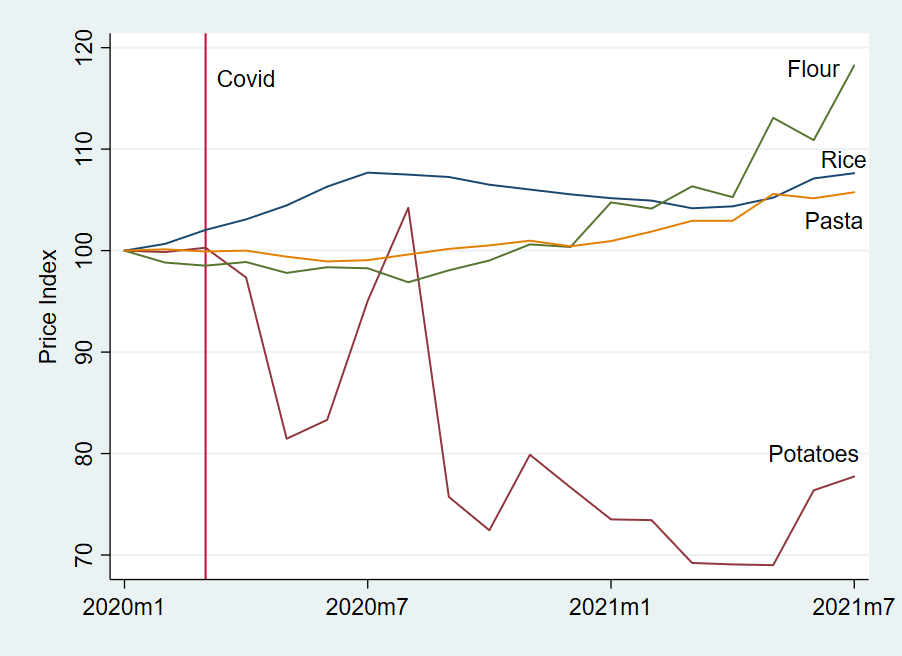
When people get hot and bothered by inflation, they often appeal to people who are of less means and who would find higher prices more burdensome. For that reason, below is a graph of some calorically dense and roughly comparable food staple prices (from the PPI).  You can put a protein on top of any one of these and call it a meal: pasta, flour, potatoes, & rice.

Let’s say that a consumer consumed equal parts of these in January of 2020. The CPI assumes that the consumption basket remains constant and plots a weighted average. In such a case, price rose 2.3% through July 2021. But in real life, penny-pinchers gonna pinch. If our consumer is particularly Spartan, then he will always consume the cheapest option – he treats the different foods as perfect substitutes. The Spartan price of consuming *fell* 22.3%. To be clear, the CPI assumes that the consumption composition remains unchanged, while the consumer’s actual basket is responsive to price changes.  Even if a consumer considers these goods to be imperfect substitutes and is willing to cut any particular type of consumption in half in favor of the cheapest alternative, then the price fell by 10%. In fact, a consumer who is at all responsive to prices will always have a cheaper basket than the headline CPI, all else constant.

In conclusion, be careful with your money. Spend it well and seek out alternatives. Your flexibility determines how much money you’ll have at the end of the month. The headline CPI number impacts only the most passive consumer – and even then, budget constraints gonna constrain.

Air Fryer: Redundant, Self-Indulgent Counter-Space-Waster?

While we were all imprisoned at home in 2020, we turned to eating food, and preparing food to eat in order to occupy and comfort ourselves. People baked bread for the first time in their lives. When yeast in the stores ran out, the internet was alive with tips on how to get sourdough cultures started. And a lot of air fryers were marketed and bought.

The premise of air fryers seems unassailable: quickly circulate very hot air (up to 450 F/230 C) to get that delicious fried crispiness with minimal oil, and get it in minutes with minimal fuss and cleanup. Since we had an offer of getting an air fryer at a discount, I consulted my wise friend, the internet. I wanted to love air fryers, but it seems they don’t cook much differently than a modern countertop convection toaster/oven (“turbo broiler”). There are some space-age-looking air fryers with a more slender, curvaceous profile which has a somewhat smaller footprint than a rectangular turbo broiler, but the capacity is typically only enough for one person or a couple with modest appetites.

Continue reading

The Pappy Pricing Puzzle

If you drink bourbon whiskey (or even if you don’t) you’ve probably heard of Pappy Van Winkle. Bourbon has experienced something of a revival in the past two decades, after being in decline for much of the 20th century. As part of this revival, some bourbons have become very highly sought after by the nouveau bourbon enthusiasts. And the various offerings of Pappy Van Winkle are arguably the most highly sought after. Finding Pappy is almost impossible these days, though this was also true a decade ago so it’s not really a “new” phenomena.

So here’s the “puzzle” for economists: why aren’t Pappy and other rare whiskies sold at market prices? No one in the “legal” market seems willing to do so. I put “legal” in quotation marks because there is a robust secondary market for these bottles, and the legal status of these sales is entirely unclear to me as an economist (alcohol markets are, to say the least, highly regulated).

In these secondary markets, it is not unusual for a 20-year bottle of Pappy Van Winkle to sell for $2,000. The “manufacturer’s suggested retail price” is $199.99. But you will never find this bottle on the shelf for that price. The bottles are held by retailers, either to sell to friends, auction off for charity, or conduct a lottery for the right to purchase the bottle at well below market prices.

So why doesn’t the distillery raise the MSRP? Clearly, they do this from time to time. Ten years ago, if you were lucky enough to find this bottle it was around $100 (I was lucky enough, on occasion). Clearly, they recognize that prices can increase. And that’s not just “keeping up with inflation”: $100 in 2011 is about $120 in current dollars. By 2016, they had raised the MSRP to $169.99. But why doesn’t the distillery raise the price more, perhaps all the way up to the market clearing price? By doing so, they would, perhaps, be able to ramp up production so that in 2041 there might be a lot more Pappy on the shelf. At the very least, they could dramatically increase their profit.

Receipt for 1 bottle of 20-year Pappy and 2 bottles of 12-year Van Winkle “Special Reserve” from 2011.

Also, why don’t retailers just put bottles on the shelf at $2,000? Stores occasionally do this, but mostly because they are fed up with all of the customers calling about rare bottles. Sometimes they will price it even higher than secondary markets. But usually, they allocate the bottles by something other than the price mechanism. Why? Businesses don’t usually leave dollar bills, especially $1,000 dollar bills, on the table.

Continue reading

Vegetarians and Profits

Like most people, vegetarians have some weird opinions. Let’s assume that they have the ultimate goal of fewer live-stock deaths and less chattel cattle. Ask a vegetarian what they are achieving by choosing not to eat meat and you’ll hear the explanations let loose. By abstaining from meat they’re “reducing factory farm profits” or “helping to keep the price of beef low and unprofitable”. While being a vegetarian may save more cows from the butcher’s blade, it’s not at all clear that vegetarians have a good understanding of their sometimes perpetual boycotts.

What do vegetarians even do?

The decision to consume meat or not falls nicely into the supply-and-demand framework. Fewer people willing to eat meat means fewer purchases of meat products – no matter the price. A decline in meat demand lowers both the number of cows that ranchers will raise a slaughter and the price that they receive. There you have it. By lowering demand for meat, vegetarians reduce both the quantity and price of meat, reducing profits for those evil, animal-carving businessmen.

Not so fast.

Continue reading

The Many Faces of Molasses

It started as a simple question: can you substitute blackstrap molasses for regular molasses in a gingerbread recipe?

In order to reduce our potential exposure to Covid, we are ordering groceries online and having them delivered. Whole Foods (owned by Amazon), delivers free to Amazon Prime customers like us. In our order the other day we included molasses. We are almost out, and I wanted to make a gingerbread recipe this holiday week. The bottle that arrived yesterday along with the rest of our order says “Blackstrap Molasses”. Hmm, I wondered, what is different about blackstrap molasses and can you use it in place of the usual Grandma’s molasses that we have always had in our cupboards?

Once I get reading on a topic, it is hard to stop. It turns out there is much to know about molasses (treacle, in the U.K.). We all know it to be a sweet, flavorful ingredient in baked goods, and in savory dishes like pulled pork and baked beans. Diluted molasses is touted as a hair de-frizzer and hair mask, and there are even claims it can help combat gray hair.

However, there is a decidedly unsavory side to its past. It played a key role in fueling the triangular Atlantic slave trade in the 1700’s and early 1800s. Plantations worked by slaves in the Caribbean would ship molasses to the American colonies, where it would be converted into rum. The rum was shipped to West Africa, to pay for more people to be captured and then shipped to the Caribbean plantations to grow more sugar and make more molasses.

Not to mention the deadly “Great Molasses Flood” in Boston. On January 15, 1919, a 50-ft high storage tank of molasses ruptured, and sent a 15-ft high wall of syrup racing through the street at 35 miles an hour. It crushed and drowned anything and anyone in its path. Buildings were collapsed, and 19 people died. It has a place in the history of litigation as the birthing the modern class action lawsuit.


But I digress. Back to the difference since between types of molasses. Sugarcane is squeezed to extract cane juice. Sugar, the main desired product, starts off dissolved in the juice. The cane juice is boiled to remove water, to precipitate the solid sugar crystals. The liquid that remains after the first boiling (and the removal of the sugar from that stage) is called first or light molasses. That is what has usually been sold in U.S. grocery stores.


That first molasses is subjected to a second boiling, to extract even more sugar. The remaining liquid is called second molasses, or dark or robust molasses. From all accounts, this is pretty similar in properties to the initial light molasses, just somewhat less sweet and more flavorful. Folks say that you can substitute dark molasses for light molasses in most recipes without making a big difference.

To extract the last little bit of sugar, the second molasses is boiled even longer and hotter. After the sugar from that stage has been removed, what is left is the so-called blackstrap molasses. Obviously, this product will have less sugar and less liquid, then the light molasses, with a higher concentration of the other flavoring components. The operational question for me is: Can I take some of that blackstrap molasses and simply re-dilute it with some sugar and some water to get the equivalent of light molasses?


Internet opinion on this matter is mixed. On the one hand, there are those who answer this question in the affirmative. They say that a half cup of blackstrap molasses plus half cup of light corn syrup (or half a cup of a water plus sugar mixture) can readily be substituted for a cup of light molasses.

On the other hand I read counsel such as this:

Blackstrap molasses is what results when regular molasses is boiled down and super-concentrated, This results in bitter, salty sludge that only has a 45 percent sugar content, as opposed to the 70 percent sugar level found in both light and dark varieties of baking molasses. Spoon University warns against using blackstrap molasses as substitute for true molasses in any recipe calling for the latter due to the fact that its bitter flavor will overpower the taste of whatever you’re making.

And this :

Do not use blackstrap molasses as a substitute for light or dark molasses. It has a strong, bitter taste and isn’t very sweet. It’s more likely to wreck your recipe than help it.

But still I (being a chemical engineer by trade) wondered if this “strong, bitter” taste is merely the lack of sugar, which could be cured by replacing the missing sugar. After all, unsweetened chocolate is unpalatably bitter, but we fix that by adding sugar.

I don’t claim the final word on this, but it seems that the severe third boiling that yields the blackstrap molasses does some chemical alterations. It is not merely a matter of removing sugar. It is all well when sugar is lightly heated to form light brown caramel, but when it gets pushed too far, some bitter, dark brown compounds can form. It is not clear that merely adding sugar can undo these flavors, considering that blackstrap still contains a lot (45%) of sugar.

Conclusion: Blackstrap molasses may be fine for your BBQ sauce and as a trendy, mineral-packed low-sugar sweetener for your yoghurt and tea. But that bottle of thick black goo on my counter is going back to Whole Foods, not into my gingerbread.

Thanksgiving Thoughts: Should I Be Cooking More Soup?

On Thanksgiving, we cook a bird. We eat meat. Then I make turkey soup by boiling the carcass and such. After making turkey soup, I have nagging thoughts, ‘That seemed quite economical. I have so much food now. I should make soup from scratch again soon.’

In fact, I will not make soup from scratch again until next Thanksgiving.*

Part of the reason for starting this blog is to explore my own cognitive dissonance. Is making soup from scratch economical and should I be doing it more? Right now I’m trying to work full-time and also produce food for a family 2 or 3 times every day. I want to minimize the time I spend cooking.

To start, naturally, I Googled “is soup the most economical food”.

Peasants and poor folk could get nutrients out of bones and root vegetables by making soup. Soup is economical in that sense, but I’m not talking about making broth.**

The Seattle Times has an article about chicken soup from scratch. In their introduction, they gave themselves away:

During America’s inexorable march toward processed food, chicken soup became something to buy, not something to make … and many cooks simply don’t know how satisfying a project it is.

So, they are admitting that it’s a lot of work. I do not want a “satisfying project”. I want food that is healthy and appealing; and I also want to avoid buying food from restaurants constantly.

Another article I arrived at was by Prudent Penny Pincher. The title is “60 CHEAP AND EASY FALL SOUPS”. Never trust all-caps. According to this site:

Name brand soups are about $2 per serving. Many soups can be made at home for under $1 per serving with less 30 minutes of prep/cook time.

The Prudent Penny Pincher page is little more than a list of links to other recipe sites. They wash their hands of the responsibility of telling you how to actually make soup. For research, I clicked their link for chicken soup.

What do you need to have on hand to make chicken soup in a mere 30 minute? Canned broth, for one. Making your own broth is not ‘quick and easy.’ You also need to have cooked chopped chicken and chopped vegetables.

If I have cooked chopped chicken and chopped vegetables, then I could just eat that! That’s a meal nearly finished. My guilt over not making soup from scratch regularly was completely resolved when I read that.

I had a similar revelation after I tried juicing for a week. Not counting the cost of a juicing machine, should you be juicing? If you have never once felt a pang of guilt for not juicing, then maybe you are male.

I borrowed a juicer once and I bought lots of fresh produce. I chopped fruits and veggies into chunks and juiced them. One cup of juice came out, which I drank while spending 20 minutes cleaning the yucky machine covered in pulp.

I realized that I should stop at the step where I have chopped fruits and veggies and just eat them. Fortunately, I hadn’t bought the juicer. Pity the women who juice regularly because of sunk cost bias after they bought the machine. Anyway, I concluded that juicing was expensive in terms of ingredients and time.

Through writing this, I realized that I make soup from scratch at Thanksgiving because it’s a holiday and I’m on vacation. It’s fun when you have free time.

Anyone who disagrees is welcome to comment. Am I discounting the future too much? Should I put work into making soup so that we can eat soup for days?

*There is an exception. I make delicious scallop corn chowder once a year when I am on vacation with extended family in the summer. So, that’s also when I’m not doing my professional work and an extended family member is taking care of my children.

**I do not participate in trendy “bone broth”. Do you think my son would be happy if I put bone broth on the table for dinner?