John Bogle, the founder of Vanguard, wrote a short book in 2006 that explains his investment philosophy. I can sum it up at much less than book length: the best investment advice for almost everyone is to buy and hold a diversified, low-fee fund that tracks an index like the S&P 500.
Of course, a strategy that is simple to state may still take time to understand and effort to stick to. So the book helps to build intuition for why this strategy makes sense. I think Bogle makes his case well, though the book is getting a bit dated- the charts and examples end in 2006, and he sets up mutual funds as the big foil, when today it might be high-fee index funds or picking your own stocks.
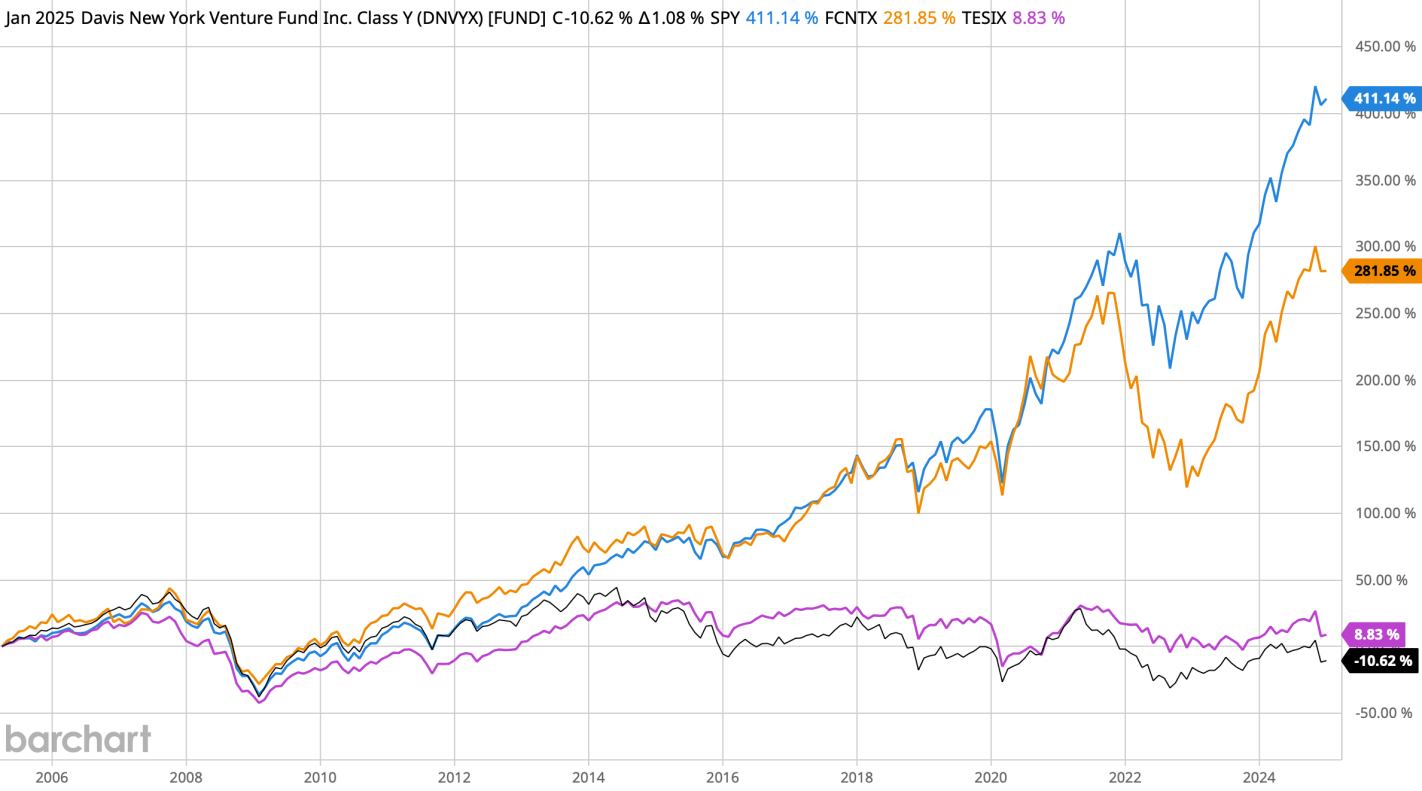
The silver lining of any dated investing book is that we can check up on how its predictions have fared. In chapter 8, Bogle compared the performance of the 355 equity mutual funds that existed in 1970 to that of the S&P over the 1970-2006 period. He notes that 223 of the funds had gone out of business by 2006, and even most of the surviving funds underperformed the S&P. But he identifies 3 funds that outperformed the S&P significantly (over 2% per year) on a sustained basis (consistently good performance, not just high returns at the beginning when they were small): Davis New York Venture, Fidelity Contrafund, and Franklin Mutual Shares. But how have they done since the book came out?
It is a huge victory for the S&P (in blue). Franklin Mutual Shares is basically flat over the past 20 years, while Davis New York Fund actually lost money. Fidelity Contrafund returned a respectable 281% (about 7% per year), and matched the S&P as recently as 2020. But as of 2025 the S&P is the clear winner, up 411% in 20 years (over 8% per year). Score one for Bogle.
But I still have to wonder if there is a way to beat the S&P- and I think one of Bogle’s warnings is really an idea in disguise. He warns repeatedly about “performance chasing”:
But whatever returns each sector ETF may earn, the investors in those very ETFs will likely, if not certainly, earn returns that fall well behind them. There is abundant evidence that the most popular sector funds of the day are those that have recently enjoyed the most spectacular recent performance, and that such “after-the-fact” popularity is a recipe for unsuccessful investing.
The claim is that investors pile into funds that did well over the past 1-3 years, but these funds subsequently underperform. But if this is true, could you succeed by reversing the strategy, buying into the unpopular sectors that have recently underperformed? I’ve been wondering about this, though I have yet to try seriously backtesting the idea. I was surprised to see Mr. Index Fund himself support such attempts to beat the market toward the end of his book:
Building an investment portfolio can be exciting…. If you crave excitement, I would encourage you to do exactly that. Life is short. If you want to enjoy the fun, enjoy! But not with one penny more than 5 percent of your investment assets.
He goes on to say that even for the fun 5% of the portfolio he still doesn’t recommend hedge funds, commodity funds, or closet indexers. But go ahead and try buying individual stocks, or actively managed mutual funds “if they are run buy managers who own their own firms, who follow distinctive philosophies, and who invest for the long term, without benchmark hugging.”
Quick thoughts on what I read in 2024- though note that none of these were published in 2024, since almost all the best stuff is older. First some econ books I reviewed here this year:
Rockonomics– “Alan Kreuger’s 2019 book on the economics of popular music…. a well-written mix of economic theory, data, and interviews with well-known musicians, by an author who clearly loves music.”
We’ve Got You Covered– “Liran Einav and Amy Finkelstein are easily two of the best health economists of their generation.… while I don’t agree with all of their policy proposals, the book makes for an engaging, accurate, and easily readable introduction to the current US health care system.”
The Psychology of Money– “Morgan Housel’s Psychology of Money is not much like other personal finance books…. The book is not only pleasant to read, but at least for me exerts a calming effect I definitely do not normally associate with the finance genre, as if the subtext of ‘just be chill, be patient, follow the plan and everything will be alright’ is continually seeping into my brain.”
One Up on Wall Street– “Peter Lynch was one of the most successful investors of the 1970’s and 1980’s as the head of the Fidelity Magellan Fund. In 1989 he explained how he did it and why he thought retail investors could succeed with the same strategies”
The Simple Path to Wealth (JL Collins, 2016): the book is indeed simple, and its advice is indeed likely to leave you fairly wealthy in terms of money. One sentence summarizes it well: save a large portion of your income and invest it in VTSAX, and perhaps VBTLX. Easy to read, a bit like reading a series of blog posts, which is how much of the material originated. Good introduction to the lean-FIRE type mentality. But the book, like that mentality, is too frugal and debt-averse for my taste, and I say that as someone much more frugal and debt-averse than the average American.
The Great Reversal: How America Gave Up on Free Markets: Thomas Philippon argues that markets have been growing less competitive in America because of weakening antitrust enforcement, and that this has harmed consumers and productivity. He acknowledges that over-regulation can also harm competition, but clearly thinks antitrust is much more important; I think otherwise and didn’t find the book convincing. He sets European markets as an example for what America should aspire to, which means the book has aged poorly since its 2019 publication. It still of course has some value, and I may do a full review at some point.
The Storm Before the Storm: The Beginning of the End of the Roman Republic (Mike Duncan, 2017): Non-fiction but more exciting than most novels. A story of obvious importance to those who worry about modern republics teetering, but fresh compared to the much more famous events around Julius and Augustus Caesar and the ‘official’ fall of the Republic. Though arguably the Republic fell in the 80s BC, not the 40s- the book explains that Rome was taken over three times in this era by armies seeking political change.
Ivanhoe (Walter Scott, 1819): A particularly medieval telling of the Robin Hood tale, with a focus on the nobility and knights of England at that time. Chivalric romance, trial by combat, storming a castle. Highs are high but it needed an editor, could be cut by at least 1/3 without losing anything.
Kim (Rudyard Kipling, 1901): Three books in one, all excellent: a coming of age story, a spy thriller, and a portrait of the many different types of people and religions to be found in India around 1900. All wrapped together with beautiful English prose that makes heavy use of Indian loan words.
Final Thoughts:
Obviously I’m not Tyler Cowen reading a book a day, unless you count the kids books I read to my 1-year-old. But overall 2024 was a good year, better than I realized before I put this post together. Partly I credit the 1-year-old who wants to take my phone and computer but doesn’t mind when I have a book in my hands.
Red Lobster used to be a pretty profitable business. Then in 2014 its owners sold it to a private equity firm called Golden Gate Capital. This private equity firm promptly plundered Red Lobster by selling its real estate out from under it, with those funds going to the PE firm. Instead of owning their own land and buildings, now the restaurants had to pay rent to landlords. This put a permanent hurt on the restaurant chain’s profits. I don’t know this as fact, but because it is part of the usual PE playbook, I assume that the PE firm also made Red Lobster issue debt (bonds) so the PE firm could further plunder Red Lobster by having it pay “dividends” to its PE firm owners, using the money raised by issuing the bonds. After this glorious financial engineering, the private equity firm in 2019 sold a 49% stake to a company called Thai Union. Thai Union bought out the rest of Red Lobster ownership from Golden Gate in 2020.
Thai Union did a poor job managing the U.S. based restaurant chain, forcing cost-cutting measures that were counterproductive, and finally forcing a continual all-you-can-eat shrimp special, against the better judgment of on-the-ground Red Lobster management. That shrimp special made Red Lobster buy a lot of Thai Union’s shrimp, but led to large losses last year. The business had been suffering for a couple of years, with Covid shutdowns and competition from nimbler eateries, but the losses from the shrimp special sent it scurrying for bankruptcy protection back in May.
There are two main flavors of business bankruptcy. The direst form is Chapter 7, where the assets of the firm are sold off to meet obligations to creditors, and the firm goes out of business.
The more common form is Chapter 11, where the intent is to keep the business going (see Appendix). Somebody gets stiffed in the process, of course. Usually, common shareholders get almost nothing except maybe a reduced number of shares in the reorganized company. Preferred shareholders often get a few more shares. Unsecured bondholders may get 30-40 cents on the dollar as a settlement, or a reduced amount of bonds in the new company, or maybe stock shares. Sometimes the company will issue a new set of bonds which are “senior” to the old bonds, which reduces the value of old bonds. Other unsecured creditors like vendors may get something like 50 cents on the dollar.
Secured creditors are higher up in the pecking order, and so often get higher recoveries. (The “covenant” for a bond or loan would specify if the loan is secured by, say, the value of the equipment in the restaurant).
Red Lobster restaurants have kept operating this year (2024), while creditors were kept at bay via the protection offered by the bankruptcy filing. As of September, Red Lobster emerged from the chapter 11 bankruptcy. A private equity group has taken over operations. They have injected some $60 million cash, which is actually not very much for this situation.
I was curious about what happened to Red Lobster’s creditors, such as vendors and bond holders. A first-level internet search, even with AI help, did not tell me how they fared as part of the settlement. I had read earlier this year that Red Lobster had something like $ 1 billion in debt, so I assume that a lot of bondholders got stiffed in this process.
In May the company announced that it had “ voluntarily filed for relief under Chapter 11 of the Bankruptcy Code in the United States Bankruptcy Court for the Middle District of Florida. The Company intends to use the proceedings to drive operational improvements, simplify the business through a reduction in locations, and pursue a sale of substantially all of its assets as a going concern…Red Lobster’s restaurants will remain open and operating as usual during the Chapter 11 process, continuing to be the world’s largest and most-loved seafood restaurant company. The Company has been working with vendors to ensure that operations are unaffected and has received a $100 million debtor-in-possession (“DIP”) financing commitment from its existing lenders.”
The “working with vendors” is an important piece here. When I peered at the official Red Lobster court bankruptcy website to try to glean more intel on the fate of the creditors, there was a list of leading “Unsecured Creditors”. These included Pepsico (supplying beverages) and Gordon Food Services, a major Canadian food supplier, as well as the owner of the store properties (Realty Income Corporation), which was presumably owed a lot of unpaid back rent.
Ironically, after one private equity firm plundered Red Lobster, then sold it to the hapless Thai Union (which ended up taking a $540 million write-down on their investment), the restaurant chain is now in the hands of yet another PE firm. I could not find definite information on the deal, but again we may assume that the PE firm got the creditors (bondholders, vendors, etc.) to accept “haircuts” on what they were owed, as opposed to getting almost nothing if Red Lobster went Chapter 7 and shut down. Thus, the new PE firm will start off with a relatively virgin company to plunder again.
My Brave AI search agrees with that assessment:
The company’s restructuring efforts may prioritize the interests of new investors and creditors over those of existing bondholders, potentially resulting in a less favorable outcome for bondholders… It is likely that the bondholders will be subject to a restructuring plan that may involve debt forgiveness, debt-for-equity swaps, or other arrangements that could result in a loss of principal or interest for the bondholders.
The text below is from the North Carolina bankruptcy law firm Stubbs Perdue:
Chapter 11 bankruptcy is a legal process that allows businesses to reorganize their debts and operations while continuing to operate. Unlike Chapter 7, which involves liquidating assets to pay off creditors, Chapter 11 aims to restructure a company’s obligations to improve financial stability and pave the way for future growth. Chapter 13, on the other hand, is typically reserved for individuals with a regular income, focusing on debt repayment plans.
Typical Chapter 11 Process
Chapter 11 process typically involves several key steps:
Filing the Petition: The process begins with the company filing a petition in bankruptcy court.
Developing a Reorganization Plan: The company works with its creditors to create a plan that outlines how it will restructure its debts and operations.
Negotiating with Creditors: The plan is subject to approval by the court and the creditors, who may negotiate the terms to protect their interests.
Throughout this process, the court plays a supervisory role to ensure fair treatment of all parties involved.
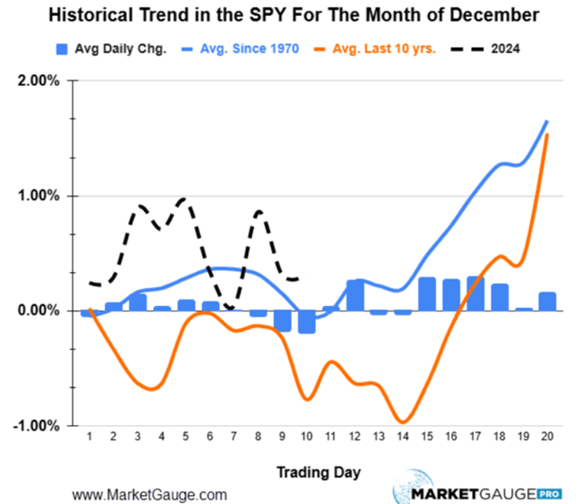
There tends to be a significant rise in broad stock indices the last two weeks of the old year and into the first two trading days of the new year. This is termed the “Santa Claus” rally. Sometimes it is focused on the last five trading days of the old and the first two days of the new.
Here is a chart showing average changes in S&P 500 prices for the month of December for 1970-2023 (blue line), and more recent data (last ten years, orange line).
Tax-loss harvesting: Investors may sell stocks at the end of a year to claim capital losses, to offset capital gains. They may then repurchase these stocks at the start of the new year.
Low trading volume: Larger institutional investors often go on holiday in this timeframe, leaving the market more to individual retail investors, who may be more optimistic.
Herd mentality: If most investors believe stocks will go up, then probably stocks will go up.
Santa Predicts the Future
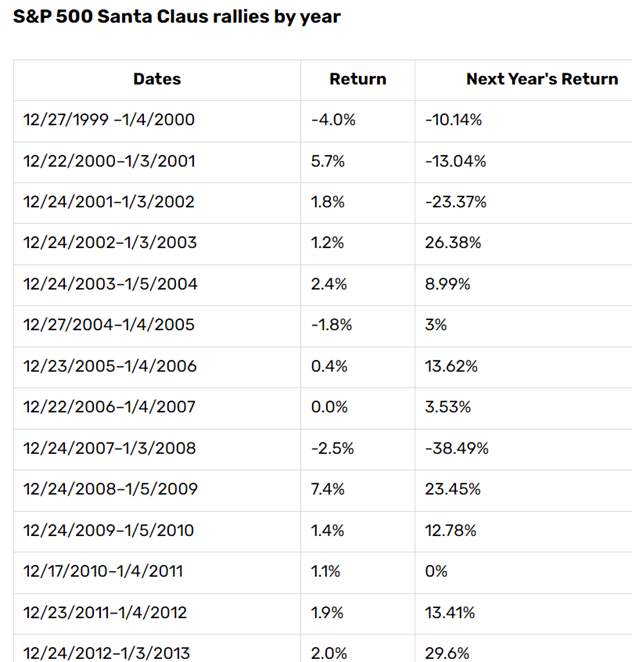
Perhaps even more significant is the power of the Santa Claus rally to predict stock returns in the coming year. The following table lists returns for the last five trading days of the old year plus the first two days of the new year, and also the returns for the whole new year:
The table above was published in 2023, so the full year 2023 stock returns at that point were “TBD”. We now know the 2023 returns were hugely positive (approx. 23%). So, for 1999-2023, Santa came to town 19 out of 24 times for a year-end rally. Also, since 1999, the market rose 19 times during the Santa Claus rally; the following year, the S&P posted gains 15 times. Out of the 5 times the market lost ground during same period, the market fell in 3 of the following years. So the market performance in this transitional timeframe correlates well with the stock gains for the whole new year.
Will stocks soar again this holiday season? I have no idea. We are off to a shaky start, with the S&P 500 down about 1.5% in the past five days , through 12/22. This after the market hated the Fed’s more hawkish stance last week, being now likely slower to reduce interest rates than previously assumed.
As usual, nothing here should be considered advice to buy or sell any security.
In March and April of this year, I moaned and groaned here in blogland, chronicling my attempts to recover my funds from an interest-bearing account at crypto firm BlockFi.
Back in 2021, interest rates had been so low for so long that that seemed to be the new normal. Yields on stable assets like money market funds were around 0.3% (essentially zero, and well below inflation), as I recall. As a yield addict, I scratched around for a way to earn higher interest, while sticking with an asset where (unlike bonds) the dollar value would stay fairly stable.
It was an era of crypto flourishing, and so I latched onto the notion of decentralized finance (DeFi) lending. I found what seemed to be a reputable, honest company called BlockFi, where I could buy stablecoin (constant dollar value) crypto assets which would sit on their platform. They would lend them out into the crypto world, and pay me something like 9 % interest. That was really, really good money back then, compared to 0.3%.
On this blog, I chronicled some of my steps in this journal. First, in signing up for BlockFi, I had to allow the intermediary company Plaid complete access to my bank account. Seriously, I had to give them my username and password, so they could log in as me, and not only be able to withdraw all my funds, but see all my banking transactions and history. That felt really violating, so I ended up setting up a small auxiliary bank account for Plaid to use and snoop to their heart’s content.
BlockFi assured me that they only loaned my assets out to “Trusted institutional counterparties” with a generous margin of collateral. What could possibly go wrong??
What went wrong is that BlockFi as a company got into some close relationship with Sam Bankman-Fried’s company, FTX. Back in 2021-2022, twenty-something billionaire Sam Bankman-Fried (“SBF”) was the whiz kid, the visionary genius, the white knight savior of the crypto universe. In several cases, when some crypto enterprise was tottering, he would step in and invest funds to stabilize things. This reminded some of the role that J. P. Morgan had played in staving off the financial panics of 1893 and 1907. SBF was feted and lauded and quoted endlessly.
For reasons I never understood, BlockFi as a company was having a hard time turning a profit, so I think the plan was for FTX to acquire them. That process was partway along, when the great expose’ of SBF as a self-serving fraudster occurred at the end of 2022. FTX quickly declared bankruptcy, which forced BlockFi to go BK as well. SBF was eventually locked up, but so were the funds I had put into BlockFi. The amount was not enough to threaten my lifestyle, but it was enough to be annoying.
BlockFi Assets Begin to Thaw
I got emails from BlockFi every few months, assuring customers that they would do what they could to return our assets. Their bankruptcy proceedings kept things locked, but eventually they started to return some money.
As I noted in a blog post, in April, 2024, I was able to recover about 27% of my account. At the time, there was no clear prospect of getting the rest. Along the way, I clicked on a well-camouflaged scam email link, which gave me some heartburn but fortunately no harm came of it.
And now, hooray, they have finally returned it all, following their successful claw-back of assets from SBF’s organization(s). This vindicates my sense that the BlockFi management was/is fundamentally honest and good-willed, and was just a victim of SBF’s machinations.
Some personal takeaways from all this:
Keep allocations smallish to outlier investments
Sell out at the first serious signs of trouble
Triple-check before clicking on any link in an email
Having been forced to engage in opening crypto wallets and transferring coins, I have a better feel for the world of crypto which had seemed like a black box. It does not draw me like it does some folks, but if circumstances ever require me to deal in crypto (relocate to Honduras?), I could do it.
It seems to be an accepted fact that there is a momentum effect with stock prices: a stock which has done well over the past 6-12 months is likely to continue to do better than average over the next six months or so. A number of funds (ETFs) have been devised which try to take advantage of this factor.
On the other hand, sometimes trends reverse, and stock that was hot twelve months ago has now run up in price, and may be due for a pause.
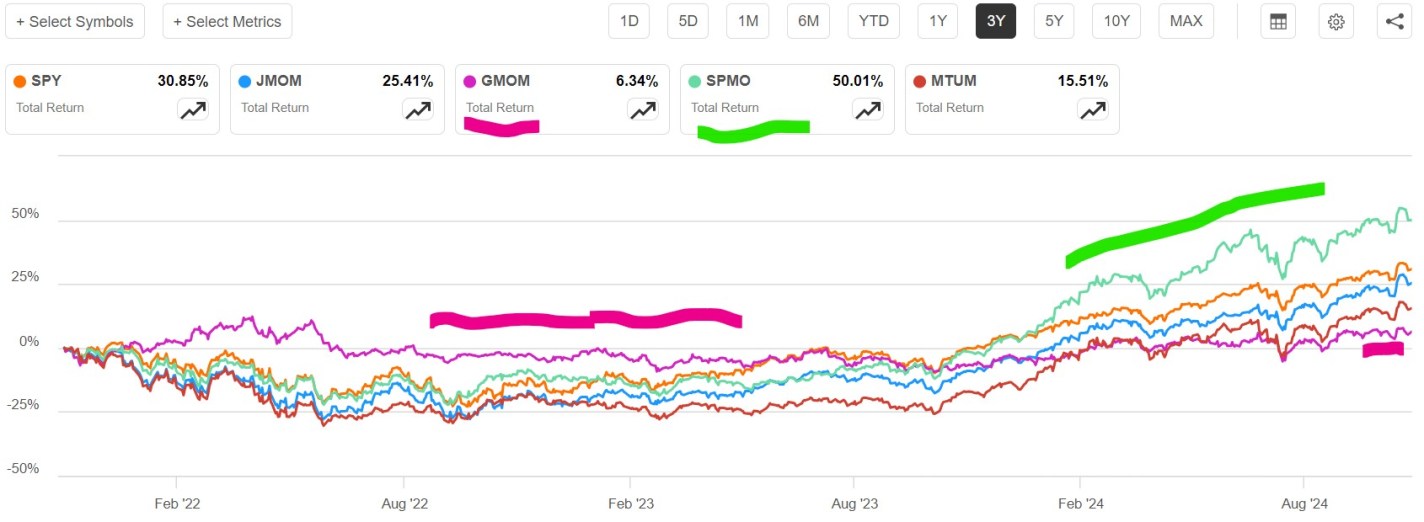
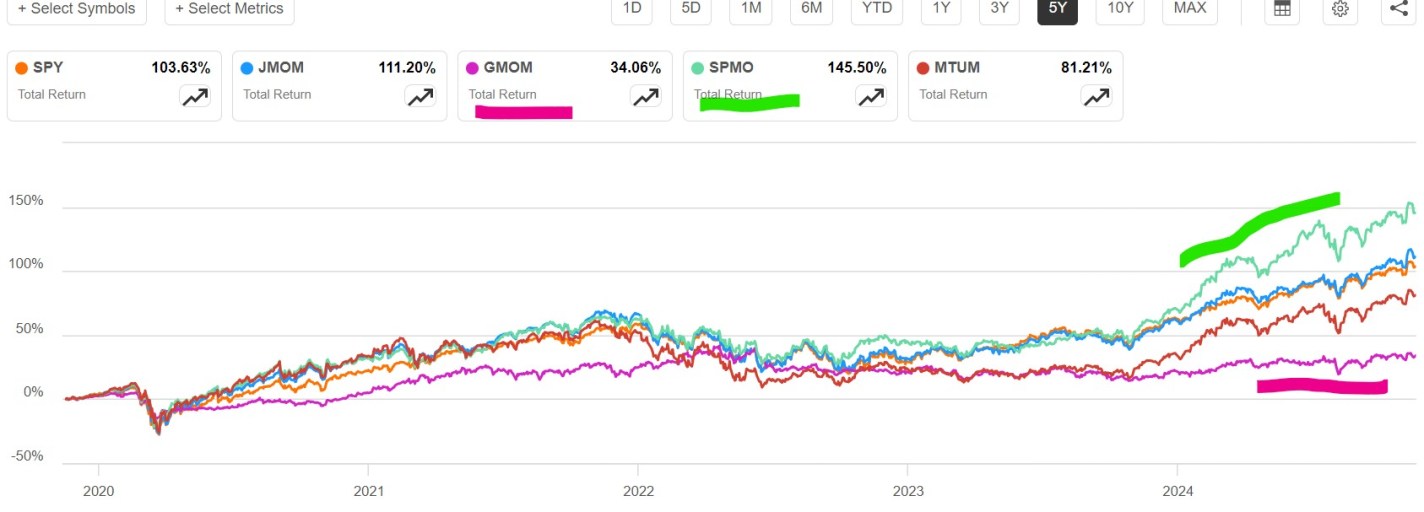
Here we will compare several momentum ETFs against the plain S&P 500 fund, SPY. In order to make it an apples-to-apples comparison, I am looking mainly at momentum funds that primarily draw from the S&P 500 large cap universe of stocks, excluding small-cap or tech only funds. [1] These large cap momentum funds are MTUM, JMOM, and SPMO. These funds all select stocks according to various rules. Besides trying to identify stocks with raw price momentum, these rules typically aim to minimize risk or volatility. I added one outlier, GMOM, that is very diversified. This fund does not hold individual stocks. Rather, it draws on some 50 different ETFs, including funds that focus on fixed income, commodities, or international or small cap as well as large cap US stocks, seeking to hold funds that show good relative momentum.
A plot of total returns over the past three years for these funds is shown below. It can be seen that plain SPY (orange line) beat all of the momentum funds except for SPMO (green line) in this timeframe. This is partly explained by the fact that SPY itself is a sort of momentum fund: the more a given stock’s price goes up, the bigger its representation in this capital-weighted fund. Also, over the past ten years or so, simply the biggest companies (the big tech quasi-monopolies like Google, Microsoft, etc.) have been generating more and more earnings, leaving the traditional auto and oil companies and banks, etc., in the dust.
By not focusing on U.S. large cap stocks, the diversified GMOM (marked with purple highlighter line) is less volatile. Its price did not drop nearly as much as the other funds in 2022, but it missed out on the great 2023-2024 stock run-up. SPMO (marked with green highlighter) really took off in that 2023-2024 big tech fiesta, by virtue of being concentrated in stocks like Nvidia, which went up roughly 10X in this timeframe. But this outperformance may be something of a one-off lucky strike. SPMO is still about the best of the momo funds, normally at least keeping up with SPY, but it does not consistently outperform it.
The five-year plot below illustrates similar trends, though it is a bit harder to read. Again, SPMO (green highlighter) largely keeps up with SPY, with a big outperformance spurt at the end. And GMOM is pretty flat; that really hurt it in the big 2020-2021 runup of big tech stocks. Over this five-year timeframe, JMOM kept up with SPY, and actually edged a bit ahead. MTUM, like most of the stock momo funds, actually ran ahead of SPY in the 2020-2021 runup, but fell somewhat more in 2022, and then got left in the dust in 2023. It is likely that it fell prey to trend reversal, which is a constant hazard for momentum funds. For most of 2022, the “best” stocks were dull value stocks, while tech stocks did terribly. Thus, a plain momentum algo fund would come into 2023 loaded with non-tech stocks. I suspect that is what happened to MTUM.
It happens that the SPMO algo has features that try to protect it from loading up on non-growth stocks during a bear market. So, it seems to be the best general momentum stock fund. It selects stocks which have shown positive momentum over the past twelve months, with the most recent month excluded (so as not to discriminate against a stock which had a temporary drop). Its chief vulnerability is that it only updates its holdings once every six months (mid-March and mid-September), so it is often acting on very old information. (Supposedly, it is better to update a momentum fund every three months).
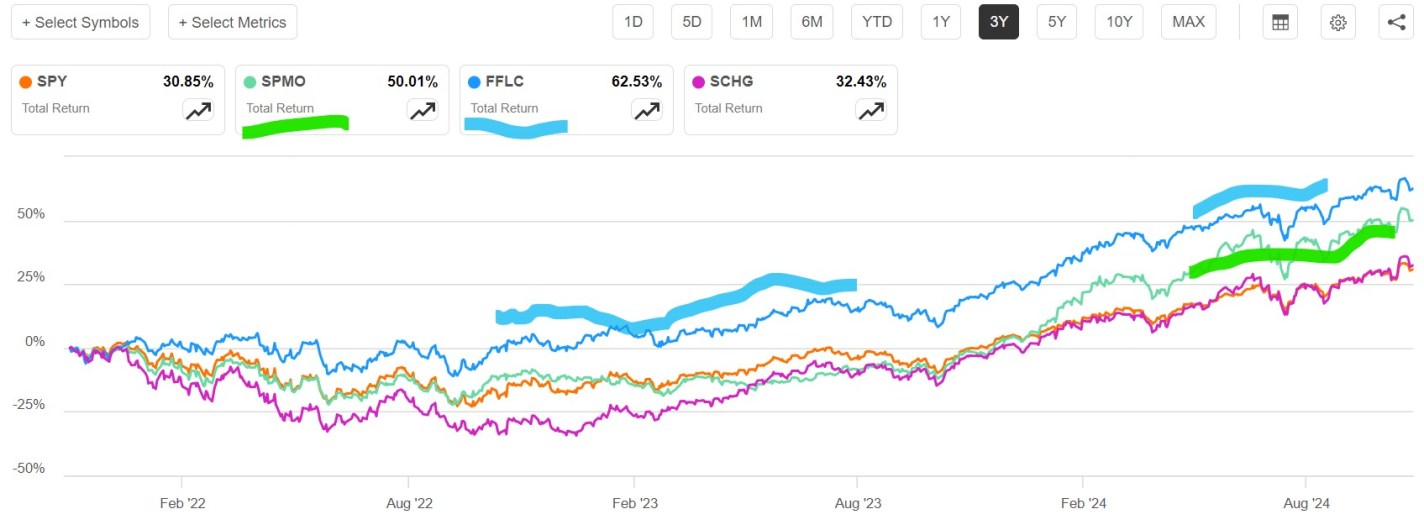
How does SPMO compare to a top actively-managed fund like FFLC or plain growth stock fund SCHG? The three-year plot below shows that FFLC (blue line, 63% total return) beat SPMO (green line, 50% return). Although SPMO had an impressive surge in the past year, FFLC just kept steadily outperforming SPY over the whole three-year period. This suggests that having good human judgement at the helm, able to adapt to differing market environments (2022 bear vs. 2023-2024 tech bull) can do better than a single, focused algorithm. I prefer a fund which keeps steadily outperforming “the market” (i.e., S&P 500) rather than one which only occasionally has moments of glory, so I hold more FFLC than SPMO.
In the plot above, the growth fund SCHG suffered more in 2022 when the tech high-flyers fell to earth, but made up for it in 2023-2024, to end up matching SPY over three years. On longer time-frames, SCHG handily beats SPY, as we noted in an earlier article on growth stocks.
[1] See this Insider Monkey article for a listing of ten best U.S. stock momentum funds. Some of these focus on small cap, mid cap, or technology stocks.
I thought this was going to be another election post, but it didn’t turn out that way.
My plan was to do another annual portfolio review, with a focus on changes I’ll make to my portfolio as a result of how the election impacts various market themes, and how my take on the election differs from the market’s take. But as I looked at my portfolio, what struck me wasn’t how the election changes things, but instead how severely my stock picks underperformed the incredible 26% return the S&P has posted so far this year.
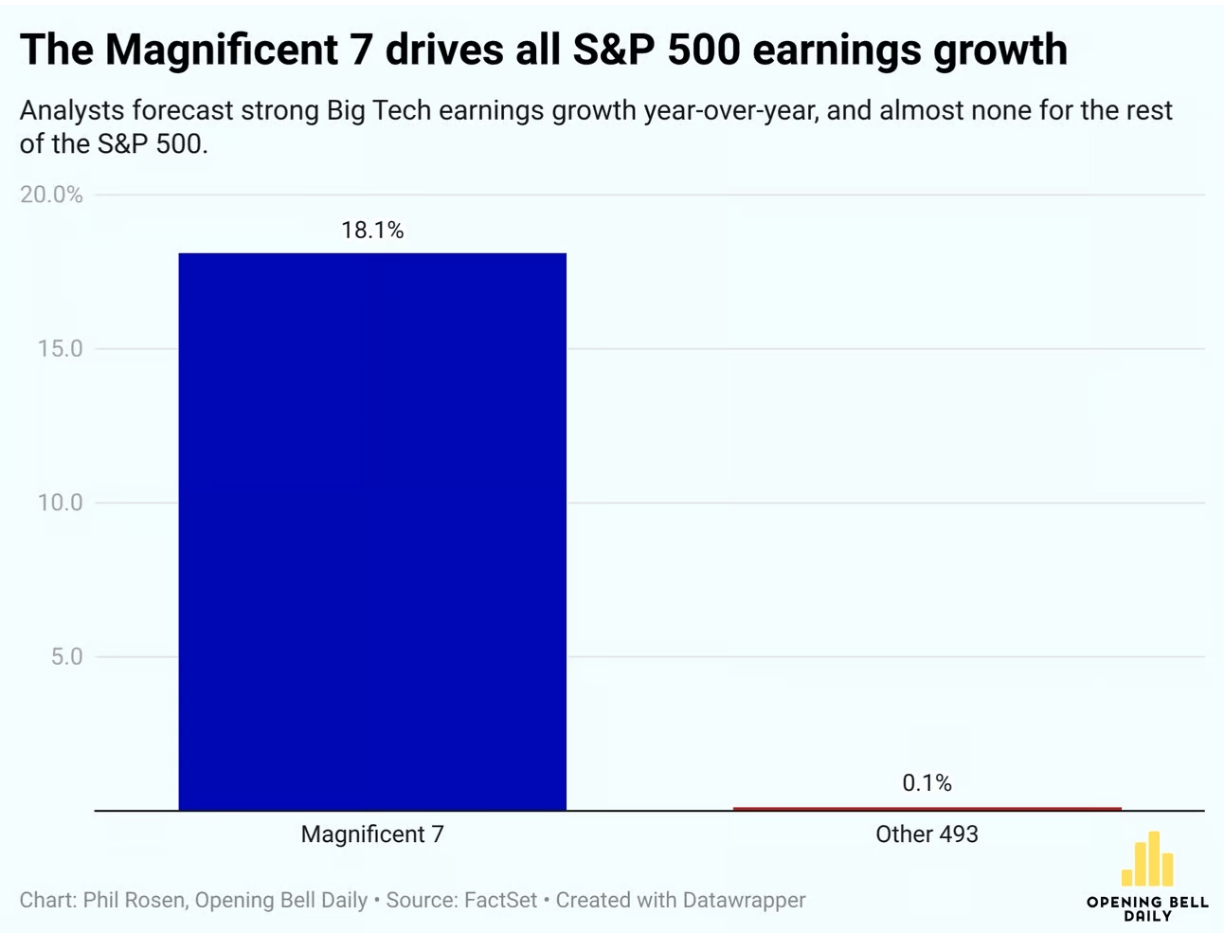
My first couple years of stock picking tended to match the S&P, roughly what you’d expect if markets are efficient and I’m just throwing darts. But more recently so much of the overall return of the market has been driven by just 7 mega-cap stocks, the “Magnificent 7”, that if you don’t own them you are probably underperforming big time.
Of course buying a broad index, especially a market-cap-weighted one like the S&P, is a way to ensure you own at least a piece of the big winners, which is one reason economists usually recommend buying the broad index. And I did this with 80% of my portfolio, to match my 80% belief in the efficient markets hypothesis. But I’m now back up to 90% belief in efficient markets, at least for stocks.
This efficiency seems to change a lot over time. Probably fewer than 10% of US stocks have obvious mis-pricings right now; really none stand out as super mispriced to a casual observer like me. Instead, it seems like every 10 years or so a broad swathe of the market is driven crazy by a bubble or a crash, and you get lots of mispricing- like tech in 2000, forced/panic selling at the bottom in 2009, or meme stocks in 2021. The rest of the time, the stock market is quite efficient. So, in typical times, just be boring and buy and hold a broad index fund.
Of course, you might think that AI is a bubble now. I certainly don’t love the 68 P/E on NVIDIA, but this doesn’t strike me as a true bubble driven by irrational hope- peoples’ hopes have proven well justified so far, with AI performing miracles and the Mag 7 delivering huge profits. So like Scott, I’m finally giving up on being overweight value stocks. Perhaps our capitulation is the sign that growth’s decade-plus run is finally about to reverse; but if so, I’ll try not to regret it. After all, the S&P has plenty of value stocks too.
Will Growth Stocks Continue to Trounce Value Stocks?
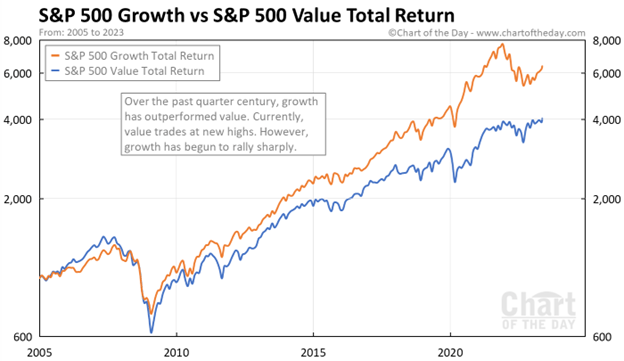
It’s no secret that growth stocks, mainly big tech companies like Apple and Microsoft, have massively out-performed so-called value stocks in the past fifteen years. Value stocks tend to have lower price/earnings and steady earnings and low price/earnings. They include sectors such as petroleum, utilities, traditional banks, and consumer products. These companies often pay substantial dividends from their cash flow.
Here are some charts which make the point. This 2005-early 2023 chart shows value stocks (blue curve) having a small edge 2005-2008, then the growth stocks (orange curve) keep ripping higher and higher. Financial stocks, which mainly fall in the value category, were hit particularly hard in the 2008-2009 downturn.
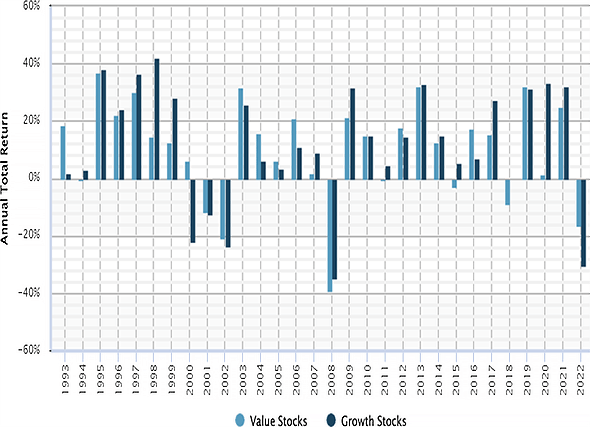
Here is a bar chart display of annual returns of value stocks (blue bars) and of growth stocks for the years 1993-2022. In 1997-1999 growth stocks outperformed. This was the great tech bubble – I remember it well, investors were shoveling money into any enterprise with a customer-facing website, whether or not there was any reasonable path to profitability. Reality caught up in 2000 (“What was I thinking??”), tech stock prices crashed and then tech was hated for a couple of years. But by 2009 or so, today’s big tech firms had emerged and established their quasi-monopolies, and started actually making money and even more money.
So, is the answer to just allocate all your equity portfolio to big tech and walk away? This is a question I have been asking myself. Even as growth stocks dominate year after year, there have continued to be voices warning that this is anomaly; historically, value stocks have performed better. So, with the sky-high valuations of today’s big tech, there is due to be a big mean reversion where the “Magnificent 7” get crushed, and Big Banks and Big Oil and Proctor & Gamble and even humble utilities finally get to shine.
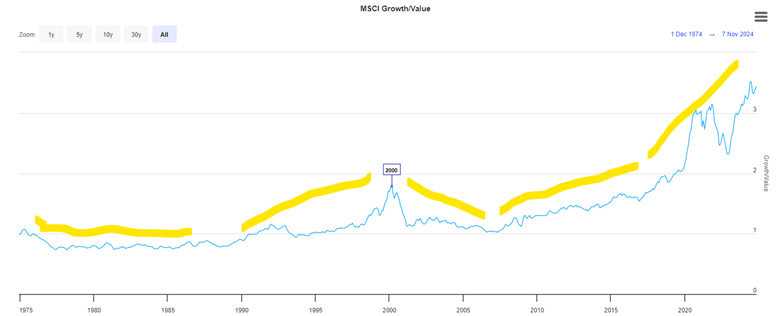
I don’t have a chart that goes that far back, but I have read that over the past 100 years, value has usually beat “growth”. Here is a hard-to-read plot of value vs growth for 1975-2024. I have added yellow highlighter lines to mark major trend periods. Growth underperformed 1975-1990, then growth picked up steam and culminated in the peak in the middle of the chart at 2000. Growth then underperformed 2000-2008, as noted earlier, as the excesses of the tech bubble were unwound, and people made paper fortunes in the real estate bubble of 2001-2007.
Growth has dominated since 2009, excerpt for 2022. That was the year the Fed raised interest rates, which tends to punish growth stocks. However, with their unstoppable increases in earnings (accounting for the vast majority of the earnings in the whole S&P 500), big tech has come roaring back. Yes, they sport high P/E ratios, but they have the earnings and the growth to largely justify their high valuations.
I have been influenced by the continual cautions about growth stocks becoming overvalued. Many an expert has advocated for value stocks. In June of this year, Bank of America head of US equity strategy Savita Subramanian told an audience at the Morningstar Investment Conference: “I have one message to you: Buy large-cap value.” So, for the past couple of years, I have gone relatively light on big tech and have over-allocated to “safer” investments like fixed income and value stocks. Silly me.
In the last few months, I finally decided to give up fighting the dominant trend, and so I put some funds into SCHG, which is specifically large cap growth, and in other growth-heavy funds. As you may imagine, these funds are loaded with Nvidia and Meta and other big tech. They have done very well since then.
How about going forward? Will the growth dominance continue, or will the dreaded mean reversion strike at last? At some point, I suspect that big tech earnings will slow down to where their high valuations can no longer be supported. But I don’t know when that will be, so I will just stay diversified.
Boilerplate disclaimer: Nothing here should be taken as advice to buy or sell any security.
Last week I laid out my own expectations for what economic policy would look like in a Trump or Harris presidency. Now after yesterday’s market reaction, we can infer what market participants as a whole expect by roughly doubling the size of yesterday’s market moves. Prediction markets had a 50-60% change of Trump winning as of Tuesday morning’s market close, which moved to a 99+% chance by Wednesday morning. Look at how other markets moved over the same time, multiply it by 2-2.5x, and you get the expected effect of a Trump presidency relative to a Harris presidency. So what do we see?
Stocks Up Overall: S&P 500 up 2%, Dow up 3%, Russell 2000 (small caps) up 6%. My guess this is mostly about avoiding tax increases- the odds that most of the Tax Cuts and Jobs Act gets renewed when it expires in 2025 just went way up. Lower corporate taxes boost corporate earnings directly, while lower taxes on households mean that they have more money to spend on their stocks and their products. Lower regulation and looser antitrust rules are also likely to boost corporate earnings.
Bond Prices Down (Yields Up): 10yr Treasury yields rose from 4.29% to 4.4%. This is the flip side of the tax cuts- they need to be paid for, and markets expect they will be paid for through deficits rather than cutting spending. The government will issue more bonds to borrow the money, lowering the value of existing bonds.
Dollar Up: The US dollar is up 2% against a basket of foreign currencies. I think this is mostly about the expected tariffs. People like the sound of the phrase “strong dollar” but it isn’t necessarily a good thing; it makes it cheaper to vacation abroad, but makes it harder to export, even before we consider potential retaliatory tariffs.
Crypto Way Up: Bitcoin went up 7% overnight, Ethereum is now 15% up since Tuesday. Crypto exchange Coinbase was up 31%. Markets anticipate friendlier regulation of crypto, along with a potential ‘strategic Bitcoin reserve’.
Single Stock Moves: Private prison stocks are up 30%+. Tesla is up 15%, mostly due to Elon Musk’s ties to Trump, but also due to tariffs. Foreign car companies were way down on the expectation of tariffs- Mercedes-Benz down 8%, BMW down 10%, Honda down 8%.
Sector Moves: Steel stocks are up on the expectation of tariffs, while solar stocks (which can’t catch a break, doing poorly under Biden despite big subsidies and big revenue increases) were down 12% in the expectation of falling subsidies. Bank stocks did especially well, with one bank ETF up 12%. This gives us one hint on what to me is now the biggest question about the second Trump administration- who will staff it? I could see Trump appointing free-market types, or wall-streeters in the mold of Steve Mnuchin, or dirigiste nationalist conservatives in the JD Vance / Heritage Foundation mold, or an eclectic mix of political backers like Elon Musk and RFK Jr, or a combination of all of the above. The fact that bank stocks are way up tells me that markets expect the free-marketers and/or the Wall-Street types to mostly win out.
Just Ask Prediction Markets: If you want to know what markets expect from a Presidency, you can do what I just did, look at moves the big traditional markets like stocks and bonds and try to guess what is driving them. But increasingly you can skip this step and just ask prediction markets directly- the same markets that just had a very goodelection night. Kalshi now has markets on both who Trump will nominate to cabinet posts, as well as the fate of specific policies like ‘no tax on tips‘
Typically, the federal government spends more than it takes in. This has been going on for decades. At moderate levels, i.e. moderate debt/GDP ratios, this is not cause for concern. Presumably the national economy will grow enough to service the debt.
Historically, deficit spending would temporarily increase during some crisis like a major recession or major war, then it quickly tapered back down again. There was a general understanding, it seems, among most voters and most politicians that huge deficits were not healthy; one would not want to burden future generations with a lot of debt.
During the 2020-2021 epidemic experience, however, politicians found they got instant popularity by handing out trillions in stimulus money; anyone who squeaked that we couldn’t afford this much largesse got run over. And this spend-big, tax-small mentality has now become entrenched. Both presidential candidates have been traversing the nation promising juicy tax cuts. Apparently, we the people have decided to vote ourselves lots of free money right now, and the heck with future generations.
Here is a forecast from the Congressional Budget Office, with the optimistic assumption that we will never get another recession, showing that the recent levels of deficit are much higher than historical norms:
This is just the yearly deficit, not the exponentially-growing accumulated debt. The influence of the total debt may be seen in the mushrooming interest outlays. Below is another chart with data from the St Louis Fed, displaying both deficit level and unemployment over the past 80 years. Again, deficit spending would ramp up during recessions, due to reduced tax revenue and increased spending on unemployment benefits, etc., but then it would ramp right back down again. It failed to come back down completely after the 2008-2009 recession, and indeed started ramping up around 2016, even with low unemployment.
I don’t see this trend changing, and so investors need to take this into account. Here I will summarize some key points from analyst Lyn Alden Schwartzer in her article on the Seeking Alpha investing site titled Why Nothing Stops The Fiscal Train.
She notes that besides the primary deficit, the interest paid on the federal debt is a transfer of money to mainly the private sector, and so is further stimulus. This is one factor that has helped keep the economy stronger, and inflation higher, than it would otherwise be.
Some key bullet points in the article are
The U.S. faces structurally high fiscal deficits driven by unbalanced Social Security, inefficient healthcare spending, foreign adventurism, accumulated debt interest, and political polarization.
Investment implications suggest favoring equities and scarce assets over bonds, with defensive positions in T-bills, gold, and inflation-protected Treasury notes.
Fiscal dominance will likely lead to persistent inflation, asset price volatility, and potential stagflation, making traditional recession indicators less reliable.
A neutral-to-negative outlook on U.S. stocks in inflation-adjusted terms, with better prospects for international equities and cyclical mid-sized U.S. stocks.
She suggests looking to the recent histories of emerging economies to see what happens in nations with perhaps stagnating real economies kept afloat by ongoing federal deficits. Her tentative five-year outlook for investing is bearish on the major U.S. stock indices (gotten overpriced) and on government bonds (real returns, in light of anticipated ongoing inflation, will be low), but bullish on international stocks, inflation-protected bonds, short-term T-bills, gold, and bitcoin (again, all mainly driven by expected stubborn inflation as the money supply keeps growing):
-For U.S. stocks, I have a neutral-to-negative view on the major U.S. stock indices in inflation-adjusted terms. They’re starting from an expensive baseline, and with a high ratio of household investable assets already stuffed into them. However, I do think that among the universe of more cyclical and/or mid-sized stocks that make up smaller portions of the U.S. indices, there are plenty of reasonably priced ones with better forward prospects.
-For international stocks, I think the 2024-2025 Fed interest rate cutting cycle is one of the first true windows for them to have a period of outperformance relative to U.S. stocks for a change. It doesn’t mean that they certainly will follow through with that, but my base case is for a meaningful asset rotation cycle to occur, with some of the underperforming international equity markets having a period of outperformance. At the very least, I would want some exposure to them in an overall portfolio, to account for that possibility.
-For developed market government bonds, like the U.S. and elsewhere, I don’t have a positive long-term outlook in terms of maintaining purchasing power. A ten-year U.S. Treasury note currently yields about 3.7%, while money supply historically grows by an average of 7% per year, and $20 trillion in net Treasury debt is expected to hit the market over the next decade. So I think the long end of the curve is a useful trading sardine, but not something I want to have passive long exposure to.
-A five-year inflation-protected Treasury note, however, pays about 1.7% above CPI, and I view that as a reasonable position for the defensive portion of a portfolio. T-bills are also useful for the defensive portion of a portfolio. They’re not my favorite assets, but there are worse assets out there than these.
-Gold remains interesting for this five-year period, although it might be tactically overbought in the near-term. It has had a nice breakout in 2024, but is still relatively under-owned by most metrics, and should benefit from the U.S. rate cutting cycle. So I’m bullish as a base case.
-Bitcoin has been highly correlated with global liquidity, and I expect that to continue. My five-year outlook on the asset is very bullish, but the volatility must be accounted for in position sizes for a given portfolio and its requirements.
I’ll add two comments on this list. First, the bond market is usually pretty good about figuring things out, and has evidently realized that endless huge deficits mean endless huge bond issuance and ongoing inflation. Thus, even though the Fed is lowering short-term rates, bond buyers have started demanding higher rates on long-term bonds. And so long-term government bonds may not be as bad as Schwartzer thinks.
Second, for reasons described in The Kalecki Profit Equation: Why Government Deficit Spending (Typically) MUST Boost Corporate Earnings, when you work through the various sectoral balances in the macro economy, most of the huge deficit spend dollars will end up in either corporate earnings or in the foreign trade deficit. So the ongoing deficits will continue to buoy up U.S. corporate earnings, and hence U.S. stock prices.