The past 12 months has been dominated by COVID-19, the related recession, the government response, and other matters. But it has not just dominated our lives, it has also dominated new research, including research by economists!
Working papers from the National Bureau of Economic Research are one place to track on-going research by economists. While not all economic research is released as an NBER working paper (there are other series, and some economists just post them on their own website or department page), the volume of NBER papers should tell us something about the trends.
Here’s a chart showing the weekly NBER working papers that are in some way related to COVID-19. The first batch of three papers was released in late February, one long year ago. The second batch of nine papers came one month later. Since then, there have been papers released every single week, with the exception of the week of Christmas.
In total, there have 373 papers released that relate to COVID-19. The peak comes in late May and early June, with 61 papers released in a 4-week period and 21 of those papers coming out on May 25 alone. Since the May-June peak, we’ve seen a slow decline in papers on COVID-19, and we are now at our lowest level, with just 14 papers released in the past 4 weeks.
Everybody knows that Bitcoin is a “digital currency”. But what does that really mean, and what is Bitcoin really good for? Who developed it? Turns out, oddly, that we don’t actually know. Can you buy a pizza with it? Turns out that perhaps the most famous pizza purchase of all time was made with Bitcoin.
— Mike Makowsky is here to violently equivocate (@mikemakowsky) February 22, 2021
My advisor was Laurence Iannaccone, student of Gary Becker, seminal and in many ways founding contributor to the economic study of religion, now of Chapman University. His observation is a common one in academia, a point of pride for some even, though that varies greatly by discipline, as does their market options outside of the academy. And, yes, flexible work schedules, post-tenure job security, and sometimes picturesque campuses all should be counted towards the total compensation of those fortunate enough to secure a faculty appointment. But the power of the observation goes far beyond proper labor market accounting.
As I find so often to be the case, there is good sociology to be done, but the best first step in doing so is a little bit of economics. To wit:
The academy is, on average, considerably to the left of the population at large. Now this difference, mind you, is grossly exaggerated by your typical right-wing windbag who seems to think that universities begin and end in the English department, but the difference remains. So why would your typical economics, chemistry, or architecture professor tend to be left of the popular center? Well, if the median self-identified lefty got to choose the federal and state tax rates, what would they be? Ok, and how much of that will I have to pay out of my non-pecuniary income? Until they figure out how to tax the thrill of pursuing my own self-determined research agenda, not very much. Taxes are cheap when half of your compensation is non-pecuniary.
The academy is a club.
Scratch that.
The academy is a hierarchy of nested clubs. Which means that we often suffer from exclusionary FOMO akin to fourth tier English gentry trying to marry off five daughter in the early 19th century. Membership in those clubs– those famed research groups, donor-named centers, or even (god forbid) schools of thought — they become more than just sources of funding, workshop critique, and coauthor match-making sock hops. These clubs become the well springs from which ever increasing portions of our non-pecuniary income come from. They become our social networks, our friends, and even ,with a handful of co-authors you’ve gone into scientific battle alongside, a second family. The next time you see someone dig in their heels, seemingly denying the mounting evidence that they were on the wrong side of a scientific argument, don’t just blindly assume they are too stubborn and arrogant to acknowledge they might have been wrong. Consider how unfunded or, more importantly, how lonely they stand to be if they’re the first to give up the fight.
It’s why we covet tenure so much. Don’t get me wrong, everyone wants job security. But for most of us, the prospect of being laid off doesn’t necessarily include the possibility of being jettisoned from what you’ve slowly constructed as a separate parallel universe within which you have carefully curated the technical, educational, and social capital necessary to produce your career and life. If you get laid off from programming for Netflix, the next few weeks or months will be unpleasant, scary even. You may begin to doubt your ability or life choices. But that next job will come, and you will as often as not find yourself with a nearly identical life on the other side.
There are those in the academy though for whom this is all they’ve ever known. Bachelors, doctorate, tenure-track academic placement. Throw in a post-doc and that’s 20 years, and you’re entire adult life, in and around universities. Even if they’re from a field fortunate enough to have robust private sector options, how much will doubling your salary really soften the blow for such a person?
I say all of this now not as a critique of academia, or even to lead to prescriptions or advice. You want my advice? Fine, here: don’t go straight to grad school. Dip your toe in the real world, see how you like it. Come back in a few years with a little experience and distaste for office life. It’ll serve you well when your dissertation hits one of its many inevitable nadirs.
Rather, I invite you to consider this: what does the world start to look like when our utility comes less from the goods that we buy and the experiences we have, and more from the clubs we are members of? What does it look like when those clubs find newer and better ways to monitor our behavior and our expressed beliefs? What does it look like when the purging of membership rolls becomes a part of the culture of those clubs?
My third post on Covid data heroes features Dr. Emily Oster. Emily is a mom. Lot’s of economists are moms, but few have incorporated it quite as much into their careers. Emily has written a book on pregnancy and a new one on what to do with the kids after they are born. She does a great job explaining scientific research in a way that is easy to understand.
Emily made a big push to collect data on schools and covid back when there was crippling uncertainty about how dangerous it is to let children go to school in person.
She has a great email newsletter and substack. Her latest post is called “Vaccines & Transmission Redux Redux”. In this post, she distills the latest research to give practical advice on when kids can see grandparents once the vaccines are out.
For a long time now, some families have been avoiding close contact with elderly relatives. When can we go back to normal?
I asked students to read an excerpt of the first chapter of Cal Newport’s book Deep Work and comment in a discussion board. The prompt asked whether deep work goes on in college and what are the barriers to deep work. I think it’s important for society that some people engage in deep work on our problems. I’m interested in how 20-year-olds perceive Newport’s ideas on focus and what barriers they identify to deep work.
Replies ranged from “I do believe that deep work is happening at college, but I think that it is hard to find students using this strategy regularly.” to “I know multiple people who do not practice deep work….” They each have a different subjective view of “deep work” and their replies are anecdotal. It’s possible that some students are too hard on themselves, considering that I biased them to be negative with the discussion prompt. Some of them might have thought that “deep work” requires many consecutive hours of focus, which is not actually what I expect of undergraduates. Still, the discussion could be helpful to others who aspire to deep work.
The following barriers to deep work were identified:
“The barriers that we experience include social media, roommates, friends, significant others, going to classes, having to work, and any number of other things that cause our day to become disjointed … We are the first generation that has spent the majority of our life utilizing social media… and in general, are used to taking in information from a large number of sources over a short period of time.
“Most students cannot spend a large amount of hours just focused on the one task at hand and that is required for deep work. For most college students it will be nearly impossible to practice deep work because of a job, outside social life, or a heavy class workload …
“I believe that deep work happens in college a lot. Students often times must prepare/study for tests for a long time and that is when it happens the most. When someone has to study for hours they are intensely focused if they put themselves in a good studying environment…
“This can be achieved when you are able to clear your mind of external things and place yourself in a non-distracting environment. As a college student, this can be difficult especially because we are constantly thinking about our to-do list, when will we hang out with friends, or what’s for dinner.
In class today we discuss education and marriage. While we see a general trend toward fewer and later marriages there are substantial differences across education. More educated men and women are marrying more than less educated men and women. They are also divorcing less. So highly educated people who are well-paid are combining their incomes and securing the benefits that come from marriage. Meanwhile less educated individuals are either not forming relationships (single parents) or forming relationships and living arrangements that are less durable (e.g. cohabitation). So on average there is either a low single income or two low but combined incomes. This is a topic that has been discussed substantially in news outlets. For example, here are articles from The Atlantic, Forbes, and Freakonomics.
You can imagine this has lead to substantial income inequality. For example, this study from a few years ago in the NBER reports that, “Data from the United States Census Bureau suggests there has been a rise in assortative mating….[I]f matching in 2005 between husbands and wives had been random, instead of the pattern observed in the data, then the Gini coefficient would have fallen from the observed 0.43 to 0.34, so that income inequality would be smaller.”
That assortative mating refers to people sorting into relationships with people like them. In this case, people with high education marrying people with high education. But, even for its coverage in the media, we probably do not discuss enough how rising income inequality is driven by patterns in marriage and divorce among those with high and low education.
My 3 year-old will scream. She will lay on the floor, thrash about, and make demands as an infant would if they could communicate and develop the motor control adequate to do so. It doesn’t matter whether she can remember the reason for her disposition – she will continue. My wife and I usually sense the situation. We could get angry and threaten punishments. Alternatively, we know that no amount of reasoning and attempts at persuasion will convert our daughter’s behavior into the sweet, desirable sort. We have found that smothering her with love works best. And when the demands of other children prevent such single-minded attention, we at least try to act lovingly toward her.
My wife is quite beside herself. Why is this happening? (Truth be told, it’s all my fault. It’s in the genes.) Sometimes we see the momentary consideration of a calmer world in our daughter’s face. Then, she rejects it like there is no goodness left in the world. To be clear: I see my daughter know that she can stop her comprehensive riot and instead enjoy some other activity, then definitively decline the opportunity. She has cognitive dissonance.
My child is not crazy. One might say that she is irrational. The entirety of her behavior up to that point is a sunk cost. She could just stop the outburst and feel better. But she doesn’t. Why the heck doesn’t she?
When natural disasters and other emergencies strike, two things are certain. First, many essential goods will run out of stock at stores. Second, economists will complain that if only prices would rise in response to the increase in demand, shortages could be avoided.
Let’s take the current winter storm passing through much of the center of the nation, importantly including the southern US where both individuals and governments are unprepared for major winter storms. Here is a sign up at Home Depot in Arkansas:
I can verify that many people in Arkansas don’t have snow shovels. I’ve seen folks using dust pans and leaf rakes to try and clear their driveway. This video is a few years old, but I have no doubt that someone in Arkansas right now is strapping a widescreen TV box to their lawn tractor to clear snow.
So why no snow shovels in Arkansas at Home Depot? The common answer: it doesn’t snow much here, so the stores don’t stock many, and then when it does snow everyone rushes out to buy them.
Simple enough, but the economist says: WRONG! The reason Home Depot doesn’t have any snow shovels in Arkansas is because they didn’t raise the price. Why do economists insist on this?
With all the uproar around the election in December, the news of the SolarWinds data breach did not get the attention it deserved. Some well-resourced foreign organization, almost certainly in Russia, succeeded in infiltrating the data systems of an astounding 18,000 or more U.S. organizations. These included major federal agencies such as the Pentagon, the Department of Homeland Security, the State Department, the Department of Energy, the National Nuclear Security Administration, and the Treasury, and other big targets like Microsoft, Cisco, Intel, and Deloitte, and organizations like the California Department of State Hospitals, and Kent State University. Security watchdogs run out of adjectives (“11 out of 10”) in characterizing the magnitude of this hack.
At the same time, security experts cannot help admiring the sheer artistry of this exploit. Hackers themselves often view their codes as a work of art. According to one cybersecurity expert, “Programmers and hackers like to sign their work like artists…So they sign that code in various ways. Often, they’ll leave their initials or they’ll try to be cute and put some sort of cryptic message.” So how was this hack accomplished?
As a dedicated supporter of Tottenham Hotspur Football Club, it is with much shame that I have referenced the anthem of Liverpool FC, but the sentiment implied by their club slogan is a powerful one.* To promise someone they will never have to suffer the torments of loneliness is to promise them a lifetime of riches. When we soft, vulnerable human beings find a source of community and support, we are loathe to give it up. Which is to say the promise of membership and threat of banishment are powerful means of solving collective action problems.
The promise of forever walking within columns of lockstep compatriots is a big part of why Gamestop (GME) went to the moon 🚀🚀🚀, but also why it came back down to earth. As Scott noted in his post, the story of the last, and most meteoric, stage of the Gamestop saga was the “short-squeeze”– short-sellers suddenly desperate to cover their positions found themselves needing more shares than existed, while the “unsophisticated” gamblers of r/wallstreetbets refused to sell their shares. Specifically, the large, but uncoordinated institutional short-position holders all pursued their independent self-interest, while the seemingly disaggregated redditors managed to solve their collective action problem. Which raises what, to me, is the most interesting question of the whole saga: if coordinating a short-squeeze is so lucrative, why doesn’t it happen more often? Put another way, why were a large number of strangers able to coordinate a complex financial gambit rarely pulled off by sophisticated institutional investors?
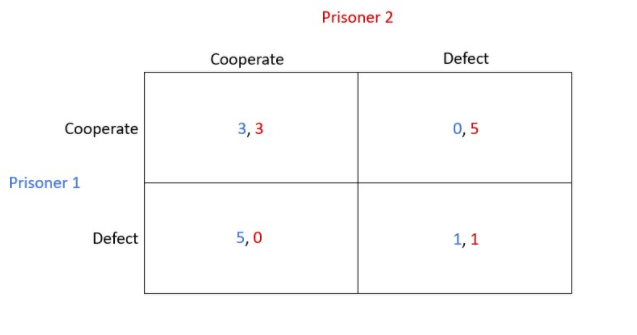
The answer, in part, is that they weren’t strangers. They may be anonymous to one another, absent recognition or connection in real life (IRL aka meatspace), but that doesn’t make them strangers. These men and women had built a community so deep they had their own (often incredibly offensive) language. Their own jokes. They had a culture and sources of status, going so far as to create their own within-group celebrities. And, absent any visible coordination, that culture had evolved in this moment toward a single idea: hold the stock. They were playing a massive prisoner’s dilemma game with each other. Can you form a group for the express purpose of creating a short-squeeze? Probably not – the very action of creating an identity around profit from financial speculation belies the prospect of building an identity valued more than pure profit by its members. That’s the rub – if you want to pull off a massive collective financial action, you’re going to have to build a group of people interested in financial collective action that nonetheless values the identity of the group above the profits of collective financial action. That’s what makes this Planet Money podcast about Gamestop so special– more than anyone anyone else, they seemed to understand that the absurdist emoji usage and language, the elaborate memes, the actual freaking sea-shanties, those weren’t just color for the story, they were the story. Hedge funds weren’t losing tens (hundreds?) of millions of dollars in a zero sum game to a bunch of idiots obsessed with chicken tender-centric memes and sea shanties. They were losing a millions of dollars in a zero sum game because of the memes and sea shanties.
Put succinctly, at every stage leading up to and during the short-squeeze, each and every holder of Gamestock shares would have been better “defecting” on their r\wallstreetbets comrades-in-arms. Yes, the group is better off if everyone holds, but everyone knows the incentives faced by everyone else, which creates a seemingly irresistible economic gravity of self-interest (defect, defect). So how do we solve these collective action problems? Well, first and foremost, we change the payoffs. That’s what we do in successful families, mafias, and religious groups. It’s what we fail to do in our misfiring coups, cooperatives, and communes.
Yes, your bank account balance will increment upwards if you defect and sell your stock. But that also means you’re no longer a true Son of Gondor. Sure, no one else on the subreddit knows it, but you’ll know it. You’ll know it in your cold, lonely, traitorous heart. Sure, you can use the words and participate in the jokes, but will you ever know the same sense of fellow-feeling within the community as you knew before. That’s a real cost. Is it worth cashing in $5000 in profit a week early, especially knowing it might be worth more next week? Remember – the benefit of group identity doesn’t have to be greater than the profit at hand, it only has to be greater than the risk holding the stock bears for your future profit. Combined with a little motivated reasoning, and it quickly becomes clear how a community, formed independent of profit-via-collective-action, now suddenly becomes an engine of pro-social decision-making sufficient to create an existential threat to any institution over-leveraged on a short position.
The same payoff matrix, however, also demonstrates that a short-squeeze built around a group identity is living on borrowed time. With every short position that gets closed out, the price climbs both higher and closer to its (actually) inevitable peak. There are a finite number of short positions, and there is a finite number of days their share lenders will allow them to hold out, all of which mean a peak will be reached, after that point the price will begin to rapidly decline. Which all means that as the price rises the risk to holding also rises, both of which are increasing the opportunity costs of holding the stock, shifting the payoffs back to a classic Prisoner’s Dilemma. Sure, your group identity might be worth $5K, or even $50K, but there’s a point at which anonymous community is dominated by the prospect of material wealth. I’m not saying you can buy true friends, but eventually you can buy something that offers a close substitute for anonymous friends. Or an island.