Oil Price Lesson Plan for Economic Principles

Alex Tabarrok noted in Oil versus Ice Cream that he and Tyler, as textbook authors, “chose the oil market as our central example. Oil is always in the news…”

when a student sees that the price of crude has surged past $100 a barrel because Iran closed the Strait of Hormuz—choking off 20% of the world’s oil supply—they have the framework to understand what is happening. Supply shock, inelastic demand, expectations and speculation, the macroeconomic transmission to GDP—it’s all right there in the headlines.

In a classroom, a good way to begin is to ask the students to tell you what they have noticed recently about oil or gas prices. Having the students obtain the oil price data themselves could be fun, if you are in an environment with screens/computers.

A data source for undergrads is the FRED chart for WTI crude oil prices. It is clean and easy to explain in class. An instructor with slides could pull this up in real time. https://fred.stlouisfed.org/series/DCOILWTICO
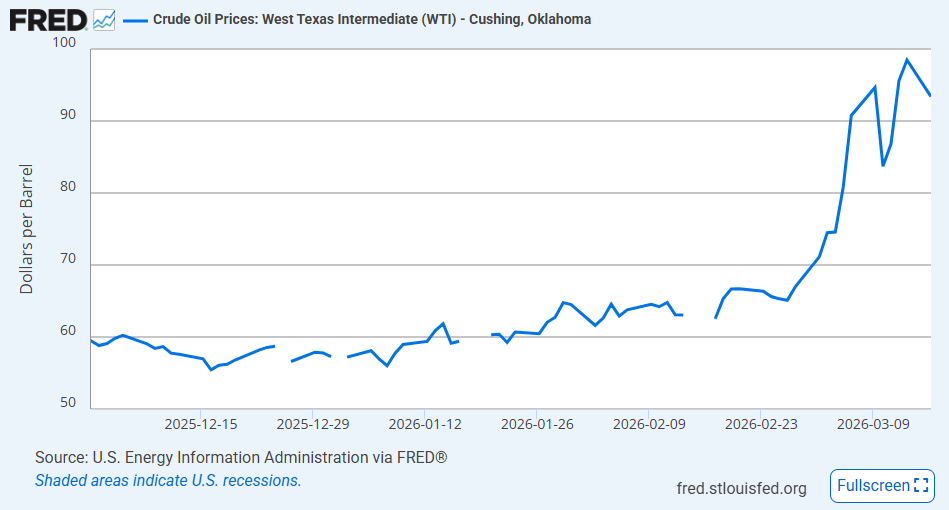
Ask students: “Is this price change primarily explained by

  1. Increase in demand
  2. Decrease in demand
  3. Increase in supply
  4. Decrease in supply

Correct answer: d. Decrease in supply

If you cover elasticity, this is especially helpful as an example. “Why would the price jump more when demand is inelastic?”

It’s not too late to work this into a lesson plan for the Spring 2026 semester, economic teachers. I might use it to illustrate supply shocks next week.

This event is a classic example of a negative supply shock: a disruption in the Strait of Hormuz would reduce the amount of oil reaching world markets, pushing energy prices sharply upward. Because oil is an important input for transportation, manufacturing, and heating, higher oil prices raise costs across much of the economy. Firms may cut production, households may spend more on gasoline and utilities and less on other goods, and overall economic activity can slow. That is why economists worry that large oil supply shocks can contribute to recessions. They do not just make one product more expensive; they can ripple outward, reducing real income, lowering consumer confidence, and weakening GDP growth while inflation rises.

Related posts. The whole crew showed up this month:

James from March 12: Is a US Oil Export Ban Coming?

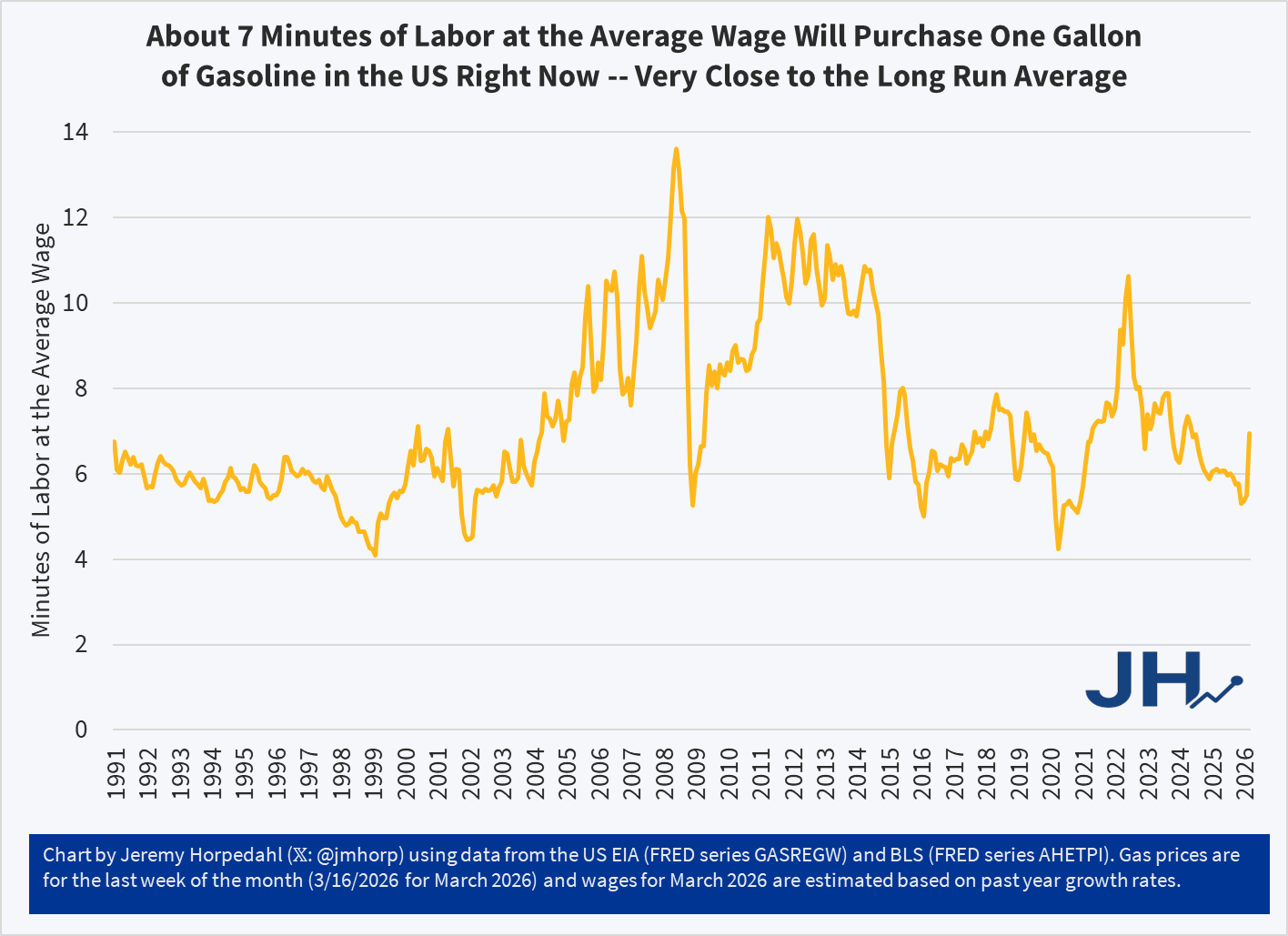
Jeremy from March 18: Gasoline Prices Have Increased at Record Rates, but Remain At About Average Levels of Affordability

Tyler from March 22: How much more will oil prices have to go up?

MattY from March 24: Why hasn’t oil gotten even more expensive?

Austin Vernon: https://www.austinvernon.site/blog/thestrait.html
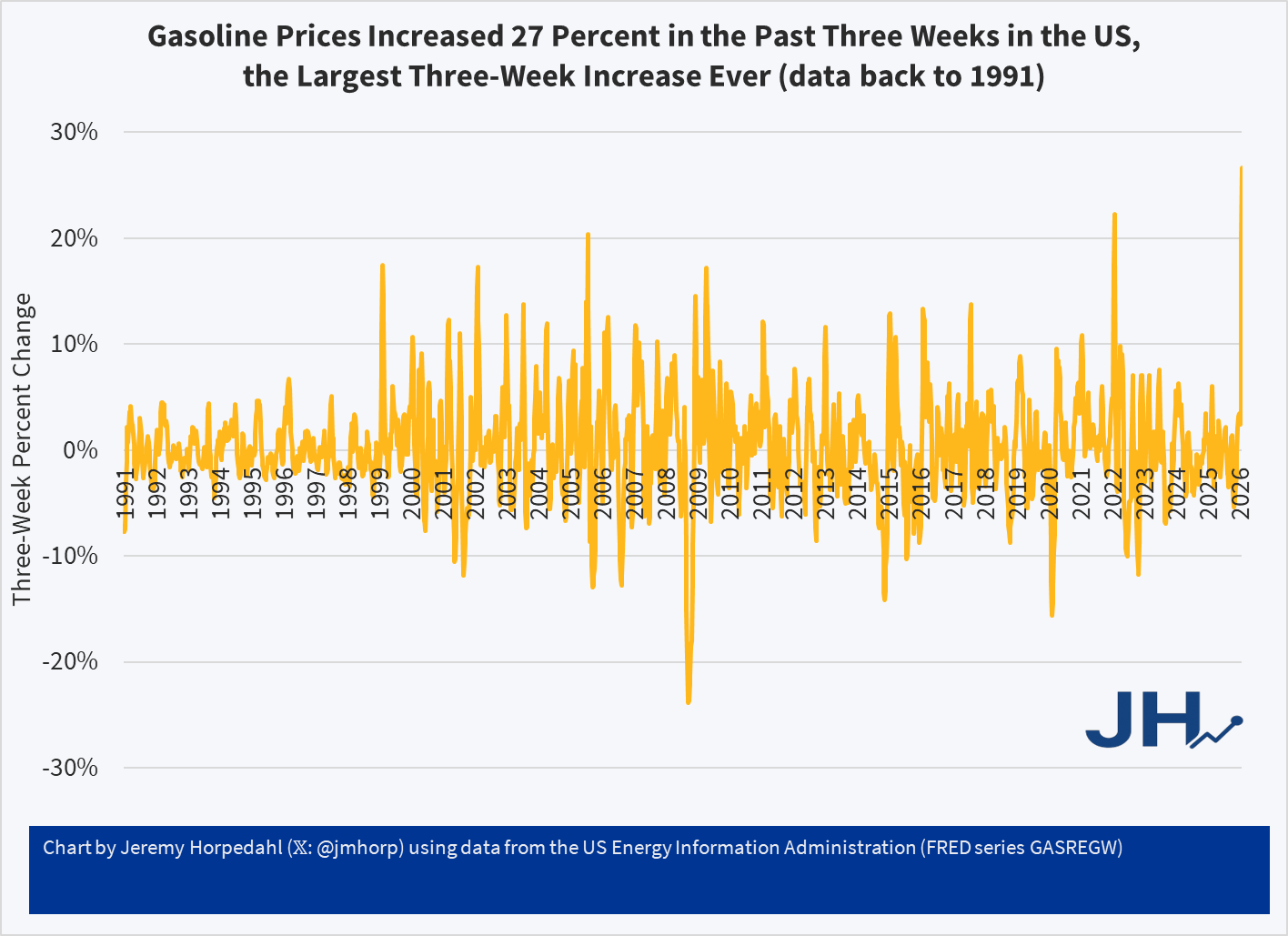
Gasoline Prices Have Increased at Record Rates, but Remain At About Average Levels of Affordability

In the (so far) short military engagement with Iran, crude oil and gasoline prices have jumped significantly. The three-week change in gasoline prices at the pump for US consumers was 27 percent, the largest three-week increase consumers in the US have ever seen (with data back through the 1990s). The four-week increase is also a record.

Despite this sharp increase, gasoline prices remain near the long-run average in terms of affordability: it takes about 7 minutes of work at the average wage to purchase a gallon of gasoline. To be sure, this is a big jump of where it had been earlier in 2026, at about 5 minutes of labor. Nonetheless, gasoline is still (for now!) more affordable than it was, relative to wages, for almost all of 2022 and 2023.

Dressed for Recess(ion)

In my previous post, I decomposed consumer expenditures to figure out which service sectors experienced the largest supply-side disruptions due to Covid-19. I illustrated that transportation & recreation services were the only consumer service to experience substantial and persistent supply shocks. Health, food, and accommodation services also experienced supply shocks, but quickly rebounded. Housing, utility, and financial services experienced no supply disruptions whatsoever.

What about non-durables?

Total consumption spending is the largest category of spending in our economy and is composed of services, durable goods, and non-durables. Services are the largest portion and durable goods compose the smallest portion. So, while there were plenty of stories during the Covid-19 pandemic about months-long delivery times for durables, they did not constitute the typical experience for most consumption.

Even though it’s not the largest category, many people think of non-durables when they think of consumption. Below is the break-down of non-durable spending in 2019. The largest singular category of non-durable spending was for food and beverages, followed by pharmaceuticals & medical products, clothing & shoes, and gasoline and other energy goods. Clearly, the larger the proportion that each of these items composes of an individual household budget, the more significant the welfare implications of price changes.

Continue reading

Is Travel Back?

According to the most recent TSA data, on December 21st of this year there were 1,979,089 people traveling by plane. That’s almost exactly equal to the number of people that flew in the US on the same date in 2019: 1,981,433 travelers. It’s also double the number of people that few on December 21, 2020 (about 992,000). These numbers are encouraging. Does that mean that we’re back to normal levels of travel?

Not quite. We shouldn’t read too much into one day of data, for a variety of reasons, but most importantly because while we’re looking at the same date, travel varies throughout the week and December 21st is a different day of the week every year (Tuesday this year, Saturday in 2019). It’s better to use a weekly average and compare it to 2019. Here’s what the data looks like for 2020 and 2021.

With this data, we can see that airline travel is back to about 85 percent of 2019 levels. That’s not bad, but airline travel was already back to 85 percent by early July 2021, with some variation since then, but generally staying in the 70-90 percent range for most of the second half of the year.

For those that are flying this year, there is good news in terms of prices (unusual to have good prices news right now): airfares are still about 20 percent cheaper than pre-pandemic levels. In fact, airline prices are the cheapest they have been since 1999. In nominal terms! If you are interested in even more historical price data, take a look at my May 2021 post on the “golden age” of flight.

And of course, flying is not the most common way that people travel for Christmas and the holiday season. According to estimates from AAA, only about 6 percent of holiday travelers choose to fly. This was true in 2019, and will be roughly true in 2021 (as usual, 2020 was the exception: around 3 percent). By far the most common mode of travel in the US is driving, accounting for over 90 percent of holiday travel.

If you are traveling by car, there isn’t much good news for prices. As you have no doubt heard constantly for the past few months, gasoline costs a lot more than it did last Christmas, on average about $1 per gallon more. But even compared to Christmas 2019, gasoline prices are almost 29 percent higher. The last time gasoline prices were this high (in nominal terms) around Christmas was in 2013.

I hope you all have safe holiday travels, and we’ll all look forward to better prices in the New Year!