Corporate Landlords Make Rent… Lower?

Let’s keep it brief. Stick with me.

You know how perfect diversification means that one bears no idiosyncratic risk? That means that one is willing to pay more for some given return, driving up the price of assets included in such a diversified portfolio. That means that, without an informational advantage, index funds should place upward pressure on the price of assets that compose them. Anyone who invests in individual stocks, again without an informational advantage, would be priced out of the market because they bear idiosyncratic risk and would need to enjoy a risk premium that lowers the maximum price that they are willing to pay.

What about real estate?

Continue reading

House Rich, House Richer

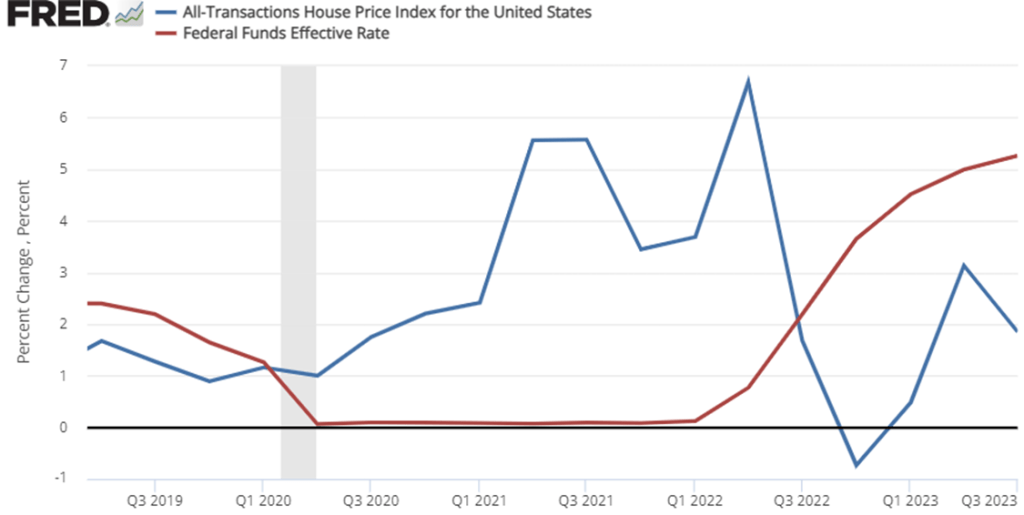
The third quarter ‘All Transaction’ housing price data was just released this week. These numbers are interesting for a few of reasons. One reason is that home prices are a big component of our cost of living. Higher home prices are relevant to housing affordability. This week’s release is especially interesting because it’s starting to look like the Fed might be pausing its year 18-month streak of interest rates hikes. In case you don’t know, higher interest rates increase the cost of borrowing and decrease the price that buyers are willing to pay for a home. Nationally, we only had one quarter of falling home prices in late 2022, but the recent national growth rate in home prices is much slower than it was in 2021 through mid-2022.

Do you remember when there were a bunch of stories about remote workers and early retirees fleeing urban centers in the wake of Covid? We stopped hearing that story so much once interest rates started rising. The inflection point in the data was in Q2 of 2022. After that, price growth started slowing with the national average home price up 6.5%. But the national average masks some geographic diversity.  

Continue reading

Work From Home Sours Financing for Office Buildings, Which Threatens Regional Banks

As you drive through cities and many suburbs near cities, you see lot and lots and lots of office buildings. Employees by the tens of millions used to get dressed and fight their way through traffic to get to these building every weekday, park, and go up to their desks to do their white-collar jobs.

The demand for new office space seemed endless, and so developers borrowed money to build more office buildings, and firms like real estate investment trusts (REITs) also borrowed money to buy such buildings in order to rent them out.

Covid changed all that. Suddenly, in early/mid 2020, nearly all office buildings went dark, and people started working from home. With affordable computers and internet access, and with Zoom and other conferencing tools, it was found that workers could get their jobs done remotely. Even after vaccines rolled out in early/mid 2021, concerns over contagious Covid variants kept offices closed. 2022 was when things started opening up again big time, and by end 2022/early 2023 there were stories in the news about companies ordering employees back to their desks.

By January, 2023 Bloomberg could report “More than half of workers in major US cities went to the office last week, the first time that return-to-office rates crossed 50% of their pre-pandemic levels.”  However, that movement seems to have stalled, and has even reversed in some cases, as workers have pushed back strongly against being forced back to the cubes.  Notably, Elon Musk initially banned remote work at Twitter after taking it over in November, but after rethinking the costs of maintaining offices, has shut down Twitter’s offices in Seattle and Singapore, telling employees to work from home

Per the Morning Consult, “The pandemic lockdown triggered one of the swiftest, most significant behavior changes in human history. People’s habits changed overnight, and through the successive lockdowns, shutdowns and new standards, these new habits became ingrained. The experience triggered new, positive associations with working from home, working out with virtual trainers, cooking, gardening and more. A vast web of neural pathways formed to hold these new associations – and that web runs deep.”

And thus, many office buildings remain largely empty, which in turn is resulting in rising defaults on the loans for these buildings. A number of high profile corporate owners in recent months have deliberately (in their own pecuniary interest) defaulted on their loans, forfeited their equity interest in a building , and handed the keys back to the mortgage lenders, who are now stuck with big losses on their loans and with holding a building that nobody much wants.

There are many ramifications of these trends. The one I will focus on is how this extended underutilization of offices affects the parties that lent money to build or buy these buildings.  In many cases, those lenders were smaller (regional) banks. They have much greater exposure to commercial real estate loans than the larger banks, which may cause serious problems in the coming months.


Eric Basmajian calls out some key differences between large and small banks in the U.S.:

At large US banks, loans make up 51% of total assets.  Small banks have 65% loans as a percentage of total assets. So small banks have a lot of loans, and large banks have a lot of cash, Treasury bonds, and MBS.

…At small US banks, loans make up 65% of assets. Of that loan portfolio, real estate is 65%, meaning a lot of real estate exposure….Within that real estate loan portfolio, almost 70% was commercial real estate lending.  So small banks have a high concentration of commercial real estate loans…. Within the commercial real estate category, the highest concentration is “non-residential property,” which can include office buildings, retail stores, and data centers.

….So small banks have a potentially large problem. Deposits are starting to leave after the SVB crisis in search of more safety, but also in search of higher yields on safe assets like Treasury bills.  Deposit outflows will make it hard for small banks to grow lending and may cause a deleveraging.  If deposit outflows are severe, deleveraging will cause banks to sell securities or loans.

Securities can be pledged at the Fed for a relatively high-interest rate. This keeps a bank solvent but at a material hit to earnings.  The loan portfolio is a much bigger problem because the value of these potentially permanently impaired assets will be called into question.

Basmajian summarizes:

There are major differences between large and small US banks.

Large banks hold a lot of reserves, Treasuries, MBS, and residential real estate loans. The asset mix at large banks is very conservative.

Small banks have most of their assets in loans, with commercial real estate holding the highest weight.   Small banks appear to have outsized exposure to highly impaired office buildings which could generate significant losses.

It will be critical to monitor lending standards and availability at small banks because, in the post-2008 cycle, small banks are the lifeblood of credit to the private economy.
Wealth Growth During the Pandemic

In the US wealth distribution, which group has seen the largest increase in wealth during the pandemic? A recent working paper by Blanchet, Saez, and Zucman attempts to answer that question with very up-to-date data, which they also regularly update at RealTimeInequality.org. As they say on TV, the answer may shock you: it’s the bottom 50%. At least if we are looking at the change in percentage terms, the bottom 50% are clearly the winners of the wealth race during the pandemic.

chart created at https://realtimeinequality.org/

Average wealth of the bottom 50% increased by over 200 percent since January 2020, while for the entire distribution it was only 20 percent, with all the other groups somewhere between 15% and 20%. That result is jaw-dropping on its own. Of course, it needs some context.

Part of what’s going on here is that average wealth at the bottom was only about $4,000 pre-pandemic (inflation adjusted), while today it’s somewhere around $12,000. In percentage terms, that’s a huge increase. In dollar terms? Not so much. Contrast this with the Top 0.01%. In percentage terms, their growth was the lowest among these slices of the distribution: only 15.8%. But that amounts to an additional $64 million of wealth per adult in the Top 0.01%. Keeping percentage changes and level changes separate in your mind is always useful.

Still, I think it’s useful to drill down into the wealth gains of the bottom 50% to see where all this new wealth is coming from. In total, there was about $2 trillion of nominal wealth gains for the bottom 50% from the first quarter of 2020 to the first quarter of 2022. Where did it come from?

Continue reading

Two Decades of Real Estate Data

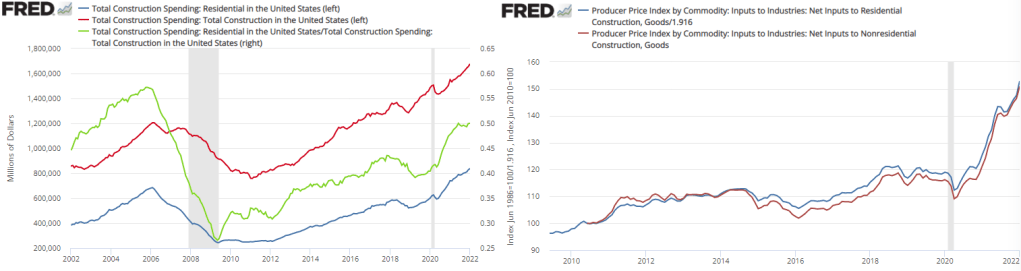
Total spending on real estate construction has been rising since 2011. By 2016 it had reached its previous 2006 peak. However, total spending on *residential* real estate construction didn’t reach its previous 2006 peak until November of 2020. The graph below also includes the proportion of residential construction spending (Green). It has been rising since 2009. In and of itself, nothing is good or bad about this figure. We might be spending less on non-residential construction because we are getting better at using less land per unit of good or service produced. Or, it could be that our real investment in future production is falling relative to our current residential consumption.  Regardless, the share of residential construction hasn’t been at this level since 2003.

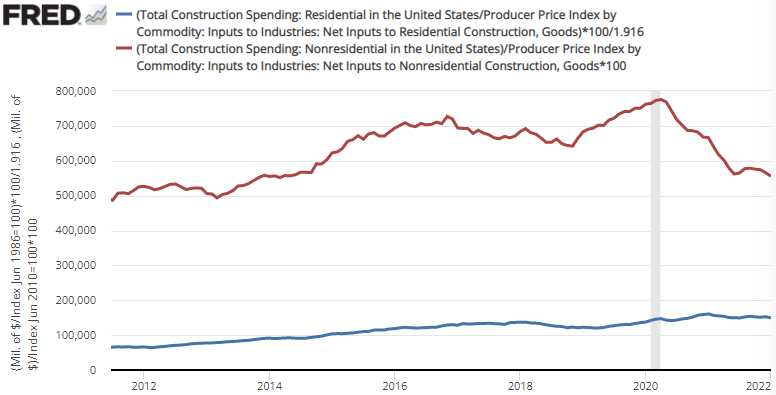
Importantly, the difference in spending has not been driven by different construction costs. Both residential and non-residential construction costs have moved in tandem since 2010. Therefore, the rise in residential construction spending is not merely nominal – a greater proportion of resources are being consumed by residential construction. Indeed, real residential construction is up about 25% from 2019. The figure below illustrates real residential and nonresidential construction.

That figure requires a double-take.

Continue reading

I Miss Paying Rent

I’ve been a homeowner not quite long enough to watch the entire run of Parker Lewis Can’t Lose in one sitting, but I have already arrived at the incontrovertible conclusion that being a landlord is foolish. Renting is a blissful paradise that I am wistfully nostalgic for, a glorious time when I had only one job: feasibly above-average economist. Now I’m also the worst plumber, woodworker, mason, electrician, and landscaper I’ve ever met. To be clear, none of that is true. Rather, I am a poor home inspector and over-qualified errand boy who moonlights as the manager of a hastily assembled team of contractors to whom I write a litany of checks.

I know the rent is too d*mn high, but the interesting question is why? Thinking about high rise apartments, rowhouses, or detached homes, its seems pretty clear that there are significant returns to specialization and scale. Whether its 212 apartments or 25 detached homes, a team of salaried handymen, inspectors, and property managers offers considerable efficiency gains, a reality borne out by the inexorable rise of HOAs and their continuing growing reach into their constituents lives. But as anyone who’s ever attended an HOA meeting can attest, the limits to contracting and the value of our time provides the opportunity for an industrious individual or firm to bundle collective ownership and services into a single entity, selling the turnkey solution that is the modern rental residence, at considerable potential savings to the tenant in a competitive market.

So why are we so mad at our landlords? I see a couple possible answers:

  1. The rent isn’t too high, we’re all just greedy and would complain about the purveyor of any good that represented 40% of household expenses, regardless of how much value we were or were not receiving for the price.
  2. Landlords have considerable market power, allowing them to reduce supply and jack up the price, leaving us little recourse but to either nationalize housing or apply that sweet, never-ever-backfired rent control.
  3. The market is relatively well-functioning, but with incomplete contracts, leaving us all nervous that our tenants are going to bankrupt us while our landlords cast us out into the streets.

(1) likely has some behavioral truth to it, but isn’t a very satisfying explanation*, while (2) has likely more merit in the short run or in areas where landlords have solved their collective action problem sufficiently to stymie growth of the housing supply at every turn (<cough> San Francisco <cough>).

But perhaps (3) is underappreciated. Everyone who’s ever lived in a major city, especially when they were young, has a story about how they were screwed over by their landlord. At the same time, landlords (particularly smaller, independent ones) live in terror of tenants arriving at a cost-benefit conclusion that paying their rent is a suboptimal decision. Plenty of states and cities have enacted tenant bills of rights, creating considerable variation across states, often making it incredibly difficult and costly to evict someone. Regardless of state laws, however, I am comfortable saying without any evidence or additional research that landlords and tenants continue to have a strained relationship. Tenants think landlords are getting rich off their backs without any labor, only the property their wealthy parents no doubt handed them on a silver platter, property they themselves acquired by exploiting their employees while running a puppy mill. Landlords, meanwhile, find out real quick they’re not actually making that much profit trying to keep a home intact as their hippie tenants burn sofas and flush paper towels while the bathtubs been flooding the 2nd floor for a month.

The interesting question, to my mind, isn’t whether landlords are exploiting tenants or vice versa, but rather why have property tenant laws evolved to such an inefficient equilibrium, where there doesn’t seem to be any satisfied parties?** If no one feels protected by a contract, then it’s likely not a very good one.


* The behavioral answer in (1) shouldn’t be dismissed too quickly, to be fair. Given that size of rent as a fraction of most household budgets combined with profits to be had churning tenants in supply-restricted cities, its possible that all parties are constantly trying to scam each other, leading to the observed acrimony.

**Yes, I know people have become quite wealthy as landlords, but my read on that market outcome is not the profitability of property management but rather of property speculation, with equal parts winners and losers. Rental management is principally in service of subsidizing said speculation and lower property tax rates.