AS-AD: From Levels to Percent

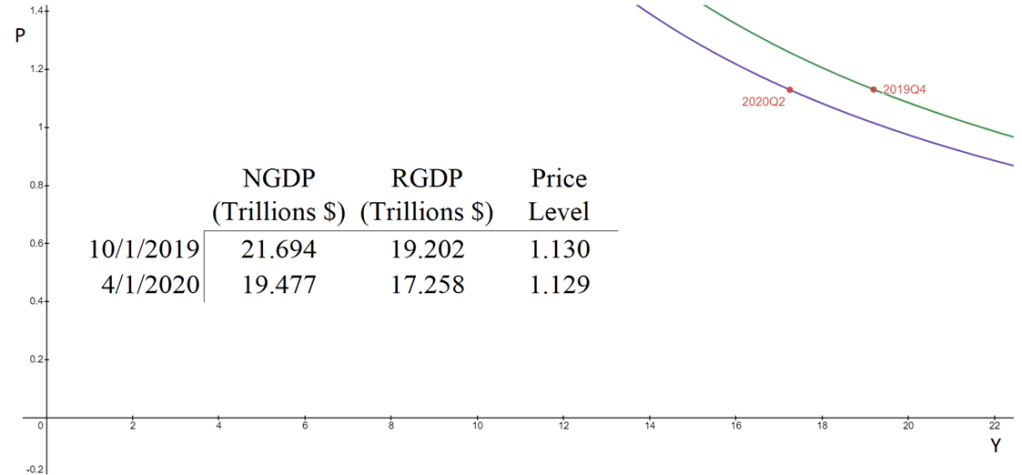
The aggregate supply & aggregate demand model (AS-AD) is nice because it’s flexible and clear. Often professors will teach it in levels. That is, they teach it with the level of output on one axis, and the price level on the other axis. This presentation is convenient for the equation of exchange, which can be arranged to reflect that aggregate demand (AD) is a hyperbola in (Y, P) space. Graphed below is the AD curve in 2019Q4 and in 2020Q2 using real GDP, NGDP, and the GDP price deflator.

The textbook that I use for Principles of Macroeconomics, instead places inflation (π) on the vertical axis while keeping the level of output on the horizontal axis. The authors motivate the downward slope by asserting that there is a policy reaction function for the Federal Reserve. When people observe high rates of inflation, state the authors, they know that the Fed will increase interest rates and reduce output. Personally, I find this reasoning to be inadequate because it makes a fundamental feature of the AS-AD model – downward sloping demand – contingent on policy context.

At the same time, I do think that it can be useful to put inflation on the vertical axis. Afterall, individuals are forward looking. We expect positive inflation because that’s what has happened previously, and we tend to be correct. So, I tell my students that “for our purposes”, placing inflation on the vertical axis is fine. I tell them that, when they take intermediate macro, they’ll want to express both axes as rates of change. I usually say this, and then go about my business of teaching principles.

But, what does it look like when we do graph in percent-change space?

Continue reading

Inflation and GDP Growth Around the World

Kalshi cofounder Tarek Mansour recently shared this graph:

In hindsight it seems like an obvious graph to make, and a good way to teach Aggregate Supply / Aggregate Demand models, but I don’t actually recall seeing much like this. One obvious improvement is to include more countries. I do so below using data from Trading Economics, showing all 182 countries that have recent data on both annual GDP growth and inflation. I also flip the axes to be more consistent with the convention in economics:

This makes clear both the costs and benefits of including all countries. We see just how extreme some outliers are: hyperinflation in Venezuela, Sudan, Lebanon, and Syria; a severe contraction in Libya; and huge growth in Azerbaijan and the Maldives (errors in the data?). But all the more typical countries blend together. So here I zoom in on the more typical countries:

This makes clear the strong aversion to deflation that most countries have. Well over a hundred countries here, many with very low inflation, but only in South Sudan does inflation actually go negative. Real GDP growth does not exhibit the same sharp divide at zero, presumably because its much harder to central banks to fine-tune. Now I try to zoom and enhance one more time:

But things are starting to just get messy, so its time to drop more countries. Here I focus on the 30 largest economies (minus Turkey, which breaks the scale on inflation):

Here we see:

  • Japan is demonstrating stagnation/ low aggregate demand / “running cold”
  • Brazil, Stagflation (negative supply shocks?)
  • Poland, high aggregate demand / running hot
  • Saudi Arabia and Israel, high growth without high inflation (positive supply shocks?)

The US is on the higher end of inflation, and I still think we should be doing more about this, but in this graph we don’t look like a huge outlier. We’re all still working through Covid-related shocks. But the very latest quarterly data today (not reflected in these graphs) showed negative GDP growth in the US, sending us toward the “Stagflation” quadrant and making the Fed’s job much harder.

Are the COVID Vaccines Effective at Preventing Death?

A recent analysis by the Kaiser Family Foundation of CDC data suggests that about 234,000 COVID deaths in the US could have been prevented if everyone was vaccinated. That’s about 25% of all COVID deaths throughout the pandemic, and about 60% of COVID deaths since June 2021 (roughly the time when most older adults in most states had had a chance to be vaccinated).

The first way to think of that death rate is tragic, given that so many lives could have been saved. Rather than being the high-income nation with the highest COVID death rate, the US could have been more in line with countries like Italy, the UK, and France. The US actually had a lower COVID death rate than Italy and the UK when the vaccine roll-out began, and today we could be at about France’s level with better vaccination rates.

But there’s a flipside to the KFF numbers. If 60% of COVID deaths since June 2021 were preventable, that means 40% weren’t preventable. Furthermore, the same data show that about 40% of COVID deaths in January and February 2022 were fully vaccinated or had boosters. That sounds like the vaccines might not work very well! So what does this all mean? Let’s dig into the data from the CDC a little bit.

The first, and most important thing, to recognize is that most American adults are vaccinated (about 78%), so unless vaccines are 100% effective (and they aren’t, despite some public officials overenthusiastic pronouncements early in the vaccine rollout), there are still going to be a lot of COVID deaths among the vaccinated. If 100% of the population was vaccinated, 100% of the deaths would be among the vaccinated. The key question is whether vaccines lower the chance of death.

And they do. Let’s see why.

Continue reading

New Fossil Discoveries Shed Light on When and How the Dinosaurs Died Out

For nearly 200 million years, reptiles were the dominant animals on land, in the air (e.g. pterodactyls), and in the sea (e.g. mosasaurs). They were efficient herbivores, munching on lush vegetation, and also were efficient carnivores (think: T. rex). They were protected by scaly skin and often horns or armor plates. Mammals at this point were typically small, rat-like creatures, hiding in their burrows from the reptiles, and creeping out at night to feed.

However, the Age of Reptiles came to a sudden end 66 million years ago. Dinosaurs and many other large reptiles disappeared, which gave opportunity for mammals to rapidly evolve and proliferate to fill many key ecological niches. What happened to all those reptiles? The leading hypothesis is that a huge meteorite impacted the earth near what is now the Yucatan peninsula of Mexico. The dust and aerosol cloud that was thrown into the atmosphere darkened the skies around the world enough to shut down photosynthesis long enough to starve the reptilian herbivores, which in turn starved the reptilian carnivores. Somehow enough mammals survived the event to repopulate the earth (my guess is they ate insects which ate dead dinosaurs).

The impact blasted tons of molten rock droplets high in the air, which then fell as little glassy spheres or dust particles all over the world, and especially in North America. Where these “tektites” fell in undisturbed places like bogs, they accumulated as a distinct layer. Over time, these spheres decomposed into a clay layer which is distinguished by a high iridium content. Here is a cut-out section of rock which shows this meteorite-derived boundary layer between lower (older) rocks that contain dinosaurs and an overlying layer where dinosaurs are absent:

Rock section showing layers from the Cretaceous Period (when dinosaurs lived), overlaid by boundary layer material from the asteroid strike 66 million years ago, and then younger Paleogene rocks (no dinosaurs). Source: Phil Manning/Uni of Manchester, UK.

Exactly When and How Did the Dinosaurs Perish?

The picture is complicated by the fact that very few dinosaur fossils have been found in roughly three meters (ten feet) of sedimentary rocks immediately below the Ir-rich meteorite layer. This is known as the “three-meter problem”, and suggests that the dinosaurs had already largely died out from other causes; maybe the meteorite impact just finished them off. Shortly before the impact event, there was a massive series of volcanic eruptions in the Deccan Traps area of India which released enormous amounts of sulfur dioxide and other gasses in the atmosphere, which probably altered the climate. It has been proposed that this fatally stressed the dinosaur populations.

Recent finds from the “Tanis” fossil site in North Dakota have brought clarity to this question. Apparently when the meteorite hit in what is now Mexico, it created a forceful earthquake. When this tremor rolled up to North Dakota, it caused several large waves of water to surge upstream in a creek near the sea, which deposited layers of muddy clay on preexisting sandbars. This occurred several hours after the impact. Providentially, that was just when some of the small glassy spheres which were blasted into the atmosphere were raining down on North Dakota. Some of these spheres, and even their little impact depressions from smacking into the mud at terminal velocity, have been found in the layers of sediment deposited on the sandbars. So we know that whatever fossil remains we find in these sediments were entombed there on the very day the meteorite hit.

It turns out that numerous fossils of dinosaurs have been found in these Tanis mud layers, indicating that there was a thriving community of huge reptiles right up until the impact. These finds include a dinosaur hip/leg with exquisite details of skin preserved, and an egg with a partly-developed pterosaur embryo visible in it:

Ornithischian dinosaur hip/leg/skin from Tanis site.  Source: BBC

Fossilized egg with bones of pterosaur embryo in it. Source: Yahoo

Also, immediately below the mud deposit layer have been found numerous dinosaur footprints, indicating the juvenile and adult dinosaurs from a variety of species were tramping around shortly before the impact event:

Source: Riley Wehr et al. paper at 2021 GSA Conference

Bottom line: it looks like we humans do owe our existence in large part to this one, seemingly random meteorite impact which cleaned out the dominant reptiles and made room for mammals.

Attention as Rational Addiction

I’ve never gotten this much attention before. Which is to say, my writing receives a small sliver of attention on occasion, but that small sliver is nonetheless far more than I’ve received previously in my life. To put it in better context, I’ve had a couple posts and tweets go mini-viral, which by the standards of major pundits or celebrities amount to little more than a throwaway post, but by the standards of my life up until now they elicited tidal waves of attention.

It felt pretty good.

Those good feelings, though, morphed into something else within a couple days. First, there came the fear of saying something wrong while more people were paying attention. That fear of negative approbation is nothing new or special, but it was certainly heightened. What was more disconcerting, however, was how the anticipation of attention, or more importantly possible lack thereof, crept into the back of my mind as I sat down to write future posts and tweets.

Here’s a an interesting phenomona: once you have enough followers on twitter, the lack of likes/retweets on anything you write becomes recognizable as implicit disapproval. You know what you wrote was put in front of a couple thousand people and yet nearly none of them felt it warranted a tenth of a second click. It stings.

That sting from the absence of approbation changes the incentives in front of you, maybe for some even more than the initial serotonin-dump from previous bursts of positive attention. You feel the pull to write about the things that got attention before, to write in the same manner or mood. To give the customers what they want.

And the customer that matters most is the part of your brain that wants to re-live the thrill of thousands of strangers telling you that you are good and smart and pretty and are totally worth keeping around. This is an addiction. Now there is, of course, no shortage of people calling social media an addiction. What I would like to argue is that it is a particularly dangerous addiction because it is a perfectly rational addiction.

A Rational Addiction Model of Attention

I’ll skip any real math, but indulge me a moment of framing:

A simple model of rational addiction to attention starts with three inputs: positive approbation (P), negative approbation (N), and total attention (T), where T = P + N.

Now lets assume that your utility is increasing with P and decreasing with N, while also increasing with T. That’s all pretty uncontroversial for humans. Let’s also assume that negative attention is easier to reliably generate than positive attention (i.e. trolling is harder to ignore). To put a little structure on it, we’ll assume that they are all substitutes, but with different weights .

U = T^w1 + P^w2 – N^w3

What that means is that people have an incentive to pursue attention, but how they allocate their efforts across plays for positive and negative attention will depend on how much they weight the cost of negative attention relative to what they gain from total attention.

Here comes the twist, though.

What if T is not the absolute total attention you are receiving today, but instead T is the total attention you are receiving today relative to the average attention you have received in the past, the level of attention you have become accustomed to?

U = (T- T_mean)^w1 + P^w2 – N^w3

Well now you’re on a hedonic treadmill, but for attention instead of wealth or luxury. Your brain has grown used to a rush of serotonin from the attention of millions of strangers. You’re like an adrenaline junkie, but instead of jumping out airplanes you’re trolling public figures and latching on to “Twitter’s main character” everyday.

What’s interesting about this model of rational addiction, however, is how quickly you can find yourself pursuing negatiive attention. ostensibly producing negative utility (i.e. actively making yourself unhappy) by pursuing negative attention because the total cost of that negative attention to you is less than the even costlier option of no one paying attention at all. Would you log on to twitter everyday if if cost you a hundred dollars? You would if not logging on cost you ten thousand. Same thing for those who are rationally addicted. What started out as a positive reaction to a small number of well-received insights has created a utility monster trolling the world in a desperate plea for negative attention in the hopes that it will grant the slightest reprieve from the icy desperate loneliness inside that haunts my every moment.

I’m fine. Really. I’m making a point.

When we talk about the problems of social media for mental health, we tend to focus on bullying, dysmorphic self-images, and the creation of false standards of value. I think all of those problems are extremely real, but they also seem like things that can be addressed with policies, oversight, or cultural adaptation. What I want us to consider is that attention at this scale is something that is so baked into the construct of social media that problems emerge from perfectly rational engagement by otherwise well-intending people. I’ve previously tried to model the loneliness that can come with being extermely online, but this in some ways is actually deeper.

What if, for most of us, the only way to win at social media is not to play?

The New Econ Bloggers

On the Bretton Goods podcast, host Pradyumna Prasad asked student Trevor Chow about blogs. To start the segment, Prasad noted that there has been an increase in what he called “econ blogs” in the past 2-3 years. Will that trend continue? Prasad believes that this is not sustainable because: 1) he thinks the paid subscriber model will not support many writers, which leads to 2) bloggers writing for free will run out of time and energy.

Chow replied that he thinks the recent explosion is partly due to Substack, which makes it easy to start blogging. Chow described the current climate as a “flourishing blogosphere.” He assumes that some people started during a Covid shutdown when the opportunity cost was low. Some of the younger people might shift their focus, as he did when his interests changed, but he believes that many of the blogs started in this phase are here to stay. Both young men think about longevity.

Prasad asked, “What are the qualities of the most successful bloggers across time?”

Chow replied that the only blog that has influenced him “across time” is Marginal Revolution, partly because few writers stick with blogging. Chow thinks a successful blogger over time would find a special niche. I have a similar intuition, even though MR is not about a niche topic. If everyone is checking MR for their “daily links”, then it’s unlikely that inferior new aggregator blogs will attract large numbers of readers. Also, Twitter largely fills that role now.

The fact that duration was discussed more than quality is interesting. To blog is to enter a network and join a community. Part of sticking around for a while is not just writing but also reading and paying attention to the work of others. Good writing is a necessary but not sufficient component of what would be considered a successful blog.

As an economist, I was happy to hear Prasad open this segment by talking about “econ blogs”. Econ blogging occurs when people are interesting online, even if the topic is outside of the traditional domain of economists. I think this is partly due to Tyler Cowen both being prolific and also willing to engage non-standard thinkers.

I enjoyed the podcast. It raised some questions which I posed to Tyler Cowen, the OG econ blogger. We all know that MR generates a high level of engagement, today. My first question was:

1. What was the evolution of reader engagement with MR? How long did you work before a lot of people were reading, commenting? 

Cowen: It took us 3-4 years to have a lot of readers. but I never tracked the numbers very closely. When I started, I was thrilled by the notion of 5,000 readers a day — of course we have done many times more than that.

2. The consensus is that many new people have started since 2020, which I believe is something that you called for. Do you now see the space as, in some sense, saturated, or would you encourage more people to keep joining now? 

Cowen: I don’t think it is saturated now.

 3. For bloggers who started since 2020, should they quit if the opportunity cost increases? 

Cowen: The main thing is simply whether you enjoy it and learn from it!  If so, reason to continue. That sounds trivial, but it is really the bottom line.

Should the new bloggers keep going? Yes, if you enjoy it and learn from it. Is it too late to start? No, if you will enjoy blogging and learn from it.

The blog form is better than a 280-character tweet for capturing nuance. Something I learn from blogging, which might not be obvious from the outside, is that I have some bad ideas. Sometimes trying to write out a piece teaches me that I had an unsupported thought. It would be good if more people would stop scrolling for an hour a week and try to write out an argument.  

Co-blogger Mike alerted me to this comic:

This is one frame of a long SMBC comic strip https://www.smbc-comics.com/comic/liberal-education

The comic first describes a cynical take on academia, with which I don’t fully agree. Then, the woman paints a picture of an alternative haven for intellectual conversation. Can econ blogs be an old pub where the people are always and only there in earnest? “Most people don’t even want to go in, and you certainly don’t get credentials for descending the stairs.”

In Praise of the FRED Excel Add-in

Sometimes, large entities have enough money to throw at a problem that by sheer magnitude they produce something great (albeit at too high a cost). The iPhone app from the FRED is not that thing. But the Excel add-in is something that every macroeconomics professor should consider adding to their toolkit.

Personally, I include links to FRED content in the lecture notes that I provide to students. But FRED makes it easy to do so much more. They now have an add-in that makes accessing data *much* faster. With it, professors can demonstrate in excel their transformations that students can easily replicate. The advantage is that students can learn to access and transform their own data rather than relying on links that I provide them.

The tool is easy enough to find – FRED wants you to use it. After that, the installation is largely automatic.

Installed in excel you will see the below new ribbon option. It’s very user friendly.

Continue reading

Fed Dot Plot vs Markets

After their last meeting in March, the Federal Open Market Committee released the summary of economic projections. Most of the variables they project are inherently difficult to predict: GDP, unemployment, inflation. But their forecasts of the Federal Funds rate should be pretty good, since they’re the ones that get to pick what it will be. The median FOMC member thinks the the Federal Funds rate will be just under 2% by the end of 2022.

I said in my last post that the Fed is under-reacting to inflation. Markets seem to agree, but they also think that the Fed will change. Kalshi runs prediction markets on what the Fed Funds rate will be, which they recently started to summarize using this nice curve:

So traders think that the Fed will raise rates faster than the Fed thinks they will, with rates getting to 2.5% by year end. Traders at the Chicago Mercantile Exchange see an even bigger change, with rates at 2.75% by year end, and 3.5% by July 2023 (the longest-term market they offer).

I lean toward the markets on this one; if they are wrong there is plenty of money to be made by betting so.

How to Get People Vaccinated for 93 Cents

We’ve talked a lot about vaccines on this blog, including both the benefits of vaccines and how to get people vaccinated. For example, last month I posted about Robert Barro’s estimate on the number of additional vaccines needed to save 1 life. Barro put it at about 250 vaccines. Using some reasonable assumptions, I further suggested that each person vaccinated has a social value of about $20,000. That’s a lot!

But how do we convince people to get vaccinated? Lotteries? Pay them? In addition to just paying them (the economist’s preferred method), another good old capitalist method is advertising (the marketer’s preferred method). And a new working paper tries just that, running pro-vaccine ads on YouTube with a very specific spokesman: Donald Trump.

Running ads on YouTube is pretty cheap. For $100,000, the researchers were able to reach 6 million unique users. And because they randomized who saw the ads across counties, they are able to make a strong claim that any increase in vaccinations was caused by the ads. They argue that this ad campaign led to about 104,000 more people getting vaccinated, or less than $1 per person (the actual budget was $96,000, which is how they get 93 cents per vaccine — other specifications suggest 99 cents or $1.01, but all of their estimates are around a buck).

Considering, again, my rough estimate that each additional vaccinated person is worth $20,000 to society (in terms of lives saved), this is a massive return on investment. Of course, we know that everything runs into diminishing returns at some point (they also targeted areas that lagged in vaccine uptake). Would spending $1,000,000 on YouTube ads featuring Trump lead to 1 million additional people getting vaccinated? Probably not quite. But it might lead to a half million. And a half million more vaccinated people could potentially save 2,000 lives (using Barro’s estimate).

I dare you to find a cheaper way to save 2,000 lives.

Musk, Twitter, and Poison Pills

It has been all over the financial news that Elon Musk made an offer last week to buy out Twitter for $54.20 per share, which is well above its recent stock price. And also, that the board quickly stiff-armed Musk by adopting a “poison pill” provision. What are poison pills, are they a good thing, and how does this particular one work?

Major decisions for a corporation are made by its board of directors. In theory, they are supposed to direct operations for the benefit of the company’s shareholders, who are considered the actual owners of the corporation. The members of the board are elected by the shareholders in annual meetings.

In practice, the board largely does what it wants, and has an outsized influence on who gets elected. The board sets the agenda of the annual meetings, and proposes successor directors. In theory, shareholders can propose resolutions and alternative board candidates at an annual meeting, but it usually takes a determined effort by some activist shareholder group to actually push through some measure that is not approved by the existing board. The outside board members are often executives of other companies, and so are naturally attuned to the interests of the managerial class.  Thus, the members of this Old Boys (and Girls) Club tend to vote each other generous pay:  board members are typically paid very handsomely for what is often a fairly undemanding, part-time job.

Big corporate mergers and takeovers became a thing in the 1980’s. Some outside investor would make an offer to buy up company shares for more than the current market price. Often,  management would resist this offer, since it might entail them losing their cushy jobs. The delicate matter for management in such cases was to convince shareholders that rejecting the buyout offer was in their best long-term interest.

As in so many matters, “where you stand depends on where you sit.” Management would argue that “short-termism” is bad for the company and for the nation as a whole; the “corporate raiders” would just fire people, break up the company, and sell off the pieces, and generally create misery. The outside investors would reply that their new management would “unlock value” better than the current management was doing, by making operations more efficient and competitive and innovative.

A variety of measures might be implemented by the board to make it less attractive or less feasible for a change in control. The terms of the board of directors might be staggered, so that it would be impossible for the existing board to be totally changed out in less than say 3 years, even if someone controlled 100% of the shares. A company I was associated with in the 1990’s implemented a policy that provided for generous severance packages for upper employees in the event of change of control. (Again, management looking out for themselves).

The term “poison pill” typically refers to some measure that  targets share prices, in a way to discourage a hostile takeover. The most common form is the “flip-in” approach: 

A flip-in poison pill strategy involves allowing the shareholders, except for the acquirer, to purchase additional shares at a discount. Though purchasing additional shares provides shareholders with instantaneous profits, the practice dilutes the value of the limited number of shares already purchased by the acquiring company. This right to purchase is given to the shareholders before the takeover is finalized and is often triggered when the acquirer amasses a certain threshold percentage of shares of the target company.

This is what the Twitter board has pulled on Musk. If he acquires more than 15% of Twitter shares without board approval, the company will allow any shareholder (except Musk) to purchase additional shares at a 50% discount. Yes, this dilution would tend to lower the value of the shares, but if a lot of shareholders bought into this offer, his share of control would shrink. If he tried to buy yet more shares to get back to more than 15% ownership, the company would issue yet more discounted shares to everyone except him.

Is the Twitter board acting in their own interests, or the interests of the shareholders? Investment adviser Larry Black noted, “Let me point out something obvious: If Elon Musk takes Twitter private, the Twitter board members don’t have jobs any more, which pays them $250K-$300K per year for what is a nice part-time job. That could explain a lot.”

Musk hinted at a “Plan B”, and tweeted provocatively, “Love Me Tender”. He might be considering trying to bypass the board altogether and make a “tender offer” to the shareholders at large to sell their shares to him, at some attractive price. Typical conditions for such an offer would be that he only has to make good on his purchase offer if some large plurality of the shareholders take him up on it. It turns out that in practice this approach can be messy and complicated and delayed, probably not something the fast-moving Musk might have patience with. Also, even if he captured 100% of the shares, he could not replace all the existing board members for something like three years, so they could remain sitting there,  making anti-Musk decisions all along.

Musk’s offer has now put Twitter “in play” as a takeover target. You know that lots of wealthy people and entities are consulting their investment bankers about becoming a white (or black) knight here. Anyway, it makes for great theater. Popcorn, anyone?