Beer, Hot Dogs, and Inflation

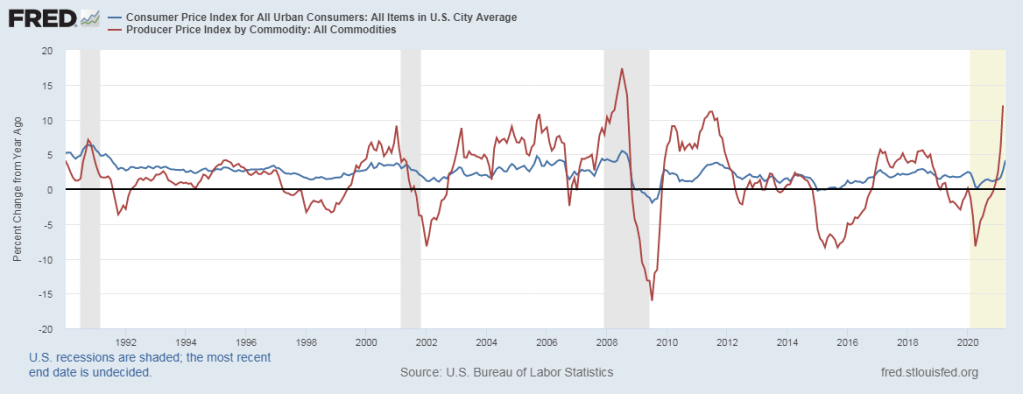
The latest inflation data for the US has been released, and the headline CPI-U annual increase of 5.4% is once again raising worries that high inflation could be a permanent part of the landscape for the near future.

My personal opinion is that the picture is much too muddled now, between temporary supply issues and low bases for 2020 prices, to say much about the medium-term picture. I think we’ll have a better picture by the end of the year. Still, it’s worth drilling down into the data, as we have done in the past on this blog, to understand some things about economics, prices, and how price changes are impacting real people.

Certainly the prices of some goods are rising at alarming rates. Many of these are related to automobiles and transportation generally, but some categories of food have rose a lot in the past year too (though groceries overall are only up 2.6%).

But I want to talk about two categories of consumption: beer and hot dogs.

Actually, my co-blogger Zachary has already written about beer. And using the producer price index, he found that canned beer is actually cheaper than it was a year ago. If you like canned beer, rejoice! And for all beer at home, the CPI shows only a 1.8% increase since last year, after a similar small 1.6% increase last July (not much of a base effect… a clue for later!).

But not all Americans consumer alcohol. So let’s talk about that most American food product: the hot dog.

Why should we care about hot dogs? Read on.

Continue reading

Vaccine Lotteries: They Work!

To try and encourage vaccination during the on-going COVID pandemic, there have been many public and private incentives offered. For example, free doughnuts. Or offering $200 to state employees in Arkansas (taxable income, of course!).

But when the governor of Ohio announced on May 12, 2021 that they would be offering a $1 million lottery prize, with 5 winners, it took the incentive game to a new level (college scholarships were also a prize for 5 winners under 18).

So do the lotteries “work”? Do they get more people vaccinated? And even if they do “work,” does it pass a cost benefit test? Many expressed concern that, even if more people get vaccinated, that this is a lot of money to spend in uncertain budget times.

A new working paper by Andrew Barber and Jeremy West attempts to answer these questions. And they do so using synthetic control, one of the better methods social scientists have for attempting to identify causal relationships (which can be tricky).

What do they find? First, vaccine lotteries do work! They estimate that vaccination rates increased by 1.5% in Ohio because of the lottery. This amount is above and beyond the increase that would have been expected without the lottery (by comparing Ohio to other states that didn’t use a lottery — this is what the synthetic control method does).

But does it pass a cost-benefit test?

Continue reading

The Recession Is Over! (15 months ago)

Lately there has been lots of both good and bad news about the pandemic and its impact on the economy. But here’s once piece of good news you might have missed: the recession which began in February 2020 ended in April. And not April 2021… it ended in April 2020. At least, that’s according to the NBER Business Cycle Dating Committee, which made the announcement last week.

The 2020 recession of just 2 months is by far the shortest on record. NBER maintains a list of recessions with monthly dates going back to 1854 (there are annual business cycles dates before that, including important modern revisions of the original estimates, but the monthly series starts in 1854). In that timeframe, there have been 7 recessions in the 6-8 month range, but nothing this short. Still, it was mostly definitely a recession, as unemployment briefly spiked to levels not seen since the Great Depression. But only for 2 months. Keep in mind that the first part of the Great Depression last 43 months.

Unemployment Rate, 1948-present

But how can this be? Is the recession really over? There are still about 6-7 million fewer people working than before the pandemic began. Lots of businesses are still hurting. The unemployment rate is still 2 full percentage points above pre-pandemic levels. How in the world can we say the recession ended 15 months ago?

To answer that question, it helps to know what NBER and most macroeconomists mean by a “recession” — essentially, it is used interchangeably with “contraction.” It means the economy, by a broad array of measures (NBER uses about 10 measures), is shrinking — or we might say, going in the wrong direction. The only other option, at least in the NBER chronology, is an expansion — when the economy is going in the right direction.

Does an economic expansion mean that everything is fine the economy?

Continue reading

COVID Deaths and Middle Age

We have known for a long time (basically since the start of the pandemic) that COVID primarily affects the elderly. Infection fatality rates are hard to calculate (since not all infections are reported), but most of the data suggest that the elderly are much more likely to die from COVID than other age groups.

For some, this has become one of the most important aspects of the pandemic. For example, Don Boudreaux emphasizes the age distribution of deaths many times in a recent episode of Econtalk, and he uses this point to argue that we addressed the pandemic incorrectly (to say the least). Boudreaux specifies that COVID is only deadly for those 70 and older. And while I won’t rehash the argument here, please also see my exchange with Bryan Caplan, where he argues that elderly lives are worth a lot less than younger lives (I disagree).

At first blush, the data seems to bear that out. The CDC reports that almost 80% of COVID-involved deaths were among those aged 65 and older (I will use the CDC’s definition of COVID-involved deaths throughout this post). In other words, of the currently reported almost 600,000 COVID deaths in the US, about 475,000 were 65 and older. Throw in the 50-64 age group, and you’ve now got 570,000 of the deaths (95% of the total).

But is this the right way to think about it? Remember, the elderly always account for a large share of deaths, around 75% in recent years. So it shouldn’t surprise us that most deaths from just about any disease are concentrated among the elderly.

Continue reading

Cars, Inflation, and the Quantity Theory of Money

You have probably seen the latest inflation data. The headline number is 5.4% increase in prices in the past year as measured by the CPI-U. That’s a lot! Even the Core CPI (removing volatile food and energy) is up 4.5%.

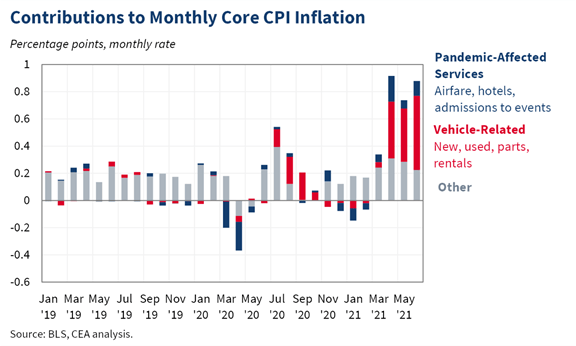
If you follow the data closely, you may also have heard that a big chunk of that increase comes from prices related to automobiles: new cars, used cars, rental cars, car parts. All way up!

If you are in the market to buy a car, or if you really need a rental, it’s a bad time for prices. (Conversely, if you have an extra car sitting around, it’s a great time to sell!)

But what if you aren’t in the market for a car? What does the inflation data look like? The White House CEA tweeted out this chart to deconstruct the factors in the recent CPI release.

What does it all mean?

Continue reading

“Zoning Taxes” — The Cost of Residential Land Use Restrictions

Fascinating new working paper on why housing prices are so high in some markets, by Gyourko and Krimmel: “The Impact of Local Residential Land Use Restrictions on Land Values Across and Within Single Family Housing Markets.”

Key sentence from the abstract: “In the San Francisco, Los Angeles, and Seattle metropolitan areas, the price of land everywhere within those three markets having been bid up by amounts that at least equal typical household income.”

Economists, libertarians, and more recently “neoliberals” have long complained about land-use restrictions as a primary factor contributing to unaffordable housing. This paper provides some pretty solid data, at least for some housing markets.

Here’s a key chart from the paper, Figure 5. Notice that there is a lot of heterogeneity across cities. In San Francisco, land use restrictions add roughly four times the median household income to the price of housing. But in places like Columbus, Dallas, and Minneapolis, there is essentially no zoning tax. That’s not because these cities have no land use restrictions! It’s just that they aren’t currently binding.

The paper also notes that “zoning taxes are especially burdensome in large coastal markets.”

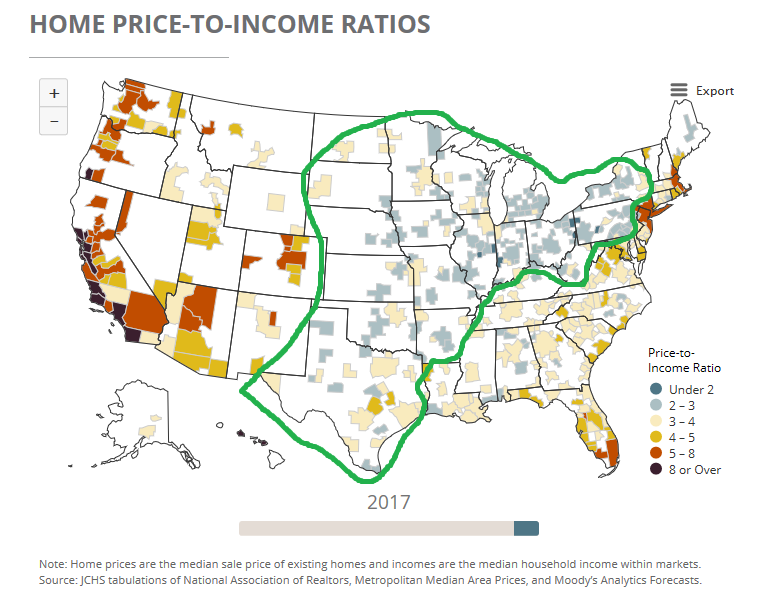
This is similar to what I showed in a very non-scientific map that I created (in about 5 minutes) for a Twitter thread that I wrote in January 2020 on housing prices. In that map and thread I pointed out that there are still lots of fine US cities where you can purchase homes for roughly 3 times median income (a commonly used rule of thumb for affordability).

Image
Cities where you can buy the median house for about 3 times median income.

Will these cities continue to be affordable in the future? As demand increases, and supply-side restrictions remain in place, we would predict the same thing will happen to Columbus as happened to San Francisco. But probably not for decades.

So if you seek housing affordability, move to the Zone of Affordability! But let’s also work on reforming the rest of the country to make everywhere affordable.

Steve Horwitz on “The Graduate Student Disease”

On Sunday the world lost a great teacher, economist, and all-around fantastic person in Steve Horwitz. If you don’t know about Steve, I recommend reading the tributes from Pete Boettke and Art Carden.

Pete and Art speak to Steve’s overall legacy and greatness. But I will tell you about a very specific piece of advice that Steve gave me about teaching undergrads.

Steve called it “the graduate student disease.” By this he meant the tendency of newly minted PhD economists to teach undergraduate courses as if they were mini versions of graduate courses. Steve insisted this was the wrong approach.

Continue reading

Should Andrew Yang Wait to Concede?

Yesterday New York City held their mayoral primary elections. This was an exciting event for election system nerds (political scientists and public choice economists) because NYC is now using a form of ranked choice voting to determine the winner.

While this is not the first place in the US to use RCV (Maine, Alaska, and a handful of cities use it), it is still notable for a few reasons. First, this is America’s largest city. Second, there are a lot of viable candidates, which makes RCV especially interesting and useful.

Specifically, NYC is using a form of voting called instant runoff. There are currently 13 candidates, and voters indicate their top 5 in order. If no one has a majority (>50%) of the votes, then the rankings entered by voters come into play. And indeed that is what happened yesterday.

On the first round, only counting first place votes, Andrew Yang came in 4th with just under 12% of the votes. So last night he conceded.

But should Yang have conceded? Maybe not! Let’s explore how instant runoff works.

Continue reading

Temporary Income Shocks

As a graduate student in 2005, I took macroeconomics from Tyler Cowen. It was a fascinating class, covering not just the sweep of business cycle theories, but also just a good dose of “here is what it means to be an economist.” It was the first class in sequence, and for many incoming PhD students with no economics background (yes, this happens a lot!) it was the first economics class they took.

In that class we read a number of papers by Richard Thaler from his Anomalies series in the Journal of Economic Perspectives. We also read The Winner’s Curse in Bryan Caplan’s micro II course at GMU, the book that collected a lot of those JEP papers (for anyone that thinks the GMU PhD program is just straight Chicago school mixed with libertarianism, think again!).

One of the Thaler papers that always stuck with me was his criticism of the life-cycle theory of savings. That paper opens with a story of Thaler winning $300 in a football betting pool. Thaler, of course, used that income shock to splurge on some temporary indulgence, such as a bottle of champagne or a nice dinner. But a strictly rational agent should just use that extra income to increase their annual lifetime income by an even amount, such as about $20. That’s what the famous life-cycle hypothesis says, which is part of what Modigliani won the Econ Nobel for developing. That was in 1985. The joke is that just 5 years later, Thaler (and presumably other economists) were not personally behaving the way that economic theory says that people behave. (The meta-joke is that Thaler later wins the Econ Nobel too.)

This past week, that theory came full circle for me when Tyler Cowen awarded me an Emergent Ventures prize. It really did come as a shock, both in a real sense and an income sense. I was not expecting this prize in any way, but I am very honored and humbled to receive it. (Side note: this very blog that you are reading also received an EV grant, separate from my personal grant. Hooray for us!). The award was largely for my work on social media and this blog trying to convey good information and data during the pandemic, and to fight bad information.

The question that has been gnawing at me since receiving the award is: what should I do with it? It’s a nice problem to have. I am not complaining in any way. But it’s an especially fascinating question for an economist to think about, and to reconsider how we model human behavior.

The award also intersects with my blog post from last week on “what is income?“. The IRS most definitely considers an award like this to be “income,” and not just any income: it is self-employed income, since it doesn’t come from my employer. If I take it as a cash award, the tax bite will be quite large. However, I could also use the award for some academic purpose: purchasing equipment or software; attending a conference (perhaps one that my University would not normally pay for); or running a small workshop or conference (possibly, in the theme of the award, on how to communicate good information effectively on social media?). In those cases, I might legally avoid some taxes.

I don’t yet know what I want to do with the award. But it’s a really interesting intellectual, professional, and personal challenge to think about. Again, nice problem to have. But thank you again to Tyler, Mercatus, and Emergent Ventures for the honor. And thank you to all my readers out there for making the intellectual journey with me over the past year and a half!

What Is Income?

The United States, like nearly all countries, has an income tax. What is an income tax? It’s a tax on income. What is income? That’s actually a very hard question.

The question comes up in a recent report by ProPublica on the taxes that very wealthy Americans pay (I’m not going to link to it, because the data was likely illegally obtained, and almost certainly immorally obtained, but you can easily find it). What’s really interesting is that never define income, but they do have an implicit definition which includes changes in net wealth. More on this later, but it does raise an important question under an income tax: what exactly should count as income?

For most wage and salary workers, income is fairly straightforward. It’s the compensation that your employer pays you in exchange for your labor services. Easy enough. There are some wrinkles. For example, most non-cash compensation is not considering income for tax purposes. And even some cash compensation, such as contributions to retirement plans, are not considered income. Still, pretty straightforward.

But what if you own a business? It gets a little more complicated. We could define your income as all of the money you receive when you sell goods and services to your customers. But that has a few problems. Let’s say you run a restaurant. You sell burgers for $5. Should you pay income tax on every $5 burger you sell? Keep in mind that you probably had $4.50 in expenses to sell that burger. You bought the beef, buns, and condiments. You paid your workers. You paid to “keep the lights on” (that’s how small business owners refer to utilities and other overheard). So our income tax system will only tax you on the $0.50 difference, which we usually call profit (in some years, of course, businesses have costs that exceed their sales revenue, in which case they owe no income tax).

Now for the really hard question: what if most of your income is derived from assets that you own? That’s where things get even more complicated, and both legal and philosophical questions come up.

Continue reading